

UX revealed after digging through data
 |
Description
Book Introduction
***12th Brunch Book Award Winner***
Data-driven UX: Theory abounds, but reality is different!
For UX design that persuades with data, not intuition.
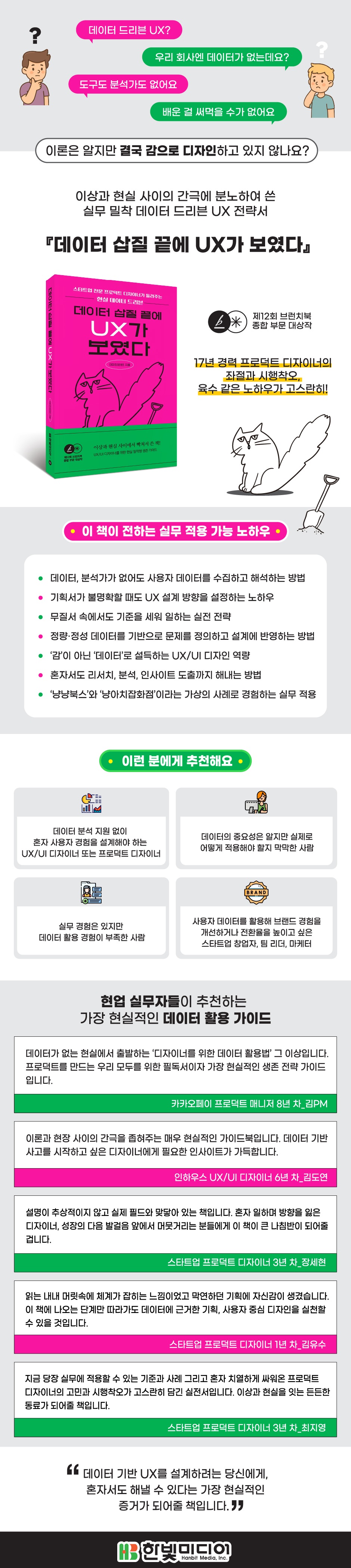
A practical, data-driven UX guide you can use right now.
"UX Revealed After Digging Through Data" is a survival guide for UX/UI designers and product designers who face the reality of designing user experiences.
It contains the trial and error and insights of a product designer with 17 years of experience who has independently collected, interpreted, and reflected user data in UX.
In a situation where there is neither data nor analysts, this book uses a practical approach to explain in detail what data to look for, where to collect it, and how to make decisions and design on your own, using the hypothetical cases of 'Nyangnyang Books' and 'Nyangachi General Store'.
The record of 'data digging', which ultimately found direction in the midst of confusion, helps designers connect with users by using data as a tool.
It will provide practical insights not only to designers concerned about user experience, but also to team leaders and marketers who want to increase brand conversion rates.
Data-driven UX: Theory abounds, but reality is different!
For UX design that persuades with data, not intuition.
A practical, data-driven UX guide you can use right now.
"UX Revealed After Digging Through Data" is a survival guide for UX/UI designers and product designers who face the reality of designing user experiences.
It contains the trial and error and insights of a product designer with 17 years of experience who has independently collected, interpreted, and reflected user data in UX.
In a situation where there is neither data nor analysts, this book uses a practical approach to explain in detail what data to look for, where to collect it, and how to make decisions and design on your own, using the hypothetical cases of 'Nyangnyang Books' and 'Nyangachi General Store'.
The record of 'data digging', which ultimately found direction in the midst of confusion, helps designers connect with users by using data as a tool.
It will provide practical insights not only to designers concerned about user experience, but also to team leaders and marketers who want to increase brand conversion rates.
- You can preview some of the book's contents.
Preview
index
[PART 1 Getting to Know It]
CHAPTER 1: It's Not Your Fault That Data-Driven UX Is Difficult
__01 It's enough to just be able to do it, but it's difficult because you don't know how to do it
__02 It's difficult because there is no absolute answer in UX and data.
__[Insight like broth] This is how I solved this problem
CHAPTER 2 Why Our Company Has No Data
__01 Because the data format is different
__02 It's because of the reality of the company.
__03 It's because others don't take care of the data I need.
__[Insight like broth] This is how I solved this problem
CHAPTER 3: The Truth UX/UI Designers and Product Designers Need to Know
__01 data contains questions to the user, not answers.
__02 Not all users' voices are correct
[PART 2 Check this out first]
CHAPTER 4: CHECKING THE BUSINESS MODEL
__01 Defining users properly
__02 How does our service make money?
CHAPTER 5 Identifying Purposes and Objectives
__01 Data comes from the project background, purpose, goals, and tasks.
__02 When only the project background is known: Set a 'temporary goal' to determine the data direction.
__03 When the project background, purpose, and goals are not fully understood: Gaining a sense of data as the company's reason for existence
CHAPTER 6 Checking Data Refining Status
__01 Why designers need to know the data's cleanliness status
__02 Let's refine the quantitative data.
__03 Let's refine the qualitative data.
[PART 3: Leveraging Existing Data]
CHAPTER 7 Data is Hidden in Surprising Places
__01 How to request data held by other occupations
__02 How to check hidden data on the admin page
__03 The identity of the data hidden in frequently asked questions
__04 User data hidden in GA4 set by others
CHAPTER 8 Market Research to Increase Accuracy in Interpreting Internal User Data
__01 Designers' Market Research Should Be Different
__02 Why market research from a UX perspective improves the accuracy of internal data interpretation
__03 Why Market Research is Difficult for Designers
__04 Market Research Methods from a UX Perspective
[PART 4: Obtaining Data Directly from Users]
CHAPTER 9: Surveys and User Interviews
__01 The Usefulness and Differences Between Surveys and User Interviews
__02 Quickly and Amount of Target User Quantitative and Qualitative Data: Survey
__03 Data on Users' Inner Thoughts Unknown to Users: User Interviews
__04 Deriving Insights
CHAPTER 1: It's Not Your Fault That Data-Driven UX Is Difficult
__01 It's enough to just be able to do it, but it's difficult because you don't know how to do it
__02 It's difficult because there is no absolute answer in UX and data.
__[Insight like broth] This is how I solved this problem
CHAPTER 2 Why Our Company Has No Data
__01 Because the data format is different
__02 It's because of the reality of the company.
__03 It's because others don't take care of the data I need.
__[Insight like broth] This is how I solved this problem
CHAPTER 3: The Truth UX/UI Designers and Product Designers Need to Know
__01 data contains questions to the user, not answers.
__02 Not all users' voices are correct
[PART 2 Check this out first]
CHAPTER 4: CHECKING THE BUSINESS MODEL
__01 Defining users properly
__02 How does our service make money?
CHAPTER 5 Identifying Purposes and Objectives
__01 Data comes from the project background, purpose, goals, and tasks.
__02 When only the project background is known: Set a 'temporary goal' to determine the data direction.
__03 When the project background, purpose, and goals are not fully understood: Gaining a sense of data as the company's reason for existence
CHAPTER 6 Checking Data Refining Status
__01 Why designers need to know the data's cleanliness status
__02 Let's refine the quantitative data.
__03 Let's refine the qualitative data.
[PART 3: Leveraging Existing Data]
CHAPTER 7 Data is Hidden in Surprising Places
__01 How to request data held by other occupations
__02 How to check hidden data on the admin page
__03 The identity of the data hidden in frequently asked questions
__04 User data hidden in GA4 set by others
CHAPTER 8 Market Research to Increase Accuracy in Interpreting Internal User Data
__01 Designers' Market Research Should Be Different
__02 Why market research from a UX perspective improves the accuracy of internal data interpretation
__03 Why Market Research is Difficult for Designers
__04 Market Research Methods from a UX Perspective
[PART 4: Obtaining Data Directly from Users]
CHAPTER 9: Surveys and User Interviews
__01 The Usefulness and Differences Between Surveys and User Interviews
__02 Quickly and Amount of Target User Quantitative and Qualitative Data: Survey
__03 Data on Users' Inner Thoughts Unknown to Users: User Interviews
__04 Deriving Insights
Detailed image
Into the book
What's unfortunate is that no one has properly explained how crucial "trying to understand users," "using data for them," and "making data-driven design decisions" are to a company's success.
So, that gap is not easily narrowed.
And many designers are still filling that gap on their own, like I did in the past.
(···) I wrote this for designers who have to survive in a reality that is not an ideal environment, and for designers who think, 'I want to design with the user in mind even though no one is helping me.'
--- From "Starting"
What I can do now is enough.
In any case, data utilization depends on ‘who’ and ‘how’ it is utilized.
This ultimately means that there is no right answer.
(···) The important thing is that instead of starting a design with 'In my opinion···', you can use data to start with something like 'Based on the requirements extracted from reviews left by users of our service···'.
--- p.29
I often hear, “Our company doesn’t have any usable data.”
The good news is that that's a misunderstanding.
It's not that the company doesn't have the data, it's just that they haven't found it yet.
--- p.41
So, when designing UX based on data, the first thing to do is not ask, "Why is the click-through rate for this button low?" but rather, "Why didn't users click this button?"
--- p.66
Treating all users as “service users” can lead to errors in data analysis and design decisions.
Depending on the user, the data they need to see will also change, and this will affect design decisions.
--- p.91
Because plans are primarily written by people who measure performance, their perspective on data and the information they consider important differs subtly from that of designers.
So, designers must personally reprocess and organize the information in the plan so that it is tailored to their needs.
--- p.118
If there are no project goals, no purpose, and no one to tell you, the company's raison d'être should be the basis for my design and the basis for looking at data.
--- p.145
“UX/UI designers are not people who draw screens.
He is the one who makes the users move.
It's literally designing the user experience.
“It’s a design, a design.”
--- p.210
UX/UI design is not simply about ‘arranging planned functions in a pretty way.’
It is about ‘properly conveying the value of the function to the user.’
If designers don't understand the market their users are in, they won't be able to properly reflect their planning intent or the values users need in their UX.
--- p.247
In this way, quantitative data tells us the numbers, but not the why.
So, when creating a survey, it is important to design some interpretation criteria in advance.
--- p.331
We often have to work without perfect tools or perfect systems.
But you will find out through this book.
Even if the environment isn't perfect, we can still ask better questions and design better user experiences.
That question will begin to define the problem, and that definition will ultimately change the user experience and empower you to move forward.
So, that gap is not easily narrowed.
And many designers are still filling that gap on their own, like I did in the past.
(···) I wrote this for designers who have to survive in a reality that is not an ideal environment, and for designers who think, 'I want to design with the user in mind even though no one is helping me.'
--- From "Starting"
What I can do now is enough.
In any case, data utilization depends on ‘who’ and ‘how’ it is utilized.
This ultimately means that there is no right answer.
(···) The important thing is that instead of starting a design with 'In my opinion···', you can use data to start with something like 'Based on the requirements extracted from reviews left by users of our service···'.
--- p.29
I often hear, “Our company doesn’t have any usable data.”
The good news is that that's a misunderstanding.
It's not that the company doesn't have the data, it's just that they haven't found it yet.
--- p.41
So, when designing UX based on data, the first thing to do is not ask, "Why is the click-through rate for this button low?" but rather, "Why didn't users click this button?"
--- p.66
Treating all users as “service users” can lead to errors in data analysis and design decisions.
Depending on the user, the data they need to see will also change, and this will affect design decisions.
--- p.91
Because plans are primarily written by people who measure performance, their perspective on data and the information they consider important differs subtly from that of designers.
So, designers must personally reprocess and organize the information in the plan so that it is tailored to their needs.
--- p.118
If there are no project goals, no purpose, and no one to tell you, the company's raison d'être should be the basis for my design and the basis for looking at data.
--- p.145
“UX/UI designers are not people who draw screens.
He is the one who makes the users move.
It's literally designing the user experience.
“It’s a design, a design.”
--- p.210
UX/UI design is not simply about ‘arranging planned functions in a pretty way.’
It is about ‘properly conveying the value of the function to the user.’
If designers don't understand the market their users are in, they won't be able to properly reflect their planning intent or the values users need in their UX.
--- p.247
In this way, quantitative data tells us the numbers, but not the why.
So, when creating a survey, it is important to design some interpretation criteria in advance.
--- p.331
We often have to work without perfect tools or perfect systems.
But you will find out through this book.
Even if the environment isn't perfect, we can still ask better questions and design better user experiences.
That question will begin to define the problem, and that definition will ultimately change the user experience and empower you to move forward.
--- p.399
Publisher's Review
***12th Brunch Book Award Winner***
“I know it all in theory, but why can’t I use it in practice?”
No data, no standards, no colleagues
But if you still want to design with the user in mind,
UX/UI designers and product designers have a lot to do to improve the user experience.
You need to define problems based on quantitative and qualitative data, improve UX, and derive insights through user research.
Data-driven decision-making capabilities are no longer optional; they are essential.
But what's the reality? Is this an environment where designers can fully demonstrate their capabilities? In startups without even a GA setup, let alone a data analyst, in situations where designers are thrown straight into the field without mentoring, and in organizations that pressure them to immediately increase conversion rates, designers must become architects, analysts, and communicators.
This book is a 'data-driven UX practical strategy book' for those designers.
This book contains traces of my efforts, each one of which can be used to help you get started on your own, knowing where to find data, how to read it, and what to change first.
For those who felt lost because of the gap between theory and reality, those who opened analysis tools but didn't know where to start, and those who wanted to incorporate data into their designs but didn't have anyone to help, this book provides practical confidence and concrete methods that tell you, "You can do it on your own."
This book helps designers understand and design in the language of data, users, and business, eliminating the gap between theory and practice. For any designer who aspires to design UX based on evidence, not intuition, this book will be a practical companion and a quiet yet firm advocate.
★ Target audience for this book
- UX/UI designers or product designers who must design user experiences alone without support for data analysis.
- UX/UI designers or product designers who know the importance of data but are at a loss as to how to actually apply it.
- UX/UI designers or product designers with practical experience but lack of experience utilizing data
- Startup founders, team leaders, and marketers who want to improve brand experiences or increase conversion rates by leveraging user data.
“I know it all in theory, but why can’t I use it in practice?”
No data, no standards, no colleagues
But if you still want to design with the user in mind,
UX/UI designers and product designers have a lot to do to improve the user experience.
You need to define problems based on quantitative and qualitative data, improve UX, and derive insights through user research.
Data-driven decision-making capabilities are no longer optional; they are essential.
But what's the reality? Is this an environment where designers can fully demonstrate their capabilities? In startups without even a GA setup, let alone a data analyst, in situations where designers are thrown straight into the field without mentoring, and in organizations that pressure them to immediately increase conversion rates, designers must become architects, analysts, and communicators.
This book is a 'data-driven UX practical strategy book' for those designers.
This book contains traces of my efforts, each one of which can be used to help you get started on your own, knowing where to find data, how to read it, and what to change first.
For those who felt lost because of the gap between theory and reality, those who opened analysis tools but didn't know where to start, and those who wanted to incorporate data into their designs but didn't have anyone to help, this book provides practical confidence and concrete methods that tell you, "You can do it on your own."
This book helps designers understand and design in the language of data, users, and business, eliminating the gap between theory and practice. For any designer who aspires to design UX based on evidence, not intuition, this book will be a practical companion and a quiet yet firm advocate.
★ Target audience for this book
- UX/UI designers or product designers who must design user experiences alone without support for data analysis.
- UX/UI designers or product designers who know the importance of data but are at a loss as to how to actually apply it.
- UX/UI designers or product designers with practical experience but lack of experience utilizing data
- Startup founders, team leaders, and marketers who want to improve brand experiences or increase conversion rates by leveraging user data.
GOODS SPECIFICS
- Date of issue: July 31, 2025
- Page count, weight, size: 400 pages | 130*203*16mm
- ISBN13: 9791169214155
- ISBN10: 1169214150
You may also like
카테고리
korean


korean

![GQ KOREA Mark (Monthly): December [2025]](http://librairie.coreenne.fr/cdn/shop/files/8ef265dbbfbf186523ed75ba7319009d.jpg?v=1765340328&width=3840)


