

The words of the Buddha
 |
Description
Book Introduction
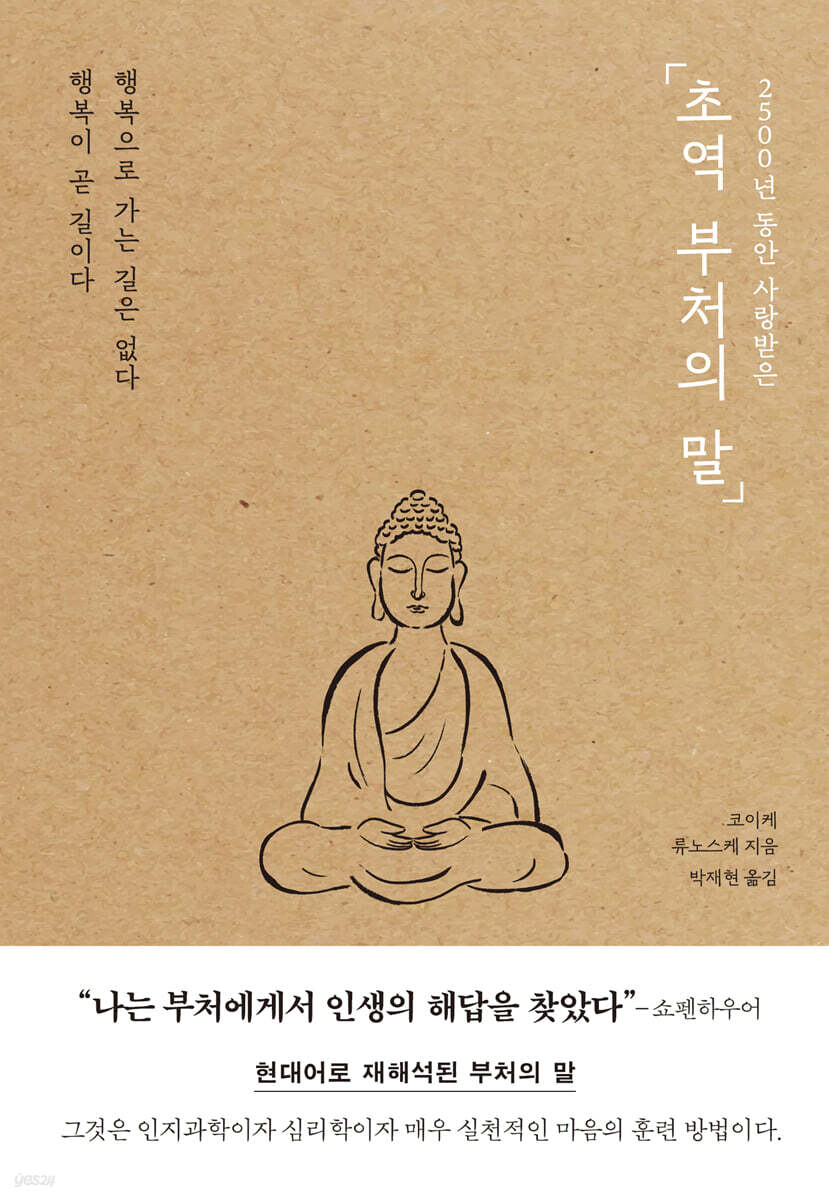
“I found the answer to life in Buddha.”_Schopenhauer
Buddha's words reinterpreted in modern language
Be patient.
Everything comes in its own time
Eventually, it will come to you.
Someday you
Where you should be
With the person you are destined to be with
Do what you have to do
Will live.
--- "Buddha"
The words of Buddha, which have been loved and passed down to people for 2,500 years, have been reinterpreted in modern language by monk Ryunosuke Koike and published in a book.
The Buddha's message, concisely summarized and containing only the essential points, gives strength and courage to those who are weak-hearted and in trouble.
Just as the Buddha's words are concise, the planning intention of this book is also very simple.
The author wrote in the preface that he hopes that wherever readers pick up this book and open it, the Buddha's words written there will gently color their hearts, and at some point, a pleasant breeze will rise within them, leading them in a better direction.
Schopenhauer, a German philosopher, was deeply fascinated by Eastern philosophy.
He focused on reading Eastern philosophy from a young age and said he could find answers to life in the words of Buddha.
World-renowned actor Keanu Reeves is also famous for living his life reflecting on the teachings of Buddha.
The Buddha's words gave him great strength whenever he faced great trials.
This book, which contains 190 sayings of the Buddha grouped into 12 themes, provides comfort to modern people weary of the complexities of life while also imparting essential life wisdom.
Buddha's words reinterpreted in modern language
Be patient.
Everything comes in its own time
Eventually, it will come to you.
Someday you
Where you should be
With the person you are destined to be with
Do what you have to do
Will live.
--- "Buddha"
The words of Buddha, which have been loved and passed down to people for 2,500 years, have been reinterpreted in modern language by monk Ryunosuke Koike and published in a book.
The Buddha's message, concisely summarized and containing only the essential points, gives strength and courage to those who are weak-hearted and in trouble.
Just as the Buddha's words are concise, the planning intention of this book is also very simple.
The author wrote in the preface that he hopes that wherever readers pick up this book and open it, the Buddha's words written there will gently color their hearts, and at some point, a pleasant breeze will rise within them, leading them in a better direction.
Schopenhauer, a German philosopher, was deeply fascinated by Eastern philosophy.
He focused on reading Eastern philosophy from a young age and said he could find answers to life in the words of Buddha.
World-renowned actor Keanu Reeves is also famous for living his life reflecting on the teachings of Buddha.
The Buddha's words gave him great strength whenever he faced great trials.
This book, which contains 190 sayings of the Buddha grouped into 12 themes, provides comfort to modern people weary of the complexities of life while also imparting essential life wisdom.
- You can preview some of the book's contents.
Preview
index
Introduction
Part 1: Don't be swayed by emotions
Part 2 does not compare
I don't want a part 3
Part 4: Accumulating Good Karma
Part 5: Choose a friend
Part 6: Knowing Happiness
Part 7: Knowing Yourself
Part 8: Looking at the body
Part 9: Become Free
Part 10: Learning Compassion
Part 11 Realizing
Part 12: Facing Death
Looking back on the life of Buddha
Author's Note
Part 1: Don't be swayed by emotions
Part 2 does not compare
I don't want a part 3
Part 4: Accumulating Good Karma
Part 5: Choose a friend
Part 6: Knowing Happiness
Part 7: Knowing Yourself
Part 8: Looking at the body
Part 9: Become Free
Part 10: Learning Compassion
Part 11 Realizing
Part 12: Facing Death
Looking back on the life of Buddha
Author's Note
Detailed image

Into the book
When Buddha was active in ancient India, his various sayings were memorized and recited by his disciples and passed down as scriptures.
The passages in this book are taken from those very ancient scriptures.
Among the passages that can be understood by anyone from high school students to grandparents, I selected the ones I particularly liked and translated them into a super translation.
--- p.6
If you get depressed or discouraged by a competitor's unpleasant behavior, the competitor will laugh and be happy when he sees it and say, "That's great."
Therefore, those who know true profit and loss do not lament or grieve, but maintain composure, no matter how unpleasant the situation may be.
The person who sees your gentle and soft expression, just like before, will be disappointed and say, 'Tch, what a disappointment.'
The best way to make your enemy worry is to remain gentle and not angry, that's all.
---From the “Jeongjibu Gyeongjeon”
There are people who tell you how much they work, how much they've accomplished, how well they know celebrities, and how great their job is, without you even asking.
If you don't let go of that desire to reveal yourself, people will increasingly distance themselves from you.
---From "Gyeongjip 782"
Don't make someone you can't stand by wanting them so much.
When the person you want and want so badly that you can't stand it doesn't turn out the way you want.
There comes a time when you have to lose that person.
Your heart will be filled with extreme pain.
If you break free from the curse of endless craving for 'I want, I want to have', your mind will be free and unfettered by anything.
---From “Dharmagumitta 211”
A wise person knows that this insatiable obsession is a 'powerful bondage'.
Even though the bonds may seem loose, they are actually tightly and tenaciously entangled, making it extremely difficult to break free. However, those who have broken free from those bonds are free from the desires of wanting to do this or that.
---From “Dharmagumitta Sutra 345, 346”
No matter how hard the wind blows, the mountain does not move.
Learn from the mountain's example, and whether others criticize you as a "bad guy" or praise you as a "cool person," turn a deaf ear and maintain a calm and unwavering mind.
---From “Dharmagumitta 81”
Nothing seems more beautiful than reality and nothing stimulates desire like a flower blooming high on a mountain, out of reach.
Whenever you long for and desire something that is intangible and seems to not exist in this world, a painful stimulus torments you.
---From the “Great Mindfulness Sutra” in the Book of Books
“I have never once said that I realized it myself.
“Doesn’t it bother you what happened when I, who am now enlightened, say so?” Finally, having succeeded in garnering their interest, the Buddha loudly declared that in order to reduce afflictions, all emptiness in the mind must be burned away.
And he taught them the practices he had devised for that purpose.
The passages in this book are taken from those very ancient scriptures.
Among the passages that can be understood by anyone from high school students to grandparents, I selected the ones I particularly liked and translated them into a super translation.
--- p.6
If you get depressed or discouraged by a competitor's unpleasant behavior, the competitor will laugh and be happy when he sees it and say, "That's great."
Therefore, those who know true profit and loss do not lament or grieve, but maintain composure, no matter how unpleasant the situation may be.
The person who sees your gentle and soft expression, just like before, will be disappointed and say, 'Tch, what a disappointment.'
The best way to make your enemy worry is to remain gentle and not angry, that's all.
---From the “Jeongjibu Gyeongjeon”
There are people who tell you how much they work, how much they've accomplished, how well they know celebrities, and how great their job is, without you even asking.
If you don't let go of that desire to reveal yourself, people will increasingly distance themselves from you.
---From "Gyeongjip 782"
Don't make someone you can't stand by wanting them so much.
When the person you want and want so badly that you can't stand it doesn't turn out the way you want.
There comes a time when you have to lose that person.
Your heart will be filled with extreme pain.
If you break free from the curse of endless craving for 'I want, I want to have', your mind will be free and unfettered by anything.
---From “Dharmagumitta 211”
A wise person knows that this insatiable obsession is a 'powerful bondage'.
Even though the bonds may seem loose, they are actually tightly and tenaciously entangled, making it extremely difficult to break free. However, those who have broken free from those bonds are free from the desires of wanting to do this or that.
---From “Dharmagumitta Sutra 345, 346”
No matter how hard the wind blows, the mountain does not move.
Learn from the mountain's example, and whether others criticize you as a "bad guy" or praise you as a "cool person," turn a deaf ear and maintain a calm and unwavering mind.
---From “Dharmagumitta 81”
Nothing seems more beautiful than reality and nothing stimulates desire like a flower blooming high on a mountain, out of reach.
Whenever you long for and desire something that is intangible and seems to not exist in this world, a painful stimulus torments you.
---From the “Great Mindfulness Sutra” in the Book of Books
“I have never once said that I realized it myself.
“Doesn’t it bother you what happened when I, who am now enlightened, say so?” Finally, having succeeded in garnering their interest, the Buddha loudly declared that in order to reduce afflictions, all emptiness in the mind must be burned away.
And he taught them the practices he had devised for that purpose.
--- p.247
Publisher's Review
***** Cumulative sales of 300,000 copies
A must-have for people who are tired of life
190 Wisdoms
Buddha, whose real name is Siddhartha Gautama.
A man born as a prince of the Shakya tribe, but later called Shakyamuni or Shakyamuni.
This book contains the words he wanted to convey to the world from the time he was born as a human until he died.
When Buddha was active in ancient India, his various sayings were memorized and recited by his disciples and passed down as scriptures.
The passages in this book are taken from those very ancient scriptures.
In ancient scriptures, there are often expressions that blindly deify Buddha or revere him as the founder of a great religion.
Such expressions were arbitrarily inserted by the disciples to give them authority, so they are not covered in this book.
If we are to be faithful to the Buddha's teaching, "Do not rely on me, but rely on your own senses," we must place greater importance on how we put his message into practice rather than on how we uphold him.
The structure of this book is as follows.
The 190 personally selected passages were again classified into twelve topics and arranged in order from Part 1 to Part 12.
In the first half, I have placed things that can be read lightly with an everyday mind, and in particular, I have placed words that will calm the 'anger' that destroys happiness in the first chapter.
You don't necessarily have to read from the beginning, but it would be great to start by washing away the toxins of 'anger' in your heart with clear water.
As the book progresses, it includes passages that transcend the common worldview or human-centered, ordinary perspective.
Going against the brainwashing called common sense and weakening its power is the process of removing the dirt from the mind and creating a clean mind.
The last chapter deals with 'death'.
“The teachings of Buddha are cognitive science and psychology,
“It is a very practical way to train the mind.”
The essence of Eastern philosophy that transcends time and space!
India is a country where the caste system strongly dominates society.
The highest class among them were the 'Bharim priests', and once a Brahmin priest who was impressed by the Buddha came to him and said, 'I want to renounce my religion and become your disciple.'
To this the Buddha replied:
“As a priest, you are doing religious work of offering rites to the believers.
If you throw your work away and come to me, that would be truly irresponsible.
“I would like you to continue working as you are now, and come to me to learn meditation when you have free time.”
Here we can see that there is no need to deny other religions in order to receive the teachings of the Buddha.
Buddha indirectly says that what he teaches is not a religion.
If the Buddha's teachings are a 'religion', then other religions are an obstacle to practicing them.
Because religion claims that 'only this is right.'
But what he teaches is not 'uniqueness'.
Rather, it is closer to psychological training to control the mind.
Because it does not have a religious color, anyone of any religion can use it.
A must-have for people who are tired of life
190 Wisdoms
Buddha, whose real name is Siddhartha Gautama.
A man born as a prince of the Shakya tribe, but later called Shakyamuni or Shakyamuni.
This book contains the words he wanted to convey to the world from the time he was born as a human until he died.
When Buddha was active in ancient India, his various sayings were memorized and recited by his disciples and passed down as scriptures.
The passages in this book are taken from those very ancient scriptures.
In ancient scriptures, there are often expressions that blindly deify Buddha or revere him as the founder of a great religion.
Such expressions were arbitrarily inserted by the disciples to give them authority, so they are not covered in this book.
If we are to be faithful to the Buddha's teaching, "Do not rely on me, but rely on your own senses," we must place greater importance on how we put his message into practice rather than on how we uphold him.
The structure of this book is as follows.
The 190 personally selected passages were again classified into twelve topics and arranged in order from Part 1 to Part 12.
In the first half, I have placed things that can be read lightly with an everyday mind, and in particular, I have placed words that will calm the 'anger' that destroys happiness in the first chapter.
You don't necessarily have to read from the beginning, but it would be great to start by washing away the toxins of 'anger' in your heart with clear water.
As the book progresses, it includes passages that transcend the common worldview or human-centered, ordinary perspective.
Going against the brainwashing called common sense and weakening its power is the process of removing the dirt from the mind and creating a clean mind.
The last chapter deals with 'death'.
“The teachings of Buddha are cognitive science and psychology,
“It is a very practical way to train the mind.”
The essence of Eastern philosophy that transcends time and space!
India is a country where the caste system strongly dominates society.
The highest class among them were the 'Bharim priests', and once a Brahmin priest who was impressed by the Buddha came to him and said, 'I want to renounce my religion and become your disciple.'
To this the Buddha replied:
“As a priest, you are doing religious work of offering rites to the believers.
If you throw your work away and come to me, that would be truly irresponsible.
“I would like you to continue working as you are now, and come to me to learn meditation when you have free time.”
Here we can see that there is no need to deny other religions in order to receive the teachings of the Buddha.
Buddha indirectly says that what he teaches is not a religion.
If the Buddha's teachings are a 'religion', then other religions are an obstacle to practicing them.
Because religion claims that 'only this is right.'
But what he teaches is not 'uniqueness'.
Rather, it is closer to psychological training to control the mind.
Because it does not have a religious color, anyone of any religion can use it.
GOODS SPECIFICS
- Date of issue: May 30, 2024
- Page count, weight, size: 256 pages | 342g | 130*188*15mm
- ISBN13: 9791193506516
- ISBN10: 1193506514
You may also like
카테고리
korean


korean

![ELLE 엘르 스페셜 에디션 A형 : 12월 [2025]](http://librairie.coreenne.fr/cdn/shop/files/b8e27a3de6c9538896439686c6b0e8fb.jpg?v=1766436872&width=3840)


