

Reading in Youth
 |
Description
Book Introduction
- A word from MD
-
If you still haven't experienced the joy of readingMore than 60,000 new books are published every year.
Which of the many books should I choose? Let's start with the books included in "Reading in Youth."
It introduces classics from novels, humanities, and social sciences, revealing points of connection to the present.
A wonderful book that will help you realize the meaning and joy of reading.
May 16, 2025. Humanities PD Son Min-gyu
A timeless "Book of Youth" that transcends time
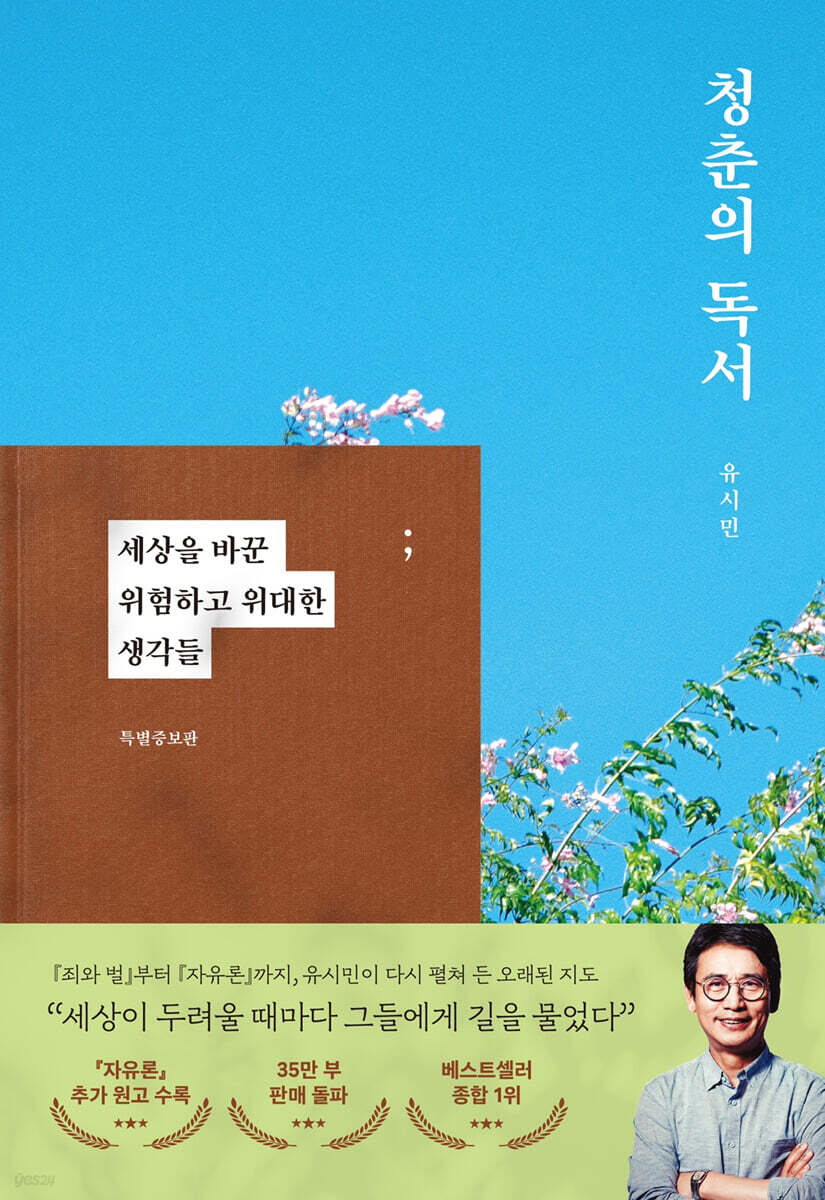
A special expanded edition of Yoo Si-min's "Reading in Youth" has been published!
“Whenever I was afraid of the world, I asked them for directions.”
From "Crime and Punishment" to "On Liberty," Yoo Si-min rediscovers an old map.
★ 330,000 copies commemorative deluxe hardcover edition
★ Newly included manuscript of the 15th book, On Liberty, and the preface to the special edition
Yoo Si-min, an intellectual of our time, has served as a tranquilizer, offering clear insights in every turbulent political situation.
One of his representative works, 『Reading in Youth』, first published in 2009 and beloved for a long time, is now available to readers in a special expanded edition in high-quality hardcover.
A discussion of John Stuart Mill's On Liberty and a preface to the special expanded edition have been added.
The sentences were also revised overall.
"Reading in Youth" began when Yoo Si-min opened up old, worn books, wondering, "What if I reread the classics I read in my youth? Times have changed, I've gotten older, so wouldn't something be different?"
『Crime and Punishment』 that I discovered by chance in my father's study as a child, 『The Communist Manifesto』 that I secretly read while lying down under the dim light of the nightstand, 『The Lost Honor of Katharina Blum』 that reminded me of the heartbreaking end of former President Roh Moo-hyun, 『What is History』 that opened my eyes to a new way of looking at history, and 『On Liberty』 that reminded me of the value of freedom now that long after the 21st century has begun.
This book is the source of the passion that made Yoo Si-min a young man, and it also contains the answers to the questions that Yoo Si-min poses to himself and to us today.
"Why do people all want to be rich?", "Are humans inherently selfish?", "What does it mean to think with my own head?", "How are facts distorted?", and "How should we live?" Fifteen great books that have marked huge milestones in the history of civilization.
It contains the worries and answers of those who have lived before.
By following in their footsteps through "Reading in Youth," you will learn the wisdom to live today and have the thrilling experience of envisioning a better tomorrow.
A special expanded edition of Yoo Si-min's "Reading in Youth" has been published!
“Whenever I was afraid of the world, I asked them for directions.”
From "Crime and Punishment" to "On Liberty," Yoo Si-min rediscovers an old map.
★ 330,000 copies commemorative deluxe hardcover edition
★ Newly included manuscript of the 15th book, On Liberty, and the preface to the special edition
Yoo Si-min, an intellectual of our time, has served as a tranquilizer, offering clear insights in every turbulent political situation.
One of his representative works, 『Reading in Youth』, first published in 2009 and beloved for a long time, is now available to readers in a special expanded edition in high-quality hardcover.
A discussion of John Stuart Mill's On Liberty and a preface to the special expanded edition have been added.
The sentences were also revised overall.
"Reading in Youth" began when Yoo Si-min opened up old, worn books, wondering, "What if I reread the classics I read in my youth? Times have changed, I've gotten older, so wouldn't something be different?"
『Crime and Punishment』 that I discovered by chance in my father's study as a child, 『The Communist Manifesto』 that I secretly read while lying down under the dim light of the nightstand, 『The Lost Honor of Katharina Blum』 that reminded me of the heartbreaking end of former President Roh Moo-hyun, 『What is History』 that opened my eyes to a new way of looking at history, and 『On Liberty』 that reminded me of the value of freedom now that long after the 21st century has begun.
This book is the source of the passion that made Yoo Si-min a young man, and it also contains the answers to the questions that Yoo Si-min poses to himself and to us today.
"Why do people all want to be rich?", "Are humans inherently selfish?", "What does it mean to think with my own head?", "How are facts distorted?", and "How should we live?" Fifteen great books that have marked huge milestones in the history of civilization.
It contains the worries and answers of those who have lived before.
By following in their footsteps through "Reading in Youth," you will learn the wisdom to live today and have the thrilling experience of envisioning a better tomorrow.
- You can preview some of the book's contents.
Preview
index
Preface to the Special Augmented Edition.
A story about reading books
Preface to the first edition.
Looking at old maps again
01.
Can One Great Man Save the World?: Fyodor Dostoevsky, Crime and Punishment
-Who is responsible for poverty?
-A book like Sharp First Kiss
-The ordinary majority saves themselves
02.
What Intellectuals Live By: Lee Young-hee, The Logic of a Transitional Age
-Underground University and the Teacher of Thought
-Finding the naked emperor
-Knowledge must be accompanied by a clear soul.
03.
The Allure of Revolution That Shaked Youth: Karl Marx and Friedrich Engels, The Communist Manifesto
-A political statement that touched the soul
-The tragedy of the stuffed revolutionary textbook
-There is no end to history.
04.
Is Inequality an Inevitable Law of Nature?: Thomas Malthus, "An Essay on the Principle of Population"
-Malthus, the cold and bizarre genius
-Charity is a social evil
-Property rights and the right to life
Prejudice blinds even the eyes of genius.
05.
Even if life deceives you: Alexander Pushkin, The Captain's Daughter
- A political novel disguised as romance
- Sketch of a cheerful rebellion
-Flowers bloom in the frozen ground
-The vain death of a great poet
06.
Meet the True Conservative: Mencius, The Mencius
-Meet the theory of the reverse revolution
-The people are the most precious
-The Beautiful Conservative, Rediscovering Mencius
-A great man gives up his life for righteousness.
07.
The Desire of an Individual Who Belongs Nowhere: Choi In-hun, "The Square"
-The legitimacy of the national history of the Republic of Korea
-A revolution that is only rumored
-Injectionist, Lee Myung-jun in the 1980s
-Reject a life without passion
08.
The Light and Shadow of the Power Struggle: Sima Qian, Records of the Grand Historian
-The protagonist of "The Records of the Grand Historian," Emperor Gaozu of Han, Liu Bang
-The indignation of the intellectual Sima Qian
A new era calls for new people.
-The Glory of Power, the Tragedy of Man
-I think about the greatness of politics.
09.
Can Grief Become Strength?: Aleksandr Solzhenitsyn, One Day in the Life of Ivan Denisovich
-A very ordinary day for someone who has been stripped of their dignity.
-The aesthetics of sadness and anger
-The Secret of Ivan Denisovich's Birth
-A working human is beautiful
10.
Are Humans Selfish?: Charles Darwin, On the Origin of Species
-A classic whose commentary you must read first
-Darwin and Wallace, simultaneous discovery of the theory of evolution
-Is Darwinism the enemy of progress?
-The potential of altruistic humans
11.
Why We Want to Be Rich: Thorstein Veblen, The Theory of the Leisure Class
-Wealth is an end in itself.
-The barbaric culture of private ownership
-People who deliberately waste money
-The loneliest economist on earth
-Everyone is conservative.
12.
Why Poverty Doesn't Eradicate with Civilization: Henry George, Progress and Poverty
-Ricardo's return to New York
-The Book of the Saint that Awakens Dreams
-The cry of the soul that awakens others
13.
Are My Thoughts Really My Thoughts?: Heinrich Böll, The Lost Honor of Katharina Blum
-The distance between what is seen and the truth
-honor killing
-68 Revolution and Far-Right Media
-Who is freedom of the press for?
14.
Can we trust the progress of history? : E.
H. Carr, What is History?
-Leaving Ranke and going to Ka
-Fall into a maze of meetings
-Illiteracy problem
-Encouragement and comfort for progressives
15.
A Prophecy of 21st-Century Civilization: John Stuart Mill, On Liberty
-Declaration of Personal Independence
-The world's most powerful intellectual
-The story Mill unfolded in On Liberty
Harriet Taylor Mill, co-author of On Liberty
-A person who has not transcended his time, but is a good person
- Encouragement to the Korean people
Review.
Gratitude for a great legacy
References.
A story about reading books
Preface to the first edition.
Looking at old maps again
01.
Can One Great Man Save the World?: Fyodor Dostoevsky, Crime and Punishment
-Who is responsible for poverty?
-A book like Sharp First Kiss
-The ordinary majority saves themselves
02.
What Intellectuals Live By: Lee Young-hee, The Logic of a Transitional Age
-Underground University and the Teacher of Thought
-Finding the naked emperor
-Knowledge must be accompanied by a clear soul.
03.
The Allure of Revolution That Shaked Youth: Karl Marx and Friedrich Engels, The Communist Manifesto
-A political statement that touched the soul
-The tragedy of the stuffed revolutionary textbook
-There is no end to history.
04.
Is Inequality an Inevitable Law of Nature?: Thomas Malthus, "An Essay on the Principle of Population"
-Malthus, the cold and bizarre genius
-Charity is a social evil
-Property rights and the right to life
Prejudice blinds even the eyes of genius.
05.
Even if life deceives you: Alexander Pushkin, The Captain's Daughter
- A political novel disguised as romance
- Sketch of a cheerful rebellion
-Flowers bloom in the frozen ground
-The vain death of a great poet
06.
Meet the True Conservative: Mencius, The Mencius
-Meet the theory of the reverse revolution
-The people are the most precious
-The Beautiful Conservative, Rediscovering Mencius
-A great man gives up his life for righteousness.
07.
The Desire of an Individual Who Belongs Nowhere: Choi In-hun, "The Square"
-The legitimacy of the national history of the Republic of Korea
-A revolution that is only rumored
-Injectionist, Lee Myung-jun in the 1980s
-Reject a life without passion
08.
The Light and Shadow of the Power Struggle: Sima Qian, Records of the Grand Historian
-The protagonist of "The Records of the Grand Historian," Emperor Gaozu of Han, Liu Bang
-The indignation of the intellectual Sima Qian
A new era calls for new people.
-The Glory of Power, the Tragedy of Man
-I think about the greatness of politics.
09.
Can Grief Become Strength?: Aleksandr Solzhenitsyn, One Day in the Life of Ivan Denisovich
-A very ordinary day for someone who has been stripped of their dignity.
-The aesthetics of sadness and anger
-The Secret of Ivan Denisovich's Birth
-A working human is beautiful
10.
Are Humans Selfish?: Charles Darwin, On the Origin of Species
-A classic whose commentary you must read first
-Darwin and Wallace, simultaneous discovery of the theory of evolution
-Is Darwinism the enemy of progress?
-The potential of altruistic humans
11.
Why We Want to Be Rich: Thorstein Veblen, The Theory of the Leisure Class
-Wealth is an end in itself.
-The barbaric culture of private ownership
-People who deliberately waste money
-The loneliest economist on earth
-Everyone is conservative.
12.
Why Poverty Doesn't Eradicate with Civilization: Henry George, Progress and Poverty
-Ricardo's return to New York
-The Book of the Saint that Awakens Dreams
-The cry of the soul that awakens others
13.
Are My Thoughts Really My Thoughts?: Heinrich Böll, The Lost Honor of Katharina Blum
-The distance between what is seen and the truth
-honor killing
-68 Revolution and Far-Right Media
-Who is freedom of the press for?
14.
Can we trust the progress of history? : E.
H. Carr, What is History?
-Leaving Ranke and going to Ka
-Fall into a maze of meetings
-Illiteracy problem
-Encouragement and comfort for progressives
15.
A Prophecy of 21st-Century Civilization: John Stuart Mill, On Liberty
-Declaration of Personal Independence
-The world's most powerful intellectual
-The story Mill unfolded in On Liberty
Harriet Taylor Mill, co-author of On Liberty
-A person who has not transcended his time, but is a good person
- Encouragement to the Korean people
Review.
Gratitude for a great legacy
References.
Detailed image

Into the book
『Reading of Youth』 is a 'slight' exception.
Although it deals with widely known classics, it was not written to convey information about the book.
I wrote this to express my own feelings and thoughts about life, people, the world, and history, which I gained while reading books.
It's not about the book itself, but about the act of reading it.
I was driven by a desire to 'express myself' rather than a desire to 'make the world a better place'.
I'm not the only one who feels this way.
Anyone would feel an attachment to a piece of writing that expresses their inner self.
--- From the "Preface to the Special Augmented Edition"
As I give this book to my beloved daughter, I want to say something.
The world is so big and wide that you won't be able to see it all until you die, and life is an indescribably beautiful blessing.
Humans were not born for this world, but came to live in this world, and there are many paths in life, none of which are of equal value.
And that you can find joy, fulfillment, and happiness in any path if you cultivate your humanity well.
--- From the "Preface to the First Edition"
“No matter how good the purpose, man cannot escape the mental suffering that comes from using evil means,” says Dostoevsky.
It is the law of life that if you commit a sin, you cannot escape punishment.
But this problem can also be viewed in another context.
To ask whether it is justifiable to use evil means to achieve good ends presupposes that good ends can be achieved by evil means.
But I do not accept this premise.
Before we consider its legitimacy, I believe that evil means never achieve good ends.
--- From "Chapter 1: Can One Great Person Save the World?"
What do intellectuals live by?
Teacher Lee Young-hee says:
Truth, truthfulness, endless reflection, and the belief and integrity to align perception and life.
The courage to endure hardship for the truth.
Intellectuals live with these things.
As I read the teacher's writing again, the teacher asks me a question.
--- From “Chapter 2: What Intellectuals Live By”
Since the beginning of time, all human-created powers have suppressed and restricted freedom of thought.
There was only a difference in degree.
I am happy to be reading the Communist Manifesto now without fear.
It's not that you can find the truth there.
Because we have the freedom to read books that contain errors.
--- From "Chapter 3: The Allure of Revolution That Shook Youth"
The emotion I feel while reading 『Essay on the Principle of Population』 again is fear.
We all live with various prejudices and stereotypes.
Since it is impossible to test and examine every common belief about everything in this world to see if it has logical and empirical validity, we have no choice but to accept, to a certain extent, commonly accepted ideas and ways of thinking.
So how different am I from Malthus?
Among the many common beliefs that support my beliefs, what I believe to be right, are there any false prejudices or stereotypes?
--- From "Chapter 4: Is Inequality an Inevitable Law of Nature?"
But why do we love this poem so much? When I read it, I feel a gentle wave crashing down from the bottom of my heart.
Perhaps, during the Japanese colonial period, someone translated it into Japanese and it touched the hearts of the Joseon people who were angry and sad about life.
Whatever Pushkin's intentions were, it's fascinating how someone's poetry can resonate so deeply with different peoples in different times.
The tsar's tyranny and the Japanese oppression were equally 'difficult days' and 'sad present'.
Our ancestors seem to have found great comfort and encouragement in Pushkin's poetry.
--- From "Chapter 5 Even if Life Deceives You"
It is often said that conservatives seek material gain and worldly advancement, but true conservatives seek values, not gain.
A true conservative anchors his identity within himself, not on a frontline battle against someone else.
Before criticizing others, reflect on yourself.
Even if no one recognizes you, you do not become discouraged, and you shine on your own even in the deepest darkness.
--- From "Chapter 6: Meeting a True Conservative"
Why did I read 『The Square』 back then?
It was because of the fame.
A novel that any intellectual who ponders the reality of their country and the future of their people must read at least once.
『The Square』 was a work with such a reputation.
What did I see in this novel then?
I'm just now realizing this as I look back at the parts that left a strong impression on me.
Aha, I see.
What I saw was only half.
The protagonist, Lee Myeong-jun, only saw one side of modern history.
The author must have only seen the mountain peaks drawn from one place and then turned around.
Is the beauty of a novel, not just of cultural assets, only seen to the extent that the reader understands it?
--- From "Chapter 7: The Desire of an Individual Who Cannot Belong Anywhere"
Politics is a great business.
It is the work of enduring the lowliness of a beast, fighting against bestial greed, and achieving the nobility of a saint.
--- From "Chapter 8: The Light and Shadow of the Power Struggle"
But the sight of Shukhov finishing two bowls of soup did not look humble at all.
It was a magnificent and sacred sight.
I think this was Solzhenitsyn himself.
I can't write something like this without experiencing it firsthand.
Reading this passage, I felt an uncontrollable animosity toward the Soviet political system and those in power who had imprisoned Shukhov in the camps.
I don't know if Solzhenitsyn intended this emotion to arise in his readers' hearts, but anyone who advocates human dignity will.
--- From Chapter 9, "Can Sadness Become Strength?"
I didn't read Darwin when I was young.
Just as I believed I knew the laws of population without having read An Essay on the Principle of Population, I thought I knew the theory of evolution without having read The Origin of Species.
I didn't feel like reading about Darwin because he was often mentioned alongside 'unpleasant names' like Thomas Malthus and Herbert Spencer.
I hated Malthus, who justified poverty and criticized poor relief, and I disliked Spencer, who sided with the socially strong with the concept of survival of the fittest.
I thought that the 'social Darwinism' or 'social Darwinism' they promoted was a shallow ideology that glorified the rich and the strong and rationalized inequality.
I thought that although the theory of evolution was a correct biological theory, it had a negative social impact.
In short, I didn't know much about Darwin.
--- From "Chapter 10: Are Humans Selfish Beings?"
I feel sorry for Veblen who lived a lonely life.
Although he left a will asking me not to write anything in memory of or in memory of him, I have no obligation to keep that will.
“Dr. Veblen, don’t live alone on your home planet.
And now that it's all in the past, Homo sapiens is a better species than you thought.”
--- From Chapter 11, “Why Do We Want to Be Rich?”
‘Fundamental change’ is a beautiful dream.
However, this does not mean that partial and gradual improvements that do not reach that level should be criticized as being ugly or meaningless.
If we do that, no one will be able to challenge us to make a change.
Because we all know how difficult it is to bring about ‘fundamental change.’
--- From "Chapter 12: Why Poverty Does Not Eradicate Even With the Advancement of Civilization"
We have to live breathing information that we don't know is true, drinking in distortions and lies.
So, I can't help but be suspicious.
Are the thoughts I have really my own?
--- From Chapter 13, Are My Thoughts Really My Thoughts?
If you follow Ranke, your life will be comfortable.
There is no progress in history, and all eras have equal value.
There is no need to think about opening a new era.
The era you live in has equal value to all other eras, so just accept reality and live with it.
It is no coincidence that when the Japanese colonial government pursued the distortion of history that belittled and denigrated our national history, the historians of the 'Jindan Society' who collaborated with them upheld Ranke while advocating for 'positivist history.'
EH
After reading Karl, I said goodbye to Ranke.
A dark cloud hung over my life.
--- From Chapter 14, "Can We Believe in the Progress of History?"
Mill comforted and encouraged us in a book he wrote back in 1859.
To those who have endured and overcome the anger, pain, and absurdity since electing a fool as president, to the citizens who blocked the martial law troops in the National Assembly on the night of martial law, to the young people who created the miracle of Namtaeryeong, to the men, women, and children who spent the night in front of the Constitutional Court in the blizzard, I want to express my infinite gratitude.
If the philosopher John Stuart Mill were to see us today, he would say:
“You have shown us the source of all that is worthy of human pride.
You can be proud of yourself.
“You deserve it.”
Although it deals with widely known classics, it was not written to convey information about the book.
I wrote this to express my own feelings and thoughts about life, people, the world, and history, which I gained while reading books.
It's not about the book itself, but about the act of reading it.
I was driven by a desire to 'express myself' rather than a desire to 'make the world a better place'.
I'm not the only one who feels this way.
Anyone would feel an attachment to a piece of writing that expresses their inner self.
--- From the "Preface to the Special Augmented Edition"
As I give this book to my beloved daughter, I want to say something.
The world is so big and wide that you won't be able to see it all until you die, and life is an indescribably beautiful blessing.
Humans were not born for this world, but came to live in this world, and there are many paths in life, none of which are of equal value.
And that you can find joy, fulfillment, and happiness in any path if you cultivate your humanity well.
--- From the "Preface to the First Edition"
“No matter how good the purpose, man cannot escape the mental suffering that comes from using evil means,” says Dostoevsky.
It is the law of life that if you commit a sin, you cannot escape punishment.
But this problem can also be viewed in another context.
To ask whether it is justifiable to use evil means to achieve good ends presupposes that good ends can be achieved by evil means.
But I do not accept this premise.
Before we consider its legitimacy, I believe that evil means never achieve good ends.
--- From "Chapter 1: Can One Great Person Save the World?"
What do intellectuals live by?
Teacher Lee Young-hee says:
Truth, truthfulness, endless reflection, and the belief and integrity to align perception and life.
The courage to endure hardship for the truth.
Intellectuals live with these things.
As I read the teacher's writing again, the teacher asks me a question.
--- From “Chapter 2: What Intellectuals Live By”
Since the beginning of time, all human-created powers have suppressed and restricted freedom of thought.
There was only a difference in degree.
I am happy to be reading the Communist Manifesto now without fear.
It's not that you can find the truth there.
Because we have the freedom to read books that contain errors.
--- From "Chapter 3: The Allure of Revolution That Shook Youth"
The emotion I feel while reading 『Essay on the Principle of Population』 again is fear.
We all live with various prejudices and stereotypes.
Since it is impossible to test and examine every common belief about everything in this world to see if it has logical and empirical validity, we have no choice but to accept, to a certain extent, commonly accepted ideas and ways of thinking.
So how different am I from Malthus?
Among the many common beliefs that support my beliefs, what I believe to be right, are there any false prejudices or stereotypes?
--- From "Chapter 4: Is Inequality an Inevitable Law of Nature?"
But why do we love this poem so much? When I read it, I feel a gentle wave crashing down from the bottom of my heart.
Perhaps, during the Japanese colonial period, someone translated it into Japanese and it touched the hearts of the Joseon people who were angry and sad about life.
Whatever Pushkin's intentions were, it's fascinating how someone's poetry can resonate so deeply with different peoples in different times.
The tsar's tyranny and the Japanese oppression were equally 'difficult days' and 'sad present'.
Our ancestors seem to have found great comfort and encouragement in Pushkin's poetry.
--- From "Chapter 5 Even if Life Deceives You"
It is often said that conservatives seek material gain and worldly advancement, but true conservatives seek values, not gain.
A true conservative anchors his identity within himself, not on a frontline battle against someone else.
Before criticizing others, reflect on yourself.
Even if no one recognizes you, you do not become discouraged, and you shine on your own even in the deepest darkness.
--- From "Chapter 6: Meeting a True Conservative"
Why did I read 『The Square』 back then?
It was because of the fame.
A novel that any intellectual who ponders the reality of their country and the future of their people must read at least once.
『The Square』 was a work with such a reputation.
What did I see in this novel then?
I'm just now realizing this as I look back at the parts that left a strong impression on me.
Aha, I see.
What I saw was only half.
The protagonist, Lee Myeong-jun, only saw one side of modern history.
The author must have only seen the mountain peaks drawn from one place and then turned around.
Is the beauty of a novel, not just of cultural assets, only seen to the extent that the reader understands it?
--- From "Chapter 7: The Desire of an Individual Who Cannot Belong Anywhere"
Politics is a great business.
It is the work of enduring the lowliness of a beast, fighting against bestial greed, and achieving the nobility of a saint.
--- From "Chapter 8: The Light and Shadow of the Power Struggle"
But the sight of Shukhov finishing two bowls of soup did not look humble at all.
It was a magnificent and sacred sight.
I think this was Solzhenitsyn himself.
I can't write something like this without experiencing it firsthand.
Reading this passage, I felt an uncontrollable animosity toward the Soviet political system and those in power who had imprisoned Shukhov in the camps.
I don't know if Solzhenitsyn intended this emotion to arise in his readers' hearts, but anyone who advocates human dignity will.
--- From Chapter 9, "Can Sadness Become Strength?"
I didn't read Darwin when I was young.
Just as I believed I knew the laws of population without having read An Essay on the Principle of Population, I thought I knew the theory of evolution without having read The Origin of Species.
I didn't feel like reading about Darwin because he was often mentioned alongside 'unpleasant names' like Thomas Malthus and Herbert Spencer.
I hated Malthus, who justified poverty and criticized poor relief, and I disliked Spencer, who sided with the socially strong with the concept of survival of the fittest.
I thought that the 'social Darwinism' or 'social Darwinism' they promoted was a shallow ideology that glorified the rich and the strong and rationalized inequality.
I thought that although the theory of evolution was a correct biological theory, it had a negative social impact.
In short, I didn't know much about Darwin.
--- From "Chapter 10: Are Humans Selfish Beings?"
I feel sorry for Veblen who lived a lonely life.
Although he left a will asking me not to write anything in memory of or in memory of him, I have no obligation to keep that will.
“Dr. Veblen, don’t live alone on your home planet.
And now that it's all in the past, Homo sapiens is a better species than you thought.”
--- From Chapter 11, “Why Do We Want to Be Rich?”
‘Fundamental change’ is a beautiful dream.
However, this does not mean that partial and gradual improvements that do not reach that level should be criticized as being ugly or meaningless.
If we do that, no one will be able to challenge us to make a change.
Because we all know how difficult it is to bring about ‘fundamental change.’
--- From "Chapter 12: Why Poverty Does Not Eradicate Even With the Advancement of Civilization"
We have to live breathing information that we don't know is true, drinking in distortions and lies.
So, I can't help but be suspicious.
Are the thoughts I have really my own?
--- From Chapter 13, Are My Thoughts Really My Thoughts?
If you follow Ranke, your life will be comfortable.
There is no progress in history, and all eras have equal value.
There is no need to think about opening a new era.
The era you live in has equal value to all other eras, so just accept reality and live with it.
It is no coincidence that when the Japanese colonial government pursued the distortion of history that belittled and denigrated our national history, the historians of the 'Jindan Society' who collaborated with them upheld Ranke while advocating for 'positivist history.'
EH
After reading Karl, I said goodbye to Ranke.
A dark cloud hung over my life.
--- From Chapter 14, "Can We Believe in the Progress of History?"
Mill comforted and encouraged us in a book he wrote back in 1859.
To those who have endured and overcome the anger, pain, and absurdity since electing a fool as president, to the citizens who blocked the martial law troops in the National Assembly on the night of martial law, to the young people who created the miracle of Namtaeryeong, to the men, women, and children who spent the night in front of the Constitutional Court in the blizzard, I want to express my infinite gratitude.
If the philosopher John Stuart Mill were to see us today, he would say:
“You have shown us the source of all that is worthy of human pride.
You can be proud of yourself.
“You deserve it.”
--- From "Chapter 15: The Prophecy of 21st Century Civilization"
Publisher's Review
The 'tranquilizer' of this era
The old map that Yushimin unfolded again
“This book is a redrawing of the map I carried around when I was young.” Yoo Si-min, an intellectual of our time, has served as a tranquilizer, offering clear insights in every turbulent political situation.
He, who had lived a youth more passionate and intense than anyone else, took out the book he had used to ask for guidance whenever he encountered crossroads and obstacles in his life.
And on top of that, he added his own thoughts, philosophy, worries, emotions, questions, and realizations to draw a new map.
『Crime and Punishment』, which I discovered by chance in my father's study as a child; 『The Communist Manifesto』, which I secretly read while lying down under the dim light of the nightstand; 『The Lost Honor of Katharina Blum』, which reminded me of the heartbreaking end of former President Roh Moo-hyun; 『What is History』, which opened my eyes to a new way of looking at history; and 『On Liberty』, which reminded me of the value of freedom once again as I faced the night of martial law in the 21st century.
Each and every book is the source that created the young Yoo Si-min.
『Reading in Youth』 tells the story of the world through 15 great classics.
“The book I am most personally attached to”
『Reading in Youth』, where you can encounter his life story
One of Yoo Si-min's representative works, "Reading in Youth," was first published in 2009 and has been loved for a long time.
This time, it meets readers anew in a special expanded edition.
In addition to the existing 14 stories, a new story on John Stuart Mill's classic 『On Liberty』 has been added, and a special expanded edition preface has been added.
The sentences were also revised overall.
As one of the best-selling authors in Korea, he has written many books, including 『Reading World History Backwards』, which has sold over a million copies since its publication at the age of 29, as well as 『My Modern Korean History』, 『History of History』, 『What is a Nation?』, and 『Postpaid Democracy』.
Among the many books I have written, I would say that the one I have the greatest affection for is “Reading in Youth.”
Unlike books written based on a specific theme, this book is written in an honest way about oneself.
“I wrote this to express my own feelings and thoughts about life, people, the world, and history, which I gained while reading books.”
That is why the questions he pondered and pondered intensely in his youth, and the process by which his perspective on humanity, history, and society changed over time, are contained throughout the book.
In that sense, it is also Yoo Si-min's life story.
You will meet the figure of Yoo Si-min, a young man who was more passionate than anyone else before becoming a writer, politician, or administrator.
“Is the world progressing?”, “What is democracy?”, “Are humans inherently selfish beings?”, “How are facts and truth distorted?”, and “How should we live from now on?” These are the questions that the young Yoo Si-min sought answers to through classics.
It is impossible for today's youth to not have such concerns.
So, wouldn't these books he's opened again provide meaningful answers to today's youth?
“Whenever I was afraid of the world, I asked them for directions.”
15 Great Classics That Became a Milestone for Young Yoo Si-min
This book began when Yoo Si-min, upon rereading the classics he'd read in his youth, wondered, "What if I reread them? Times have changed, I've grown older, so wouldn't something be different?" He began to reread old, worn-out books.
The book I took out again looked completely different from before.
At the time, there were parts that I had not seen or ignored, but they resonated strongly with me.
I read the same book again, but it was never the same book.
In Fyodor Dostoevsky's "Crime and Punishment," the character Dunya, who I didn't remember when I first read it, catches my eye.
His actions reveal that ordinary people come together to sustain and even change society.
Even in the section dealing with the Mencius, the difference in perspective between the ‘young Yu Si-min’ and ‘today’s Yu Si-min’ is clearly revealed.
When I read it as a college student, I was strongly impressed by Mencius, a "revolutionary thinker" who placed the people above all other values. However, when I read it again, I discovered the virtues that a "true conservative" should possess in Mencius's emphasis on filial piety and community.
The section dealing with Charles Darwin's 'Origin of Species' is also interesting.
It feels like watching a conversation in which the youthful Yushimin asks questions and the present-day Yushimin answers.
The author confesses that he did not read Darwin in his youth.
Although I hadn't actually read "The Origin of Species," I thought I knew a lot about evolution, and I was reluctant to accept the idea that evolution served as the theoretical foundation for eugenics.
In fact, it was evidence that “I didn’t know much about Darwin.”
As I read this book with more experience, I reflect on my past misunderstandings and ignorance, and at the same time, I realize that humans are beings with selfish instincts, but they are also altruistic beings.
Newly included as the 15th chapter, "On Liberty"
The preciousness of freedom felt again while surviving the 'night of martial law'
In this special expanded edition, one chapter has been added along with the preface.
This is a story about rereading John Stuart Mill's famous work, On Liberty.
Why "On Liberty"? Yoo Si-min, who has cited "On Liberty" several times on television, answers as follows.
“I chose it because I thought it would help us all process the national and political turmoil we have all experienced together since the declaration of martial law on December 3.” The time after the ‘night of martial law’ was a time to realize that what we had taken for granted was not, in fact, so obvious.
The proclamation prohibiting political activity, publishing and the press, and assembly posed a serious threat to freedom.
Mill emphasized freedom of expression, freedom of enjoyment of tastes, and freedom of association, saying, “If these three freedoms are not respected in principle, no society, regardless of its form of government, can be called free.”
The author felt comforted and encouraged by Mill.
Mill highly values the human capacity for "corrective action," which he says is why "rational opinion and action generally prevail" in our human society.
Our country's history shows this well.
Despite the Japanese colonial rule, division of North and South Korea, and the Korean War that left the entire country in ruins, we achieved industrialization and democratization.
Despite countless failures and wrong choices, ordinary people have come together to fix the problem.
The author returns the comfort and encouragement he received from Mill to the Korean people living today.
Mill comforted and encouraged us in a book he wrote back in 1859.
To those who have endured and overcome the anger, pain, and absurdity since electing a fool as president, to the citizens who blocked the martial law troops in the National Assembly on the night of martial law, to the young people who created the miracle of Namtaeryeong, to the men, women, and children who spent the night in front of the Constitutional Court in the blizzard, I want to express my infinite gratitude.
If the philosopher John Stuart Mill were to see us today, he would say:
“You have shown us the source of all that is worthy of human pride.
You can be proud of yourself.
“You deserve it.”
Create your own map
A List of Wisdom Recommendations for Every Young Person
At the end of the book, Yoo Si-min leaves a request.
I'm not writing a balanced review of the classics, so please don't let your own perspective bias you towards the books and authors I've discussed here.
In one interview, he said this:
“Just as a writer has the right to write a book as he pleases, so too does a reader have the right to read a book as he pleases.” That’s right.
'Read as you please.' This is probably the most appropriate attitude to take when reading this book, 'Reading in Youth.'
The moment a book comes into the world, it belongs to the reader.
It is meaningful to read this book to hear the thoughts and concerns of Yoo Si-min, a human being with diverse experiences not only as a writer but also as a democracy activist, politician, and administrator. It is also meaningful to read it with the intention of experiencing the world of classics under the guidance of Yoo Si-min, the "knowledge retailer."
You may not agree with the author's interpretation.
Because “different people will hear different stories and feel different emotions from the same book.”
You can think of life and reading as maps carefully created by someone who has experienced them firsthand.
15 great books that marked a huge milestone in the history of civilization.
It contains the worries and answers of those who have lived before.
If you follow their footsteps, using "Reading in Youth" as a guide, you will have the thrilling experience of drawing your own map at some point.
The old map that Yushimin unfolded again
“This book is a redrawing of the map I carried around when I was young.” Yoo Si-min, an intellectual of our time, has served as a tranquilizer, offering clear insights in every turbulent political situation.
He, who had lived a youth more passionate and intense than anyone else, took out the book he had used to ask for guidance whenever he encountered crossroads and obstacles in his life.
And on top of that, he added his own thoughts, philosophy, worries, emotions, questions, and realizations to draw a new map.
『Crime and Punishment』, which I discovered by chance in my father's study as a child; 『The Communist Manifesto』, which I secretly read while lying down under the dim light of the nightstand; 『The Lost Honor of Katharina Blum』, which reminded me of the heartbreaking end of former President Roh Moo-hyun; 『What is History』, which opened my eyes to a new way of looking at history; and 『On Liberty』, which reminded me of the value of freedom once again as I faced the night of martial law in the 21st century.
Each and every book is the source that created the young Yoo Si-min.
『Reading in Youth』 tells the story of the world through 15 great classics.
“The book I am most personally attached to”
『Reading in Youth』, where you can encounter his life story
One of Yoo Si-min's representative works, "Reading in Youth," was first published in 2009 and has been loved for a long time.
This time, it meets readers anew in a special expanded edition.
In addition to the existing 14 stories, a new story on John Stuart Mill's classic 『On Liberty』 has been added, and a special expanded edition preface has been added.
The sentences were also revised overall.
As one of the best-selling authors in Korea, he has written many books, including 『Reading World History Backwards』, which has sold over a million copies since its publication at the age of 29, as well as 『My Modern Korean History』, 『History of History』, 『What is a Nation?』, and 『Postpaid Democracy』.
Among the many books I have written, I would say that the one I have the greatest affection for is “Reading in Youth.”
Unlike books written based on a specific theme, this book is written in an honest way about oneself.
“I wrote this to express my own feelings and thoughts about life, people, the world, and history, which I gained while reading books.”
That is why the questions he pondered and pondered intensely in his youth, and the process by which his perspective on humanity, history, and society changed over time, are contained throughout the book.
In that sense, it is also Yoo Si-min's life story.
You will meet the figure of Yoo Si-min, a young man who was more passionate than anyone else before becoming a writer, politician, or administrator.
“Is the world progressing?”, “What is democracy?”, “Are humans inherently selfish beings?”, “How are facts and truth distorted?”, and “How should we live from now on?” These are the questions that the young Yoo Si-min sought answers to through classics.
It is impossible for today's youth to not have such concerns.
So, wouldn't these books he's opened again provide meaningful answers to today's youth?
“Whenever I was afraid of the world, I asked them for directions.”
15 Great Classics That Became a Milestone for Young Yoo Si-min
This book began when Yoo Si-min, upon rereading the classics he'd read in his youth, wondered, "What if I reread them? Times have changed, I've grown older, so wouldn't something be different?" He began to reread old, worn-out books.
The book I took out again looked completely different from before.
At the time, there were parts that I had not seen or ignored, but they resonated strongly with me.
I read the same book again, but it was never the same book.
In Fyodor Dostoevsky's "Crime and Punishment," the character Dunya, who I didn't remember when I first read it, catches my eye.
His actions reveal that ordinary people come together to sustain and even change society.
Even in the section dealing with the Mencius, the difference in perspective between the ‘young Yu Si-min’ and ‘today’s Yu Si-min’ is clearly revealed.
When I read it as a college student, I was strongly impressed by Mencius, a "revolutionary thinker" who placed the people above all other values. However, when I read it again, I discovered the virtues that a "true conservative" should possess in Mencius's emphasis on filial piety and community.
The section dealing with Charles Darwin's 'Origin of Species' is also interesting.
It feels like watching a conversation in which the youthful Yushimin asks questions and the present-day Yushimin answers.
The author confesses that he did not read Darwin in his youth.
Although I hadn't actually read "The Origin of Species," I thought I knew a lot about evolution, and I was reluctant to accept the idea that evolution served as the theoretical foundation for eugenics.
In fact, it was evidence that “I didn’t know much about Darwin.”
As I read this book with more experience, I reflect on my past misunderstandings and ignorance, and at the same time, I realize that humans are beings with selfish instincts, but they are also altruistic beings.
Newly included as the 15th chapter, "On Liberty"
The preciousness of freedom felt again while surviving the 'night of martial law'
In this special expanded edition, one chapter has been added along with the preface.
This is a story about rereading John Stuart Mill's famous work, On Liberty.
Why "On Liberty"? Yoo Si-min, who has cited "On Liberty" several times on television, answers as follows.
“I chose it because I thought it would help us all process the national and political turmoil we have all experienced together since the declaration of martial law on December 3.” The time after the ‘night of martial law’ was a time to realize that what we had taken for granted was not, in fact, so obvious.
The proclamation prohibiting political activity, publishing and the press, and assembly posed a serious threat to freedom.
Mill emphasized freedom of expression, freedom of enjoyment of tastes, and freedom of association, saying, “If these three freedoms are not respected in principle, no society, regardless of its form of government, can be called free.”
The author felt comforted and encouraged by Mill.
Mill highly values the human capacity for "corrective action," which he says is why "rational opinion and action generally prevail" in our human society.
Our country's history shows this well.
Despite the Japanese colonial rule, division of North and South Korea, and the Korean War that left the entire country in ruins, we achieved industrialization and democratization.
Despite countless failures and wrong choices, ordinary people have come together to fix the problem.
The author returns the comfort and encouragement he received from Mill to the Korean people living today.
Mill comforted and encouraged us in a book he wrote back in 1859.
To those who have endured and overcome the anger, pain, and absurdity since electing a fool as president, to the citizens who blocked the martial law troops in the National Assembly on the night of martial law, to the young people who created the miracle of Namtaeryeong, to the men, women, and children who spent the night in front of the Constitutional Court in the blizzard, I want to express my infinite gratitude.
If the philosopher John Stuart Mill were to see us today, he would say:
“You have shown us the source of all that is worthy of human pride.
You can be proud of yourself.
“You deserve it.”
Create your own map
A List of Wisdom Recommendations for Every Young Person
At the end of the book, Yoo Si-min leaves a request.
I'm not writing a balanced review of the classics, so please don't let your own perspective bias you towards the books and authors I've discussed here.
In one interview, he said this:
“Just as a writer has the right to write a book as he pleases, so too does a reader have the right to read a book as he pleases.” That’s right.
'Read as you please.' This is probably the most appropriate attitude to take when reading this book, 'Reading in Youth.'
The moment a book comes into the world, it belongs to the reader.
It is meaningful to read this book to hear the thoughts and concerns of Yoo Si-min, a human being with diverse experiences not only as a writer but also as a democracy activist, politician, and administrator. It is also meaningful to read it with the intention of experiencing the world of classics under the guidance of Yoo Si-min, the "knowledge retailer."
You may not agree with the author's interpretation.
Because “different people will hear different stories and feel different emotions from the same book.”
You can think of life and reading as maps carefully created by someone who has experienced them firsthand.
15 great books that marked a huge milestone in the history of civilization.
It contains the worries and answers of those who have lived before.
If you follow their footsteps, using "Reading in Youth" as a guide, you will have the thrilling experience of drawing your own map at some point.
GOODS SPECIFICS
- Date of issue: April 30, 2025
- Format: Hardcover book binding method guide
- Page count, weight, size: 356 pages | 498g | 145*210*30mm
- ISBN13: 9788901294742
- ISBN10: 8901294745
You may also like
카테고리
korean


korean

![GQ KOREA Mark (Monthly): December [2025]](http://librairie.coreenne.fr/cdn/shop/files/8ef265dbbfbf186523ed75ba7319009d.jpg?v=1765340328&width=3840)


