

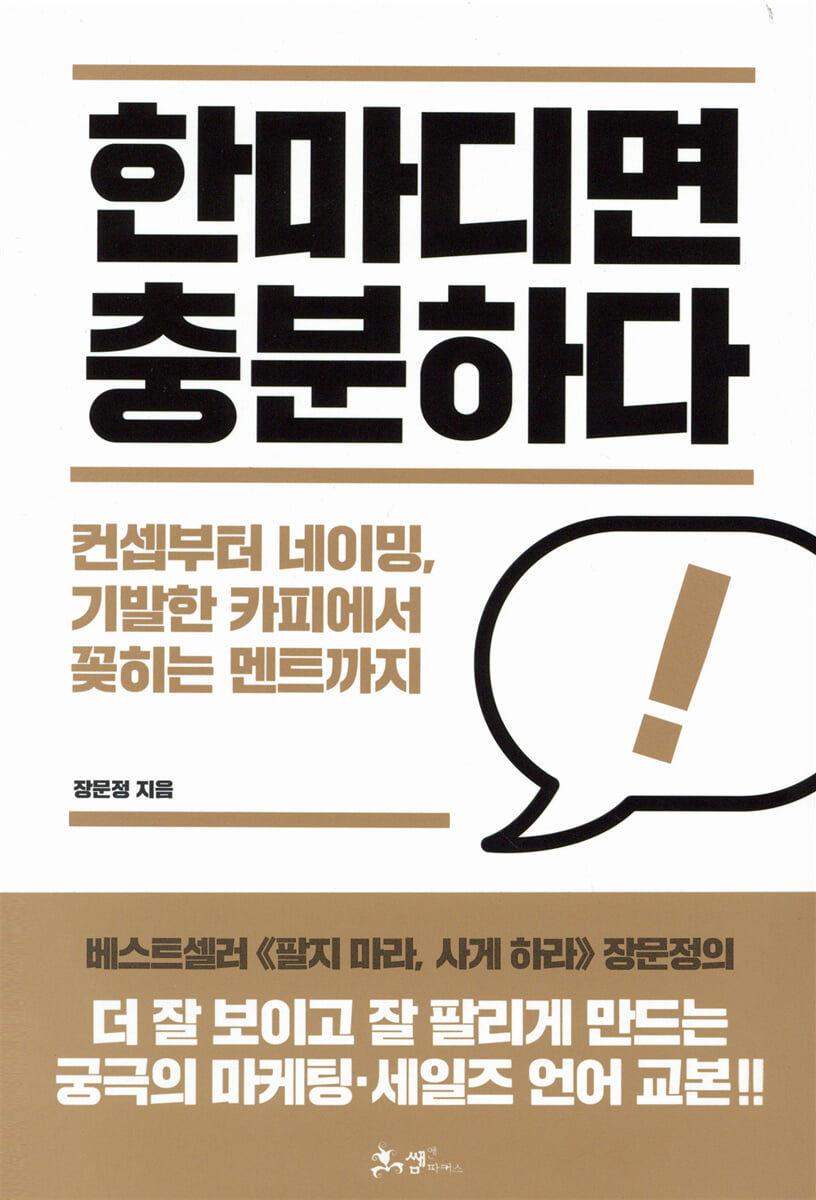
One word is enough
 |
Description
Book Introduction
The ultimate marketing sales language that will have you buying as soon as you hear it! A man who generates hundreds of billions of dollars in sales per hour, a man who refines and creates the perfect 'language' for every product in the world, giving marketing a jet engine. A magician of persuasive language who breathes life into products. Jang Moon-jung, author of the best-selling book on planning, marketing, and sales that captivated 200,000 readers, "Don't Sell, Make Them Buy," has returned with even more power with her new book, "One Word Is Enough." "One Word Is Enough" perfectly introduces the "persuasive language packaging technique" that will help you gain the upper hand and seize the victory in the business world, a battleground of words that relentlessly attack the eyes and ears of customers and consumers. As the subtitle suggests, “From concept to naming, from clever copy to catchy comments,” this book provides a thorough understanding of not only marketing and sales, but also the know-how required for product planning and concepts that are catchy and memorable. |
- You can preview some of the book's contents.
Preview
index
Prologue | Something new under the sun, you can create with just one word.
Before you lead the way | Focus on the 'What', not the 'How'
PART 1: The More You Take, the More Perfect You Get - A Killer Technique That Hits You in One Hit
1.
Naming - A well-chosen name holds the key to a product's life.
The life of a product depends on its name | Naming sense that even changes its efficacy | 6 types of naming that cause the opposite effect - ① Names that people ask for again, ② Names with abbreviations, ③ Names with special symbols or signs, ④ Names with numbers, ⑤ Names that are too long, ⑥ Names with negative connotations | When do you come up with the best name? | Make it easy to remember no matter what | Eel, oh my goodness... It's alive! | Key Point
2.
Conceptualization - A powerful word that triggers the impulse to consume
A subtle concept is 100% doomed | Concept Expansion: ① Leave the essence alone and change its purpose, ② Change even the essence to a different purpose | Humor is half the battle | Wordplay and language destruction are also useful cards | A concept that utilizes rhymes to make it "exciting!" | Concepts and copy share the same parent | Key Points
3.
Image Declaration - Make them believe what you declare.
Differentiate and Impress | Image Declaration Rules ① "In a word…", ② Create a slogan that embodies your beliefs and will | Key Points
4.
One point - Throw away everything but the yolk
Cut through the language bubbles | Crafting copy that hits the mark | Say "Choose for me" instead of "Choose for me" | The most powerful climax is a twist | When mackerel is served, eat the body first | A single punch when customers hesitate | Escape a crisis with a single word! | A powerful move that cuts through flesh and gets what you want | Key Points
5.
Assertion - "Do you have a lot of money? Otherwise, buy this!"
Backfire Waste of Language | Powerful Arguments: "Don't worry!" "There's no such thing!" | Put the Verb First | "Have you got enough money? Take our flight!" | There's no "next time" for salespeople | Key Points
PART 2: Forget What You Were Doing - The Hot Trend of Persuasion Techniques
1.
Eyes on the ground - Use your customers' language, not your business's.
Close the Knowledge Gap | Free Language from Echo Chambers | Translate Known Words into Spoken Words | Speak Comprehensibly, Not Accurately | Learn Consumer Speak | Key Points
2.
Value - Change, edit, subtract, add, and combine
A Raphael painting sold for 20,000 won | Start by raising awareness and winning | When buying, look for "price," when spending, look for "value" | Pull out as much as you can | Key Point
3.
History - From Then to Now
From now on, the first
The oldest is the best | Water with a story tastes better | There's no such thing as good marketing | Anyone with a history can be the first | Not the first from now on, but 'the first since then!' | Key Point
4.
Honey Tip - Captivate Your Soul with Sweet Information
Make people take a second look at things they might otherwise pass by | "This gentleman does business with such humanity" | The ultimate destination for these tips is always my product! | Key Point
5.
Organize - Make your customer's mind into a chest of drawers.
How to Build Skills Without Trial and Error | How to Use Organizing Techniques: ① Number Your Work, ② Provide Standards | Key Points
PART 3: Unlocking and Reversing - The Language Packaging Technique of Unknowingly OKing
1.
Awareness - Don't advise, make them aware
How to Use the Psychology of Suspicious Customers | How to Use Self-Awareness Techniques ① Make them aware of the discomfort, then suggest an alternative; ② Don't make suggestions, then make them realize it; ③ Make them aware of something they know but have forgotten; ④ Make them feel guilty; Trigger the emotion of regret | Key Points
2.
Association - Let customers come up with their own answers.
What customers want isn't reality, it's belief | Guide your conclusions to align with theirs | Let customers come to their own conclusions | Guide them step-by-step toward their goals | Key Points
3.
Nungchigi - Disarming discontent by surrounding it
Ridiculous self-destructive language mistakes | Explicit, self-destructive comments that will obviously result in losses | Absolutely no conditions! | A single investigation can lead to heaven and hell | Frantic self-destructive actions | If it's right, say "yes," otherwise say "no." | Add a soft, sly comment | "You're so pretty, I thought you were my daughter." | Administer a highly effective vaccine | Key Points
4.
A change of perspective - if you twist it, even "that guy" becomes "that person."
How to Use the Perspective-Shifting Technique: ① Finding the Unseen Side, ② Persuading from a Conflicting Position | Can You Sell Underwear in the Midst of Summer? | Key Points
5.
Variant - The master strikes back
How to use irregular techniques ① Writing an ambush message, ② Exploiting consumer misconceptions, ③ Attaching clues, ④ Legal fraud, ⑤ Burying it quietly, ⑥ Turning abusive customers into B, ⑦ Copying, ⑧ 'Doing something else', ⑨ Giveaways, ⑩ Throwing bait, ⑪ Compensation sales, ⑫ Strikethrough the price, ⑬ Using vague and unfamiliar terms to confuse | Other irregular tricks | Key Point
main
Before you lead the way | Focus on the 'What', not the 'How'
PART 1: The More You Take, the More Perfect You Get - A Killer Technique That Hits You in One Hit
1.
Naming - A well-chosen name holds the key to a product's life.
The life of a product depends on its name | Naming sense that even changes its efficacy | 6 types of naming that cause the opposite effect - ① Names that people ask for again, ② Names with abbreviations, ③ Names with special symbols or signs, ④ Names with numbers, ⑤ Names that are too long, ⑥ Names with negative connotations | When do you come up with the best name? | Make it easy to remember no matter what | Eel, oh my goodness... It's alive! | Key Point
2.
Conceptualization - A powerful word that triggers the impulse to consume
A subtle concept is 100% doomed | Concept Expansion: ① Leave the essence alone and change its purpose, ② Change even the essence to a different purpose | Humor is half the battle | Wordplay and language destruction are also useful cards | A concept that utilizes rhymes to make it "exciting!" | Concepts and copy share the same parent | Key Points
3.
Image Declaration - Make them believe what you declare.
Differentiate and Impress | Image Declaration Rules ① "In a word…", ② Create a slogan that embodies your beliefs and will | Key Points
4.
One point - Throw away everything but the yolk
Cut through the language bubbles | Crafting copy that hits the mark | Say "Choose for me" instead of "Choose for me" | The most powerful climax is a twist | When mackerel is served, eat the body first | A single punch when customers hesitate | Escape a crisis with a single word! | A powerful move that cuts through flesh and gets what you want | Key Points
5.
Assertion - "Do you have a lot of money? Otherwise, buy this!"
Backfire Waste of Language | Powerful Arguments: "Don't worry!" "There's no such thing!" | Put the Verb First | "Have you got enough money? Take our flight!" | There's no "next time" for salespeople | Key Points
PART 2: Forget What You Were Doing - The Hot Trend of Persuasion Techniques
1.
Eyes on the ground - Use your customers' language, not your business's.
Close the Knowledge Gap | Free Language from Echo Chambers | Translate Known Words into Spoken Words | Speak Comprehensibly, Not Accurately | Learn Consumer Speak | Key Points
2.
Value - Change, edit, subtract, add, and combine
A Raphael painting sold for 20,000 won | Start by raising awareness and winning | When buying, look for "price," when spending, look for "value" | Pull out as much as you can | Key Point
3.
History - From Then to Now
From now on, the first
The oldest is the best | Water with a story tastes better | There's no such thing as good marketing | Anyone with a history can be the first | Not the first from now on, but 'the first since then!' | Key Point
4.
Honey Tip - Captivate Your Soul with Sweet Information
Make people take a second look at things they might otherwise pass by | "This gentleman does business with such humanity" | The ultimate destination for these tips is always my product! | Key Point
5.
Organize - Make your customer's mind into a chest of drawers.
How to Build Skills Without Trial and Error | How to Use Organizing Techniques: ① Number Your Work, ② Provide Standards | Key Points
PART 3: Unlocking and Reversing - The Language Packaging Technique of Unknowingly OKing
1.
Awareness - Don't advise, make them aware
How to Use the Psychology of Suspicious Customers | How to Use Self-Awareness Techniques ① Make them aware of the discomfort, then suggest an alternative; ② Don't make suggestions, then make them realize it; ③ Make them aware of something they know but have forgotten; ④ Make them feel guilty; Trigger the emotion of regret | Key Points
2.
Association - Let customers come up with their own answers.
What customers want isn't reality, it's belief | Guide your conclusions to align with theirs | Let customers come to their own conclusions | Guide them step-by-step toward their goals | Key Points
3.
Nungchigi - Disarming discontent by surrounding it
Ridiculous self-destructive language mistakes | Explicit, self-destructive comments that will obviously result in losses | Absolutely no conditions! | A single investigation can lead to heaven and hell | Frantic self-destructive actions | If it's right, say "yes," otherwise say "no." | Add a soft, sly comment | "You're so pretty, I thought you were my daughter." | Administer a highly effective vaccine | Key Points
4.
A change of perspective - if you twist it, even "that guy" becomes "that person."
How to Use the Perspective-Shifting Technique: ① Finding the Unseen Side, ② Persuading from a Conflicting Position | Can You Sell Underwear in the Midst of Summer? | Key Points
5.
Variant - The master strikes back
How to use irregular techniques ① Writing an ambush message, ② Exploiting consumer misconceptions, ③ Attaching clues, ④ Legal fraud, ⑤ Burying it quietly, ⑥ Turning abusive customers into B, ⑦ Copying, ⑧ 'Doing something else', ⑨ Giveaways, ⑩ Throwing bait, ⑪ Compensation sales, ⑫ Strikethrough the price, ⑬ Using vague and unfamiliar terms to confuse | Other irregular tricks | Key Point
main
Into the book
Just as the world's population of over 7 billion people all have different appearances, every product must have its own unique image.
What is your product image? Doppelgangers are common in products.
Haven't you often thought, 'I've seen this somewhere'?
You have to declare your own image on the front of your product to make it the face of that product.
The image is the face of the product.
One time, I was assigned to give a 15-minute lecture to four aspiring corporate lecturers.
I introduced myself for one minute, and I confidently told the first two people that I was an expert in this field.
The last two people were asked to passively introduce themselves, saying things like, “I am a learner,” “I don’t know much,” and “I am a learner, so I have my shortcomings.”
Then, when we surveyed the audience who listened to the PT, the latter responded that they were more amateur than the former.
Likewise, human thoughts can be manipulated according to my intention.
This is the image declaration technology.
This refers to the psychology of people believing what is declared as it is, regardless of the actual state or appearance, once the image is declared first.
A kind of public commitment effect is when you declare that 'A is B', the public accepts A as B without question.
It could be C or D, but because the image has been declared, consumers psychologically believe it.
For example, Kyobo Life Insurance's phrases such as "Life insurance that wipes away the storms of life is like a handkerchief," "Life insurance that stays with you through good times and bad is like a lifelong friend," and "Life insurance that provides a solid foundation for the whole family is like a meal table" are image declarations.
--- pp.74-75
I asked Hi Living, a network marketing sales company, about how to sell their laser treatment device. Looking at the product description, it seemed like there were at least 50 benefits.
I thought that if things continued like this, there would be no need for a hospital.
The product's features should be expressed concisely and simply.
I understand that you have a lot to say, but listing all the features one by one is the worst.
This will only result in losing customers.
For example, if a fishmonger goes on and on about how they have mackerel, saury, and hairtail today, the customers will just walk away.
We should boldly omit them and only pick one and put it forward.
“The tuna today is really amazing~!”
If you advertise a new technology pot with a 5-layer bottom coating or other materials, you will fail.
In short, it should be something like 'No detergent absorption!'
Especially when placing a full-page advertisement in a newspaper, a large sentence should be included as a basic feature.
At this time, the period is removed.
Even a single period is messy, hinders readability, and is an eyesore.
By the same logic, investigations are also excluded if possible.
For example, a supermarket flyer advertises a ‘special benefit’ rather than a ‘special offer’.
In June 2015, OB Beer changed its OB brand from 'The Premier OB' to 'Premier OB'.
I reduced it by at least one.
In mathematics, there is a method of elimination, which involves eliminating the incorrect choices one by one from five options and selecting the remaining one as the answer.
The method of elimination is also widely used in advertising.
It's about creating the entire ad copy, then removing unnecessary elements one by one, to ultimately deliver a very simplified message.
--- pp.88-89
Many sales books advise you to first acknowledge what the other person is saying and then present your own logic.
In other words, it is incorrect to respond by saying, “That is true, but”.
Speaking vaguely or in a tone that is neither here nor there can further confuse the other person, lead to misunderstandings, and even cloud the tone of the argument.
People can tolerate defeatism in the form of speech, but they cannot tolerate vague arguments in the tone of speech.
One president was criticized for his ambiguous speech style.
Anything like, “It’s either this or that,” “This could be right, that could be right,” is out.
In particular, you should not hesitate when answering the other person's key questions.
For example, if a customer asks, “Isn’t it illegal if the tint is too dark?” he answers as if he had been waiting for it.
"Don't worry! I've been tinting windows my entire life, and if I ever get fined for having too dark a tint, I'll close up shop!"
Also, if you complain that the blanket is too expensive, I will strongly disagree.
"you're welcome.
Bedding is your second skin.
No matter how much you love someone, you don't spend a third of your life together, but your bedding does.
“It’s not expensive at all.”
When traveling, going in a straight line is the fastest and most accurate way.
Sometimes you need to be direct with your words.
Speaking in circles or making people think for a moment before understanding is a bad sales manual.
The assertion technique is also good for quickly overturning an opponent's logic.
A real estate investor grumbled, “Gangnam is expensive, but there is no place to relax.”
I responded head-on.
“Not at all! There are 100 parks in Gangnam-gu alone (96, to be exact).”
If you make a direct, two-pronged counter-declaration, the other party will no longer be able to refute you.
Let's say there's someone selling old stuff that looks like it belongs in a museum.
Someone asks.
“What do you do?”
“Selling Zippo lighters.”
“Do people still buy things like that these days?”
The best answer at this time is this.
"Of course! I can't sell it because I don't have it." --- pp.114-115
There is a famous samgyetang restaurant in Gwanghwamun, but you usually have to wait 30 minutes to eat samgyetang there.
So how long should we wait if the game gets tough? One hour.
This is because people tend to use their money more valuably during a recession.
When your pockets are full, you can spend money anywhere, so you become insensitive to value.
Conversely, when your pockets get thinner, you try to spend money properly and wisely.
We, who live by words, must place value on words.
If you reveal hidden value through words, the hidden desire to buy will rise in customers.
For example, let's start with the specific features of hairspray and gradually build up to the ultimate value it can provide to customers.
- Specific features: It is a pump type.
Spray an appropriate amount.
- Functional benefits: Holds hair firmly in place.
- Psychological benefits: You can create the style you want.
- Instrumental value: It increases attractiveness so that you stand out in front of others.
→ Final value: I like myself because I look cool.
Wherever I go, my confident appearance boosts my self-esteem.
By taking these steps, you can see that what matters most to customers is not the spin-off feature, but enjoying the final value.
Let's take another example.
What is the value of hearing aids?
- Fact (Performance): Detects surrounding sounds 100 times per second
- Intermediate value: 30% improvement in conversation comprehension
→ Final value: Vitality of life
If you want to sell Oticon hearing aids based on performance, the mid-value should be 'Scanning surrounding sounds 100 times per second'. If you want to sell them based on value, the mid-value should be '30% improvement in conversation understanding', and the final value should be 'vitality for life'.
So what is the value of English? While technically it's just a combination of letters, we need to sell English for its value.
For parents, English is an 'eternal longing', and for children, it is a 'window to the world'.
--- pp.156-157
You don't know what's inside a steamed bun, songpyeon, or dumpling until you bite into it.
And then, when you bite into it and it has a flavor you like, you feel like you've struck it rich.
Since you can't really bite into each product like this, you have to let them know that something great is inside when you open it.
I think snacks are instant foods.
However, if you reveal the history, your perception will change. Orion Choco Pie is aged for 5 days before being shipped, while Haitai Confectionery's Matdongsan is aged for 20 hours.
Market O Real Brownie ages the chocolate for 8 weeks to give it a rich flavor and chewy texture.
It gives the impression of being slow food that has a deep flavor through long fermentation.
Saewookkang's outer packaging says on the back that each bag contains four raw shrimp.
Of course, it's a bit illogical to say there are four shrimp without specifying whether they are the size of a palm or an anchovy, but consumers perceive that they are eating seafood, not a flour snack.
Orion Pocari Chips has revealed that there are 1.8 billion potatoes in Pocari Chips, giving the impression that they are eating agricultural products rather than snacks.
It is more important to preserve the flavor of the words than simply saying that something is old.
For example, the explanation that “Jungang Express is the oldest express bus company” is vague.
Rather, “Jungang Expressway was established in 1971 along with the opening of the Gyeongbu Expressway.
It is better to say, “When you ride the Gyeongbu Line, don’t forget that Jungang Express has been with you on that road and through that history.”
“You probably know that natural sea salt obtained from the sea is better than chemically made refined salt.”
It is said that if you leave out the sea salt for a year, it will taste bitter, if you leave it for two years, it will taste good, and if you leave it for three years, it will taste sweet.
“Insan bamboo salt is created only after three-year-old sea salt is roasted nine times over a pine wood fire,” the quality is elevated when the history is revealed.
--- pp.170-171
One of the common mistakes salespeople make is concluding with a descriptive statement, "You should buy it."
Coming to a conclusion on my own without being able to persuade the other person to my intentions is like dancing and singing alone in my mind.
The other person wasn't particularly impressed, but I was the only one who felt excited.
The desire to buy is triggered when the customer internally motivates himself, so even though it is my conclusion, I must let the customer make it on his own.
To do this, you must follow these two steps:
Step 1: Determine your target conclusion and keep the customer thinking about it until you get there.
Step 2: Once the target point is reached, instead of the salesperson making the conclusion, ask for agreement and let the customer come to the conclusion themselves.
To carry out the conclusion of my argument, a process is needed, and that process is the associative process.
I have to keep associating until I reach the conclusion I am aiming for.
You have to climb up the steps one by one to gradually occupy the opponent's mind until you reach your goal, then ask the opponent questions and let him/her come to his/her own conclusion.
Don't try to explain everything to the end.
At the very least, customers should be allowed to draw their own conclusions.
What is your product image? Doppelgangers are common in products.
Haven't you often thought, 'I've seen this somewhere'?
You have to declare your own image on the front of your product to make it the face of that product.
The image is the face of the product.
One time, I was assigned to give a 15-minute lecture to four aspiring corporate lecturers.
I introduced myself for one minute, and I confidently told the first two people that I was an expert in this field.
The last two people were asked to passively introduce themselves, saying things like, “I am a learner,” “I don’t know much,” and “I am a learner, so I have my shortcomings.”
Then, when we surveyed the audience who listened to the PT, the latter responded that they were more amateur than the former.
Likewise, human thoughts can be manipulated according to my intention.
This is the image declaration technology.
This refers to the psychology of people believing what is declared as it is, regardless of the actual state or appearance, once the image is declared first.
A kind of public commitment effect is when you declare that 'A is B', the public accepts A as B without question.
It could be C or D, but because the image has been declared, consumers psychologically believe it.
For example, Kyobo Life Insurance's phrases such as "Life insurance that wipes away the storms of life is like a handkerchief," "Life insurance that stays with you through good times and bad is like a lifelong friend," and "Life insurance that provides a solid foundation for the whole family is like a meal table" are image declarations.
--- pp.74-75
I asked Hi Living, a network marketing sales company, about how to sell their laser treatment device. Looking at the product description, it seemed like there were at least 50 benefits.
I thought that if things continued like this, there would be no need for a hospital.
The product's features should be expressed concisely and simply.
I understand that you have a lot to say, but listing all the features one by one is the worst.
This will only result in losing customers.
For example, if a fishmonger goes on and on about how they have mackerel, saury, and hairtail today, the customers will just walk away.
We should boldly omit them and only pick one and put it forward.
“The tuna today is really amazing~!”
If you advertise a new technology pot with a 5-layer bottom coating or other materials, you will fail.
In short, it should be something like 'No detergent absorption!'
Especially when placing a full-page advertisement in a newspaper, a large sentence should be included as a basic feature.
At this time, the period is removed.
Even a single period is messy, hinders readability, and is an eyesore.
By the same logic, investigations are also excluded if possible.
For example, a supermarket flyer advertises a ‘special benefit’ rather than a ‘special offer’.
In June 2015, OB Beer changed its OB brand from 'The Premier OB' to 'Premier OB'.
I reduced it by at least one.
In mathematics, there is a method of elimination, which involves eliminating the incorrect choices one by one from five options and selecting the remaining one as the answer.
The method of elimination is also widely used in advertising.
It's about creating the entire ad copy, then removing unnecessary elements one by one, to ultimately deliver a very simplified message.
--- pp.88-89
Many sales books advise you to first acknowledge what the other person is saying and then present your own logic.
In other words, it is incorrect to respond by saying, “That is true, but”.
Speaking vaguely or in a tone that is neither here nor there can further confuse the other person, lead to misunderstandings, and even cloud the tone of the argument.
People can tolerate defeatism in the form of speech, but they cannot tolerate vague arguments in the tone of speech.
One president was criticized for his ambiguous speech style.
Anything like, “It’s either this or that,” “This could be right, that could be right,” is out.
In particular, you should not hesitate when answering the other person's key questions.
For example, if a customer asks, “Isn’t it illegal if the tint is too dark?” he answers as if he had been waiting for it.
"Don't worry! I've been tinting windows my entire life, and if I ever get fined for having too dark a tint, I'll close up shop!"
Also, if you complain that the blanket is too expensive, I will strongly disagree.
"you're welcome.
Bedding is your second skin.
No matter how much you love someone, you don't spend a third of your life together, but your bedding does.
“It’s not expensive at all.”
When traveling, going in a straight line is the fastest and most accurate way.
Sometimes you need to be direct with your words.
Speaking in circles or making people think for a moment before understanding is a bad sales manual.
The assertion technique is also good for quickly overturning an opponent's logic.
A real estate investor grumbled, “Gangnam is expensive, but there is no place to relax.”
I responded head-on.
“Not at all! There are 100 parks in Gangnam-gu alone (96, to be exact).”
If you make a direct, two-pronged counter-declaration, the other party will no longer be able to refute you.
Let's say there's someone selling old stuff that looks like it belongs in a museum.
Someone asks.
“What do you do?”
“Selling Zippo lighters.”
“Do people still buy things like that these days?”
The best answer at this time is this.
"Of course! I can't sell it because I don't have it." --- pp.114-115
There is a famous samgyetang restaurant in Gwanghwamun, but you usually have to wait 30 minutes to eat samgyetang there.
So how long should we wait if the game gets tough? One hour.
This is because people tend to use their money more valuably during a recession.
When your pockets are full, you can spend money anywhere, so you become insensitive to value.
Conversely, when your pockets get thinner, you try to spend money properly and wisely.
We, who live by words, must place value on words.
If you reveal hidden value through words, the hidden desire to buy will rise in customers.
For example, let's start with the specific features of hairspray and gradually build up to the ultimate value it can provide to customers.
- Specific features: It is a pump type.
Spray an appropriate amount.
- Functional benefits: Holds hair firmly in place.
- Psychological benefits: You can create the style you want.
- Instrumental value: It increases attractiveness so that you stand out in front of others.
→ Final value: I like myself because I look cool.
Wherever I go, my confident appearance boosts my self-esteem.
By taking these steps, you can see that what matters most to customers is not the spin-off feature, but enjoying the final value.
Let's take another example.
What is the value of hearing aids?
- Fact (Performance): Detects surrounding sounds 100 times per second
- Intermediate value: 30% improvement in conversation comprehension
→ Final value: Vitality of life
If you want to sell Oticon hearing aids based on performance, the mid-value should be 'Scanning surrounding sounds 100 times per second'. If you want to sell them based on value, the mid-value should be '30% improvement in conversation understanding', and the final value should be 'vitality for life'.
So what is the value of English? While technically it's just a combination of letters, we need to sell English for its value.
For parents, English is an 'eternal longing', and for children, it is a 'window to the world'.
--- pp.156-157
You don't know what's inside a steamed bun, songpyeon, or dumpling until you bite into it.
And then, when you bite into it and it has a flavor you like, you feel like you've struck it rich.
Since you can't really bite into each product like this, you have to let them know that something great is inside when you open it.
I think snacks are instant foods.
However, if you reveal the history, your perception will change. Orion Choco Pie is aged for 5 days before being shipped, while Haitai Confectionery's Matdongsan is aged for 20 hours.
Market O Real Brownie ages the chocolate for 8 weeks to give it a rich flavor and chewy texture.
It gives the impression of being slow food that has a deep flavor through long fermentation.
Saewookkang's outer packaging says on the back that each bag contains four raw shrimp.
Of course, it's a bit illogical to say there are four shrimp without specifying whether they are the size of a palm or an anchovy, but consumers perceive that they are eating seafood, not a flour snack.
Orion Pocari Chips has revealed that there are 1.8 billion potatoes in Pocari Chips, giving the impression that they are eating agricultural products rather than snacks.
It is more important to preserve the flavor of the words than simply saying that something is old.
For example, the explanation that “Jungang Express is the oldest express bus company” is vague.
Rather, “Jungang Expressway was established in 1971 along with the opening of the Gyeongbu Expressway.
It is better to say, “When you ride the Gyeongbu Line, don’t forget that Jungang Express has been with you on that road and through that history.”
“You probably know that natural sea salt obtained from the sea is better than chemically made refined salt.”
It is said that if you leave out the sea salt for a year, it will taste bitter, if you leave it for two years, it will taste good, and if you leave it for three years, it will taste sweet.
“Insan bamboo salt is created only after three-year-old sea salt is roasted nine times over a pine wood fire,” the quality is elevated when the history is revealed.
--- pp.170-171
One of the common mistakes salespeople make is concluding with a descriptive statement, "You should buy it."
Coming to a conclusion on my own without being able to persuade the other person to my intentions is like dancing and singing alone in my mind.
The other person wasn't particularly impressed, but I was the only one who felt excited.
The desire to buy is triggered when the customer internally motivates himself, so even though it is my conclusion, I must let the customer make it on his own.
To do this, you must follow these two steps:
Step 1: Determine your target conclusion and keep the customer thinking about it until you get there.
Step 2: Once the target point is reached, instead of the salesperson making the conclusion, ask for agreement and let the customer come to the conclusion themselves.
To carry out the conclusion of my argument, a process is needed, and that process is the associative process.
I have to keep associating until I reach the conclusion I am aiming for.
You have to climb up the steps one by one to gradually occupy the opponent's mind until you reach your goal, then ask the opponent questions and let him/her come to his/her own conclusion.
Don't try to explain everything to the end.
At the very least, customers should be allowed to draw their own conclusions.
--- p.248
Publisher's Review
“In the end, customers open their wallets for your ‘one word’!”
Jang Mun-jeong, author of "Don't Sell, Let Them Buy," which captivated 200,000 readers
Returning with an even more powerful engine with “One Word is Enough”!!
“Is this domestically produced?”
A woman passing by asks an old woman who is trimming a bunch of doraji piled up in a red basin.
Instead of explaining what the domestic product is and what the Chinese product is, the grandmother just says one thing.
“I just grew it in my backyard.”
Herb Kelleher, CEO of Southwest Airlines, America's most popular low-cost carrier, tells his customers:
“Let me be blunt: Don’t take any other plane.
"Do you have a lot of money? Let's take our flight."
A customer at a bedding store is complaining that bedding is too expensive these days.
What should I do?
"you're welcome.
Bedding is your second skin.
No matter how much you love someone, you don't spend a third of your life together, but your bedding does.
“It’s not expensive at all.”
The message in all these stories is one.
“Ultimately, customers open their wallets based on your ‘one word.’”
It makes you buy it as soon as you hear it without even realizing it.
The ultimate marketing and sales language packaging technology!
A man who generates hundreds of billions of dollars in sales per hour, a man who refines and creates the perfect 'language' for every product in the world, giving marketing a jet engine.
A magician of persuasive language who breathes life into products.
Jang Moon-jung, author of the best-selling book on planning, marketing, and sales that captivated 200,000 readers, "Don't Sell, Make Them Buy," has returned with even more power with her new book, "One Word Is Enough."
"One Word Is Enough" perfectly introduces the "persuasive language packaging technique" that will help you gain the upper hand and seize the opportunity to win in the business world, a battleground of words that constantly attack the eyes and ears of customers and consumers.
As the subtitle suggests, “From concept to naming, from clever copy to catchy comments,” this book provides a thorough understanding of not only marketing and sales, but also the know-how required for product planning and concepts that are catchy and memorable.
- How do you create a product name that is catchy and easy to remember?
- What are the principles for creating concepts and copy that trigger an infinite impulse to consume?
- “Ours is additive-free vs ours is additive-free vs only ours is additive-free”...
One investigation can separate heaven and hell.
- Speak in the customer's language so they can understand, rather than speaking precisely!
- How to instantly turn a bullying customer into a loser?
In this way, this book can be said to be the ultimate marketing and sales language textbook, covering everything from how to create product names that are catchy and catchy, to copywriting tips that extract core concepts and eliminate useless elements, to ensuring a "100% success rate" when meeting customers in the field.
As the title suggests, “One Word Is Enough,” the book’s neat, direct, and uncluttered explanations are another great strength.
Your product is more precious than your own child, and you cherish it like a child.
The 'Ultimate One Word' That Makes You Look Better and Sell Better
Instead of saying “Please choose,” say “Shall I choose for you?”
It's not "There are a lot of advantages" but "There are a lot of advantages!"
Instead of saying, “Think about it slowly and decide,” say, “If you don’t buy it now, you’ll regret it!”
This book will be helpful to people in various fields, from those who are always wondering how to write a 'killer' promotional copy for a new product to marketing managers at large corporations, employees who directly deal with customers in the field, salespeople who promote and sell their products at supermarkets, markets, and street stalls, self-employed people, insurance salespeople, and even those who mainly give public lectures or are about to have an interview.
There is a famous samgyetang restaurant in Gwanghwamun, but you usually have to wait 30 minutes to eat samgyetang there.
So how long should we wait if the game gets tough? One hour.
Because in a recession, people tend to use their money more valuably.
Increasingly, customers and consumers are becoming more stingy when it comes to opening their wallets.
Besides, they are always busy.
If you keep repeating yourself, repeating the same thing, and doing this and that, everything will disappear in an instant.
If you want to stop passersby in their tracks, if you want a powerful weapon that cuts to the heart rather than a feast of empty words, then "One Word Is Enough" will give you what you want.
“You who have picked up this book now have got what you wanted.
Jang Moon-jung shares her persuasion know-how, which is like her own "trade secret," and provides a wealth of examples that you'll want to try right away, in surprisingly detailed and friendly terms.
I highly recommend this book to anyone who desperately needs a clever product name, a copy that hits the nail on the head, or a persuasive line that makes you nod in agreement.
This is a book with such a charm that once you pick it up, you can't help but read it all the way through, but I urge you not to put it back on the bookshelf right away after reading it.
“Because in the field where you constantly encounter customers, there will be countless moments when you will need to reread it.” (From a recommendation by Professor Emeritus Hong Seong-tae of Hanyang University’s School of Business)
[Recommendation]
The business world is a battleground of words that constantly attack the eyes and ears of consumers.
If you can't capture people, you'll be eliminated, and if you can't persuade them, you won't survive.
Do you want to stop passersby in their tracks? Do you want a powerful weapon that penetrates the heart, not a mere quip of empty words? If so, you've picked up this book now, and you've found what you're looking for.
Jang Moon-jung shares her persuasion know-how, which is like her own "trade secret," and provides a wealth of examples that you'll want to try right away, in surprisingly detailed and friendly terms.
I highly recommend this book to anyone who desperately needs a clever product name, a copy that hits the nail on the head, or a persuasive line that makes you nod in agreement.
This is a book with such a charm that once you pick it up, you can't help but read it all the way through, but I urge you not to put it back on the bookshelf right away after reading it.
Because in the field where you constantly meet customers, there will be times when you will have to go back and read it again.
- Hong Seong-tae (Professor Emeritus, Hanyang University School of Business)
Jang Mun-jeong, author of "Don't Sell, Let Them Buy," which captivated 200,000 readers
Returning with an even more powerful engine with “One Word is Enough”!!
“Is this domestically produced?”
A woman passing by asks an old woman who is trimming a bunch of doraji piled up in a red basin.
Instead of explaining what the domestic product is and what the Chinese product is, the grandmother just says one thing.
“I just grew it in my backyard.”
Herb Kelleher, CEO of Southwest Airlines, America's most popular low-cost carrier, tells his customers:
“Let me be blunt: Don’t take any other plane.
"Do you have a lot of money? Let's take our flight."
A customer at a bedding store is complaining that bedding is too expensive these days.
What should I do?
"you're welcome.
Bedding is your second skin.
No matter how much you love someone, you don't spend a third of your life together, but your bedding does.
“It’s not expensive at all.”
The message in all these stories is one.
“Ultimately, customers open their wallets based on your ‘one word.’”
It makes you buy it as soon as you hear it without even realizing it.
The ultimate marketing and sales language packaging technology!
A man who generates hundreds of billions of dollars in sales per hour, a man who refines and creates the perfect 'language' for every product in the world, giving marketing a jet engine.
A magician of persuasive language who breathes life into products.
Jang Moon-jung, author of the best-selling book on planning, marketing, and sales that captivated 200,000 readers, "Don't Sell, Make Them Buy," has returned with even more power with her new book, "One Word Is Enough."
"One Word Is Enough" perfectly introduces the "persuasive language packaging technique" that will help you gain the upper hand and seize the opportunity to win in the business world, a battleground of words that constantly attack the eyes and ears of customers and consumers.
As the subtitle suggests, “From concept to naming, from clever copy to catchy comments,” this book provides a thorough understanding of not only marketing and sales, but also the know-how required for product planning and concepts that are catchy and memorable.
- How do you create a product name that is catchy and easy to remember?
- What are the principles for creating concepts and copy that trigger an infinite impulse to consume?
- “Ours is additive-free vs ours is additive-free vs only ours is additive-free”...
One investigation can separate heaven and hell.
- Speak in the customer's language so they can understand, rather than speaking precisely!
- How to instantly turn a bullying customer into a loser?
In this way, this book can be said to be the ultimate marketing and sales language textbook, covering everything from how to create product names that are catchy and catchy, to copywriting tips that extract core concepts and eliminate useless elements, to ensuring a "100% success rate" when meeting customers in the field.
As the title suggests, “One Word Is Enough,” the book’s neat, direct, and uncluttered explanations are another great strength.
Your product is more precious than your own child, and you cherish it like a child.
The 'Ultimate One Word' That Makes You Look Better and Sell Better
Instead of saying “Please choose,” say “Shall I choose for you?”
It's not "There are a lot of advantages" but "There are a lot of advantages!"
Instead of saying, “Think about it slowly and decide,” say, “If you don’t buy it now, you’ll regret it!”
This book will be helpful to people in various fields, from those who are always wondering how to write a 'killer' promotional copy for a new product to marketing managers at large corporations, employees who directly deal with customers in the field, salespeople who promote and sell their products at supermarkets, markets, and street stalls, self-employed people, insurance salespeople, and even those who mainly give public lectures or are about to have an interview.
There is a famous samgyetang restaurant in Gwanghwamun, but you usually have to wait 30 minutes to eat samgyetang there.
So how long should we wait if the game gets tough? One hour.
Because in a recession, people tend to use their money more valuably.
Increasingly, customers and consumers are becoming more stingy when it comes to opening their wallets.
Besides, they are always busy.
If you keep repeating yourself, repeating the same thing, and doing this and that, everything will disappear in an instant.
If you want to stop passersby in their tracks, if you want a powerful weapon that cuts to the heart rather than a feast of empty words, then "One Word Is Enough" will give you what you want.
“You who have picked up this book now have got what you wanted.
Jang Moon-jung shares her persuasion know-how, which is like her own "trade secret," and provides a wealth of examples that you'll want to try right away, in surprisingly detailed and friendly terms.
I highly recommend this book to anyone who desperately needs a clever product name, a copy that hits the nail on the head, or a persuasive line that makes you nod in agreement.
This is a book with such a charm that once you pick it up, you can't help but read it all the way through, but I urge you not to put it back on the bookshelf right away after reading it.
“Because in the field where you constantly encounter customers, there will be countless moments when you will need to reread it.” (From a recommendation by Professor Emeritus Hong Seong-tae of Hanyang University’s School of Business)
[Recommendation]
The business world is a battleground of words that constantly attack the eyes and ears of consumers.
If you can't capture people, you'll be eliminated, and if you can't persuade them, you won't survive.
Do you want to stop passersby in their tracks? Do you want a powerful weapon that penetrates the heart, not a mere quip of empty words? If so, you've picked up this book now, and you've found what you're looking for.
Jang Moon-jung shares her persuasion know-how, which is like her own "trade secret," and provides a wealth of examples that you'll want to try right away, in surprisingly detailed and friendly terms.
I highly recommend this book to anyone who desperately needs a clever product name, a copy that hits the nail on the head, or a persuasive line that makes you nod in agreement.
This is a book with such a charm that once you pick it up, you can't help but read it all the way through, but I urge you not to put it back on the bookshelf right away after reading it.
Because in the field where you constantly meet customers, there will be times when you will have to go back and read it again.
- Hong Seong-tae (Professor Emeritus, Hanyang University School of Business)
GOODS SPECIFICS
- Date of issue: May 10, 2017
- Page count, weight, size: 336 pages | 497g | 153*224*16mm
- ISBN13: 9788965704539
- ISBN 10: 8965704537
You may also like
카테고리
korean


korean

![ELLE 엘르 스페셜 에디션 A형 : 12월 [2025]](http://librairie.coreenne.fr/cdn/shop/files/b8e27a3de6c9538896439686c6b0e8fb.jpg?v=1766436872&width=3840)


