

Alex Ferguson: My Story
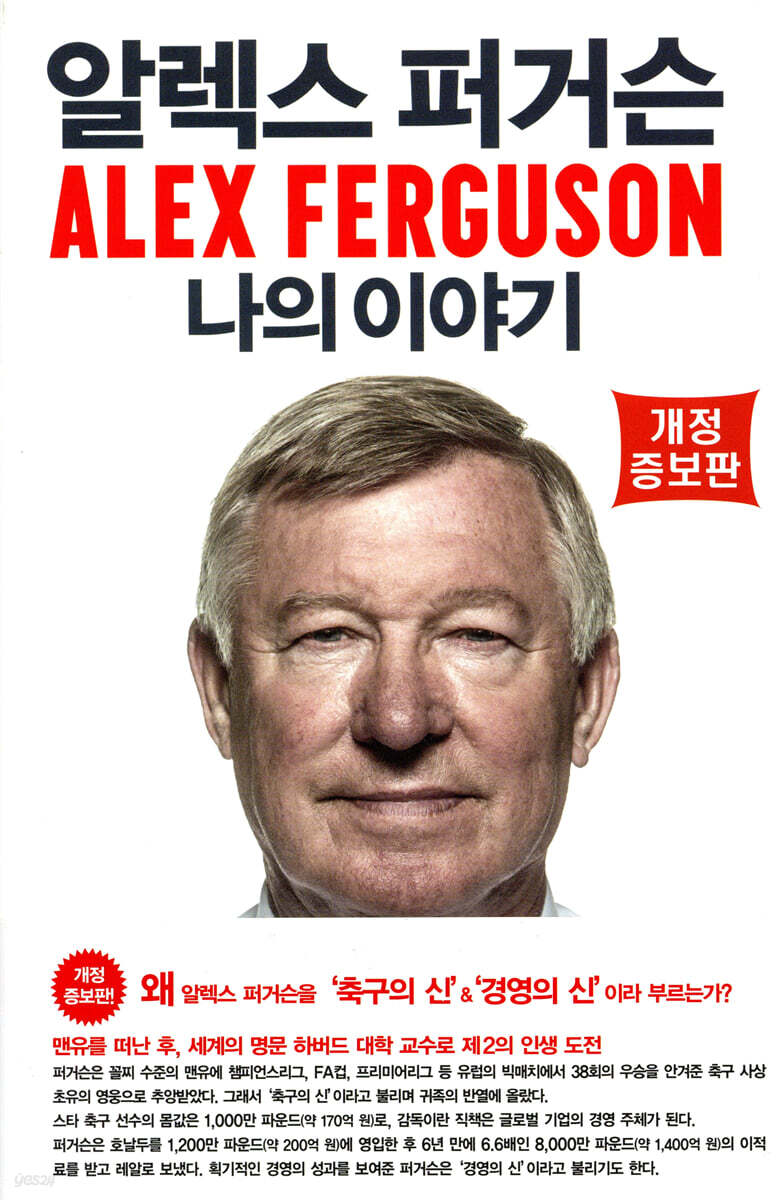 |
Description
Book Introduction
Alex Ferguson's second life begins as a Harvard University professor!
A revised and expanded edition of the autobiographical essays of Alex Ferguson, considered one of the greatest managers in English football history.
Born in Govan, Scotland in 1941, Alex Ferguson played football from a young age and became a manager in 1974, living as a football manager for approximately 40 years until his retirement in 2013. He is a living witness to the history of football.
Furthermore, he is remembered as a great manager by soccer fans not only in Europe but also around the world, as he led Aberdeen to victory in the 1982-83 European Cup Winners' Cup, and after moving to Manchester United in 1986, he led the club to 38 trophies, including one Club World Cup, two Champions League titles, 13 Premier League titles, and five FA Cups.
He told his story honestly and openly, without hiding a single thing.
Ferguson reflects on his life's journey, his journey as a manager and his 27 glorious years with Manchester United.
And this revised and expanded edition tells the story of Ferguson, who stepped down as Manchester United manager and took on a new challenge as a professor at Harvard University.
A revised and expanded edition of the autobiographical essays of Alex Ferguson, considered one of the greatest managers in English football history.
Born in Govan, Scotland in 1941, Alex Ferguson played football from a young age and became a manager in 1974, living as a football manager for approximately 40 years until his retirement in 2013. He is a living witness to the history of football.
Furthermore, he is remembered as a great manager by soccer fans not only in Europe but also around the world, as he led Aberdeen to victory in the 1982-83 European Cup Winners' Cup, and after moving to Manchester United in 1986, he led the club to 38 trophies, including one Club World Cup, two Champions League titles, 13 Premier League titles, and five FA Cups.
He told his story honestly and openly, without hiding a single thing.
Ferguson reflects on his life's journey, his journey as a manager and his 27 glorious years with Manchester United.
And this revised and expanded edition tells the story of Ferguson, who stepped down as Manchester United manager and took on a new challenge as a professor at Harvard University.
- You can preview some of the book's contents.
Preview
index
Alex Ferguson: My Story
preface
introduction
1.
recall
2.
Glasgow's roots
3.
Retirement U-turn
4.
A new beginning
5.
Beckham
6.
Rio
7.
difficult times
8.
Ronaldo
9.
Keen
10.
Interests outside of soccer
11.
Panistelloi
12.
Mourinho - A 'special' rival
13.
Competition with Wenger
14.
92nd generation
15.
Liverpool - Great Tradition
16.
World of Talent
17.
One night in Moscow
18.
psychological warfare
19.
Barcelona (2009-2011) - Small is Beautiful
20.
Media
21.
United's 19th title
22.
Man City - Champions
23.
family
24.
Rooney
25.
final season
26.
A new challenge as a Harvard professor
27.
Manchester United in transition
Career record
Search
preface
introduction
1.
recall
2.
Glasgow's roots
3.
Retirement U-turn
4.
A new beginning
5.
Beckham
6.
Rio
7.
difficult times
8.
Ronaldo
9.
Keen
10.
Interests outside of soccer
11.
Panistelloi
12.
Mourinho - A 'special' rival
13.
Competition with Wenger
14.
92nd generation
15.
Liverpool - Great Tradition
16.
World of Talent
17.
One night in Moscow
18.
psychological warfare
19.
Barcelona (2009-2011) - Small is Beautiful
20.
Media
21.
United's 19th title
22.
Man City - Champions
23.
family
24.
Rooney
25.
final season
26.
A new challenge as a Harvard professor
27.
Manchester United in transition
Career record
Search
Publisher's Review
Alex Ferguson: My Story
Alex Ferguson's second life begins as a Harvard University professor!
A revised and expanded edition of the autobiographical essays of Alex Ferguson, considered one of the greatest managers in British football history, has been published by Munhaksasang.
Born in Govan, Scotland in 1941, Alex Ferguson played football from a young age and became a manager in 1974, living as a football manager for approximately 40 years until his retirement in 2013. He is a living witness to the history of football.
Furthermore, he is remembered as a great manager by soccer fans not only in Europe but also around the world, as he led Aberdeen to victory in the 1982-83 European Cup Winners' Cup, and after moving to Manchester United in 1986, he led the club to 38 trophies, including one Club World Cup, two Champions League titles, 13 Premier League titles, and five FA Cups.
He told his story honestly and openly, without hiding a single thing.
Ferguson reflects on his life's journey, his journey as a manager and his 27 glorious years with Manchester United.
And this revised and expanded edition tells the story of Ferguson, who stepped down as Manchester United manager and took on a new challenge as a professor at Harvard University.
Ferguson's vision, energy, and leadership!
While Alex Ferguson's first essay, Managing My Life (published in 2000, published in Korea under the title Infinite Life Management in 2007), included his childhood and his managerial career up to Aberdeen, this book, My Story, focuses on the magical times he spent in Manchester.
He also spoke candidly about his conflicts with star players like Cristiano Ronaldo and David Beckham, and his rivalry with Arsene Wenger and Jose Mourinho.
One more thing, it also revealed in an interesting way Ferguson's hobbies, such as horse racing and reading, which were previously unknown.
Over the past 25 years, Manchester United has undergone tremendous change as it has grown into a global sporting power.
But one thing has remained constant: the quality of the squad and United's incredible performances, including their second Champions League title in 2008 and the Premier League title in 2013.
It was down to Alex Ferguson's vision and energy and his ability to build a team both on and off the pitch.
In this book, Ferguson reveals his vision, know-how, and perspectives with honesty and candidness, neither pretentious nor humble.
This book will be a must-read not only for soccer fans but also for those who aspire to become true leaders.
The reality of big football clubs and the bloody rivalry between players.
We call England the home of football.
It is no exaggeration to say that for British people, football is not just a sport, but a way of life, where they share joys and sorrows with the team they support.
In this book, Alex Ferguson reveals the reality of the Premier League in detail, and readers who vaguely thought of Manchester United, Liverpool, and Arsenal as large soccer clubs will be surprised by their enormity.
Players developed through youth teams are traded to other clubs for dozens of times their value, or players are brought in from other clubs, polished, and then transferred to yet another club... ... Through this process, clubs increase profits and improve quality.
For example, Cristiano Ronaldo, one of Sir Alex Ferguson's most highly regarded players, was brought in for £9 million and sold to Real Madrid for £80 million.
Not only Ronaldo, but the scouts, the manager and everyone at the club are on edge to scout outstanding players.
Alex Ferguson said: “One night I was watching a film called White Fang.
It is based on Jack London's book about a man who goes to the Klondike to find gold.
Scouting is probably similar.
Standing there watching a Saturday morning football match, you see George Best, Ryan Giggs or Bobby Charlton.
That's exactly how I felt that day in Lisbon.
He spoke of his excitement when he first saw Ronaldo, saying, “It was a revelation.”
Meanwhile, successful players are giving their all to keep their places at their clubs.
Because you never know when a better player will come along and take your spot.
The ironic fate is that even if a player plays a different position, if the manager's plan changes, he or she may lose his or her place and be released.
“It was a terrible thing to let go of such experienced and loyal players,” Ferguson confessed.
Beckham, Ronaldo, Roy Keane, and more: Overcoming conflict to become father figures
It would not be wrong to say that today's soccer players are not just athletes, but stars on par with entertainers.
Sir Alex Ferguson also revealed how he has dealt with the growing number of world-class stars within the team.
As a representative example, he honestly confessed his conflict with David Beckham and wrote in detail about his dissatisfaction at the time and his regrets towards Beckham.
Of course, he didn't forget to leave a message of support at the end while shaking off his old feelings.
He also goes into detail about the conflicts he experienced with each player, including Beckham, Ronaldo, Wayne Rooney, and Ryan Giggs, and tells the story of how he overcame them.
Sir Alex Ferguson made his thoughts clear as a manager:
“What I absolutely cannot tolerate is losing command.
Because command is the only thing that can save me.
As we can see in the case of David Beckham, the moment a single footballer starts trying to move the club, the team is finished.
True players like to be in control.
They like managers who are tough or can be tough when necessary.”
A great mentor to many players who played for Manchester United, including Park Ji-sung.
Manchester United is also famous for being the team where our eternal captain Park Ji-Sung played.
The welcome name Park Ji-sung is mentioned several times in this book, which gives us a glimpse into how hard Park Ji-sung worked as a player.
Sir Alex Ferguson said, “In the Milan team, Andrea Pirlo had a 75 percent pass success rate.
When we played against them, Park Ji-sung was assigned the role of chasing him and brought that figure down to 25 percent.” He also said, “Park Ji-sung was placed in Yaya Touré’s area and was assigned to cover him throughout the game.
“No one has done that better than Park Ji-sung,” he said, praising him.
In addition to Park Ji-sung, it also tells the stories of other top players we are familiar with, such as Ryan Giggs, Paul Scholes, the Neville brothers, Roy Keane, Van Nistelrooy, Wayne Rooney, and Rio Ferdinand.
Along with the players' strengths and weaknesses and trivial anecdotes.
Sir Alex Ferguson's outstanding leadership, which brought together players from around the world into one team, naturally comes out when talking about each player individually.
Ferguson cared for, encouraged, and sometimes strictly disciplined his players, and his leadership ultimately earned him the nickname of a master.
Sir Alex Ferguson said this about his beliefs as a manager.
“I have always protected my players.
That's my job.
That's why I can't apologize for the times I took their side, even when there were plenty of reasons to do otherwise.
(……) I can’t stand on the opposite side of the players.
Other than publicly rebuking them, I had to find another solution.
Of course, sometimes they were fined or punished, but the fact was never made known outside the dressing room.
If that happens, I will feel like I have betrayed one of the principles I have consistently maintained throughout my time as a director.
“It would mean more to protect the players from criticism from the outside world than simply blocking them.”
Listen to Alex Ferguson, who retired in 2013 to the applause of countless football fans, as he speaks candidly to fans around the world about his story.
As you read, you will probably picture Alex Ferguson watching the game while chewing gum on the Old Trafford ground, and you will feel the thrill of watching an exciting and thrilling soccer match.
Alex Ferguson's second life begins as a Harvard University professor!
A revised and expanded edition of the autobiographical essays of Alex Ferguson, considered one of the greatest managers in British football history, has been published by Munhaksasang.
Born in Govan, Scotland in 1941, Alex Ferguson played football from a young age and became a manager in 1974, living as a football manager for approximately 40 years until his retirement in 2013. He is a living witness to the history of football.
Furthermore, he is remembered as a great manager by soccer fans not only in Europe but also around the world, as he led Aberdeen to victory in the 1982-83 European Cup Winners' Cup, and after moving to Manchester United in 1986, he led the club to 38 trophies, including one Club World Cup, two Champions League titles, 13 Premier League titles, and five FA Cups.
He told his story honestly and openly, without hiding a single thing.
Ferguson reflects on his life's journey, his journey as a manager and his 27 glorious years with Manchester United.
And this revised and expanded edition tells the story of Ferguson, who stepped down as Manchester United manager and took on a new challenge as a professor at Harvard University.
Ferguson's vision, energy, and leadership!
While Alex Ferguson's first essay, Managing My Life (published in 2000, published in Korea under the title Infinite Life Management in 2007), included his childhood and his managerial career up to Aberdeen, this book, My Story, focuses on the magical times he spent in Manchester.
He also spoke candidly about his conflicts with star players like Cristiano Ronaldo and David Beckham, and his rivalry with Arsene Wenger and Jose Mourinho.
One more thing, it also revealed in an interesting way Ferguson's hobbies, such as horse racing and reading, which were previously unknown.
Over the past 25 years, Manchester United has undergone tremendous change as it has grown into a global sporting power.
But one thing has remained constant: the quality of the squad and United's incredible performances, including their second Champions League title in 2008 and the Premier League title in 2013.
It was down to Alex Ferguson's vision and energy and his ability to build a team both on and off the pitch.
In this book, Ferguson reveals his vision, know-how, and perspectives with honesty and candidness, neither pretentious nor humble.
This book will be a must-read not only for soccer fans but also for those who aspire to become true leaders.
The reality of big football clubs and the bloody rivalry between players.
We call England the home of football.
It is no exaggeration to say that for British people, football is not just a sport, but a way of life, where they share joys and sorrows with the team they support.
In this book, Alex Ferguson reveals the reality of the Premier League in detail, and readers who vaguely thought of Manchester United, Liverpool, and Arsenal as large soccer clubs will be surprised by their enormity.
Players developed through youth teams are traded to other clubs for dozens of times their value, or players are brought in from other clubs, polished, and then transferred to yet another club... ... Through this process, clubs increase profits and improve quality.
For example, Cristiano Ronaldo, one of Sir Alex Ferguson's most highly regarded players, was brought in for £9 million and sold to Real Madrid for £80 million.
Not only Ronaldo, but the scouts, the manager and everyone at the club are on edge to scout outstanding players.
Alex Ferguson said: “One night I was watching a film called White Fang.
It is based on Jack London's book about a man who goes to the Klondike to find gold.
Scouting is probably similar.
Standing there watching a Saturday morning football match, you see George Best, Ryan Giggs or Bobby Charlton.
That's exactly how I felt that day in Lisbon.
He spoke of his excitement when he first saw Ronaldo, saying, “It was a revelation.”
Meanwhile, successful players are giving their all to keep their places at their clubs.
Because you never know when a better player will come along and take your spot.
The ironic fate is that even if a player plays a different position, if the manager's plan changes, he or she may lose his or her place and be released.
“It was a terrible thing to let go of such experienced and loyal players,” Ferguson confessed.
Beckham, Ronaldo, Roy Keane, and more: Overcoming conflict to become father figures
It would not be wrong to say that today's soccer players are not just athletes, but stars on par with entertainers.
Sir Alex Ferguson also revealed how he has dealt with the growing number of world-class stars within the team.
As a representative example, he honestly confessed his conflict with David Beckham and wrote in detail about his dissatisfaction at the time and his regrets towards Beckham.
Of course, he didn't forget to leave a message of support at the end while shaking off his old feelings.
He also goes into detail about the conflicts he experienced with each player, including Beckham, Ronaldo, Wayne Rooney, and Ryan Giggs, and tells the story of how he overcame them.
Sir Alex Ferguson made his thoughts clear as a manager:
“What I absolutely cannot tolerate is losing command.
Because command is the only thing that can save me.
As we can see in the case of David Beckham, the moment a single footballer starts trying to move the club, the team is finished.
True players like to be in control.
They like managers who are tough or can be tough when necessary.”
A great mentor to many players who played for Manchester United, including Park Ji-sung.
Manchester United is also famous for being the team where our eternal captain Park Ji-Sung played.
The welcome name Park Ji-sung is mentioned several times in this book, which gives us a glimpse into how hard Park Ji-sung worked as a player.
Sir Alex Ferguson said, “In the Milan team, Andrea Pirlo had a 75 percent pass success rate.
When we played against them, Park Ji-sung was assigned the role of chasing him and brought that figure down to 25 percent.” He also said, “Park Ji-sung was placed in Yaya Touré’s area and was assigned to cover him throughout the game.
“No one has done that better than Park Ji-sung,” he said, praising him.
In addition to Park Ji-sung, it also tells the stories of other top players we are familiar with, such as Ryan Giggs, Paul Scholes, the Neville brothers, Roy Keane, Van Nistelrooy, Wayne Rooney, and Rio Ferdinand.
Along with the players' strengths and weaknesses and trivial anecdotes.
Sir Alex Ferguson's outstanding leadership, which brought together players from around the world into one team, naturally comes out when talking about each player individually.
Ferguson cared for, encouraged, and sometimes strictly disciplined his players, and his leadership ultimately earned him the nickname of a master.
Sir Alex Ferguson said this about his beliefs as a manager.
“I have always protected my players.
That's my job.
That's why I can't apologize for the times I took their side, even when there were plenty of reasons to do otherwise.
(……) I can’t stand on the opposite side of the players.
Other than publicly rebuking them, I had to find another solution.
Of course, sometimes they were fined or punished, but the fact was never made known outside the dressing room.
If that happens, I will feel like I have betrayed one of the principles I have consistently maintained throughout my time as a director.
“It would mean more to protect the players from criticism from the outside world than simply blocking them.”
Listen to Alex Ferguson, who retired in 2013 to the applause of countless football fans, as he speaks candidly to fans around the world about his story.
As you read, you will probably picture Alex Ferguson watching the game while chewing gum on the Old Trafford ground, and you will feel the thrill of watching an exciting and thrilling soccer match.
GOODS SPECIFICS
- Date of publication: June 13, 2014
- Format: Hardcover book binding method guide
- Page count, weight, size: 484 pages | 933g | 152*233*35mm
- ISBN13: 9788970129044
- ISBN10: 8970129049
You may also like
카테고리
korean


korean

![GQ KOREA Mark (Monthly): December [2025]](http://librairie.coreenne.fr/cdn/shop/files/8ef265dbbfbf186523ed75ba7319009d.jpg?v=1765340328&width=3840)


