

Dasan's sentences
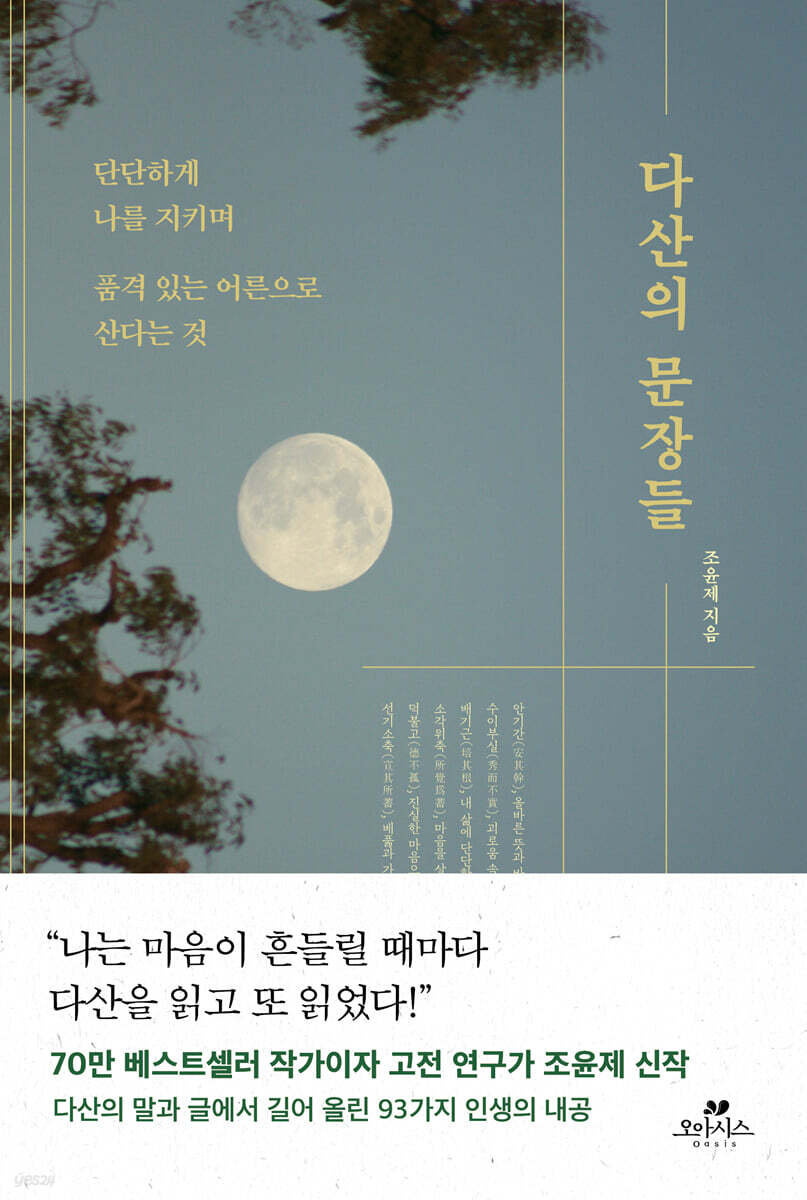 |
Description
Book Introduction
- A word from MD
-
The essence of Dasan's sentencesDasan Jeong Yak-yong, the most prolific writer in Korean history.
Thanks to writing a lot, there are many great sentences.
A new work by author Jo Yoon-je, who has been showcasing the charm of Dasan’s writing style.
Even now, we have selected Dasan's wonderful sentences and explained the meaning of the original text.
Son Min-gyu, humanities producer
Learn life wisdom and the true dignity of an adult from Joseon's greatest intellectual giant!
Carefully selected by classic researcher Jo Yoon-je
93 Proverbs of Fertility Reinterpreted in Today's Language
Jo Yoon-je, a bestselling author with 700,000 copies sold and Korea's leading classical scholar, has been studying Dasan's life for a long time, extracting only the essence of the wisdom he imparted and reinterpreting it in today's language.
Even in the midst of the pain of 18 years of exile, which began in his forties, Dasan Jeong Yak-yong's passion for life and learning did not waver. Instead, he boldly fulfilled his calling by writing the 500-volume "Yeoyudangjeonseo" with only brush and ink.
Let's look at 93 life wisdoms about learning, hardship, life, reflection, relationships, and the world, gleaned from Dasan's writings, including 'Jachanmyojimyeong', 'Yeoyudanggi', 'Dosansa Sukrok', and 'Letters to Two Sons and Disciples'.
Not only can we apply these sparkling insights to our lives, we also learn what it means to live a truly dignified adult life.
Even after 200 years, Dasan's words, which have survived without being buried, will soothe our hearts that waver even in trivial matters and provide clear answers to all the worries we face in life.
Carefully selected by classic researcher Jo Yoon-je
93 Proverbs of Fertility Reinterpreted in Today's Language
Jo Yoon-je, a bestselling author with 700,000 copies sold and Korea's leading classical scholar, has been studying Dasan's life for a long time, extracting only the essence of the wisdom he imparted and reinterpreting it in today's language.
Even in the midst of the pain of 18 years of exile, which began in his forties, Dasan Jeong Yak-yong's passion for life and learning did not waver. Instead, he boldly fulfilled his calling by writing the 500-volume "Yeoyudangjeonseo" with only brush and ink.
Let's look at 93 life wisdoms about learning, hardship, life, reflection, relationships, and the world, gleaned from Dasan's writings, including 'Jachanmyojimyeong', 'Yeoyudanggi', 'Dosansa Sukrok', and 'Letters to Two Sons and Disciples'.
Not only can we apply these sparkling insights to our lives, we also learn what it means to live a truly dignified adult life.
Even after 200 years, Dasan's words, which have survived without being buried, will soothe our hearts that waver even in trivial matters and provide clear answers to all the worries we face in life.
- You can preview some of the book's contents.
Preview
index
Preface: Living a Life Without Losing Myself
Chapter 1.
[On Learning]
Angigan (安其幹), fill it with the right intention and right mind and write it.
Walking the right path without compromising | A great awakening taught by an old woman in an inn | Ruins become a space for reflection | Authority does not always mean right | Learning does not happen in an instant | If you do not quit, you can carve patterns even on stone | Do not retreat from learning | How can one remain in evil after being taught? | Those who know their own shortcomings have no time to compare themselves with others | Do not teach carelessly, even if you are right | Do not be fooled by superficial teachings | What is the essence of learning? | A heart that truly loves learning | Reading is a duty that must be performed by humans | The fragrance of books and writing is deeper and stronger than the fragrance of orchids | Only those who reflect and correct themselves grow | Who is qualified to take on great tasks? | If your heart is right, you will naturally kneel | A study method that makes knowledge 'mine' | Is learning more important than your parents' hunger? | Standing still like a great mountain
Chapter 2.
[On Suffering]
Showing off but not being effective, staying in pain and sticking to one's own path
Even the suffering of a serious illness cannot stop me | To lose one's mind is to lose oneself | Humiliation is not a cause for worry, suffering from humiliation is worry | How to bide one's time like a nobleman | One's abilities are revealed only when one reaches a dead end | The shadow of a chrysanthemum reflected in a candlelight | Twenty or so poems acquired after three days of idleness | Overcoming suffering is not the only way to overcome suffering | Who created sorrow? | Two books on life that helped me overcome difficult times together | A gentleman only diligently does good deeds | Discovering the essence of life in the difficulty of writing poetry | Even after the lonely autumn wind, the winter cold blows | What animals do not have, but humans have
Chapter 3.
[On Life]
Baegi-geun (培其根), putting down firm roots in my life
Meaning is something you know without even saying it | Dasan's two attitudes toward life | Why you must stay in Seoul | Where is the joy of life? | If you don't have money, dig a pond and raise fish | Those who build fortune and those who seek fortune | If you have the center, isn't it China wherever you go? | A person without a nickname | Five ways to live life | You won't necessarily get it if you pursue wealth | Why do you make noise? | Everything will inevitably return when it reaches its peak | If you want to change your impression, be rectified in your conduct | What is the difference between a general who wins on the battlefield? | Those who chase deer cannot see Mount Tai | Are you living up to your name? | Don't become lazy and lose your roots | Diligence and frugality are the conduct of a gentleman
Chapter 4.
[On Reflection]
By examining the mind and accumulating enlightenment, I grow.
Reflecting on myself at Sa-ui-jae (四宜齋) | Writing my own epitaph at the age of sixty | Isn't this something I will be ashamed of for a long time? | Reflecting on my greed obsessed with writing | Be self-restrained with caution and fear | It is my fault that I cannot correct my mistakes | There is nothing in the world easier to lose than 'myself' | An honest confession about my shortcomings | Am I a being appropriate for my age? | Following goodness is as difficult as climbing a mountain | Like a child crying because a single chestnut has been taken away | The many ailments in our hearts | There are ten thousand times more things to regret than my older brother
Chapter 5.
[About Relationships]
Virtue is not alone, be sincere in your relationships and treat them wisely.
Deep love is conveyed without words | Harmony but not assimilation | Excessive compliments are not true friendship | Say what needs to be said | Friends made with virtue do not easily drift away | Are you gaining favor or are you building respect? | It is difficult to persuade people even if you spend all your gold | Gentle feelings lead to gentle relationships | Never get close
A person you shouldn't be with | Even a well-made pottery vessel becomes useless with a single small hole | What's more important than pointing out others' mistakes | Be on the same page as others | What kind of person do you want to be with?
Chapter 6.
[About the World]
Proclaiming and saving what is in store for others, benefiting people widely through giving and teaching.
Rulers who do evil to the world | Buyongdang is better for observing people | On the inferior mental state of noble children | The dignity of a nation is revealed in the words and writings of its people | The distinction between China and barbarians | The reason it is called 'Mokminsimseo' | Virtue bought with wealth lasts for eternity | How is it that heaven gives talented people this way? | A nation's leader shares the joys and sorrows of the people | What is the legacy that should be passed on to children? | Bad types of people who secretly ruin society | Swindlers who misuse what they have learned | What is true good deed? | How to secretly hide wealth
Chapter 1.
[On Learning]
Angigan (安其幹), fill it with the right intention and right mind and write it.
Walking the right path without compromising | A great awakening taught by an old woman in an inn | Ruins become a space for reflection | Authority does not always mean right | Learning does not happen in an instant | If you do not quit, you can carve patterns even on stone | Do not retreat from learning | How can one remain in evil after being taught? | Those who know their own shortcomings have no time to compare themselves with others | Do not teach carelessly, even if you are right | Do not be fooled by superficial teachings | What is the essence of learning? | A heart that truly loves learning | Reading is a duty that must be performed by humans | The fragrance of books and writing is deeper and stronger than the fragrance of orchids | Only those who reflect and correct themselves grow | Who is qualified to take on great tasks? | If your heart is right, you will naturally kneel | A study method that makes knowledge 'mine' | Is learning more important than your parents' hunger? | Standing still like a great mountain
Chapter 2.
[On Suffering]
Showing off but not being effective, staying in pain and sticking to one's own path
Even the suffering of a serious illness cannot stop me | To lose one's mind is to lose oneself | Humiliation is not a cause for worry, suffering from humiliation is worry | How to bide one's time like a nobleman | One's abilities are revealed only when one reaches a dead end | The shadow of a chrysanthemum reflected in a candlelight | Twenty or so poems acquired after three days of idleness | Overcoming suffering is not the only way to overcome suffering | Who created sorrow? | Two books on life that helped me overcome difficult times together | A gentleman only diligently does good deeds | Discovering the essence of life in the difficulty of writing poetry | Even after the lonely autumn wind, the winter cold blows | What animals do not have, but humans have
Chapter 3.
[On Life]
Baegi-geun (培其根), putting down firm roots in my life
Meaning is something you know without even saying it | Dasan's two attitudes toward life | Why you must stay in Seoul | Where is the joy of life? | If you don't have money, dig a pond and raise fish | Those who build fortune and those who seek fortune | If you have the center, isn't it China wherever you go? | A person without a nickname | Five ways to live life | You won't necessarily get it if you pursue wealth | Why do you make noise? | Everything will inevitably return when it reaches its peak | If you want to change your impression, be rectified in your conduct | What is the difference between a general who wins on the battlefield? | Those who chase deer cannot see Mount Tai | Are you living up to your name? | Don't become lazy and lose your roots | Diligence and frugality are the conduct of a gentleman
Chapter 4.
[On Reflection]
By examining the mind and accumulating enlightenment, I grow.
Reflecting on myself at Sa-ui-jae (四宜齋) | Writing my own epitaph at the age of sixty | Isn't this something I will be ashamed of for a long time? | Reflecting on my greed obsessed with writing | Be self-restrained with caution and fear | It is my fault that I cannot correct my mistakes | There is nothing in the world easier to lose than 'myself' | An honest confession about my shortcomings | Am I a being appropriate for my age? | Following goodness is as difficult as climbing a mountain | Like a child crying because a single chestnut has been taken away | The many ailments in our hearts | There are ten thousand times more things to regret than my older brother
Chapter 5.
[About Relationships]
Virtue is not alone, be sincere in your relationships and treat them wisely.
Deep love is conveyed without words | Harmony but not assimilation | Excessive compliments are not true friendship | Say what needs to be said | Friends made with virtue do not easily drift away | Are you gaining favor or are you building respect? | It is difficult to persuade people even if you spend all your gold | Gentle feelings lead to gentle relationships | Never get close
A person you shouldn't be with | Even a well-made pottery vessel becomes useless with a single small hole | What's more important than pointing out others' mistakes | Be on the same page as others | What kind of person do you want to be with?
Chapter 6.
[About the World]
Proclaiming and saving what is in store for others, benefiting people widely through giving and teaching.
Rulers who do evil to the world | Buyongdang is better for observing people | On the inferior mental state of noble children | The dignity of a nation is revealed in the words and writings of its people | The distinction between China and barbarians | The reason it is called 'Mokminsimseo' | Virtue bought with wealth lasts for eternity | How is it that heaven gives talented people this way? | A nation's leader shares the joys and sorrows of the people | What is the legacy that should be passed on to children? | Bad types of people who secretly ruin society | Swindlers who misuse what they have learned | What is true good deed? | How to secretly hide wealth
Detailed image

Into the book
Dasan did not create or fabricate writing, but wrote in a way that naturally expressed what was inside him.
A person who writes like this can, with his or her wealth of knowledge and experience, discuss the principles of living in the world, suggest the right path, pour out his or her emotions for the beautiful things of the world and his or her anger at the world's injustices, and write famous sentences that move people's hearts like water pouring from an inexhaustible spring.
Mencius defined an adult as follows:
“An adult is someone who sets all things right by setting himself right.” A person who does not set himself right but demands things from others, a person who usually acts well but becomes cowardly when faced with difficulties, a person who has social status and fame but is broken and worn out on the inside is not a true adult.
An adult is someone who first sets himself upright and then leads everything around him to set things up right.
Even without saying anything, people can sense the true dignity of an adult by looking at his life and writing.
--- From the "Preface"
King Jeongjo jokingly tested Dasan by asking him to "lecture on another chapter," but Dasan completed his lecture without any errors.
King Jeongjo must have admired Dasan's uncompromising old-fashionedness and been amazed by his academic talent.
What is revealed through this anecdote is the strictness of Dasan's scholarship towards himself.
He didn't fool anyone, but he tried not to fool himself.
If you don't compromise and go the right way, it may seem late, but it can be the fastest way.
The highest level of honesty is being honest with yourself.
--- 「Chapter 1.
From “Angigan (安其幹), fill it with the right intention and right mind and write it”
He wrote to fulfill his calling in the worst of circumstances.
I sat there silently, absorbed in writing, until my peach pit was punctured three times.
This is the idiom ‘piercing the bone three times’.
The reason his writing was able to deepen during his years of exile was because he used even his failing body as an opportunity for study and cultivation.
Even the hardships of a serious illness could not stop him.
Rather, it became the strength to hold on to one's heart and protect oneself to the end.
--- Chapter 2.
From “Showing off but not being real, staying in suffering and protecting one’s own path”
“If one wears proper clothing, has solemn eyes, and has a dignified demeanor like someone molded from clay, then you will know that his intention is in the study of the Way.
If he holds a book in his left hand and a brush in his right, and is reciting with all his might, you will know that his intention is in the sentences. If he is planting flowers or trees and walking around leisurely, you will know that his intention is in the countryside.”
--- 「Chapter 3.
From "Baegi-geun (培其根), putting down firm roots in my life"
And at some point in life, there comes a time when you have to start over completely.
Dasan wrote his own epitaph at the age of sixty, using that time as a starting point for a new life.
Looking back on my life, I decided for myself what kind of person I want to be remembered as in the future.
The trigger will be different for each person.
But if you look back at yourself and renew yourself at the most desperate and desperate moment in life, you have already taken a step forward.
Dasan called the twenty years he spent preparing for the exam and praising success "a time I lost."
We too may be satisfied with living a fiercely competitive life and working hard, but we may actually be losing ourselves.
No matter how successful or famous you are, if you lose yourself, your life is meaningless.
--- 「Chapter 4.
From “Incineration of the mind, accumulation of enlightenment, growth of self through examining the mind and accumulation of enlightenment”
Shin Jae-jung was a prominent scholar of his time who passed the civil service examination but did not pursue a government post and instead devoted himself to his studies.
In his later years, Dasan and he had several heated debates over academic differences.
But Dasan's attitude was always the same.
By first acknowledging the other person's knowledge and humbling himself, he prevented the academic discussion from devolving into an emotional conflict.
He showed the essence of a dignified debate that respects the other party without compromising his own opinion.
But in the end, he did not give up his argument.
It is cowardly to give up my claims because of pressure from power.
It is petty not to give up because of pride.
When I don't bend my subjectivity until the end, the other person actually acknowledges me.
--- Chapter 5.
From “Virtue is not lonely, associate with sincerity and treat with wisdom”
Dasan points this out precisely.
He criticizes those who unconditionally side with those who share the same views and attack those who disagree, preventing even discussion, and those who use academics, which were established to benefit the world, as a tool to corrupt the world.
How am I using what I've learned, and how should I use it? This is what Dasan asks us.
A person who writes like this can, with his or her wealth of knowledge and experience, discuss the principles of living in the world, suggest the right path, pour out his or her emotions for the beautiful things of the world and his or her anger at the world's injustices, and write famous sentences that move people's hearts like water pouring from an inexhaustible spring.
Mencius defined an adult as follows:
“An adult is someone who sets all things right by setting himself right.” A person who does not set himself right but demands things from others, a person who usually acts well but becomes cowardly when faced with difficulties, a person who has social status and fame but is broken and worn out on the inside is not a true adult.
An adult is someone who first sets himself upright and then leads everything around him to set things up right.
Even without saying anything, people can sense the true dignity of an adult by looking at his life and writing.
--- From the "Preface"
King Jeongjo jokingly tested Dasan by asking him to "lecture on another chapter," but Dasan completed his lecture without any errors.
King Jeongjo must have admired Dasan's uncompromising old-fashionedness and been amazed by his academic talent.
What is revealed through this anecdote is the strictness of Dasan's scholarship towards himself.
He didn't fool anyone, but he tried not to fool himself.
If you don't compromise and go the right way, it may seem late, but it can be the fastest way.
The highest level of honesty is being honest with yourself.
--- 「Chapter 1.
From “Angigan (安其幹), fill it with the right intention and right mind and write it”
He wrote to fulfill his calling in the worst of circumstances.
I sat there silently, absorbed in writing, until my peach pit was punctured three times.
This is the idiom ‘piercing the bone three times’.
The reason his writing was able to deepen during his years of exile was because he used even his failing body as an opportunity for study and cultivation.
Even the hardships of a serious illness could not stop him.
Rather, it became the strength to hold on to one's heart and protect oneself to the end.
--- Chapter 2.
From “Showing off but not being real, staying in suffering and protecting one’s own path”
“If one wears proper clothing, has solemn eyes, and has a dignified demeanor like someone molded from clay, then you will know that his intention is in the study of the Way.
If he holds a book in his left hand and a brush in his right, and is reciting with all his might, you will know that his intention is in the sentences. If he is planting flowers or trees and walking around leisurely, you will know that his intention is in the countryside.”
--- 「Chapter 3.
From "Baegi-geun (培其根), putting down firm roots in my life"
And at some point in life, there comes a time when you have to start over completely.
Dasan wrote his own epitaph at the age of sixty, using that time as a starting point for a new life.
Looking back on my life, I decided for myself what kind of person I want to be remembered as in the future.
The trigger will be different for each person.
But if you look back at yourself and renew yourself at the most desperate and desperate moment in life, you have already taken a step forward.
Dasan called the twenty years he spent preparing for the exam and praising success "a time I lost."
We too may be satisfied with living a fiercely competitive life and working hard, but we may actually be losing ourselves.
No matter how successful or famous you are, if you lose yourself, your life is meaningless.
--- 「Chapter 4.
From “Incineration of the mind, accumulation of enlightenment, growth of self through examining the mind and accumulation of enlightenment”
Shin Jae-jung was a prominent scholar of his time who passed the civil service examination but did not pursue a government post and instead devoted himself to his studies.
In his later years, Dasan and he had several heated debates over academic differences.
But Dasan's attitude was always the same.
By first acknowledging the other person's knowledge and humbling himself, he prevented the academic discussion from devolving into an emotional conflict.
He showed the essence of a dignified debate that respects the other party without compromising his own opinion.
But in the end, he did not give up his argument.
It is cowardly to give up my claims because of pressure from power.
It is petty not to give up because of pride.
When I don't bend my subjectivity until the end, the other person actually acknowledges me.
--- Chapter 5.
From “Virtue is not lonely, associate with sincerity and treat with wisdom”
Dasan points this out precisely.
He criticizes those who unconditionally side with those who share the same views and attack those who disagree, preventing even discussion, and those who use academics, which were established to benefit the world, as a tool to corrupt the world.
How am I using what I've learned, and how should I use it? This is what Dasan asks us.
--- Chapter 6.
From “Proclaiming and Saving What You Have, Benefiting People Widely Through Giving and Teaching”
From “Proclaiming and Saving What You Have, Benefiting People Widely Through Giving and Teaching”
Publisher's Review
“Every time my heart wavered, I read and reread Dasan!”
To the countless questions we face in life
93 Wisdoms from Dasan
A lonely man sitting in a room rented from a poor old woman in a remote and barren land on the southern coast.
Dasan Jeong Yak-yong, who had been at the pinnacle of power and enjoyed King Jeongjo's favor until recently, is now facing 18 years of exile.
However, Dasan transformed the despair of life and death into a moment of amazing recovery and began to boldly fulfill his calling.
“There are few who understand, and many who criticize.
If heaven does not approve,
“You can burn all my books with that torch.” _〈Self-praised Epitaph〉
As we go through life, we all face life's challenges.
"Why is my heart so empty?", "How did my life come to this?", "When will this suffering end?" Dasan also faced these questions, and he quietly walked his own path, leaving behind over 500 works written only with ink and brush.
《Dasan's Sentences》 provides answers to all the worries we face in life, and offers advice that can serve as a strong support when we doubt whether we are on the right path.
Author Jo Yoon-je, Korea's leading classical scholar and the author of the "Dasan's Last" series that touched the hearts of 700,000 readers, has extracted only the essence of wisdom from Dasan's own words and writings, reinterpreted them in today's language, and written them in an easily understandable way.
And the author's unique insights from Dasan's sentences are divided into six chapters on learning, hardship, life, reflection, relationships, and the world.
Each chapter contains instructions on how to fill and write with the right intention and right mind, how to stay in suffering and keep your own path, how to plant firm roots in your life, how to grow yourself by examining your heart and accumulating enlightenment, how to associate with a sincere heart and treat others wisely, and how to widely benefit others through giving and teaching.
‘Self-praised epitaph’, ‘Yeoyu Danggi’, ‘Letters to two sons and disciples’, etc.
The inner strength of life gained from Dasan's words and writings
“Banhakjeong is a quiet and secluded place perfect for reading and writing poetry.
“After cleaning and sweeping today, I plan to move the bed and blanket.” _〈Banhakjeonggi〉
Banhakjeong was an old abandoned pavilion with an ominous rumor going around that it was haunted by ghosts.
But Dasan said this.
“Ghosts are only called by people. If there are no ghosts in my heart, how can they come of their own accord?” He maintained inner peace, unshaken by worldly fears and empty rumors, and transformed the ruins into a space for contemplation.
“It is sad that others look down on me and think of me as a mean person in the world,
You are now looking down on yourselves and thinking of yourselves as mean.
This is creating your own sorrow.” _〈A Prayer to Two Sons〉
Even though the family was ruined and everyone was scattered, Dasan calmly and steadfastly told his two sons to focus on their studies.
In this passage, he poses the question to us: 'Who created sorrow?'
It is not sad as long as you do not despise and degrade yourself.
These were the words he left for his beloved children.
This book is full of life-piercing insights and teachings extracted from Dasan's writings, such as 'Self-praised Epitaph', 'Yeoyu Danggi', 'Dosan Sasukrok', and 'Letters to Two Sons and Disciples'.
His writing is imbued with the spirit of not backing down even in the face of authority, reflecting on his own shortcomings, and striving to move forward while fiercely contemplating not to lose himself until the very end.
“It will help you straighten out your life and move forward.
You will be able to encounter writings like bamboo rain!”
Dasan dreamed of growing up himself, helping those around him grow together, and making the world a better place.
Even in the midst of setbacks, he found a new path and fulfilled his calling, and he showed the true character of an adult who does not give up his will and determination in the face of any difficulty.
His unwavering path through life, discussing reason with his knowledge and experience, suggesting the right path, being moved by the beauty of the world, and venting his anger at injustice, still resonates with countless people today, 200 years later.
The author said that he was able to calm his wavering heart through Dasan's words at every turning point in his life.
From the way he devoted himself to writing to the point of having three holes in his peach pit, I was able to realize the path to fulfilling his calling, and from his uncompromising attitude toward learning, I was able to realize what true self-esteem is.
No matter which page you open in the book, there is not a single sentence that should be discarded, and it permeates our lives.
And some sentences become strong pillars that support life.
For those of you who are weary of life and lost on the path of life, this book will act like a guiding light, rectifying your mind and allowing you to move forward into the world without wavering.
To the countless questions we face in life
93 Wisdoms from Dasan
A lonely man sitting in a room rented from a poor old woman in a remote and barren land on the southern coast.
Dasan Jeong Yak-yong, who had been at the pinnacle of power and enjoyed King Jeongjo's favor until recently, is now facing 18 years of exile.
However, Dasan transformed the despair of life and death into a moment of amazing recovery and began to boldly fulfill his calling.
“There are few who understand, and many who criticize.
If heaven does not approve,
“You can burn all my books with that torch.” _〈Self-praised Epitaph〉
As we go through life, we all face life's challenges.
"Why is my heart so empty?", "How did my life come to this?", "When will this suffering end?" Dasan also faced these questions, and he quietly walked his own path, leaving behind over 500 works written only with ink and brush.
《Dasan's Sentences》 provides answers to all the worries we face in life, and offers advice that can serve as a strong support when we doubt whether we are on the right path.
Author Jo Yoon-je, Korea's leading classical scholar and the author of the "Dasan's Last" series that touched the hearts of 700,000 readers, has extracted only the essence of wisdom from Dasan's own words and writings, reinterpreted them in today's language, and written them in an easily understandable way.
And the author's unique insights from Dasan's sentences are divided into six chapters on learning, hardship, life, reflection, relationships, and the world.
Each chapter contains instructions on how to fill and write with the right intention and right mind, how to stay in suffering and keep your own path, how to plant firm roots in your life, how to grow yourself by examining your heart and accumulating enlightenment, how to associate with a sincere heart and treat others wisely, and how to widely benefit others through giving and teaching.
‘Self-praised epitaph’, ‘Yeoyu Danggi’, ‘Letters to two sons and disciples’, etc.
The inner strength of life gained from Dasan's words and writings
“Banhakjeong is a quiet and secluded place perfect for reading and writing poetry.
“After cleaning and sweeping today, I plan to move the bed and blanket.” _〈Banhakjeonggi〉
Banhakjeong was an old abandoned pavilion with an ominous rumor going around that it was haunted by ghosts.
But Dasan said this.
“Ghosts are only called by people. If there are no ghosts in my heart, how can they come of their own accord?” He maintained inner peace, unshaken by worldly fears and empty rumors, and transformed the ruins into a space for contemplation.
“It is sad that others look down on me and think of me as a mean person in the world,
You are now looking down on yourselves and thinking of yourselves as mean.
This is creating your own sorrow.” _〈A Prayer to Two Sons〉
Even though the family was ruined and everyone was scattered, Dasan calmly and steadfastly told his two sons to focus on their studies.
In this passage, he poses the question to us: 'Who created sorrow?'
It is not sad as long as you do not despise and degrade yourself.
These were the words he left for his beloved children.
This book is full of life-piercing insights and teachings extracted from Dasan's writings, such as 'Self-praised Epitaph', 'Yeoyu Danggi', 'Dosan Sasukrok', and 'Letters to Two Sons and Disciples'.
His writing is imbued with the spirit of not backing down even in the face of authority, reflecting on his own shortcomings, and striving to move forward while fiercely contemplating not to lose himself until the very end.
“It will help you straighten out your life and move forward.
You will be able to encounter writings like bamboo rain!”
Dasan dreamed of growing up himself, helping those around him grow together, and making the world a better place.
Even in the midst of setbacks, he found a new path and fulfilled his calling, and he showed the true character of an adult who does not give up his will and determination in the face of any difficulty.
His unwavering path through life, discussing reason with his knowledge and experience, suggesting the right path, being moved by the beauty of the world, and venting his anger at injustice, still resonates with countless people today, 200 years later.
The author said that he was able to calm his wavering heart through Dasan's words at every turning point in his life.
From the way he devoted himself to writing to the point of having three holes in his peach pit, I was able to realize the path to fulfilling his calling, and from his uncompromising attitude toward learning, I was able to realize what true self-esteem is.
No matter which page you open in the book, there is not a single sentence that should be discarded, and it permeates our lives.
And some sentences become strong pillars that support life.
For those of you who are weary of life and lost on the path of life, this book will act like a guiding light, rectifying your mind and allowing you to move forward into the world without wavering.
GOODS SPECIFICS
- Date of issue: September 22, 2025
- Page count, weight, size: 280 pages | 464g | 148*220*17mm
- ISBN13: 9791168273252
- ISBN10: 1168273250
You may also like
카테고리
korean


korean

![ELLE 엘르 스페셜 에디션 A형 : 12월 [2025]](http://librairie.coreenne.fr/cdn/shop/files/b8e27a3de6c9538896439686c6b0e8fb.jpg?v=1766436872&width=3840)


