

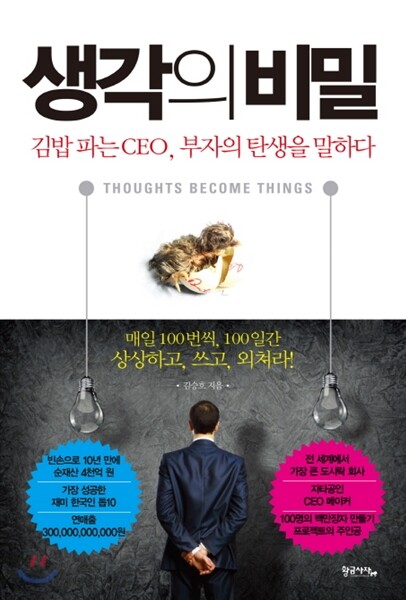
The Secret of Thought
 |
Description
Book Introduction
The CEO of a Kimbap Seller Creates the World's No. 1 Lunchbox Company
This book contains the dramatic success story of super-rich Seungho Kim, who started from nothing and ran a global food company with annual sales of 300 billion won and the world's largest lunchbox company in less than 10 years.
He has been attracting attention from both domestic and international media by launching restaurants with the world's first grab-and-go business model in Seoul, New York, and other places, and also becoming the largest shareholder of a domestic listed company.
This book movingly depicts the author's thoughts and the secrets of his imagination as he works with 4,000 employees across 1,215 stores in 11 countries to create a "company where everyone is happy."
Kim Seung-ho, the protagonist of the column "26 Life Wisdoms from a Father to His Son," which resonated with millions of readers in 2002.
In his previous work, [CEO Who Sells Kimbap], he won the sympathy of numerous readers by telling a dramatic story of his life's reversal, starting from nothing and building a 70 billion won company.
The story of Seungho Kim, who is considered to be the "first Korean to break into the American mainland food market," is full of anecdotes that cannot be found in other success stories.
This book contains the dramatic success story of super-rich Seungho Kim, who started from nothing and ran a global food company with annual sales of 300 billion won and the world's largest lunchbox company in less than 10 years.
He has been attracting attention from both domestic and international media by launching restaurants with the world's first grab-and-go business model in Seoul, New York, and other places, and also becoming the largest shareholder of a domestic listed company.
This book movingly depicts the author's thoughts and the secrets of his imagination as he works with 4,000 employees across 1,215 stores in 11 countries to create a "company where everyone is happy."
Kim Seung-ho, the protagonist of the column "26 Life Wisdoms from a Father to His Son," which resonated with millions of readers in 2002.
In his previous work, [CEO Who Sells Kimbap], he won the sympathy of numerous readers by telling a dramatic story of his life's reversal, starting from nothing and building a 70 billion won company.
The story of Seungho Kim, who is considered to be the "first Korean to break into the American mainland food market," is full of anecdotes that cannot be found in other success stories.
- You can preview some of the book's contents.
Preview
index
The Secret of Thought
prolog
Part 1: Success Comes from Habit
The world's largest lunchbox company
How to Make Good Dreams Come True
A woman from France, a woman from China
Habits of the Successful and Wealthy
Things you learn from failure
Some people laugh, some people's hearts race
Management wisdom learned from a chicken-raising housewife
Truths I learned only in my fifties
8 Things Successful Entrepreneurs Have in Common
How to work at our company
I am the result of my thoughts
Things that others consider impossible
Part 2: The Man Who Met Six O'Clock Twice
If you have a sense of responsibility and pride even after death
The person who meets 6 o'clock twice rules the world.
A man to leave his wife to
Study of transformation and distortion, history and geography
Changing an appointment time is no different from being late.
Straighten your back and your destiny will change.
Desk drawers, car trunks, and wallets
The secret to making people secretly hate me
Don't make a credit card
Aversion to formalizing thoughts
Courage to change your mind
A conversation with Panda Express CEO Andrew
Jack George's Bag
Why Korean Franchises Should Expand to the US
Part 3: Sell What They Want
The power of the president
A real boss needs to be able to rest
Traveling with American Businessmen
Breaking through a 600 billion won market with three sentences
The janitor's office, the bathroom, the president's office, and shareholder policy
The person right behind you strategy
Rebellion in the frontier or revolution in the capital?
Things to watch out for as your business grows
The meaning of the fruit trees planted in the headquarters garden
12 Signs Your Business Is Failing
7 Reasons Why Good Bosses Fail
The hardest thing is dealing with people
Change the rules themselves
How to Increase Your Customers Tenfold
Choosing the best talent
To get your employees to work on their own
Part 4: 100 Miracles a Day, 100 Days
The problem of excessive kindness
Work until you don't need money anymore
Gather the masters of martial arts
right to self-determination
Is it business or business?
The Economics of Calculating the Price of a Meal
In Praise of Laziness
You found order in chaos?
If you want to get, give.
Weaknesses become strengths when revealed
13 Differences Between Successful and Highly Successful People
Part 5: Be kind and honest, but also clever and lazy.
The Mistake of Smart People: Delusions of Grandeur
Money is a person
The difference between frugality and stinginess
This is heaven
No one ever got rich by diversifying their investments.
Zodiac signs, blood types, and multi-level marketing
Worst wife, worst employee
Why I Make Money
The boss must be healthy
bad customer
How far can the luxury of the rich go?
Things that seem unrelated to business but are important
To gain respect from others
People who grow from forty, people who stop from forty
The courage to say you don't know what you don't know
Statistics lie
Epilogue
prolog
Part 1: Success Comes from Habit
The world's largest lunchbox company
How to Make Good Dreams Come True
A woman from France, a woman from China
Habits of the Successful and Wealthy
Things you learn from failure
Some people laugh, some people's hearts race
Management wisdom learned from a chicken-raising housewife
Truths I learned only in my fifties
8 Things Successful Entrepreneurs Have in Common
How to work at our company
I am the result of my thoughts
Things that others consider impossible
Part 2: The Man Who Met Six O'Clock Twice
If you have a sense of responsibility and pride even after death
The person who meets 6 o'clock twice rules the world.
A man to leave his wife to
Study of transformation and distortion, history and geography
Changing an appointment time is no different from being late.
Straighten your back and your destiny will change.
Desk drawers, car trunks, and wallets
The secret to making people secretly hate me
Don't make a credit card
Aversion to formalizing thoughts
Courage to change your mind
A conversation with Panda Express CEO Andrew
Jack George's Bag
Why Korean Franchises Should Expand to the US
Part 3: Sell What They Want
The power of the president
A real boss needs to be able to rest
Traveling with American Businessmen
Breaking through a 600 billion won market with three sentences
The janitor's office, the bathroom, the president's office, and shareholder policy
The person right behind you strategy
Rebellion in the frontier or revolution in the capital?
Things to watch out for as your business grows
The meaning of the fruit trees planted in the headquarters garden
12 Signs Your Business Is Failing
7 Reasons Why Good Bosses Fail
The hardest thing is dealing with people
Change the rules themselves
How to Increase Your Customers Tenfold
Choosing the best talent
To get your employees to work on their own
Part 4: 100 Miracles a Day, 100 Days
The problem of excessive kindness
Work until you don't need money anymore
Gather the masters of martial arts
right to self-determination
Is it business or business?
The Economics of Calculating the Price of a Meal
In Praise of Laziness
You found order in chaos?
If you want to get, give.
Weaknesses become strengths when revealed
13 Differences Between Successful and Highly Successful People
Part 5: Be kind and honest, but also clever and lazy.
The Mistake of Smart People: Delusions of Grandeur
Money is a person
The difference between frugality and stinginess
This is heaven
No one ever got rich by diversifying their investments.
Zodiac signs, blood types, and multi-level marketing
Worst wife, worst employee
Why I Make Money
The boss must be healthy
bad customer
How far can the luxury of the rich go?
Things that seem unrelated to business but are important
To gain respect from others
People who grow from forty, people who stop from forty
The courage to say you don't know what you don't know
Statistics lie
Epilogue
Into the book
In 2007, I promised every employee that if we reached $487,690 in weekly sales (or $25 million in annual sales), I would buy them all a BMW.
As of March 19, 2011, weekly sales reached $484,431.
I immediately ordered five BMWs from the dealer.
The five BMWs were each received by employees who had been with the company since the beginning.
Compared to previous years, when sales growth was around 25% annually, sales growth in 2010 was over 40%, and sales growth of over 100% was expected for the following year.
--- p.26
Compared to competitors of similar size who sigh at the sight of lawsuits piling up every year, our company is a true exception in the United States.
The company has never sued its employees or had any escalating disputes.
A dispute with a customer has never resulted in litigation.
It is a source of pride for a company with over 1,300 stores nationwide and around the world that has never faced a single legal judgment since its founding.
--- p.59
The world is ruled by those who meet 6 o'clock twice.
There are two 6 o'clocks in a day.
6 am and 6 pm.
Those who do not rise when the sun rises will never learn the majesty of the day when it enters its dominion under the sun.
Anyone who wants to be successful and healthy must develop the habit of waking up early in the morning to greet the sun and start the day with it.
All the wealth and success gained without seeing the sun will one day fade away like the wind.
--- p.92
Thoughts and imaginations themselves have physical power.
The moment I think of something, that thought takes on the energy of reality and is ready to manifest.
The first time an idea becomes reality is when the person who started it writes it down on paper.
Thoughts written on paper are real.
Because it is visible and exists on its own.
Now the seed has sprouted from the thought.
And whether or not this seed of thought will truly manifest depends on how persistently you maintain that thought.
Even if you plant a seed in a flower pot, it will dry up and die immediately if you don't water it.
If I keep thinking about that seed over and over again, the thought will grow and become real, enveloping me.
I have achieved everything in my life in such a simple way.
--- p.153
Customers bought the products as if they had been waiting for this day.
No matter how many employees made it, it never ended.
When the display cases we had prepared couldn't handle it, the store emptied two of their best display cases.
We made lunch boxes for 600 to 1,000 people a day.
One in seven customers bought a lunchbox, which accounted for a consistent 1.2% of their total sales every day.
It was a huge success.
As of March 19, 2011, weekly sales reached $484,431.
I immediately ordered five BMWs from the dealer.
The five BMWs were each received by employees who had been with the company since the beginning.
Compared to previous years, when sales growth was around 25% annually, sales growth in 2010 was over 40%, and sales growth of over 100% was expected for the following year.
--- p.26
Compared to competitors of similar size who sigh at the sight of lawsuits piling up every year, our company is a true exception in the United States.
The company has never sued its employees or had any escalating disputes.
A dispute with a customer has never resulted in litigation.
It is a source of pride for a company with over 1,300 stores nationwide and around the world that has never faced a single legal judgment since its founding.
--- p.59
The world is ruled by those who meet 6 o'clock twice.
There are two 6 o'clocks in a day.
6 am and 6 pm.
Those who do not rise when the sun rises will never learn the majesty of the day when it enters its dominion under the sun.
Anyone who wants to be successful and healthy must develop the habit of waking up early in the morning to greet the sun and start the day with it.
All the wealth and success gained without seeing the sun will one day fade away like the wind.
--- p.92
Thoughts and imaginations themselves have physical power.
The moment I think of something, that thought takes on the energy of reality and is ready to manifest.
The first time an idea becomes reality is when the person who started it writes it down on paper.
Thoughts written on paper are real.
Because it is visible and exists on its own.
Now the seed has sprouted from the thought.
And whether or not this seed of thought will truly manifest depends on how persistently you maintain that thought.
Even if you plant a seed in a flower pot, it will dry up and die immediately if you don't water it.
If I keep thinking about that seed over and over again, the thought will grow and become real, enveloping me.
I have achieved everything in my life in such a simple way.
--- p.153
Customers bought the products as if they had been waiting for this day.
No matter how many employees made it, it never ended.
When the display cases we had prepared couldn't handle it, the store emptied two of their best display cases.
We made lunch boxes for 600 to 1,000 people a day.
One in seven customers bought a lunchbox, which accounted for a consistent 1.2% of their total sales every day.
It was a huge success.
--- p.170
Publisher's Review
The Secret of Thought
I got everything by imagining, writing, and shouting it 100 times a day for 100 days!
Kim Seung-ho immigrated to the United States in 1987 with no money and started helping his parents at their grocery store. He then tried his hand at a bedding store, a computer sales business, a local newspaper, and a securities and futures company, but he continued to taste bitter results.
Around 2000, the company acquired an organic food company and steadily built a foundation for success. It overcame the crisis of the 9/11 terrorist attacks, but collapsed eight months later due to road expansion work in front of the store.
While he was trying to recover his body and mind while falling repeatedly, he happened to come across kimbap at a grocery store in Houston, Texas.
After analyzing and researching the mechanism of generating profits in a space of only 1 pyeong, we signed a contract to open a store with Kroger, the largest grocery chain in the United States.
After taking over a store that was generating monthly sales of $1,500, and its weekly sales were over $1,000, he successfully captured the hearts of customers by rearranging the space and introducing show business and entertainment elements, such as cooking kimbap ingredients in the store and showing the process of making kimbap directly, and the monthly sales exceeded $15,000.
He then went on to acquire JFE, a company with a long history in the industry. He negotiated with the president of JFE to hand over the business for $4 million, and by keeping his promise to lease five JFE stores and increase sales tenfold, he got a $4 million business for only $2,300 with owner financing.
By 2007, it had grown into a business with approximately 130 stores and annual sales of 18 billion won.
And seven years have passed.
This book, [The Secret of Thought], is the sequel to the previous work, [The CEO Who Sells Kimbap].
What is his secret to success? What changes have occurred in his business and life over the years? The author wrote this book to answer these two questions, which many readers are most curious about.
He says.
“I believe in the power of words.
I believe that once you say something, its power will never fade until you forget it.
And to give strength to that word, I create an image that fits it and make it into a poster and hang it up or write about it and look at it again and again every day, mutter to myself, and think about it.
When I have really strong goals, I imagine, write, and shout them out 100 times a day for 100 days.
That's how I've always achieved everything I have." If I set a goal of growing the number of stores to 3,000 and achieving annual sales of 1 trillion won, I would use a long email password like '3,000 stores, annual sales of 1 trillion won.'
Even though five or six people worked closely together at a single desk in a shabby warehouse building, they would sneak into buildings that were for sale early in the morning, take photos before the purchase price was even prepared, and then enlarge them and post them with the caption, "Our company's future headquarters."
Now he works in that wonderful building.
He bought a brand-new building, completely free of mortgage, with a sturdy fence surrounding it on all sides, a garden that could fit a lake and a fancy coffee shop, the most expensive office furniture and desks, a garage overflowing with cabinets, and a warehouse large enough to hold 60 shipping containers.
It all started with me secretly going there in the morning and taking a picture.
In 2010, we understood the intention of the giant dinosaur Kroger (the largest supermarket chain in the U.S.) to reorganize 800 lunchbox stores operated by 18 companies and efficiently manage only 4 companies. We thoroughly looked for solutions from their perspective and presented answers.
Through this, an agreement was reached to comprehensively revise and improve the lunchbox business within Kroger, and with JFE leading the effort, it grew to the point where it surpassed the number one industry in the United States.
When annual sales reached 30 billion won, he kept his promise to buy BMWs for all employees, and the company set a new goal of 100 billion won in annual sales.
There is a common thread at the starting point of all of this.
Decide specifically what you want, create a visualization, imagine it, and write and recite it 100 times a day for 100 days.
He emphasizes.
“I am myself.
I am the product of my thoughts.
I can live the way I want.
“I can create the future the way I want.”
How to Create and Complete an Imagination List
The author always imagined something first if he really wanted to have it or achieve it.
I got my wife that way too, and I went to America after repeating it countless times in my mind.
When I saw a business I liked, I stopped by its parking lot every morning and said to myself 100 times a day, "I'm going to buy that business." After four months, I bought a $500,000 business without investing a single penny, and I used the same method to build a $4 million business.
Even now, he writes down his dreams and carries them around in a notebook.
On one side of the business card, I wrote down the types of dreams I had, and on the other side, I put pictures depicting those goals.
This is the easiest way to become a billionaire.
A woman who read [The CEO Who Sells Kimbap] and flew all the way from France to visit is a living witness.
Kelly spent a month at the Houston headquarters learning the author's business and lifestyle in-depth before returning to France and rapidly expanding the business across Europe.
She followed the author's lead and wrote down everything she wanted to achieve, one by one.
The list included everything from business to personal life.
I detailed my wishes for everything, from the appearance of my husband to my unborn child, the house and yacht I wanted to have.
Years later, Kelly achieved all her wishes.
After a few business and romantic failures in France, he made a spectacular comeback.
The author does not forget that the original purpose of starting a business is to live well together with you as well as with me.
In other words, the goal of the business is to ‘do something that is good for everyone.’
I am a person who believes that if a business is good for the members of the company, good for customers, good for business partners, and good for society, then it is worth doing.
By providing customers with high-quality materials at reasonable prices and promptly executing payments regardless of industry practices, we are strengthening the financial capacity of our subcontractors and creating numerous jobs in society.
He has a brief 30-minute meeting with the president and vice presidents every Monday, but even then, if they are out of town, they don't have a separate meeting and instead exchange updates via text or email.
There are only a few internal meetings a year.
There is no need to hold another meeting because we can gather the relevant people in a separate KakaoTalk group to check and discuss matters that need to be directed or confirmed.
The company has a strong delegation of authority and a tradition of employees finding work on their own, so it operates without anyone giving specific instructions.
This is thanks to the dream and practice of ultra-organic business management, like Lao Tzu's saying, "The best is like water."
The author arrives at work before 6 a.m. and finishes work before 9 a.m.
Employees work five days a week, starting at 9 and finishing at 4, and take all days marked red on the calendar off.
Despite this, the company maintains high growth of over 50% every year.
The employees only know that there is a CEO named Seungho Kim, so they all work on their own.
The store owners also know of his existence, but they don't know his face very well.
The fourth thing on his wish list is to become one of the Forbes 400 richest people.
To achieve this, he recently wrote down at the top of his list a project to make 100 of his family members and acquaintances millionaires.
Already, some of these people are achieving their goals.
Money isn't everything in life.
And the life of wealth may not be the ultimate destination we all strive for.
But the author says:
“I have lived poorly and I have lived richly.
I worked for three years without a single day off, was so poor that I couldn't even afford ramen, and while running a business, I spent years dreading the call from the bank every morning because I was on the verge of bankruptcy, and I also suffered from hair loss.
On the other hand, no matter how much I spent, I always had money left in my pocket, I could buy books at the bookstore without even looking at the price tag, I bought houses as gifts for my parents-in-law, sent them on trips every season, bought luxury cars without any credit, and even bought a house worth several billion won with the money I earned in three months.
Still, I'll have that much money coming in next month.
“I haven’t lived in extreme poverty, nor have I become a tycoon, but having experienced both ends of life, I think it’s much better to live rich.”
Many of our worries are connected to money.
If anyone were to write down 10 of their current concerns and write down solutions to those concerns, they would be amazed at how much money can solve.
Super rich Kim Seung-ho wants to live like a poor person with a lot of money.
Kim Seung-ho's challenge to achieve annual sales of 1 trillion won with 4,000 employees working in 1,215 stores in 11 countries around the world, the world's number one company selling 100,000 lunch boxes a day and 36 million boxes a year, is not over yet.
And the starting point was penniless.
That's why the author's point throughout the book sounds more persuasive.
“Now close the book and write down what you want to achieve on the back of your business card.
Write it down thoroughly.
And read it every morning.
“Look until you succeed.” People learn from the mistakes that 90% of people make through repeated failure nine times and become successful.
And then you stand up with one more success.
“I deeply respect the experiences that failure has given me in my life.
And I'm proud of how I was able to make a wonderful comeback after turning forty through that learning.
If you haven't failed, it's not something to brag about.
Because you never know when you might experience failure.
So there is absolutely no reason to be ashamed of failure.
Rather, we should be concerned about not failing.
Any failure has the value of success, as long as you learn from it.
I hope you don't get scared.
Success actually follows a very simple principle.
Even if you keep failing, you just have to keep trying.
If you do that, you will see yourself becoming successful.”
I got everything by imagining, writing, and shouting it 100 times a day for 100 days!
Kim Seung-ho immigrated to the United States in 1987 with no money and started helping his parents at their grocery store. He then tried his hand at a bedding store, a computer sales business, a local newspaper, and a securities and futures company, but he continued to taste bitter results.
Around 2000, the company acquired an organic food company and steadily built a foundation for success. It overcame the crisis of the 9/11 terrorist attacks, but collapsed eight months later due to road expansion work in front of the store.
While he was trying to recover his body and mind while falling repeatedly, he happened to come across kimbap at a grocery store in Houston, Texas.
After analyzing and researching the mechanism of generating profits in a space of only 1 pyeong, we signed a contract to open a store with Kroger, the largest grocery chain in the United States.
After taking over a store that was generating monthly sales of $1,500, and its weekly sales were over $1,000, he successfully captured the hearts of customers by rearranging the space and introducing show business and entertainment elements, such as cooking kimbap ingredients in the store and showing the process of making kimbap directly, and the monthly sales exceeded $15,000.
He then went on to acquire JFE, a company with a long history in the industry. He negotiated with the president of JFE to hand over the business for $4 million, and by keeping his promise to lease five JFE stores and increase sales tenfold, he got a $4 million business for only $2,300 with owner financing.
By 2007, it had grown into a business with approximately 130 stores and annual sales of 18 billion won.
And seven years have passed.
This book, [The Secret of Thought], is the sequel to the previous work, [The CEO Who Sells Kimbap].
What is his secret to success? What changes have occurred in his business and life over the years? The author wrote this book to answer these two questions, which many readers are most curious about.
He says.
“I believe in the power of words.
I believe that once you say something, its power will never fade until you forget it.
And to give strength to that word, I create an image that fits it and make it into a poster and hang it up or write about it and look at it again and again every day, mutter to myself, and think about it.
When I have really strong goals, I imagine, write, and shout them out 100 times a day for 100 days.
That's how I've always achieved everything I have." If I set a goal of growing the number of stores to 3,000 and achieving annual sales of 1 trillion won, I would use a long email password like '3,000 stores, annual sales of 1 trillion won.'
Even though five or six people worked closely together at a single desk in a shabby warehouse building, they would sneak into buildings that were for sale early in the morning, take photos before the purchase price was even prepared, and then enlarge them and post them with the caption, "Our company's future headquarters."
Now he works in that wonderful building.
He bought a brand-new building, completely free of mortgage, with a sturdy fence surrounding it on all sides, a garden that could fit a lake and a fancy coffee shop, the most expensive office furniture and desks, a garage overflowing with cabinets, and a warehouse large enough to hold 60 shipping containers.
It all started with me secretly going there in the morning and taking a picture.
In 2010, we understood the intention of the giant dinosaur Kroger (the largest supermarket chain in the U.S.) to reorganize 800 lunchbox stores operated by 18 companies and efficiently manage only 4 companies. We thoroughly looked for solutions from their perspective and presented answers.
Through this, an agreement was reached to comprehensively revise and improve the lunchbox business within Kroger, and with JFE leading the effort, it grew to the point where it surpassed the number one industry in the United States.
When annual sales reached 30 billion won, he kept his promise to buy BMWs for all employees, and the company set a new goal of 100 billion won in annual sales.
There is a common thread at the starting point of all of this.
Decide specifically what you want, create a visualization, imagine it, and write and recite it 100 times a day for 100 days.
He emphasizes.
“I am myself.
I am the product of my thoughts.
I can live the way I want.
“I can create the future the way I want.”
How to Create and Complete an Imagination List
The author always imagined something first if he really wanted to have it or achieve it.
I got my wife that way too, and I went to America after repeating it countless times in my mind.
When I saw a business I liked, I stopped by its parking lot every morning and said to myself 100 times a day, "I'm going to buy that business." After four months, I bought a $500,000 business without investing a single penny, and I used the same method to build a $4 million business.
Even now, he writes down his dreams and carries them around in a notebook.
On one side of the business card, I wrote down the types of dreams I had, and on the other side, I put pictures depicting those goals.
This is the easiest way to become a billionaire.
A woman who read [The CEO Who Sells Kimbap] and flew all the way from France to visit is a living witness.
Kelly spent a month at the Houston headquarters learning the author's business and lifestyle in-depth before returning to France and rapidly expanding the business across Europe.
She followed the author's lead and wrote down everything she wanted to achieve, one by one.
The list included everything from business to personal life.
I detailed my wishes for everything, from the appearance of my husband to my unborn child, the house and yacht I wanted to have.
Years later, Kelly achieved all her wishes.
After a few business and romantic failures in France, he made a spectacular comeback.
The author does not forget that the original purpose of starting a business is to live well together with you as well as with me.
In other words, the goal of the business is to ‘do something that is good for everyone.’
I am a person who believes that if a business is good for the members of the company, good for customers, good for business partners, and good for society, then it is worth doing.
By providing customers with high-quality materials at reasonable prices and promptly executing payments regardless of industry practices, we are strengthening the financial capacity of our subcontractors and creating numerous jobs in society.
He has a brief 30-minute meeting with the president and vice presidents every Monday, but even then, if they are out of town, they don't have a separate meeting and instead exchange updates via text or email.
There are only a few internal meetings a year.
There is no need to hold another meeting because we can gather the relevant people in a separate KakaoTalk group to check and discuss matters that need to be directed or confirmed.
The company has a strong delegation of authority and a tradition of employees finding work on their own, so it operates without anyone giving specific instructions.
This is thanks to the dream and practice of ultra-organic business management, like Lao Tzu's saying, "The best is like water."
The author arrives at work before 6 a.m. and finishes work before 9 a.m.
Employees work five days a week, starting at 9 and finishing at 4, and take all days marked red on the calendar off.
Despite this, the company maintains high growth of over 50% every year.
The employees only know that there is a CEO named Seungho Kim, so they all work on their own.
The store owners also know of his existence, but they don't know his face very well.
The fourth thing on his wish list is to become one of the Forbes 400 richest people.
To achieve this, he recently wrote down at the top of his list a project to make 100 of his family members and acquaintances millionaires.
Already, some of these people are achieving their goals.
Money isn't everything in life.
And the life of wealth may not be the ultimate destination we all strive for.
But the author says:
“I have lived poorly and I have lived richly.
I worked for three years without a single day off, was so poor that I couldn't even afford ramen, and while running a business, I spent years dreading the call from the bank every morning because I was on the verge of bankruptcy, and I also suffered from hair loss.
On the other hand, no matter how much I spent, I always had money left in my pocket, I could buy books at the bookstore without even looking at the price tag, I bought houses as gifts for my parents-in-law, sent them on trips every season, bought luxury cars without any credit, and even bought a house worth several billion won with the money I earned in three months.
Still, I'll have that much money coming in next month.
“I haven’t lived in extreme poverty, nor have I become a tycoon, but having experienced both ends of life, I think it’s much better to live rich.”
Many of our worries are connected to money.
If anyone were to write down 10 of their current concerns and write down solutions to those concerns, they would be amazed at how much money can solve.
Super rich Kim Seung-ho wants to live like a poor person with a lot of money.
Kim Seung-ho's challenge to achieve annual sales of 1 trillion won with 4,000 employees working in 1,215 stores in 11 countries around the world, the world's number one company selling 100,000 lunch boxes a day and 36 million boxes a year, is not over yet.
And the starting point was penniless.
That's why the author's point throughout the book sounds more persuasive.
“Now close the book and write down what you want to achieve on the back of your business card.
Write it down thoroughly.
And read it every morning.
“Look until you succeed.” People learn from the mistakes that 90% of people make through repeated failure nine times and become successful.
And then you stand up with one more success.
“I deeply respect the experiences that failure has given me in my life.
And I'm proud of how I was able to make a wonderful comeback after turning forty through that learning.
If you haven't failed, it's not something to brag about.
Because you never know when you might experience failure.
So there is absolutely no reason to be ashamed of failure.
Rather, we should be concerned about not failing.
Any failure has the value of success, as long as you learn from it.
I hope you don't get scared.
Success actually follows a very simple principle.
Even if you keep failing, you just have to keep trying.
If you do that, you will see yourself becoming successful.”
GOODS SPECIFICS
- Date of issue: September 15, 2015
- Page count, weight, size: 324 pages | 570g | 153*224*30mm
- ISBN13: 9788997287093
- ISBN10: 8997287095
You may also like
카테고리
korean


korean

![ELLE 엘르 스페셜 에디션 A형 : 12월 [2025]](http://librairie.coreenne.fr/cdn/shop/files/b8e27a3de6c9538896439686c6b0e8fb.jpg?v=1766436872&width=3840)


