

One page a day, a notebook for my vocabulary
 |
Description
Book Introduction
"Starting today, I'll start writing one page a day to improve my vocabulary."
- The book that has become a hot topic of conversation, chosen by 200,000 readers!
The publication of the "Composition Edition," a synonym for handwritten notes.
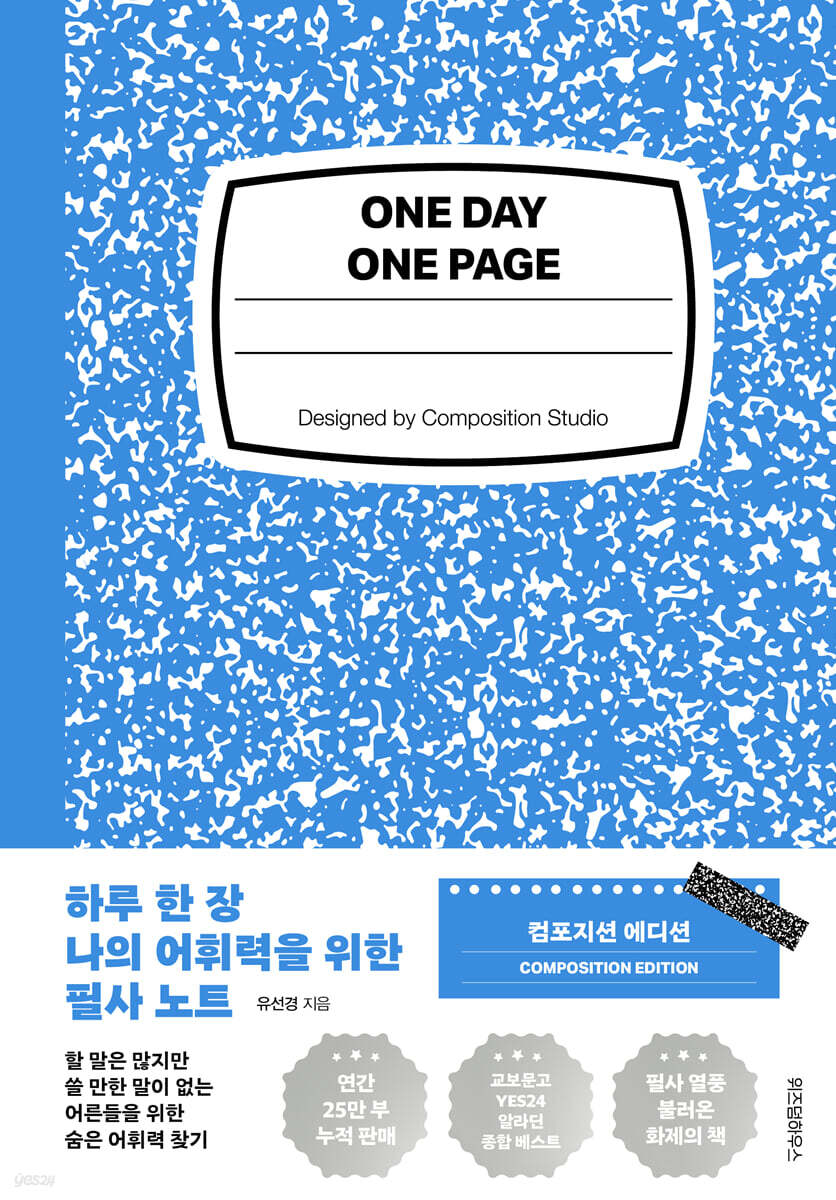
The book, "One Page a Day for My Vocabulary," which became a bestseller in the humanities category immediately after its publication and sparked a craze for handwriting, is now available to readers in a new composition edition.
Readers who had previously thought that writing was difficult praised this book as a "life-changing book" that made them put down their smartphones and pick up a pen.
It not only recommended high-quality books spanning the East and the West, but also included a comprehensive guide to copying to expand vocabulary while thoroughly examining the benefits of copying, receiving a warm response from beginners who are just starting to copy.
This 'Composition Edition', presented through collaboration with Composition Studio, a synonym for handwritten notes, adds the analog sensibility and detail of handwritten notes, further increasing its collection value.
- The book that has become a hot topic of conversation, chosen by 200,000 readers!
The publication of the "Composition Edition," a synonym for handwritten notes.
The book, "One Page a Day for My Vocabulary," which became a bestseller in the humanities category immediately after its publication and sparked a craze for handwriting, is now available to readers in a new composition edition.
Readers who had previously thought that writing was difficult praised this book as a "life-changing book" that made them put down their smartphones and pick up a pen.
It not only recommended high-quality books spanning the East and the West, but also included a comprehensive guide to copying to expand vocabulary while thoroughly examining the benefits of copying, receiving a warm response from beginners who are just starting to copy.
This 'Composition Edition', presented through collaboration with Composition Studio, a synonym for handwritten notes, adds the analog sensibility and detail of handwritten notes, further increasing its collection value.
- You can preview some of the book's contents.
Preview
index
Preface - Transcription, To Live
First Step: Getting Familiar with Vocabulary
1.
Writing with feeling using onomatopoeia and mimetic words
Michael Ende's novel "Momo"
Park Kyung-ni's novel "Land 5"
Hwang Ji-woo's poem "While Waiting for You"
Françoise Sagan's novel "Signs of Defeat"
[My Writing] Knock knock! Knock!
Kim Yu-jeong's novel "Bom Bom"
Shin Hyeong-geon's poem "Spring Day"
Kwon Dae-woong's prose, "Heart-pounding"
[My Writing] The Sound of Your Heartbeat
Park Mok-wol's poem "Machine Market Day"
Moon Sun-tae's poem "Anchovies"
Kim Seung-hee's poem "Dawn Meal"
Christian Bobin's novel "Light Heart"
Kwon Yeo-seon's novel "Three People"
Sandor Marai's novel "The Transformation of Marriage (Volume 1)"
Yoo Seon-gyeong's Prose, "Emotional Vocabulary: Pain and Apprehension"
[My Writing] What vocabulary comes to mind?
2.
Experience the Taste of Language: Developing Linguistic Intuition
Yun Dong-ju's poem "Boy"
Federico García Lorca's poem "Truth"
Daniel Glattauer's novel "Is the Wind Blowing at Three in the Morning?"
William Shakespeare's play Romeo and Juliet
Yasunari Kawabata's novel "Snow Country"
Han Kang's novel "Greek Time"
Jeong Ji-yong's poem "Shooting Star"
Chusa Kim Jeong-hui's poem "Spring is Deep and Dewy"
Maxim Gorky's novel "Mother"
Dongpa News Poem "Poem of the Geomungo"
Ryunosuke Akutagawa's novel "Kappa"
Victor Hugo's novel Les Misérables
Yoo Seon-gyeong's prose, "Accept the fact that you cannot understand each other."
3.
Replacing the vocabulary of winner-take-all
A variety of vocabulary that can be used instead of winner-take-all vocabulary.
Oscar Wilde's novel The Picture of Dorian Gray
Park Wan-seo's novel "Who Ate All Those Singa?"
Jeon Hye-rin's prose, "A Long Wandering"
Amélie Nothomb's novel "Three Beautiful Years"
Émile Ajar's novel The Life Before Us
Jang Young-hee's prose, "A 'special' ordinary year"
Kahlil Gibran's poem "On Marriage"
Kim Ae-ran's prose, "Adverbs and Greetings"
Miyashita Natsu's novel "The Forest of Sheep and Steel"
Yoo Seon-gyeong's prose, "Shifting your perspective broadens your horizons."
Step Two: The Secret to Building Your Vocabulary
1.
The beginning of a relationship, interest
Lee Hyo-seok's novel "When Buckwheat Flowers Bloom"
Osamu Dazai's prose, "Trump Called Laziness"
Kim Ae-ran's novel "Bugs"
Vocabulary that helped me connect with new eyes
Kim Nam-geuk's poem "Ginkgo Blossoms"
Lee Tae-jun's prose, "Autumn Flowers"
Jeong Ji-yong's prose, "The Cuckoo and the Chrysanthemum"
Lee Moon-jae's poem "Wave Flower"
Choi Yun's novel "Whisper, Whisper"
Park Wan-seo's prose, "The Unshakeable Whole"
Patrick Mogniano's novel "The Street of Dark Shops"
Hans Christian Andersen's novel The Little Mermaid
Excerpt from Charles Pierre Baudelaire's poem "Windows"
Michel Tournier's prose, "The Back is the Truth"
Francis Jam's "The Restaurant"
Saihate Tahi's prose "I like it"
2.
The beginning of seeing properly, observation
David Le Breton's prose "Silence"
Alain de Botton's prose, "On the Country and the City"
Hope Jahren's prose, Roots and Leaves
Hwang Jeong-eun's novel "Myeongsil"
Hyun Ki-young's novel "Wife and Gaeodong"
Olga Tokarczuk's novel "Primeval Times"
3.
A turning point that leads to a change in perspective, a description
Kim Hwa-young's prose, "The Morning Market in Provence and the Scent of Cavaillon Melons"
Lulu Miller's prose "Dandelion"
Delia Owens' novel "Where the Crawdads Sing"
Park Mok-wol's poem "Spring Rain"
Woo Suk-young's prose, "Fallen Leaves and Maple Leaves"
Kim Hoon's prose, "In Jeju"
Federico García Lorca's prose, "The Monastery of Saint Peter of Cardeña"
Jang Seok-nam's prose, "The Sound of Drawing Water"
Han Seung-won's novel "But Not All Are Like That"
Gustave Flaubert's novel Madame Bovary
Karen Blixen's novel "Out of Africa" 204
Park Kyung-ni's novel "Land 9" 206
F.
Scott Fitzgerald's novel The Great Gatsby 208
Baek Seok's poem "Night" 212
Jacques Prévert, Poetry "Breakfast" 214
Step Three: The Power of Vocabulary
1.
Empathy: Responding to and entering the world of others
Peter Wicksel's novel "A Desk is a Desk"
Natsume Soseki's novel "Kokoro"
Eun Hee-kyung's novel "The Bird's Gift"
Genjiro Haitani's novel "The Lonely Zoo - Preface"
Baek Seok's poem "Mountain Lodge"
Cheon Myeong-gwan's novel "My Uncle Bruce Lee 1"
Ryunosuke Akutagawa's novel "Tangerines"
Moon Tae-jun's prose, "Stroking is Passion"
Kim Sa-in's poem "Quiet Days"
Mary Shelley's novel Frankenstein
Viktor Frankl's prose "Grief and Disillusionment"
Jeong Gyeot-byeol's poem "High Tide"
[My Writing] A Story of Empathy
2.
Comprehension: Breaking away from dichotomous structures and interpreting in three dimensions.
Kim Hyun's prose (July 1, 1987)
Margaret Atwood's Prose "How Do You Change the World?"
Nikos Kazantzakis' novel Zorba the Greek
Shin Young-bok's prose, "The Language of Hope, Seokgwabulsik"
Etienne de La Boesy's Prose, "Habit, the First Reason of Voluntary Obedience"
Park Hong-sun's prose, "Inside a Third-Class Train"
Mitsuyo Kakuda's novel "Paper Moon"
Paul Auster's novel "Voyage to the Record Room"
Louise Rinser's novel "In the Middle of Life"
Karel Čapek's play "The Meaning of Robots"
Lee Byeong-ryul's prose, "The Heart Ordered It"
Bill Bryson's Prose "A Short History of Nearly Everything - Preface"
[My Writing] Discovering a New Perspective
3.
Insight: To see through things or phenomena with keen observation and know the best.
Pascal Mercier (Peter Bieri)'s novel "Night Train to Lisbon"
Martin Schleske's prose, "You Are the One Loved"
Lee Cheong-jun's novel "Ieodo"
Bertrand Russell's prose, "The Psychology of Worry"
Kim Dae-hyun's prose, "Waterscape"
Mahatma Gandhi's Prose "Thoughts 2"
Lucius Annaeus Seneca, Prose, "Without Arguing with Fate"
Zhuangzi, "Theory of Ordering All Things, Part II"
Jeongmin's Prose, "Monk! What Do You See?"
Oscar Wilde's Prose, Literature, Criticism, Journalism: Create Yourself, Become Your Own Poetry
William Shakespeare's play Macbeth
Sandor Marai's novel "Passion"
[My Writing] Imagining Myself as Insightful
4.
Self-regulation: maintaining balance by controlling emotions and thoughts
John Fowles' novel The French Lieutenant's Woman
Willy Ronis's prose, "The Bohemians of Montreuil, 1945"
Park No-hae's poem "How to Catch a Tiger"
Vadim Zeland's prose "Pendulum"
Yoo Seon-gyeong's prose, "You Can Live Well Even with a Hole"
Epictetus's Prose: "Always Remember the Nature of the Things I Love"
Kahlil Gibran's poem "On Joy and Sorrow"
Hermann Hesse's novel Demian
Lee Ja-hyeon's prose, "Jeipyo (Second Petition)"
Henry David Thoreau's Prose "Walden: Conclusion"
Rachel Naomi Remen's prose, "True Stories"
Miguel de Cervantes' novel Don Quixote
Vincent van Gogh's Prose "Admiration"
Zhang Qian's poem "Trembling Centipede"
[My Writing] Questions and Answers on Self-Control
5.
Expressiveness: to concretize abstract ideas, feelings, etc. into words and writing
Ogawa Ito's novel "Tsubaki Stationery Store"
Excerpt from Robert Frost's poem "The Tree at the Window"
Cheongheo Hyujeong Poem, "Passing by an Inn, Hearing the Sound of the Geomungo"
Henning Mankell's novel "Italian Shoes"
Johann Wolfgang von Goethe's novel The Sorrows of Young Werther
Jeong Ji-yong's poem "Apcheon"
Bertolt Brecht's poem "My Mother"
Lee Seong-bok's poem "Feeling"
Jeong Hyeon-jong's poem, "Every Moment is a Flower Bud"
Choi Seung-ja's prose, "Round and Ripe Life"
Friedrich Wilhelm Nietzsche's prose poem "On the Island of Beatitudes"
[My Writing] Expressing
First Step: Getting Familiar with Vocabulary
1.
Writing with feeling using onomatopoeia and mimetic words
Michael Ende's novel "Momo"
Park Kyung-ni's novel "Land 5"
Hwang Ji-woo's poem "While Waiting for You"
Françoise Sagan's novel "Signs of Defeat"
[My Writing] Knock knock! Knock!
Kim Yu-jeong's novel "Bom Bom"
Shin Hyeong-geon's poem "Spring Day"
Kwon Dae-woong's prose, "Heart-pounding"
[My Writing] The Sound of Your Heartbeat
Park Mok-wol's poem "Machine Market Day"
Moon Sun-tae's poem "Anchovies"
Kim Seung-hee's poem "Dawn Meal"
Christian Bobin's novel "Light Heart"
Kwon Yeo-seon's novel "Three People"
Sandor Marai's novel "The Transformation of Marriage (Volume 1)"
Yoo Seon-gyeong's Prose, "Emotional Vocabulary: Pain and Apprehension"
[My Writing] What vocabulary comes to mind?
2.
Experience the Taste of Language: Developing Linguistic Intuition
Yun Dong-ju's poem "Boy"
Federico García Lorca's poem "Truth"
Daniel Glattauer's novel "Is the Wind Blowing at Three in the Morning?"
William Shakespeare's play Romeo and Juliet
Yasunari Kawabata's novel "Snow Country"
Han Kang's novel "Greek Time"
Jeong Ji-yong's poem "Shooting Star"
Chusa Kim Jeong-hui's poem "Spring is Deep and Dewy"
Maxim Gorky's novel "Mother"
Dongpa News Poem "Poem of the Geomungo"
Ryunosuke Akutagawa's novel "Kappa"
Victor Hugo's novel Les Misérables
Yoo Seon-gyeong's prose, "Accept the fact that you cannot understand each other."
3.
Replacing the vocabulary of winner-take-all
A variety of vocabulary that can be used instead of winner-take-all vocabulary.
Oscar Wilde's novel The Picture of Dorian Gray
Park Wan-seo's novel "Who Ate All Those Singa?"
Jeon Hye-rin's prose, "A Long Wandering"
Amélie Nothomb's novel "Three Beautiful Years"
Émile Ajar's novel The Life Before Us
Jang Young-hee's prose, "A 'special' ordinary year"
Kahlil Gibran's poem "On Marriage"
Kim Ae-ran's prose, "Adverbs and Greetings"
Miyashita Natsu's novel "The Forest of Sheep and Steel"
Yoo Seon-gyeong's prose, "Shifting your perspective broadens your horizons."
Step Two: The Secret to Building Your Vocabulary
1.
The beginning of a relationship, interest
Lee Hyo-seok's novel "When Buckwheat Flowers Bloom"
Osamu Dazai's prose, "Trump Called Laziness"
Kim Ae-ran's novel "Bugs"
Vocabulary that helped me connect with new eyes
Kim Nam-geuk's poem "Ginkgo Blossoms"
Lee Tae-jun's prose, "Autumn Flowers"
Jeong Ji-yong's prose, "The Cuckoo and the Chrysanthemum"
Lee Moon-jae's poem "Wave Flower"
Choi Yun's novel "Whisper, Whisper"
Park Wan-seo's prose, "The Unshakeable Whole"
Patrick Mogniano's novel "The Street of Dark Shops"
Hans Christian Andersen's novel The Little Mermaid
Excerpt from Charles Pierre Baudelaire's poem "Windows"
Michel Tournier's prose, "The Back is the Truth"
Francis Jam's "The Restaurant"
Saihate Tahi's prose "I like it"
2.
The beginning of seeing properly, observation
David Le Breton's prose "Silence"
Alain de Botton's prose, "On the Country and the City"
Hope Jahren's prose, Roots and Leaves
Hwang Jeong-eun's novel "Myeongsil"
Hyun Ki-young's novel "Wife and Gaeodong"
Olga Tokarczuk's novel "Primeval Times"
3.
A turning point that leads to a change in perspective, a description
Kim Hwa-young's prose, "The Morning Market in Provence and the Scent of Cavaillon Melons"
Lulu Miller's prose "Dandelion"
Delia Owens' novel "Where the Crawdads Sing"
Park Mok-wol's poem "Spring Rain"
Woo Suk-young's prose, "Fallen Leaves and Maple Leaves"
Kim Hoon's prose, "In Jeju"
Federico García Lorca's prose, "The Monastery of Saint Peter of Cardeña"
Jang Seok-nam's prose, "The Sound of Drawing Water"
Han Seung-won's novel "But Not All Are Like That"
Gustave Flaubert's novel Madame Bovary
Karen Blixen's novel "Out of Africa" 204
Park Kyung-ni's novel "Land 9" 206
F.
Scott Fitzgerald's novel The Great Gatsby 208
Baek Seok's poem "Night" 212
Jacques Prévert, Poetry "Breakfast" 214
Step Three: The Power of Vocabulary
1.
Empathy: Responding to and entering the world of others
Peter Wicksel's novel "A Desk is a Desk"
Natsume Soseki's novel "Kokoro"
Eun Hee-kyung's novel "The Bird's Gift"
Genjiro Haitani's novel "The Lonely Zoo - Preface"
Baek Seok's poem "Mountain Lodge"
Cheon Myeong-gwan's novel "My Uncle Bruce Lee 1"
Ryunosuke Akutagawa's novel "Tangerines"
Moon Tae-jun's prose, "Stroking is Passion"
Kim Sa-in's poem "Quiet Days"
Mary Shelley's novel Frankenstein
Viktor Frankl's prose "Grief and Disillusionment"
Jeong Gyeot-byeol's poem "High Tide"
[My Writing] A Story of Empathy
2.
Comprehension: Breaking away from dichotomous structures and interpreting in three dimensions.
Kim Hyun's prose (July 1, 1987)
Margaret Atwood's Prose "How Do You Change the World?"
Nikos Kazantzakis' novel Zorba the Greek
Shin Young-bok's prose, "The Language of Hope, Seokgwabulsik"
Etienne de La Boesy's Prose, "Habit, the First Reason of Voluntary Obedience"
Park Hong-sun's prose, "Inside a Third-Class Train"
Mitsuyo Kakuda's novel "Paper Moon"
Paul Auster's novel "Voyage to the Record Room"
Louise Rinser's novel "In the Middle of Life"
Karel Čapek's play "The Meaning of Robots"
Lee Byeong-ryul's prose, "The Heart Ordered It"
Bill Bryson's Prose "A Short History of Nearly Everything - Preface"
[My Writing] Discovering a New Perspective
3.
Insight: To see through things or phenomena with keen observation and know the best.
Pascal Mercier (Peter Bieri)'s novel "Night Train to Lisbon"
Martin Schleske's prose, "You Are the One Loved"
Lee Cheong-jun's novel "Ieodo"
Bertrand Russell's prose, "The Psychology of Worry"
Kim Dae-hyun's prose, "Waterscape"
Mahatma Gandhi's Prose "Thoughts 2"
Lucius Annaeus Seneca, Prose, "Without Arguing with Fate"
Zhuangzi, "Theory of Ordering All Things, Part II"
Jeongmin's Prose, "Monk! What Do You See?"
Oscar Wilde's Prose, Literature, Criticism, Journalism: Create Yourself, Become Your Own Poetry
William Shakespeare's play Macbeth
Sandor Marai's novel "Passion"
[My Writing] Imagining Myself as Insightful
4.
Self-regulation: maintaining balance by controlling emotions and thoughts
John Fowles' novel The French Lieutenant's Woman
Willy Ronis's prose, "The Bohemians of Montreuil, 1945"
Park No-hae's poem "How to Catch a Tiger"
Vadim Zeland's prose "Pendulum"
Yoo Seon-gyeong's prose, "You Can Live Well Even with a Hole"
Epictetus's Prose: "Always Remember the Nature of the Things I Love"
Kahlil Gibran's poem "On Joy and Sorrow"
Hermann Hesse's novel Demian
Lee Ja-hyeon's prose, "Jeipyo (Second Petition)"
Henry David Thoreau's Prose "Walden: Conclusion"
Rachel Naomi Remen's prose, "True Stories"
Miguel de Cervantes' novel Don Quixote
Vincent van Gogh's Prose "Admiration"
Zhang Qian's poem "Trembling Centipede"
[My Writing] Questions and Answers on Self-Control
5.
Expressiveness: to concretize abstract ideas, feelings, etc. into words and writing
Ogawa Ito's novel "Tsubaki Stationery Store"
Excerpt from Robert Frost's poem "The Tree at the Window"
Cheongheo Hyujeong Poem, "Passing by an Inn, Hearing the Sound of the Geomungo"
Henning Mankell's novel "Italian Shoes"
Johann Wolfgang von Goethe's novel The Sorrows of Young Werther
Jeong Ji-yong's poem "Apcheon"
Bertolt Brecht's poem "My Mother"
Lee Seong-bok's poem "Feeling"
Jeong Hyeon-jong's poem, "Every Moment is a Flower Bud"
Choi Seung-ja's prose, "Round and Ripe Life"
Friedrich Wilhelm Nietzsche's prose poem "On the Island of Beatitudes"
[My Writing] Expressing
Detailed image

Publisher's Review
“Can’t you just copy it?”
“Does writing really improve your vocabulary?”
★The one book you should read if you're just starting to write to improve your vocabulary★
As interest in artificial intelligence has grown recently, the scope of ChatGPT's use is expanding.
Many people reacted by saying that they only thought of the mechanical responses of mobile chatbots, but when they actually used them, they were surprised to find that they had quite plausible language and unexpected logic.
If you think about it, there aren't any particularly difficult words or sharp messages, but I can't shake the feeling that they read exactly what I wanted to say and think.
It's not that I can't use it because I don't know how to use it, but rather, seeing ChatGPT smoothly express thoughts and arguments that I knew in my head but didn't know how to express, makes me look back on my vocabulary and writing skills.
I feel like I have a lot to say but nothing to write about, and I find myself taking an interest in reading or writing like I never had before.
"One Page a Day for My Vocabulary" begins by resolving questions that anyone who has started or is currently writing a manuscript has probably asked themselves at least once.
Rather than simply copying a book, it presents specific methods step by step to derive greater utility from it.
It provides an opportunity to encounter a variety of works that are difficult to read in everyday life, such as novels, poetry, prose, and plays. In particular, the works in the text carefully selected by the author are good to read with your eyes, but they have a special 'resonance' when you concentrate and slowly copy them by hand.
It presents specific methods to improve vocabulary, such as 'How to become familiar with vocabulary', 'Secrets to building vocabulary', and 'The power of vocabulary', while also helping you deepen your transcription to better suit your own goals.
There is also space for you to write your own piece using vocabulary discovered in newly read and copied sentences, and by reading the text and inserting synonyms in the footnotes, you can experience the subtle 'taste of words' that you had been missing.
Words that are not used are ultimately words that cannot be used.
- 134 practical writing and transcriptions to help you discover your hidden vocabulary.
It is true that the basic vocabulary we need to live is sufficient if we have no problems reading and expressing ourselves.
But if you look closely, the words and writing we exchange in everyday life are not as colorful as we think.
Similar words and formal content are repeated over and over again.
As a result, I lack the opportunity to hear and learn new things and enrich my language.
A poor vocabulary prevents me from expressing my thoughts and feelings effectively, and also causes me to lag behind in interpreting information and knowledge.
This book is the first vocabulary transcription book created by author Yoo Seon-gyeong, combining her reading experience and transcription know-how, for those who are thirsty for rich language skills and rapid literacy.
By writing one page a day for about 10 minutes, it helps you use words you haven't used before.
It's not that I can't use it because I don't know it, but I learned expressions and vocabulary that I knew but rarely used, and finally made them my own.
We can only know what we have experienced, and everything else is unknown.
The same goes for language.
After all, the words I don't use are words I can't use.
As the area of unused words decreases and the number of words I can use gradually increases, I feel that my vocabulary and writing skills have expanded significantly, not only in public writing but also in everyday conversation.
Moreover, since the act of copying unfamiliar literary works or unfamiliar vocabulary can be experienced as a form of mental exercise and meditation, it is also suitable as a study for 'adult culture'.
Those who continue to write through this book, lightly but steadily, will experience the joy of reading and writing even one page a day, and will experience the joy of writing and the utility of studying for themselves.
At that time, you will face yourself sitting at your desk with a notebook and pen, waiting for this moment, even if you don't move.
That's the power of routine.
“Does writing really improve your vocabulary?”
★The one book you should read if you're just starting to write to improve your vocabulary★
As interest in artificial intelligence has grown recently, the scope of ChatGPT's use is expanding.
Many people reacted by saying that they only thought of the mechanical responses of mobile chatbots, but when they actually used them, they were surprised to find that they had quite plausible language and unexpected logic.
If you think about it, there aren't any particularly difficult words or sharp messages, but I can't shake the feeling that they read exactly what I wanted to say and think.
It's not that I can't use it because I don't know how to use it, but rather, seeing ChatGPT smoothly express thoughts and arguments that I knew in my head but didn't know how to express, makes me look back on my vocabulary and writing skills.
I feel like I have a lot to say but nothing to write about, and I find myself taking an interest in reading or writing like I never had before.
"One Page a Day for My Vocabulary" begins by resolving questions that anyone who has started or is currently writing a manuscript has probably asked themselves at least once.
Rather than simply copying a book, it presents specific methods step by step to derive greater utility from it.
It provides an opportunity to encounter a variety of works that are difficult to read in everyday life, such as novels, poetry, prose, and plays. In particular, the works in the text carefully selected by the author are good to read with your eyes, but they have a special 'resonance' when you concentrate and slowly copy them by hand.
It presents specific methods to improve vocabulary, such as 'How to become familiar with vocabulary', 'Secrets to building vocabulary', and 'The power of vocabulary', while also helping you deepen your transcription to better suit your own goals.
There is also space for you to write your own piece using vocabulary discovered in newly read and copied sentences, and by reading the text and inserting synonyms in the footnotes, you can experience the subtle 'taste of words' that you had been missing.
Words that are not used are ultimately words that cannot be used.
- 134 practical writing and transcriptions to help you discover your hidden vocabulary.
It is true that the basic vocabulary we need to live is sufficient if we have no problems reading and expressing ourselves.
But if you look closely, the words and writing we exchange in everyday life are not as colorful as we think.
Similar words and formal content are repeated over and over again.
As a result, I lack the opportunity to hear and learn new things and enrich my language.
A poor vocabulary prevents me from expressing my thoughts and feelings effectively, and also causes me to lag behind in interpreting information and knowledge.
This book is the first vocabulary transcription book created by author Yoo Seon-gyeong, combining her reading experience and transcription know-how, for those who are thirsty for rich language skills and rapid literacy.
By writing one page a day for about 10 minutes, it helps you use words you haven't used before.
It's not that I can't use it because I don't know it, but I learned expressions and vocabulary that I knew but rarely used, and finally made them my own.
We can only know what we have experienced, and everything else is unknown.
The same goes for language.
After all, the words I don't use are words I can't use.
As the area of unused words decreases and the number of words I can use gradually increases, I feel that my vocabulary and writing skills have expanded significantly, not only in public writing but also in everyday conversation.
Moreover, since the act of copying unfamiliar literary works or unfamiliar vocabulary can be experienced as a form of mental exercise and meditation, it is also suitable as a study for 'adult culture'.
Those who continue to write through this book, lightly but steadily, will experience the joy of reading and writing even one page a day, and will experience the joy of writing and the utility of studying for themselves.
At that time, you will face yourself sitting at your desk with a notebook and pen, waiting for this moment, even if you don't move.
That's the power of routine.
GOODS SPECIFICS
- Date of issue: October 23, 2024
- Format: Hardcover book binding method guide
- Page count, weight, size: 372 pages | 521g | 145*210*25mm
- ISBN13: 9791171711673
- ISBN10: 1171711670
You may also like
카테고리
korean


korean

![GQ KOREA Mark (Monthly): December [2025]](http://librairie.coreenne.fr/cdn/shop/files/8ef265dbbfbf186523ed75ba7319009d.jpg?v=1765340328&width=3840)


