

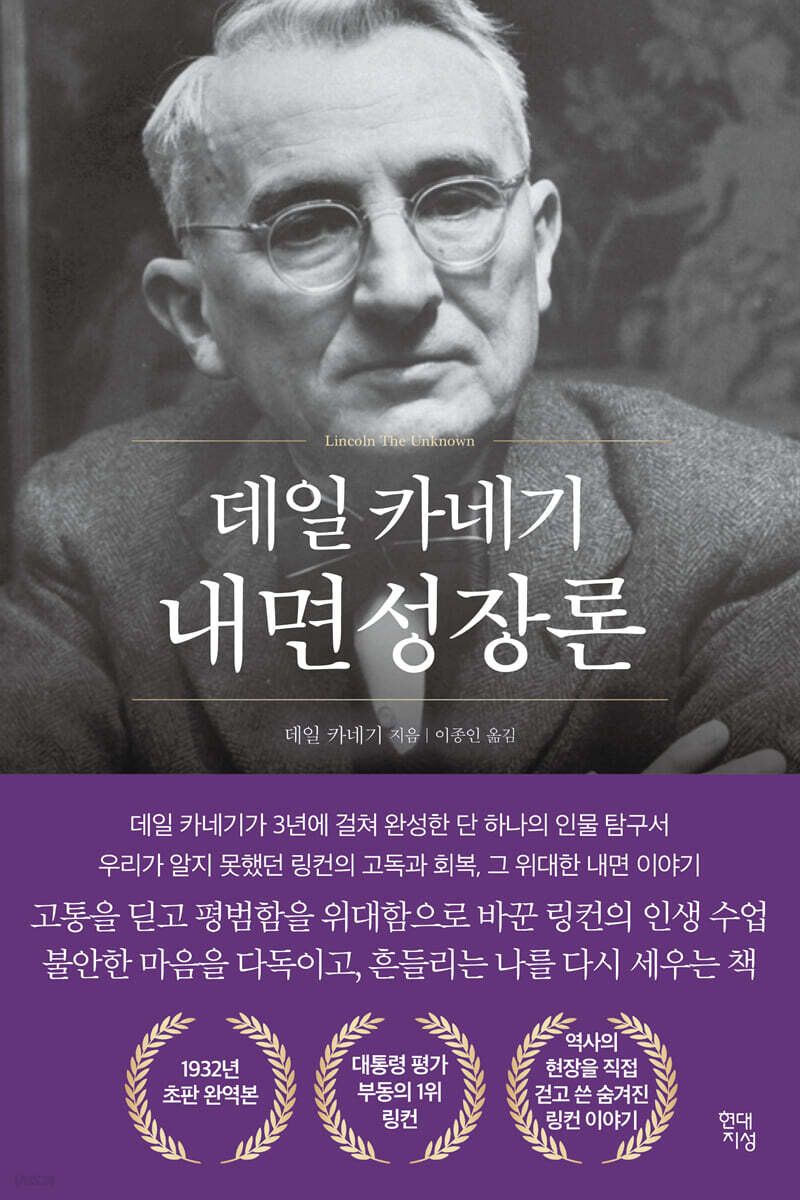
Dale Carnegie's theory of inner growth
 |
Description
Book Introduction
“Dale Carnegie focused on Lincoln’s ‘inner secret’ rather than his outward appearance.”
Choi Tae-seong (EBSi Korean History Lecturer, Author of "Minimum Korean History")
The Lincoln we didn't know,
The great inner self is revealed for the first time
The only person Dale Carnegie explored for three years: Abraham Lincoln.
He ended the war and freed the slaves.
But no one ever spoke of the inner war he had been fighting his entire life.
From a poor country boy to the president who saved America, Lincoln endured deep sorrow, loneliness, and intense inner training that were not revealed to the world.
"Dale Carnegie's Theory of Inner Growth" is a unique biography written by Dale Carnegie himself, traveling across America to the places where Lincoln cried, the moments when he fell, and the places where he rose again.
His only character study that explores the 'power of the mind' before the 'power of words'.
Choi Tae-seong (EBSi Korean History Lecturer, Author of "Minimum Korean History")
The Lincoln we didn't know,
The great inner self is revealed for the first time
The only person Dale Carnegie explored for three years: Abraham Lincoln.
He ended the war and freed the slaves.
But no one ever spoke of the inner war he had been fighting his entire life.
From a poor country boy to the president who saved America, Lincoln endured deep sorrow, loneliness, and intense inner training that were not revealed to the world.
"Dale Carnegie's Theory of Inner Growth" is a unique biography written by Dale Carnegie himself, traveling across America to the places where Lincoln cried, the moments when he fell, and the places where he rose again.
His only character study that explores the 'power of the mind' before the 'power of words'.
- You can preview some of the book's contents.
Preview
index
The circumstances and reasons for writing this book: Dale Carnegie
Part 1.
Lincoln's hometown and upbringing
1.
Lincoln's ancestors
2.
Lincoln's parents
3.
Lincoln's studies
4.
Lincoln's New Salem Years
5.
Love and Parting with Ann Rutledge
6.
My days as a lawyer in Springfield
7.
Engagement and breakup with Mary Todd
8.
Lincoln's depression
Part 2.
The arduous road to the White House
9.
The caring Lincoln and the radical Mrs. Lincoln
10.
The Generous Attorney Lincoln
11.
Mrs. Lincoln, the temperamental woman
12.
Mrs. Lincoln's political obsession
13.
Termination of the Missouri Compromise
14.
Lincoln's political frustration
15.
Republican Presidential Nominating Convention
16.
16th Presidential Election
17.
The President's Inauguration and the Prelude to War
Part 3.
The Civil War and Enduring Leadership
18.
Unprepared for War: The North's First Trial
19.
A frightened General McClellan
20.
Repeated defeats of the North Korean army
21.
Cabinet Divisions and Lincoln's Leadership
22.
Emancipation Proclamation
23.
1863, a turning point in the Civil War
24.
The Appearance of General Grant
25.
1864, Darkness Before Dawn
26.
General Lee's surrender
27.
Mrs. Lincoln's difficult personality
28.
Lincoln assassin John Wilkes Booth
Part 4.
After a tragic death
29.
Lincoln's funeral
30.
Assassin Booth's escape
31.
Booth's body disposal process
32.
Lincoln's widow's undignified behavior
33.
Lincoln's Grave Robbery Case
Commentary | Lee Jong-in
Lincoln Chronology
Part 1.
Lincoln's hometown and upbringing
1.
Lincoln's ancestors
2.
Lincoln's parents
3.
Lincoln's studies
4.
Lincoln's New Salem Years
5.
Love and Parting with Ann Rutledge
6.
My days as a lawyer in Springfield
7.
Engagement and breakup with Mary Todd
8.
Lincoln's depression
Part 2.
The arduous road to the White House
9.
The caring Lincoln and the radical Mrs. Lincoln
10.
The Generous Attorney Lincoln
11.
Mrs. Lincoln, the temperamental woman
12.
Mrs. Lincoln's political obsession
13.
Termination of the Missouri Compromise
14.
Lincoln's political frustration
15.
Republican Presidential Nominating Convention
16.
16th Presidential Election
17.
The President's Inauguration and the Prelude to War
Part 3.
The Civil War and Enduring Leadership
18.
Unprepared for War: The North's First Trial
19.
A frightened General McClellan
20.
Repeated defeats of the North Korean army
21.
Cabinet Divisions and Lincoln's Leadership
22.
Emancipation Proclamation
23.
1863, a turning point in the Civil War
24.
The Appearance of General Grant
25.
1864, Darkness Before Dawn
26.
General Lee's surrender
27.
Mrs. Lincoln's difficult personality
28.
Lincoln assassin John Wilkes Booth
Part 4.
After a tragic death
29.
Lincoln's funeral
30.
Assassin Booth's escape
31.
Booth's body disposal process
32.
Lincoln's widow's undignified behavior
33.
Lincoln's Grave Robbery Case
Commentary | Lee Jong-in
Lincoln Chronology
Detailed image

Into the book
I was amazed as I read the series with great interest.
Having spent the first 20 years of my life in the Midwest, near Lincoln's hometown, and always having a keen interest in American history, I thought I knew Lincoln's life well.
But then I realized I didn't know much.
It was truly shameful.
It was only when I, an American, came to London and read an article about Lincoln written by an Irishman in a British newspaper that I opened my eyes to his life story and realized that it was one of the most fascinating stories in the history of the world! …
I started writing in Europe and worked there for about a year, then returned to New York and worked there for two more years.
But in the end, I ended up tearing up everything I had written and throwing it in the trash.
Then I headed to Illinois.
Because I wanted to write about Lincoln in the very land where he himself dreamed and labored.
I lived among the local people for several months, whose fathers had once helped Lincoln survey the land, build fences, and drive hogs to market.
I spent months combing through old books, letters, speeches, half-forgotten newspapers, and musty court records to get a sense of Lincoln's true colors.
…when I was writing a chapter on Lincoln's lover, Ann Rutledge, I loaded my car with a small folding table and typewriter and drove a long way down the country road, past pig pens and cow pastures, to the remote place where she was buried.
The place was already neglected and overgrown with weeds, and to get near the tomb, one had to push through thick weeds, twigs, and tangled vines.
Sitting there, right where Lincoln had come and wept, he wrote chapters filled with his deep sorrow.
Several chapters of this book were born in Springfield.
Some chapters were written in the parlor of Lincoln's old home where he spent sixteen unhappy years, some at the desk where he wrote his first inaugural address, and some on the very spot where he had fought his way to Mary Todd and returned.
---From “The Background and Reasons for Writing This Book”
If you call it a school, it's just a crude log cabin.
The ceiling was so low that the teacher could barely stand.
Instead of windows, oiled paper was spread between the logs to let in sunlight.
The floor and chairs were made of split logs.
Lincoln learned to read from the Bible and learned to write by imitating the handwriting of Washington and Jefferson.
His handwriting was so clear and neat that illiterate neighbors would walk miles to ask him to write their letters for them.
…
When he learned to read, a mysterious world he had never dreamed of before opened up before him.
Reading transformed him, broadened his horizons, and gave him vision.
For 25 years, reading books became a passionate passion that dominated his life.
The five small books his stepmother had brought him—the Bible, Aesop's Fables, Robinson Crusoe, The Pilgrim's Progress, and The Adventures of Sinbad—were his inestimable treasures.
Lincoln kept these books, especially the Bible and Aesop's Fables, close by and read them repeatedly whenever he had time.
As a result, his writing style, tone, and logical development changed significantly.
---「3.
From "Lincoln's Academic Studies"
The morning he arrived in Springfield, he had no money in his pocket to spend freely.
To make matters worse, he was $1,100 in debt.
It was a loss he had incurred because of the failed store he ran in New Salem with Berry.
However, since Barry died from drinking too much, Lincoln was left to shoulder the debt alone.
Strictly speaking, Lincoln was not obliged to repay that debt.
There was an escape route by claiming divided responsibility or bankruptcy.
But that wasn't Lincoln's way.
He went to each of his creditors and promised to pay them back with interest if they gave him enough time.
Everyone agreed except Peter Van Bergen.
Bergen immediately sued and won a judgment, auctioning off Lincoln's horses and surveying instruments.
The remaining creditors persevered, and Lincoln spent the next 14 years tightening his belt and fulfilling his promises to them.
Even after becoming a member of the House of Representatives in 1848, he sent part of his salary back home and paid off the last debts of his grocery store.
---From "My Days as a Springfield Lawyer"
After an all-night search, Lincoln was found in his law office at dawn.
He was muttering to himself, his mind wandering.
His friends were worried that he had lost his mind.
Mary's relatives were already convinced that she was out of her mind and that was why she didn't show up to the wedding.
Doctor Henry was called in urgently.
When Lincoln threatened suicide, the doctor ordered Speed and Butler to keep a close eye on him.
He took his pocket knife away, just as he had done when Ann Rutledge died.
Dr. Henry advised him to attend the state legislature regularly, saying he needed something to focus his mind on.
It was also a natural duty as the Whig Party leader.
However, records show that he only appeared four times in three weeks, and even then, his face was only visible for an hour or two.
On January 19, 1841, John Hardin was forced to report his illness to Congress.
---From "Lincoln's Depression"
From this period until the end of his life, Abraham Lincoln's most prominent characteristic was a deep sadness and depression.
The symptoms are so severe that simply listing words fails to fully convey their profound meaning.
Jesse Wake helped Herndon complete his immortal Lincoln biography.
At the time, Wake believed Lincoln's description of grief was exaggerated.
So I went to people who had been associated with Lincoln for a long time, such as Judges Stewart, Whitney, Mattney, Sweat, and Davis, and discussed this issue at length.
As a result, Wake gained this confidence.
“No one who has not met Lincoln will ever understand his melancholic tendencies,” Herndon agreed, echoing the words I quoted earlier.
“I don’t know if Lincoln ever had a happy day in the last 20 years.
A perpetually sad expression was his most distinctive feature.
As he walked, a feeling of melancholy flowed from his whole body.”
On his travels to the circuit, Lincoln often shared a room with two or three lawyers.
They would wake up early in the morning to the sound of his voice, and they would often see him sitting on the edge of the bed muttering to himself.
At such times, Lincoln would recite this poem:
“Oh, why should the human spirit become proud?”
---From "Mrs. Lincoln's Political Obsession"
On January 1, 1863, Lincoln spent several hours shaking hands with guests visiting the White House.
Mid-afternoon that day, he returned to his office, dipped his pen in ink, and prepared to sign the Declaration of Liberty.
He looked at Shure hesitantly, then opened his mouth.
“Minister, if slavery is not bad, then nothing in this world is bad.
I am more confident than ever that I am doing the right thing.
But after greeting guests and shaking hands since morning, my arms became stiff and I lost feeling in them.
“The signatures on this document will be scrutinized, and if my hand shows even a trace of shaking, people will say, ‘The President must have felt a pang of conscience.’”
After a brief pause to stretch his arms and rest, he slowly signed the document, thus opening the way to freedom for 3.5 million slaves.
However, at the time, this declaration did not receive public support.
Lincoln's close and staunch supporter, Orville H.
Browning said:
“The only effect of the Emancipation Proclamation was to enrage and unite Southerners, and to divide and confuse Northerners.”
Having spent the first 20 years of my life in the Midwest, near Lincoln's hometown, and always having a keen interest in American history, I thought I knew Lincoln's life well.
But then I realized I didn't know much.
It was truly shameful.
It was only when I, an American, came to London and read an article about Lincoln written by an Irishman in a British newspaper that I opened my eyes to his life story and realized that it was one of the most fascinating stories in the history of the world! …
I started writing in Europe and worked there for about a year, then returned to New York and worked there for two more years.
But in the end, I ended up tearing up everything I had written and throwing it in the trash.
Then I headed to Illinois.
Because I wanted to write about Lincoln in the very land where he himself dreamed and labored.
I lived among the local people for several months, whose fathers had once helped Lincoln survey the land, build fences, and drive hogs to market.
I spent months combing through old books, letters, speeches, half-forgotten newspapers, and musty court records to get a sense of Lincoln's true colors.
…when I was writing a chapter on Lincoln's lover, Ann Rutledge, I loaded my car with a small folding table and typewriter and drove a long way down the country road, past pig pens and cow pastures, to the remote place where she was buried.
The place was already neglected and overgrown with weeds, and to get near the tomb, one had to push through thick weeds, twigs, and tangled vines.
Sitting there, right where Lincoln had come and wept, he wrote chapters filled with his deep sorrow.
Several chapters of this book were born in Springfield.
Some chapters were written in the parlor of Lincoln's old home where he spent sixteen unhappy years, some at the desk where he wrote his first inaugural address, and some on the very spot where he had fought his way to Mary Todd and returned.
---From “The Background and Reasons for Writing This Book”
If you call it a school, it's just a crude log cabin.
The ceiling was so low that the teacher could barely stand.
Instead of windows, oiled paper was spread between the logs to let in sunlight.
The floor and chairs were made of split logs.
Lincoln learned to read from the Bible and learned to write by imitating the handwriting of Washington and Jefferson.
His handwriting was so clear and neat that illiterate neighbors would walk miles to ask him to write their letters for them.
…
When he learned to read, a mysterious world he had never dreamed of before opened up before him.
Reading transformed him, broadened his horizons, and gave him vision.
For 25 years, reading books became a passionate passion that dominated his life.
The five small books his stepmother had brought him—the Bible, Aesop's Fables, Robinson Crusoe, The Pilgrim's Progress, and The Adventures of Sinbad—were his inestimable treasures.
Lincoln kept these books, especially the Bible and Aesop's Fables, close by and read them repeatedly whenever he had time.
As a result, his writing style, tone, and logical development changed significantly.
---「3.
From "Lincoln's Academic Studies"
The morning he arrived in Springfield, he had no money in his pocket to spend freely.
To make matters worse, he was $1,100 in debt.
It was a loss he had incurred because of the failed store he ran in New Salem with Berry.
However, since Barry died from drinking too much, Lincoln was left to shoulder the debt alone.
Strictly speaking, Lincoln was not obliged to repay that debt.
There was an escape route by claiming divided responsibility or bankruptcy.
But that wasn't Lincoln's way.
He went to each of his creditors and promised to pay them back with interest if they gave him enough time.
Everyone agreed except Peter Van Bergen.
Bergen immediately sued and won a judgment, auctioning off Lincoln's horses and surveying instruments.
The remaining creditors persevered, and Lincoln spent the next 14 years tightening his belt and fulfilling his promises to them.
Even after becoming a member of the House of Representatives in 1848, he sent part of his salary back home and paid off the last debts of his grocery store.
---From "My Days as a Springfield Lawyer"
After an all-night search, Lincoln was found in his law office at dawn.
He was muttering to himself, his mind wandering.
His friends were worried that he had lost his mind.
Mary's relatives were already convinced that she was out of her mind and that was why she didn't show up to the wedding.
Doctor Henry was called in urgently.
When Lincoln threatened suicide, the doctor ordered Speed and Butler to keep a close eye on him.
He took his pocket knife away, just as he had done when Ann Rutledge died.
Dr. Henry advised him to attend the state legislature regularly, saying he needed something to focus his mind on.
It was also a natural duty as the Whig Party leader.
However, records show that he only appeared four times in three weeks, and even then, his face was only visible for an hour or two.
On January 19, 1841, John Hardin was forced to report his illness to Congress.
---From "Lincoln's Depression"
From this period until the end of his life, Abraham Lincoln's most prominent characteristic was a deep sadness and depression.
The symptoms are so severe that simply listing words fails to fully convey their profound meaning.
Jesse Wake helped Herndon complete his immortal Lincoln biography.
At the time, Wake believed Lincoln's description of grief was exaggerated.
So I went to people who had been associated with Lincoln for a long time, such as Judges Stewart, Whitney, Mattney, Sweat, and Davis, and discussed this issue at length.
As a result, Wake gained this confidence.
“No one who has not met Lincoln will ever understand his melancholic tendencies,” Herndon agreed, echoing the words I quoted earlier.
“I don’t know if Lincoln ever had a happy day in the last 20 years.
A perpetually sad expression was his most distinctive feature.
As he walked, a feeling of melancholy flowed from his whole body.”
On his travels to the circuit, Lincoln often shared a room with two or three lawyers.
They would wake up early in the morning to the sound of his voice, and they would often see him sitting on the edge of the bed muttering to himself.
At such times, Lincoln would recite this poem:
“Oh, why should the human spirit become proud?”
---From "Mrs. Lincoln's Political Obsession"
On January 1, 1863, Lincoln spent several hours shaking hands with guests visiting the White House.
Mid-afternoon that day, he returned to his office, dipped his pen in ink, and prepared to sign the Declaration of Liberty.
He looked at Shure hesitantly, then opened his mouth.
“Minister, if slavery is not bad, then nothing in this world is bad.
I am more confident than ever that I am doing the right thing.
But after greeting guests and shaking hands since morning, my arms became stiff and I lost feeling in them.
“The signatures on this document will be scrutinized, and if my hand shows even a trace of shaking, people will say, ‘The President must have felt a pang of conscience.’”
After a brief pause to stretch his arms and rest, he slowly signed the document, thus opening the way to freedom for 3.5 million slaves.
However, at the time, this declaration did not receive public support.
Lincoln's close and staunch supporter, Orville H.
Browning said:
“The only effect of the Emancipation Proclamation was to enrage and unite Southerners, and to divide and confuse Northerners.”
---From "The Emancipation Proclamation"
Publisher's Review
Carnegie himself walked and recorded
Lincoln's Defining Moments
Lincoln was not a natural leader.
He failed, he broke down, he was clumsy in love, and he lived with deep depression.
But he never once gave up on himself.
Dale Carnegie discovered in Lincoln's complex inner self a trace of growth that no one could destroy.
I spent over three years following his life to write not about Lincoln as a great man, but about Lincoln as a man who fell and then rose again.
So, this book focuses not on Lincoln's achievements, but on the invisible inner strength that made them possible.
A person who never stopped learning even in despair, who embraced love and loss, depression and anxiety, and ultimately transcended himself.
He was great not because of his flashy achievements, but because he protected himself.
This book is the first record proving how he became great.
*
“Right there, sitting in the very spot where Lincoln had come and wept, I wrote a chapter that contained his profound sorrow.
Several chapters of this book were born in Springfield.
Some chapters were written in the parlor of Lincoln's old home where he spent sixteen unhappy years; some at the desk where he wrote his first inaugural address; some on the very spot where he went to propose to Mary Todd and then returned from his fight.”
_ From the author's preface
Dale Carnegie completed it over three years.
A single character exploration book
This book is not just a simple biography.
It has a distinctly different ending from existing biographies that list historical facts or record chronology.
Dale Carnegie does not portray Lincoln as a great politician or president.
Instead, he delves deeply into Lincoln as an imperfect human being, constantly shaken and tormented.
The Lincoln Carnegie captured was neither a natural leader nor a decisive strategist.
Instead, he repeated his failures, was clumsy in love, and suffered from severe depression.
Despite this, he did not give up on himself.
Dale Carnegie discovered in Lincoln's complex inner self a trace of growth that no one could destroy.
Dale Carnegie followed in Lincoln's footsteps and spent three years completing this book.
He didn't simply sit at a desk and gather data; he walked the path Lincoln walked and wrote where he shed tears.
From the old reception room in Springfield, to the desk where he wrote his first inaugural address, to the corner where he turned away after arguing with Mary Todd… Carnegie sought out every place where Lincoln's breath lingered.
Carnegie also wrote several chapters of this book in Lincoln's old home where he spent sixteen unhappy years.
By poring over old books and letters, digging through half-forgotten newspapers and musty court records, Carnegie got to the heart of the man himself.
And finally, we have completed the true story of Lincoln that we never knew.
This book is not a simple biography, but Carnegie's most profound account of his exploration of the human soul.
A person who has not betrayed his message,
True growth driven by inner strength
Born in a log cabin in Kentucky, the son of poor pioneers took a path no one expected.
The school was nothing more than a chair made from split logs, and learning began in a place where oiled paper was used instead of windows to let in sunlight.
There were only five books in his home when he was a child.
The Bible, Aesop's Fables, Robinson Crusoe, Pilgrim's Progress, and Sinbad's Adventures.
However, he read these books repeatedly whenever he had free time, and as a result, his writing style, tone, and logical development method completely changed.
He walked 15 miles to borrow a book, and then read it all night.
I would put the book between the logs and read it again the next morning.
He memorized famous speeches from rhetoric books and learned eloquence by imitating arguments and sermons in court.
Beyond being just a ‘reader’, you have been reborn as a ‘thinker and expresser’.
Lincoln's self-discipline went beyond mere reading and accumulating knowledge.
The anecdote of not taking a poor client's fee but instead giving him travel expenses, and his action of turning back without hesitation to save a dog that was about to fall into icy water, show the humanity deeply rooted in him.
His true growth came not from the accumulation of knowledge, but from the expansion of his mind.
The morality and compassion that he personally practiced in life were firmly combined with the intellect he had cultivated through books.
Lincoln's inner strength was constantly demonstrated through the unity of his thoughts and actions, and this authenticity made him a true man.
When Lincoln first set foot in Springfield with dreams of becoming a lawyer, he had not a single penny in his pocket.
Instead, he was carrying a debt of $1,100.
When his business partner, Barry, passed away from excessive drinking, he was left to shoulder the debt alone.
Although he was not legally responsible, he went to each and every creditor and made a promise.
“If you give me time, I will pay it all back, including the interest.” It took 14 years, but he paid back every last penny.
The most fatal ordeal was mental suffering.
For Lincoln, who had to battle depression throughout his life, life was often a series of sufferings.
Even his friend and assistant, William Herndon, said, “I don’t know if he’s had a single happy day in the past 20 years.”
His depression was not just a simple emotional state, but a thick fog that dominated his life.
Yet, he never lost his composure at any crucial moment of decision, and he never lost his humor even in pessimism.
Even in deep depression, he did not leave his place.
For Lincoln, 'inner strength' was the basic principle of life, transcending emotional ups and downs.
This whole journey tells one truth.
True growth comes not from outward success, but from inner strength.
The strength that supported his inner self was not given to him by chance.
It was slowly nurtured from a deep thirst for learning, unwavering moral standards, and a warm gaze and empathy for the weak.
Despite the countless hardships life threw at him, he was able to rise again on that very foundation.
“To you who wants to start over”
A book to read when your heart is broken
In the long tunnel called life, we sometimes lose our way.
At that moment, Lincoln's story will become your guiding light.
He carried the burden of depression all his life.
As the testimony goes, “When he walked, melancholy flowed from his whole body,” his sadness was so deep that it weighed down even the onlookers.
Faced with the sudden death of his first love, Ann Rutledge, he felt lost.
He spent the night alone in front of her weed-covered grave, reciting poetry as he longed for his lover who slept beneath the moss-covered tombstone.
Married life was another ordeal for him.
When he wandered the streets alone at night and met a friend, he confessed, “I don’t want to go home,” and the conflict with his wife made him feel even more lonely.
Even after becoming president, cabinet discord and political criticism continued to weigh on him.
He entered the White House as if it were his last decision in life, saying, “I am going to Washington to die.”
But Lincoln found a special way out of every moment of despair.
Humor was his cure, and stories were his refuge.
Reading a book under a lamp left on alone late at night, he created his own rhythm that would not break even in such loneliness.
This book candidly exposes Lincoln's weaknesses and suffering.
That makes it even more comforting.
Because it is not a perfect success story of a great person, but a true story of a human being who, like us, suffered, fell, and got back up again.
His life speaks to us.
“No matter how dark this moment may be, it is not the end.”
On days when your heart is broken, open this book.
Lincoln's story will whisper to you.
No matter how dark this moment may be, we can always start again.
As his life proves, no darkness can last forever unless you give up.
Lincoln's Defining Moments
Lincoln was not a natural leader.
He failed, he broke down, he was clumsy in love, and he lived with deep depression.
But he never once gave up on himself.
Dale Carnegie discovered in Lincoln's complex inner self a trace of growth that no one could destroy.
I spent over three years following his life to write not about Lincoln as a great man, but about Lincoln as a man who fell and then rose again.
So, this book focuses not on Lincoln's achievements, but on the invisible inner strength that made them possible.
A person who never stopped learning even in despair, who embraced love and loss, depression and anxiety, and ultimately transcended himself.
He was great not because of his flashy achievements, but because he protected himself.
This book is the first record proving how he became great.
*
“Right there, sitting in the very spot where Lincoln had come and wept, I wrote a chapter that contained his profound sorrow.
Several chapters of this book were born in Springfield.
Some chapters were written in the parlor of Lincoln's old home where he spent sixteen unhappy years; some at the desk where he wrote his first inaugural address; some on the very spot where he went to propose to Mary Todd and then returned from his fight.”
_ From the author's preface
Dale Carnegie completed it over three years.
A single character exploration book
This book is not just a simple biography.
It has a distinctly different ending from existing biographies that list historical facts or record chronology.
Dale Carnegie does not portray Lincoln as a great politician or president.
Instead, he delves deeply into Lincoln as an imperfect human being, constantly shaken and tormented.
The Lincoln Carnegie captured was neither a natural leader nor a decisive strategist.
Instead, he repeated his failures, was clumsy in love, and suffered from severe depression.
Despite this, he did not give up on himself.
Dale Carnegie discovered in Lincoln's complex inner self a trace of growth that no one could destroy.
Dale Carnegie followed in Lincoln's footsteps and spent three years completing this book.
He didn't simply sit at a desk and gather data; he walked the path Lincoln walked and wrote where he shed tears.
From the old reception room in Springfield, to the desk where he wrote his first inaugural address, to the corner where he turned away after arguing with Mary Todd… Carnegie sought out every place where Lincoln's breath lingered.
Carnegie also wrote several chapters of this book in Lincoln's old home where he spent sixteen unhappy years.
By poring over old books and letters, digging through half-forgotten newspapers and musty court records, Carnegie got to the heart of the man himself.
And finally, we have completed the true story of Lincoln that we never knew.
This book is not a simple biography, but Carnegie's most profound account of his exploration of the human soul.
A person who has not betrayed his message,
True growth driven by inner strength
Born in a log cabin in Kentucky, the son of poor pioneers took a path no one expected.
The school was nothing more than a chair made from split logs, and learning began in a place where oiled paper was used instead of windows to let in sunlight.
There were only five books in his home when he was a child.
The Bible, Aesop's Fables, Robinson Crusoe, Pilgrim's Progress, and Sinbad's Adventures.
However, he read these books repeatedly whenever he had free time, and as a result, his writing style, tone, and logical development method completely changed.
He walked 15 miles to borrow a book, and then read it all night.
I would put the book between the logs and read it again the next morning.
He memorized famous speeches from rhetoric books and learned eloquence by imitating arguments and sermons in court.
Beyond being just a ‘reader’, you have been reborn as a ‘thinker and expresser’.
Lincoln's self-discipline went beyond mere reading and accumulating knowledge.
The anecdote of not taking a poor client's fee but instead giving him travel expenses, and his action of turning back without hesitation to save a dog that was about to fall into icy water, show the humanity deeply rooted in him.
His true growth came not from the accumulation of knowledge, but from the expansion of his mind.
The morality and compassion that he personally practiced in life were firmly combined with the intellect he had cultivated through books.
Lincoln's inner strength was constantly demonstrated through the unity of his thoughts and actions, and this authenticity made him a true man.
When Lincoln first set foot in Springfield with dreams of becoming a lawyer, he had not a single penny in his pocket.
Instead, he was carrying a debt of $1,100.
When his business partner, Barry, passed away from excessive drinking, he was left to shoulder the debt alone.
Although he was not legally responsible, he went to each and every creditor and made a promise.
“If you give me time, I will pay it all back, including the interest.” It took 14 years, but he paid back every last penny.
The most fatal ordeal was mental suffering.
For Lincoln, who had to battle depression throughout his life, life was often a series of sufferings.
Even his friend and assistant, William Herndon, said, “I don’t know if he’s had a single happy day in the past 20 years.”
His depression was not just a simple emotional state, but a thick fog that dominated his life.
Yet, he never lost his composure at any crucial moment of decision, and he never lost his humor even in pessimism.
Even in deep depression, he did not leave his place.
For Lincoln, 'inner strength' was the basic principle of life, transcending emotional ups and downs.
This whole journey tells one truth.
True growth comes not from outward success, but from inner strength.
The strength that supported his inner self was not given to him by chance.
It was slowly nurtured from a deep thirst for learning, unwavering moral standards, and a warm gaze and empathy for the weak.
Despite the countless hardships life threw at him, he was able to rise again on that very foundation.
“To you who wants to start over”
A book to read when your heart is broken
In the long tunnel called life, we sometimes lose our way.
At that moment, Lincoln's story will become your guiding light.
He carried the burden of depression all his life.
As the testimony goes, “When he walked, melancholy flowed from his whole body,” his sadness was so deep that it weighed down even the onlookers.
Faced with the sudden death of his first love, Ann Rutledge, he felt lost.
He spent the night alone in front of her weed-covered grave, reciting poetry as he longed for his lover who slept beneath the moss-covered tombstone.
Married life was another ordeal for him.
When he wandered the streets alone at night and met a friend, he confessed, “I don’t want to go home,” and the conflict with his wife made him feel even more lonely.
Even after becoming president, cabinet discord and political criticism continued to weigh on him.
He entered the White House as if it were his last decision in life, saying, “I am going to Washington to die.”
But Lincoln found a special way out of every moment of despair.
Humor was his cure, and stories were his refuge.
Reading a book under a lamp left on alone late at night, he created his own rhythm that would not break even in such loneliness.
This book candidly exposes Lincoln's weaknesses and suffering.
That makes it even more comforting.
Because it is not a perfect success story of a great person, but a true story of a human being who, like us, suffered, fell, and got back up again.
His life speaks to us.
“No matter how dark this moment may be, it is not the end.”
On days when your heart is broken, open this book.
Lincoln's story will whisper to you.
No matter how dark this moment may be, we can always start again.
As his life proves, no darkness can last forever unless you give up.
GOODS SPECIFICS
- Date of issue: June 2, 2025
- Page count, weight, size: 384 pages | 484g | 150*225*20mm
- ISBN13: 9791139723717
- ISBN10: 1139723715
You may also like
카테고리
korean


korean

![GQ KOREA Mark (Monthly): December [2025]](http://librairie.coreenne.fr/cdn/shop/files/8ef265dbbfbf186523ed75ba7319009d.jpg?v=1765340328&width=3840)


