

Arirang
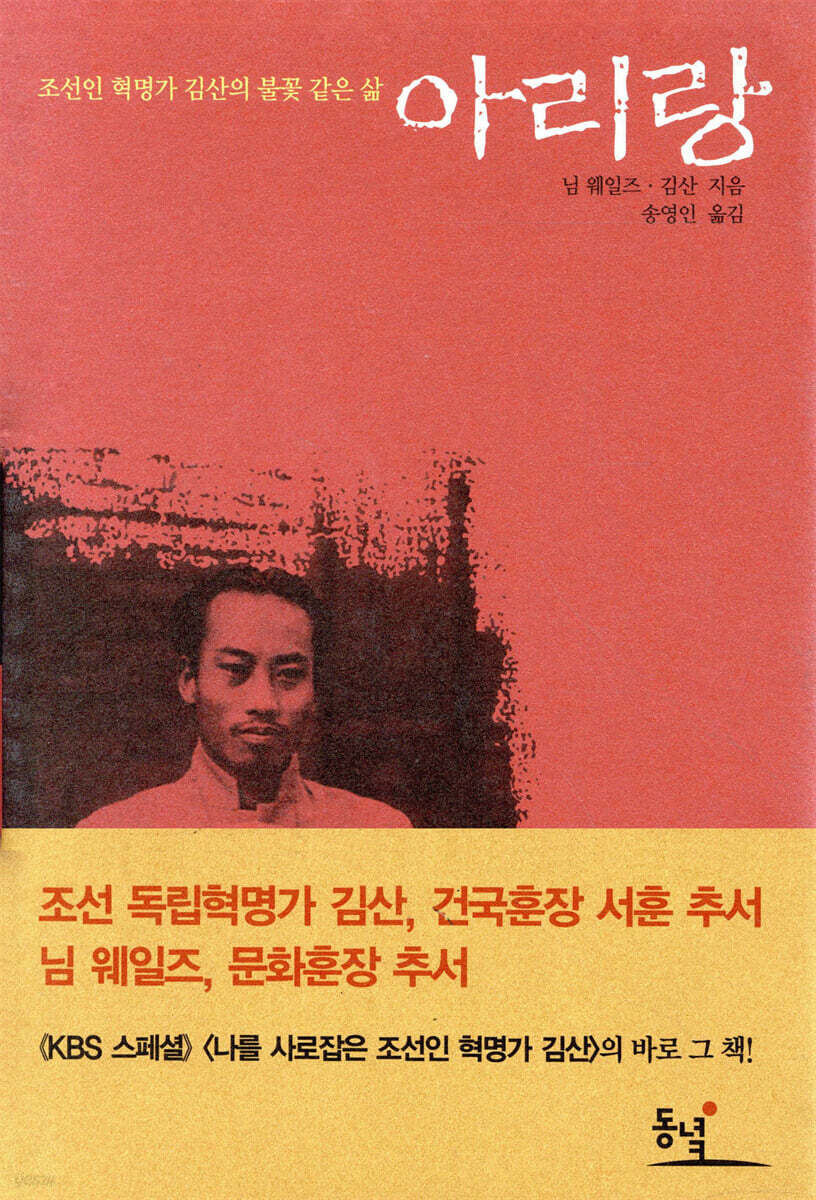 |
Description
Book Introduction
The book 『Arirang』, written by a young woman named Nim Wales, records the life of Kim San (real name Jang Ji-rak), who was reborn as a Korean revolutionary through the struggles and anguish of a young Korean man during the Japanese colonial period.
This book is a vivid biography of an intellectual who thoroughly lived through that era, a record and testimony of the breathless history of East Asia, and the bloody footsteps of a Korean independence revolutionary who lived like a fiery arrow according to the dictates of history.
This book is a vivid biography of an intellectual who thoroughly lived through that era, a record and testimony of the breathless history of East Asia, and the bloody footsteps of a Korean independence revolutionary who lived like a fiery arrow according to the dictates of history.
- You can preview some of the book's contents.
Preview
index
Recommendation / Lee Young-hee
Preface to the Korean edition / Nim Wales
Prologue / Mr. Wales
1.
recall
2.
Childhood in the homeland
3.
Declaration of Independence
4.
When I was studying abroad in Tokyo
5.
Crossing the Yalu River
6.
Shanghai, Mother of Exiles
7.
People who wait for their time
8.
Outstanding Terrorists: Kim Yak-san and Oh Seong-ryun
9.
I will never marry
10.
From Tolstoy to Marx
11.
Participating in the Chinese 'Great Revolution'
12.
Guangdong Commune
13.
Life and Death in the Sea and Land Breeze
14.
Reunion in Shanghai
15.
Dangerous thoughts
16.
Back to Manchuria
17.
Great First Love
18.
Crossing the Arirang Pass
19.
Intra-party struggle and personal struggle
20.
Murder, suicide, despair
21.
Back to the mass movement
22.
Captured by Japan again
23.
Two women
24.
Anti-Japanese Front
25.
Only those who do not become discouraged even when defeated
Ending the Record / Nim Wales
Commentary / George Totten
Translator's Note
Preface to the Korean edition / Nim Wales
Prologue / Mr. Wales
1.
recall
2.
Childhood in the homeland
3.
Declaration of Independence
4.
When I was studying abroad in Tokyo
5.
Crossing the Yalu River
6.
Shanghai, Mother of Exiles
7.
People who wait for their time
8.
Outstanding Terrorists: Kim Yak-san and Oh Seong-ryun
9.
I will never marry
10.
From Tolstoy to Marx
11.
Participating in the Chinese 'Great Revolution'
12.
Guangdong Commune
13.
Life and Death in the Sea and Land Breeze
14.
Reunion in Shanghai
15.
Dangerous thoughts
16.
Back to Manchuria
17.
Great First Love
18.
Crossing the Arirang Pass
19.
Intra-party struggle and personal struggle
20.
Murder, suicide, despair
21.
Back to the mass movement
22.
Captured by Japan again
23.
Two women
24.
Anti-Japanese Front
25.
Only those who do not become discouraged even when defeated
Ending the Record / Nim Wales
Commentary / George Totten
Translator's Note
Publisher's Review
Arirang's third revised edition published after 12 years
Dongnyok Publishing has released a revised third edition of 『Arirang』, which contains the symbolic meaning of the 60th anniversary of liberation and the passionate patriotism of Mr. Kim San (Jang Ji-rak), who was posthumously awarded the Order of Merit for National Foundation, to make it more accessible to more people. This revised third edition, with a completely revised format and layout, was released 12 years after the publication of the revised second edition in 1993, to coincide with Liberation Day on August 15th.
In this third revised edition, we have attempted to transform the book, which is over a decade old, into a binding that is easy to read and view in a contemporary manner.
To achieve this, the format was changed from a new national edition to a hand-held four-letter edition, and the layout of the text was completely re-edited from the previous letterpress font to a font and refreshing lines that are widely read today.
In particular, the cover featured a strong image of Kim San taken in prison at the age of 27, which was not in the previous edition, in an attempt to inform readers of Kim San's real image. In terms of content, the dialogue from the previous edition was refined to fit a modern sensibility, and Chinese names of people and places were modified from Sino-Korean pronunciation to Chinese notation (e.g., Yan'an - Yan'an, Mao Zedong - Mao Zedong).
Lastly, in order to restore the translator's name, who had no choice but to use the pseudonym Jo Woo-hwa while translating this book during the chilling military dictatorship era, I have written it as his real name, Song Young-in.
Through this revision, I sincerely hope that 『Arirang』 will become a book that anyone in high school or older can easily read, and that it will serve as an opportunity to reflect on Kim San's intense life and its meaning, and that as a Korean, I will cherish the passion to 'live as intensely as Kim San.'
History of Arirang
In late 1983, my friend Song Young-in (then under the pseudonym Jo Woo-hwa), who was in hiding as a labor activist, translated 『Song of Arriran』, which had been published in the United States in 1941, and published it in March 1984, despite the chilling National Security Act.
Three months after publication, President Lee Geon-bok was summoned to the agency, and Arirang was classified as a pro-communist book, and a decision was made to ban its sale and return the copy.
Additionally, in the years that followed, Dongnyok Publishing Company was subjected to countless searches and seizures.
In July 1990, President Lee Geon-bok, who confirmed Nim Wales's survival through Professor Lee Young-hee, immediately contacted Nim Wales and asked for her understanding for not being able to inform her of the publication due to the circumstances of the time.
Dongnyok Publishing Company first sent Nim Wales $1,000 as a courtesy fee and then signed a formal publishing contract with Nim Wales.
In July 1990, Mr. Wales sent a letter to Dongnyok Publishing expressing his excitement at receiving his first manuscript fee since writing Arirang.
In 1992, a revised edition was published with a handwritten preface by Nim Wales, photographs by Kim San, a recommendation by Professor Lee Young-hee, and commentary by George Totten.
In the second revised edition in 1993, the authors' names were listed side by side as Nim Wales and Kim San, and the cover was changed from hardcover to wireless binding.
The third revised edition was published on August 15, 2005.
Dongnyok Publishing has released a revised third edition of 『Arirang』, which contains the symbolic meaning of the 60th anniversary of liberation and the passionate patriotism of Mr. Kim San (Jang Ji-rak), who was posthumously awarded the Order of Merit for National Foundation, to make it more accessible to more people. This revised third edition, with a completely revised format and layout, was released 12 years after the publication of the revised second edition in 1993, to coincide with Liberation Day on August 15th.
In this third revised edition, we have attempted to transform the book, which is over a decade old, into a binding that is easy to read and view in a contemporary manner.
To achieve this, the format was changed from a new national edition to a hand-held four-letter edition, and the layout of the text was completely re-edited from the previous letterpress font to a font and refreshing lines that are widely read today.
In particular, the cover featured a strong image of Kim San taken in prison at the age of 27, which was not in the previous edition, in an attempt to inform readers of Kim San's real image. In terms of content, the dialogue from the previous edition was refined to fit a modern sensibility, and Chinese names of people and places were modified from Sino-Korean pronunciation to Chinese notation (e.g., Yan'an - Yan'an, Mao Zedong - Mao Zedong).
Lastly, in order to restore the translator's name, who had no choice but to use the pseudonym Jo Woo-hwa while translating this book during the chilling military dictatorship era, I have written it as his real name, Song Young-in.
Through this revision, I sincerely hope that 『Arirang』 will become a book that anyone in high school or older can easily read, and that it will serve as an opportunity to reflect on Kim San's intense life and its meaning, and that as a Korean, I will cherish the passion to 'live as intensely as Kim San.'
History of Arirang
In late 1983, my friend Song Young-in (then under the pseudonym Jo Woo-hwa), who was in hiding as a labor activist, translated 『Song of Arriran』, which had been published in the United States in 1941, and published it in March 1984, despite the chilling National Security Act.
Three months after publication, President Lee Geon-bok was summoned to the agency, and Arirang was classified as a pro-communist book, and a decision was made to ban its sale and return the copy.
Additionally, in the years that followed, Dongnyok Publishing Company was subjected to countless searches and seizures.
In July 1990, President Lee Geon-bok, who confirmed Nim Wales's survival through Professor Lee Young-hee, immediately contacted Nim Wales and asked for her understanding for not being able to inform her of the publication due to the circumstances of the time.
Dongnyok Publishing Company first sent Nim Wales $1,000 as a courtesy fee and then signed a formal publishing contract with Nim Wales.
In July 1990, Mr. Wales sent a letter to Dongnyok Publishing expressing his excitement at receiving his first manuscript fee since writing Arirang.
In 1992, a revised edition was published with a handwritten preface by Nim Wales, photographs by Kim San, a recommendation by Professor Lee Young-hee, and commentary by George Totten.
In the second revised edition in 1993, the authors' names were listed side by side as Nim Wales and Kim San, and the cover was changed from hardcover to wireless binding.
The third revised edition was published on August 15, 2005.
GOODS SPECIFICS
- Date of issue: August 16, 2005
- Format: Hardcover book binding method guide
- Page count, weight, size: 512 pages | 606g | 137*197*35mm
- ISBN13: 9788972974833
- ISBN10: 8972974838
You may also like
카테고리
korean


korean

![GQ KOREA Mark (Monthly): December [2025]](http://librairie.coreenne.fr/cdn/shop/files/8ef265dbbfbf186523ed75ba7319009d.jpg?v=1765340328&width=3840)


