

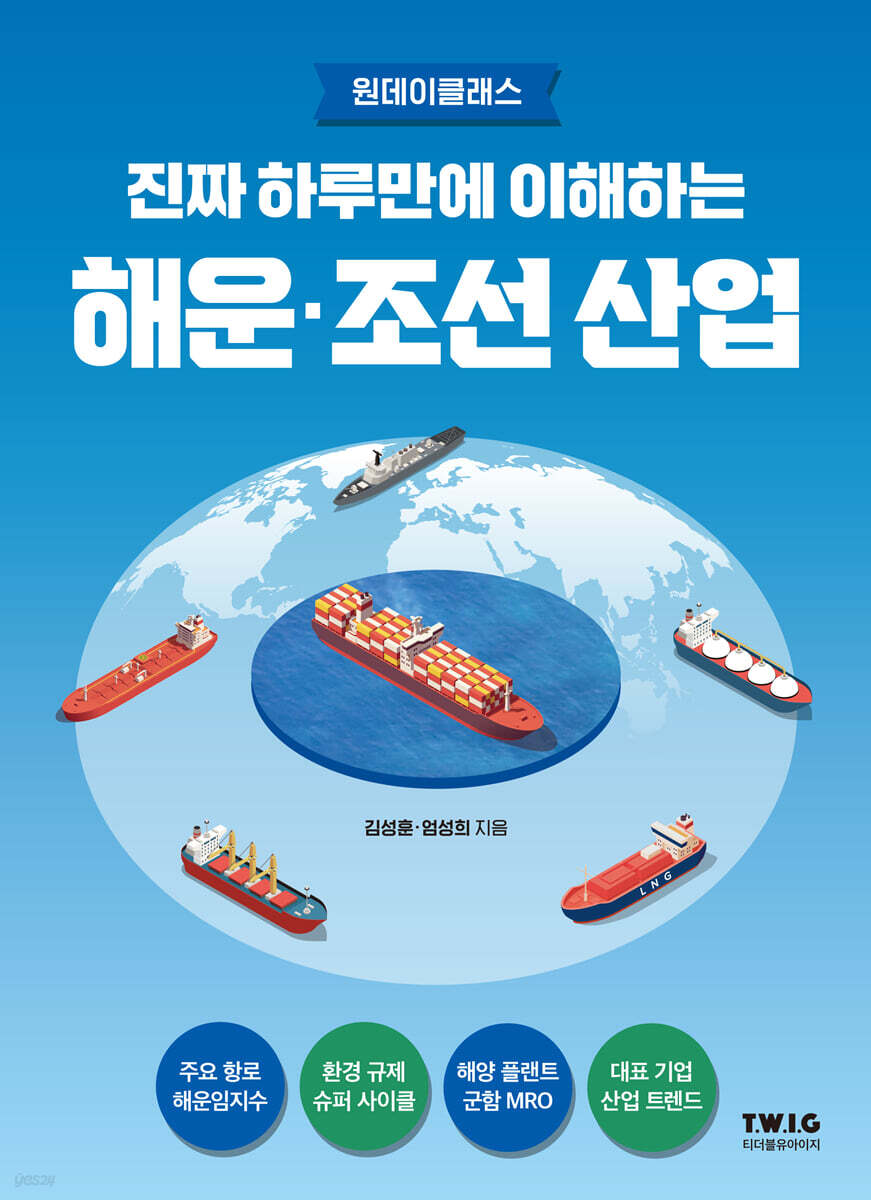
Understanding the Shipping and Shipbuilding Industry in Just One Day
 |
Description
Book Introduction
"The fourth in the industry series! A truly accessible book that explains the big picture and core concepts of the shipping and shipbuilding industries!"
More than 80% of global trade is transported by sea.
And the industries that make this massive maritime transport possible are the shipping and shipbuilding industries.
The shipping industry connects the world by transporting goods and resources, and the shipbuilding industry supports this industry by building massive ships.
In this way, the shipping and shipbuilding industries are closely interconnected and serve as arteries connecting the global economy.
In particular, the shipping and shipbuilding industries play a key role in the Korean economy.
Due to its limited resources, Korea imports most of its energy and raw materials from abroad. At the same time, it has an export-driven economic structure, exporting a variety of products, including semiconductors, automobiles, and petrochemicals, to the world.
Additionally, due to the geopolitical situation of being surrounded by the sea and being divided into North and South, 99.7% of import and export cargo depends on maritime transport.
But despite its importance, we know too little about the shipping and shipbuilding industries.
Even when reading news or analyst reports, we are often overwhelmed by unfamiliar terms like DWT, CGT, SCFI, BDI, tanker, newbuilding price, cargo hold, Panamax, FPSO, bulk carrier, MRO, etc., and are unable to fully understand the content.
How on earth should I study shipping and shipbuilding?
You have to understand the big picture first.
You can't get the answer by looking at the trees without knowing the forest.
It's like having a world map makes it easy to understand the relationships and structures of each country, but without a world map, no matter how much you study each country, you can't grasp the overall concept.
『Understanding the Shipping and Shipbuilding Industry in Just One Day』 was born with this planning intention.
We've made it as easy as possible to understand the industry's big picture and core concepts, using a variety of examples and abundant illustrations to help even non-experts understand it.
I hope this book will faithfully fulfill its role as a compass for policymakers, a microscope for businesspeople and investors to examine opportunities and risks, and a navigation system for job seekers exploring their career paths.
More than 80% of global trade is transported by sea.
And the industries that make this massive maritime transport possible are the shipping and shipbuilding industries.
The shipping industry connects the world by transporting goods and resources, and the shipbuilding industry supports this industry by building massive ships.
In this way, the shipping and shipbuilding industries are closely interconnected and serve as arteries connecting the global economy.
In particular, the shipping and shipbuilding industries play a key role in the Korean economy.
Due to its limited resources, Korea imports most of its energy and raw materials from abroad. At the same time, it has an export-driven economic structure, exporting a variety of products, including semiconductors, automobiles, and petrochemicals, to the world.
Additionally, due to the geopolitical situation of being surrounded by the sea and being divided into North and South, 99.7% of import and export cargo depends on maritime transport.
But despite its importance, we know too little about the shipping and shipbuilding industries.
Even when reading news or analyst reports, we are often overwhelmed by unfamiliar terms like DWT, CGT, SCFI, BDI, tanker, newbuilding price, cargo hold, Panamax, FPSO, bulk carrier, MRO, etc., and are unable to fully understand the content.
How on earth should I study shipping and shipbuilding?
You have to understand the big picture first.
You can't get the answer by looking at the trees without knowing the forest.
It's like having a world map makes it easy to understand the relationships and structures of each country, but without a world map, no matter how much you study each country, you can't grasp the overall concept.
『Understanding the Shipping and Shipbuilding Industry in Just One Day』 was born with this planning intention.
We've made it as easy as possible to understand the industry's big picture and core concepts, using a variety of examples and abundant illustrations to help even non-experts understand it.
I hope this book will faithfully fulfill its role as a compass for policymakers, a microscope for businesspeople and investors to examine opportunities and risks, and a navigation system for job seekers exploring their career paths.
- You can preview some of the book's contents.
Preview
index
prolog
PART 01 Basic Knowledge for Understanding the Shipping Industry
1.
Definition of the shipping industry
2.
Type of ship
container ship
bulk carrier
tanker ship
gas carrier
Other vessels
3.
Major routes
English Channel
Strait of Malacca
Strait of Hormuz
Suez Canal
Panama Canal
4.
Size of the ship
Classification by tonnage
Size classification by type of ship
5.
The price and construction period of the ship
6.
Ship operation
7.
Life of the ship
8.
Shipping rate index
Container ships - SCFI, CCFI, HRCI
Bulk carrier - BDI
Tanker ships - WS, BDTI, BCTI
Gas carriers - BLNG, BLPG
9.
Understanding the Port
▶Just the essentials!
▶One step further!
PART 02 Mechanisms that drive the shipping industry
1.
Shipping industry cycle
2.
Factors affecting supply and demand
Demand side
supply side
3.
Various indicators for assessing shipping market conditions
New ship prices and used ship prices
regular charter fees
Scrap rate and average ship age
Average operating speed
4.
Super cycles through examples
2002~2004
2006~2008
2009~2020
2021~2022
Late 2023~2024
▶Just the essentials!
▶One step further!
PART 03 Global Representative Companies & Future Direction
1.
Representative companies
container ship
bulk carrier
crude oil tanker
Product carrier
LNG carrier
LPG carrier
car carrier
domestic companies
port operating companies
2.
Competitiveness by country
3.
shipping alliance
What is a shipping alliance?
Status of shipping alliances
4.
The direction the shipping industry is heading
Environmental regulations and eco-friendly ships
Smartization
▶Just the essentials!
▶One step further!
PART 04 Basic knowledge for understanding the shipbuilding industry
1.
Characteristics of the shipbuilding industry
2.
Ship ordering and ship financing
Ship ordering process
ship finance
3.
Shipbuilding process
design
Processing (pretreatment, cutting, and forming of steel plates)
Assembly (making blocks)
Preceding Chairman and Preceding Seal
Mounting and drying of blocks
Trailing Chairman and Trailing Seal
Jinsu and berth chairman
Offshore trials and delivery
4.
Ship's equipment
engine
Major equipment
▶Just the essentials!
▶One step further!
PART 05 Marine Plant, Ship Repair, and Warship Markets
1.
Marine plants
Drilling and production facilities
Fixed and floating
2.
ship repair
Ship repair and its types
Market characteristics
growth factors
Major countries
3.
warship market
Types of warships
US warship MRO project
▶Just the essentials!
▶One step further!
PART 06 Global Representative Companies & Future Direction
1.
Leading shipbuilding company
Overall ranking
Ranking by Zen sect
2.
Representative equipment company
engine
Major equipment
3.
The direction in which the shipbuilding industry is moving
Environmental regulations and eco-friendly ships
Super cycle
Korea-China-Japan hegemony war
▶Just the essentials!
▶One step further!
Appendix - The Beginning of Korea's Shipbuilding Industry, Chung Ju-yung
Epilogue 1
Epilogue 2
References
PART 01 Basic Knowledge for Understanding the Shipping Industry
1.
Definition of the shipping industry
2.
Type of ship
container ship
bulk carrier
tanker ship
gas carrier
Other vessels
3.
Major routes
English Channel
Strait of Malacca
Strait of Hormuz
Suez Canal
Panama Canal
4.
Size of the ship
Classification by tonnage
Size classification by type of ship
5.
The price and construction period of the ship
6.
Ship operation
7.
Life of the ship
8.
Shipping rate index
Container ships - SCFI, CCFI, HRCI
Bulk carrier - BDI
Tanker ships - WS, BDTI, BCTI
Gas carriers - BLNG, BLPG
9.
Understanding the Port
▶Just the essentials!
▶One step further!
PART 02 Mechanisms that drive the shipping industry
1.
Shipping industry cycle
2.
Factors affecting supply and demand
Demand side
supply side
3.
Various indicators for assessing shipping market conditions
New ship prices and used ship prices
regular charter fees
Scrap rate and average ship age
Average operating speed
4.
Super cycles through examples
2002~2004
2006~2008
2009~2020
2021~2022
Late 2023~2024
▶Just the essentials!
▶One step further!
PART 03 Global Representative Companies & Future Direction
1.
Representative companies
container ship
bulk carrier
crude oil tanker
Product carrier
LNG carrier
LPG carrier
car carrier
domestic companies
port operating companies
2.
Competitiveness by country
3.
shipping alliance
What is a shipping alliance?
Status of shipping alliances
4.
The direction the shipping industry is heading
Environmental regulations and eco-friendly ships
Smartization
▶Just the essentials!
▶One step further!
PART 04 Basic knowledge for understanding the shipbuilding industry
1.
Characteristics of the shipbuilding industry
2.
Ship ordering and ship financing
Ship ordering process
ship finance
3.
Shipbuilding process
design
Processing (pretreatment, cutting, and forming of steel plates)
Assembly (making blocks)
Preceding Chairman and Preceding Seal
Mounting and drying of blocks
Trailing Chairman and Trailing Seal
Jinsu and berth chairman
Offshore trials and delivery
4.
Ship's equipment
engine
Major equipment
▶Just the essentials!
▶One step further!
PART 05 Marine Plant, Ship Repair, and Warship Markets
1.
Marine plants
Drilling and production facilities
Fixed and floating
2.
ship repair
Ship repair and its types
Market characteristics
growth factors
Major countries
3.
warship market
Types of warships
US warship MRO project
▶Just the essentials!
▶One step further!
PART 06 Global Representative Companies & Future Direction
1.
Leading shipbuilding company
Overall ranking
Ranking by Zen sect
2.
Representative equipment company
engine
Major equipment
3.
The direction in which the shipbuilding industry is moving
Environmental regulations and eco-friendly ships
Super cycle
Korea-China-Japan hegemony war
▶Just the essentials!
▶One step further!
Appendix - The Beginning of Korea's Shipbuilding Industry, Chung Ju-yung
Epilogue 1
Epilogue 2
References
Detailed image

Publisher's Review
“Understand the shipping and shipbuilding industries in just one day!”
We've explained the big picture and core concepts of the shipping and shipbuilding industries in the simplest possible way, using a variety of examples and abundant illustrations.
After reading this book, you will understand everything covered in shipping and shipbuilding-related news and analyst reports.
Highly recommended for investors, job seekers, and industry professionals interested in shipping and shipbuilding.
We've explained the big picture and core concepts of the shipping and shipbuilding industries in the simplest possible way, using a variety of examples and abundant illustrations.
After reading this book, you will understand everything covered in shipping and shipbuilding-related news and analyst reports.
Highly recommended for investors, job seekers, and industry professionals interested in shipping and shipbuilding.
GOODS SPECIFICS
- Date of issue: June 23, 2025
- Page count, weight, size: 360 pages | 170*234*21mm
- ISBN13: 9791191590319
- ISBN10: 1191590313
You may also like
카테고리
korean


korean

![ELLE 엘르 스페셜 에디션 A형 : 12월 [2025]](http://librairie.coreenne.fr/cdn/shop/files/b8e27a3de6c9538896439686c6b0e8fb.jpg?v=1766436872&width=3840)


