

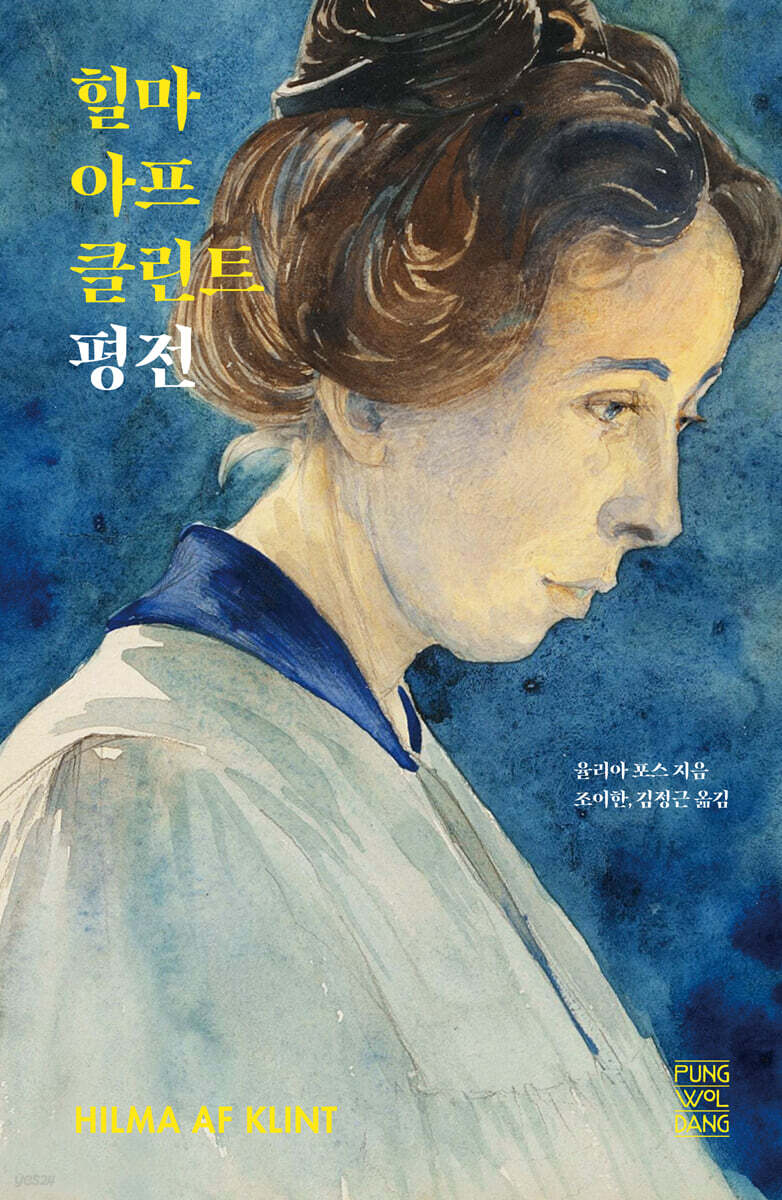
Hilma af Klint's Biography
 |
Description
Book Introduction
“People will be amazed by the attempts I have made.”
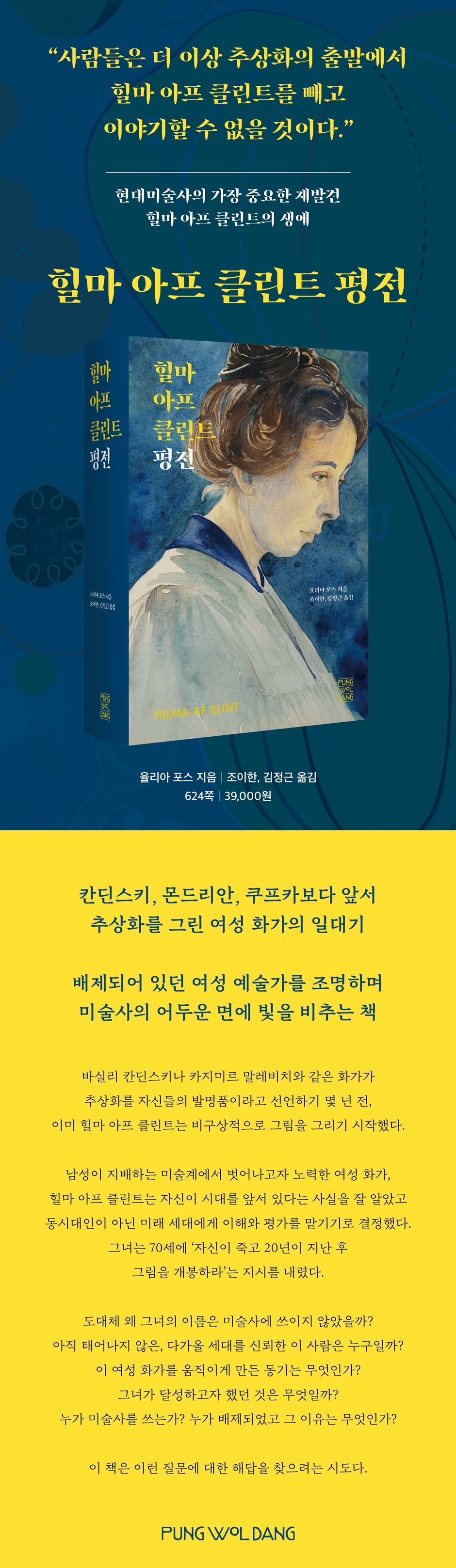
The most important rediscovery in modern art history: the life of Hilma af Klint.
Hilma af Klint is one of the most important rediscoveries in the history of modern art.
The Hilma af Klint retrospective held at the Solomon R. Guggenheim Museum in New York in 2018 recorded the largest number of visitors since its opening.
The exhibition catalog became the museum's best-selling book.
Since 2019, Af Klint's paintings have been on loan to the Museum of Modern Art in New York's New Collections Gallery, propelling the outsider of art history into stardom.
Hilma af Klint, a Swedish female painter who began abstract painting before Kandinsky, Mondrian, and Malevich, had been thoroughly excluded from existing art history until then.
Af Klint's unusual paintings were only widely shared and disseminated by future generations who visited the museum.
Many questions followed.
What motivated this female artist? What did she hope to achieve? Who writes art history? Who was excluded, and why?
Based on extensive research, Hilma af Klint: A Biography tells the extraordinary life of an exceptional artist, shatters stereotypes and myths about artists.
This book will be your key to the life of Hilma af Klint, bringing the past vividly into the future that has become the present.
It is your job to turn your gaze to the excluded history and look into the world that has been invisible.
The most important rediscovery in modern art history: the life of Hilma af Klint.
Hilma af Klint is one of the most important rediscoveries in the history of modern art.
The Hilma af Klint retrospective held at the Solomon R. Guggenheim Museum in New York in 2018 recorded the largest number of visitors since its opening.
The exhibition catalog became the museum's best-selling book.
Since 2019, Af Klint's paintings have been on loan to the Museum of Modern Art in New York's New Collections Gallery, propelling the outsider of art history into stardom.
Hilma af Klint, a Swedish female painter who began abstract painting before Kandinsky, Mondrian, and Malevich, had been thoroughly excluded from existing art history until then.
Af Klint's unusual paintings were only widely shared and disseminated by future generations who visited the museum.
Many questions followed.
What motivated this female artist? What did she hope to achieve? Who writes art history? Who was excluded, and why?
Based on extensive research, Hilma af Klint: A Biography tells the extraordinary life of an exceptional artist, shatters stereotypes and myths about artists.
This book will be your key to the life of Hilma af Klint, bringing the past vividly into the future that has become the present.
It is your job to turn your gaze to the excluded history and look into the world that has been invisible.
- You can preview some of the book's contents.
Preview
index
The Life Journey of Hilma af Klint
Introduction
Five Things You Need to Know About Hilma af Klint
preface
Return to Uppsala
I.
Family history, childhood and youth in Stockholm
Mary Wollstonecraft visits Sweden and is upset.
Great-grandfather Eric Clint was ennobled
birth
Academics and Faith
An exhibition held in London
Bertha Valerius and the Dead
Kerstin Cardon's School of Painting
Hermina dies
II.
Academic and Independent Period at the Academy
Academy
Guardian spirit
receive an award
Anna Cassel
First experience as a medium in 1891
My days in the atelier and traveling
Dr. Helladay and Love
5-person group
Art from the East
Roses and Crosses
Time spent at the Veterinary Research Institute
Children's books and decorative arts
Italy
genius
III.
Paintings for the temple
Old paintings
revolution
First chaos
Eros
spirit medium
Ten large paintings
I was a tool of the mindless realm
Rudolf Steiner visits Sweden
youth faction
Sigrid Lansen
Women Artists Association
Frank Heimann
A kingdom built on an island in Lake Mälaren
The first exhibition held at a gathering of Theosophists
Tree of Awareness
kiss
Singoala
Baltic Sea Exhibition
war
St. George
Kandinsky staying in Stockholm
Parsifal and the Atom
Atelier building on Moonsoe Island
Thomasine Andersson
IV.
Dornach, Amsterdam and London
An art gallery in a suitcase
Flowers, moss, lichens
My first visit to the Goetheanum
S = Schlange = Ormen
Fire and Letter
Amsterdam
London
V.
Temple and the Afterlife
Temple and Spiral
+x
Temple built in New York
Lightning over London
future humans
Nazism
Speech given in Stockholm
German 'mutant' art and New York abstract art
Plans for the Tura Clean and Art Museum
The last few months
Concluding remarks
Addendum by Johann af Klint
Addendum by Ulrika af Klint
Acknowledgements
List of Hilma af Klint's travel destinations and residences
Hilma af Klint's collection
References
List of illustrations and photographs
Translator's Note
Introduction
Five Things You Need to Know About Hilma af Klint
preface
Return to Uppsala
I.
Family history, childhood and youth in Stockholm
Mary Wollstonecraft visits Sweden and is upset.
Great-grandfather Eric Clint was ennobled
birth
Academics and Faith
An exhibition held in London
Bertha Valerius and the Dead
Kerstin Cardon's School of Painting
Hermina dies
II.
Academic and Independent Period at the Academy
Academy
Guardian spirit
receive an award
Anna Cassel
First experience as a medium in 1891
My days in the atelier and traveling
Dr. Helladay and Love
5-person group
Art from the East
Roses and Crosses
Time spent at the Veterinary Research Institute
Children's books and decorative arts
Italy
genius
III.
Paintings for the temple
Old paintings
revolution
First chaos
Eros
spirit medium
Ten large paintings
I was a tool of the mindless realm
Rudolf Steiner visits Sweden
youth faction
Sigrid Lansen
Women Artists Association
Frank Heimann
A kingdom built on an island in Lake Mälaren
The first exhibition held at a gathering of Theosophists
Tree of Awareness
kiss
Singoala
Baltic Sea Exhibition
war
St. George
Kandinsky staying in Stockholm
Parsifal and the Atom
Atelier building on Moonsoe Island
Thomasine Andersson
IV.
Dornach, Amsterdam and London
An art gallery in a suitcase
Flowers, moss, lichens
My first visit to the Goetheanum
S = Schlange = Ormen
Fire and Letter
Amsterdam
London
V.
Temple and the Afterlife
Temple and Spiral
+x
Temple built in New York
Lightning over London
future humans
Nazism
Speech given in Stockholm
German 'mutant' art and New York abstract art
Plans for the Tura Clean and Art Museum
The last few months
Concluding remarks
Addendum by Johann af Klint
Addendum by Ulrika af Klint
Acknowledgements
List of Hilma af Klint's travel destinations and residences
Hilma af Klint's collection
References
List of illustrations and photographs
Translator's Note
Detailed image
Into the book
But she had no interest in creating illusions.
Rather, it was the opposite.
Nothing she created with her brush belonged to reality as people knew it.
She had a natural talent for seeing things not as they are, but as they could be.
Her work does not deal with objects or boundaries.
In her work, life appears undistorted, vibrantly moving and beautiful, buzzing, buzzing and spinning.
--- p.34
Hilma af Klint, wearing buttoned-up clothes up to her neck, looks at the men wearing nothing but a small piece of cloth and draws them.
She and a dozen other female students periodically look at the male model.
This is an arrangement that turns art history upside down.
A clothed woman drawing a naked man.
What tradition is this scene based on? Many male artists and professors have deemed it unsightly, unnatural, and grotesque.
It is for this very reason that royal academies of art elsewhere in Europe continued to reject women.
--- p.129
Hilma af Klint did not portray the king's daughter with the wide, terrified eyes that usually seek the viewer's gaze, as if helplessly pleading.
The Andromeda she drew turns its head towards the sea.
She acts professionally, like a captain who is cool, cautious, and tries to figure out the situation without believing in sea monsters or anything like that.
No tears, no pleading, no shaking of the feet or twisting of the body.
Andromeda's attitude does not at all indicate that her life is in danger.
She is standing upright.
From the figure of the victim, a female hero emerged, a master in control of the situation.
In the long history of art, no one had ever thought of showing a princess, unafraid, waiting for a sea monster.
--- p.139~140
In contrast, the works of female artists were relegated to the farthest corners of the labyrinthine exhibition hall, two small spaces next to the stairs and the emergency exit.
In order to ensure that no member of the association was excluded, the walls were densely hung with a total of 200 paintings.
Although Af Klint is no longer a member after leaving the group, one of her paintings is on display.
But finding that picture is as hard as finding a needle in a haystack.
--- p.352
Isn't this artist's life a reckless struggle? Hilma af Klint is 64, but despite all her circumstances, she hasn't lost her greatest strength: the ability to start and see things through.
Every rejection is a beginning.
Every ending is also a beginning.
This artist seems to lack the patience needed to finish his work.
She keeps losing sight of patience, and patience is ebbing away like the tide.
One plan leads to the next, and she continues to open up new territory in a constantly changing form.
--- p.425~426
Little did the painter in Stockholm know that at the same time, on the other side of the Atlantic, the doors were wide open for explicitly non-figurative painting.
(…) From now on, the canon of art that will be formed in New York will be determined by Alfred Barr’s perspective on history.
Abstraction would be regarded as a formalist experiment for decades to come, with Kandinsky, Mondrian, Malevich and Kupka proclaimed as its inventors.
As with spiritual beings and spiritual values, there is no place for women there.
Rather, it was the opposite.
Nothing she created with her brush belonged to reality as people knew it.
She had a natural talent for seeing things not as they are, but as they could be.
Her work does not deal with objects or boundaries.
In her work, life appears undistorted, vibrantly moving and beautiful, buzzing, buzzing and spinning.
--- p.34
Hilma af Klint, wearing buttoned-up clothes up to her neck, looks at the men wearing nothing but a small piece of cloth and draws them.
She and a dozen other female students periodically look at the male model.
This is an arrangement that turns art history upside down.
A clothed woman drawing a naked man.
What tradition is this scene based on? Many male artists and professors have deemed it unsightly, unnatural, and grotesque.
It is for this very reason that royal academies of art elsewhere in Europe continued to reject women.
--- p.129
Hilma af Klint did not portray the king's daughter with the wide, terrified eyes that usually seek the viewer's gaze, as if helplessly pleading.
The Andromeda she drew turns its head towards the sea.
She acts professionally, like a captain who is cool, cautious, and tries to figure out the situation without believing in sea monsters or anything like that.
No tears, no pleading, no shaking of the feet or twisting of the body.
Andromeda's attitude does not at all indicate that her life is in danger.
She is standing upright.
From the figure of the victim, a female hero emerged, a master in control of the situation.
In the long history of art, no one had ever thought of showing a princess, unafraid, waiting for a sea monster.
--- p.139~140
In contrast, the works of female artists were relegated to the farthest corners of the labyrinthine exhibition hall, two small spaces next to the stairs and the emergency exit.
In order to ensure that no member of the association was excluded, the walls were densely hung with a total of 200 paintings.
Although Af Klint is no longer a member after leaving the group, one of her paintings is on display.
But finding that picture is as hard as finding a needle in a haystack.
--- p.352
Isn't this artist's life a reckless struggle? Hilma af Klint is 64, but despite all her circumstances, she hasn't lost her greatest strength: the ability to start and see things through.
Every rejection is a beginning.
Every ending is also a beginning.
This artist seems to lack the patience needed to finish his work.
She keeps losing sight of patience, and patience is ebbing away like the tide.
One plan leads to the next, and she continues to open up new territory in a constantly changing form.
--- p.425~426
Little did the painter in Stockholm know that at the same time, on the other side of the Atlantic, the doors were wide open for explicitly non-figurative painting.
(…) From now on, the canon of art that will be formed in New York will be determined by Alfred Barr’s perspective on history.
Abstraction would be regarded as a formalist experiment for decades to come, with Kandinsky, Mondrian, Malevich and Kupka proclaimed as its inventors.
As with spiritual beings and spiritual values, there is no place for women there.
--- p.505
Publisher's Review
Hilma af clintrani!
Was there a painter with that name?
Why on earth is her name not written in art history?
Who is this man who trusted in the coming generation, who has not yet been born?
What motivated this spiritual painter?
What was she trying to achieve?
Who writes art history? Who is excluded, and why?
This book is an attempt to find answers to these questions.
The most important rediscovery in modern art history: the life of Hilma af Klint.
“First of all, I will try to understand the flowers of the earth, starting from the plants of the earth.
Then we will try to study in the same detail what lives in the water on Earth.
Next, the blue sky with its numerous animal figures will become the subject of my research.
And finally, we will go into the forest, study the silent moss, and study the animals that live in the trees and cold, dark undergrowth.”
“Art history must be rewritten.”
Hilma af Klint was a revolutionary genius, but a completely forgotten painter.
For just three years now, her presence and paintings have been generating a lot of buzz worldwide.
Hilma af Klint was an abstract painter before Kandinsky.
Why was she so unknown? There's only one reason: Hilma af Klint was a woman.
As Europe experienced turmoil, including repeated revolutions and two world wars, the flow of modern art shifted to the United States.
World art is defined by the views of Alfred Bahr, who was the first director of the Museum of Modern Art in New York at the time.
This illustrates the consequences of people in positions of influence being narrow-minded or biased.
In defining abstract art, he proclaims Kandinsky, Mondrian, and Malevich as its founders.
Even though there were women who painted abstract paintings before or around the same time as them.
There was no place for women in Bar's praise.
A female artist who tried to escape the male-dominated art world.
Hilma af Klint was educated in a wealthy environment and was an intelligent woman who was good at drawing from a young age, but was also interested in natural science, humanities, and prophecy.
Although many European art academies still refused to admit women, she entered the Royal Academy of Fine Arts in Stockholm.
As a painter, she created some of the most original and forward-thinking paintings of her time.
But in the authoritarian art world, Af Klint was always discriminated against 'because she was a woman.'
At an event showcasing the works of some 200 Academy members, only two of her paintings were displayed in the most remote corners of the exhibition hall, next to the stairwell and the emergency exit.
Of course, no one could be interested in her.
Painting for the next generation
Amidst this unfair treatment, Hilma af Klint leaves the art association.
But she didn't stop drawing.
Instead, I draw pictures by myself.
Break away from the established art world and don't interact with anyone.
Af Klint began to paint pictures that, in his own judgment, were timeless.
I didn't paint to sell.
But she knew that one day her paintings would be appreciated and displayed permanently.
However, he thought that his contemporaries did not have the eyes to appreciate his paintings.
Therefore, her paintings were for the next generation.
“Open the painting 20 years after I die.”
In 1932, at the age of 70, Hilma organized all her paintings herself.
Get rid of a lot of records and notes, and re-classify and organize the pictures.
Then, mark +X with a pencil on your notebook.
And he writes, “This marked painting should be opened 20 years after my death.”
It was like putting something in a time capsule and sending it into space or burying it underground.
According to Af Klint's will, all of her paintings were bequeathed to her nephew, Vice Admiral Erik af Klint of the Swedish Navy.
And the nephew faithfully carried out his aunt's will.
Eric kept his aunt's paintings safe from anyone's reach, and after 20 years, the sealed boxes were opened.
It doesn't appear in textbooks or art history books.
600,000 people flock to the painter's retrospective!
The 2018 Hilma af Klint retrospective at the renowned Guggenheim Museum in New York attracted 600,000 visitors, the largest attendance in the museum's history.
This is an exhibition of a painter who doesn't appear in textbooks or art history books.
Her art collection has become the museum's best-selling catalog since its opening.
Additionally, her paintings have been on tour in major European cities since 2019, attracting over 10 million visitors.
Just one exhibition has brought art history and art textbooks to a point where they need to be revised.
Hilma af Klint was the first to start abstract art, and she painted more beautiful pictures than anyone else.
And they are now visible to all.
The Hilma af Klint craze continues in Korea!
Interest in Hilma af Klint is just beginning.
Especially in her home country, she is still little known.
I will not speak of the tragic private life and mysterious anecdotes of her later life.
As readers read this biography, I hope they will discover the fascinating life of a truly fascinating artist and the magnificent life of an unfortunate woman born in the wrong era.
Getting to know an artist is not only about getting to know a person and his life, but also about an era and society, and furthermore, it leads to an understanding of art in general.
This is the value of a biography.
Here is a book about the most brilliant and outstanding woman in the world, yet she was abandoned by the world.
It contains all of one woman's hopes, glory, and torn pain.
A Crucial Rediscovery of Modern Art History: Hilma af Klint
Hilma af Klint is one of the most important rediscoveries in the history of modern art.
The Hilma af Klint retrospective held at the Solomon R. Guggenheim Museum in New York in 2018 recorded the largest number of visitors since its opening.
The exhibition catalog became the museum's best-selling book.
Since 2019, Af Klint's paintings have been on loan to the Museum of Modern Art in New York's New Collections exhibition, propelling the outsider of art history into stardom.
Hilma af Klint, a Swedish female painter who began abstract painting before Kandinsky, Mondrian, and Malevich, had been thoroughly excluded from existing art history until then.
Af Klint's unusual paintings were only widely shared and disseminated by future generations who visited the museum.
Many questions followed.
What motivated this female artist? What did she hope to achieve? Who writes art history? Who was excluded, and why?
Drawing the invisible dimension
Darwin's announcement of the theory of evolution, proof of the existence of atoms, discovery of Roentgen, invention of the microscope and incandescent light bulb...
From the late 19th century to the early 20th century, science made remarkable progress.
This made it possible to confirm existences that had previously been invisible to the eye, and those who believed in the spiritual world or souls were convinced that invisible things powerfully worked to shape humans and the world.
Those who believed that the invisible dimension was more important created 'Theosophy' or 'Anthroposophy'.
The figures in modern art who began abstract art in the early 20th century are those who sympathized with or paid attention to the trend that emphasized that spirit.
In the midst of that flow was Hilma af Klint.
She developed her own theories of spiritualism and was an artist with a rare level of knowledge and understanding of natural science for her time.
He attempted to harmonize spirituality and scientific knowledge, and left his view of the universe in drawings.
Af Klint knew that there were phenomena that could not be expressed in words, and he painted what could not be expressed.
She had no interest in creating illusions, and what she painted did not belong to the reality people knew.
Af Klint had a natural talent for seeing things not as they are, but as they 'could be'.
Her work is directed not at the subject or the boundaries, but at the 'invisible'.
Excluded Women Painters and the Unrecorded History of Abstraction
In such a time, female painters such as Georgiana Hutton and Hilma af Klint pioneered the development of abstract art.
However, women were ultimately excluded from the history of abstract art.
It was a time when the movement for women's suffrage was taking place in Sweden, and only men were appointed as teachers in the academy.
The works of female artists were often pushed to the farthest corners of the labyrinthine exhibition hall, next to the stairs and emergency exits.
Karin, the wife of the painter Carl Larsson, once attempted to become a painter as a student at the Stockholm Academy, but after marrying Carl Larsson, she was stripped of her identity as a painter and was reduced to a model for her husband's paintings.
In the midst of the turbulent world history of revolution and world war, the leadership of art shifted to New York, USA.
From then on, the flow of art was determined by the views of Alfred Barr, the first director of the Museum of Modern Art in New York.
Abstract art was later seen as a formalist experiment in the following decades, with Kandinsky, Mondrian, Malevich and Kupka being 'proclaimed' as its inventors.
There is no place for women there.
The spiritual and feminine irrationality that dominated the flow of abstract art was eliminated, and the leading role in interpretation was transferred to abstract art as a formal experiment based on masculine reason and logic.
Turning our gaze to the next generation and the future
Despite this, Hilma af Klint never gave up drawing.
Every rejection becomes a beginning.
She worked with the intention of creating works that would be permanently collected in a museum, not for sale.
He archived his drawings by transferring them to small albums so that he could take them out and show them at any time.
But in the end, she says goodbye to the contemporary art world.
It seeks greater meaning than simply occupying a firm place in the history of painting.
It sought to break down rigid systems of thought and order, including the dichotomies of gender, class, materialism, capitalism, and East and West.
Hilma af Klint chooses the next generation over those who do not understand her paintings.
She did not doubt her own work, but she doubted and decided the meaning of her contemporaries.
In 1932, Hilma af Klint marked a +x in pencil in her notebook and wrote an explanation below it.
“All works marked above should be opened 20 years after my death.” Her works were placed in a time capsule and launched into the future.
Both the understanding of the work that initiated the history of abstract art and the evaluation of the figure who pioneered women's lives by not giving up are now the responsibility of future generations.
Viewing the artist's life through the eyes of future generations
The baton passed by Hilma af Klint is now in our hands.
It is important not only to appreciate and try to understand the work, but also to talk about the individual who created the work and his or her life.
Women's lives have not been a topic of conversation for a very long time.
As a result, people have come to believe that there is nothing to talk about when it comes to women.
Not only the work, but also the individual artist was underestimated.
Because the creation, history, events, or relationship of the work to other artists and their work is not conveyed, art quickly becomes a personal affair.
Without information, context, and surroundings, the entire work is diminished.
As a result, the work becomes smaller and smaller, unviewable, and meaningless.
Based on extensive research, Hilma af Klint: A Biography tells the extraordinary life of an exceptional artist, shatters stereotypes and myths about artists.
This book will be your key to the life of Hilma af Klint, bringing the past vividly into the future that has become the present.
It is your job to turn your gaze to the excluded history and look into the world that has been invisible.
“I am very small and insignificant, but I feel a great force flowing within me that compels me to move forward.” - Hilma af Klint (1862-1944)
Was there a painter with that name?
Why on earth is her name not written in art history?
Who is this man who trusted in the coming generation, who has not yet been born?
What motivated this spiritual painter?
What was she trying to achieve?
Who writes art history? Who is excluded, and why?
This book is an attempt to find answers to these questions.
The most important rediscovery in modern art history: the life of Hilma af Klint.
“First of all, I will try to understand the flowers of the earth, starting from the plants of the earth.
Then we will try to study in the same detail what lives in the water on Earth.
Next, the blue sky with its numerous animal figures will become the subject of my research.
And finally, we will go into the forest, study the silent moss, and study the animals that live in the trees and cold, dark undergrowth.”
“Art history must be rewritten.”
Hilma af Klint was a revolutionary genius, but a completely forgotten painter.
For just three years now, her presence and paintings have been generating a lot of buzz worldwide.
Hilma af Klint was an abstract painter before Kandinsky.
Why was she so unknown? There's only one reason: Hilma af Klint was a woman.
As Europe experienced turmoil, including repeated revolutions and two world wars, the flow of modern art shifted to the United States.
World art is defined by the views of Alfred Bahr, who was the first director of the Museum of Modern Art in New York at the time.
This illustrates the consequences of people in positions of influence being narrow-minded or biased.
In defining abstract art, he proclaims Kandinsky, Mondrian, and Malevich as its founders.
Even though there were women who painted abstract paintings before or around the same time as them.
There was no place for women in Bar's praise.
A female artist who tried to escape the male-dominated art world.
Hilma af Klint was educated in a wealthy environment and was an intelligent woman who was good at drawing from a young age, but was also interested in natural science, humanities, and prophecy.
Although many European art academies still refused to admit women, she entered the Royal Academy of Fine Arts in Stockholm.
As a painter, she created some of the most original and forward-thinking paintings of her time.
But in the authoritarian art world, Af Klint was always discriminated against 'because she was a woman.'
At an event showcasing the works of some 200 Academy members, only two of her paintings were displayed in the most remote corners of the exhibition hall, next to the stairwell and the emergency exit.
Of course, no one could be interested in her.
Painting for the next generation
Amidst this unfair treatment, Hilma af Klint leaves the art association.
But she didn't stop drawing.
Instead, I draw pictures by myself.
Break away from the established art world and don't interact with anyone.
Af Klint began to paint pictures that, in his own judgment, were timeless.
I didn't paint to sell.
But she knew that one day her paintings would be appreciated and displayed permanently.
However, he thought that his contemporaries did not have the eyes to appreciate his paintings.
Therefore, her paintings were for the next generation.
“Open the painting 20 years after I die.”
In 1932, at the age of 70, Hilma organized all her paintings herself.
Get rid of a lot of records and notes, and re-classify and organize the pictures.
Then, mark +X with a pencil on your notebook.
And he writes, “This marked painting should be opened 20 years after my death.”
It was like putting something in a time capsule and sending it into space or burying it underground.
According to Af Klint's will, all of her paintings were bequeathed to her nephew, Vice Admiral Erik af Klint of the Swedish Navy.
And the nephew faithfully carried out his aunt's will.
Eric kept his aunt's paintings safe from anyone's reach, and after 20 years, the sealed boxes were opened.
It doesn't appear in textbooks or art history books.
600,000 people flock to the painter's retrospective!
The 2018 Hilma af Klint retrospective at the renowned Guggenheim Museum in New York attracted 600,000 visitors, the largest attendance in the museum's history.
This is an exhibition of a painter who doesn't appear in textbooks or art history books.
Her art collection has become the museum's best-selling catalog since its opening.
Additionally, her paintings have been on tour in major European cities since 2019, attracting over 10 million visitors.
Just one exhibition has brought art history and art textbooks to a point where they need to be revised.
Hilma af Klint was the first to start abstract art, and she painted more beautiful pictures than anyone else.
And they are now visible to all.
The Hilma af Klint craze continues in Korea!
Interest in Hilma af Klint is just beginning.
Especially in her home country, she is still little known.
I will not speak of the tragic private life and mysterious anecdotes of her later life.
As readers read this biography, I hope they will discover the fascinating life of a truly fascinating artist and the magnificent life of an unfortunate woman born in the wrong era.
Getting to know an artist is not only about getting to know a person and his life, but also about an era and society, and furthermore, it leads to an understanding of art in general.
This is the value of a biography.
Here is a book about the most brilliant and outstanding woman in the world, yet she was abandoned by the world.
It contains all of one woman's hopes, glory, and torn pain.
A Crucial Rediscovery of Modern Art History: Hilma af Klint
Hilma af Klint is one of the most important rediscoveries in the history of modern art.
The Hilma af Klint retrospective held at the Solomon R. Guggenheim Museum in New York in 2018 recorded the largest number of visitors since its opening.
The exhibition catalog became the museum's best-selling book.
Since 2019, Af Klint's paintings have been on loan to the Museum of Modern Art in New York's New Collections exhibition, propelling the outsider of art history into stardom.
Hilma af Klint, a Swedish female painter who began abstract painting before Kandinsky, Mondrian, and Malevich, had been thoroughly excluded from existing art history until then.
Af Klint's unusual paintings were only widely shared and disseminated by future generations who visited the museum.
Many questions followed.
What motivated this female artist? What did she hope to achieve? Who writes art history? Who was excluded, and why?
Drawing the invisible dimension
Darwin's announcement of the theory of evolution, proof of the existence of atoms, discovery of Roentgen, invention of the microscope and incandescent light bulb...
From the late 19th century to the early 20th century, science made remarkable progress.
This made it possible to confirm existences that had previously been invisible to the eye, and those who believed in the spiritual world or souls were convinced that invisible things powerfully worked to shape humans and the world.
Those who believed that the invisible dimension was more important created 'Theosophy' or 'Anthroposophy'.
The figures in modern art who began abstract art in the early 20th century are those who sympathized with or paid attention to the trend that emphasized that spirit.
In the midst of that flow was Hilma af Klint.
She developed her own theories of spiritualism and was an artist with a rare level of knowledge and understanding of natural science for her time.
He attempted to harmonize spirituality and scientific knowledge, and left his view of the universe in drawings.
Af Klint knew that there were phenomena that could not be expressed in words, and he painted what could not be expressed.
She had no interest in creating illusions, and what she painted did not belong to the reality people knew.
Af Klint had a natural talent for seeing things not as they are, but as they 'could be'.
Her work is directed not at the subject or the boundaries, but at the 'invisible'.
Excluded Women Painters and the Unrecorded History of Abstraction
In such a time, female painters such as Georgiana Hutton and Hilma af Klint pioneered the development of abstract art.
However, women were ultimately excluded from the history of abstract art.
It was a time when the movement for women's suffrage was taking place in Sweden, and only men were appointed as teachers in the academy.
The works of female artists were often pushed to the farthest corners of the labyrinthine exhibition hall, next to the stairs and emergency exits.
Karin, the wife of the painter Carl Larsson, once attempted to become a painter as a student at the Stockholm Academy, but after marrying Carl Larsson, she was stripped of her identity as a painter and was reduced to a model for her husband's paintings.
In the midst of the turbulent world history of revolution and world war, the leadership of art shifted to New York, USA.
From then on, the flow of art was determined by the views of Alfred Barr, the first director of the Museum of Modern Art in New York.
Abstract art was later seen as a formalist experiment in the following decades, with Kandinsky, Mondrian, Malevich and Kupka being 'proclaimed' as its inventors.
There is no place for women there.
The spiritual and feminine irrationality that dominated the flow of abstract art was eliminated, and the leading role in interpretation was transferred to abstract art as a formal experiment based on masculine reason and logic.
Turning our gaze to the next generation and the future
Despite this, Hilma af Klint never gave up drawing.
Every rejection becomes a beginning.
She worked with the intention of creating works that would be permanently collected in a museum, not for sale.
He archived his drawings by transferring them to small albums so that he could take them out and show them at any time.
But in the end, she says goodbye to the contemporary art world.
It seeks greater meaning than simply occupying a firm place in the history of painting.
It sought to break down rigid systems of thought and order, including the dichotomies of gender, class, materialism, capitalism, and East and West.
Hilma af Klint chooses the next generation over those who do not understand her paintings.
She did not doubt her own work, but she doubted and decided the meaning of her contemporaries.
In 1932, Hilma af Klint marked a +x in pencil in her notebook and wrote an explanation below it.
“All works marked above should be opened 20 years after my death.” Her works were placed in a time capsule and launched into the future.
Both the understanding of the work that initiated the history of abstract art and the evaluation of the figure who pioneered women's lives by not giving up are now the responsibility of future generations.
Viewing the artist's life through the eyes of future generations
The baton passed by Hilma af Klint is now in our hands.
It is important not only to appreciate and try to understand the work, but also to talk about the individual who created the work and his or her life.
Women's lives have not been a topic of conversation for a very long time.
As a result, people have come to believe that there is nothing to talk about when it comes to women.
Not only the work, but also the individual artist was underestimated.
Because the creation, history, events, or relationship of the work to other artists and their work is not conveyed, art quickly becomes a personal affair.
Without information, context, and surroundings, the entire work is diminished.
As a result, the work becomes smaller and smaller, unviewable, and meaningless.
Based on extensive research, Hilma af Klint: A Biography tells the extraordinary life of an exceptional artist, shatters stereotypes and myths about artists.
This book will be your key to the life of Hilma af Klint, bringing the past vividly into the future that has become the present.
It is your job to turn your gaze to the excluded history and look into the world that has been invisible.
“I am very small and insignificant, but I feel a great force flowing within me that compels me to move forward.” - Hilma af Klint (1862-1944)
GOODS SPECIFICS
- Publication date: November 10, 2021
- Format: Hardcover book binding method guide
- Page count, weight, size: 624 pages | 916g | 148*222*50mm
- ISBN13: 9791189346270
- ISBN10: 1189346273
You may also like
카테고리
korean


korean

![GQ KOREA Mark (Monthly): December [2025]](http://librairie.coreenne.fr/cdn/shop/files/8ef265dbbfbf186523ed75ba7319009d.jpg?v=1765340328&width=3840)


