

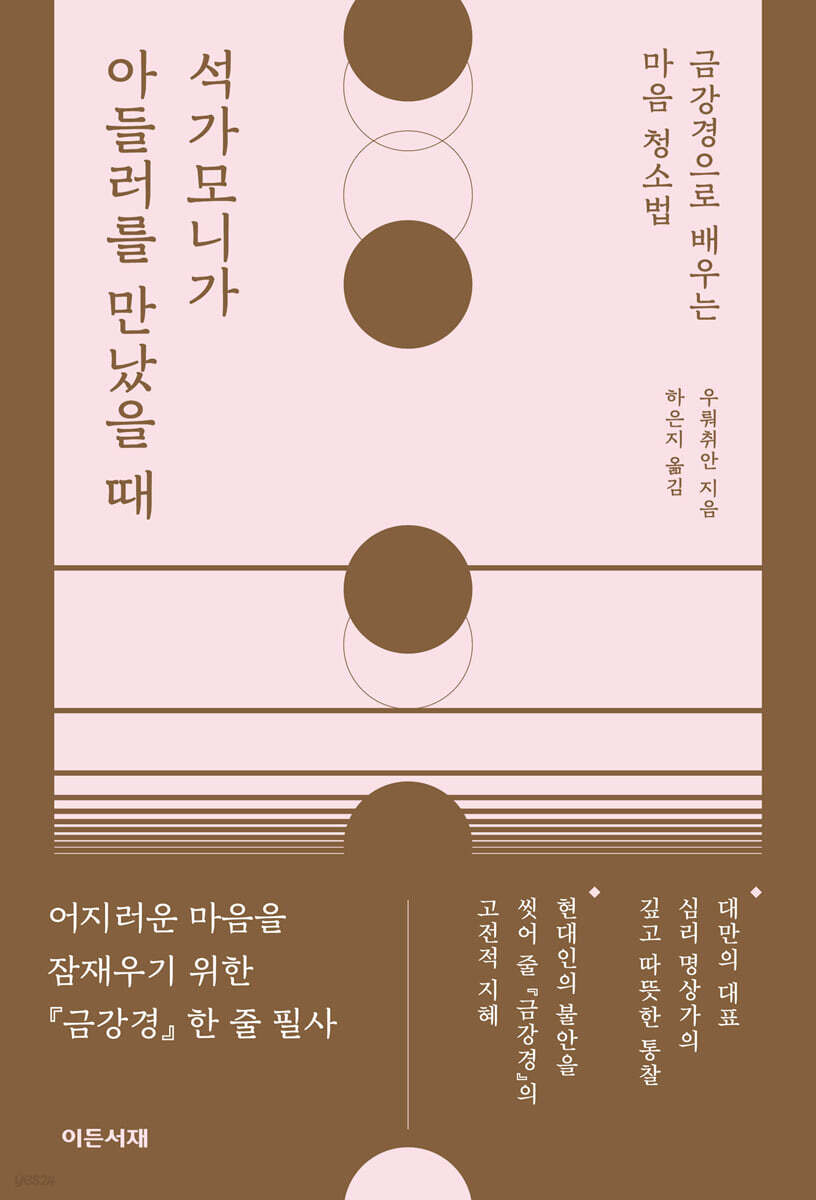
When Buddha met Adler
 |
Description
Book Introduction
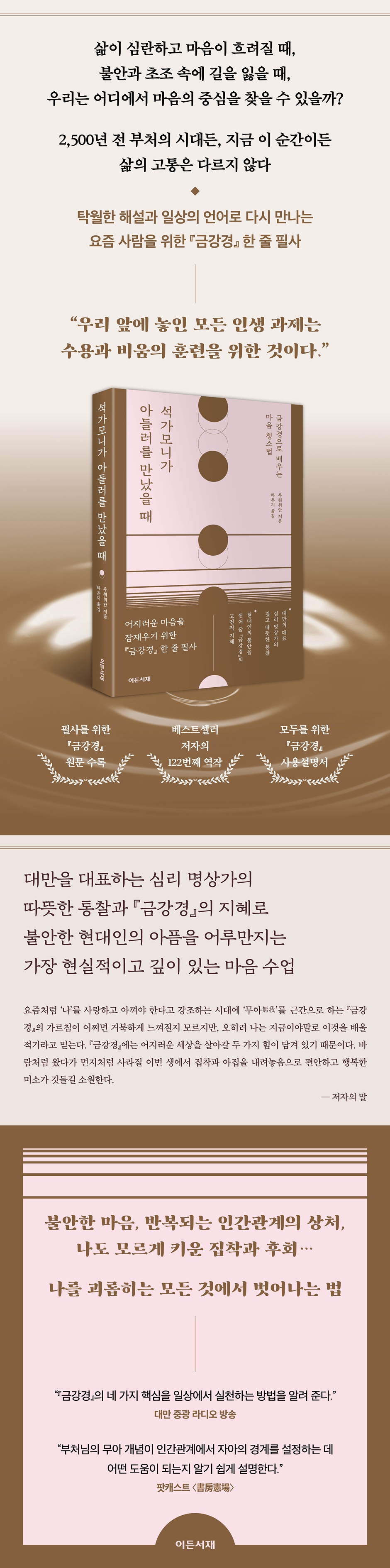
"A Handwritten Copy of the Diamond Sutra for Anxious Modern People"
Deep and warm insights from Taiwan's leading psychological meditator.
Five Realizations to Free Your Mind from Hatred, Anxiety, Regret, and Self-Reproach
It doesn't always take a single turning point to change a person's life.
Some people find enlightenment in grand temples or monasteries, while others start simply by 'putting down the peach cake.'
Just reading the Diamond Sutra, which contains the wisdom of Buddha from 2,500 years ago, can strengthen our hearts, clear our vision, and significantly change our lives.
This is because the Diamond Sutra contains practical methods to free oneself from the afflictions that torment us, such as anxiety, impatience, regret, and obsession, and to become free and peaceful.
This book explains the Diamond Sutra in an easy yet profound way, helping anyone apply its insights and wisdom to their daily lives.
The author, a Taiwanese psychotherapist and global corporate strategist with a unique background, is also a bestselling author with over 100 books to his name.
Additionally, as a communicator who has given over 2,000 lectures, he has an outstanding ability to listen to people's hearts and convey them through language.
He began studying the Heart Sutra in earnest at the age of thirty, and studied the Diamond Sutra at the age of fifty.
As I recited and transcribed it, I calmly encountered the deep layers of emotion in my heart, as if peeling off the layers of an onion one by one.
Based on my experience of practicing in daily life for many years, I have translated the wisdom of the Diamond Sutra into a book.
In particular, this book goes beyond a simple commentary on the Diamond Sutra in that it preaches the pain and worries that arise from interpersonal relationships in social life by connecting them with the wisdom of Shakyamuni.
This book connects the four core teachings of the Diamond Sutra—anatta, impermanence, ownership, and attainment—with a clear attitude toward life.
'Mu-a' is the practice of letting go of the stubbornness of 'I am right' and looking at people and situations differently, 'mu-sang' is the practice of finding one's center so that one's mind is not swayed by others' evaluations or external conditions, 'mu-ju' is the attitude of living flexibly without being tied down by the past, the future, or even the present, this moment, and 'mudeuk' naturally leads to the courage to accept life itself rather than striving to gain something.
Even readers who are not interested in Buddhism will naturally realize that the four teachings are connected to the problems of life.
A strong point of this book is that it brings the teachings of the Diamond Sutra into the heart of our lives.
This book speaks warmly yet firmly to modern people who are plagued by worries such as unfairness at work, misunderstandings in relationships, obsession with achievement, and fear of aging.
“It’s okay if you don’t try too hard.
“The practice of letting go is the beginning of finding your true self.”
This book speaks to everyone, whether Buddhist or simply someone who wants to let go of their burdens, in different ways.
Anyone can lighten the burdens of life through the philosophy of emptiness and acceptance.
Deep and warm insights from Taiwan's leading psychological meditator.
Five Realizations to Free Your Mind from Hatred, Anxiety, Regret, and Self-Reproach
It doesn't always take a single turning point to change a person's life.
Some people find enlightenment in grand temples or monasteries, while others start simply by 'putting down the peach cake.'
Just reading the Diamond Sutra, which contains the wisdom of Buddha from 2,500 years ago, can strengthen our hearts, clear our vision, and significantly change our lives.
This is because the Diamond Sutra contains practical methods to free oneself from the afflictions that torment us, such as anxiety, impatience, regret, and obsession, and to become free and peaceful.
This book explains the Diamond Sutra in an easy yet profound way, helping anyone apply its insights and wisdom to their daily lives.
The author, a Taiwanese psychotherapist and global corporate strategist with a unique background, is also a bestselling author with over 100 books to his name.
Additionally, as a communicator who has given over 2,000 lectures, he has an outstanding ability to listen to people's hearts and convey them through language.
He began studying the Heart Sutra in earnest at the age of thirty, and studied the Diamond Sutra at the age of fifty.
As I recited and transcribed it, I calmly encountered the deep layers of emotion in my heart, as if peeling off the layers of an onion one by one.
Based on my experience of practicing in daily life for many years, I have translated the wisdom of the Diamond Sutra into a book.
In particular, this book goes beyond a simple commentary on the Diamond Sutra in that it preaches the pain and worries that arise from interpersonal relationships in social life by connecting them with the wisdom of Shakyamuni.
This book connects the four core teachings of the Diamond Sutra—anatta, impermanence, ownership, and attainment—with a clear attitude toward life.
'Mu-a' is the practice of letting go of the stubbornness of 'I am right' and looking at people and situations differently, 'mu-sang' is the practice of finding one's center so that one's mind is not swayed by others' evaluations or external conditions, 'mu-ju' is the attitude of living flexibly without being tied down by the past, the future, or even the present, this moment, and 'mudeuk' naturally leads to the courage to accept life itself rather than striving to gain something.
Even readers who are not interested in Buddhism will naturally realize that the four teachings are connected to the problems of life.
A strong point of this book is that it brings the teachings of the Diamond Sutra into the heart of our lives.
This book speaks warmly yet firmly to modern people who are plagued by worries such as unfairness at work, misunderstandings in relationships, obsession with achievement, and fear of aging.
“It’s okay if you don’t try too hard.
“The practice of letting go is the beginning of finding your true self.”
This book speaks to everyone, whether Buddhist or simply someone who wants to let go of their burdens, in different ways.
Anyone can lighten the burdens of life through the philosophy of emptiness and acceptance.
- You can preview some of the book's contents.
Preview
index
Entering_ The more you let go of your attachments, the more strange things you gain
Chapter 1.
Cut off suffering, cut off affliction
_ Life's challenges seen through the Diamond Sutra
The boundaries between people are drawn with dotted lines, not solid lines.
Sharing the happiness of others brings joy to life.
How to Live Wisely in a World Full of Lies
Should the left hand always be unaware of what the right hand is doing?
If I don't let go of my thoughts, I can't see the truth of things.
Only when you have the ability to lift can you have the courage to let go.
To live a simple but not shabby life
Chapter 2.
A life that reaches the state of no-self, no-self life
_ How we live in harmony with others and with ourselves
The key to change is always in my hands.
Don't trust every thought that comes into your head.
No one can insult me unless I allow it.
If you always feel like you're right, you should definitely think about it.
What you rely on is what holds you back
Bless the one you hate
A dreamlike life, a life that is not eternal
Chapter 3.
A life of giving without being bound by what is visible, giving without form
_ About a happy life for both the giver and the receiver of help
Favors bestowed on others based on my own arbitrary ideas ruin relationships.
About a happy life for both the giver and the receiver of help
The simplest, yet most difficult thing
Training to dedicate my body and mind to someone
A noble sacrifice never makes anyone suffer.
Accumulate blessings and cleanse your sins.
Love in a subtractive way
Chapter 4.
A life without dwelling anywhere, a life without a home
_ The freedom you truly enjoy when you let go of your obsession
Wherever you are, there is Buddha.
There is no such thing as 'absolute' or 'definite' life.
Success is like an invisible ceiling.
Sometimes what you see isn't everything
Can that moon represent my heart?
A life like a milk crepe cake
He who loves others is Buddha.
Chapter 5.
Experiencing emptiness through practice, without attaining it and practicing it
_ Pray and practice as you breathe
A life without practice is the best practice
Write one letter and bless the world, write one letter and pray
You can be angry, but you shouldn't vent it.
The Tathagata who neither comes nor goes
The more you chase, the more empty you become.
For you, thousands of times, tens of thousands of times
The most beautiful goodbye in the world
[supplement]
An Easy Interpretation of the Diamond Sutra
Seven Questions to Master the Diamond Sutra
Chapter 1.
Cut off suffering, cut off affliction
_ Life's challenges seen through the Diamond Sutra
The boundaries between people are drawn with dotted lines, not solid lines.
Sharing the happiness of others brings joy to life.
How to Live Wisely in a World Full of Lies
Should the left hand always be unaware of what the right hand is doing?
If I don't let go of my thoughts, I can't see the truth of things.
Only when you have the ability to lift can you have the courage to let go.
To live a simple but not shabby life
Chapter 2.
A life that reaches the state of no-self, no-self life
_ How we live in harmony with others and with ourselves
The key to change is always in my hands.
Don't trust every thought that comes into your head.
No one can insult me unless I allow it.
If you always feel like you're right, you should definitely think about it.
What you rely on is what holds you back
Bless the one you hate
A dreamlike life, a life that is not eternal
Chapter 3.
A life of giving without being bound by what is visible, giving without form
_ About a happy life for both the giver and the receiver of help
Favors bestowed on others based on my own arbitrary ideas ruin relationships.
About a happy life for both the giver and the receiver of help
The simplest, yet most difficult thing
Training to dedicate my body and mind to someone
A noble sacrifice never makes anyone suffer.
Accumulate blessings and cleanse your sins.
Love in a subtractive way
Chapter 4.
A life without dwelling anywhere, a life without a home
_ The freedom you truly enjoy when you let go of your obsession
Wherever you are, there is Buddha.
There is no such thing as 'absolute' or 'definite' life.
Success is like an invisible ceiling.
Sometimes what you see isn't everything
Can that moon represent my heart?
A life like a milk crepe cake
He who loves others is Buddha.
Chapter 5.
Experiencing emptiness through practice, without attaining it and practicing it
_ Pray and practice as you breathe
A life without practice is the best practice
Write one letter and bless the world, write one letter and pray
You can be angry, but you shouldn't vent it.
The Tathagata who neither comes nor goes
The more you chase, the more empty you become.
For you, thousands of times, tens of thousands of times
The most beautiful goodbye in the world
[supplement]
An Easy Interpretation of the Diamond Sutra
Seven Questions to Master the Diamond Sutra
Detailed image
Into the book
The Diamond Sutra, consisting of over 5,000 characters, contains profound wisdom and philosophy that provides insight into life in every line, and contains timeless lessons and practical methods for living a wise life.
The four major elements of ‘anicca’, ‘anatta’, ‘no-dwelling’, and ‘no-acquisition’ practiced by Master Seongun, who is known as the epitome of practical Buddhism, left a deep impression on many people.
This book contains the small insights I gained over the years from practicing the Diamond Sutra in my daily life, based on these four elements.
In Buddhism, 'giving' refers to the act of giving wealth or Buddhist teachings to someone out of compassion.
To put it simply, it means that when doing good deeds, you should not do the following three things.
First, do not do hypocritical good deeds that do not come from sincerity.
Second, I don't count what I have sacrificed for others.
Third, do not consider the conditions or background of the person being helped.
When helping someone, you must keep these three things in mind.
The most important reason is that this allows you to let go of your stubbornness.
Stubbornness is an obsession with narrow, self-centered thinking and pushing only one's own opinions or positions forward without considering the opinions or positions of others.
If you let go of your stubbornness, you can enjoy immeasurable happiness and joy.
And what's more important is that people who let go of their 'self' don't dwell on how much they benefited from that action.
Everyone values themselves more than others.
I can hardly tolerate anyone infringing on my rights.
So, when a conflict or clash arises with someone, we must keep in mind that the other person, ourselves, and all of us deserve respect.
Otherwise, someone innocent will either unilaterally give in or unilaterally get hurt.
From a psychological perspective, the way to maintain composure when conflict or conflict arises is to confidently state your position to the other person.
In the Diamond Sutra, Shakyamuni tells Subhuti that it is natural for a bodhisattva to give to living beings, and that it is simply being faithful to one's duty.
He explains that since he did what he was supposed to do, he never expected any reward or recompense from the beginning, and he never thought of receiving blessings for it, so he never enjoyed blessings in the first place.
If we apply this Buddhist spirit to our daily lives, we should not expect any reward or recompense from someone when we help them.
More importantly, I shouldn't brag or act like I did something great.
It's just a matter of being true to your duty of goodwill, so there's no need to think that you've done anything for the other person.
When we dedicate ourselves to someone, we start from the 'add' method.
Help or give with the thought, 'What more can I do for him?'
Few people think in the 'subtract' direction.
This means that it does not start with the question, 'How can I reduce my stubbornness and suffering?'
But usually, the closer we are to someone, the more we try to give them 'overflowing love'.
I worry and fret that the love I give might not be enough, that it might not be enough.
Then, when the other person says, "Enough is enough," and complains that he can't breathe, he becomes disappointed and even angry.
In this way, the relationship between the two sides becomes strained and only pain remains.
In Oriental medicine, even if symptoms are similar, different prescriptions are given depending on the person's constitution.
So, you shouldn't be fixated on just one method.
Once the condition improves, that method should be abandoned.
Once the disease is completely cured, you no longer need to take medication.
There is nothing that you 'must' or 'absolutely' do.
The reason life is beautiful is because it has countless different aspects.
The world changes all the time.
So, we must get rid of the delusions that arise in our minds and let go of our attachments.
That is the wisdom of living in a changing world.
People only feel the need to 'practice' when they encounter adversity or experience a major setback.
In other words, it is only after going through difficult times that one feels the need to correct one's words and actions.
Of course, there are some people who are stubborn and stubborn, and no matter how great the adversity or hardship they face, they say that it is not their fault at all, but rather everyone else's fault.
If you blame others for all the hardships and suffering that occur in this life, it is like losing the opportunity to correct your words and actions throughout your life.
The sins that accumulate in this way will be borne by me in my next life.
You may be able to get by in this life, but you can never escape in the next.
These days, some people ask, "Do I really need to transcribe?", "What do I do with the paper I transcribe?", "Isn't that a waste of resources?"
What to do and what choices to make are entirely up to you.
Based on my personal experience, I would say, “You still have to write it down.” After writing, you can keep the paper for yourself, or you can respectfully separate it for recycling or burn it.
Saving resources and loving the Earth can be practiced in many other ways.
You can also donate to the tree planting campaign.
You can show your anger to others, but that doesn't mean you should vent your anger.
The reason I show my anger to the other person is to remind them that there are boundaries between relationships.
So you really shouldn't express your anger.
Otherwise, it can hurt your relationship and destroy your self-esteem.
The saying, "Emotions change like the palm of your hand," may sound negative at first glance, but if you think about it from another angle, it means that you are expressing your feelings appropriately.
As the Diamond Sutra says, worrying that you are lowly and will not be able to obtain the truth, or thinking that you can obtain the truth if you spend a lot of money, are both delusions.
You don't have to spend a lot of money or meet any conditions to achieve peace.
Let's start by practicing the most basic breathing.
Let's focus on our breathing in and out.
Then, let's practice purely forgetting the breath we just exhaled and the breath we just inhaled.
Through this process, you will experience the removal of delusions and the letting go of yourself.
The four major elements of ‘anicca’, ‘anatta’, ‘no-dwelling’, and ‘no-acquisition’ practiced by Master Seongun, who is known as the epitome of practical Buddhism, left a deep impression on many people.
This book contains the small insights I gained over the years from practicing the Diamond Sutra in my daily life, based on these four elements.
In Buddhism, 'giving' refers to the act of giving wealth or Buddhist teachings to someone out of compassion.
To put it simply, it means that when doing good deeds, you should not do the following three things.
First, do not do hypocritical good deeds that do not come from sincerity.
Second, I don't count what I have sacrificed for others.
Third, do not consider the conditions or background of the person being helped.
When helping someone, you must keep these three things in mind.
The most important reason is that this allows you to let go of your stubbornness.
Stubbornness is an obsession with narrow, self-centered thinking and pushing only one's own opinions or positions forward without considering the opinions or positions of others.
If you let go of your stubbornness, you can enjoy immeasurable happiness and joy.
And what's more important is that people who let go of their 'self' don't dwell on how much they benefited from that action.
Everyone values themselves more than others.
I can hardly tolerate anyone infringing on my rights.
So, when a conflict or clash arises with someone, we must keep in mind that the other person, ourselves, and all of us deserve respect.
Otherwise, someone innocent will either unilaterally give in or unilaterally get hurt.
From a psychological perspective, the way to maintain composure when conflict or conflict arises is to confidently state your position to the other person.
In the Diamond Sutra, Shakyamuni tells Subhuti that it is natural for a bodhisattva to give to living beings, and that it is simply being faithful to one's duty.
He explains that since he did what he was supposed to do, he never expected any reward or recompense from the beginning, and he never thought of receiving blessings for it, so he never enjoyed blessings in the first place.
If we apply this Buddhist spirit to our daily lives, we should not expect any reward or recompense from someone when we help them.
More importantly, I shouldn't brag or act like I did something great.
It's just a matter of being true to your duty of goodwill, so there's no need to think that you've done anything for the other person.
When we dedicate ourselves to someone, we start from the 'add' method.
Help or give with the thought, 'What more can I do for him?'
Few people think in the 'subtract' direction.
This means that it does not start with the question, 'How can I reduce my stubbornness and suffering?'
But usually, the closer we are to someone, the more we try to give them 'overflowing love'.
I worry and fret that the love I give might not be enough, that it might not be enough.
Then, when the other person says, "Enough is enough," and complains that he can't breathe, he becomes disappointed and even angry.
In this way, the relationship between the two sides becomes strained and only pain remains.
In Oriental medicine, even if symptoms are similar, different prescriptions are given depending on the person's constitution.
So, you shouldn't be fixated on just one method.
Once the condition improves, that method should be abandoned.
Once the disease is completely cured, you no longer need to take medication.
There is nothing that you 'must' or 'absolutely' do.
The reason life is beautiful is because it has countless different aspects.
The world changes all the time.
So, we must get rid of the delusions that arise in our minds and let go of our attachments.
That is the wisdom of living in a changing world.
People only feel the need to 'practice' when they encounter adversity or experience a major setback.
In other words, it is only after going through difficult times that one feels the need to correct one's words and actions.
Of course, there are some people who are stubborn and stubborn, and no matter how great the adversity or hardship they face, they say that it is not their fault at all, but rather everyone else's fault.
If you blame others for all the hardships and suffering that occur in this life, it is like losing the opportunity to correct your words and actions throughout your life.
The sins that accumulate in this way will be borne by me in my next life.
You may be able to get by in this life, but you can never escape in the next.
These days, some people ask, "Do I really need to transcribe?", "What do I do with the paper I transcribe?", "Isn't that a waste of resources?"
What to do and what choices to make are entirely up to you.
Based on my personal experience, I would say, “You still have to write it down.” After writing, you can keep the paper for yourself, or you can respectfully separate it for recycling or burn it.
Saving resources and loving the Earth can be practiced in many other ways.
You can also donate to the tree planting campaign.
You can show your anger to others, but that doesn't mean you should vent your anger.
The reason I show my anger to the other person is to remind them that there are boundaries between relationships.
So you really shouldn't express your anger.
Otherwise, it can hurt your relationship and destroy your self-esteem.
The saying, "Emotions change like the palm of your hand," may sound negative at first glance, but if you think about it from another angle, it means that you are expressing your feelings appropriately.
As the Diamond Sutra says, worrying that you are lowly and will not be able to obtain the truth, or thinking that you can obtain the truth if you spend a lot of money, are both delusions.
You don't have to spend a lot of money or meet any conditions to achieve peace.
Let's start by practicing the most basic breathing.
Let's focus on our breathing in and out.
Then, let's practice purely forgetting the breath we just exhaled and the breath we just inhaled.
Through this process, you will experience the removal of delusions and the letting go of yourself.
--- From the text
Publisher's Review
“The wisdom to escape from everything that bothers me.”
Become free from attachment and suffering
A verse from the Diamond Sutra every day
The Diamond Sutra, consisting of questions and answers between the Buddha and his disciples, is relatively short, but it is full of philosophical content, transcending religion and time, and conveying wisdom and resonance for life that remains relevant even today.
The author, a Taiwanese writer, psychologist, and former global corporate marketer, views the Diamond Sutra with a more realistic perspective than anyone else and interprets it in familiar, everyday language.
He connects each phrase of the Diamond Sutra to specific examples from our daily lives, quietly posing questions to our consciousness, extracting profound thoughts and leading us to practice.
Through the story of 'Yeonsuk', who runs a local noodle shop, this book naturally conveys the profound wisdom of one of the teachings of the Diamond Sutra, namely, "Give help without even thinking about giving."
One day, when business was going well, she planned a '1+1 Noodle Event' with the desire to help more people.
When you eat noodles, a bowl is given to a neighbor in need.
People praised the novel idea, but problems soon emerged.
As people flock to Yeonsuk hoping for free noodles, she suffers not only financial losses but also the frustration of losing her good heart.
After much deliberation, she decides to abandon the event and instead provide jobs to young people.
They gave children the opportunity to live on their own by giving them money and giving them work to do.
It covers common real-life examples, such as a passage from the Diamond Sutra and the story of Yeonsuk, and conveys the concept of 'emptiness' in an easy-to-understand manner.
Additionally, the original text and interpretation of the Diamond Sutra are included so that you can read it every day and reflect on its wisdom.
If you consistently practice the mind of acceptance and emptiness while writing, you can escape from suffering and become free.
Healing extremely realistic worries
Wisdom of the Diamond Sutra
“Freedom begins the moment you let go.”
This book is filled with metaphors and stories that convey the deep resonance of life, such as "Bless Cancer Cells Too," "Learning about Free from the Chairman Wearing Slippers," and "Layers of Emotions Stacked Like Mille Crepe Cakes."
None of these episodes force a moral.
It quietly, but clearly seeps into the reader's mind and shakes their heart.
The author examines the wounds inflicted in interpersonal relationships, the pride that must be maintained at work, the recurring anxiety and fear, and the self-deprecating feelings that plague him, one by one.
“All suffering ultimately comes from the mind that holds on, and the suffering stems from not being able to let go. Freedom begins only from the moment you let go.”
This book doesn't just provide psychological comfort.
Through the voice of the Buddha, one clear truth is conveyed to us.
“It’s not because you’re weak that you’re feeling down.
“It’s because you’re holding on to too much.” If you’ve ever tried to help someone but ended up getting hurt instead, if you’ve ever wanted to be a good person but found yourself falling apart over and over again, this book will speak to you quietly.
“Even a good heart needs practice.”
And that practice might be the beginning of the path to finally letting go of myself and meeting my true self.
Regardless of religious affiliation, the teachings of the Diamond Sutra and its title, like a diamond-like firm heart, may help us face our own tranquility.
Become free from attachment and suffering
A verse from the Diamond Sutra every day
The Diamond Sutra, consisting of questions and answers between the Buddha and his disciples, is relatively short, but it is full of philosophical content, transcending religion and time, and conveying wisdom and resonance for life that remains relevant even today.
The author, a Taiwanese writer, psychologist, and former global corporate marketer, views the Diamond Sutra with a more realistic perspective than anyone else and interprets it in familiar, everyday language.
He connects each phrase of the Diamond Sutra to specific examples from our daily lives, quietly posing questions to our consciousness, extracting profound thoughts and leading us to practice.
Through the story of 'Yeonsuk', who runs a local noodle shop, this book naturally conveys the profound wisdom of one of the teachings of the Diamond Sutra, namely, "Give help without even thinking about giving."
One day, when business was going well, she planned a '1+1 Noodle Event' with the desire to help more people.
When you eat noodles, a bowl is given to a neighbor in need.
People praised the novel idea, but problems soon emerged.
As people flock to Yeonsuk hoping for free noodles, she suffers not only financial losses but also the frustration of losing her good heart.
After much deliberation, she decides to abandon the event and instead provide jobs to young people.
They gave children the opportunity to live on their own by giving them money and giving them work to do.
It covers common real-life examples, such as a passage from the Diamond Sutra and the story of Yeonsuk, and conveys the concept of 'emptiness' in an easy-to-understand manner.
Additionally, the original text and interpretation of the Diamond Sutra are included so that you can read it every day and reflect on its wisdom.
If you consistently practice the mind of acceptance and emptiness while writing, you can escape from suffering and become free.
Healing extremely realistic worries
Wisdom of the Diamond Sutra
“Freedom begins the moment you let go.”
This book is filled with metaphors and stories that convey the deep resonance of life, such as "Bless Cancer Cells Too," "Learning about Free from the Chairman Wearing Slippers," and "Layers of Emotions Stacked Like Mille Crepe Cakes."
None of these episodes force a moral.
It quietly, but clearly seeps into the reader's mind and shakes their heart.
The author examines the wounds inflicted in interpersonal relationships, the pride that must be maintained at work, the recurring anxiety and fear, and the self-deprecating feelings that plague him, one by one.
“All suffering ultimately comes from the mind that holds on, and the suffering stems from not being able to let go. Freedom begins only from the moment you let go.”
This book doesn't just provide psychological comfort.
Through the voice of the Buddha, one clear truth is conveyed to us.
“It’s not because you’re weak that you’re feeling down.
“It’s because you’re holding on to too much.” If you’ve ever tried to help someone but ended up getting hurt instead, if you’ve ever wanted to be a good person but found yourself falling apart over and over again, this book will speak to you quietly.
“Even a good heart needs practice.”
And that practice might be the beginning of the path to finally letting go of myself and meeting my true self.
Regardless of religious affiliation, the teachings of the Diamond Sutra and its title, like a diamond-like firm heart, may help us face our own tranquility.
GOODS SPECIFICS
- Date of issue: November 10, 2025
- Page count, weight, size: 320 pages | 153*225*30mm
- ISBN13: 9791194812104
- ISBN10: 1194812104
You may also like
카테고리
korean


korean

![GQ KOREA Mark (Monthly): December [2025]](http://librairie.coreenne.fr/cdn/shop/files/8ef265dbbfbf186523ed75ba7319009d.jpg?v=1765340328&width=3840)


