

I want to be a person like a tree
 |
Description
Book Introduction
Strongly recommended by poet Na Tae-ju and botanist Shin Hye-woo
◆ Amazon, Goodreads 4.4+ stars, 'The Philosophy of Trees' loved by international readers as well
◆ A book that has become a hot topic on social media in the US, UK, Canada, Vietnam, and other countries with the theme of 'trees'
“Like a tree that has accumulated profound wisdom for 400 million years,
“I want to live my life steadily, slowly, and silently, and that’s how I want to live!”
A book has been published that beautifully encapsulates the charm of trees.
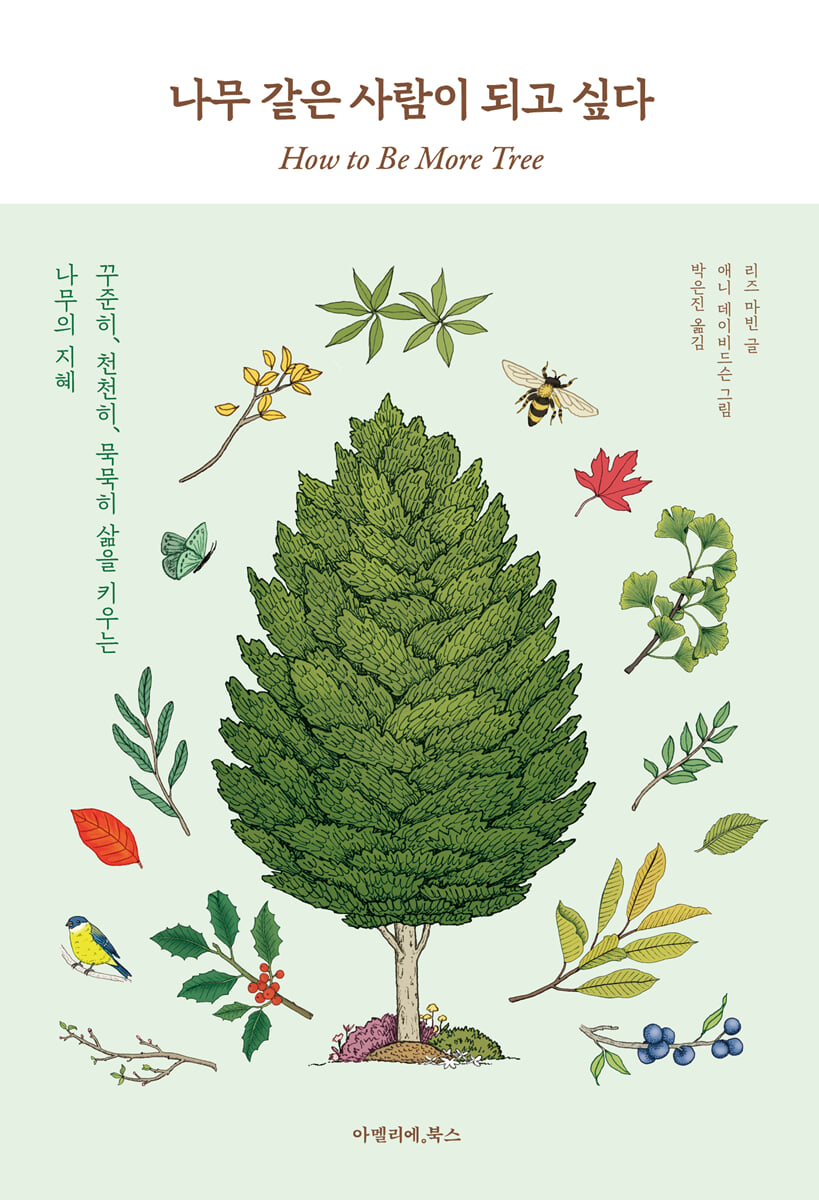
This book, "I Want to Become a Tree," is a collection of texts filled with the wisdom of 59 trees that steadily, slowly, and silently nurture life, and illustrations full of vitality and greenery on every page.
It received a rating of 4.4 or higher on Amazon and Goodreads, the world's largest reading community, and was praised as a "tree philosophy book" that we need right now.
This book delivers a deep and quiet message to modern people who waver at every moment of life by applying the ecological characteristics of various trees to the wisdom of life.
For example, living truly as myself like a zelkova tree, humbly accepting my limitations and knowing when to stop like a sequoia tree, and having the wisdom to wait quietly like a deciduous tree.
The quiet, solid message that the trees, which have lived on this earth for 400 million years and embody the oldest wisdom, convey to us resonates deeply with our modern lives, which are forced to live in a fast-paced, competitive, and uniform way of life.
This may be the reason why we want to become ‘people like trees.’
Ultimately, this book helps me reflect on myself through the existence of a 'tree' and enrich my life.
That is why poet Na Tae-ju's recommendation, "This is a book that can change someone's life," is all the more meaningful.
This book, which has transcended language and culture to include the US, UK, Canada, and Vietnam and has colored social media around the world with 'trees', is truly an attractive book that lives up to the recommendation of botanist Shin Hye-woo, who said, "It is a warm and lovely introductory book that will help you find your tree friend."
◆ Amazon, Goodreads 4.4+ stars, 'The Philosophy of Trees' loved by international readers as well
◆ A book that has become a hot topic on social media in the US, UK, Canada, Vietnam, and other countries with the theme of 'trees'
“Like a tree that has accumulated profound wisdom for 400 million years,
“I want to live my life steadily, slowly, and silently, and that’s how I want to live!”
A book has been published that beautifully encapsulates the charm of trees.
This book, "I Want to Become a Tree," is a collection of texts filled with the wisdom of 59 trees that steadily, slowly, and silently nurture life, and illustrations full of vitality and greenery on every page.
It received a rating of 4.4 or higher on Amazon and Goodreads, the world's largest reading community, and was praised as a "tree philosophy book" that we need right now.
This book delivers a deep and quiet message to modern people who waver at every moment of life by applying the ecological characteristics of various trees to the wisdom of life.
For example, living truly as myself like a zelkova tree, humbly accepting my limitations and knowing when to stop like a sequoia tree, and having the wisdom to wait quietly like a deciduous tree.
The quiet, solid message that the trees, which have lived on this earth for 400 million years and embody the oldest wisdom, convey to us resonates deeply with our modern lives, which are forced to live in a fast-paced, competitive, and uniform way of life.
This may be the reason why we want to become ‘people like trees.’
Ultimately, this book helps me reflect on myself through the existence of a 'tree' and enrich my life.
That is why poet Na Tae-ju's recommendation, "This is a book that can change someone's life," is all the more meaningful.
This book, which has transcended language and culture to include the US, UK, Canada, and Vietnam and has colored social media around the world with 'trees', is truly an attractive book that lives up to the recommendation of botanist Shin Hye-woo, who said, "It is a warm and lovely introductory book that will help you find your tree friend."
- You can preview some of the book's contents.
Preview
index
Recommendation
Entering
The beginning is small and slow, but _ maple tree
The Virtue of Patience _ Note
The Power of Connection _ Sasinamu
Reach out for help when needed _ Elm Tree
Finding Your Way Through Change _ American Beech
Truly my own _ Seonamu
Always prepare alternatives _ Thorn Plum Tree
From caring for the foundation of life _ Willow
Surrendering your whole body to the sunlight _ Pine tree
Finding my own space _ Ori tree
A life with a strong inner self - Black Walnut
Looking far ahead _ Mangrove
Live Today _ Thornberry
Moving forward, overcoming fear _ Maple Tree
A moment of rest _ White fir
Shoulders up and proud _ Baobab tree
Outside the box, creatively _ European tiger thorn
The giving tree _ Olive tree
Finding My Place _ Silver Sheep
Protecting Each Other _ Umbrella Thorn Acacia Tree
When you're tired, it's okay to take a break - Maple
A Life Filled with Small Miracles _ Acai Palm
A mind that adapts to change _ Balsam fir
Don't worry about things you can't change - Picnandra Akuminata
Following your own path _ Banian tree
Until we reach the forest canopy _ Gutta Percha Tree
Where Positivity Dwells _ Guarea
Being different is a wonderful thing _ Yong-hyeol-su
Learning from yesterday and living for today _ Corsican Pine
This very moment _ King Cherry Blossom Tree
Time to look into the wounds _ You too, chestnut tree
Accepting Limitations _ Sequoia
Against the flow of the seasons _ Hwangyeonmok
Life with the Community _ Misong
Every age is beautiful _ Pine tree
No one is perfect _ Ginkgo
Let it flow without regrets _ Western boxwood
Caring for the Next Generation _ Sugar Maple
Taking Control of Your Life _ Larch
Everyone has strengths _ Watercress
Learning to Stand Alone _ Kauri Tree
Embracing change, even if it's scary _ Banksia
Filling the time of pause _ Oak tree
Keeping my place _ Savior's Pine
Focus on what I'm good at _ Maga Mok
How to Survive a Storm _ Hawthorn
Waiting for the right time _ You too, beech tree
Sometimes You Have to Let Go _ Sierra Palm
Living Together _ North American Arborvitae
The courage to break away from the everyday _ Maple
Enjoy every moment of the process _ Cork Oak
Waste is No Good _ Nysa Silvatica
Spreading warmth around you _ Neem tree
Deep-rooted tree _ Zelkova
The Dignity of a Shining Supporting Role _ Birch
Which way will it lean? _ Araucaria Columnaris
Tough but flexible _ Dogwood
Happiness starts from the moment you make up your mind _ Lilac
Preparing for a rainy day _ Jaranamu
Facing the Spirituality Within _ Indian Bodhi Tree
Entering
The beginning is small and slow, but _ maple tree
The Virtue of Patience _ Note
The Power of Connection _ Sasinamu
Reach out for help when needed _ Elm Tree
Finding Your Way Through Change _ American Beech
Truly my own _ Seonamu
Always prepare alternatives _ Thorn Plum Tree
From caring for the foundation of life _ Willow
Surrendering your whole body to the sunlight _ Pine tree
Finding my own space _ Ori tree
A life with a strong inner self - Black Walnut
Looking far ahead _ Mangrove
Live Today _ Thornberry
Moving forward, overcoming fear _ Maple Tree
A moment of rest _ White fir
Shoulders up and proud _ Baobab tree
Outside the box, creatively _ European tiger thorn
The giving tree _ Olive tree
Finding My Place _ Silver Sheep
Protecting Each Other _ Umbrella Thorn Acacia Tree
When you're tired, it's okay to take a break - Maple
A Life Filled with Small Miracles _ Acai Palm
A mind that adapts to change _ Balsam fir
Don't worry about things you can't change - Picnandra Akuminata
Following your own path _ Banian tree
Until we reach the forest canopy _ Gutta Percha Tree
Where Positivity Dwells _ Guarea
Being different is a wonderful thing _ Yong-hyeol-su
Learning from yesterday and living for today _ Corsican Pine
This very moment _ King Cherry Blossom Tree
Time to look into the wounds _ You too, chestnut tree
Accepting Limitations _ Sequoia
Against the flow of the seasons _ Hwangyeonmok
Life with the Community _ Misong
Every age is beautiful _ Pine tree
No one is perfect _ Ginkgo
Let it flow without regrets _ Western boxwood
Caring for the Next Generation _ Sugar Maple
Taking Control of Your Life _ Larch
Everyone has strengths _ Watercress
Learning to Stand Alone _ Kauri Tree
Embracing change, even if it's scary _ Banksia
Filling the time of pause _ Oak tree
Keeping my place _ Savior's Pine
Focus on what I'm good at _ Maga Mok
How to Survive a Storm _ Hawthorn
Waiting for the right time _ You too, beech tree
Sometimes You Have to Let Go _ Sierra Palm
Living Together _ North American Arborvitae
The courage to break away from the everyday _ Maple
Enjoy every moment of the process _ Cork Oak
Waste is No Good _ Nysa Silvatica
Spreading warmth around you _ Neem tree
Deep-rooted tree _ Zelkova
The Dignity of a Shining Supporting Role _ Birch
Which way will it lean? _ Araucaria Columnaris
Tough but flexible _ Dogwood
Happiness starts from the moment you make up your mind _ Lilac
Preparing for a rainy day _ Jaranamu
Facing the Spirituality Within _ Indian Bodhi Tree
Detailed image

Into the book
Don't rush.
I will plan calmly.
I will look back on the path I have walked.
This attitude toward life tells us where we should go.
The juniper tree is like a grandmother, holding the wisdom of a long life.
It has been considered a mystical tree with magical symbols since ancient times, and is said to have a long lifespan, living up to 2000 years.
However, it is difficult to know the exact age of this tree.
As time goes by, it is often the case that people become more and more empty inside, as if trying to hide their age, so it is impossible to count the years.
The secret to this tree's longevity lies in its slow, slow growth and wide root spread.
It stores nutrients in the roots in case the tree is damaged.
So, wouldn't it be okay to take it easy like a spotlight, but also be a little mysterious?
--- p.15
A tree never wastes its precious chlorophyll trying to become something other than itself.
Focus solely on your own growth without worrying about what others think.
The same goes for the plain and inconspicuous cedar tree.
This tree does not grow particularly tall, does not produce showy flowers, and does not produce tasty fruit.
It has simply grown strong, firmly rooted in its place, with a consistent appearance for thousands of years.
Without ever asking for applause.
--- p.22
As we live, there are times when we have to let go of the orthodox approach and take a slightly twisted approach in order to find a solution.
Creative thinking outside the box can be a decisive factor in turning a crisis around.
Trees that have learned this natural law with their whole body often grow leaves of various heights to maximize growth.
For example, the number of light-absorbing cells is finely tuned to increase or decrease depending on the amount of sunlight the leaf receives.
Going a step further, the European tiger thorn tree has the ingenuity to place its thorns more densely on the lower leaves than on the upper ones, to prevent passing animals from picking at the leaves.
Sometimes, I think I should live like the European tiger thorn tree, which is not afraid of new ideas.
--- p.44
Not only does the ash tree produce very hard wood, it also grows quite quickly.
But even when spring comes, it doesn't rush to be the first to sprout leaves.
Both beech and oak trees boast dense foliage.
In other words, it is difficult for plants to grow properly under these trees.
On the other hand, sunlight filters through the dense canopy of the ash tree, allowing other plants to sprout and grow under the tree.
In a word, the ash tree is strong and confident.
It doesn't help much when a sudden downpour starts.
--- p.91
The dogwood tree is considered a master of resilience and flexibility.
This tree vigorously pushes out new shoots from its base every year without any help from others.
The new shoots grow into straight, flexible stems and have been a resource for people for thousands of years.
"Tough but flexible." This is the life philosophy that the dogwood tree, which bends but never breaks, has practiced with its entire body.
I will plan calmly.
I will look back on the path I have walked.
This attitude toward life tells us where we should go.
The juniper tree is like a grandmother, holding the wisdom of a long life.
It has been considered a mystical tree with magical symbols since ancient times, and is said to have a long lifespan, living up to 2000 years.
However, it is difficult to know the exact age of this tree.
As time goes by, it is often the case that people become more and more empty inside, as if trying to hide their age, so it is impossible to count the years.
The secret to this tree's longevity lies in its slow, slow growth and wide root spread.
It stores nutrients in the roots in case the tree is damaged.
So, wouldn't it be okay to take it easy like a spotlight, but also be a little mysterious?
--- p.15
A tree never wastes its precious chlorophyll trying to become something other than itself.
Focus solely on your own growth without worrying about what others think.
The same goes for the plain and inconspicuous cedar tree.
This tree does not grow particularly tall, does not produce showy flowers, and does not produce tasty fruit.
It has simply grown strong, firmly rooted in its place, with a consistent appearance for thousands of years.
Without ever asking for applause.
--- p.22
As we live, there are times when we have to let go of the orthodox approach and take a slightly twisted approach in order to find a solution.
Creative thinking outside the box can be a decisive factor in turning a crisis around.
Trees that have learned this natural law with their whole body often grow leaves of various heights to maximize growth.
For example, the number of light-absorbing cells is finely tuned to increase or decrease depending on the amount of sunlight the leaf receives.
Going a step further, the European tiger thorn tree has the ingenuity to place its thorns more densely on the lower leaves than on the upper ones, to prevent passing animals from picking at the leaves.
Sometimes, I think I should live like the European tiger thorn tree, which is not afraid of new ideas.
--- p.44
Not only does the ash tree produce very hard wood, it also grows quite quickly.
But even when spring comes, it doesn't rush to be the first to sprout leaves.
Both beech and oak trees boast dense foliage.
In other words, it is difficult for plants to grow properly under these trees.
On the other hand, sunlight filters through the dense canopy of the ash tree, allowing other plants to sprout and grow under the tree.
In a word, the ash tree is strong and confident.
It doesn't help much when a sudden downpour starts.
--- p.91
The dogwood tree is considered a master of resilience and flexibility.
This tree vigorously pushes out new shoots from its base every year without any help from others.
The new shoots grow into straight, flexible stems and have been a resource for people for thousands of years.
"Tough but flexible." This is the life philosophy that the dogwood tree, which bends but never breaks, has practiced with its entire body.
--- p.124
Publisher's Review
★ Special gift for the Korean version
― 180-degree unfolding, four-season binding, the back of the band can be used as a rich wooden poster
“At every moment of our lives, we have a tree!”
The oldest wisdom and beauty of life, told by nature
In our busy and hectic daily lives, there are moments when we recognize trees.
When I feel my heart is heavy and I need rest, when I want to be strong but things don't go as planned, I sigh and look out the window, where I see a tree that has always been there silently.
At that moment, we think, 'I want to live like a tree', 'I want to become a person like a tree'.
If you can't leave for the dense forest right away, this book will give you the fresh oxygen that the trees exhale.
This book features 59 different trees, including the ginkgo, chestnut, maple, and sequoia that we commonly encounter in our daily lives, as well as the wonderful deciduous trees, baobab, juniper, and Indian banyan trees.
The lyrical and delicate illustrations, which make you feel as if you are in a forest just by looking at them, are the highlight of this book, and the messages implicit in them—tree survival strategies, the resilience of life, recovery, and perseverance—are not simple lessons, but rather dense wisdom that can be applied to our lives.
This book says that self-care begins with 'taking care of the foundation of life,' like a willow tree that securely supports the riverbank.
He also advises us to live each moment to the fullest, enjoying 'this very moment' that shines before our eyes like a cherry blossom tree, and pats us on the shoulder, saying 'everyone has strengths', while telling us about the 'ash tree' that allows other plants to grow between its lush canopy.
Ultimately, this book began with the hope that readers would find a single phrase that would soothe the wounds and pains of life, and that that sentence would bring gentle comfort to their weary hearts.
As if containing that hope, I hope that this book, like poet Na Tae-ju's recommendation, will be a gift to readers that "will purify and relax their hearts and souls, and change their lives."
"Emotional Lessons for Modern People: Learning from Nature"
“A book that helps you adjust the rhythm of life.”
A plant essay with sensory illustrations on every page.
Slow Reading Book: Use it as an Emotional Recovery Routine Book
One of the most notable things about this book is that every page is accompanied by beautiful botanical illustrations.
Australian illustrator Annie Davidson's paintings, inspired by nature, delicately capture the characteristics of over 60 different trees, while simultaneously conveying a warm and sensual sensibility of nature.
As such, it is a book that combines the strengths of both a plant essay and an emotional art book, allowing readers to visually experience the rhythm of nature and emotions beyond simply reading the text.
It's great as a gift or for interior decoration, but it's also worth keeping as a mindfulness reading book for yourself.
In particular, this Korean edition was designed with the hope that the book itself would be a gift, so the tree illustrations from the book were placed on the back of the booklet, creating a beautiful poster the moment it is opened.
Here, the text is bound in a 180-degree, four-sided, nude binding to prevent the illustrations that are spread across both pages from being obscured by folding.
This book has the power to make you reflect on your life on every page.
There is no need to read it in order from the first page.
Just find a page that resonates with you, read the life wisdom the tree conveys, admire the painting, and organize your emotions for the day.
So, on social media, it is referred to as a ‘slow reading book’ or a ‘book for emotional recovery’, and many people share passages and illustrations from the book.
Major reader communities like Goodreads and Amazon are also pouring in with favorable reviews such as, “A book that helps you adjust to the rhythm of life,” “An emotional lesson for modern people learning from nature,” “A book that brings comfort just by looking at it,” “Short but with a big impact,” and “A book to read when you need inspiration.”
― 180-degree unfolding, four-season binding, the back of the band can be used as a rich wooden poster
“At every moment of our lives, we have a tree!”
The oldest wisdom and beauty of life, told by nature
In our busy and hectic daily lives, there are moments when we recognize trees.
When I feel my heart is heavy and I need rest, when I want to be strong but things don't go as planned, I sigh and look out the window, where I see a tree that has always been there silently.
At that moment, we think, 'I want to live like a tree', 'I want to become a person like a tree'.
If you can't leave for the dense forest right away, this book will give you the fresh oxygen that the trees exhale.
This book features 59 different trees, including the ginkgo, chestnut, maple, and sequoia that we commonly encounter in our daily lives, as well as the wonderful deciduous trees, baobab, juniper, and Indian banyan trees.
The lyrical and delicate illustrations, which make you feel as if you are in a forest just by looking at them, are the highlight of this book, and the messages implicit in them—tree survival strategies, the resilience of life, recovery, and perseverance—are not simple lessons, but rather dense wisdom that can be applied to our lives.
This book says that self-care begins with 'taking care of the foundation of life,' like a willow tree that securely supports the riverbank.
He also advises us to live each moment to the fullest, enjoying 'this very moment' that shines before our eyes like a cherry blossom tree, and pats us on the shoulder, saying 'everyone has strengths', while telling us about the 'ash tree' that allows other plants to grow between its lush canopy.
Ultimately, this book began with the hope that readers would find a single phrase that would soothe the wounds and pains of life, and that that sentence would bring gentle comfort to their weary hearts.
As if containing that hope, I hope that this book, like poet Na Tae-ju's recommendation, will be a gift to readers that "will purify and relax their hearts and souls, and change their lives."
"Emotional Lessons for Modern People: Learning from Nature"
“A book that helps you adjust the rhythm of life.”
A plant essay with sensory illustrations on every page.
Slow Reading Book: Use it as an Emotional Recovery Routine Book
One of the most notable things about this book is that every page is accompanied by beautiful botanical illustrations.
Australian illustrator Annie Davidson's paintings, inspired by nature, delicately capture the characteristics of over 60 different trees, while simultaneously conveying a warm and sensual sensibility of nature.
As such, it is a book that combines the strengths of both a plant essay and an emotional art book, allowing readers to visually experience the rhythm of nature and emotions beyond simply reading the text.
It's great as a gift or for interior decoration, but it's also worth keeping as a mindfulness reading book for yourself.
In particular, this Korean edition was designed with the hope that the book itself would be a gift, so the tree illustrations from the book were placed on the back of the booklet, creating a beautiful poster the moment it is opened.
Here, the text is bound in a 180-degree, four-sided, nude binding to prevent the illustrations that are spread across both pages from being obscured by folding.
This book has the power to make you reflect on your life on every page.
There is no need to read it in order from the first page.
Just find a page that resonates with you, read the life wisdom the tree conveys, admire the painting, and organize your emotions for the day.
So, on social media, it is referred to as a ‘slow reading book’ or a ‘book for emotional recovery’, and many people share passages and illustrations from the book.
Major reader communities like Goodreads and Amazon are also pouring in with favorable reviews such as, “A book that helps you adjust to the rhythm of life,” “An emotional lesson for modern people learning from nature,” “A book that brings comfort just by looking at it,” “Short but with a big impact,” and “A book to read when you need inspiration.”
GOODS SPECIFICS
- Date of issue: August 13, 2025
- Page count, weight, size: 136 pages | 208g | 140*205*10mm
- ISBN13: 9791199031739
- ISBN10: 1199031739
You may also like
카테고리
korean


korean

![GQ KOREA Mark (Monthly): December [2025]](http://librairie.coreenne.fr/cdn/shop/files/8ef265dbbfbf186523ed75ba7319009d.jpg?v=1765340328&width=3840)


