

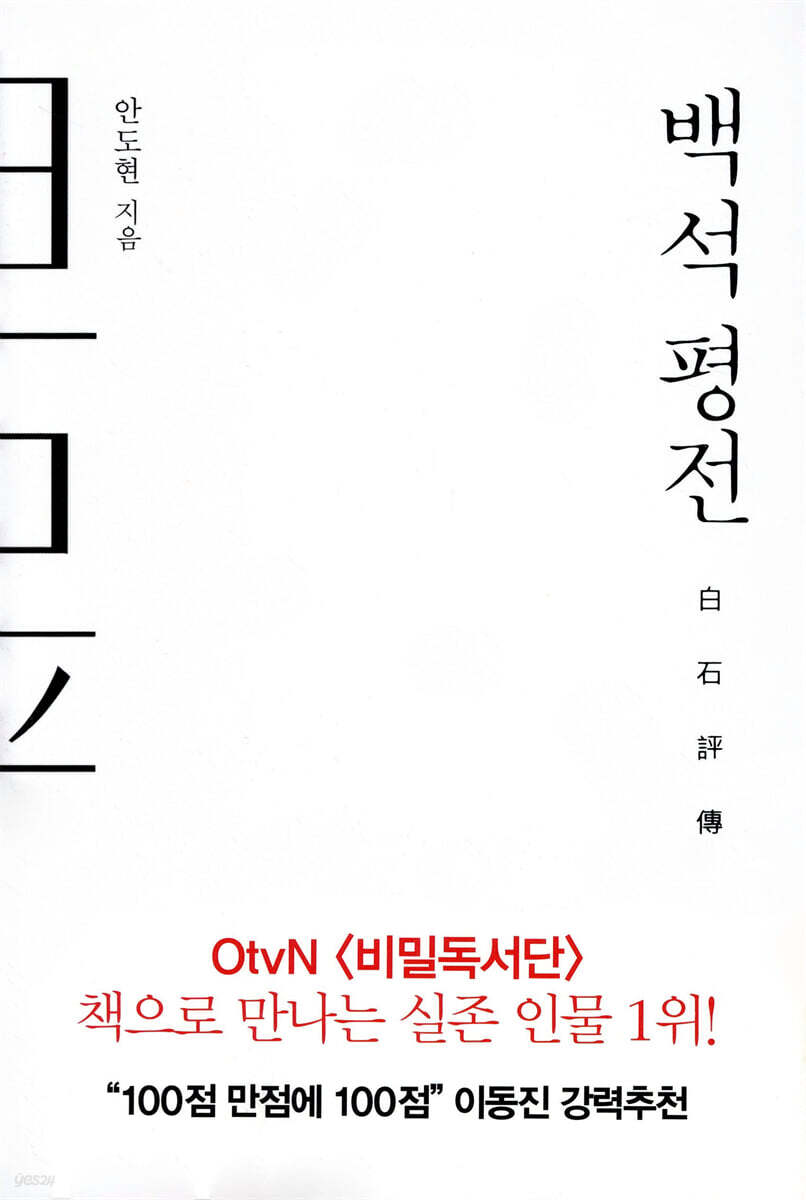
Baekseok Biography
 |
Description
Book Introduction
Completed by poet Ahn Do-hyun, who has been in love with Baek Seok for 30 years
The greatest biography of our time!
Baek Seok's first poetry collection, "Deer," was published on January 20, 1936, in a limited edition of 100 copies.
Baek Seok “threw a book of poetry into the poetry world at the beginning of the new year, as if throwing a shell.” (Kim Ki-rim) Yun Dong-ju, who was unable to obtain Baek Seok’s book of poetry, “was barely able to borrow ‘Deer’ from the library.
As soon as he borrowed the book of poems, he began to copy it on the spot.” Shin Kyeong-rim, a representative poet influenced by Baek Seok, once said, “I wonder if it was actually because of poet Baek Seok that I came to like poetry.” (Baek Seok Biography, p. 140)
A biography of Baek Seok, which contains the life of Baek Seok, who captivated many poets of his time and had an absolute and wide-ranging influence on later poets after liberation, has been published.
Poet Ahn Do-hyun, who has had a crush on Baek Seok since he was in his twenties, confesses that Baek Seok's poetry was "an almost perfect nest for me to nest in" and that he "wanted to copy Baek Seok in some way," reconstructed Baek Seok's life "in order to repay even a little of the debt I owe to Baek Seok" and "thought it could be a way to meet him in person."
I thought that if I were to restore Baek Seok's life in the form of a biography, this could also be a way to meet him directly.
Reconstructing the time he lived was ultimately an act of copying him.
While writing poetry, I have been trying to imitate Baek Seok's tone, his poetic diction, his way of developing and concluding his poems, and even his attitude as a poet responding to the world. _From the 'Preface'
The greatest biography of our time!
Baek Seok's first poetry collection, "Deer," was published on January 20, 1936, in a limited edition of 100 copies.
Baek Seok “threw a book of poetry into the poetry world at the beginning of the new year, as if throwing a shell.” (Kim Ki-rim) Yun Dong-ju, who was unable to obtain Baek Seok’s book of poetry, “was barely able to borrow ‘Deer’ from the library.
As soon as he borrowed the book of poems, he began to copy it on the spot.” Shin Kyeong-rim, a representative poet influenced by Baek Seok, once said, “I wonder if it was actually because of poet Baek Seok that I came to like poetry.” (Baek Seok Biography, p. 140)
A biography of Baek Seok, which contains the life of Baek Seok, who captivated many poets of his time and had an absolute and wide-ranging influence on later poets after liberation, has been published.
Poet Ahn Do-hyun, who has had a crush on Baek Seok since he was in his twenties, confesses that Baek Seok's poetry was "an almost perfect nest for me to nest in" and that he "wanted to copy Baek Seok in some way," reconstructed Baek Seok's life "in order to repay even a little of the debt I owe to Baek Seok" and "thought it could be a way to meet him in person."
I thought that if I were to restore Baek Seok's life in the form of a biography, this could also be a way to meet him directly.
Reconstructing the time he lived was ultimately an act of copying him.
While writing poetry, I have been trying to imitate Baek Seok's tone, his poetic diction, his way of developing and concluding his poems, and even his attitude as a poet responding to the world. _From the 'Preface'
- You can preview some of the book's contents.
Preview
index
Homecoming
Iksong-dong, Galsan-myeon, Jeongju-gun, Pyeonganbuk-do
Osan School days
Sowol and Baekseok
Going to study abroad at Aoyama Gakuin
Literature classes in Japan
Relationship with the Chosun Ilbo
The Three Musketeers of Gwanghwamun
One rainy day
I took my first steps as a poet
Limited edition of 100 copies of poetry collection 『Deer』
"Deer" is a shell thrown into the paragraph
Tongyeong, Tongyeong
A night of singing and drinking in Jinju
Depart for Hamheung
Another way to look at 『Deer』
Poets influenced by Baek Seok's poetry
Jaya, whom I met in Hamheung
The surprising betrayal of my friend Shin Hyun-joong
In the midst of the Sino-Japanese War
Me, Natasha, and the White Donkey
Choi Jeong-hee, No Cheon-myeong, Mo Yun-suk, and the deer
The creaking days of Hamheung
The outstanding editor of Women's Magazine
Painter Jeong Hyeon-ung
I'm leaving for Manchuria
In the North
Boredom and disillusionment
I'm sick of surveying and documentation.
There is a white wind wall
At Andong Customs near the Yalu River
The disappearance of poetry
In liberated Pyongyang
Why we didn't cross the 38th parallel
Namshinuiju Yoodong Park Si-bongbang
War and Translation
The discovery of fairy tale poetry
Aggressive children's literature criticism
Embroiled in the debate over preschool children's literature
To survive
Raise the number of comments by holding a red letter
Pyongyang hasn't changed at all.
Samjiyeon Ski Resort Report
Letter to the South
And so the name disappeared
The Poet's Death
Iksong-dong, Galsan-myeon, Jeongju-gun, Pyeonganbuk-do
Osan School days
Sowol and Baekseok
Going to study abroad at Aoyama Gakuin
Literature classes in Japan
Relationship with the Chosun Ilbo
The Three Musketeers of Gwanghwamun
One rainy day
I took my first steps as a poet
Limited edition of 100 copies of poetry collection 『Deer』
"Deer" is a shell thrown into the paragraph
Tongyeong, Tongyeong
A night of singing and drinking in Jinju
Depart for Hamheung
Another way to look at 『Deer』
Poets influenced by Baek Seok's poetry
Jaya, whom I met in Hamheung
The surprising betrayal of my friend Shin Hyun-joong
In the midst of the Sino-Japanese War
Me, Natasha, and the White Donkey
Choi Jeong-hee, No Cheon-myeong, Mo Yun-suk, and the deer
The creaking days of Hamheung
The outstanding editor of Women's Magazine
Painter Jeong Hyeon-ung
I'm leaving for Manchuria
In the North
Boredom and disillusionment
I'm sick of surveying and documentation.
There is a white wind wall
At Andong Customs near the Yalu River
The disappearance of poetry
In liberated Pyongyang
Why we didn't cross the 38th parallel
Namshinuiju Yoodong Park Si-bongbang
War and Translation
The discovery of fairy tale poetry
Aggressive children's literature criticism
Embroiled in the debate over preschool children's literature
To survive
Raise the number of comments by holding a red letter
Pyongyang hasn't changed at all.
Samjiyeon Ski Resort Report
Letter to the South
And so the name disappeared
The Poet's Death
Into the book
In 1980, when I was around twenty years old, Baek Seok's poem "Bonfire" first came to me.
From then on, I started to have a crush on him.
At a time when literature was driven by social scientific passion and energy, Baek Seok's poetry was almost the perfect nest for me to nest in.
It was that nest where I returned to rest after shouting slogans at countless rallies whose names I can no longer remember, and it was that nest that showed me the way when I was wandering in search of the lost compass of poetry.
_In the 'Introduction'
Young Baek-seok was dreaming of the future that would come to him while listening to the sound of the Gyeongui Line train passing by during class.
If you take the train south, Pyongyang is not far away, and in about 10 hours you will reach Gyeongseong.
If you transfer to the Gyeongbu Line and get off in Busan, a ferry to Japan will be waiting for you.
If you look at the map, isn't Japan just across the sea?
That's not all.
To the north, it was possible to run all the way to Sinuiju, the terminus of the Gyeongui Line, and if one crossed the Yalu River, one could embrace the vast Chinese continent.
The Gyeongui Line was connected to the Danbong Railway from Dandong (Andong) in China to Fengtian, and served as a direct passage to Manchuria.
_Page 24 of the text
Baek Seok was not just a 'modern boy' in appearance.
From the time he was studying abroad in Japan, he pondered how to combine the 'most modern' and the 'most Joseon-style'.
Before Baek Seok, Joo Yoo-han and Jeong Ji-yong published poems written in Japanese since their time studying abroad.
However, Baek Seok did not publish a single poem in Japanese.
He was a poet who read modernist poetry and accepted poetic theory, but he also wanted to be a poet who preserved the language of the Joseon people.
_Page 51 of the text
The person who captured Baek Seok's heart at first sight was Park Gyeong-ryeon.
Her black hair was neatly parted, and her eyes, which were particularly bright and sparkling, were on her slender face.
Above all, she was a quiet person.
When Shin Hyun-joong tried to make the audience laugh by being playful, he would only occasionally show a faint smile on his lips.
The carefree smile at that time shook Baek Seok's heart.
_Page 73 of the text
Yun Dong-ju was stamping his feet because he couldn't get Baek Seok's poetry collection.
He was five years younger than Baekseok.
Yun Dong-ju attended Sungsil Middle School in Pyongyang in 1936, but when the school was closed due to his refusal to worship at Shinto shrines, he transferred to the 4th year of middle school at Gwangmyeong Academy in Yongjeong.
He was a literary boy who cherished poetry in his heart and dreamed of becoming a poet in the future.
On his bookshelf, there were Kim Dong-hwan's "Night at the Border," Han Yong-un's "Your Silence," Jeong Ji-yong's "Jeong Ji-yong Poetry Collection," Lee Eun-sang's "Nosan Sijo Collection," and Yun Seok-jung's "Yun Seok-jung Children's Song Collection," but he couldn't find "Deer," which he really wanted to read.
_Page 136
Before winter break, Baek-seok received a letter from his father.
It was a letter telling me to come up to Gyeongseong without delay when the vacation starts in December.
Baek-seok told Jaya about this, and Jaya told him to go without worrying about anything.
“How can I go to Gyeongseong alone?”
"why"
"What if I go crazy missing you? I might get off at Gyeongseong Station, and if I miss you, I might return to Hamheung right away." _Page 168
The expression “Poor me/ loves the beautiful Natasha/ so it’s snowing heavily tonight” is clearly a conflict or contradiction that ignores the causal relationship of sentence structure.
He is truly a master of love.
There is no woman who would not fall for this.
It snows in this universe because I love you! And so, even the simple words "I am poor, and you are beautiful" become dazzling.
The phrase "I want to meet my lover on the first snowy day" became a dead phrase after Baek Seok.
From then on, I started to have a crush on him.
At a time when literature was driven by social scientific passion and energy, Baek Seok's poetry was almost the perfect nest for me to nest in.
It was that nest where I returned to rest after shouting slogans at countless rallies whose names I can no longer remember, and it was that nest that showed me the way when I was wandering in search of the lost compass of poetry.
_In the 'Introduction'
Young Baek-seok was dreaming of the future that would come to him while listening to the sound of the Gyeongui Line train passing by during class.
If you take the train south, Pyongyang is not far away, and in about 10 hours you will reach Gyeongseong.
If you transfer to the Gyeongbu Line and get off in Busan, a ferry to Japan will be waiting for you.
If you look at the map, isn't Japan just across the sea?
That's not all.
To the north, it was possible to run all the way to Sinuiju, the terminus of the Gyeongui Line, and if one crossed the Yalu River, one could embrace the vast Chinese continent.
The Gyeongui Line was connected to the Danbong Railway from Dandong (Andong) in China to Fengtian, and served as a direct passage to Manchuria.
_Page 24 of the text
Baek Seok was not just a 'modern boy' in appearance.
From the time he was studying abroad in Japan, he pondered how to combine the 'most modern' and the 'most Joseon-style'.
Before Baek Seok, Joo Yoo-han and Jeong Ji-yong published poems written in Japanese since their time studying abroad.
However, Baek Seok did not publish a single poem in Japanese.
He was a poet who read modernist poetry and accepted poetic theory, but he also wanted to be a poet who preserved the language of the Joseon people.
_Page 51 of the text
The person who captured Baek Seok's heart at first sight was Park Gyeong-ryeon.
Her black hair was neatly parted, and her eyes, which were particularly bright and sparkling, were on her slender face.
Above all, she was a quiet person.
When Shin Hyun-joong tried to make the audience laugh by being playful, he would only occasionally show a faint smile on his lips.
The carefree smile at that time shook Baek Seok's heart.
_Page 73 of the text
Yun Dong-ju was stamping his feet because he couldn't get Baek Seok's poetry collection.
He was five years younger than Baekseok.
Yun Dong-ju attended Sungsil Middle School in Pyongyang in 1936, but when the school was closed due to his refusal to worship at Shinto shrines, he transferred to the 4th year of middle school at Gwangmyeong Academy in Yongjeong.
He was a literary boy who cherished poetry in his heart and dreamed of becoming a poet in the future.
On his bookshelf, there were Kim Dong-hwan's "Night at the Border," Han Yong-un's "Your Silence," Jeong Ji-yong's "Jeong Ji-yong Poetry Collection," Lee Eun-sang's "Nosan Sijo Collection," and Yun Seok-jung's "Yun Seok-jung Children's Song Collection," but he couldn't find "Deer," which he really wanted to read.
_Page 136
Before winter break, Baek-seok received a letter from his father.
It was a letter telling me to come up to Gyeongseong without delay when the vacation starts in December.
Baek-seok told Jaya about this, and Jaya told him to go without worrying about anything.
“How can I go to Gyeongseong alone?”
"why"
"What if I go crazy missing you? I might get off at Gyeongseong Station, and if I miss you, I might return to Hamheung right away." _Page 168
The expression “Poor me/ loves the beautiful Natasha/ so it’s snowing heavily tonight” is clearly a conflict or contradiction that ignores the causal relationship of sentence structure.
He is truly a master of love.
There is no woman who would not fall for this.
It snows in this universe because I love you! And so, even the simple words "I am poor, and you are beautiful" become dazzling.
The phrase "I want to meet my lover on the first snowy day" became a dead phrase after Baek Seok.
---p.175
Publisher's Review
“When I suddenly miss poet Baek Seok
“I want to take out this book written by Ando Hyun and read it to soothe the longing that is gnawing at me.”
Lee Dong-soon (poet? Yeungnam University professor)
That night, the wrinkled old mother took her thirty-four-year-old son's hand and said:
“Why did our son come home so late to his mother?”
Mother's tears fell on the back of Baekseok's hand.
Baek Seok couldn't say anything.
_Page 16 of the text
The Biography of Baekseok begins with a scene where Baekseok, who had spent more than five years in desolation in Manchuria, returns to his hometown upon liberation.
“There was no one next to him.
There was no Tongyeong girl, Park Gyeong-ryeon, and no Jaya, who was last seen in Gyeongseong.
Neither Choi Jeong-hee nor No Cheon-myeong were present.
There was also no Moon Kyung-ok, who got married in Pyongyang and lived together for a while in Andong and Sinuiju.
Neither Shin Hyun-joong, Heo Jun, nor Jeong Hyeon-woong, who I often shared a drink with while working at the Chosun Ilbo, were there.
There was neither Kim Dong-myeong nor Han Seol-ya from Hamheung.
“There was no friend Lee Gap-gi, no poet Park Pal-yang, no Lee Seok-hun who had taken care of him in the unfamiliar Manchuria.” (Page 13 of the text) Only his old mother held his hand.
Baek Seok's story goes back to his childhood in his hometown.
From his days at Osan School, when he dreamed of a bigger world, to his time in Japan as a scholarship student under Bang Eung-mo, to his days as an editor of the successful 『Women』 magazine after publishing 『Deer』, to the love story that permeated Baek Seok's life... ... In this way, poet Ando-hyun traces Baek Seok's entire life.
The story of Baek Seok, from his days teaching in Hamheung, to his days wandering in Manchuria, to his literary activities in North Korea, until his death in January 1996 at the age of eighty-five, is vividly and movingly brought to life by poet Ahn Do-hyun.
Ando Hyun's unique poetic intuition and insight,
A unique biography that brings to life the noble imagination.
『Baek Seok Biography』 gradually draws the reader into the heart of Baek Seok’s life, “as if reading a novel, a biography, or an analytical study of his works.”
“In fact, although there have been attempts by numerous researchers to partially study and shed light on Baek Seok’s life and literary world, there has been almost no overall insight.
However, poet Ando Hyun achieved “overall insight” by studying and reproducing the entire system of this vast narrative structure with “his unique poetic intuition, insight, and refined imagination.”
“It is by no means easy to gain insight into the life of Baek Seok, who lived through the most intense and turbulent times in modern Korean history, including the colonial era, studying abroad in Japan, wandering in Manchuria, and living in the North Korean literary world after the division of the country.
“A truly diverse range of research is needed, including modern Korean political history, economic history, colonial life, division, dialect studies, local cuisine, children’s games, shamanism, and folk medicine.”
However, poet Ando Hyun completely pieced together the fragmented life of poet Baek Seok by finding and reading a lot of materials and meeting people who could testify to the specific facts of the time.
This was possible because I had always harbored a deep sorrow and attachment to Baek Seok, and because I had lived for a long time with a "special eye for and love of Baek Seok's literature." (From the "Recommendation")
Instead of answering, he nodded.
“Please tell me about poet Baek Seok.”
“…….”
“Baek Seok is a poet who is very popular in the South these days.”
Oh Young-jae swept his hair back.
The years were falling like snowflakes over his head.
“Poet Baek Seok lived a rural life in his later years and passed away.”
The answer was the same.
If you ask any poet or writer working in North Korea, you will get the same answer.
_Page 422 of the text
“He was one of the most notable poets in South Korea before liberation, but his later years as a poet in North Korea after liberation were not happy.
However, we cannot say anything definitive about the life Baek Seok lived as a natural person.
“Because life is not something to be evaluated, but something to be lived.” (Page 421) “In the Korean language textbooks for middle and high schools developed according to the 2009 revision, Baek Seok, along with Kim Su-yeong, has the most poems included.” Also, “According to Go Hyeong-jin’s “Reading Baek Seok’s Poetry” (Munhakdongne, 2013), there are over 800 research works on Baek Seok, including books, theses, critiques, and essays.” (Page 424)
Baekseok newly revealed and newly identified in Ando Hyun's 『Baekseok Biography』
"Successfully reconstructing Baek Seok's life"
This book reconstructs the scattered facts about Baek Seok's life based on objective data.
It has not been clearly established what prompted Baek Seok to write poetry, or who influenced him while he was studying abroad in Japan.
Poet Ando Hyun revealed that Baek Seok broadly accepted the Japanese modernist poetic theory of the 1920s.
Additionally, by comparing the contents of Baek Seok's poetry and prose with his actual actions, several new facts were discovered.
They uncovered specific and detailed circumstances, such as the fact that Godang Jo Man-sik did not live in Baek Seok's house; that Park Gyeong-ryeon of Tongyeong, whom Baek Seok had a crush on, suffered from pulmonary tuberculosis like his father; that she later married Shin Hyeon-jung and had no children; and that Baek Seok visited Tongyeong three times in total.
In addition, it was revealed that he had a close relationship with Moon Kyung-ok's older brother Moon Hak-su (a junior at Osan School) who married Baek Seok in Pyongyang in 1941, and that this fact is revealed in Baek Seok's essay "Illustration of a Sketchbook."
This biography makes it clear that works such as “Me and Jirangi” published in the first issue of Jogwang, “The Monologue of the Old Reed” published in the same issue under the pen name “Baekjeong”, “Loneliness,” “Seol-ui,” and “Goryeo Myoja” published in Manchuria’s Manseon Ilbo under the name “Han Eol-saeng”, and “Gye-wol-hyang Shrine” published in North Korea’s Literature Newspaper in 1957 cannot be classified as Baek Seok’s poetry, and “Cleanly sets straight the facts that have been misinformed by some researchers who “significantly damage the very essence of Baek Seok’s literature and promote confusion and disorder” (from the “Recommendation”).
Although Baek Seok never published any pro-Japanese works during the late Japanese colonial period, we have unearthed evidence that he changed his name to Shiramura Kiko.
In the essay “My Love Baekseok” by Jaya Kim Young-han, who was once Baekseok’s lover, we corrected some facts that were misunderstood due to errors in memory, and newly discovered two essays that Kim Young-han published in Samcheolli in 1939 under the name “Kim Sook.”
In addition, we have compiled facts related to Baek Seok's love life and married life that have been overly exaggerated or rumored.
It was also revealed that novelist Han Seol-ya, who was the chairman of the Joseon Writers' Association and remained by Baek Seok's side in North Korea after liberation, acted as Baek Seok's guardian.
And it specifically described the process through which it disappeared from the North Korean literary world after the children's literature debate, and traced the route through which "Namsinuiju Yudong Park Si-bongbang" was finally published in a South Korean magazine in 1948.
To help readers understand, we have included reference photos and a chronology of Baek Seok written by poet Ando Hyeon himself.
The book includes chronologically arranged photographs of materials such as the Korea University Central Library's copy of "Deer," a newspaper article announcing the publication party for "Deer," a letter sent by Jaya to Lee Dong-sun when "My Love Baek-seok" was published, an 18-year-old Park Gyeong-ryeon from her time at Ewha Girls' High School, the house in Cheongjin-dong, Seoul where Baek-seok and Jaya briefly lived together, and Moon Hak-su's painting "Dead Bird," which Baek-seok describes in "Illustrations from a Sketchbook," which is shown for the first time in this book.
Additionally, a map was shown of the routes Baek Seok took by train throughout his life.
Poet Ando Hyun has been keeping Baek Seok in his heart for 30 years since he encountered Baek Seok's poem "Bonfire" at the age of 20.
Poet Ando Hyun said, “The poetic temperament and nature itself are very similar to those of poet Baek Seok.” One can feel Baek Seok’s “breath and stride” even in the “poetry creation techniques, expressive styles, poses, and styles displayed in his various poetry collections.”
In this way, poet Ahn Do-hyun "has lived with the aim of learning from and emulating Baek Seok's poetic world, poetic spirit, and poetic journey." 『Baek Seok Biography』 is the greatest biography of our time, written with poet Ahn Do-hyun's unrequited love for Baek Seok and sorrow, and can be called "a unique masterpiece, unprecedented in the history of our literature." (From the 'Recommendation')
“I want to take out this book written by Ando Hyun and read it to soothe the longing that is gnawing at me.”
Lee Dong-soon (poet? Yeungnam University professor)
That night, the wrinkled old mother took her thirty-four-year-old son's hand and said:
“Why did our son come home so late to his mother?”
Mother's tears fell on the back of Baekseok's hand.
Baek Seok couldn't say anything.
_Page 16 of the text
The Biography of Baekseok begins with a scene where Baekseok, who had spent more than five years in desolation in Manchuria, returns to his hometown upon liberation.
“There was no one next to him.
There was no Tongyeong girl, Park Gyeong-ryeon, and no Jaya, who was last seen in Gyeongseong.
Neither Choi Jeong-hee nor No Cheon-myeong were present.
There was also no Moon Kyung-ok, who got married in Pyongyang and lived together for a while in Andong and Sinuiju.
Neither Shin Hyun-joong, Heo Jun, nor Jeong Hyeon-woong, who I often shared a drink with while working at the Chosun Ilbo, were there.
There was neither Kim Dong-myeong nor Han Seol-ya from Hamheung.
“There was no friend Lee Gap-gi, no poet Park Pal-yang, no Lee Seok-hun who had taken care of him in the unfamiliar Manchuria.” (Page 13 of the text) Only his old mother held his hand.
Baek Seok's story goes back to his childhood in his hometown.
From his days at Osan School, when he dreamed of a bigger world, to his time in Japan as a scholarship student under Bang Eung-mo, to his days as an editor of the successful 『Women』 magazine after publishing 『Deer』, to the love story that permeated Baek Seok's life... ... In this way, poet Ando-hyun traces Baek Seok's entire life.
The story of Baek Seok, from his days teaching in Hamheung, to his days wandering in Manchuria, to his literary activities in North Korea, until his death in January 1996 at the age of eighty-five, is vividly and movingly brought to life by poet Ahn Do-hyun.
Ando Hyun's unique poetic intuition and insight,
A unique biography that brings to life the noble imagination.
『Baek Seok Biography』 gradually draws the reader into the heart of Baek Seok’s life, “as if reading a novel, a biography, or an analytical study of his works.”
“In fact, although there have been attempts by numerous researchers to partially study and shed light on Baek Seok’s life and literary world, there has been almost no overall insight.
However, poet Ando Hyun achieved “overall insight” by studying and reproducing the entire system of this vast narrative structure with “his unique poetic intuition, insight, and refined imagination.”
“It is by no means easy to gain insight into the life of Baek Seok, who lived through the most intense and turbulent times in modern Korean history, including the colonial era, studying abroad in Japan, wandering in Manchuria, and living in the North Korean literary world after the division of the country.
“A truly diverse range of research is needed, including modern Korean political history, economic history, colonial life, division, dialect studies, local cuisine, children’s games, shamanism, and folk medicine.”
However, poet Ando Hyun completely pieced together the fragmented life of poet Baek Seok by finding and reading a lot of materials and meeting people who could testify to the specific facts of the time.
This was possible because I had always harbored a deep sorrow and attachment to Baek Seok, and because I had lived for a long time with a "special eye for and love of Baek Seok's literature." (From the "Recommendation")
Instead of answering, he nodded.
“Please tell me about poet Baek Seok.”
“…….”
“Baek Seok is a poet who is very popular in the South these days.”
Oh Young-jae swept his hair back.
The years were falling like snowflakes over his head.
“Poet Baek Seok lived a rural life in his later years and passed away.”
The answer was the same.
If you ask any poet or writer working in North Korea, you will get the same answer.
_Page 422 of the text
“He was one of the most notable poets in South Korea before liberation, but his later years as a poet in North Korea after liberation were not happy.
However, we cannot say anything definitive about the life Baek Seok lived as a natural person.
“Because life is not something to be evaluated, but something to be lived.” (Page 421) “In the Korean language textbooks for middle and high schools developed according to the 2009 revision, Baek Seok, along with Kim Su-yeong, has the most poems included.” Also, “According to Go Hyeong-jin’s “Reading Baek Seok’s Poetry” (Munhakdongne, 2013), there are over 800 research works on Baek Seok, including books, theses, critiques, and essays.” (Page 424)
Baekseok newly revealed and newly identified in Ando Hyun's 『Baekseok Biography』
"Successfully reconstructing Baek Seok's life"
This book reconstructs the scattered facts about Baek Seok's life based on objective data.
It has not been clearly established what prompted Baek Seok to write poetry, or who influenced him while he was studying abroad in Japan.
Poet Ando Hyun revealed that Baek Seok broadly accepted the Japanese modernist poetic theory of the 1920s.
Additionally, by comparing the contents of Baek Seok's poetry and prose with his actual actions, several new facts were discovered.
They uncovered specific and detailed circumstances, such as the fact that Godang Jo Man-sik did not live in Baek Seok's house; that Park Gyeong-ryeon of Tongyeong, whom Baek Seok had a crush on, suffered from pulmonary tuberculosis like his father; that she later married Shin Hyeon-jung and had no children; and that Baek Seok visited Tongyeong three times in total.
In addition, it was revealed that he had a close relationship with Moon Kyung-ok's older brother Moon Hak-su (a junior at Osan School) who married Baek Seok in Pyongyang in 1941, and that this fact is revealed in Baek Seok's essay "Illustration of a Sketchbook."
This biography makes it clear that works such as “Me and Jirangi” published in the first issue of Jogwang, “The Monologue of the Old Reed” published in the same issue under the pen name “Baekjeong”, “Loneliness,” “Seol-ui,” and “Goryeo Myoja” published in Manchuria’s Manseon Ilbo under the name “Han Eol-saeng”, and “Gye-wol-hyang Shrine” published in North Korea’s Literature Newspaper in 1957 cannot be classified as Baek Seok’s poetry, and “Cleanly sets straight the facts that have been misinformed by some researchers who “significantly damage the very essence of Baek Seok’s literature and promote confusion and disorder” (from the “Recommendation”).
Although Baek Seok never published any pro-Japanese works during the late Japanese colonial period, we have unearthed evidence that he changed his name to Shiramura Kiko.
In the essay “My Love Baekseok” by Jaya Kim Young-han, who was once Baekseok’s lover, we corrected some facts that were misunderstood due to errors in memory, and newly discovered two essays that Kim Young-han published in Samcheolli in 1939 under the name “Kim Sook.”
In addition, we have compiled facts related to Baek Seok's love life and married life that have been overly exaggerated or rumored.
It was also revealed that novelist Han Seol-ya, who was the chairman of the Joseon Writers' Association and remained by Baek Seok's side in North Korea after liberation, acted as Baek Seok's guardian.
And it specifically described the process through which it disappeared from the North Korean literary world after the children's literature debate, and traced the route through which "Namsinuiju Yudong Park Si-bongbang" was finally published in a South Korean magazine in 1948.
To help readers understand, we have included reference photos and a chronology of Baek Seok written by poet Ando Hyeon himself.
The book includes chronologically arranged photographs of materials such as the Korea University Central Library's copy of "Deer," a newspaper article announcing the publication party for "Deer," a letter sent by Jaya to Lee Dong-sun when "My Love Baek-seok" was published, an 18-year-old Park Gyeong-ryeon from her time at Ewha Girls' High School, the house in Cheongjin-dong, Seoul where Baek-seok and Jaya briefly lived together, and Moon Hak-su's painting "Dead Bird," which Baek-seok describes in "Illustrations from a Sketchbook," which is shown for the first time in this book.
Additionally, a map was shown of the routes Baek Seok took by train throughout his life.
Poet Ando Hyun has been keeping Baek Seok in his heart for 30 years since he encountered Baek Seok's poem "Bonfire" at the age of 20.
Poet Ando Hyun said, “The poetic temperament and nature itself are very similar to those of poet Baek Seok.” One can feel Baek Seok’s “breath and stride” even in the “poetry creation techniques, expressive styles, poses, and styles displayed in his various poetry collections.”
In this way, poet Ahn Do-hyun "has lived with the aim of learning from and emulating Baek Seok's poetic world, poetic spirit, and poetic journey." 『Baek Seok Biography』 is the greatest biography of our time, written with poet Ahn Do-hyun's unrequited love for Baek Seok and sorrow, and can be called "a unique masterpiece, unprecedented in the history of our literature." (From the 'Recommendation')
GOODS SPECIFICS
- Date of issue: June 9, 2014
- Page count, weight, size: 456 pages | 706g | 140*215*25mm
- ISBN13: 9791130602769
- ISBN10: 1130602761
You may also like
카테고리
korean


korean

![GQ KOREA Mark (Monthly): December [2025]](http://librairie.coreenne.fr/cdn/shop/files/8ef265dbbfbf186523ed75ba7319009d.jpg?v=1765340328&width=3840)


