

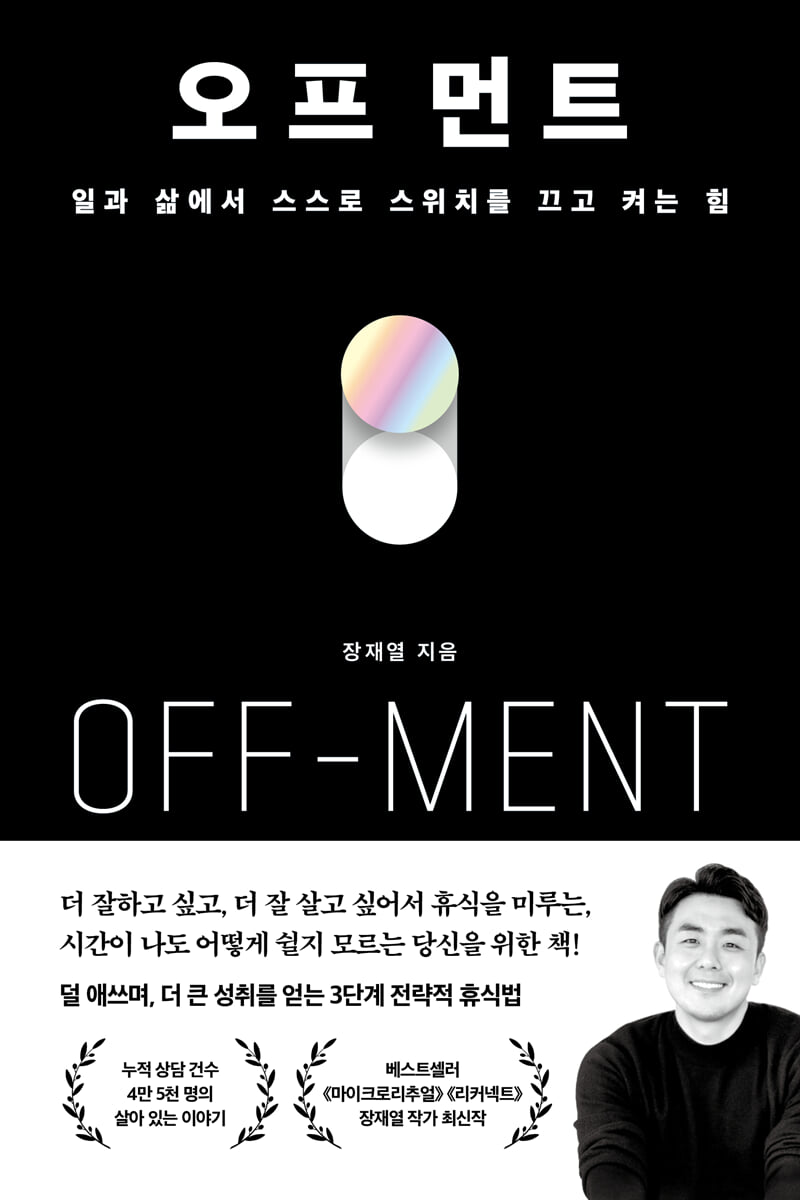
OFF-MENT
 |
Description
Book Introduction
Insights from 45,000 Live Stories
Helps you achieve more while using only 85% of your energy
3-Step Strategic Rest Method, Everything About 《Off Ment》!
★ What is OFF-MENT?
Off-ment is a combination of the word off, meaning stop, and moment, and in this book, it refers to a strategic rest method that balances work and daily life and ultimately achieves more with less energy.
“I should stop here after this, I should finish here and rest….”
Isn't this the phrase that people who have worked hard to do better and live better always say? But anyone who has empathized with this sentiment will understand.
That day will never come.
People who have lived so hard are the ones who finish their work on time but then put off doing tomorrow's work.
Because even when they are given time to rest, they don't know how to rest and instead rush into work.
Jang Jae-yeol, a counselor and writer who has studied youth burnout and mental health more deeply than anyone else, has met with over 45,000 people over the past 12 years as the head of the non-profit counseling group 'Unnies Who Played a Little'.
His new book, "Off-ment," is a guide to mental health for these people, and a strategy book that teaches us how to properly rest to recover our energy and re-immerse ourselves, as well as how rest is an essential process for achieving success.
This book talks about how to diagnose yourself so that you can objectively know the cause and effect of 'why and why you are trying so hard', and about developing the habit of 'off-ment', which increases the density of immersion by trying hard when you are trying and resting when you are resting.
In particular, the specific methods of 'off-ment' presented in this book are things that can be easily done by investing only 5 to 10 minutes a day.
The book contains methods to improve your physical and mental health as well as work efficiency by letting go of the obsession that you have to work hard to get better results, such as taking an empty-handed walk to separate yourself from work or using a locking app for a digital detox, and creating space in your daily life to breathe.
For those who have achieved success by pushing themselves but no longer find that method effective, this book will not only present new options but also serve as a booster for re-immersion.
Helps you achieve more while using only 85% of your energy
3-Step Strategic Rest Method, Everything About 《Off Ment》!
★ What is OFF-MENT?
Off-ment is a combination of the word off, meaning stop, and moment, and in this book, it refers to a strategic rest method that balances work and daily life and ultimately achieves more with less energy.
“I should stop here after this, I should finish here and rest….”
Isn't this the phrase that people who have worked hard to do better and live better always say? But anyone who has empathized with this sentiment will understand.
That day will never come.
People who have lived so hard are the ones who finish their work on time but then put off doing tomorrow's work.
Because even when they are given time to rest, they don't know how to rest and instead rush into work.
Jang Jae-yeol, a counselor and writer who has studied youth burnout and mental health more deeply than anyone else, has met with over 45,000 people over the past 12 years as the head of the non-profit counseling group 'Unnies Who Played a Little'.
His new book, "Off-ment," is a guide to mental health for these people, and a strategy book that teaches us how to properly rest to recover our energy and re-immerse ourselves, as well as how rest is an essential process for achieving success.
This book talks about how to diagnose yourself so that you can objectively know the cause and effect of 'why and why you are trying so hard', and about developing the habit of 'off-ment', which increases the density of immersion by trying hard when you are trying and resting when you are resting.
In particular, the specific methods of 'off-ment' presented in this book are things that can be easily done by investing only 5 to 10 minutes a day.
The book contains methods to improve your physical and mental health as well as work efficiency by letting go of the obsession that you have to work hard to get better results, such as taking an empty-handed walk to separate yourself from work or using a locking app for a digital detox, and creating space in your daily life to breathe.
For those who have achieved success by pushing themselves but no longer find that method effective, this book will not only present new options but also serve as a booster for re-immersion.
- You can preview some of the book's contents.
Preview
index
Prologue | Before I completely collapse from exhaustion, I need a moment to pause.
PART 1|Why do I get further from what I want the more I try?
A third-time student who was cornered by the enlistment corner decided to try again seven times, but ended up passing?
Why Your Face Got Better in Your 40s “I’ll figure it out somehow!”
Letting go of obsessions rather than goals
What you see when you slightly shift your gaze from the way you were using it
The more you try, the worse it gets, and the more you let go, the better it gets.
Your predictions for the future will most likely be wrong - Nari's story
There are times when you have to taste it to know if it's poop or soybean paste - Kyungho's story
PART 2|What are you working so hard for, and why?
“Why on earth do you live like that?”
The first step to letting go: expressing your emotions fully.
Why Kintsugi porcelain, almost thrown away, is so expensive
Am I digging my own grave, or is it circumstances that have shaped me?
A structural look at why we put in so much effort
Practice finding your core emotions: What scene in life would you most like to avoid?
Living with the brakes half-pressed at every moment—the story of Broccoli Nerma's Yoon Deok-won.
People who have their own 'breathing space'
Sometimes all we need is to stop thinking too much - Jimin and Yoonbum's story
PART 3|A time to fill the empty space left by effort with energy 'Off Ment
When was the last time you walked empty-handed?
It's not that I'm watching it because it's particularly interesting, but for you who only watch YouTube
Margaret Thatcher, who said rest was a luxury, said a word from a British princess who predicted her downfall.
Do you have any op-ment?
39-year-old Jang Jae-yeol realizes what he was missing after being diagnosed with stomach cancer.
My Funeral Experience - Joo Won's Story
Finding time to relax and let go completely
How to Create a "Kerencia," a Place of Relaxation and Recovery
The Importance of Conscious Aloneness - Eun-kyung's Story
Off-point as a time of re-immersion
When you can't let go, recognize it as a schedule.
A letter from the first reader to experience the op-ment|
“I hope your daily life becomes a little more comfortable.”
Epilogue | The moment I lived with effort, the moment I let go and live,
After all those moments, the moment you will definitely meet
PART 1|Why do I get further from what I want the more I try?
A third-time student who was cornered by the enlistment corner decided to try again seven times, but ended up passing?
Why Your Face Got Better in Your 40s “I’ll figure it out somehow!”
Letting go of obsessions rather than goals
What you see when you slightly shift your gaze from the way you were using it
The more you try, the worse it gets, and the more you let go, the better it gets.
Your predictions for the future will most likely be wrong - Nari's story
There are times when you have to taste it to know if it's poop or soybean paste - Kyungho's story
PART 2|What are you working so hard for, and why?
“Why on earth do you live like that?”
The first step to letting go: expressing your emotions fully.
Why Kintsugi porcelain, almost thrown away, is so expensive
Am I digging my own grave, or is it circumstances that have shaped me?
A structural look at why we put in so much effort
Practice finding your core emotions: What scene in life would you most like to avoid?
Living with the brakes half-pressed at every moment—the story of Broccoli Nerma's Yoon Deok-won.
People who have their own 'breathing space'
Sometimes all we need is to stop thinking too much - Jimin and Yoonbum's story
PART 3|A time to fill the empty space left by effort with energy 'Off Ment
When was the last time you walked empty-handed?
It's not that I'm watching it because it's particularly interesting, but for you who only watch YouTube
Margaret Thatcher, who said rest was a luxury, said a word from a British princess who predicted her downfall.
Do you have any op-ment?
39-year-old Jang Jae-yeol realizes what he was missing after being diagnosed with stomach cancer.
My Funeral Experience - Joo Won's Story
Finding time to relax and let go completely
How to Create a "Kerencia," a Place of Relaxation and Recovery
The Importance of Conscious Aloneness - Eun-kyung's Story
Off-point as a time of re-immersion
When you can't let go, recognize it as a schedule.
A letter from the first reader to experience the op-ment|
“I hope your daily life becomes a little more comfortable.”
Epilogue | The moment I lived with effort, the moment I let go and live,
After all those moments, the moment you will definitely meet
Detailed image

Into the book
I've come to realize that when it comes to achieving something, it's not just about the amount of effort you put in. Sometimes, being brave and trying things out and thinking about things from a slightly different angle are also very important keys.
In order to think a little differently, to try something with so-called 'strong heart', the most important thing is that my mind is not too cornered.
--- p.49
I believe that this is exactly what we need: 'letting go as an attitude and method.'
If we, who have always achieved our goals through hard work or through pressure, also experience achieving them through indifference and letting go, we will have two tools in our hands.
So, how will our lives change? Whenever we face a goal or problem in life, we can actively consider and choose, "What approach is more appropriate for this goal? To strive hard and work hard? Or to let go and relax?"
When you are running towards a goal and the method of 'trying hard' is not working, you can replace it with the method of 'giving up'.
In the process, we can be reborn as more proactive beings rather than people who are dragged along by circumstances.
--- p.73~74
“The people of our country really need to learn how to let go and let go.
They say that when you turn 40, you get a report card about how you lived in your 20s and 30s.
So I really tried to live as hard as I could, but after the stroke, I started to think a lot.
When I looked around at that time, I realized that among the people who lived like me, only a few were rewarded for their crazy hard work.
A significant number of the rest end up with cancer, burnout, or depression.
“I never thought I would receive my report card like that.”
--- p.100
“I sat in that chair and thought about why I was trying so hard.
I guess it's just because it's my job.
“No one is doing it for me, so I have to take care of it myself. I feel like I have to figure out what to do.”
“But, listening to you, it seems a little strange.”
“What is it?”
“If you work so hard to take care of it because it’s your job, why don’t you take care of your own life? Your life is yours, too.”
--- p.118
Are you experiencing feelings like resentment, irritation, and palpitations more frequently and intensely? Are you unable to control them, suddenly bursting into tears in a taxi, or becoming more serious about things you would have easily laughed off in the past? If so, it's time to listen to what they're saying, rather than avoiding them.
Those superficial emotions are not here to ruin my life, they are here to help me. They may look bad, but if you get to know them, they might actually be good people.
--- p.127
When you're overwhelmed with thoughts, don't you find yourself immersed in a task until it's over, putting off even the most basic things like food and sleep? And when you get home, feeling so empty and frustrated, you find yourself endlessly watching YouTube or playing games on your phone? As the princess said, rest can help you gain perspective and even enhance your cognitive abilities, allowing you to make better choices.
Even if it's not necessarily that, allowing us to have a 'little more relaxed mind' changes our entire attitude towards life.
Sometimes a loose mind can give you the courage to make important choices in life.
Therefore, rest is not an optional choice, nor is it a low-priority item that can be put on the back burner when the time comes.
Rather, it is more essential than any other thing.
--- p.220
Whether we practice 'off-ment' every day or leave for Kerencia when we have free time, even when such an environment is created, we must continue to feel the sense of 'I am with myself now' so that we do not let the time we are alone slip away.
If I had to spend 30 minutes with myself, if I had to take an hour off to go on a date with myself, what would I want to do with myself? The very process of thinking about it is a form of relaxation.
We can naturally escape from the countless tensions and stressful moments that have been weighing us down during the day.
Today, when my phone is off and the night is filled with silence, I ask myself:
'Now, how do you want to spend this time with me?' I ask and listen to myself to treat myself as the most important person.
In order to think a little differently, to try something with so-called 'strong heart', the most important thing is that my mind is not too cornered.
--- p.49
I believe that this is exactly what we need: 'letting go as an attitude and method.'
If we, who have always achieved our goals through hard work or through pressure, also experience achieving them through indifference and letting go, we will have two tools in our hands.
So, how will our lives change? Whenever we face a goal or problem in life, we can actively consider and choose, "What approach is more appropriate for this goal? To strive hard and work hard? Or to let go and relax?"
When you are running towards a goal and the method of 'trying hard' is not working, you can replace it with the method of 'giving up'.
In the process, we can be reborn as more proactive beings rather than people who are dragged along by circumstances.
--- p.73~74
“The people of our country really need to learn how to let go and let go.
They say that when you turn 40, you get a report card about how you lived in your 20s and 30s.
So I really tried to live as hard as I could, but after the stroke, I started to think a lot.
When I looked around at that time, I realized that among the people who lived like me, only a few were rewarded for their crazy hard work.
A significant number of the rest end up with cancer, burnout, or depression.
“I never thought I would receive my report card like that.”
--- p.100
“I sat in that chair and thought about why I was trying so hard.
I guess it's just because it's my job.
“No one is doing it for me, so I have to take care of it myself. I feel like I have to figure out what to do.”
“But, listening to you, it seems a little strange.”
“What is it?”
“If you work so hard to take care of it because it’s your job, why don’t you take care of your own life? Your life is yours, too.”
--- p.118
Are you experiencing feelings like resentment, irritation, and palpitations more frequently and intensely? Are you unable to control them, suddenly bursting into tears in a taxi, or becoming more serious about things you would have easily laughed off in the past? If so, it's time to listen to what they're saying, rather than avoiding them.
Those superficial emotions are not here to ruin my life, they are here to help me. They may look bad, but if you get to know them, they might actually be good people.
--- p.127
When you're overwhelmed with thoughts, don't you find yourself immersed in a task until it's over, putting off even the most basic things like food and sleep? And when you get home, feeling so empty and frustrated, you find yourself endlessly watching YouTube or playing games on your phone? As the princess said, rest can help you gain perspective and even enhance your cognitive abilities, allowing you to make better choices.
Even if it's not necessarily that, allowing us to have a 'little more relaxed mind' changes our entire attitude towards life.
Sometimes a loose mind can give you the courage to make important choices in life.
Therefore, rest is not an optional choice, nor is it a low-priority item that can be put on the back burner when the time comes.
Rather, it is more essential than any other thing.
--- p.220
Whether we practice 'off-ment' every day or leave for Kerencia when we have free time, even when such an environment is created, we must continue to feel the sense of 'I am with myself now' so that we do not let the time we are alone slip away.
If I had to spend 30 minutes with myself, if I had to take an hour off to go on a date with myself, what would I want to do with myself? The very process of thinking about it is a form of relaxation.
We can naturally escape from the countless tensions and stressful moments that have been weighing us down during the day.
Today, when my phone is off and the night is filled with silence, I ask myself:
'Now, how do you want to spend this time with me?' I ask and listen to myself to treat myself as the most important person.
--- p.264~265
Publisher's Review
“I think it would be better if we just did this much more,
“I should stop here and rest…”
But that day never came
A must-read for you!
★★★★★ Includes a self-diagnosis sheet to objectively identify the reasons for your efforts and specific practices for strategic rest.
★★★★★ New work by Jang Jae-yeol, author of the bestsellers Microritual and Reconnect
★★★★★ Highly recommended by psychiatrist Kim Ji-yong, psychologist Lee Seo-hyeon (Cool Summer Night), Yoon Deok-won (Broccoli You Too), and Oh Eun (Poet)!
In 2018, a survey of 23,000 Seoul citizens was conducted to investigate the state of mental health, and the results showed that “I feel like I am the only one who is falling behind.
And 56.1% of people thought that “the gap caused by this lag is unlikely to be repaired.”
What will the situation be like in 2025, several years later?
A survey of 1,000 people found that 41.3% of respondents cited stress-related distress as the cause of their mental health problems, 31.4% cited depression lasting several days, and 31.2% cited persistent anxiety.
There are still a significant number of people who complain of anxiety, depression, and stress.
In such a situation, who are most at risk? Those who, while not "burned out," still feel a sense of injustice, frustration, and subtle cracks in their daily lives. Those who, "I'm tired, but not sick," continue to push themselves as they always have, telling themselves that if they just keep trying a little harder, they'll do better. They'll get better. Those who, with diligence, push themselves every day.
However, the ending that such people will face is more likely to be a sad ending where they either lose energy and fall out, their health deteriorates, or they become unable to carry out daily life due to burnout, rather than achieving the achievements they desire.
《Off-ment》 can be said to be a kind of 'burnout prevention guide' for people who are strict with themselves, have a strong desire to do well, and are conscientious.
Jang Jae-yeol, a counselor and writer who has studied youth burnout and mental health more deeply than anyone else, has met with over 45,000 people over the past 12 years as the head of the non-profit counseling group 'Unnies Who Played a Little'.
Through this new work, he proposes a three-step strategic rest method called “Offment” based on insights from accumulated counseling data so that “people who want to do better and live better” can achieve the same results while working less and resting better, rather than experiencing a situation where the harder they work, the worse the outcome.
“Why is it that the harder I try, the further away I get from what I want?”
“What are you working so hard for, and why?”
“Do you have any offence?”
The term 'off-ment' is derived from 'OFF', meaning stop, and 'MOMENT', meaning moment. It can be easily understood by thinking of it as turning a switch on and off.
However, in this book, the author uses the concept of 'off-ment' not simply as a 'rest' for healing, but as a rest that restores energy and becomes a stepping stone to greater achievement and immersion.
In particular, by asking three big strategic questions, it encourages people to look deep inside themselves and ask, “Why do we move further away from our desired state the more we try?” and “Why and for what reason do we try so hard?” It also emphasizes that those who want to do better must not only try as they have done so far, but rather, must take a break.
The author persuasively explains why we sometimes insist on trying too hard, using an experiment by German psychologist Karl Dunker from 1945 as an example.
The content of this experiment was to observe the reactions of the subjects when they were given a paper box containing a candle, matches, and a pushpin and given the mission of “hanging the candle on the wall without letting the candle wax run out.”
Most people tried to stick candles into the wall with a tack or melt the candles to stick them, but the answer to the experiment was actually simple.
Empty all the pins from the cardboard box, place the candle inside the box, and then stick the pins into the cardboard box itself and attach it to the wall.
When we become fixated on the use of an object, we tend to think only of that object. This is called 'functional fixation', and the author points out that the reason we make efforts is ultimately due to this functional fixation.
Ultimately, it is difficult for people who have achieved success and accomplishments in this way to consider other methods.
By adding real-life stories of people who lost their health and job opportunities because they worked too hard, putting 'rest' at the bottom of their life's priorities, it vividly shows us the ending we will face if we live only by working hard.
In addition, this book helps you to become more objective by asking questions on various worksheets to see if you are striving for something that is mistakenly considered an 'obsession or stereotype' as your goal, and if there is no way to achieve your goal other than by really striving for it.
Based on this, a person who has found the fundamental cause of ‘what is it for (goal)’ and ‘why am I putting in so much effort (core emotion, cause that makes me put in so much effort)’ can design an ‘off-ment’, which corresponds to a specific methodology, in the direction of overcoming that cause.
If anxiety or worry is the cause, there is a therapy that allows you to ask yourself where those emotions came from; if the environment is the problem, there is a 'lock app digital detox' that allows you to forcibly separate work and daily life; how to make 'Kerencia' that helps you find peace of mind; and 'eye-stopping meditation' that increases the density of immersion. This book is full of methods that can be applied to your daily life even if you invest only 10 minutes or so a day.
‘Rest’ is not something you do when you have time.
It is an essential act for re-immersion and achievement!
Vivid examples of various people and
Brilliant insights from the author's experience
This book contains stories of people who have maintained their careers longer by working hard when they need to and resting when they need to, like living with the brakes half-pressed, and people who have gone through periods of working overtime as if eating, but know exactly how to rest and recover their energy during other times, and who have overcome those periods of hardship healthily and have become better at re-immersing themselves.
Above all, the author honestly captured the moments when he practiced 'off-ment' to overcome the crisis while pushing himself from his 20s to his 40s, when he suffered burnout, quit his job at a large company, and when his health deteriorated to the point of being diagnosed with stomach cancer. He then heard, "Your face feels relaxed and you look good."
This is the story of how I decided to take the college entrance exam 7 times after trying to get into Seoul National University 3 times and then let go of my obsession and got accepted.
This is the story of a man who ended up quitting his job after blowing most of his salary on taxis to and from work, and then living a second life as a counselor, healing his own wounds and those of his peers through self-reflection writing.
This is the story of how, despite being suddenly exposed to the media, receiving attention, and feeling pressured, he found his own routine that allowed him to achieve bigger goals and not lose energy by practicing the 'off-ment' methodology in this book.
If you listen carefully to those stories, you will realize, “Oh, working hard isn’t always the answer,” “I shouldn’t push myself to the point of overload, but I shouldn’t ignore the signals that I need to rest,” and “I can rest well and reach my desired point without reducing my goals.” This will give you the courage to refute the anxiety that “If I rest, will I fall behind?”
For those who still have the desire to do better and live well, this book will provide healthy options other than 'trying harder.'
For those who want to achieve greater things without giving up on their goals, "Offment" will be another powerful weapon.
“I should stop here and rest…”
But that day never came
A must-read for you!
★★★★★ Includes a self-diagnosis sheet to objectively identify the reasons for your efforts and specific practices for strategic rest.
★★★★★ New work by Jang Jae-yeol, author of the bestsellers Microritual and Reconnect
★★★★★ Highly recommended by psychiatrist Kim Ji-yong, psychologist Lee Seo-hyeon (Cool Summer Night), Yoon Deok-won (Broccoli You Too), and Oh Eun (Poet)!
In 2018, a survey of 23,000 Seoul citizens was conducted to investigate the state of mental health, and the results showed that “I feel like I am the only one who is falling behind.
And 56.1% of people thought that “the gap caused by this lag is unlikely to be repaired.”
What will the situation be like in 2025, several years later?
A survey of 1,000 people found that 41.3% of respondents cited stress-related distress as the cause of their mental health problems, 31.4% cited depression lasting several days, and 31.2% cited persistent anxiety.
There are still a significant number of people who complain of anxiety, depression, and stress.
In such a situation, who are most at risk? Those who, while not "burned out," still feel a sense of injustice, frustration, and subtle cracks in their daily lives. Those who, "I'm tired, but not sick," continue to push themselves as they always have, telling themselves that if they just keep trying a little harder, they'll do better. They'll get better. Those who, with diligence, push themselves every day.
However, the ending that such people will face is more likely to be a sad ending where they either lose energy and fall out, their health deteriorates, or they become unable to carry out daily life due to burnout, rather than achieving the achievements they desire.
《Off-ment》 can be said to be a kind of 'burnout prevention guide' for people who are strict with themselves, have a strong desire to do well, and are conscientious.
Jang Jae-yeol, a counselor and writer who has studied youth burnout and mental health more deeply than anyone else, has met with over 45,000 people over the past 12 years as the head of the non-profit counseling group 'Unnies Who Played a Little'.
Through this new work, he proposes a three-step strategic rest method called “Offment” based on insights from accumulated counseling data so that “people who want to do better and live better” can achieve the same results while working less and resting better, rather than experiencing a situation where the harder they work, the worse the outcome.
“Why is it that the harder I try, the further away I get from what I want?”
“What are you working so hard for, and why?”
“Do you have any offence?”
The term 'off-ment' is derived from 'OFF', meaning stop, and 'MOMENT', meaning moment. It can be easily understood by thinking of it as turning a switch on and off.
However, in this book, the author uses the concept of 'off-ment' not simply as a 'rest' for healing, but as a rest that restores energy and becomes a stepping stone to greater achievement and immersion.
In particular, by asking three big strategic questions, it encourages people to look deep inside themselves and ask, “Why do we move further away from our desired state the more we try?” and “Why and for what reason do we try so hard?” It also emphasizes that those who want to do better must not only try as they have done so far, but rather, must take a break.
The author persuasively explains why we sometimes insist on trying too hard, using an experiment by German psychologist Karl Dunker from 1945 as an example.
The content of this experiment was to observe the reactions of the subjects when they were given a paper box containing a candle, matches, and a pushpin and given the mission of “hanging the candle on the wall without letting the candle wax run out.”
Most people tried to stick candles into the wall with a tack or melt the candles to stick them, but the answer to the experiment was actually simple.
Empty all the pins from the cardboard box, place the candle inside the box, and then stick the pins into the cardboard box itself and attach it to the wall.
When we become fixated on the use of an object, we tend to think only of that object. This is called 'functional fixation', and the author points out that the reason we make efforts is ultimately due to this functional fixation.
Ultimately, it is difficult for people who have achieved success and accomplishments in this way to consider other methods.
By adding real-life stories of people who lost their health and job opportunities because they worked too hard, putting 'rest' at the bottom of their life's priorities, it vividly shows us the ending we will face if we live only by working hard.
In addition, this book helps you to become more objective by asking questions on various worksheets to see if you are striving for something that is mistakenly considered an 'obsession or stereotype' as your goal, and if there is no way to achieve your goal other than by really striving for it.
Based on this, a person who has found the fundamental cause of ‘what is it for (goal)’ and ‘why am I putting in so much effort (core emotion, cause that makes me put in so much effort)’ can design an ‘off-ment’, which corresponds to a specific methodology, in the direction of overcoming that cause.
If anxiety or worry is the cause, there is a therapy that allows you to ask yourself where those emotions came from; if the environment is the problem, there is a 'lock app digital detox' that allows you to forcibly separate work and daily life; how to make 'Kerencia' that helps you find peace of mind; and 'eye-stopping meditation' that increases the density of immersion. This book is full of methods that can be applied to your daily life even if you invest only 10 minutes or so a day.
‘Rest’ is not something you do when you have time.
It is an essential act for re-immersion and achievement!
Vivid examples of various people and
Brilliant insights from the author's experience
This book contains stories of people who have maintained their careers longer by working hard when they need to and resting when they need to, like living with the brakes half-pressed, and people who have gone through periods of working overtime as if eating, but know exactly how to rest and recover their energy during other times, and who have overcome those periods of hardship healthily and have become better at re-immersing themselves.
Above all, the author honestly captured the moments when he practiced 'off-ment' to overcome the crisis while pushing himself from his 20s to his 40s, when he suffered burnout, quit his job at a large company, and when his health deteriorated to the point of being diagnosed with stomach cancer. He then heard, "Your face feels relaxed and you look good."
This is the story of how I decided to take the college entrance exam 7 times after trying to get into Seoul National University 3 times and then let go of my obsession and got accepted.
This is the story of a man who ended up quitting his job after blowing most of his salary on taxis to and from work, and then living a second life as a counselor, healing his own wounds and those of his peers through self-reflection writing.
This is the story of how, despite being suddenly exposed to the media, receiving attention, and feeling pressured, he found his own routine that allowed him to achieve bigger goals and not lose energy by practicing the 'off-ment' methodology in this book.
If you listen carefully to those stories, you will realize, “Oh, working hard isn’t always the answer,” “I shouldn’t push myself to the point of overload, but I shouldn’t ignore the signals that I need to rest,” and “I can rest well and reach my desired point without reducing my goals.” This will give you the courage to refute the anxiety that “If I rest, will I fall behind?”
For those who still have the desire to do better and live well, this book will provide healthy options other than 'trying harder.'
For those who want to achieve greater things without giving up on their goals, "Offment" will be another powerful weapon.
GOODS SPECIFICS
- Date of issue: October 24, 2025
- Page count, weight, size: 328 pages | 434g | 140*210*20mm
- ISBN13: 9791194979715
- ISBN10: 1194979718
You may also like
카테고리
korean


korean

![GQ KOREA Mark (Monthly): December [2025]](http://librairie.coreenne.fr/cdn/shop/files/8ef265dbbfbf186523ed75ba7319009d.jpg?v=1765340328&width=3840)


