

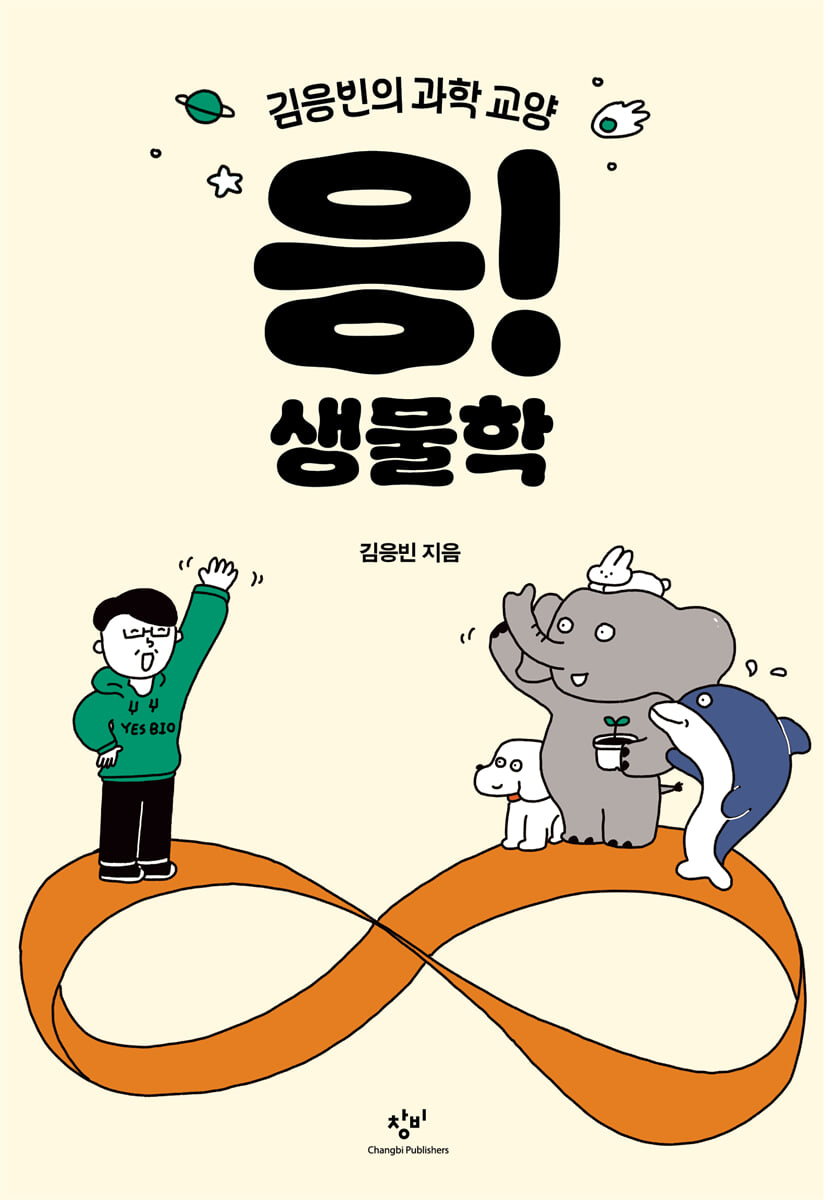
Yeah! Biology
 |
Description
Book Introduction
“Science shines brightest when you ask questions!”
Yeah? If you ask, you'll know!
100% intellectual dopamine-filled science and culture
Professor Kim Eung-bin, a professor of systems biology at Yonsei University and a YouTuber who pursues "science through questioning and discussion," has published a new book, "Yes! Biology."
This book is written by an author who has communicated with the public and shared his knowledge of biology through various science YouTube channels such as 'See Science', 'Science That Won't Work', and his own channel 'Eungbiology', and answers the absurd and unique questions around us in scientific language.
Based on his philosophy that “science shines brightest the moment you ask questions,” he has carefully explained the curious questions that people ask with innocent faces in various settings such as schools, broadcasts, and lectures, along with fun illustrations.
Professor Kim Eung-bin's specialty is presenting a feast of knowledge that crosses science, art, and the humanities, to the point where subscribers to "Eungbiology" often ask, "Is this a science channel? Or a humanities channel?"
On the 'See Science' channel, he showed the essence of scientific discussion, breaking down stereotypes and prejudices one by one to arrive at his own answer, and his subscribers even gave him the nickname 'King of Scientific Discussion'.
This book is filled with not only a wealth of scientific knowledge, but also the thrill of the question, "Why?" that flashes through your mind like lightning.
We've created a "Let's Discuss!" corner where readers can expand their thinking through discussions on their own, with friends, or with AI.
As emphasized in all fields, the most important power in the AI era is the 'ability to ask questions.'
To find good answers, you must be able to ask good questions and experience the joy of asking questions yourself.
Just as a question mark (?) becomes a fishhook (¿) when flipped over, let's meet the 100% dopamine science story that will become the key to changing rigid thinking and opening the world of knowledge.
Yeah? If you ask, you'll know!
100% intellectual dopamine-filled science and culture
Professor Kim Eung-bin, a professor of systems biology at Yonsei University and a YouTuber who pursues "science through questioning and discussion," has published a new book, "Yes! Biology."
This book is written by an author who has communicated with the public and shared his knowledge of biology through various science YouTube channels such as 'See Science', 'Science That Won't Work', and his own channel 'Eungbiology', and answers the absurd and unique questions around us in scientific language.
Based on his philosophy that “science shines brightest the moment you ask questions,” he has carefully explained the curious questions that people ask with innocent faces in various settings such as schools, broadcasts, and lectures, along with fun illustrations.
Professor Kim Eung-bin's specialty is presenting a feast of knowledge that crosses science, art, and the humanities, to the point where subscribers to "Eungbiology" often ask, "Is this a science channel? Or a humanities channel?"
On the 'See Science' channel, he showed the essence of scientific discussion, breaking down stereotypes and prejudices one by one to arrive at his own answer, and his subscribers even gave him the nickname 'King of Scientific Discussion'.
This book is filled with not only a wealth of scientific knowledge, but also the thrill of the question, "Why?" that flashes through your mind like lightning.
We've created a "Let's Discuss!" corner where readers can expand their thinking through discussions on their own, with friends, or with AI.
As emphasized in all fields, the most important power in the AI era is the 'ability to ask questions.'
To find good answers, you must be able to ask good questions and experience the joy of asking questions yourself.
Just as a question mark (?) becomes a fishhook (¿) when flipped over, let's meet the 100% dopamine science story that will become the key to changing rigid thinking and opening the world of knowledge.
- You can preview some of the book's contents.
Preview
index
Introduction: The Curious and Thrilling World of Biology Chapter 1: All Life is Wonderful: Nature's Infinite Questions 1.
Bluebird, does it really exist? / 2.
Can humans and whales communicate? / 3.
What is the survival strategy of the 100% female born drunkard? / 4.
Seaweed's Shocking Confession: I'm Not a Plant! / 5.
Are the rabbit and the turtle still competing? / 6.
How does a 100-meter tree drink water? / 7.
Are saltwater fish's bodies permeated with salt? / 8.
Does my dog like red balls or yellow balls? / 9.
How to identify a place infested with bedbugs? / 10.
Cockroaches of the future, which ones will survive? / 11.
Why did peanuts become ground beans? / 12.
Let's hear the story of this plant that lives without photosynthesis/ 13.
Are the feet of a 7-ton elephant healthy? Chapter 2: Humans, the Most Interesting Beings: Scientific Experiments and Controversies Surrounding Us 1.
Why are 9 out of 10 people right-handed? / 2.
There is only one nose, but why are there two nostrils? / 3.
How does K-play train the brain and body at the same time? / 4.
Why do mosquitoes only bite me? / 5.
From eels to hagfish, why are there so many types of eels? / 6.
When building muscle, what is more important: weight or reps? / 7.
Potatoes or sweet potatoes, which is the best famine relief crop? / 8.
Why do humans hate snakes? / 9.
Water can also be poisonous? / 10.
Why is human childbirth so painful? / 11.
Do humans dream of immortal jellyfish? / 12.
Do identical twins have identical fingerprints? Chapter 3: Science Crosses the Line Between Imagination and Reality: From Michelangelo to Pikachu, Through the Eyes of Biology 1.
Find the Michelangelo Code in the Sistine Chapel/ 2.
How did Pinocchio survive in the whale's belly? / 3.
How does Pikachu's bio-battery system work? / 4.
Is it possible for the movie "Planet of the Apes" to become a reality? / 5.
Tigers leave their skins behind when they die, but what if mold leaves its skins behind too? / 6.
Rudolph, let's talk about the science that protects our hearts/ 7.
What Earth creature is closest to an alien? / 8.
How do dragons breathe fire? Image source
Bluebird, does it really exist? / 2.
Can humans and whales communicate? / 3.
What is the survival strategy of the 100% female born drunkard? / 4.
Seaweed's Shocking Confession: I'm Not a Plant! / 5.
Are the rabbit and the turtle still competing? / 6.
How does a 100-meter tree drink water? / 7.
Are saltwater fish's bodies permeated with salt? / 8.
Does my dog like red balls or yellow balls? / 9.
How to identify a place infested with bedbugs? / 10.
Cockroaches of the future, which ones will survive? / 11.
Why did peanuts become ground beans? / 12.
Let's hear the story of this plant that lives without photosynthesis/ 13.
Are the feet of a 7-ton elephant healthy? Chapter 2: Humans, the Most Interesting Beings: Scientific Experiments and Controversies Surrounding Us 1.
Why are 9 out of 10 people right-handed? / 2.
There is only one nose, but why are there two nostrils? / 3.
How does K-play train the brain and body at the same time? / 4.
Why do mosquitoes only bite me? / 5.
From eels to hagfish, why are there so many types of eels? / 6.
When building muscle, what is more important: weight or reps? / 7.
Potatoes or sweet potatoes, which is the best famine relief crop? / 8.
Why do humans hate snakes? / 9.
Water can also be poisonous? / 10.
Why is human childbirth so painful? / 11.
Do humans dream of immortal jellyfish? / 12.
Do identical twins have identical fingerprints? Chapter 3: Science Crosses the Line Between Imagination and Reality: From Michelangelo to Pikachu, Through the Eyes of Biology 1.
Find the Michelangelo Code in the Sistine Chapel/ 2.
How did Pinocchio survive in the whale's belly? / 3.
How does Pikachu's bio-battery system work? / 4.
Is it possible for the movie "Planet of the Apes" to become a reality? / 5.
Tigers leave their skins behind when they die, but what if mold leaves its skins behind too? / 6.
Rudolph, let's talk about the science that protects our hearts/ 7.
What Earth creature is closest to an alien? / 8.
How do dragons breathe fire? Image source
Detailed image

Publisher's Review
“Questions are the key to entering the world of knowledge.”
The fun of science explodes when you fish the world with question marks (?)!
Humans are animals that always live with a 'question mark'.
Even when I accidentally pick up money on the street or it suddenly starts raining, the question 'Why?' comes to mind.
Science was the process of preparing answers to those questions.
"Yeah! Biology" isn't a rigid science textbook.
Instead of listing facts about transpiration, evolution, or bioelectricity, it first poses quirky and absurd questions, such as how a 100-meter-tall tree drinks water, whether the feet of a 7-ton elephant are healthy, and how the biological battery system of the cartoon character Pikachu works.
When the author, a top lecturer at Yonsei University and a popular science YouTuber, offers his signature serious and detailed answers to these questions, we find ourselves laughing while also encountering new scientific knowledge.
It is a moment when the mask of complex theories and boring exam-oriented science is refreshingly removed.
This is a science textbook that anyone can easily and enjoyably enjoy, from science nerds who question everything in the world to those who are tired of the "memorized biology" they learn in school.
From our dog to the imaginary Pikachu,
A bountiful intellectual feast of biology, as rich as a banquet table!
As social interest in the bio industry grows, it's not easy to read a book to understand biology and related cutting-edge technologies.
However, this book was written so that not only adults with little scientific background knowledge but also teenagers who usually have difficulty reading science books can read it easily and without burden.
Chapter 1 discusses the science surrounding living things that are intertwined with us, such as dogs, trees, and whales.
The story of seaweed, which, contrary to common sense, is not a 'plant' that lives in the sea, is shocking to us, but it expands our understanding of the world of microorganisms.
Curiosity surrounding saltwater fish, peanuts, and bedbugs also leads to reflections on human food, clothing, and shelter.
Chapter 2 covers interesting biological discoveries and controversies surrounding human existence.
Facts that were once taken for granted, such as why 9 out of 10 people are right-handed and why we have two nostrils, become a labyrinth and lead to a chain of interesting questions.
Chapter 3 biologically unravels creations born at the intersection of science and imagination, such as fire-breathing dragons and the "facehuggers" from the film "Alien."
Beyond simple fun, this is a passage that allows us to understand and reflect more deeply on nature, life, and evolution.
The process by which the author seeks answers to seemingly incongruous questions is interesting in itself.
The book doesn't stop there. It also encourages readers to ask and answer their own questions through the "Let's Discuss" section, which is frequently included at the end of each sentence.
If you've read this book and suddenly found yourself questioning a problem you've never encountered before, you'll realize that you've gained the "questioning muscle" and learned something.
Freely crossing over science, art, and humanities
"A thrilling science textbook"
What makes this book special is that it goes beyond the field of 'biology' and freely crosses over into the arts and humanities.
As we contemplate the blue of the bluebird, we find ourselves overlapping the blue that symbolizes depression (blue) with the blue of the artist Picasso, and in Michelangelo's "The Creation of Adam," we can read the metaphor of the conception and birth of life hidden in the knowledge of anatomy.
As we scientifically unravel the mystery of Rudolph's shining nose, the symbol of Christmas, we are reminded of the preciousness of the human heart that shares and preserves imaginary stories.
Kim Eung-bin's "Yes! Biology" is a perfect example of how to open your mind with questions and expand your thinking through discussion.
We invite you, our readers, into the world of biology, a world filled with the joy of transcending knowledge and life.
The fun of science explodes when you fish the world with question marks (?)!
Humans are animals that always live with a 'question mark'.
Even when I accidentally pick up money on the street or it suddenly starts raining, the question 'Why?' comes to mind.
Science was the process of preparing answers to those questions.
"Yeah! Biology" isn't a rigid science textbook.
Instead of listing facts about transpiration, evolution, or bioelectricity, it first poses quirky and absurd questions, such as how a 100-meter-tall tree drinks water, whether the feet of a 7-ton elephant are healthy, and how the biological battery system of the cartoon character Pikachu works.
When the author, a top lecturer at Yonsei University and a popular science YouTuber, offers his signature serious and detailed answers to these questions, we find ourselves laughing while also encountering new scientific knowledge.
It is a moment when the mask of complex theories and boring exam-oriented science is refreshingly removed.
This is a science textbook that anyone can easily and enjoyably enjoy, from science nerds who question everything in the world to those who are tired of the "memorized biology" they learn in school.
From our dog to the imaginary Pikachu,
A bountiful intellectual feast of biology, as rich as a banquet table!
As social interest in the bio industry grows, it's not easy to read a book to understand biology and related cutting-edge technologies.
However, this book was written so that not only adults with little scientific background knowledge but also teenagers who usually have difficulty reading science books can read it easily and without burden.
Chapter 1 discusses the science surrounding living things that are intertwined with us, such as dogs, trees, and whales.
The story of seaweed, which, contrary to common sense, is not a 'plant' that lives in the sea, is shocking to us, but it expands our understanding of the world of microorganisms.
Curiosity surrounding saltwater fish, peanuts, and bedbugs also leads to reflections on human food, clothing, and shelter.
Chapter 2 covers interesting biological discoveries and controversies surrounding human existence.
Facts that were once taken for granted, such as why 9 out of 10 people are right-handed and why we have two nostrils, become a labyrinth and lead to a chain of interesting questions.
Chapter 3 biologically unravels creations born at the intersection of science and imagination, such as fire-breathing dragons and the "facehuggers" from the film "Alien."
Beyond simple fun, this is a passage that allows us to understand and reflect more deeply on nature, life, and evolution.
The process by which the author seeks answers to seemingly incongruous questions is interesting in itself.
The book doesn't stop there. It also encourages readers to ask and answer their own questions through the "Let's Discuss" section, which is frequently included at the end of each sentence.
If you've read this book and suddenly found yourself questioning a problem you've never encountered before, you'll realize that you've gained the "questioning muscle" and learned something.
Freely crossing over science, art, and humanities
"A thrilling science textbook"
What makes this book special is that it goes beyond the field of 'biology' and freely crosses over into the arts and humanities.
As we contemplate the blue of the bluebird, we find ourselves overlapping the blue that symbolizes depression (blue) with the blue of the artist Picasso, and in Michelangelo's "The Creation of Adam," we can read the metaphor of the conception and birth of life hidden in the knowledge of anatomy.
As we scientifically unravel the mystery of Rudolph's shining nose, the symbol of Christmas, we are reminded of the preciousness of the human heart that shares and preserves imaginary stories.
Kim Eung-bin's "Yes! Biology" is a perfect example of how to open your mind with questions and expand your thinking through discussion.
We invite you, our readers, into the world of biology, a world filled with the joy of transcending knowledge and life.
GOODS SPECIFICS
- Date of issue: September 18, 2025
- Page count, weight, size: 228 pages | 306g | 134*195*17mm
- ISBN13: 9788936480936
You may also like
카테고리
korean


korean

![GQ KOREA Mark (Monthly): December [2025]](http://librairie.coreenne.fr/cdn/shop/files/8ef265dbbfbf186523ed75ba7319009d.jpg?v=1765340328&width=3840)


