

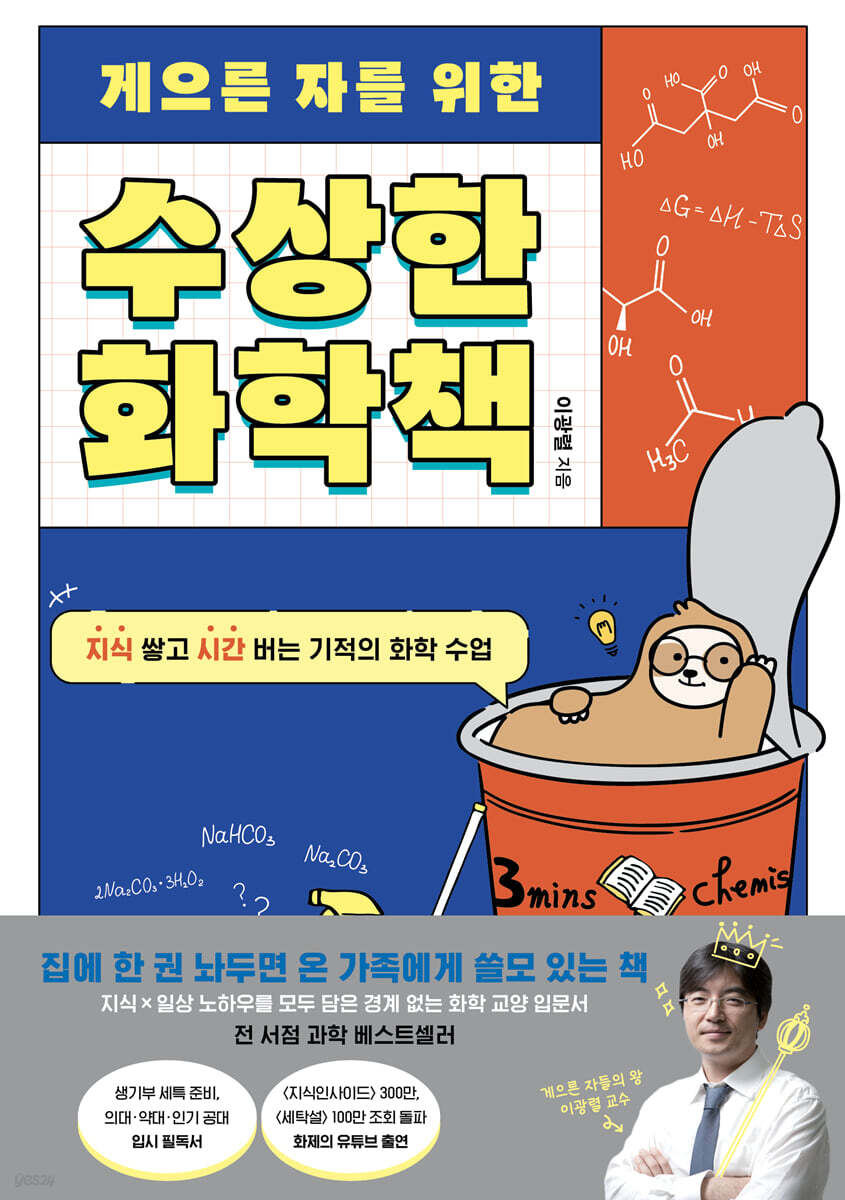
Suspicious Chemistry for Lazy People
 |
Description
Book Introduction
★ Highly recommended by chemistry professors from Seoul National University, Ewha Womans University, and KAIST!
★ Naver Premium Content Subscription #1 "Chemistry for Everyone"
“How is it? Chemistry is easy, right?”
Discover the joy of chemistry while clearing survival routines!
A Breezy Introduction to Chemistry that Makes Difficult Chemical Principles Instantly Understandable
Acids and bases, oxidation and reduction, neutralization reactions... These are all important chemical principles that you've probably learned at least once in a textbook (some readers might get a headache just reading them).
They say the world we live in is made up of chemistry, but even when we study by underlining, we often get frustrated when faced with complex chemical symbols and molecular formulas.
For those who are ignorant of science and misunderstand that memorizing the periodic table is all there is to chemistry, Professor Lee Kwang-ryeol has stepped forward to provide an experience of discovering the joy of chemistry in everyday life.
The author, who received a bachelor's degree in chemistry from KAIST and a doctorate in chemistry from the University of Illinois, is currently a professor of chemistry at Korea University and runs the popular science channel "Chemistry for Everyone" and is known as the "King of the Lazy." He focused on everyday household chores that everyone has to do but are the main culprits of time thieves, and which are closely related to chemistry.
The author humorously explains the chemical tricks he developed because he hated cleaning so much, as well as the principles behind them.
Part 1 teaches you how to use chemistry right away, so you can read it in one sitting. Part 2 provides an easy-to-understand explanation of essential chemical principles, such as acids and bases, helping you transform from a busy person into a cultured and relaxed chemist.
The final part 3 provides a list of things you should never do at home, for those of you who are constantly experimenting with dangerous chemicals (like mixing bleach with vinegar).
This book will allow me to indulge in the experience of being lazy and doing more valuable things (like drinking tea, listening to music, or spending time with loved ones) while chemistry does the work for me.
It's a paradoxical situation where a lazy person studies chemistry to become even lazier, but if you can make both knowledge and time your own, the study will be worthwhile.
If you want to know what happens when a chemist throws himself into cleaning, if you're curious about the power of chemistry to connect both life and study, if you're looking for a chemistry textbook you can read without feeling overwhelmed, open this book!
★ Naver Premium Content Subscription #1 "Chemistry for Everyone"
“How is it? Chemistry is easy, right?”
Discover the joy of chemistry while clearing survival routines!
A Breezy Introduction to Chemistry that Makes Difficult Chemical Principles Instantly Understandable
Acids and bases, oxidation and reduction, neutralization reactions... These are all important chemical principles that you've probably learned at least once in a textbook (some readers might get a headache just reading them).
They say the world we live in is made up of chemistry, but even when we study by underlining, we often get frustrated when faced with complex chemical symbols and molecular formulas.
For those who are ignorant of science and misunderstand that memorizing the periodic table is all there is to chemistry, Professor Lee Kwang-ryeol has stepped forward to provide an experience of discovering the joy of chemistry in everyday life.
The author, who received a bachelor's degree in chemistry from KAIST and a doctorate in chemistry from the University of Illinois, is currently a professor of chemistry at Korea University and runs the popular science channel "Chemistry for Everyone" and is known as the "King of the Lazy." He focused on everyday household chores that everyone has to do but are the main culprits of time thieves, and which are closely related to chemistry.
The author humorously explains the chemical tricks he developed because he hated cleaning so much, as well as the principles behind them.
Part 1 teaches you how to use chemistry right away, so you can read it in one sitting. Part 2 provides an easy-to-understand explanation of essential chemical principles, such as acids and bases, helping you transform from a busy person into a cultured and relaxed chemist.
The final part 3 provides a list of things you should never do at home, for those of you who are constantly experimenting with dangerous chemicals (like mixing bleach with vinegar).
This book will allow me to indulge in the experience of being lazy and doing more valuable things (like drinking tea, listening to music, or spending time with loved ones) while chemistry does the work for me.
It's a paradoxical situation where a lazy person studies chemistry to become even lazier, but if you can make both knowledge and time your own, the study will be worthwhile.
If you want to know what happens when a chemist throws himself into cleaning, if you're curious about the power of chemistry to connect both life and study, if you're looking for a chemistry textbook you can read without feeling overwhelmed, open this book!
- You can preview some of the book's contents.
Preview
index
Recommendation
Prologue: Why We Should Be Lazy Chemists
Part 1: Instant Chemistry Tips to Save Time You Wouldn't Have Wasted
Chapter 1: Questions on Reducing the Number of Chemical Cleanings
1 How does a lazy person wash the dishes?
2 Who removes grease from the kitchen exhaust vent screen?
3 How Do Lazy People Do the Dishes? (Upgraded Version)
4. We need to get rid of the germs in our bathroom sink, right?
5 Lazy Tricks to Handle Delivery Containers?
6 When is the vinegar and baking soda combination really useful?
7 How do I clean a burnt pot?
8 How many grains can you use to make a clean toilet?
9 How does a lazy person clean a toilet tank?
10 Should I clean the toilet tank or the toilet itself?
11 Toilet Cleaning Tips for a Clean You (Advanced Chemistry Applications)
12 Should I try chemically cleaning the shower glass?
13 How to get rid of white deposits on sinks and mirrors?
14 How to clean your bathtub and sink like a professional?
+ Shopping List for a Clean Home
Chapter 2: The Question That Makes a Lazy Person Clean
1. Can you mix baking soda, washing soda, and sodium percarbonate? A practical laundry recipe!
2. What should I do with clothes that are prone to fading?
3. If I have an anti-color sheet, I don't have to worry about washing colored clothes?
4 A Lazy Man's Trouble: How to Remove Old Stains?
5 Housewives and 10th graders all know how to manage washing machines, dishwashers, and drains?
6 How to get rid of musty smells in the bathroom and refrigerator?
7 Are there any toothbrush care tips that even lazy people can do?
8. Can we reduce foot and shoe odor with chemicals?
9 Secrets Only Chemistry Experts Know About Washing Soda's Odor Elimination
10 To those who are caught by me and do cleaning experiments day and night
+ Lazy Man's Cleaning: The Power of Time
Chapter 3: Clean, Sparklingly Managed Questions
1 What is Cleopatra's skin care secret?
2 What about acne? OOO!
3. What is the relationship between sebum and acne?
4 What is the secret behind the best-selling pore cleaner?
5 What if I can't sleep because my skin is dry and itchy?
6. The cause of freckles and dark spots! Let's get rid of melanin.
7 How do moisturizers hydrate skin?
8. What is the difference? Exploring mineral oil and petroleum jelly, two ingredients commonly used in cosmetics.
9. Plump, Kissable Lips? The Chemistry of Lip Gloss
10 Cuticle Lift or Lower? The Secret to Shiny Hair
11 Why does bleaching inevitably destroy hair?
12 Why does dyeing my hair damage it?
+ Awareness as a Chemical Being: The Beginning of Beauty
Chapter 4: Stop Pseudoscience! Healthy Questions for Safe Eating and Living
1 What is benzopyrene and why does it cause cancer?
2 How to avoid cancer-causing PAHs?
3 Did you know that diacetyl is especially harmful to children?
4 Scary Fats? Trans Fats!
Can pesticide residues be removed with a 5-stage dilution solution?
6 Can pesticides embedded in fruit peels be removed?
7. Do you know about the environmental hormones hidden in beverage cans?
8. Is perfume coming in through the nose safe for children?
9 Is aromatherapy using essential oils therapy?
+ Travel to a healthy and happy planet Earth
Chapter 5: A Refreshing Question to Free Yourself from the Annoying Pests
1 How to get rid of dust mites in your blanket?
2 Personal attitude towards dealing with bedbugs
3 Ways to Get Rid of Ants in Your Home
4. Can a bait mixed with OO solve the problem of scary cockroaches?
5. Getting rid of fruit flies? That's easy.
6. Can I just stab them with OOO and kill them?
7 The natural enemy of dust mites is the chrysanthemum flower?
8 What is the relationship between the new wave, chrysanthemums, and head lice?
9 Aphids, the troublemaker of flower beds, can I get rid of them starting from OO?
+ Life and Chemistry: The Duality of Chemistry
Part 2: A Taste of Chemistry Known Only to the Top 100
1. Surviving as a Lazy Person: Observe, Think, and Experiment
2. Lazy people analyze the chemical composition of dirt before cleaning (dirt strategy)
3 The World's Most Important Formula for Lazy People
4 Lazy Laundry Secrets: Understanding the Three Musketeers of Detergent
5 Baking Soda Derivatives? Revisiting Washing Soda
6 For the curious and intelligent among you: Why is baking soda alkaline?
7 Reasons Why Baking Soda and Vinegar React So Violently
8 I'm scared of washing soda.
To those who say, "Ahhh!"
9 Hidden Benefits of Washing Soda Dishwashing
10 Why does washing soda get hot when it dissolves in water?
11 Is it inevitable or a coincidence that washing soda dissolves in water?
12 The Lazy Man's Friend, the Lazy Man's Lament of Soda
13. Why is sodium percarbonate supposed to be eco-friendly? If you drink it, you'll die.
14 The lazy man's knowledge of acids and bases has been increased by +100.
15 Neutralization reaction and this damn thing
16 Oxygen atoms are gangsters? Learn about oxidation through stories.
17 Now that we've learned about oxidation, let's learn about reduction.
18 Still struggling? Revisit oxidation-reduction for beginners in chemistry.
Part 3: Lazy People, Don't Do This
1 A lazy person doesn't mix.
2. A word to those who are overly obsessed with cleaning.
3 Things You Should Never Do When Using Soda Percarbonate
4. How to Determine the Hazards of Oxygen Bleach and Chlorine Bleach
5. What is Natural Rocks? Like a Unicorn
6 Reasons Why You, Lazy But Smart, Stay Away From Spray Cans
7 Things You Should Never Do in the Future for a Safer Life
Epilogue
index
Prologue: Why We Should Be Lazy Chemists
Part 1: Instant Chemistry Tips to Save Time You Wouldn't Have Wasted
Chapter 1: Questions on Reducing the Number of Chemical Cleanings
1 How does a lazy person wash the dishes?
2 Who removes grease from the kitchen exhaust vent screen?
3 How Do Lazy People Do the Dishes? (Upgraded Version)
4. We need to get rid of the germs in our bathroom sink, right?
5 Lazy Tricks to Handle Delivery Containers?
6 When is the vinegar and baking soda combination really useful?
7 How do I clean a burnt pot?
8 How many grains can you use to make a clean toilet?
9 How does a lazy person clean a toilet tank?
10 Should I clean the toilet tank or the toilet itself?
11 Toilet Cleaning Tips for a Clean You (Advanced Chemistry Applications)
12 Should I try chemically cleaning the shower glass?
13 How to get rid of white deposits on sinks and mirrors?
14 How to clean your bathtub and sink like a professional?
+ Shopping List for a Clean Home
Chapter 2: The Question That Makes a Lazy Person Clean
1. Can you mix baking soda, washing soda, and sodium percarbonate? A practical laundry recipe!
2. What should I do with clothes that are prone to fading?
3. If I have an anti-color sheet, I don't have to worry about washing colored clothes?
4 A Lazy Man's Trouble: How to Remove Old Stains?
5 Housewives and 10th graders all know how to manage washing machines, dishwashers, and drains?
6 How to get rid of musty smells in the bathroom and refrigerator?
7 Are there any toothbrush care tips that even lazy people can do?
8. Can we reduce foot and shoe odor with chemicals?
9 Secrets Only Chemistry Experts Know About Washing Soda's Odor Elimination
10 To those who are caught by me and do cleaning experiments day and night
+ Lazy Man's Cleaning: The Power of Time
Chapter 3: Clean, Sparklingly Managed Questions
1 What is Cleopatra's skin care secret?
2 What about acne? OOO!
3. What is the relationship between sebum and acne?
4 What is the secret behind the best-selling pore cleaner?
5 What if I can't sleep because my skin is dry and itchy?
6. The cause of freckles and dark spots! Let's get rid of melanin.
7 How do moisturizers hydrate skin?
8. What is the difference? Exploring mineral oil and petroleum jelly, two ingredients commonly used in cosmetics.
9. Plump, Kissable Lips? The Chemistry of Lip Gloss
10 Cuticle Lift or Lower? The Secret to Shiny Hair
11 Why does bleaching inevitably destroy hair?
12 Why does dyeing my hair damage it?
+ Awareness as a Chemical Being: The Beginning of Beauty
Chapter 4: Stop Pseudoscience! Healthy Questions for Safe Eating and Living
1 What is benzopyrene and why does it cause cancer?
2 How to avoid cancer-causing PAHs?
3 Did you know that diacetyl is especially harmful to children?
4 Scary Fats? Trans Fats!
Can pesticide residues be removed with a 5-stage dilution solution?
6 Can pesticides embedded in fruit peels be removed?
7. Do you know about the environmental hormones hidden in beverage cans?
8. Is perfume coming in through the nose safe for children?
9 Is aromatherapy using essential oils therapy?
+ Travel to a healthy and happy planet Earth
Chapter 5: A Refreshing Question to Free Yourself from the Annoying Pests
1 How to get rid of dust mites in your blanket?
2 Personal attitude towards dealing with bedbugs
3 Ways to Get Rid of Ants in Your Home
4. Can a bait mixed with OO solve the problem of scary cockroaches?
5. Getting rid of fruit flies? That's easy.
6. Can I just stab them with OOO and kill them?
7 The natural enemy of dust mites is the chrysanthemum flower?
8 What is the relationship between the new wave, chrysanthemums, and head lice?
9 Aphids, the troublemaker of flower beds, can I get rid of them starting from OO?
+ Life and Chemistry: The Duality of Chemistry
Part 2: A Taste of Chemistry Known Only to the Top 100
1. Surviving as a Lazy Person: Observe, Think, and Experiment
2. Lazy people analyze the chemical composition of dirt before cleaning (dirt strategy)
3 The World's Most Important Formula for Lazy People
4 Lazy Laundry Secrets: Understanding the Three Musketeers of Detergent
5 Baking Soda Derivatives? Revisiting Washing Soda
6 For the curious and intelligent among you: Why is baking soda alkaline?
7 Reasons Why Baking Soda and Vinegar React So Violently
8 I'm scared of washing soda.
To those who say, "Ahhh!"
9 Hidden Benefits of Washing Soda Dishwashing
10 Why does washing soda get hot when it dissolves in water?
11 Is it inevitable or a coincidence that washing soda dissolves in water?
12 The Lazy Man's Friend, the Lazy Man's Lament of Soda
13. Why is sodium percarbonate supposed to be eco-friendly? If you drink it, you'll die.
14 The lazy man's knowledge of acids and bases has been increased by +100.
15 Neutralization reaction and this damn thing
16 Oxygen atoms are gangsters? Learn about oxidation through stories.
17 Now that we've learned about oxidation, let's learn about reduction.
18 Still struggling? Revisit oxidation-reduction for beginners in chemistry.
Part 3: Lazy People, Don't Do This
1 A lazy person doesn't mix.
2. A word to those who are overly obsessed with cleaning.
3 Things You Should Never Do When Using Soda Percarbonate
4. How to Determine the Hazards of Oxygen Bleach and Chlorine Bleach
5. What is Natural Rocks? Like a Unicorn
6 Reasons Why You, Lazy But Smart, Stay Away From Spray Cans
7 Things You Should Never Do in the Future for a Safer Life
Epilogue
index
Detailed image

Into the book
Soda ash is good at killing bacteria, but vinegar, citric acid, and alcohol are also effective at killing bacteria.
Highly acidic solutions denature the proteins inside bacteria, making them unviable.
Alcohol also kills germs in the same way.
Skip vinegar or pure alcohol, as they have a strong smell and are difficult to use. Instead, try soaking a dishcloth in 3-4 tablespoons of citric acid in about 1 cup of water.
You can make a clean dishcloth free of germs.
---「Part 1 Chapter 1 4.
"We need to get rid of the germs in our bathroom sinks, right?"
There is something called an anti-infection sheet.
This is a piece of cloth that, when washed with colored clothes, prevents the dye from leaking out and staining other clothes.
The principle is extremely simple.
Water with detergent is alkaline.
In this water, the dye on our clothes can fall off in a negative ion state and stick to other clothes.
Anions love cations.
When dye from a garment swims around in the washing machine, you can't help but be drawn to the attractive cations. The surface of a piece of anti-dye sheet fabric is filled with cations.
This is why anionic dyes stick to the surface of the anti-dye sheet.
---「Part 1 Chapter 2 3.
“If I have a color transfer prevention sheet, I don’t have to worry about washing colored clothes.”
It is best for our skin to be slightly acidic so that lactic acid bacteria can thrive.
But the soap we use is alkaline.
If you only use soap, your skin's slightly acidic balance will be disrupted, potentially damaging its health. For this reason, the ingredients in a pore cleanser should be designed to remove oil without altering the skin's acidity as much as possible.
It should also be able to penetrate pores and remove oil.
This is impossible with soap that is too hard.
This is why we mix different types of surfactants to make pore cleaners.
---「Part 1 Chapter 3 4.
What is the secret of a best-selling pore cleaner?
Atoms like oxygen and fluorine are very electron-loving.
And it's strong too.
Atoms like sodium, calcium, and aluminum have a weak ability to hold onto electrons.
A calcium atom grabs an electron and goes along its path, meeting an oxygen atom.
What happens? Won't the greedy oxygen atom steal an electron from the calcium atom? The calcium atom losing its electron is called oxidation, and the oxygen atom losing its electron is called reduction.
It's simple.
When electrons are lost, oxidation occurs; when electrons are gained, reduction occurs.
---「Part 2, 18.
Still struggling? From "Revisiting Oxidation-Reduction for Beginners in Chemistry"
Let's go to our bathroom.
Are there many commercially available cleaning sprays other than gel (or foam) bleach and window cleaner sprays? Probably not.
If I had a spray can, I would have made it myself.
And if you look at the instructions for commercially available spray products, they will probably tell you to be careful not to inhale them when using them and to ensure good ventilation.
If it were good for you, would it say something like that? Do you sell the original Lux in spray form? No.
Do you spray the sodium percarbonate solution? No.
So, do you sell citric acid solution? No, except lemon juice.
Where's the liquid hydrogen peroxide? It'll be sealed tightly and have lots of warnings about what not to do.
Highly acidic solutions denature the proteins inside bacteria, making them unviable.
Alcohol also kills germs in the same way.
Skip vinegar or pure alcohol, as they have a strong smell and are difficult to use. Instead, try soaking a dishcloth in 3-4 tablespoons of citric acid in about 1 cup of water.
You can make a clean dishcloth free of germs.
---「Part 1 Chapter 1 4.
"We need to get rid of the germs in our bathroom sinks, right?"
There is something called an anti-infection sheet.
This is a piece of cloth that, when washed with colored clothes, prevents the dye from leaking out and staining other clothes.
The principle is extremely simple.
Water with detergent is alkaline.
In this water, the dye on our clothes can fall off in a negative ion state and stick to other clothes.
Anions love cations.
When dye from a garment swims around in the washing machine, you can't help but be drawn to the attractive cations. The surface of a piece of anti-dye sheet fabric is filled with cations.
This is why anionic dyes stick to the surface of the anti-dye sheet.
---「Part 1 Chapter 2 3.
“If I have a color transfer prevention sheet, I don’t have to worry about washing colored clothes.”
It is best for our skin to be slightly acidic so that lactic acid bacteria can thrive.
But the soap we use is alkaline.
If you only use soap, your skin's slightly acidic balance will be disrupted, potentially damaging its health. For this reason, the ingredients in a pore cleanser should be designed to remove oil without altering the skin's acidity as much as possible.
It should also be able to penetrate pores and remove oil.
This is impossible with soap that is too hard.
This is why we mix different types of surfactants to make pore cleaners.
---「Part 1 Chapter 3 4.
What is the secret of a best-selling pore cleaner?
Atoms like oxygen and fluorine are very electron-loving.
And it's strong too.
Atoms like sodium, calcium, and aluminum have a weak ability to hold onto electrons.
A calcium atom grabs an electron and goes along its path, meeting an oxygen atom.
What happens? Won't the greedy oxygen atom steal an electron from the calcium atom? The calcium atom losing its electron is called oxidation, and the oxygen atom losing its electron is called reduction.
It's simple.
When electrons are lost, oxidation occurs; when electrons are gained, reduction occurs.
---「Part 2, 18.
Still struggling? From "Revisiting Oxidation-Reduction for Beginners in Chemistry"
Let's go to our bathroom.
Are there many commercially available cleaning sprays other than gel (or foam) bleach and window cleaner sprays? Probably not.
If I had a spray can, I would have made it myself.
And if you look at the instructions for commercially available spray products, they will probably tell you to be careful not to inhale them when using them and to ensure good ventilation.
If it were good for you, would it say something like that? Do you sell the original Lux in spray form? No.
Do you spray the sodium percarbonate solution? No.
So, do you sell citric acid solution? No, except lemon juice.
Where's the liquid hydrogen peroxide? It'll be sealed tightly and have lots of warnings about what not to do.
---「Part 3, Chapter 6.
From "Why You, Lazy But Smart, Stay Away From Spray Cans"
From "Why You, Lazy But Smart, Stay Away From Spray Cans"
Publisher's Review
“Use chemistry and be lazy!”
Knowledge is accumulating smoothly and time is created that was not there before.
A quirky and suspicious chemistry class
Are you so caught up in your daily routine that you don't even have time to slack off? The annoying dishes, the messy bathroom cleaning, the laundry piling up.
These are things that are essential to life and that everyone should do, but for busy people on Earth, they are likely to be time thieves.
But if you want to live a clean life, it's something you can't put off forever.
If you finish cleaning up as you have been doing, using all your strength and time, you will be completely exhausted.
It's a pity.
If I had studied chemistry, I could have done things faster and smarter and saved myself more time!
Professor Lee Kwang-ryeol of the Department of Chemistry at Korea University, who has been crowned the "King of the Lazy" aka "King of Crabs" for introducing easy-to-learn and smart ways to apply chemistry in real life on the Naver Premium Content Channel "Chemistry for Everyone," has opened a special class for readers who don't have time to be lazy, where they can become smarter just by listening and even save time.
This book focuses on household chores closely related to chemistry, and includes the chemical tricks and principles that the author developed because she hated cleaning so much.
Let's see what happens when a chemist with over 35 years of solid research experience decides to take on the challenge of cleaning.
“How is it? Chemistry is easy, right?”
Naver Premium Content Subscription #1 "Chemistry for Everyone"
The "Laziness" series, which has captivated readers, is now available for pre-order.
The 'lazy people' discussed in this book are not simply people who do not want to move or work.
A person who uses his brain to increase the time he has to do valuable things in his limited life.
Their goal is to minimize the time they spend on routine activities that take away time from truly important tasks or enjoyment, such as doing their hair, doing the dishes, removing stains from their clothes, or cleaning the bathroom after a shower.
That time-saving method is chemistry.
The author says that if you don't pay attention, the household chores that don't even show up on the list can be easily and quickly handled with chemistry, and the remaining time can be used for yourself. He has revealed the know-how of a chemistry expert in this book.
The "Chemistry for Everyone" channel is particularly popular for its "Lazy People's Chemistry" series, which is why I've compiled the main articles, and added plenty of new chemistry tips and advice specifically for this book.
"Knowing chemistry makes the world a better place."
Professor Lee Gwang-ryeol, the king of lazy people, tells us
Life-Centered Chemistry Solutions and Essential Science Knowledge
First, Part 1 of the text asks five major questions.
Questions include reducing the number of chemical cleanings, getting tidy (cleaning), keeping things clean (beauty), eating and living healthily (food), and being free from pests (insects).
We answer this with over 60 chemical solutions that will help you achieve a clean daily life with minimal time and effort.
This book is full of proven solutions based on the author's fascinating experiences, including how to dispose of greasy delivery dishes, how to kill germs on a dishwashing sponge, how to care for a toothbrush even the lazy can do, how to avoid trans fats, and how to kill a mosquito by stinging it.
Part 2 provides more detailed explanations of the important chemical principles (acids, bases, oxidation-reduction reactions, neutralization reactions, etc.) contained in the previously presented applications, helping you transform from a busy person into a cultured and relaxed chemist.
In the final part, we'll summarize a list of things you should never do if you find yourself constantly experimenting with dangerous chemicals at home (like mixing bleach with citric acid, or hydrogen peroxide with vinegar).
It is highly recommended for middle and high school students, current teachers, and liberal arts people who have given up on science after becoming adults, as they can easily learn chemistry using keywords from everyday life such as home, body, and food.
It's a paradoxical situation where you have to invest in studying to avoid laziness, but the author recommends it.
If I could enjoy life doing more valuable things while chemistry does the work for me, wouldn't it be a worthwhile investment? I hope this book will inspire readers to experience the joy of discovering chemistry in their daily lives and become lazy chemists, enjoying a life of physical laziness but a more diligent mind than anyone else.
Knowledge is accumulating smoothly and time is created that was not there before.
A quirky and suspicious chemistry class
Are you so caught up in your daily routine that you don't even have time to slack off? The annoying dishes, the messy bathroom cleaning, the laundry piling up.
These are things that are essential to life and that everyone should do, but for busy people on Earth, they are likely to be time thieves.
But if you want to live a clean life, it's something you can't put off forever.
If you finish cleaning up as you have been doing, using all your strength and time, you will be completely exhausted.
It's a pity.
If I had studied chemistry, I could have done things faster and smarter and saved myself more time!
Professor Lee Kwang-ryeol of the Department of Chemistry at Korea University, who has been crowned the "King of the Lazy" aka "King of Crabs" for introducing easy-to-learn and smart ways to apply chemistry in real life on the Naver Premium Content Channel "Chemistry for Everyone," has opened a special class for readers who don't have time to be lazy, where they can become smarter just by listening and even save time.
This book focuses on household chores closely related to chemistry, and includes the chemical tricks and principles that the author developed because she hated cleaning so much.
Let's see what happens when a chemist with over 35 years of solid research experience decides to take on the challenge of cleaning.
“How is it? Chemistry is easy, right?”
Naver Premium Content Subscription #1 "Chemistry for Everyone"
The "Laziness" series, which has captivated readers, is now available for pre-order.
The 'lazy people' discussed in this book are not simply people who do not want to move or work.
A person who uses his brain to increase the time he has to do valuable things in his limited life.
Their goal is to minimize the time they spend on routine activities that take away time from truly important tasks or enjoyment, such as doing their hair, doing the dishes, removing stains from their clothes, or cleaning the bathroom after a shower.
That time-saving method is chemistry.
The author says that if you don't pay attention, the household chores that don't even show up on the list can be easily and quickly handled with chemistry, and the remaining time can be used for yourself. He has revealed the know-how of a chemistry expert in this book.
The "Chemistry for Everyone" channel is particularly popular for its "Lazy People's Chemistry" series, which is why I've compiled the main articles, and added plenty of new chemistry tips and advice specifically for this book.
"Knowing chemistry makes the world a better place."
Professor Lee Gwang-ryeol, the king of lazy people, tells us
Life-Centered Chemistry Solutions and Essential Science Knowledge
First, Part 1 of the text asks five major questions.
Questions include reducing the number of chemical cleanings, getting tidy (cleaning), keeping things clean (beauty), eating and living healthily (food), and being free from pests (insects).
We answer this with over 60 chemical solutions that will help you achieve a clean daily life with minimal time and effort.
This book is full of proven solutions based on the author's fascinating experiences, including how to dispose of greasy delivery dishes, how to kill germs on a dishwashing sponge, how to care for a toothbrush even the lazy can do, how to avoid trans fats, and how to kill a mosquito by stinging it.
Part 2 provides more detailed explanations of the important chemical principles (acids, bases, oxidation-reduction reactions, neutralization reactions, etc.) contained in the previously presented applications, helping you transform from a busy person into a cultured and relaxed chemist.
In the final part, we'll summarize a list of things you should never do if you find yourself constantly experimenting with dangerous chemicals at home (like mixing bleach with citric acid, or hydrogen peroxide with vinegar).
It is highly recommended for middle and high school students, current teachers, and liberal arts people who have given up on science after becoming adults, as they can easily learn chemistry using keywords from everyday life such as home, body, and food.
It's a paradoxical situation where you have to invest in studying to avoid laziness, but the author recommends it.
If I could enjoy life doing more valuable things while chemistry does the work for me, wouldn't it be a worthwhile investment? I hope this book will inspire readers to experience the joy of discovering chemistry in their daily lives and become lazy chemists, enjoying a life of physical laziness but a more diligent mind than anyone else.
GOODS SPECIFICS
- Date of issue: March 25, 2024
- Page count, weight, size: 284 pages | 448g | 148*210*18mm
- ISBN13: 9788968334498
- ISBN10: 8968334498
You may also like
카테고리
korean


korean

![GQ KOREA Mark (Monthly): December [2025]](http://librairie.coreenne.fr/cdn/shop/files/8ef265dbbfbf186523ed75ba7319009d.jpg?v=1765340328&width=3840)


