

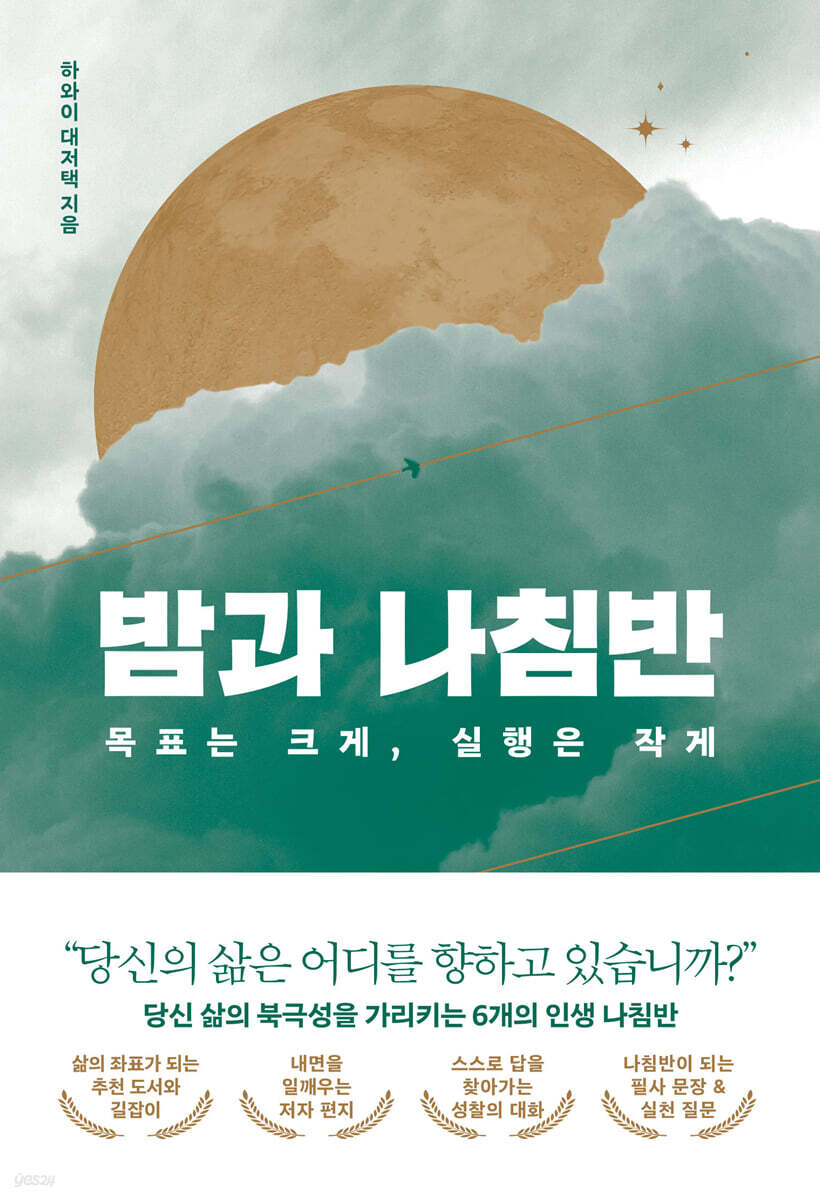
Night and Compass
 |
Description
Book Introduction
- A word from MD
-
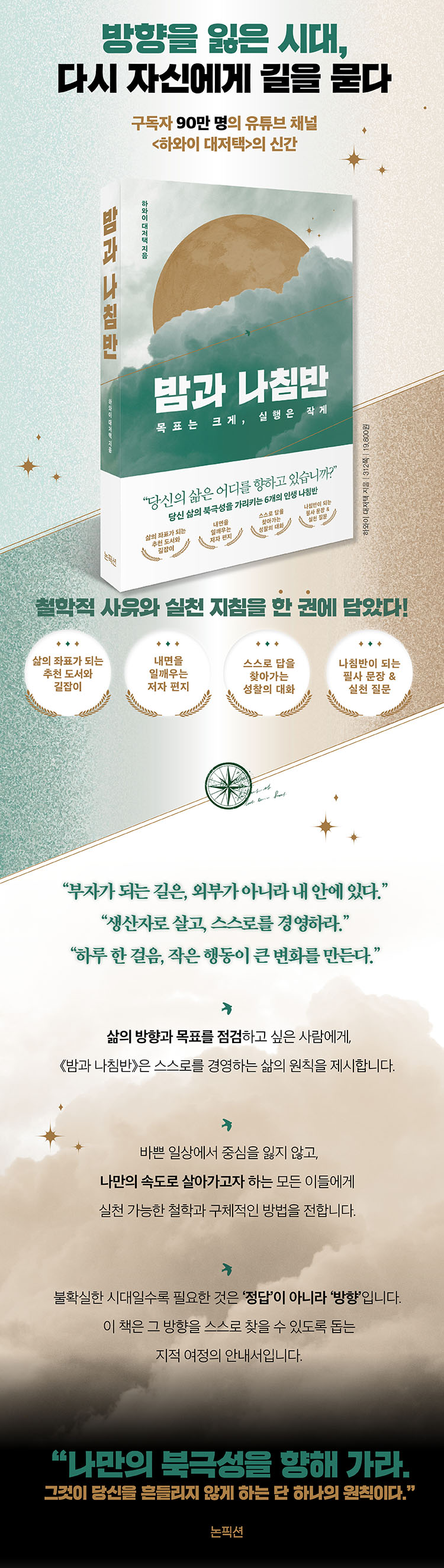
Towards my own North StarA new work from the mindset expert's Hawaiian mansion.
It presents six life compasses that will help you find your way when you lose your way in life.
Based on the experience of reading shaking up one's thoughts and changing the course of one's life, this book serves as a North Star for those who have stopped.
November 25, 2025. Self-Development PD Oh Da-eun
“Where is your life headed?”
Six Compasses for Finding Your Life's North Star
As we live, there comes a time when everyone stops.
When you don't have the strength to push forward or the luxury of backing down - what you need isn't simple comfort or advice.
It is a 'question' that makes you question the entire direction of your life.
"Night and Compass" starts from that very point.
Instead of the world asking, “What have you accomplished today?” the author asks, “What are you reading today?”
The author, a bestselling author and CEO of a content media company, proves through his own experience that books are the most powerful tools for shaking up thoughts, changing attitudes, and reshaping the trajectory of one's life.
He says.
“When I decided to change my life, the first thing I did was read.” Books gave him direction and brought about the energy for change.
And now, I want to share that energy with my readers.
This book unravels that journey of change through six life compasses.
Each chapter is comprised of 'Letters from a Hawaiian Mansion,' 'Conversations of Reflection,' and 'Practice Questions & Sentences,' along with a compass book where the author gained insight, helping readers think and practice on their own and find their own North Star.
“Just change it by one degree today.
“If those small, one-degree changes accumulate, the destination of your life will change.” “Night and the Compass” says that it is not grand resolutions but repetition of small actions that create change.
Desire is not shameful, but a human instinct, and will is the most genuine human activity that is born when that desire overflows.
Being alive and being awake are different things.
This book reminds us that the 'will to stay awake' is the only driving force that can bring life back into motion.
For those who wish to find their own direction in the silence of the night, "Night and the Compass" will be a quiet but solid light.
Six Compasses for Finding Your Life's North Star
As we live, there comes a time when everyone stops.
When you don't have the strength to push forward or the luxury of backing down - what you need isn't simple comfort or advice.
It is a 'question' that makes you question the entire direction of your life.
"Night and Compass" starts from that very point.
Instead of the world asking, “What have you accomplished today?” the author asks, “What are you reading today?”
The author, a bestselling author and CEO of a content media company, proves through his own experience that books are the most powerful tools for shaking up thoughts, changing attitudes, and reshaping the trajectory of one's life.
He says.
“When I decided to change my life, the first thing I did was read.” Books gave him direction and brought about the energy for change.
And now, I want to share that energy with my readers.
This book unravels that journey of change through six life compasses.
Each chapter is comprised of 'Letters from a Hawaiian Mansion,' 'Conversations of Reflection,' and 'Practice Questions & Sentences,' along with a compass book where the author gained insight, helping readers think and practice on their own and find their own North Star.
“Just change it by one degree today.
“If those small, one-degree changes accumulate, the destination of your life will change.” “Night and the Compass” says that it is not grand resolutions but repetition of small actions that create change.
Desire is not shameful, but a human instinct, and will is the most genuine human activity that is born when that desire overflows.
Being alive and being awake are different things.
This book reminds us that the 'will to stay awake' is the only driving force that can bring life back into motion.
For those who wish to find their own direction in the silence of the night, "Night and the Compass" will be a quiet but solid light.
- You can preview some of the book's contents.
Preview
index
Prologue_ What are you reading today? 6
Compass 1: Finding the Direction of Wealth on a Starless Night: The Millionaire Next Door Could Be You
Letters from the Hawaiian Mansion 16
There's a millionaire living next door 18
Even those with annual salaries in the hundreds of millions aren't rich. 24
Consumers and Producers: Who Will Live? 30
Ticket to the World of Wealth 35
Get out of a game you can't win in 40 minutes.
[Reflective Dialogue] 50
[Transcript Sentences & Practice Questions] 53
Compass 2: Grow the Seeds Within You: Make Yourself the Best Stock
Letters from the Hawaiian Mansion 56
How on earth do good fruits grow? 58
Who put a gun to my head? 65
How to Make the Wealthy Future You Designed a Reality 72
Rich people don't drag trash around 80
Think Rich, Act Rich 91
Spend the most energy on the most important things 100
[Reflective Dialogue] 107
[Transcript Sentences & Practice Questions] 109
Compass 3: Take one step at a time to reach your goal: Aim big, take small actions.
Letters from the Hawaiian Mansion 112
One Step at a Time, There's No Other Way 114
It's not the mountains that trip us up, it's the small pebbles. 124
What are your beliefs attracting? 133
When you have lemons, make lemonade 144
When to Activate Life's Emergency Response Committee 149
Only Action Conquers Anxiety 155
[Reflective Dialogue] 161
[Transcript Sentences & Practice Questions] 163
Compass 4: Resetting Your Thought Circuits: The Brains of Successful People Work Differently
Letters from the Hawaiian Mansion 166
If you want to change your life, change your current status 168
How Your Brain Works to Create the Life You Want 177
If you have time to cry, go buy an emergency generator 185
Visualize Your Goals 191
Let's Rebuild the Brain Blueprint 198
[Reflective Dialogue] 207
[Transcript Sentences & Practice Questions] 209
Compass 5: Taking Control of Your Life: No One But You Can Change It
Letters from the Hawaiian Mansion 212
Desire More, A New Me! 214
Live My Life by My Will 223
What Happened When I Leveled Up Alone in Solitary Cell 228
There is no personality more outstanding than mine 234
The greatest joy lies in the moment of climbing a mountain. 244
If you live without thinking, you'll end up living a life planned out for you by others. 252
[Reflective Dialogue] 261
[Transcript Sentences & Practice Questions] 263
Compass 6: Keep moving toward your own North Star: Start, and keep going.
Letters from the Hawaiian Mansion 266
268 To avoid being trapped by the term self-improvement
Life grows when you ask yourself questions 275
The reason I opened my eyes was to do human work 282
Because of that incident, I am who I am today 289
Go Toward Your Own North Star 296
[Reflective Dialogue] 301
[Transcript Sentences & Practice Questions] 304
[Epilogue] Your Next Book is Your Life 305
Compass 1: Finding the Direction of Wealth on a Starless Night: The Millionaire Next Door Could Be You
Letters from the Hawaiian Mansion 16
There's a millionaire living next door 18
Even those with annual salaries in the hundreds of millions aren't rich. 24
Consumers and Producers: Who Will Live? 30
Ticket to the World of Wealth 35
Get out of a game you can't win in 40 minutes.
[Reflective Dialogue] 50
[Transcript Sentences & Practice Questions] 53
Compass 2: Grow the Seeds Within You: Make Yourself the Best Stock
Letters from the Hawaiian Mansion 56
How on earth do good fruits grow? 58
Who put a gun to my head? 65
How to Make the Wealthy Future You Designed a Reality 72
Rich people don't drag trash around 80
Think Rich, Act Rich 91
Spend the most energy on the most important things 100
[Reflective Dialogue] 107
[Transcript Sentences & Practice Questions] 109
Compass 3: Take one step at a time to reach your goal: Aim big, take small actions.
Letters from the Hawaiian Mansion 112
One Step at a Time, There's No Other Way 114
It's not the mountains that trip us up, it's the small pebbles. 124
What are your beliefs attracting? 133
When you have lemons, make lemonade 144
When to Activate Life's Emergency Response Committee 149
Only Action Conquers Anxiety 155
[Reflective Dialogue] 161
[Transcript Sentences & Practice Questions] 163
Compass 4: Resetting Your Thought Circuits: The Brains of Successful People Work Differently
Letters from the Hawaiian Mansion 166
If you want to change your life, change your current status 168
How Your Brain Works to Create the Life You Want 177
If you have time to cry, go buy an emergency generator 185
Visualize Your Goals 191
Let's Rebuild the Brain Blueprint 198
[Reflective Dialogue] 207
[Transcript Sentences & Practice Questions] 209
Compass 5: Taking Control of Your Life: No One But You Can Change It
Letters from the Hawaiian Mansion 212
Desire More, A New Me! 214
Live My Life by My Will 223
What Happened When I Leveled Up Alone in Solitary Cell 228
There is no personality more outstanding than mine 234
The greatest joy lies in the moment of climbing a mountain. 244
If you live without thinking, you'll end up living a life planned out for you by others. 252
[Reflective Dialogue] 261
[Transcript Sentences & Practice Questions] 263
Compass 6: Keep moving toward your own North Star: Start, and keep going.
Letters from the Hawaiian Mansion 266
268 To avoid being trapped by the term self-improvement
Life grows when you ask yourself questions 275
The reason I opened my eyes was to do human work 282
Because of that incident, I am who I am today 289
Go Toward Your Own North Star 296
[Reflective Dialogue] 301
[Transcript Sentences & Practice Questions] 304
[Epilogue] Your Next Book is Your Life 305
Detailed image
Into the book
The world is full of talk about money and wealth.
We also hear a lot of practical advice like, "How to make money quickly and easily" and "10 ways to get rich."
However, there are few books that show the 'path to wealth' in a scientific and statistical way like Dr. Stanley's research.
Decades of analysis and verification have proven that ordinary people can become rich.
This can be said to be an unprecedented ‘rich man’s secret plan’.
That doesn't mean it's a boring or difficult book.
It's actually fun.
Analyzing how ordinary people became wealthy, what characteristics they possessed, and what paths they took, we find that there are clear rules that remain unchanged over decades and generations, which gives us great strength and comfort.
--- p.16-17
What's the most powerful and easiest way to break free from long-held beliefs? I think it's definitely reading.
Because it is the best tool to break the echo chamber effect.
Of course, YouTube also helps.
I also run a YouTube channel, and I find it useful for learning different perspectives.
However, we cannot be completely free from the influence of algorithms.
The 'Hawaii Mansion' channel has 880,000 subscribers as of July 2025.
But people who aren't interested in this field don't know me at all.
Even if you have 1 million or 2 million subscribers, there's a good chance you still don't know about it.
(……)
The same goes for millionaires.
They live in the same neighborhood as me, live next door to me, their children go to the same school, and they drive similar cars, yet they turn out to be incredibly wealthy! This could happen to you too.
And conversely, you could be the millionaire next door.
--- p.20-21
The basic system of modern society is capitalism.
Capitalism, in its simplest form, can be described as 'two wheels'.
It's production and consumption.
When we produce and consume, capital for further production circulates, and when we consume this, the gears of capitalism move.
But it's a little strange.
If there are two big wheels, there should be an equal number of people moving each wheel, but in reality, we are almost all consumers.
Even just stepping out of the house, or even just staying at home, or even just breathing costs money.
If we include intangible services as well as tangible services, the expenses increase even more.
What does this phenomenon mean? Producers provide tangible and intangible value and earn money in a vast array of forms, yet when I look at myself and my surroundings, I see only consumers.
If you think about it, it's really strange.
If the two giant wheels that turn capitalism are production and consumption, why do I spend my entire life with the identity of a "consumer" on the consumption side, not the production side?
(……)
I have to ask myself where I stand in a capitalist society.
If you live your whole life as a consumer, it is natural that you will never be able to become rich.
Because money is earned by producers.
--- p.30-31
One day, while reading books like this, I came to a realization.
“Financial freedom is not about how much you earn, but how much you spend.”
It felt like I had been hit in the head with a hammer.
What was more important than ‘the money you earn’ was ‘the money you spend’.
From that day on, I changed the question.
From “How much do I need to earn to be happy?” to “How much do I need to spend to be happy?”
I drastically cut down on my spending to try it out myself.
That way, you can know your standard of living by saying, “I can live well with at least this much per month.”
At first, I thought that if I reduced my spending, my life would become more difficult.
But rather, it was the opposite.
My pride in taking charge of my life has grown stronger.
--- p.67
There is only one way to change the outdated blueprint of wealth.
It's about changing your subconscious.
The subconscious mind is like an automatic pilot; no matter how much you change direction, it will always return to its original course as long as its destination remains unchanged.
That's why no matter how hard you work, you always end up living a similar life.
The more you earn, the more you spend, leaving no money left for savings.
They even fall into a vicious cycle of debt.
Only when you change the blueprint of wealth in your subconscious can you become the 'master of your life.'
--- p.71
There is always plenty to complain about.
But the choice that makes me bigger and stronger within it is not complaining, but 'organizing'.
I organize my day by organizing my words, organizing my emotions, and taking out the trash.
Even the smallest thing is fine.
Because every little act—putting a scattered cart back where it belonged, waiting for someone in the elevator, or adding a “thank you” at the end of a sentence—will gradually change the direction of my life.
Complaining is trash.
As long as we continue to hold on to it with both hands, we will never be able to capture wealth and fortune.
If you truly want to progress on the path to wealth, you must clear out the trash from your words, emotions, and actions.
You should not become a person who is accustomed to complaining.
Instead, I need to be the one who orchestrates my day for the better.
Your energy is precious.
Never waste that precious energy on trash.
--- p.85-86
“How are you treating yourself now?”
To answer this question, we must first check two things:
First, ‘Who am I with?’
I myself am the average of the people I am close to.
We all learn from the people around us: our speech, our thoughts, our lifestyle, our spending habits, our attitudes toward money, and even our self-perception.
The people I hang out with often determine the slope of my life.
So what I always emphasize is 'making books into people around me'.
--- p.89
That is, our lives depend on how we view ourselves.
The failures, frustrations, misunderstandings, and disadvantages I have experienced so far may not be because I am 'incompetent', but because I put myself in that position.
We often say, “That person is just naturally talented,” or “I’m not particularly good at anything.”
But even with similar abilities, some people turn them into weapons, while others turn them into excuses.
The price tag you put on yourself determines the 'value of your life.'
If you feel like you're in a 'convenience store' rather than a 'hotel' right now, ask yourself:
“Am I really suited to work at a convenience store?
“Like the mineral water in a hotel, can’t I change my position?”
You have to change the people around you, change the books you read, and change the way you see yourself.
Location creates value, and value soon changes the direction of life.
My worth, I can decide.
If only I could just put myself in a slightly better environment, in better relationships, and with a stronger attitude.
No one can diminish my 'true value'.
--- p.96-97
It will be easier to understand if you compare it to gravity.
Just as we are held by the Earth's powerful gravity, there are times when we need to 'self-isolate' and become completely absorbed in the one thing that matters most to us.
But even then, once you leave the gravitational field, you can never fully return.
You have to focus as densely as possible, but not so much that you get thrown out of the gravity of your own life.
To do that, we need to spend our time ‘as densely as possible in the shortest possible time.’
I often talk about time compression, but that's not the same thing as being impatient or rushing.
Setting priorities doesn't mean that only the first priority is important.
Second, third, and fourth places are of course also valuable.
We want to live the life we want, become rich, and live happily with our families.
To do that, you absolutely must go to the edge of gravity at least once, whether it's for six months, a year, or two years, to change your life.
Without this experience, you'll spend your entire life going back and forth from one thing to another, like a game of ping-pong.
--- p.118-119
There is a saying that shows how crises and trials help people grow.
“The North Wind made the Vikings.”
The reason the Vikings were able to become the most powerful people in Northern Europe at the time was because they had to survive in a harsh environment.
It's not that we're born strong, it's that we're given conditions that make us strong.
If it weren't for that fierce north wind, the name 'Viking' as we know it today might not have existed in the world.
What is your north wind? Each of us has our own north wind.
there is.
It's a handicap, so to speak.
But Carnegie advises us to think about how we can make this our talent.
This is a story that connects to the process of finding the dust-like abilities mentioned above in reverse order.
--- p.145
If, while living an ordinary life, a spark flies in your heart at some point, it is time to activate your life's emergency response committee.
The period of activity of the emergency committee is short.
If it's long, it's not a bulge.
It's just a matter of running an emergency response committee for a certain period of time.
If you say it's a big deal and it lasts for 5 or 10 years, it's too hard and no one can endure it.
There's too much to lose.
The height of life is a time of self-isolation.
It's time to compress time and focus.
At that time, only the most important goals are left and the rest are abandoned or put on hold.
But if you get too caught up and blow everything else away, that is, if you break free from gravity, it can be difficult to come back.
It's also bad for your health.
So, during this time of self-isolation, when the hyperactivity is triggered, the key is to spend it densely within a really compressed time.
--- p.152
My brain determines that what I repeat is important information.
And we optimize ourselves in that direction.
So, if you keep repeating things like “I’m tired,” “I can’t do this,” or “I’ll do it later,” those words will create a circuit in your brain, and eventually your actions and emotions will become fixed in that pattern.
Likewise, if you experience anxiety frequently, you will feel anxious even about very small things.
Anxiety is learned.
To create a new path in the brain, you have to consciously create a 'different path'.
To forge a new path, you must consciously start small.
So small that the brain doesn't notice the change.
So, when we often make grand plans and start with big actions, saying, “If we’re going to do it, let’s do it right,” most of them fall apart in less than three days.
The brain says, “It’s too unfamiliar, it’s dangerous!” and puts on the brakes.
This is why you should dream big but start small.
We have to make countless choices to get to the life we want.
Even the smallest choices accumulate and ultimately determine the direction of your life.
So, the less unnecessary emotional exhaustion you have, like anger or frustration, the more likely you are to make better choices.
--- p.175-176
There are a total of 86,400 seconds in a day.
During this time, we make countless choices.
Did you know that every choice we make is a form of "tradeoff"? If you spend an hour lying on the couch browsing social media, you're essentially trading that hour for exercise, reading, or rest.
Today is the result of 'what did I exchange for what did I live?'
So, when your resolve breaks down, it's important to plan ahead and take action to recover from the breakdown.
For example, if you fail to wake up early, instead of getting caught up in self-reproach and blame, switch to, “I’ll go for a 20-minute walk in the evening.”
--- p.188
“Some people die at twenty-five and are buried at seventy-five.”
This often-quoted phrase is not simply a figure of speech.
In reality, many people are alive, but they spend their days without being awake.
The passion, desire for change, and dreams of challenge that we had in our youth are gradually broken by fear, and eventually converge into a life of doing nothing.
A life that is alive but not alive, that moves but does not advance.
Isn't that kind of life 'already dead at twenty-five'?
Maybe we've all been through that at one time or another.
Aren't you familiar with that feeling of being busy, hectic, and the days passing by so quickly that you end up with nothing left?
As the title of the movie “Open Your Eyes” suggests, we need a sense of “being awake” rather than “being present.”
Just because your eyelids are open doesn't mean you're truly awake.
Life changes when your mind is awake.
If you are not awake, you will not see possibilities, questions, or changes.
They will still walk, work, and talk, but they will no longer be alive, just like the expressionless zombies of the "walking dead."
--- p.207
I call this 'following the crowd' life.
It's not about living the way you think, it's about thinking the way you live.
There is no desire to become oneself here.
I think that the human desire that Schopenhauer speaks of is like a 'spillover'.
Just as one drop of water, two drops of water, fall into an empty cup, the cup soon becomes full, and eventually overflows because of that crucial drop.
When that desire to achieve builds up and builds up until it can no longer be contained, there comes a moment when it overflows.
The appearance at that time is ‘will’.
--- p.225
Positivity is not in our nature.
It is the result of a conscious effort that goes against instinct.
That's why it's more precious.
True self-love isn't a fleeting feeling, but rather a constant repetition of small choices that overcome our instinctive weaknesses.
Self-pity makes you feel like the most miserable person in the world, saying, “Why is it only me who has to suffer like this?” But self-compassion is different.
It's the quiet force that keeps me going, saying, "These boulders on my shoulders right now, they will eventually shine like gold."
Real change begins with decision, not comfort.
The moment we decide to overcome self-pity, we can live a life that is 'completely different from before.'
And the only person who can protect that life is myself, the strong protector within me.
--- p.241
“Make small things great.”
Many people question this statement.
“How do you make small things great?”
But you may have had this experience.
It's the moment when this thought suddenly occurs right before you go to sleep at the end of the day.
'It wasn't much, but you did a good job today.'
This is what makes small things great.
The changes of just one day are not readily apparent.
Even after a week or a month, you may not notice any difference.
Because one day is only 0.27 percent of the 365 days in a year.
It's a number that you can't even feel.
But still, that day was definitely a step forward.
Days pile up, become weeks, become months, and eventually, I become the life I've always dreamed of.
Little by little, but surely.
That's how we change our lives. (...)
If you can praise yourself before going to bed, saying, “I did a great job today,” you’ve done one brick properly.
Don't make small things small, make small things great.
If you treat trivial things trivially, you will only get trivial results.
--- p.249-250
So I think it's important to 'customize' any book or any great person's words to your own taste.
It doesn't matter whether it's philosophy, literature, real estate, or financial investment.
Rather than just accepting the content as is, we need to apply and interpret it to fit our lives.
I didn't absorb the book's contents by understanding everything it said.
The real absorption is 'reconstructing' the content to fit the person, my current situation, and the way I can implement it.
This is how you achieve 'optimized insight for yourself' and true enlightenment.
When you read a book like this, the moment you turn the last page is not the 'end'.
Rather, the book is the beginning of the moment.
The process of constantly adjusting and narrowing the gap between books and my life is the true meaning of reading books, and it will be the first step toward reaching the level of life you desire.
Read books, but don't worship them as gods.
Listen to the great words, but don't be overwhelmed.
Following someone else's thoughts is no different from living the life they have planned for you.
Walk, see, and hear with your own two feet, your own two eyes, and your own two ears.
The most important criterion for judgment is myself.
We also hear a lot of practical advice like, "How to make money quickly and easily" and "10 ways to get rich."
However, there are few books that show the 'path to wealth' in a scientific and statistical way like Dr. Stanley's research.
Decades of analysis and verification have proven that ordinary people can become rich.
This can be said to be an unprecedented ‘rich man’s secret plan’.
That doesn't mean it's a boring or difficult book.
It's actually fun.
Analyzing how ordinary people became wealthy, what characteristics they possessed, and what paths they took, we find that there are clear rules that remain unchanged over decades and generations, which gives us great strength and comfort.
--- p.16-17
What's the most powerful and easiest way to break free from long-held beliefs? I think it's definitely reading.
Because it is the best tool to break the echo chamber effect.
Of course, YouTube also helps.
I also run a YouTube channel, and I find it useful for learning different perspectives.
However, we cannot be completely free from the influence of algorithms.
The 'Hawaii Mansion' channel has 880,000 subscribers as of July 2025.
But people who aren't interested in this field don't know me at all.
Even if you have 1 million or 2 million subscribers, there's a good chance you still don't know about it.
(……)
The same goes for millionaires.
They live in the same neighborhood as me, live next door to me, their children go to the same school, and they drive similar cars, yet they turn out to be incredibly wealthy! This could happen to you too.
And conversely, you could be the millionaire next door.
--- p.20-21
The basic system of modern society is capitalism.
Capitalism, in its simplest form, can be described as 'two wheels'.
It's production and consumption.
When we produce and consume, capital for further production circulates, and when we consume this, the gears of capitalism move.
But it's a little strange.
If there are two big wheels, there should be an equal number of people moving each wheel, but in reality, we are almost all consumers.
Even just stepping out of the house, or even just staying at home, or even just breathing costs money.
If we include intangible services as well as tangible services, the expenses increase even more.
What does this phenomenon mean? Producers provide tangible and intangible value and earn money in a vast array of forms, yet when I look at myself and my surroundings, I see only consumers.
If you think about it, it's really strange.
If the two giant wheels that turn capitalism are production and consumption, why do I spend my entire life with the identity of a "consumer" on the consumption side, not the production side?
(……)
I have to ask myself where I stand in a capitalist society.
If you live your whole life as a consumer, it is natural that you will never be able to become rich.
Because money is earned by producers.
--- p.30-31
One day, while reading books like this, I came to a realization.
“Financial freedom is not about how much you earn, but how much you spend.”
It felt like I had been hit in the head with a hammer.
What was more important than ‘the money you earn’ was ‘the money you spend’.
From that day on, I changed the question.
From “How much do I need to earn to be happy?” to “How much do I need to spend to be happy?”
I drastically cut down on my spending to try it out myself.
That way, you can know your standard of living by saying, “I can live well with at least this much per month.”
At first, I thought that if I reduced my spending, my life would become more difficult.
But rather, it was the opposite.
My pride in taking charge of my life has grown stronger.
--- p.67
There is only one way to change the outdated blueprint of wealth.
It's about changing your subconscious.
The subconscious mind is like an automatic pilot; no matter how much you change direction, it will always return to its original course as long as its destination remains unchanged.
That's why no matter how hard you work, you always end up living a similar life.
The more you earn, the more you spend, leaving no money left for savings.
They even fall into a vicious cycle of debt.
Only when you change the blueprint of wealth in your subconscious can you become the 'master of your life.'
--- p.71
There is always plenty to complain about.
But the choice that makes me bigger and stronger within it is not complaining, but 'organizing'.
I organize my day by organizing my words, organizing my emotions, and taking out the trash.
Even the smallest thing is fine.
Because every little act—putting a scattered cart back where it belonged, waiting for someone in the elevator, or adding a “thank you” at the end of a sentence—will gradually change the direction of my life.
Complaining is trash.
As long as we continue to hold on to it with both hands, we will never be able to capture wealth and fortune.
If you truly want to progress on the path to wealth, you must clear out the trash from your words, emotions, and actions.
You should not become a person who is accustomed to complaining.
Instead, I need to be the one who orchestrates my day for the better.
Your energy is precious.
Never waste that precious energy on trash.
--- p.85-86
“How are you treating yourself now?”
To answer this question, we must first check two things:
First, ‘Who am I with?’
I myself am the average of the people I am close to.
We all learn from the people around us: our speech, our thoughts, our lifestyle, our spending habits, our attitudes toward money, and even our self-perception.
The people I hang out with often determine the slope of my life.
So what I always emphasize is 'making books into people around me'.
--- p.89
That is, our lives depend on how we view ourselves.
The failures, frustrations, misunderstandings, and disadvantages I have experienced so far may not be because I am 'incompetent', but because I put myself in that position.
We often say, “That person is just naturally talented,” or “I’m not particularly good at anything.”
But even with similar abilities, some people turn them into weapons, while others turn them into excuses.
The price tag you put on yourself determines the 'value of your life.'
If you feel like you're in a 'convenience store' rather than a 'hotel' right now, ask yourself:
“Am I really suited to work at a convenience store?
“Like the mineral water in a hotel, can’t I change my position?”
You have to change the people around you, change the books you read, and change the way you see yourself.
Location creates value, and value soon changes the direction of life.
My worth, I can decide.
If only I could just put myself in a slightly better environment, in better relationships, and with a stronger attitude.
No one can diminish my 'true value'.
--- p.96-97
It will be easier to understand if you compare it to gravity.
Just as we are held by the Earth's powerful gravity, there are times when we need to 'self-isolate' and become completely absorbed in the one thing that matters most to us.
But even then, once you leave the gravitational field, you can never fully return.
You have to focus as densely as possible, but not so much that you get thrown out of the gravity of your own life.
To do that, we need to spend our time ‘as densely as possible in the shortest possible time.’
I often talk about time compression, but that's not the same thing as being impatient or rushing.
Setting priorities doesn't mean that only the first priority is important.
Second, third, and fourth places are of course also valuable.
We want to live the life we want, become rich, and live happily with our families.
To do that, you absolutely must go to the edge of gravity at least once, whether it's for six months, a year, or two years, to change your life.
Without this experience, you'll spend your entire life going back and forth from one thing to another, like a game of ping-pong.
--- p.118-119
There is a saying that shows how crises and trials help people grow.
“The North Wind made the Vikings.”
The reason the Vikings were able to become the most powerful people in Northern Europe at the time was because they had to survive in a harsh environment.
It's not that we're born strong, it's that we're given conditions that make us strong.
If it weren't for that fierce north wind, the name 'Viking' as we know it today might not have existed in the world.
What is your north wind? Each of us has our own north wind.
there is.
It's a handicap, so to speak.
But Carnegie advises us to think about how we can make this our talent.
This is a story that connects to the process of finding the dust-like abilities mentioned above in reverse order.
--- p.145
If, while living an ordinary life, a spark flies in your heart at some point, it is time to activate your life's emergency response committee.
The period of activity of the emergency committee is short.
If it's long, it's not a bulge.
It's just a matter of running an emergency response committee for a certain period of time.
If you say it's a big deal and it lasts for 5 or 10 years, it's too hard and no one can endure it.
There's too much to lose.
The height of life is a time of self-isolation.
It's time to compress time and focus.
At that time, only the most important goals are left and the rest are abandoned or put on hold.
But if you get too caught up and blow everything else away, that is, if you break free from gravity, it can be difficult to come back.
It's also bad for your health.
So, during this time of self-isolation, when the hyperactivity is triggered, the key is to spend it densely within a really compressed time.
--- p.152
My brain determines that what I repeat is important information.
And we optimize ourselves in that direction.
So, if you keep repeating things like “I’m tired,” “I can’t do this,” or “I’ll do it later,” those words will create a circuit in your brain, and eventually your actions and emotions will become fixed in that pattern.
Likewise, if you experience anxiety frequently, you will feel anxious even about very small things.
Anxiety is learned.
To create a new path in the brain, you have to consciously create a 'different path'.
To forge a new path, you must consciously start small.
So small that the brain doesn't notice the change.
So, when we often make grand plans and start with big actions, saying, “If we’re going to do it, let’s do it right,” most of them fall apart in less than three days.
The brain says, “It’s too unfamiliar, it’s dangerous!” and puts on the brakes.
This is why you should dream big but start small.
We have to make countless choices to get to the life we want.
Even the smallest choices accumulate and ultimately determine the direction of your life.
So, the less unnecessary emotional exhaustion you have, like anger or frustration, the more likely you are to make better choices.
--- p.175-176
There are a total of 86,400 seconds in a day.
During this time, we make countless choices.
Did you know that every choice we make is a form of "tradeoff"? If you spend an hour lying on the couch browsing social media, you're essentially trading that hour for exercise, reading, or rest.
Today is the result of 'what did I exchange for what did I live?'
So, when your resolve breaks down, it's important to plan ahead and take action to recover from the breakdown.
For example, if you fail to wake up early, instead of getting caught up in self-reproach and blame, switch to, “I’ll go for a 20-minute walk in the evening.”
--- p.188
“Some people die at twenty-five and are buried at seventy-five.”
This often-quoted phrase is not simply a figure of speech.
In reality, many people are alive, but they spend their days without being awake.
The passion, desire for change, and dreams of challenge that we had in our youth are gradually broken by fear, and eventually converge into a life of doing nothing.
A life that is alive but not alive, that moves but does not advance.
Isn't that kind of life 'already dead at twenty-five'?
Maybe we've all been through that at one time or another.
Aren't you familiar with that feeling of being busy, hectic, and the days passing by so quickly that you end up with nothing left?
As the title of the movie “Open Your Eyes” suggests, we need a sense of “being awake” rather than “being present.”
Just because your eyelids are open doesn't mean you're truly awake.
Life changes when your mind is awake.
If you are not awake, you will not see possibilities, questions, or changes.
They will still walk, work, and talk, but they will no longer be alive, just like the expressionless zombies of the "walking dead."
--- p.207
I call this 'following the crowd' life.
It's not about living the way you think, it's about thinking the way you live.
There is no desire to become oneself here.
I think that the human desire that Schopenhauer speaks of is like a 'spillover'.
Just as one drop of water, two drops of water, fall into an empty cup, the cup soon becomes full, and eventually overflows because of that crucial drop.
When that desire to achieve builds up and builds up until it can no longer be contained, there comes a moment when it overflows.
The appearance at that time is ‘will’.
--- p.225
Positivity is not in our nature.
It is the result of a conscious effort that goes against instinct.
That's why it's more precious.
True self-love isn't a fleeting feeling, but rather a constant repetition of small choices that overcome our instinctive weaknesses.
Self-pity makes you feel like the most miserable person in the world, saying, “Why is it only me who has to suffer like this?” But self-compassion is different.
It's the quiet force that keeps me going, saying, "These boulders on my shoulders right now, they will eventually shine like gold."
Real change begins with decision, not comfort.
The moment we decide to overcome self-pity, we can live a life that is 'completely different from before.'
And the only person who can protect that life is myself, the strong protector within me.
--- p.241
“Make small things great.”
Many people question this statement.
“How do you make small things great?”
But you may have had this experience.
It's the moment when this thought suddenly occurs right before you go to sleep at the end of the day.
'It wasn't much, but you did a good job today.'
This is what makes small things great.
The changes of just one day are not readily apparent.
Even after a week or a month, you may not notice any difference.
Because one day is only 0.27 percent of the 365 days in a year.
It's a number that you can't even feel.
But still, that day was definitely a step forward.
Days pile up, become weeks, become months, and eventually, I become the life I've always dreamed of.
Little by little, but surely.
That's how we change our lives. (...)
If you can praise yourself before going to bed, saying, “I did a great job today,” you’ve done one brick properly.
Don't make small things small, make small things great.
If you treat trivial things trivially, you will only get trivial results.
--- p.249-250
So I think it's important to 'customize' any book or any great person's words to your own taste.
It doesn't matter whether it's philosophy, literature, real estate, or financial investment.
Rather than just accepting the content as is, we need to apply and interpret it to fit our lives.
I didn't absorb the book's contents by understanding everything it said.
The real absorption is 'reconstructing' the content to fit the person, my current situation, and the way I can implement it.
This is how you achieve 'optimized insight for yourself' and true enlightenment.
When you read a book like this, the moment you turn the last page is not the 'end'.
Rather, the book is the beginning of the moment.
The process of constantly adjusting and narrowing the gap between books and my life is the true meaning of reading books, and it will be the first step toward reaching the level of life you desire.
Read books, but don't worship them as gods.
Listen to the great words, but don't be overwhelmed.
Following someone else's thoughts is no different from living the life they have planned for you.
Walk, see, and hear with your own two feet, your own two eyes, and your own two ears.
The most important criterion for judgment is myself.
--- p.259~260
Publisher's Review
In a time of lost direction, asking yourself again for guidance.
Night is the time when lost people wander.
When you're stuck and don't know where to go, what you need isn't simple comfort or motivation.
It's a more fundamental question.
“Where am I going now?”
This book is a compass for that question.
The author does not simply tell the techniques of success.
Instead, it offers six compasses to help you re-establish your 'direction in life'.
Wealth and growth, goals and thinking, initiative and persistence—each chapter depicts the process of reclaiming lost coordinates and returning to ourselves.
Chapter 1 redefines the nature of wealth.
More important than making a lot of money is understanding the structure of wealth, and the key to that is moving from living as a "consumer" to living as a "producer."
The advice to "quickly get out of a game you can't win" is a declaration to question the competitive landscape the world presents and design your own game.
Chapter 2 shifts the direction of growth from ‘external opportunities’ to ‘internal capabilities.’
Good fruit grows from good roots.
Letting go of the trash of unnecessary emotions and pouring your energy into what matters most - that is the starting point of self-growth.
The author suggests creating your own brand through the practical philosophy of 'think like a rich person, act like a rich person.'
Chapter 3 talks about the power of one step a day rather than a grand vision.
The obstacles in life are not huge mountains, but small pebbles underfoot.
Those who move despite failure and anxiety will eventually arrive.
The sentence, “Only action conquers anxiety,” is the author’s most realistic insight for an age of uncertainty.
Chapter 4 is a chapter that reframes the way we think.
The author emphasizes that in order to change your life, you must change your current state of mind, that is, reset your thought circuits.
We present specific methods for visualizing the life you want and translating your goals into the language of your brain.
This chapter is not simply about positive thinking, but about how to 'restructure your thoughts'.
Chapter 5 talks about the power of self-directed living.
Choose individuality over comparison, and your own will over the gaze of others.
The author asserts, “If you live without thinking, you will end up living a life planned out for you by others.”
The process of regaining control of one's life is unsettling, but in the process, one discovers the joy of managing oneself.
The final chapter is the philosophy of 'continuity and direction'.
It depicts the process of asking oneself questions and redefining the purpose and direction of life without being confined to the framework of self-development.
The author says:
“Go towards your own North Star.
“That is the one principle that keeps you unshakable.”
Night is the time when lost people wander.
When you're stuck and don't know where to go, what you need isn't simple comfort or motivation.
It's a more fundamental question.
“Where am I going now?”
This book is a compass for that question.
The author does not simply tell the techniques of success.
Instead, it offers six compasses to help you re-establish your 'direction in life'.
Wealth and growth, goals and thinking, initiative and persistence—each chapter depicts the process of reclaiming lost coordinates and returning to ourselves.
Chapter 1 redefines the nature of wealth.
More important than making a lot of money is understanding the structure of wealth, and the key to that is moving from living as a "consumer" to living as a "producer."
The advice to "quickly get out of a game you can't win" is a declaration to question the competitive landscape the world presents and design your own game.
Chapter 2 shifts the direction of growth from ‘external opportunities’ to ‘internal capabilities.’
Good fruit grows from good roots.
Letting go of the trash of unnecessary emotions and pouring your energy into what matters most - that is the starting point of self-growth.
The author suggests creating your own brand through the practical philosophy of 'think like a rich person, act like a rich person.'
Chapter 3 talks about the power of one step a day rather than a grand vision.
The obstacles in life are not huge mountains, but small pebbles underfoot.
Those who move despite failure and anxiety will eventually arrive.
The sentence, “Only action conquers anxiety,” is the author’s most realistic insight for an age of uncertainty.
Chapter 4 is a chapter that reframes the way we think.
The author emphasizes that in order to change your life, you must change your current state of mind, that is, reset your thought circuits.
We present specific methods for visualizing the life you want and translating your goals into the language of your brain.
This chapter is not simply about positive thinking, but about how to 'restructure your thoughts'.
Chapter 5 talks about the power of self-directed living.
Choose individuality over comparison, and your own will over the gaze of others.
The author asserts, “If you live without thinking, you will end up living a life planned out for you by others.”
The process of regaining control of one's life is unsettling, but in the process, one discovers the joy of managing oneself.
The final chapter is the philosophy of 'continuity and direction'.
It depicts the process of asking oneself questions and redefining the purpose and direction of life without being confined to the framework of self-development.
The author says:
“Go towards your own North Star.
“That is the one principle that keeps you unshakable.”
GOODS SPECIFICS
- Date of issue: November 3, 2025
- Page count, weight, size: 307 pages | 392g | 130*190*20mm
- ISBN13: 9791199489509
- ISBN10: 1199489506
You may also like
카테고리
korean


korean

![GQ KOREA Mark (Monthly): December [2025]](http://librairie.coreenne.fr/cdn/shop/files/8ef265dbbfbf186523ed75ba7319009d.jpg?v=1765340328&width=3840)


