

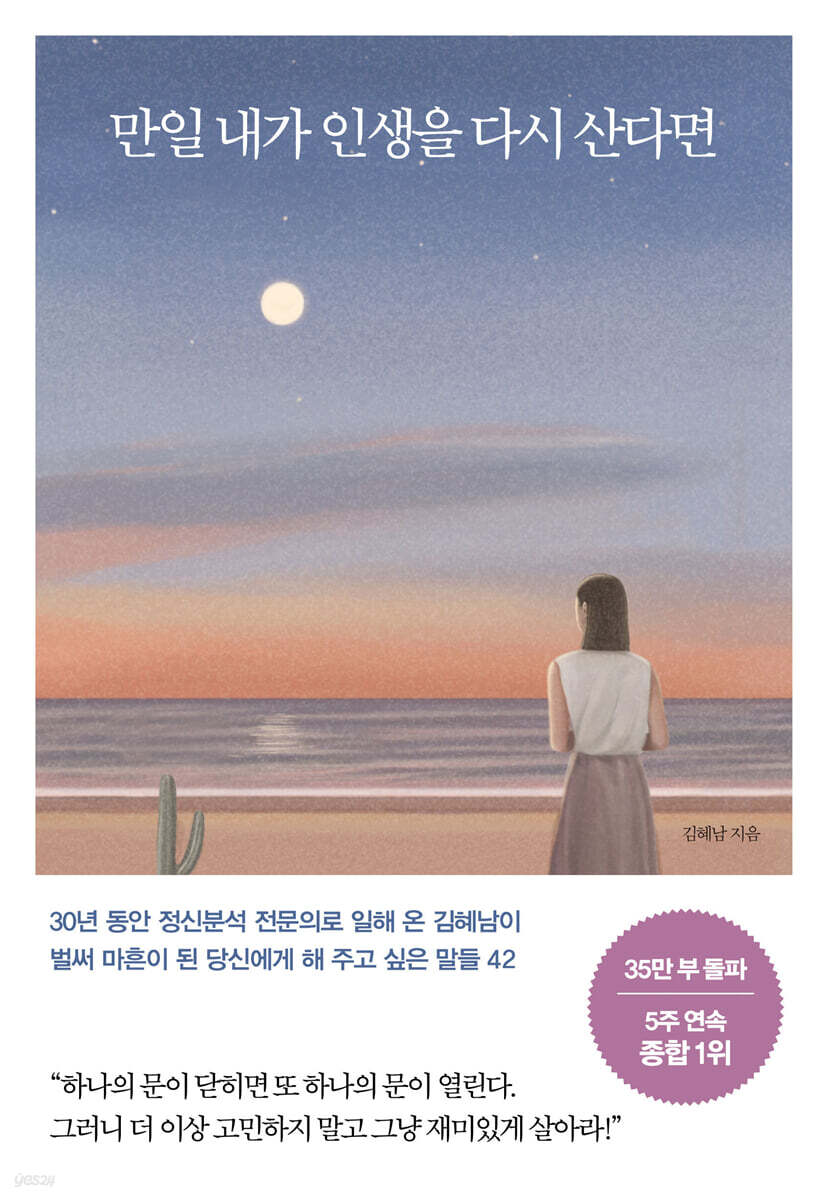
If I Had My Life to Live Over (350,000 Copies Special Edition)
 |
Description
Book Introduction
“When one door closes, another one opens.
So stop worrying and just have fun!” This book contains words of advice from Hye-nam Kim, who has been working as a psychoanalyst for 30 years, to you, who is already in your forties. She says that if there's one thing she regrets in life, it's that she pushed herself too hard and lived life like a chore. Living as a doctor, mother, wife, daughter-in-law, and daughter, I was always burdened by a sense of duty and responsibility, trying to do well in all of those roles, and in the process, I missed out on the joys of life that I should have enjoyed. Then, 22 years ago, at the age of 43, I was diagnosed with Parkinson's disease and finally found out. I felt like if I didn't have confidence, neither my house nor my hospital would run properly, but the world ran so smoothly. Only then did she see again the people who had been by her side, and reflected on what precious things in life she should not miss. So, there is only one thing I want to say to those who are already in their forties and want to live a life without regrets. “When one door closes, another one opens. So stop worrying and just have fun!” This book was published in 2015 under the title “Why I’m Enjoying Living Today,” and was a bestseller that sold over 100,000 copies. This special edition was published to commemorate the book’s success, receiving much love from readers. It tells the author’s secrets to life that he discovered while working as a psychoanalyst for 30 years and the reason why he was able to live happily despite suffering from Parkinson’s disease for 22 years. It also contains things I have not been able to tell patients but really want to tell them, such as, "The perfect time never comes," "Sometimes the answer is to persevere," "Please don't say everything hurts," and "The closer you are to someone, the more things you shouldn't do." |
- You can preview some of the book's contents.
Preview
index
Publishing a special edition commemorating 100,000 copies
Prologue: What Parkinson's Disease Taught Me
Chapter 1.
The Secrets of Life I've Learned from Working as a Psychoanalyst for 30 Years
No matter how well you live, there are times when misfortune strikes.
The perfect time never comes
Just take one step forward
Everyone is awkward at first
When one door closes, another opens.
The Real Meaning of Living the Life You Want
The thing I regret most in my life
Stop saying things that obviously won't work even if you try
Chapter 2.
A story I really want to tell my patients, but haven't had the chance to tell them yet.
About living as an adult
What patients say to me most often
Don't let the past rule your present.
Don't try to heal your loved ones without permission.
Don't try too hard to like your coworkers.
The secret to living happily even with an inferiority complex
Please don't call everything 'hurt'
To those who always say they are comfortable alone
To those who blame themselves for having bad feelings
Chapter 3.
Why I Can Live Cheerfully Even When I'm Sick
What I've Learned from 22 Years of Living with Parkinson's
It was I who was blocking me from becoming much happier.
The real reason I forgave him
About my friends who carry my sorrow on their backs
Why I'm Not Good at Giving Advice
How to protect myself without being swayed by others
About the joy of studying
About the good fortune of having someone who listens to what I have to say
I just decided to have fun
Chapter 4.
Things I Wish I Knew When I Was Forty
In front of my father's death
Attitude toward aging
Why You Need Time to Do Nothing
I don't know my husband, and my husband doesn't know me.
Don't try too hard to be a good parent.
Sometimes the answer is to persevere
The closer you are to someone, the more things you should not do.
I was a very wealthy person.
Don't trust people too much, but it's people you must trust to the end.
Chapter 5.
If I had my life to live over again
I will make more mistakes
I won't be afraid of growing old
Even if I get hurt, I will live loving more
I will walk my own path, and let the child walk his own path.
I'll go crazy about anything at least once
Even in difficult times, I will not lose my humor.
At any moment I will believe in myself
And I will die quietly
Epilogue_ My Life's Bucket List 10
Prologue: What Parkinson's Disease Taught Me
Chapter 1.
The Secrets of Life I've Learned from Working as a Psychoanalyst for 30 Years
No matter how well you live, there are times when misfortune strikes.
The perfect time never comes
Just take one step forward
Everyone is awkward at first
When one door closes, another opens.
The Real Meaning of Living the Life You Want
The thing I regret most in my life
Stop saying things that obviously won't work even if you try
Chapter 2.
A story I really want to tell my patients, but haven't had the chance to tell them yet.
About living as an adult
What patients say to me most often
Don't let the past rule your present.
Don't try to heal your loved ones without permission.
Don't try too hard to like your coworkers.
The secret to living happily even with an inferiority complex
Please don't call everything 'hurt'
To those who always say they are comfortable alone
To those who blame themselves for having bad feelings
Chapter 3.
Why I Can Live Cheerfully Even When I'm Sick
What I've Learned from 22 Years of Living with Parkinson's
It was I who was blocking me from becoming much happier.
The real reason I forgave him
About my friends who carry my sorrow on their backs
Why I'm Not Good at Giving Advice
How to protect myself without being swayed by others
About the joy of studying
About the good fortune of having someone who listens to what I have to say
I just decided to have fun
Chapter 4.
Things I Wish I Knew When I Was Forty
In front of my father's death
Attitude toward aging
Why You Need Time to Do Nothing
I don't know my husband, and my husband doesn't know me.
Don't try too hard to be a good parent.
Sometimes the answer is to persevere
The closer you are to someone, the more things you should not do.
I was a very wealthy person.
Don't trust people too much, but it's people you must trust to the end.
Chapter 5.
If I had my life to live over again
I will make more mistakes
I won't be afraid of growing old
Even if I get hurt, I will live loving more
I will walk my own path, and let the child walk his own path.
I'll go crazy about anything at least once
Even in difficult times, I will not lose my humor.
At any moment I will believe in myself
And I will die quietly
Epilogue_ My Life's Bucket List 10
Detailed image

Into the book
While organizing the book, I was able to look again at the standards of normalcy mentioned by Freud, the pioneer of psychoanalysis.
According to his criteria, it is normal for a person to have 'a little hysteria, a little paranoia, a little obsession'.
In other words, there is no one in the world without problems.
Everyone has some problems.
So there is no need to be ashamed or deny that you have a problem.
--- From the "Preface"
Still, if there's one thing I regret, it's that I lived my life as if it were homework.
Living as a doctor, mother, wife, daughter-in-law, and daughter, I was always burdened by a sense of duty and responsibility, and tried to somehow do well in all of those roles.
I kept running forward with my eyes fixed on the illusion that nothing would go well without me, and as a result, I missed out on the joys of life that I was meant to enjoy.
Rather than enjoying the joy of raising a child, I lived my life tormenting myself for fear of being inadequate and not being a good mother to my child. And rather than feeling the joy and happiness of work, I worked and studied as if I was being chased, afraid of falling behind.
If I had decided to enjoy life, I would have divided my time, decided what I could and could not do, and asked my family for help, but I didn't.
If I had decided to enjoy life, I would have made eye contact with my child and given him a hug before rushing home to prepare dinner. But I didn't.
If I had decided to enjoy life, I would have had the leisure to look up at the sky on my way to work and happily greet my patients, but I couldn't.
What's even more astonishing is that if someone asked me what I gained in return for giving up the joys of life, I would be speechless.
The guilt and sense of victimization I felt during those times only stole my joy, made me tired, and made me angry.
So now I try not to do that.
I decided to let go of my desire to be good at everything and live by taking care of myself, which I had neglected.
So, on days when I'm feeling good, I do it, and on days when I'm not feeling good, I try to have fun by doing things I wanted to do but put off with the excuse that I was busy.
---From "The Biggest Regret in My Life"
One day a reporter asked me:
“What do patients say to you most often?”
“I’m crying.”
"yes?"
Now, psychiatry has changed to psychiatry, and people's perceptions are gradually changing, but people still look at people who visit psychiatrists as strange.
So, patients spend a lot of time alone and suffering before coming to see me.
Maybe that's why.
They would often burst into tears as soon as they came into the examination room and sat down in front of me.
When I tried to tell the story that I had wanted to tell for so long but had never been able to tell anyone, it came out as tears.
---From "What Patients Say to Me Most Often"
I discovered more possibilities in the less optimal path and learned things I hadn't thought of.
People think that whatever they want, it must come true.
So there may be other ways, but we assume it's a failure just because we didn't get what we wanted.
But it is just one door closed, nothing more, nothing less.
Moreover, when one door closes, another one opens.
So there is absolutely no need to be frustrated if your best efforts are not achieved.
---From "When one door closes, another opens"
My daughter had heart surgery when she was young.
Even now, the child still has a long scar from that surgery on his chest.
My daughter was very worried about the scar, but one day I hugged her tightly and said,
“That scar is a sign that you have overcome a serious illness.
It wasn't something that just anyone could endure such a major surgery at such a young age.
So I'm rather proud of your scars." You too.
The wounds were bitter, and the process of overcoming them was difficult, but somehow you overcame them.
The scars are the proof.
Scars are the badges of life that tell you how brave and strong you were.
---From "I will believe in myself at any moment"
Looking back on my life so far, there were only about 2 out of 10 people who didn't fit with me.
And the two people who didn't fit with me could never get close to me, no matter how hard I tried.
Just as it is difficult for a romantic relationship to develop if there is no attraction between a good man and a good woman, no matter how good people are, there are many cases where the two are not that close.
So, I hope you don't spend too much energy trying to improve your relationships with people you find difficult because you want everyone to like you.
---From "Don't try too hard to like your seniors and juniors at work"
Psychoanalyst Jung said, “When you turn forty, an earthquake occurs in your mind.”
It is a state of confusion where one's entire life seems to be shaken.
According to James Hollis, we are socialized within our families and society as someone's son or daughter, someone's mother or father, or someone's team leader during our primary adulthood, from the ages of 12 to 40.
It is closer to a life that is the result of being raised to think that life should be lived this way and choices should be made this way rather than according to one's true nature.
In other words, I have been living far away from my true self.
Then, when we turn forty, we turn the pages of the past books that are filled with the time we have spent, and look back on the life we have worked so hard to build.
Even if I had everything I wanted in the process, I would still be left with doubts about who I was, what I wanted to do, and whether what I had accomplished in this one life was truly worthwhile.
There are still so many things we want, so many things we still want to do, but time keeps passing and the choices we have are only getting smaller.
---From "Attitudes toward Accepting Aging"
When people say they are holding out, they often think it is humiliating.
That's why people say they don't know why they have to live like that.
But enduring does not mean simply being passive and obeying without saying a word.
This doesn't mean you should just lie in your room and do nothing, waiting for time to pass.
Enduring is a very dynamic and difficult process that requires managing the anger, humiliation, and injustice that boils up inside, and maintaining self-confidence while conforming to external expectations.
So, holding on can be said to be waiting.
It is enduring the present for the future, and making constant efforts today to move on to the next step.
If I hadn't persevered through my college entrance exams, I wouldn't have gotten into medical school, the first step toward becoming a doctor. If I hadn't persevered through my first job, I wouldn't have thought about studying psychoanalysis. If I hadn't broken up my marriage, I wouldn't have the family I have today. If I hadn't persevered through my illness, I wouldn't be writing the books I do now.
That's how I was able to endure and move forward into the middle of life, and I learned a lot from it.
---From "Sometimes Enduring is the Answer"
Pain does not remain at the same intensity 24 hours a day.
There is definitely a little less painful time between the pain and the suffering.
So I waited for that time.
I waited for the pain to subside a little, and waited for the medicine to help me move.
And when the pain was less and I could move or walk around with some energy, I did what I could during that time.
I eat, exercise, go for a walk, go grocery shopping, and chat with friends.
So, for me, waiting has been a hope since some time ago.
Because a state of less pain and being able to move your body has definitely arrived.
When anyone is going through a difficult time, they become desperate because they don't know when the suffering will end.
But if you believe that someday the hard times will pass and good times will come, you can spend today differently.
So if you are going through the winter of your life, please remember this.
Spring will definitely come to you too.
According to his criteria, it is normal for a person to have 'a little hysteria, a little paranoia, a little obsession'.
In other words, there is no one in the world without problems.
Everyone has some problems.
So there is no need to be ashamed or deny that you have a problem.
--- From the "Preface"
Still, if there's one thing I regret, it's that I lived my life as if it were homework.
Living as a doctor, mother, wife, daughter-in-law, and daughter, I was always burdened by a sense of duty and responsibility, and tried to somehow do well in all of those roles.
I kept running forward with my eyes fixed on the illusion that nothing would go well without me, and as a result, I missed out on the joys of life that I was meant to enjoy.
Rather than enjoying the joy of raising a child, I lived my life tormenting myself for fear of being inadequate and not being a good mother to my child. And rather than feeling the joy and happiness of work, I worked and studied as if I was being chased, afraid of falling behind.
If I had decided to enjoy life, I would have divided my time, decided what I could and could not do, and asked my family for help, but I didn't.
If I had decided to enjoy life, I would have made eye contact with my child and given him a hug before rushing home to prepare dinner. But I didn't.
If I had decided to enjoy life, I would have had the leisure to look up at the sky on my way to work and happily greet my patients, but I couldn't.
What's even more astonishing is that if someone asked me what I gained in return for giving up the joys of life, I would be speechless.
The guilt and sense of victimization I felt during those times only stole my joy, made me tired, and made me angry.
So now I try not to do that.
I decided to let go of my desire to be good at everything and live by taking care of myself, which I had neglected.
So, on days when I'm feeling good, I do it, and on days when I'm not feeling good, I try to have fun by doing things I wanted to do but put off with the excuse that I was busy.
---From "The Biggest Regret in My Life"
One day a reporter asked me:
“What do patients say to you most often?”
“I’m crying.”
"yes?"
Now, psychiatry has changed to psychiatry, and people's perceptions are gradually changing, but people still look at people who visit psychiatrists as strange.
So, patients spend a lot of time alone and suffering before coming to see me.
Maybe that's why.
They would often burst into tears as soon as they came into the examination room and sat down in front of me.
When I tried to tell the story that I had wanted to tell for so long but had never been able to tell anyone, it came out as tears.
---From "What Patients Say to Me Most Often"
I discovered more possibilities in the less optimal path and learned things I hadn't thought of.
People think that whatever they want, it must come true.
So there may be other ways, but we assume it's a failure just because we didn't get what we wanted.
But it is just one door closed, nothing more, nothing less.
Moreover, when one door closes, another one opens.
So there is absolutely no need to be frustrated if your best efforts are not achieved.
---From "When one door closes, another opens"
My daughter had heart surgery when she was young.
Even now, the child still has a long scar from that surgery on his chest.
My daughter was very worried about the scar, but one day I hugged her tightly and said,
“That scar is a sign that you have overcome a serious illness.
It wasn't something that just anyone could endure such a major surgery at such a young age.
So I'm rather proud of your scars." You too.
The wounds were bitter, and the process of overcoming them was difficult, but somehow you overcame them.
The scars are the proof.
Scars are the badges of life that tell you how brave and strong you were.
---From "I will believe in myself at any moment"
Looking back on my life so far, there were only about 2 out of 10 people who didn't fit with me.
And the two people who didn't fit with me could never get close to me, no matter how hard I tried.
Just as it is difficult for a romantic relationship to develop if there is no attraction between a good man and a good woman, no matter how good people are, there are many cases where the two are not that close.
So, I hope you don't spend too much energy trying to improve your relationships with people you find difficult because you want everyone to like you.
---From "Don't try too hard to like your seniors and juniors at work"
Psychoanalyst Jung said, “When you turn forty, an earthquake occurs in your mind.”
It is a state of confusion where one's entire life seems to be shaken.
According to James Hollis, we are socialized within our families and society as someone's son or daughter, someone's mother or father, or someone's team leader during our primary adulthood, from the ages of 12 to 40.
It is closer to a life that is the result of being raised to think that life should be lived this way and choices should be made this way rather than according to one's true nature.
In other words, I have been living far away from my true self.
Then, when we turn forty, we turn the pages of the past books that are filled with the time we have spent, and look back on the life we have worked so hard to build.
Even if I had everything I wanted in the process, I would still be left with doubts about who I was, what I wanted to do, and whether what I had accomplished in this one life was truly worthwhile.
There are still so many things we want, so many things we still want to do, but time keeps passing and the choices we have are only getting smaller.
---From "Attitudes toward Accepting Aging"
When people say they are holding out, they often think it is humiliating.
That's why people say they don't know why they have to live like that.
But enduring does not mean simply being passive and obeying without saying a word.
This doesn't mean you should just lie in your room and do nothing, waiting for time to pass.
Enduring is a very dynamic and difficult process that requires managing the anger, humiliation, and injustice that boils up inside, and maintaining self-confidence while conforming to external expectations.
So, holding on can be said to be waiting.
It is enduring the present for the future, and making constant efforts today to move on to the next step.
If I hadn't persevered through my college entrance exams, I wouldn't have gotten into medical school, the first step toward becoming a doctor. If I hadn't persevered through my first job, I wouldn't have thought about studying psychoanalysis. If I hadn't broken up my marriage, I wouldn't have the family I have today. If I hadn't persevered through my illness, I wouldn't be writing the books I do now.
That's how I was able to endure and move forward into the middle of life, and I learned a lot from it.
---From "Sometimes Enduring is the Answer"
Pain does not remain at the same intensity 24 hours a day.
There is definitely a little less painful time between the pain and the suffering.
So I waited for that time.
I waited for the pain to subside a little, and waited for the medicine to help me move.
And when the pain was less and I could move or walk around with some energy, I did what I could during that time.
I eat, exercise, go for a walk, go grocery shopping, and chat with friends.
So, for me, waiting has been a hope since some time ago.
Because a state of less pain and being able to move your body has definitely arrived.
When anyone is going through a difficult time, they become desperate because they don't know when the suffering will end.
But if you believe that someday the hard times will pass and good times will come, you can spend today differently.
So if you are going through the winter of your life, please remember this.
Spring will definitely come to you too.
---From "What I Learned from 22 Years of Suffering from Parkinson's Disease"
Publisher's Review
★ Selected as a book worth reading this month by the Korea Publication Industry Promotion Agency
★ Books selected by Sejong Books
★ Special edition commemorating the sale of 100,000 copies, fully revised and expanded edition in 2022!
"Why I've Lived Cheerfully Despite 22 Years of Parkinson's Disease"
- Things I wish I had known when I was forty
As a psychoanalyst, mother of two, and daughter-in-law living with her in-laws, the author was so busy that she didn't even have time to breathe. Until she was forty, she thought, "I am where I am today because I did well."
I thought that if I was not confident at home, in the hospital, or with patients, something big would happen.
There were more times when I said thank you to the people around me, but inside I felt resentful.
But in 2001, at the age of 43, he was suddenly diagnosed with Parkinson's disease, which caused his body to become increasingly stiff.
As a mother of two and a psychoanalyst, I was at an age when I had a lot to do.
Moreover, it had not even been a year since I started my own private hospital to pursue my dream.
She could not possibly accept the misfortune that had befallen her.
I felt so wronged, hated people, and resented the world that I lay in bed for a month, unable to do anything, just staring at the ceiling.
Then one day she suddenly realized something.
That he is not dead yet and that lying down will not change anything.
Fortunately, the disease was in its early stages and there was still a lot that could be done.
So I woke up, lived the day, and lived the next day.
Instead, I started doing the things I wanted to do but kept putting off rather than the things I had to do.
It was from then that I started writing books.
So, for 22 years, I fought against illness, treated patients and lectured, raised two children, and wrote ten books.
People wonder how she can do all that with Parkinson's, she says.
There are times when my body is stiff and I need help to even roll over on my side, but there are times when it is less painful between the pains, and I just live each day step by step, doing what I can during those times.
In January 2014, her condition worsened and she closed her hospital, leaving her unable to treat patients. She underwent five surgeries, both major and minor, and even narrowly escaped death, but she says she still has many things she wants to do.
If she had continued to lie in bed 22 years ago, blaming her illness and the world, she would not be where she is today, and each day would have been meaningless.
As we live, there are times when unexpected misfortune comes.
There is no way to avoid it.
But how we spend the time after that is up to us.
So she speaks to those who are afraid of failure and are afraid of doing anything.
Be brave and take just one step forward.
Of course, the path you choose may be wrong, and there may be times when you reach a cliff despite your best efforts, but if you are afraid of that and don't take a single step, you will never get anywhere.
“In my experience, there is no wrong way.
Even if I fail, if I learn something from it, it is no longer a failure, and even if I think I took the wrong path, looking back, my life has become richer because I learned things I didn't know along the way.
So no matter who you are or what your situation is, the moment you take that one step, you will know.
“It was a good thing you had the courage.”
“When one door closes, another door opens.
So stop worrying and just have fun.”
- The secrets of life I discovered while working as a psychoanalyst for 30 years
The author, who had been lost for a while after the death of her older sister, who was like her soulmate, when she was a sophomore in high school, decided to live harder than anyone else and studied hard for six years in medical school, completing her internship with excellent grades.
So, naturally, I thought I would stay at the university hospital, complete my residency, and become a specialist.
However, as someone else was selected as a resident, she ended up choosing the National Mental Hospital (now the National Center for Mental Health) as her second choice.
At first, I was tormented by a sense of guilt at being pushed out and not being able to stay at the university hospital, but while I was at the National Mental Hospital, I had valuable experiences that I would never have been able to have anywhere else.
Through psychotherapy, I was exposed to not only drug therapy but also psychodrama, art therapy, and psychoanalysis, which helped me realize what I was interested in and what I was good at. Later, I was able to learn even more while supervising residents.
When he was unable to remain at the university hospital, the author thought his life was over.
However, a new life opened up for me as I gained various experiences at the National Mental Hospital, which I chose as my second choice.
So she says.
Don't assume you've failed just because you didn't get what you wanted.
It's just one door closed, nothing more, nothing less.
Besides, when one door closes, another one opens.
So there is no need to live your life beating yourself up too much.
Life is something you don't know until you go there, and you only know it until you go all the way.
“If there’s one thing I regret in my life, it’s that I’ve been too hard on myself and lived life like a homework assignment.
Living as a doctor, mother, wife, daughter-in-law, and daughter, I was always burdened by a sense of duty and responsibility, and tried to somehow do well in all of those roles.
As a result, I ended up missing out on the joys of life that I should have enjoyed.
Then, 22 years ago, at the age of 43, I was diagnosed with Parkinson's disease and finally found out.
I thought that without me, neither the house nor the hospital would function properly, but that wasn't the case.
The world went on just fine without me.
After the hospital closed in 2014, so many of my acquaintances disappeared.
Only then did I see again the people who had been by my side, and I began to reflect on what precious things in life I should not miss.
I hope you don't regret it like I did.
I hope you don't beat yourself up too much, don't take things too seriously, don't worry too much, and just live a fun life.
Even when life is hard, difficult, and seems like it won't get any better, there are always things to enjoy.
And the more diverse a person's enjoyment, the better he or she can endure the inevitable misfortune and unhappiness.”
The 800,000-copy bestseller "A Thirty-Year-Old Asks Psychology," the definitive edition of Kim Hye-nam's psychology book.
- Things I haven't been able to tell my patients, but really want to tell them.
The author said that in publishing the special edition commemorating the 100,000th copy sale, he wanted to say sorry to the patients.
In 2014, as his illness worsened and he could no longer provide treatment, we closed the hospital and had no choice but to send patients away. I thought that if he received treatment diligently and his condition improved, he would be able to treat patients again, but it seems that will be difficult in the future.
So I rewrote the additional stories I wanted to tell my patients.
This is a compilation of things I have been unable to tell patients, but really want to tell them, such as 'What patients tell me most', 'Don't let the past rule the present', 'Don't try to heal your loved ones arbitrarily', and 'Please don't say everything is a wound'.
“While organizing the book, I was able to look again at the standards of normalcy mentioned by Freud, the pioneer of psychoanalysis.
According to his criteria, it is normal for a person to have 'a little hysteria, a little paranoia, a little obsession'.
In other words, there is no one in the world without problems.
Everyone has some problems.
So there is no need to be ashamed or deny that you have a problem.
Me too.
After battling illness for so long, there are times when I just want to grab someone and vent my frustrations, and other times when I just want to scream because the pain is unbearable.
There are times when we say hurtful things to others, even though we know full well that we will regret it.
I always want to stay calm and be cheerful to people, but sometimes things don't go as planned.
As someone who has been working as a psychoanalyst for over 30 years and has treated countless patients, I feel incredibly embarrassed whenever I show myself in such a bad way, but I have decided to forgive myself for that.
I decided to be forgiving of myself for looking back on the day and reflecting on it, and thinking that I shouldn't do that again tomorrow.
You too.
You are healthier if you think you have a problem and want to fix it than if you think there is nothing wrong with you and you are always right.
Because if you regret and reflect on what you did wrong and think about not doing it again tomorrow, you will somehow grow.”
“If I had my life to live over again”
- 42 Things I Want to Say to You Who Are Already Forty
Psychoanalyst Jung said, “When you turn forty, an earthquake occurs in your mind.”
It is a state of confusion where one's entire life seems to be shaken.
That's understandable, as life expectancy has increased, so if you live to be 100, you still have 60 years left to live even if you turn 40.
So, forty is the age when it feels like it's too late to start something new, but it also feels like there's too much time left if you don't do anything.
Moreover, he says that he is the same now as he was then, that he still has the passion of his youth in his heart and that he can do many things in the future, but his body keeps telling him that it is not the case.
Gray hair, fine wrinkles, loss of energy, presbyopia, etc. are all hitting me at forty all at once.
That's why forty is sad.
Because I'm losing a little bit of my younger self every day.
You feel as if the center of your life is shaken and many things around you are scattering and disappearing.
One by one, you will have friends who have failed in business, friends who have had affairs or gotten divorced, and friends who have incurable diseases.
Moreover, as we enter middle age, we face the fate of having to send our children away and become parents to our parents.
Children leave our embrace to forge their own lives, and in the meantime, parents who once seemed strong and formidable now rely on us financially and psychologically.
Then, even though we are living independently from our parents, we feel like we are being dragged back into their lives.
But at the same time, the midlife crisis gives us an opportunity to reevaluate our lives.
In other words, by asking yourself, “Who am I, after taking away the way I’ve lived and the roles I’ve played so far?” you get the opportunity to meet your true self.
However, most people cannot accept the losses that come with aging and fight with all their might against the coming years.
Some people desperately try to become young again.
But the more I do this, the more I face the irony of exhausting myself by denying my aging self.
The author also confesses that he experienced an earthquake in his heart when he turned forty.
So, in this book, I have included stories based on my own experience as a psychoanalyst and a 22-year Parkinson's patient, about how to move forward without collapsing in such times.
‘Why you absolutely need time to do nothing’, ‘Sometimes holding on is the answer’, ‘The closer you are to someone, the more things you shouldn’t do’, ‘About friends who carry my sadness on their backs’, etc. I hope this book will be a small comfort to you who are enduring each day well but sometimes find it difficult and lonely.
“If I Live My Life Again” is a poem that I really liked, so I translated it and published it as a picture book.
It is said that Nadine Starr, a grandmother who lived in a rural area in Kentucky, wrote this when she was 85 years old. It felt like a confession of my own heart, and I could relate to it.
“While preparing the special edition commemorating the 100,000-copy sale of “Why I’m Interested in Living Today,” I rewrote and organized the manuscript for readers over 40, and it seemed that poetry would better fit the content, so I chose it as the title of this book.”
★ Books selected by Sejong Books
★ Special edition commemorating the sale of 100,000 copies, fully revised and expanded edition in 2022!
"Why I've Lived Cheerfully Despite 22 Years of Parkinson's Disease"
- Things I wish I had known when I was forty
As a psychoanalyst, mother of two, and daughter-in-law living with her in-laws, the author was so busy that she didn't even have time to breathe. Until she was forty, she thought, "I am where I am today because I did well."
I thought that if I was not confident at home, in the hospital, or with patients, something big would happen.
There were more times when I said thank you to the people around me, but inside I felt resentful.
But in 2001, at the age of 43, he was suddenly diagnosed with Parkinson's disease, which caused his body to become increasingly stiff.
As a mother of two and a psychoanalyst, I was at an age when I had a lot to do.
Moreover, it had not even been a year since I started my own private hospital to pursue my dream.
She could not possibly accept the misfortune that had befallen her.
I felt so wronged, hated people, and resented the world that I lay in bed for a month, unable to do anything, just staring at the ceiling.
Then one day she suddenly realized something.
That he is not dead yet and that lying down will not change anything.
Fortunately, the disease was in its early stages and there was still a lot that could be done.
So I woke up, lived the day, and lived the next day.
Instead, I started doing the things I wanted to do but kept putting off rather than the things I had to do.
It was from then that I started writing books.
So, for 22 years, I fought against illness, treated patients and lectured, raised two children, and wrote ten books.
People wonder how she can do all that with Parkinson's, she says.
There are times when my body is stiff and I need help to even roll over on my side, but there are times when it is less painful between the pains, and I just live each day step by step, doing what I can during those times.
In January 2014, her condition worsened and she closed her hospital, leaving her unable to treat patients. She underwent five surgeries, both major and minor, and even narrowly escaped death, but she says she still has many things she wants to do.
If she had continued to lie in bed 22 years ago, blaming her illness and the world, she would not be where she is today, and each day would have been meaningless.
As we live, there are times when unexpected misfortune comes.
There is no way to avoid it.
But how we spend the time after that is up to us.
So she speaks to those who are afraid of failure and are afraid of doing anything.
Be brave and take just one step forward.
Of course, the path you choose may be wrong, and there may be times when you reach a cliff despite your best efforts, but if you are afraid of that and don't take a single step, you will never get anywhere.
“In my experience, there is no wrong way.
Even if I fail, if I learn something from it, it is no longer a failure, and even if I think I took the wrong path, looking back, my life has become richer because I learned things I didn't know along the way.
So no matter who you are or what your situation is, the moment you take that one step, you will know.
“It was a good thing you had the courage.”
“When one door closes, another door opens.
So stop worrying and just have fun.”
- The secrets of life I discovered while working as a psychoanalyst for 30 years
The author, who had been lost for a while after the death of her older sister, who was like her soulmate, when she was a sophomore in high school, decided to live harder than anyone else and studied hard for six years in medical school, completing her internship with excellent grades.
So, naturally, I thought I would stay at the university hospital, complete my residency, and become a specialist.
However, as someone else was selected as a resident, she ended up choosing the National Mental Hospital (now the National Center for Mental Health) as her second choice.
At first, I was tormented by a sense of guilt at being pushed out and not being able to stay at the university hospital, but while I was at the National Mental Hospital, I had valuable experiences that I would never have been able to have anywhere else.
Through psychotherapy, I was exposed to not only drug therapy but also psychodrama, art therapy, and psychoanalysis, which helped me realize what I was interested in and what I was good at. Later, I was able to learn even more while supervising residents.
When he was unable to remain at the university hospital, the author thought his life was over.
However, a new life opened up for me as I gained various experiences at the National Mental Hospital, which I chose as my second choice.
So she says.
Don't assume you've failed just because you didn't get what you wanted.
It's just one door closed, nothing more, nothing less.
Besides, when one door closes, another one opens.
So there is no need to live your life beating yourself up too much.
Life is something you don't know until you go there, and you only know it until you go all the way.
“If there’s one thing I regret in my life, it’s that I’ve been too hard on myself and lived life like a homework assignment.
Living as a doctor, mother, wife, daughter-in-law, and daughter, I was always burdened by a sense of duty and responsibility, and tried to somehow do well in all of those roles.
As a result, I ended up missing out on the joys of life that I should have enjoyed.
Then, 22 years ago, at the age of 43, I was diagnosed with Parkinson's disease and finally found out.
I thought that without me, neither the house nor the hospital would function properly, but that wasn't the case.
The world went on just fine without me.
After the hospital closed in 2014, so many of my acquaintances disappeared.
Only then did I see again the people who had been by my side, and I began to reflect on what precious things in life I should not miss.
I hope you don't regret it like I did.
I hope you don't beat yourself up too much, don't take things too seriously, don't worry too much, and just live a fun life.
Even when life is hard, difficult, and seems like it won't get any better, there are always things to enjoy.
And the more diverse a person's enjoyment, the better he or she can endure the inevitable misfortune and unhappiness.”
The 800,000-copy bestseller "A Thirty-Year-Old Asks Psychology," the definitive edition of Kim Hye-nam's psychology book.
- Things I haven't been able to tell my patients, but really want to tell them.
The author said that in publishing the special edition commemorating the 100,000th copy sale, he wanted to say sorry to the patients.
In 2014, as his illness worsened and he could no longer provide treatment, we closed the hospital and had no choice but to send patients away. I thought that if he received treatment diligently and his condition improved, he would be able to treat patients again, but it seems that will be difficult in the future.
So I rewrote the additional stories I wanted to tell my patients.
This is a compilation of things I have been unable to tell patients, but really want to tell them, such as 'What patients tell me most', 'Don't let the past rule the present', 'Don't try to heal your loved ones arbitrarily', and 'Please don't say everything is a wound'.
“While organizing the book, I was able to look again at the standards of normalcy mentioned by Freud, the pioneer of psychoanalysis.
According to his criteria, it is normal for a person to have 'a little hysteria, a little paranoia, a little obsession'.
In other words, there is no one in the world without problems.
Everyone has some problems.
So there is no need to be ashamed or deny that you have a problem.
Me too.
After battling illness for so long, there are times when I just want to grab someone and vent my frustrations, and other times when I just want to scream because the pain is unbearable.
There are times when we say hurtful things to others, even though we know full well that we will regret it.
I always want to stay calm and be cheerful to people, but sometimes things don't go as planned.
As someone who has been working as a psychoanalyst for over 30 years and has treated countless patients, I feel incredibly embarrassed whenever I show myself in such a bad way, but I have decided to forgive myself for that.
I decided to be forgiving of myself for looking back on the day and reflecting on it, and thinking that I shouldn't do that again tomorrow.
You too.
You are healthier if you think you have a problem and want to fix it than if you think there is nothing wrong with you and you are always right.
Because if you regret and reflect on what you did wrong and think about not doing it again tomorrow, you will somehow grow.”
“If I had my life to live over again”
- 42 Things I Want to Say to You Who Are Already Forty
Psychoanalyst Jung said, “When you turn forty, an earthquake occurs in your mind.”
It is a state of confusion where one's entire life seems to be shaken.
That's understandable, as life expectancy has increased, so if you live to be 100, you still have 60 years left to live even if you turn 40.
So, forty is the age when it feels like it's too late to start something new, but it also feels like there's too much time left if you don't do anything.
Moreover, he says that he is the same now as he was then, that he still has the passion of his youth in his heart and that he can do many things in the future, but his body keeps telling him that it is not the case.
Gray hair, fine wrinkles, loss of energy, presbyopia, etc. are all hitting me at forty all at once.
That's why forty is sad.
Because I'm losing a little bit of my younger self every day.
You feel as if the center of your life is shaken and many things around you are scattering and disappearing.
One by one, you will have friends who have failed in business, friends who have had affairs or gotten divorced, and friends who have incurable diseases.
Moreover, as we enter middle age, we face the fate of having to send our children away and become parents to our parents.
Children leave our embrace to forge their own lives, and in the meantime, parents who once seemed strong and formidable now rely on us financially and psychologically.
Then, even though we are living independently from our parents, we feel like we are being dragged back into their lives.
But at the same time, the midlife crisis gives us an opportunity to reevaluate our lives.
In other words, by asking yourself, “Who am I, after taking away the way I’ve lived and the roles I’ve played so far?” you get the opportunity to meet your true self.
However, most people cannot accept the losses that come with aging and fight with all their might against the coming years.
Some people desperately try to become young again.
But the more I do this, the more I face the irony of exhausting myself by denying my aging self.
The author also confesses that he experienced an earthquake in his heart when he turned forty.
So, in this book, I have included stories based on my own experience as a psychoanalyst and a 22-year Parkinson's patient, about how to move forward without collapsing in such times.
‘Why you absolutely need time to do nothing’, ‘Sometimes holding on is the answer’, ‘The closer you are to someone, the more things you shouldn’t do’, ‘About friends who carry my sadness on their backs’, etc. I hope this book will be a small comfort to you who are enduring each day well but sometimes find it difficult and lonely.
“If I Live My Life Again” is a poem that I really liked, so I translated it and published it as a picture book.
It is said that Nadine Starr, a grandmother who lived in a rural area in Kentucky, wrote this when she was 85 years old. It felt like a confession of my own heart, and I could relate to it.
“While preparing the special edition commemorating the 100,000-copy sale of “Why I’m Interested in Living Today,” I rewrote and organized the manuscript for readers over 40, and it seemed that poetry would better fit the content, so I chose it as the title of this book.”
GOODS SPECIFICS
- Publication date: November 11, 2022
- Page count, weight, size: 280 pages | 408g | 145*210*18mm
- ISBN13: 9791190538510
- ISBN10: 1190538512
You may also like
카테고리
korean


korean

![ELLE 엘르 스페셜 에디션 A형 : 12월 [2025]](http://librairie.coreenne.fr/cdn/shop/files/b8e27a3de6c9538896439686c6b0e8fb.jpg?v=1766436872&width=3840)


