

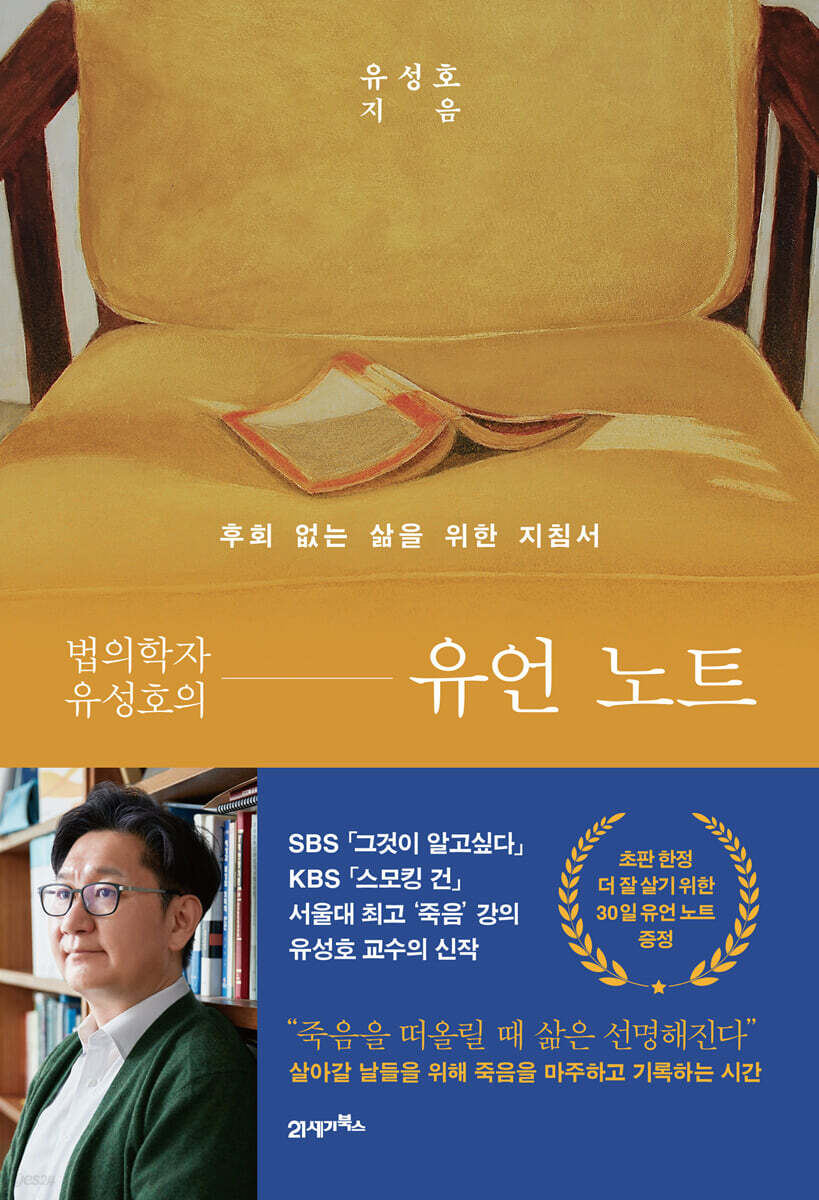
Forensic scientist Yoo Seong-ho's will notes
 |
Description
Book Introduction
"Today's will becomes a pledge for tomorrow's life."
Six years after "I Go to See a Corpse Every Week"
Professor Yoo Seong-ho, a forensic scientist who encounters death every day
I discovered this while writing a 'will' once a year.
Guidelines for a Life Without Regrets
Professor Yoo Seong-ho, who created a buzz with vivid stories and philosophy from forensic medicine through his book, “I Go to See a Corpse Every Week,” which contained the best “death” lecture at Seoul National University in 2019, has published a new book, “Forensic Scientist Yoo Seong-ho’s Will Note,” after six years.
This book is a compilation of the author's 'knowledge' and 'insight' about life and death, gained through 27 years of performing over 3,000 autopsies, as well as his deep reflections and contemplation on 'practical methods' for facing finite life and the inevitability of death.
In this book, Professor Yoo Seong-ho recommends facing death and life, especially with the keyword “will.”
The will he conveys is not a final word left at the end of life, but rather a practical way to make the days ahead more meaningful.
For a long time, the author has been responsible for autopsies and consulting on major incidents and crimes occurring in Korea, and has shed light with a keen and delicate eye on the painful scars left on our society by unprepared deaths.
This book goes a step further, expanding the discussion to include loss and mourning, life-sustaining treatment, and euthanasia. Drawing on case studies, data, and various literature and research, it presents various questions and stories surrounding a "good death" and a "good life."
Death is the ending and finale of the beautiful journey called life.
Professor Yoo Seong-ho, a forensic pathologist who encounters death every day, hopes that death is not simply "scary," "the end," or "futile," but rather shines as an ending befitting each person's life within the providence of the vast universe and the cycle of life.
This is why he tells us to “face death” and encourages us to write a will.
Many people live their lives oblivious to death and without any purpose or direction in life, driven by the hardships of life.
But life becomes clearer when we think about death.
This book advises that we imagine death at least once in our lives and reflect on what kind of person we were, what we loved, what kind of life we have lived, and what we will fill our days ahead with.
If you want to live a life without regrets, if you are feeling lost and lost, crushed by the weight of life, this book will help you find meaning and direction in your life.
Six years after "I Go to See a Corpse Every Week"
Professor Yoo Seong-ho, a forensic scientist who encounters death every day
I discovered this while writing a 'will' once a year.
Guidelines for a Life Without Regrets
Professor Yoo Seong-ho, who created a buzz with vivid stories and philosophy from forensic medicine through his book, “I Go to See a Corpse Every Week,” which contained the best “death” lecture at Seoul National University in 2019, has published a new book, “Forensic Scientist Yoo Seong-ho’s Will Note,” after six years.
This book is a compilation of the author's 'knowledge' and 'insight' about life and death, gained through 27 years of performing over 3,000 autopsies, as well as his deep reflections and contemplation on 'practical methods' for facing finite life and the inevitability of death.
In this book, Professor Yoo Seong-ho recommends facing death and life, especially with the keyword “will.”
The will he conveys is not a final word left at the end of life, but rather a practical way to make the days ahead more meaningful.
For a long time, the author has been responsible for autopsies and consulting on major incidents and crimes occurring in Korea, and has shed light with a keen and delicate eye on the painful scars left on our society by unprepared deaths.
This book goes a step further, expanding the discussion to include loss and mourning, life-sustaining treatment, and euthanasia. Drawing on case studies, data, and various literature and research, it presents various questions and stories surrounding a "good death" and a "good life."
Death is the ending and finale of the beautiful journey called life.
Professor Yoo Seong-ho, a forensic pathologist who encounters death every day, hopes that death is not simply "scary," "the end," or "futile," but rather shines as an ending befitting each person's life within the providence of the vast universe and the cycle of life.
This is why he tells us to “face death” and encourages us to write a will.
Many people live their lives oblivious to death and without any purpose or direction in life, driven by the hardships of life.
But life becomes clearer when we think about death.
This book advises that we imagine death at least once in our lives and reflect on what kind of person we were, what we loved, what kind of life we have lived, and what we will fill our days ahead with.
If you want to live a life without regrets, if you are feeling lost and lost, crushed by the weight of life, this book will help you find meaning and direction in your life.
- You can preview some of the book's contents.
Preview
index
prolog
First Note - Learning to Die
Providence - We all die
Old age - death at the end of the life cycle
Awareness - Three Perspectives on Death
Loss - Coping with Second-Person Death
Mourning - what remains in the wake of sorrow
Preparing for Death - How to Spend the End of Your Life
Finite Life - There is no good life without a good death.
Second Note: Preparing for a Life Without Regrets
Life and Death: For ancient Koreans, death was the completion of life.
The Right to Die: New Dialogue on a Good Death
The Dilemma: When the Value of Life and the Right to Self-Determination Conflict
The final choice - if death is a part of existential life
Euthanasia 1 - Would you like to proceed with discontinuing life-sustaining treatment?
Euthanasia 2 - Did he kill his wife or did he help her?
Transition: If you want a life without regrets, face death.
Third Note - Documenting Life
A Will: Life is in the Last Words
Noun's Words ─ Are you living a life without regrets?
Records - How the Living and the Dead Connect
My Funeral - What Will I Leave Behind on My Final Journey?
Farewell - After death, we remain in memory.
The Meaning of Life - Imagining Death to Live Better
To the young you ─ as if living a second life
A Guide to Life ─ Today's Will Becomes a Commitment to Life
Epilogue
supplement
main
First Note - Learning to Die
Providence - We all die
Old age - death at the end of the life cycle
Awareness - Three Perspectives on Death
Loss - Coping with Second-Person Death
Mourning - what remains in the wake of sorrow
Preparing for Death - How to Spend the End of Your Life
Finite Life - There is no good life without a good death.
Second Note: Preparing for a Life Without Regrets
Life and Death: For ancient Koreans, death was the completion of life.
The Right to Die: New Dialogue on a Good Death
The Dilemma: When the Value of Life and the Right to Self-Determination Conflict
The final choice - if death is a part of existential life
Euthanasia 1 - Would you like to proceed with discontinuing life-sustaining treatment?
Euthanasia 2 - Did he kill his wife or did he help her?
Transition: If you want a life without regrets, face death.
Third Note - Documenting Life
A Will: Life is in the Last Words
Noun's Words ─ Are you living a life without regrets?
Records - How the Living and the Dead Connect
My Funeral - What Will I Leave Behind on My Final Journey?
Farewell - After death, we remain in memory.
The Meaning of Life - Imagining Death to Live Better
To the young you ─ as if living a second life
A Guide to Life ─ Today's Will Becomes a Commitment to Life
Epilogue
supplement
main
Detailed image
.jpg)
Into the book
Being aware of death makes me more humble about life and more grateful for what I have.
In the face of limited life, we develop the will to love more passionately, understand more deeply, and live more fully.
--- From the "Prologue"
'Death' is an invisible object and cannot be directly experienced, so it is easy to feel fear.
However, as we go about our daily lives, death is perceived as an 'event' and is quickly forgotten.
In that sense, death may be 'you who are too far to approach'.
--- From "First Note - Time to Learn About Death | Three Viewpoints on Death"
We can live our present lives meaningfully because we recognize the existence of death.
But not preparing for death is like not finding meaning in your present life.
If so, isn't there a 'good death' at the end of a 'good life'?
--- From "First Note - Learning to Die | There is no good life without a good death"
Death is a process of life.
The dignity of death is no different from the dignity of life.
When human life is threatened, the right to self-determination over death can be exercised only when it leads to a dignified life.
--- From "Second Note - Preparing for a Life Without Regrets | Will You Proceed with Withdrawal of Life-Sustaining Treatment?"
Preparing for death is not planning the end.
It is a commitment to living life more faithfully and a process that makes us savor every moment of life.
Living with death means loving today more, preparing for tomorrow, and expressing the will to live in this moment.
That's how we truly love the rest of our lives.
--- From "Second Note - Preparing for a Life Without Regrets | If You Want a Life Without Regrets, Face Death"
A will contains the last message of the departed.
Beyond simply a material inheritance, a will can be a final medium of communication between a person and his or her loved ones, reflecting the values and philosophies he or she holds dear.
A will is a record of the life and beliefs of the deceased, and through it, the people left behind can carry on the deceased's sincerity and will.
--- From "The Third Note - The Work of Recording Life | Life is Embedded in the Last Words of Life"
Writing an obituary while imagining 'tomorrow without me' provides an opportunity to look back on the life I have lived.
You will discover the value of life and precious moments that you didn't realize at the time.
And it will motivate you to set goals for your future and live more faithfully in the present.
--- From "The Third Note - Documenting Life | Imagining Death to Live Better"
I write a will once a year.
Every time I do that, I look back on my life so far and realize where I am at now.
I gain the strength to recognize myself objectively and move forward in life.
A will is a pledge to me towards life.
In the face of limited life, we develop the will to love more passionately, understand more deeply, and live more fully.
--- From the "Prologue"
'Death' is an invisible object and cannot be directly experienced, so it is easy to feel fear.
However, as we go about our daily lives, death is perceived as an 'event' and is quickly forgotten.
In that sense, death may be 'you who are too far to approach'.
--- From "First Note - Time to Learn About Death | Three Viewpoints on Death"
We can live our present lives meaningfully because we recognize the existence of death.
But not preparing for death is like not finding meaning in your present life.
If so, isn't there a 'good death' at the end of a 'good life'?
--- From "First Note - Learning to Die | There is no good life without a good death"
Death is a process of life.
The dignity of death is no different from the dignity of life.
When human life is threatened, the right to self-determination over death can be exercised only when it leads to a dignified life.
--- From "Second Note - Preparing for a Life Without Regrets | Will You Proceed with Withdrawal of Life-Sustaining Treatment?"
Preparing for death is not planning the end.
It is a commitment to living life more faithfully and a process that makes us savor every moment of life.
Living with death means loving today more, preparing for tomorrow, and expressing the will to live in this moment.
That's how we truly love the rest of our lives.
--- From "Second Note - Preparing for a Life Without Regrets | If You Want a Life Without Regrets, Face Death"
A will contains the last message of the departed.
Beyond simply a material inheritance, a will can be a final medium of communication between a person and his or her loved ones, reflecting the values and philosophies he or she holds dear.
A will is a record of the life and beliefs of the deceased, and through it, the people left behind can carry on the deceased's sincerity and will.
--- From "The Third Note - The Work of Recording Life | Life is Embedded in the Last Words of Life"
Writing an obituary while imagining 'tomorrow without me' provides an opportunity to look back on the life I have lived.
You will discover the value of life and precious moments that you didn't realize at the time.
And it will motivate you to set goals for your future and live more faithfully in the present.
--- From "The Third Note - Documenting Life | Imagining Death to Live Better"
I write a will once a year.
Every time I do that, I look back on my life so far and realize where I am at now.
I gain the strength to recognize myself objectively and move forward in life.
A will is a pledge to me towards life.
--- From "Epilogue"
Publisher's Review
How to live, how to die
A forensic scientist who encounters death every day changed his life.
On Practical Attitudes for a 'Life Without Regrets'
If you had to leave a will right now, at this moment, what would you say?
How will we fill the last page of our lives?
Most people endure the hardships of daily life for the sake of future happiness and the comfort of old age, but they often postpone preparing for the 'end of life'.
Until 'death' approaches, I either think it's not my business or I just avoid it.
This book is a new work published after 6 years by Professor Yoo Seong-ho, a forensic pathologist who encounters death every day, and contains essential stories about 'death and life' and practical methods for living without regrets with deeper insight. Professor Yoo Seong-ho, who has garnered attention early on as a forensic pathologist on SBS's "I Want to Know That" and as the best 'death' lecturer at Seoul National University for 13 years, has also proposed a unique perspective on death through KBS's "Smoking Gun" and YouTube's "Yoo Seong-ho's Detective Talk," summarizes the insight he has gained through 27 years of studying death in one word.
If you want to live, prepare for death.
‘How you die’ is as important as ‘how you live’.
This book contains insights and wisdom on how to face death at the end of life's journey.
The author says:
Not preparing for a good death is as reckless as trying to survive without doing anything.
This book is the result of years of continuous exploration into death, loss, mourning, life-sustaining treatment, self-determination of death, euthanasia, and a dignified death, and contains the essential meaning of death and life, as well as specific guidelines for a life without regrets.
“The more we think about death, the clearer our lives become.”
If you are currently contemplating the direction of your life,
Start writing your will for the days ahead.
In Japan, there is a culture of writing "shukas," or "ending notes," as part of end-of-life activities.
It is a record written by the elderly to faithfully prepare for the end of their lives, and includes details such as funeral procedures, handling of remains, and wills. However, it is also being highlighted as a tool for young and middle-aged people to reflect on their lives.
In this book, Professor Yoo Seong-ho surprisingly suggests preparing for death as a life guide that can serve as a turning point for those who are exhausted by the weight of life and wandering without direction.
If there's no tomorrow, how should we prepare for the final moments of our lives? If we were to leave our final words now, would they be love and gratitude, or regret and regret? Professor Yoo Seong-ho, seeking answers to these questions, writes a "will" once a year, willingly imagining and preparing for death.
In other words, the preparation for death that the author speaks of is not only for those who have not much time left before death.
In this book, the author generously shares specific, practical techniques for actively facing death: how to reflect on the days you've lived and plan for the days ahead, how to love your loved ones more deeply, and how to discover meaning and purpose in life.
“I write a will once a year.
Every time I do that, I look back on my life so far and realize where I am at now.
I gain the strength to recognize myself objectively and move forward in life.
“A will is a pledge to me toward life.” - From the text
★★★ A Death Lesson to Find the Meaning of Life in an Age of Loss
★★★ How to love and understand finite life more deeply and more broadly
The book is divided into three parts.
As a legal scholar and an individual, I have collected stories about death that I have always wanted to share at least once, and put them into one volume.
This book tells us to plan our lives by planning our deaths.
Death and life continue.
So, shouldn't a "good life" end with a "good death"? So, open this book and prepare for death so that at your last moment, you can say, "I lived a life without regrets."
The first note, "Time to Learn About Death," talks about why we need to understand death properly.
Learning about death is realizing the finiteness of life.
Only when we recognize the finiteness of time can we truly cherish every moment and love our lives more deeply.
It also gathers knowledge and wisdom to help us understand the life cycle, old age, and death, and offers a glimpse into the author's sensitive perspective on loss and mourning after death.
Your attitude towards life changes depending on how you accept death.
The second note, "Preparing for a Life Without Regret," discusses attitudes toward death and explores why we fear and avoid death.
It also deals with still controversial topics such as 'life-sustaining treatment', 'assisted dying', and 'euthanasia', and encourages us to accept the right to decide on death as 'our own problem' rather than 'someone else's story', and to contemplate the essential meaning of a dignified life through a dignified death.
The third note, “The Work of Recording Life,” presents the meaning and practical methods of preparing for death.
By examining the meaning of life contained in the last words of people from across the East and the West, past and present, we learn how to prepare for death by reflecting on and recording our own lives.
In particular, the author's will, written silently in his own handwriting, evokes a profound emotion.
Ultimately, what the author hopes for is that everyone who reads this book will discover their own 'meaning of life' and live a fulfilling life without regrets.
I hope that we can gain the calm courage to walk forward, knowing that death lies at the end of the journey of life given to us, and the wisdom to love life and gain a deeper understanding of ourselves and life.
A forensic scientist who encounters death every day changed his life.
On Practical Attitudes for a 'Life Without Regrets'
If you had to leave a will right now, at this moment, what would you say?
How will we fill the last page of our lives?
Most people endure the hardships of daily life for the sake of future happiness and the comfort of old age, but they often postpone preparing for the 'end of life'.
Until 'death' approaches, I either think it's not my business or I just avoid it.
This book is a new work published after 6 years by Professor Yoo Seong-ho, a forensic pathologist who encounters death every day, and contains essential stories about 'death and life' and practical methods for living without regrets with deeper insight. Professor Yoo Seong-ho, who has garnered attention early on as a forensic pathologist on SBS's "I Want to Know That" and as the best 'death' lecturer at Seoul National University for 13 years, has also proposed a unique perspective on death through KBS's "Smoking Gun" and YouTube's "Yoo Seong-ho's Detective Talk," summarizes the insight he has gained through 27 years of studying death in one word.
If you want to live, prepare for death.
‘How you die’ is as important as ‘how you live’.
This book contains insights and wisdom on how to face death at the end of life's journey.
The author says:
Not preparing for a good death is as reckless as trying to survive without doing anything.
This book is the result of years of continuous exploration into death, loss, mourning, life-sustaining treatment, self-determination of death, euthanasia, and a dignified death, and contains the essential meaning of death and life, as well as specific guidelines for a life without regrets.
“The more we think about death, the clearer our lives become.”
If you are currently contemplating the direction of your life,
Start writing your will for the days ahead.
In Japan, there is a culture of writing "shukas," or "ending notes," as part of end-of-life activities.
It is a record written by the elderly to faithfully prepare for the end of their lives, and includes details such as funeral procedures, handling of remains, and wills. However, it is also being highlighted as a tool for young and middle-aged people to reflect on their lives.
In this book, Professor Yoo Seong-ho surprisingly suggests preparing for death as a life guide that can serve as a turning point for those who are exhausted by the weight of life and wandering without direction.
If there's no tomorrow, how should we prepare for the final moments of our lives? If we were to leave our final words now, would they be love and gratitude, or regret and regret? Professor Yoo Seong-ho, seeking answers to these questions, writes a "will" once a year, willingly imagining and preparing for death.
In other words, the preparation for death that the author speaks of is not only for those who have not much time left before death.
In this book, the author generously shares specific, practical techniques for actively facing death: how to reflect on the days you've lived and plan for the days ahead, how to love your loved ones more deeply, and how to discover meaning and purpose in life.
“I write a will once a year.
Every time I do that, I look back on my life so far and realize where I am at now.
I gain the strength to recognize myself objectively and move forward in life.
“A will is a pledge to me toward life.” - From the text
★★★ A Death Lesson to Find the Meaning of Life in an Age of Loss
★★★ How to love and understand finite life more deeply and more broadly
The book is divided into three parts.
As a legal scholar and an individual, I have collected stories about death that I have always wanted to share at least once, and put them into one volume.
This book tells us to plan our lives by planning our deaths.
Death and life continue.
So, shouldn't a "good life" end with a "good death"? So, open this book and prepare for death so that at your last moment, you can say, "I lived a life without regrets."
The first note, "Time to Learn About Death," talks about why we need to understand death properly.
Learning about death is realizing the finiteness of life.
Only when we recognize the finiteness of time can we truly cherish every moment and love our lives more deeply.
It also gathers knowledge and wisdom to help us understand the life cycle, old age, and death, and offers a glimpse into the author's sensitive perspective on loss and mourning after death.
Your attitude towards life changes depending on how you accept death.
The second note, "Preparing for a Life Without Regret," discusses attitudes toward death and explores why we fear and avoid death.
It also deals with still controversial topics such as 'life-sustaining treatment', 'assisted dying', and 'euthanasia', and encourages us to accept the right to decide on death as 'our own problem' rather than 'someone else's story', and to contemplate the essential meaning of a dignified life through a dignified death.
The third note, “The Work of Recording Life,” presents the meaning and practical methods of preparing for death.
By examining the meaning of life contained in the last words of people from across the East and the West, past and present, we learn how to prepare for death by reflecting on and recording our own lives.
In particular, the author's will, written silently in his own handwriting, evokes a profound emotion.
Ultimately, what the author hopes for is that everyone who reads this book will discover their own 'meaning of life' and live a fulfilling life without regrets.
I hope that we can gain the calm courage to walk forward, knowing that death lies at the end of the journey of life given to us, and the wisdom to love life and gain a deeper understanding of ourselves and life.
GOODS SPECIFICS
- Date of issue: April 16, 2025
- Page count, weight, size: 252 pages | 140*205*20mm
- ISBN13: 9791173571947
- ISBN10: 1173571949
You may also like
카테고리
korean


korean

![GQ KOREA Mark (Monthly): December [2025]](http://librairie.coreenne.fr/cdn/shop/files/8ef265dbbfbf186523ed75ba7319009d.jpg?v=1765340328&width=3840)


