

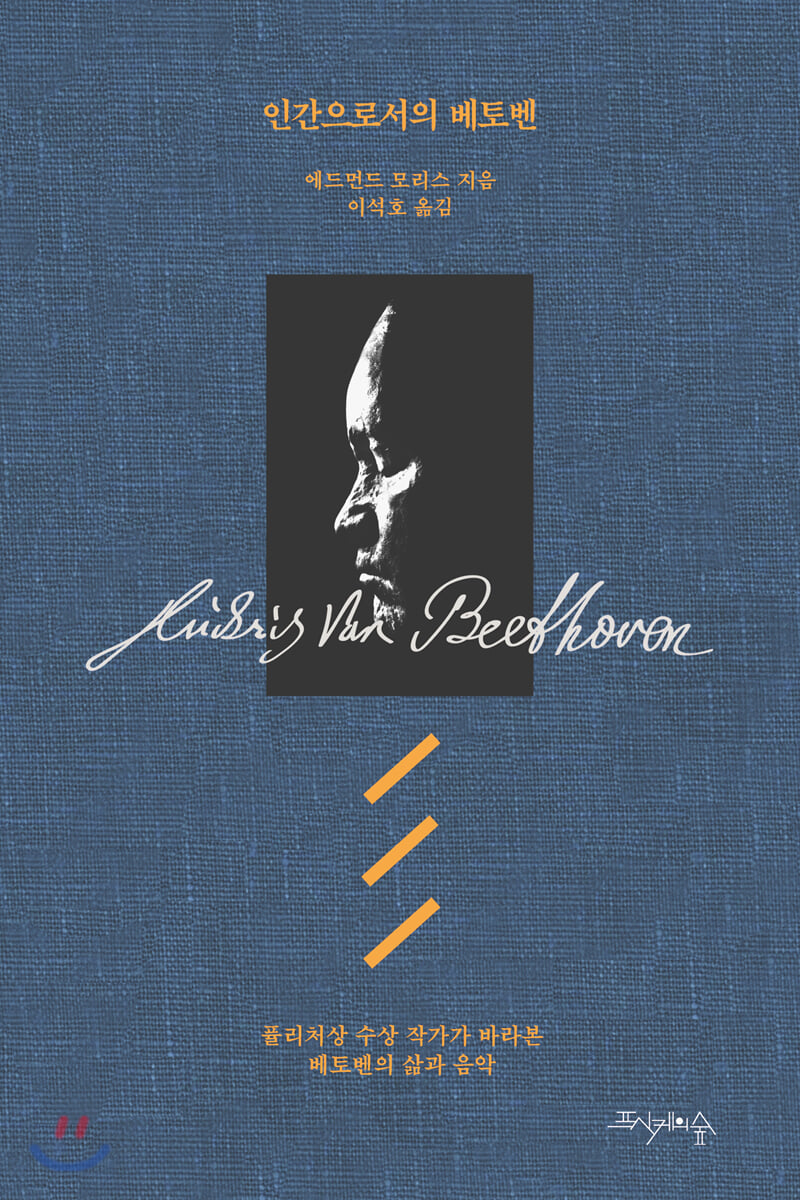
Beethoven as a human being
 |
Description
Book Introduction
Woven by a Pulitzer Prize-winning author
“An Ideal Beethoven Biography for the Ordinary Reader”
Beethoven is considered one of the most influential classical composers.
In terms of the quality and variety of his music, Beethoven left behind a wonderful gift.
This book examines Beethoven's life chronologically, examining the context of his creative work.
As an attempt to get one step closer to his work through the prism of life, it serves as an excellent companion for intellectual and three-dimensional music appreciation.
You will also be able to see at a glance the overall topography of Vienna, the center of contemporary culture and arts, and its many famous figures.
The Pulitzer Prize-winning author is a widely acclaimed biographer, and in this book he draws on research from the 20th century to present an accurate and engaging account of Beethoven's life and music.
Yet, it avoids overindulging in material and provides a model of concise biography for the general reader.
It neither excessively praises Beethoven nor unfairly belittles him, but simply illuminates him as a human being.
- You can preview some of the book's contents.
Preview
index
prolog
Chapter 1: The Spirit of Mozart
Chapter 2 Haydn's Hands
Chapter 3: The Creations of Prometheus
Chapter 4: The Cold Dungeon
Chapter 5: The Immortal Beloved
Chapter 6: Mountains of the Mind
Chapter 7: A Mother Like a Crow
Chapter 8: Beyond Silence
valediction
Epilogue
References and Acknowledgements
Search
Into the book
The power of Beethoven's music comes from its universality.
That universality, in other words, is the ability to unite all doubts and conflicts through the catharsis of sound, and eventually encompass the entire spectrum of human emotions, from the fear of death to the love of life.
--- p.12
The boy was so young that he had to stand on a footstool to reach the keyboard.
As soon as Ludwig showed even the slightest sign of hesitation, his father's beatings began.
As soon as the clavier practice was over, the child's hands were filled with violins or music theory studies continued.
It was rare for a day to pass without being clubbed or trapped in a mine.
--- p.32
The mother paid little attention to her sons, and young Ludwig was neither bathed nor dressed properly.
Mary Magdalene is said to have said this to Cecilia Fischer, who lived in the same house:
“If you are willing to listen to my sincere advice, I hope you will remain single and not get married.”
--- p.35
Beethoven appeared to have a violent temper more than he actually did.
He always had a grumpy look on his face because he had a habit of squinting due to his nearsightedness, and his large front teeth pushed his lips forward, making him look pouty even when his mouth was closed.
But in reality, he was a gentle and affectionate man, as long as he didn't provoke trouble.
--- p.50
Beethoven seemed to have his own unique humor, not laughing at things that other people found funny.
The endless stream of puns was so dull that even considering that it was in German, it was often absurd.
--- p.51
Vienna was quite different from other German cities.
The speech was somewhat laid-back, the recent Rococo architecture had a distinctly French feel, the taste for opera was closer to Italy, and the social surveillance and ornate Catholic churches were a bit like Spain.
--- p.81
Beethoven wrote this in a note to himself:
“Courage… This year must be the year you become a complete human being, leaving nothing unfinished.”
--- p.96
Among Beethoven's strengths was a technique called the triple trill.
It was a breathtaking technique that suddenly swelled to forte and then, as if nothing had happened, to a barely audible volume, using four fingers on one hand and two fingers on the other, moving back and forth rapidly like the flapping of a hummingbird's wings.
--- p.100
The habit of writing down random thoughts before they disappeared was close to an obsession.
He would lean against a tree trunk, stop in his tracks, stand up halfway through his meal, or throw down his shaving paper and write something down.
His coat pockets were always sagging, containing a handful of sheet music or a large notebook.
In an emergency, they would just scribble on any wall or window.
--- p.124
“I haven’t been to social parties in almost two years.
It is not possible to go around saying to people you meet in such a place, “I am deaf.”
If I had a different job, I could have dealt with this disease to some extent.
But isn't that a terrible handicap for a musician?"
--- p.136
“I intend to grab fate by the scruff of its neck.
“Fate will never be able to subdue me or crush me completely.”
--- p.140
Beethoven was a note-taking fanatic like no other in the history of music.
The stacks of sketchbooks and sheet music that his pen touched grew to such a large volume that moving them each time he moved was as much of a headache as moving a large archive.
Yet, Beethoven remembered the whereabouts and whereabouts of each piece of paper he filled with his own scribbles.
He is said to have valued sketches more than finished manuscripts, and once a work was published, he considered the finished manuscripts to be a bonus, something that could be had or not.
--- p.162
“Goethe seems to be enjoying the atmosphere at court very much.
As a poet, it is not befitting of his dignity and respect.
“Poets, who should be supreme figures who enlighten their fellow countrymen and the nation, are so captivated by the glamour of high society that they abandon everything. Do they have the right to mock the foolishness of virtuosos?”
--- p.232
Even Beethoven, who expressed such grandiose sentiments in the world of art, often showed an irrational and narrow-minded side in the world of everyday life.
Ludwig could not accept that his brother had become richer during the same period while he had become poorer due to extreme inflation.
--- p.233
Publisher's Review
Beethoven as a human being
Beethoven's life and music as seen by a Pulitzer Prize-winning author
For the average reader
The Ideal Beethoven Biography
Beethoven is one of the most important composers in the history of Western classical music.
Born in 1770, he composed many famous songs until his death in 1827. Furthermore, he showed an indomitable spirit in that he achieved this despite suffering from a fatal hearing impairment as a musician.
He left behind remarkable achievements in various musical forms, including symphonies, sonatas, string quartets, and even operas.
There are several ways to better listen to Beethoven's music.
Buy good quality CDs or seek out good performers and concerts.
They also spend a lot of money on audio equipment.
One way to do this, but different from the others, is to read 'related books'.
It is an approach that deepens the meaning of the song by understanding his era and life.
Contemporary music is often enough to be enjoyed simply by listening to it, as we already have an implicit understanding of its context.
However, when it comes to music from hundreds of years ago, or from a distant foreign country, the way of appreciating it is bound to be a little different.
The classic thing is that you see as much as you know, and you hear as much as you know.
This book takes a detailed look at Beethoven's life and works.
His life of just over 56 years is divided into eight chapters, chronologically narrated.
The author, who is renowned as an excellent biographer, writes a book that encompasses the latest research findings at the time of writing, yet, in keeping with the project's purpose, avoids overindulging in material, setting an example of a "concise biography" for "general readers, students, and scholars."
For reference, the original book was published in 2005 as part of the 'Eminent Lives' series.
Publisher's Weekly praised it, calling it "an ideal Beethoven biography for the average reader."
Pulitzer Prize-winning author
Thorough research and concise description
This book not only avoids the widespread influence of Anton Schindler's fabricated biography, but also faithfully follows the biographies of Alexander Willoch Sayer (1879) and Maynard Solomon (1977), which are essential reading for Beethoven studies.
Lewis Lockwood's biography (2003) and Joseph Kerman's Beethoven's String Quartets (1967) were also important references.
In particular, the author, as befitting a Pulitzer Prize-winning master of journalism, incorporated many impressive passages from a vast amount of material, including Beethoven's letters and notebooks, into the text.
The concise and balanced narrative stands out even while traversing a wealth of material.
As we follow Beethoven's life, we can see at a glance the overall topography of the figures who led the culture and arts of his time.
Beethoven was born into a musical family in Bonn, studied abroad in Vienna, and built a brilliant career as a musician.
Upon entering Vienna, he played the piano in front of Mozart, surprising him with his amazing skills, and he also came to have Haydn, the greatest musician in Vienna at the time, as his teacher.
Afterwards, thanks to his growing fame, he was able to meet the great writer Goethe on equal footing.
He eventually became a respected musician in Vienna and lived there for the rest of his life, and at his funeral, Schubert, who admired him, led the funeral procession carrying a torch.
Meanwhile, for Beethoven, who had close relationships with the Viennese aristocracy, the rise and fall of Napoleon served as an important backdrop to his life.
The author shows the relationship between Beethoven and various people step by step according to the journey of his life.
The author used 'life as a human being' as the main criterion when dividing the time period into chapters.
In the case of musical works, rather than being a standard for dividing periods, they are neatly placed within the context of life in each period.
Chapter 1 deals with his childhood in Bonn, and Chapter 2 deals with his early years in Vienna, where he studied under Haydn.
Chapter 3 focuses on the shocking hearing loss and the will, and Chapter 4 describes the artist's prolific creative career, which was marked by both success and failure.
Chapter 5 is about the periodization of the 'Immortal Beloved' Anthony Brentano, Chapter 6 is about her life in late middle age, Chapter 7 is about her legal battle to adopt her nephew Karl, and Chapter 8 is about her later life.
These passages in life are filled with musical works created by Beethoven.
For songs with significant meaning, detailed analysis is conducted regarding musical form and composition.
[New York Times Book Review] Recommendation
“Beethoven’s life has been skillfully summarized.”
Beethoven's deafness is a famous example of human drama, and helped to establish him as a mythical figure.
But if you look at it, this has a different significance.
This resulted in a massive notebook record for communicating with the other party.
This, coupled with his tendency to be a note-taking fanatic, became an important source of basic information for later biographies of him.
In other words, hearing impairment played a role in portraying Beethoven as a complete human being, not as a myth or legend.
The author faithfully reflects these aspects, neither over-praising Beethoven nor unfairly belittling him, but simply illuminating him as a human being.
GOODS SPECIFICS
- Date of issue: January 11, 2021
- Page count, weight, size: 360 pages | 452g | 140*210*17mm
- ISBN13: 9791189336318
- ISBN10: 1189336316
You may also like
카테고리
korean


korean


