

Feynman's Six Physics Stories
 |
Description
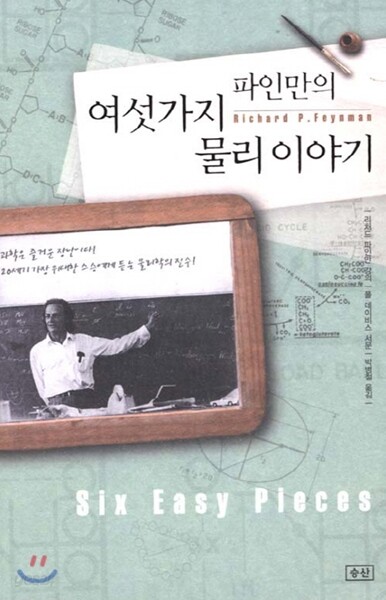
Book Introduction
This book contains six of the most entertaining and interesting physics lectures by Richard Feynman, the greatest genius scientist of the 20th century who once said, "Science is a fun game."
It covers the motion of atoms, the fundamentals of physics, the relationship between physics and other sciences, energy, gravity, and quantum mechanics.
At first glance, it may seem like a very boring topic, but as you read each sentence, you will be surprised to realize how interesting physics is.
The physics we've learned so far has been difficult and disliked because it's written too rigidly, the teacher's explanations are too boring, or it feels difficult. However, physics is actually the most fundamental of all scientific fields.
It is also the discipline that has the greatest influence on the development of science.
The author, Richard Feynman, also gave this legendary physics lecture to correct that reality.
It is highly regarded for deriving cutting-edge physics concepts from everyday examples without resorting to a confusing array of mathematics or difficult technical terms.
Simultaneous publication of hardcover and paperback editions for collectors!
It covers the motion of atoms, the fundamentals of physics, the relationship between physics and other sciences, energy, gravity, and quantum mechanics.
At first glance, it may seem like a very boring topic, but as you read each sentence, you will be surprised to realize how interesting physics is.
The physics we've learned so far has been difficult and disliked because it's written too rigidly, the teacher's explanations are too boring, or it feels difficult. However, physics is actually the most fundamental of all scientific fields.
It is also the discipline that has the greatest influence on the development of science.
The author, Richard Feynman, also gave this legendary physics lecture to correct that reality.
It is highly regarded for deriving cutting-edge physics concepts from everyday examples without resorting to a confusing array of mathematics or difficult technical terms.
Simultaneous publication of hardcover and paperback editions for collectors!
- You can preview some of the book's contents.
Preview
index
1.
moving atoms
2.
Fundamental Physics
3.
Physics' relationship with other sciences
4.
conservation of energy
5.
gravitation
6.
quantum behavior
About Richard Feynman
Search
moving atoms
2.
Fundamental Physics
3.
Physics' relationship with other sciences
4.
conservation of energy
5.
gravitation
6.
quantum behavior
About Richard Feynman
Search
Into the book
A prime example of another form of energy is the pendulum.
If you pull a pendulum to one side and then release it, it will swing back and forth, but as it moves from one end to the center, the height of the pendulum decreases.
That is, the gravitational potential energy decreases.
So where does this lost energy go? When the pendulum reaches the center, its potential energy decreases, but the pendulum continues its motion, "rising" to the other end. The gravitational potential energy isn't lost; it's stored in a different form, reappearing as the pendulum rises.
Therefore, as the pendulum gradually decreases in height and moves toward the center, it is clear that the gravitational potential energy is converted into some other form of energy.
The transformed energy is generated by the 'motion' of the pendulum.
But this kind of feeling alone cannot be physics.
We need to be able to express that energy in a formula.
If you pull a pendulum to one side and then release it, it will swing back and forth, but as it moves from one end to the center, the height of the pendulum decreases.
That is, the gravitational potential energy decreases.
So where does this lost energy go? When the pendulum reaches the center, its potential energy decreases, but the pendulum continues its motion, "rising" to the other end. The gravitational potential energy isn't lost; it's stored in a different form, reappearing as the pendulum rises.
Therefore, as the pendulum gradually decreases in height and moves toward the center, it is clear that the gravitational potential energy is converted into some other form of energy.
The transformed energy is generated by the 'motion' of the pendulum.
But this kind of feeling alone cannot be physics.
We need to be able to express that energy in a formula.
---pp.
154~155
154~155
Publisher's Review
The only physics-related book selected as one of the 100 best non-fiction books of the 20th century by Random House in 1999!!!
『Six Easy Pieces』(original title: Six Easy Pieces) is a book that compiles six of the most interesting and entertaining lectures on basic physics given by Richard Feynman, an American physicist and winner of the 1965 Nobel Prize in Physics, to first- and second-year students at Caltech (California Institute of Technology), where he was a professor, so that even the general public can understand them.
In the early 1960s, freshmen entering Caltech, one of the most prestigious engineering schools in the United States along with MIT, were required to take a required course in fundamental physics until their second year.
However, because the content was somewhat difficult, many students were gradually losing interest in the subject.
In an effort to refresh this atmosphere, the school asked Richard Feynman, a young professor still in his 40s, to give a lecture on basic physics to freshmen.
Richard Feynman, who had originally only lectured to graduate students while he was a professor at Caltech, is said to have readily agreed to lecture to undergraduates at this time.
The contents of these lectures, which continued from 1961 to 1963, were later published in three thick volumes under the title "Feynman Lectures on Physics."
Feynman's introductory physics class was intended for first- and second-year Caltech students, but as time went on and the material became increasingly difficult, students began to leave one by one.
However, because the lecture hall was always "full," it is said that Feynman himself did not realize that the number of students was decreasing.
This was because a strange phenomenon occurred where graduate students and fellow professors flocked to fill the gaps left by students who could not keep up with the progress.
Richard Feynman was originally known as a genius in the physics world, but his greatest strength was that he had an uncommon talent for "making difficult things easy to understand."
Moreover, because the lecture was aimed at ordinary undergraduate students rather than physics experts, Feynman's explanations were known to be concise, logical, humorous, and to the point.
The reason his lecture hall was always full might be because graduate students and fellow professors alike were there to see how he "makes difficult physics easy."
Perhaps for this reason, while lecturing to undergraduates, Feynman thought, "My lectures don't seem to be of much help to undergraduates."
In fact, it was not the undergraduate students who benefited the most from the lecture, but rather the graduate students who would continue studying physics in the future and the professors at Caltech.
They would often hear the surprisingly simple and clear "Feynmanian interpretation" of the fundamental concepts of physics they were familiar with, and it would spark new ideas and inspiration.
That is precisely why 『Feynman's Lectures on Physics』, published following the lectures, has remained a must-read for physics students around the world even after nearly half a century.
In the early 1960s, freshmen entering Caltech, one of the most prestigious engineering schools in the United States along with MIT, were required to take a required course in fundamental physics until their second year.
However, because the content was somewhat difficult, many students were gradually losing interest in the subject.
In an effort to refresh this atmosphere, the school asked Richard Feynman, a young professor still in his 40s, to give a lecture on basic physics to freshmen.
Richard Feynman, who had originally only lectured to graduate students while he was a professor at Caltech, is said to have readily agreed to lecture to undergraduates at this time.
The contents of these lectures, which continued from 1961 to 1963, were later published in three thick volumes under the title "Feynman Lectures on Physics."
Feynman's introductory physics class was intended for first- and second-year Caltech students, but as time went on and the material became increasingly difficult, students began to leave one by one.
However, because the lecture hall was always "full," it is said that Feynman himself did not realize that the number of students was decreasing.
This was because a strange phenomenon occurred where graduate students and fellow professors flocked to fill the gaps left by students who could not keep up with the progress.
Richard Feynman was originally known as a genius in the physics world, but his greatest strength was that he had an uncommon talent for "making difficult things easy to understand."
Moreover, because the lecture was aimed at ordinary undergraduate students rather than physics experts, Feynman's explanations were known to be concise, logical, humorous, and to the point.
The reason his lecture hall was always full might be because graduate students and fellow professors alike were there to see how he "makes difficult physics easy."
Perhaps for this reason, while lecturing to undergraduates, Feynman thought, "My lectures don't seem to be of much help to undergraduates."
In fact, it was not the undergraduate students who benefited the most from the lecture, but rather the graduate students who would continue studying physics in the future and the professors at Caltech.
They would often hear the surprisingly simple and clear "Feynmanian interpretation" of the fundamental concepts of physics they were familiar with, and it would spark new ideas and inspiration.
That is precisely why 『Feynman's Lectures on Physics』, published following the lectures, has remained a must-read for physics students around the world even after nearly half a century.
GOODS SPECIFICS
- Date of issue: January 6, 2003
- Page count, weight, size: 248 pages | 445g | 148*210*20mm
- ISBN13: 9788988907412
- ISBN10: 8988907418
You may also like
카테고리
korean


korean

![GQ KOREA Mark (Monthly): December [2025]](http://librairie.coreenne.fr/cdn/shop/files/8ef265dbbfbf186523ed75ba7319009d.jpg?v=1765340328&width=3840)


