

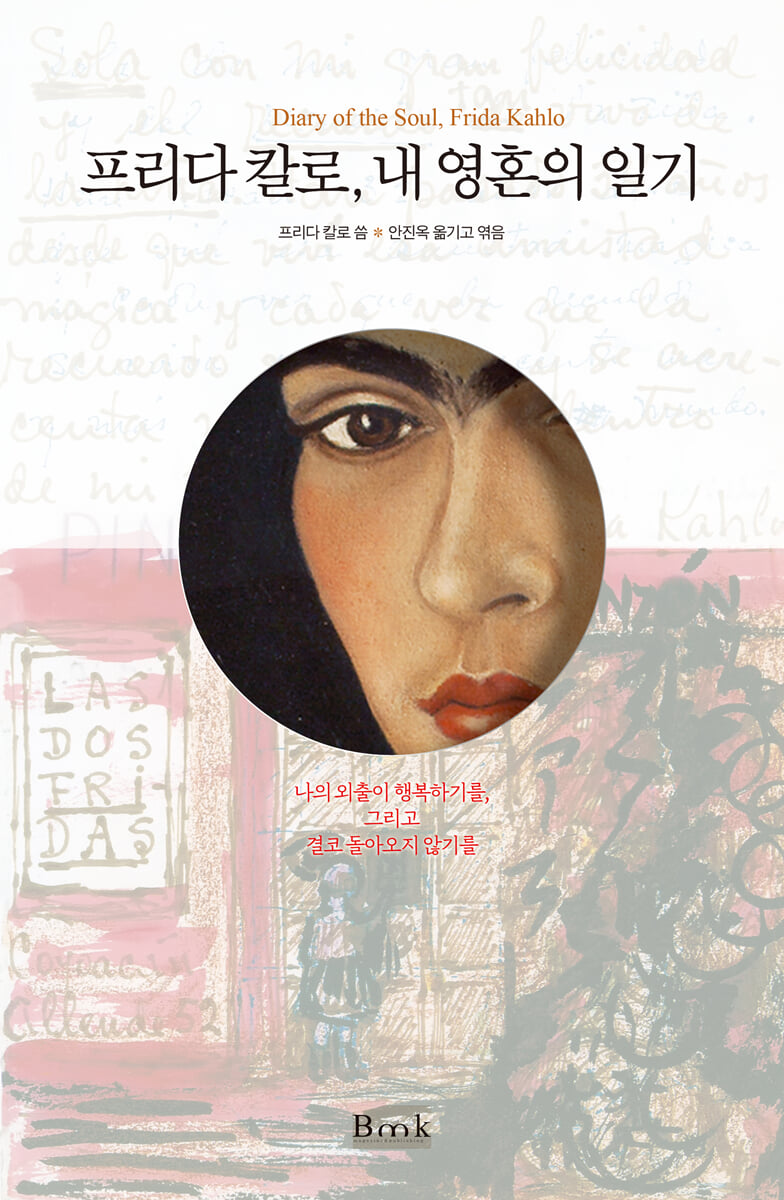
Frida Kahlo, Diary of My Soul
 |
Description
Book Introduction
The diary of Mexico's greatest painter, Frida Kahlo, now available as a book.
Frida Kahlo, who sublimated physical pain into art,
Her intimate passion and love story.
Excerpts from the diary of Frida Kahlo, one of Mexico's greatest painters, discovered in 1995, will be exhibited in a section of the [Frida Kahlo & Diego Rivera] exhibition at the Hangaram Art Museum in the Seoul Arts Center from May 28 to August 28, 2016.
To commemorate this exhibition, the full text of the diary, Frida Kahlo, Diary of My Soul (written by Frida Kahlo/translated and compiled by Jinok Ahn), has been newly published by BMK Publishing. Through this book, you can get a deeper understanding of Frida Kahlo's artistic spirit and subconsciousness, who sublimated her mental and physical pain into art.
- You can preview some of the book's contents.
Preview
index
INTRODUCTION Preface 4
DIARY 15
CHRONOLOGY Chronology 295
SELECTED BIBLIOGRAPHY REFERENCES 300
Detailed image

Publisher's Review
The diary of Mexico's greatest painter, Frida Kahlo, now available as a book.
Frida Kahlo, who sublimated physical pain into art,
Her intimate passion and love story.
Excerpts from the diary of Frida Kahlo, one of Mexico's greatest painters, discovered in 1995, will be exhibited in a section of the "Frida Kahlo & Diego Rivera" exhibition at the Hangaram Art Museum in the Seoul Arts Center from May 28 to August 28, 2016.
To commemorate this exhibition, the full text of the diary, Frida Kahlo, Diary of My Soul (written by Frida Kahlo/translated and compiled by Jinok Ahn), has been newly published by BMK Publishing. Through this book, you can get a deeper understanding of Frida Kahlo's artistic spirit and subconsciousness, who sublimated her mental and physical pain into art.
Nine-year-old Frida, and Frida, dedicated to the first page of her diary
As the diary is not meant to be shown to others, but written solely for oneself, you can encounter Frida Kahlo's true and honest appearance as never before.
In her diary, which she kept hidden with a password to prevent anyone from reading it, her artistic soul sometimes appears as a floating unconsciousness, a myth created by imagination, or a drawing scribbled wherever her hand takes her.
In that sense, her diary is the most important source for understanding the artist Frida Kahlo.
Among the elements that stand out in Frida Kahlo's diaries are the mental and physical suffering she endured throughout her life, the symbols of the Aztec civilization that formed the basis of her identity, and her love for her lover Diego Rivera.
In particular, her love for Diego is so passionate that even people who don't know Diego will fall in love with him after reading his diary.
Frida Kahlo's diary, written from 1944, when she was 37, until her death in 1954, begins with a 1916 photo of herself as a 9-year-old, seemingly asleep, arranged as if to dedicate it to her.
In the photo, Frida is lying quietly on the garden floor with her eyes closed, as if anticipating the difficult fate that lies ahead.
Over the next 47 years, she suffered 32 surgeries, three miscarriages, and her lover Diego's constant infidelity, leaving her soul torn apart.
Her painful life is fully reflected in her self-portraits, in which her identity as a successor to Mexico's ancient Aztec civilization also plays an important role.
A Conversation with Frida Kahlo's Artistic Soul
Life continued to hurt Frida, as if it was beating her harshly to make her an artist.
There were times when she fell, but she never turned away from life.
This was her artistic soul.
Frida Kahlo's diary was translated and edited by Jinok Ahn, a Latin art specialist and director of Gallery Bandi Traso. She also added friendly explanations of symbols so that readers can have a deep conversation with Frida Kahlo's artistic spirit.
"Frida Kahlo, Diary of My Soul" is available at various major bookstores as well as at the museum shop of the Hangaram Art Museum in the Seoul Arts Center, where the "Frida Kahlo & Diego Rivera" exhibition is currently being held.
If you look at page 71 of the book, you can see all kinds of animals dancing in all directions with the phrase "Dance to the Sun" and Aztecs performing a religious ritual at the bottom.
In the center are two hairless Itzcuintli dogs, associated with the Aztec god Xolotl, who symbolized death.
The solotl appears throughout her diary, providing a glimpse into the thoughts of Frida Kahlo, who was sick and closer to death than anyone else.
On page 203, there are symbols such as the sun and moon that frequently appear in ancient Aztec documents, and to the left of the sun is the pyramid of the Aztec civilization called Teotihuacan.
In the center appears a woman wearing traditional Mexican clothing, with the words “Me?” written underneath.
This is a question about whether one is the center of the sun and the moon, that is, the harmony of yin and yang, and the purple and black colors rising from the right arm represent the power of creation and the pain of creation that accompanies it.
As the diary belonged to Frida Kahlo, the subject of the diary was often herself.
A woman appears on page 77 with her waist hanging over a pillar, one leg missing, and her arms, hands, and face falling to the ground.
The face, deeply imbued with loneliness, seems to be helplessly resigned to its own miserably broken body.
Just above the painting is the phrase “I am collapse itself,” which can be seen as a stark portrayal of Frida Kahlo’s physical and mental suffering due to her injuries.
It is said that she made a copy of this painting and carried it around with her.
Sometimes Frida Kahlo wrote sketches or epilogues that served as the basis for her works.
Page 153 is the creative notes for one of her representative works, [The Two Fridas].
The work literally depicts two Fridas sitting together holding hands, one the real Frida and the other the imaginary Frida.
According to her diary, she had an imaginary friend when she was around six years old, and to meet her, young Frida had to take a special route.
The world where only the two of them existed was happy and perfect.
As 34 years passed, the Frida of our imagination would have gradually been forgotten.
However, her presence was always with Frida's unconscious, and eventually, tired of loneliness, Frida was reunited with her imaginary friend.
Her diary occasionally contains sketches that serve as the basis for actual works, such as the drawing on page 139, titled [The Love Embrace of the Universe, the Earth (Mexico), Me, Diego, and Señor Xolotl].
This painting, which was initially a simple sketch, was combined with many symbols in the actual work. The sun and moon, which symbolize the energy of the universe, were placed at the top to represent the Aztec yin-yang philosophy, and Diego, in the form of a child, is held in Frida's arms.
And these are held by Xihuacoatl, the god of the earth in Aztec mythology.
She symbolizes fertility and childbirth, and a dog is depicted next to them.
This dog is Xolotl, the god of death in Aztec mythology.
At the center of this place where life and death are in harmony, are Diego and Frida.
This is also a scene that shows how much Frida loved Diego.
Love! That was Frida Kahlo's one true feeling for Diego throughout her life.
As if to prove this, Frida Kahlo's diary, which is the very essence of her unconscious, has the word "DIEGO" written all over it.
Especially on page 146, the phrase “I am alone” is written under his name, making us feel her loneliness, which grows stronger as her love for Diego grows.
On page 54, a box of chocolates is depicted as a gift from Diego, and a painting dated July 13, 1945, mentions a palette and chromatic amalgams, symbolizing the artistic relationship between Diego and Frida.
This is related to the Aztec traditional idea of yin and yang.
The box was marked with the word “Xocolatl” instead of chocolate, a bitter drink of the gods used as an offering during Aztec religious ceremonies.
After the Spanish occupation, chocolatl became chocolate.
Frida Kahlo, who thought of bitter chocolate as a gift of love.
It's not just my imagination that I can sense the hardships of my love for Diego in the dry branches wrapped around the box of chocolates.
GOODS SPECIFICS
- Date of issue: June 8, 2016
- Page count, weight, size: 300 pages | 616g | 147*225*16mm
- ISBN13: 9791195541522
- ISBN10: 119554152X
You may also like
카테고리
korean


korean


