

Part and whole
 |
Description
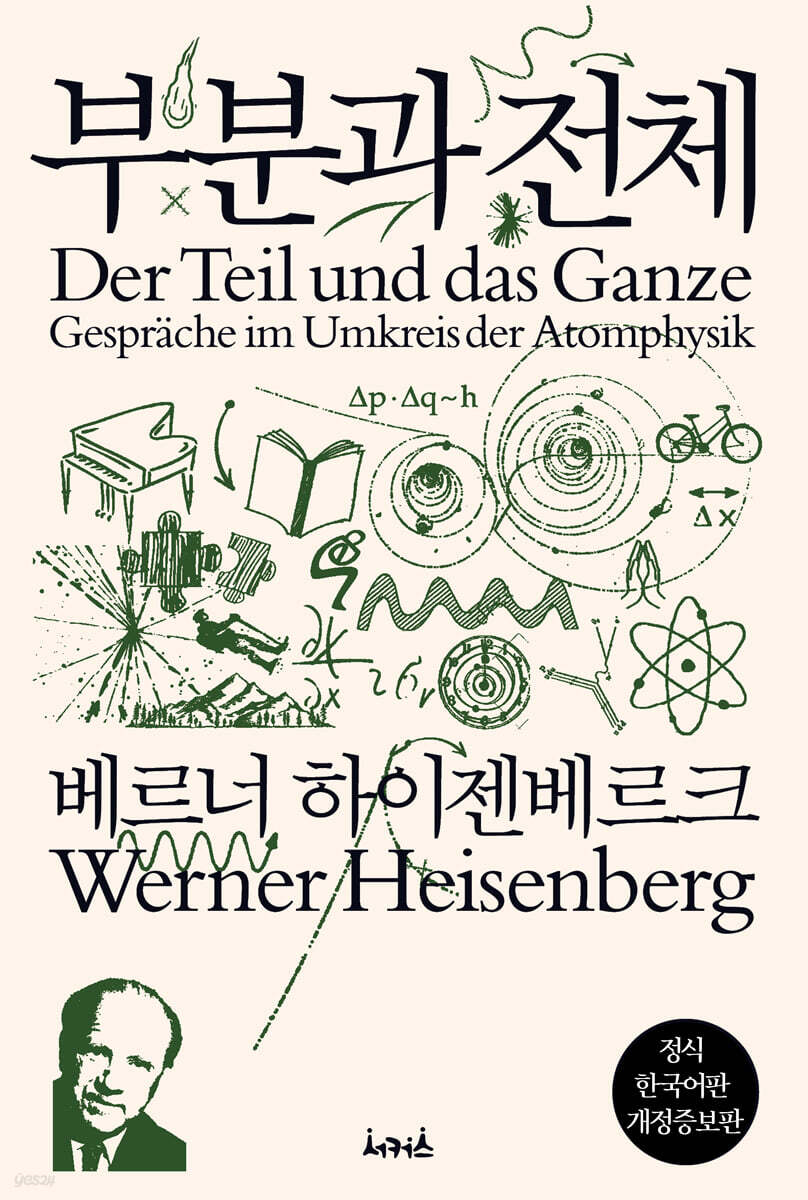
Book Introduction
The official Korean edition of the modern science classic, The Part and the Whole
A first-rate testimony to the golden age of atomic physics from the founder of quantum mechanics.
This is an expanded and revised edition of 『Part and Whole』, a representative scientific classic of our time.
This edition corrects several errors, both major and minor, in the previous edition, and, with the kind permission of the Nobel Foundation, includes the Nobel lecture given by Heisenberg, winner of the 1932 Nobel Prize in Physics.
In this lecture, titled “The Development of Quantum Mechanics,” Heisenberg revealed that his research in quantum mechanics was born from the process of refining Bohr’s correspondence principle and extending it into a perfect mathematical formula for discontinuous phenomena that could not be explained by classical physics. He predicted that quantum mechanics would produce surprising results in both atomic physics and cosmic radiation in the future.
And I thought that in order to understand the nature of quantum mechanics, we would have to give up more possibilities for visualization and objectification.
From the perspective of today, when quantum mechanics is accepted as an axiom of physics, Heisenberg's Nobel lecture, "The Development of Quantum Mechanics," which concludes with a detailed explanation of his own quantum mechanics and an optimistic outlook that quantum mechanics will be harmoniously integrated into the vast body of knowledge called science, will be a very interesting resource for specialists.
"The Part and the Whole" is the academic autobiography of Werner Heisenberg, winner of the Nobel Prize in Physics for his contribution to the creation of quantum mechanics.
Beyond the academic career of a single scientist, this book is also a first-class record of the golden age of atomic physics. It is densely filled with the characters and anecdotes of the countless geniuses who participated in the development of quantum mechanics, which revolutionized our understanding of the microscopic world of atoms.
Niels Bohr, a prophetic yet humorous mentor; Wolfgang Pauli, a mathematical genius who published a paper on the theory of relativity as a teenager; Einstein, who stimulated the imagination of scientists with the theory of relativity; Max Planck, the spiritual leader of the German scientific community famous for Planck's constant; Schrödinger, who formalized the difficult problem of quantum mechanics into elegant mathematics; and Heisenberg, the author who feels a sense of wonder at the "abundant mathematical structures that nature has unfolded in its depths" through "The Light from Helgoland" - these discussions and conversations by the greatest geniuses of 20th century science, as well as various thought experiments on new theories, vividly show the process through which an academic discipline is born.
In addition to the development of quantum mechanics, this book also addresses a variety of human, philosophical, and political issues, no less than scientific ones.
Natural science is easily thought of as dealing with objective facts, but Heisenberg's uncertainty principle and Niels Bohr's complementarity principle themselves prove that the concept of material objects independent of the observing subject is nothing more than an idealistic inference.
Therefore, Heisenberg emphasizes that science is not separate from the overall activities of the human mind, such as religion, history, philosophy, and literature, but is closely connected with them.
In Heisenberg's criticism of the logical positivism that believes only in strictly scientific statements and rejects scientifically meaningless metaphysical statements, readers see that he stands in direct opposition to what is called scientism.
Heisenberg also states in the preface that one of his intentions in writing this book was to show that natural science is inseparably linked to the general problems of spiritual science.
The development of quantum mechanics has led to a reexamination of existing concepts in mental science.
The uncertainty principle shook Kant's absolute belief in causality, led Einstein to protest that "God does not play dice," and even after quantum mechanics was accepted as an axiom of physics like Newtonian mechanics and special relativity, it ultimately forced him to accept quantum mechanics only provisionally.
New knowledge about the microscopic atomic world beyond the realm of human experience now poses fundamental questions to all disciplines about what it means to "understand."
Heisenberg said that learning is something people do and that learning is born through conversations with people.
Emphasizing this obvious and self-evident premise at the beginning of the book, the entire book is structured as a conversation between such people, showing how scholarly activity is carried out.
His fascinating and thoughtful reflections on religion, philosophy, history, and politics, including his academic activities and his thoughts on the political issues of his time—Hitler's rise to power, the two world wars, and the development of the atomic bomb—offer a moving encounter between scientific thought and complex reality.
This official Korean edition of 『Part and Whole』 has been meticulously translated from the latest German original, reviewed by a specialist scholar, and footnotes have been added to aid understanding of the content.
I tried to explain unfamiliar physics and philosophical terms in as much layman's terms as possible to help with understanding, and I increased readability by using a writing style that brings out the vivid content of the conversation.
Through the introduction, I attempted to supplement the overall theme with other aspects of the author Heisenberg's life that were omitted from the book, and included a chronological overview of the general development of quantum mechanics.
For those who want to think about the world we live in, the world that surrounds us, the world we live in, and the lives we live in and the world we influence, this book will serve as a solid guide to learning, thinking, and life.
A first-rate testimony to the golden age of atomic physics from the founder of quantum mechanics.
This is an expanded and revised edition of 『Part and Whole』, a representative scientific classic of our time.
This edition corrects several errors, both major and minor, in the previous edition, and, with the kind permission of the Nobel Foundation, includes the Nobel lecture given by Heisenberg, winner of the 1932 Nobel Prize in Physics.
In this lecture, titled “The Development of Quantum Mechanics,” Heisenberg revealed that his research in quantum mechanics was born from the process of refining Bohr’s correspondence principle and extending it into a perfect mathematical formula for discontinuous phenomena that could not be explained by classical physics. He predicted that quantum mechanics would produce surprising results in both atomic physics and cosmic radiation in the future.
And I thought that in order to understand the nature of quantum mechanics, we would have to give up more possibilities for visualization and objectification.
From the perspective of today, when quantum mechanics is accepted as an axiom of physics, Heisenberg's Nobel lecture, "The Development of Quantum Mechanics," which concludes with a detailed explanation of his own quantum mechanics and an optimistic outlook that quantum mechanics will be harmoniously integrated into the vast body of knowledge called science, will be a very interesting resource for specialists.
"The Part and the Whole" is the academic autobiography of Werner Heisenberg, winner of the Nobel Prize in Physics for his contribution to the creation of quantum mechanics.
Beyond the academic career of a single scientist, this book is also a first-class record of the golden age of atomic physics. It is densely filled with the characters and anecdotes of the countless geniuses who participated in the development of quantum mechanics, which revolutionized our understanding of the microscopic world of atoms.
Niels Bohr, a prophetic yet humorous mentor; Wolfgang Pauli, a mathematical genius who published a paper on the theory of relativity as a teenager; Einstein, who stimulated the imagination of scientists with the theory of relativity; Max Planck, the spiritual leader of the German scientific community famous for Planck's constant; Schrödinger, who formalized the difficult problem of quantum mechanics into elegant mathematics; and Heisenberg, the author who feels a sense of wonder at the "abundant mathematical structures that nature has unfolded in its depths" through "The Light from Helgoland" - these discussions and conversations by the greatest geniuses of 20th century science, as well as various thought experiments on new theories, vividly show the process through which an academic discipline is born.
In addition to the development of quantum mechanics, this book also addresses a variety of human, philosophical, and political issues, no less than scientific ones.
Natural science is easily thought of as dealing with objective facts, but Heisenberg's uncertainty principle and Niels Bohr's complementarity principle themselves prove that the concept of material objects independent of the observing subject is nothing more than an idealistic inference.
Therefore, Heisenberg emphasizes that science is not separate from the overall activities of the human mind, such as religion, history, philosophy, and literature, but is closely connected with them.
In Heisenberg's criticism of the logical positivism that believes only in strictly scientific statements and rejects scientifically meaningless metaphysical statements, readers see that he stands in direct opposition to what is called scientism.
Heisenberg also states in the preface that one of his intentions in writing this book was to show that natural science is inseparably linked to the general problems of spiritual science.
The development of quantum mechanics has led to a reexamination of existing concepts in mental science.
The uncertainty principle shook Kant's absolute belief in causality, led Einstein to protest that "God does not play dice," and even after quantum mechanics was accepted as an axiom of physics like Newtonian mechanics and special relativity, it ultimately forced him to accept quantum mechanics only provisionally.
New knowledge about the microscopic atomic world beyond the realm of human experience now poses fundamental questions to all disciplines about what it means to "understand."
Heisenberg said that learning is something people do and that learning is born through conversations with people.
Emphasizing this obvious and self-evident premise at the beginning of the book, the entire book is structured as a conversation between such people, showing how scholarly activity is carried out.
His fascinating and thoughtful reflections on religion, philosophy, history, and politics, including his academic activities and his thoughts on the political issues of his time—Hitler's rise to power, the two world wars, and the development of the atomic bomb—offer a moving encounter between scientific thought and complex reality.
This official Korean edition of 『Part and Whole』 has been meticulously translated from the latest German original, reviewed by a specialist scholar, and footnotes have been added to aid understanding of the content.
I tried to explain unfamiliar physics and philosophical terms in as much layman's terms as possible to help with understanding, and I increased readability by using a writing style that brings out the vivid content of the conversation.
Through the introduction, I attempted to supplement the overall theme with other aspects of the author Heisenberg's life that were omitted from the book, and included a chronological overview of the general development of quantum mechanics.
For those who want to think about the world we live in, the world that surrounds us, the world we live in, and the lives we live in and the world we influence, this book will serve as a solid guide to learning, thinking, and life.
- You can preview some of the book's contents.
Preview
index
introduction
1 First Encounter with Atomic Theory (1919–1920)
2 Decided to study physics (1920)
3 The concept of 'understanding' in modern physics (1920-1922)
4 Lessons on Politics and History (1922–1924)
5 Quantum Mechanics and Conversations with Einstein (1925–1926)
6. The Road to the New World (1926-1927)
7 First Dialogue on the Relationship between Natural Science and Religion (1927)
8 Atomic Physics and Pragmatic Thinking (1929)
9 Dialogue on the Relationship Between Biology, Physics, and Chemistry (1930–1932)
10 Quantum Mechanics and Kantian Philosophy (1930–1932)
11 Conversations on Language (1933)
12 Revolution and University Life (1933)
13 Discussions on the Possibilities of Atomic Technology and Elementary Particles (1935–1937)
14 Individual Behavior in a Political Crisis (1937–1941)
15 Towards a New Beginning (1941-1945)
16 The Scientist's Responsibilities (1945–1950)
17 Positivism, Metaphysics, and Religion (1952)
18 Political and Scientific Debates (1956–1957)
19 Unified Field Theory (1957-1958)
20 Elementary Particles and Platonic Philosophy (1961–1965)
clear
Chronology of Atomic Physics Related to "Part and Whole"
Translator's Note
1 First Encounter with Atomic Theory (1919–1920)
2 Decided to study physics (1920)
3 The concept of 'understanding' in modern physics (1920-1922)
4 Lessons on Politics and History (1922–1924)
5 Quantum Mechanics and Conversations with Einstein (1925–1926)
6. The Road to the New World (1926-1927)
7 First Dialogue on the Relationship between Natural Science and Religion (1927)
8 Atomic Physics and Pragmatic Thinking (1929)
9 Dialogue on the Relationship Between Biology, Physics, and Chemistry (1930–1932)
10 Quantum Mechanics and Kantian Philosophy (1930–1932)
11 Conversations on Language (1933)
12 Revolution and University Life (1933)
13 Discussions on the Possibilities of Atomic Technology and Elementary Particles (1935–1937)
14 Individual Behavior in a Political Crisis (1937–1941)
15 Towards a New Beginning (1941-1945)
16 The Scientist's Responsibilities (1945–1950)
17 Positivism, Metaphysics, and Religion (1952)
18 Political and Scientific Debates (1956–1957)
19 Unified Field Theory (1957-1958)
20 Elementary Particles and Platonic Philosophy (1961–1965)
clear
Chronology of Atomic Physics Related to "Part and Whole"
Translator's Note
Into the book
“If, as you said, it is impossible to clearly describe the internal structure of an atom—if we don’t have a language to talk about that structure—will we ever be able to understand atoms?”
Bohr hesitated for a moment and then said:
"sure.
But at the same time, we will first learn what it means to ‘understand.’”
"It's curious, doesn't this castle feel quite different when you think about Hamlet living here? Physically speaking, it's made of stone, and we admire the way the architects pieced those stones together.
Stone, old green roofs, wooden sculptures inside the church, the castle is like this.
None of this changes when we hear that Hamlet lived here.
But if you are conscious of that fact, this castle becomes a different castle.
Suddenly the walls and the fences start to speak differently.
The castle's courtyard becomes a vast world, and its dark corners remind us of the darkness within the human soul.
We hear the question, 'To be or not to be, that is the question.'"
So by the time the final calculation results came out, it was already close to 3 AM.
The law of conservation of energy was satisfied in all terms—the calculations were satisfactorily solved—and there was no doubt that quantum mechanics, which was about to be fully revealed, was mathematically complete and without contradictions.
The first moment I was so surprised.
It was as if I was looking into the beautiful source hidden deep within the superficial atomic phenomenon.
I almost felt dizzy at the thought of having to trace the rich mathematical structures that nature had unfolded for me from its depths.
I was so excited that I couldn't go to sleep.
“But in principle, it is wrong to try to create a theory based only on observable sizes.
In reality, it's the exact opposite.
In fact, it is the theory that determines what can be observed.
Observation is generally a very complex process.
Therefore, the phenomenon we want to observe first affects our measuring tools.
Then, as a result, a continuous process takes place in these tools, and through detours, it evokes sensory impressions in our consciousness and confirms the results.”
I once again felt how difficult it is to abandon the ideas that have formed the foundation of conventional science and thought.
Einstein devoted his life to studying objective physics, which operates on firm laws independent of us against the backdrop of vast time and space.
The mathematics of theoretical physics had to simulate this objective world, and thereby be able to predict its future behavior.
But now quantum theory claims that when it comes to atoms, there is no objective world in space and time, and that the mathematics of theoretical physics only shows possibilities, not facts.
Einstein was not ready to leave the solid ground he was standing on.
“For example, the concept of complementarity, which Niels Bohr now brings to the forefront in his interpretation of quantum theory, is by no means new in spiritual sciences such as philosophy.
Even though it may not have been clearly stated in words.
But the emergence of such a concept in the natural sciences, which had long championed accuracy, signified a decisive change.
The concept of complementarity shows that the concept of a material object independent of the mode of observation was an idealistic inference that did not correspond to reality.”
“In mathematics, we can distance ourselves internally from the content of the argument.
Ultimately, the content is a play of thought, and we can either engage with it or not.
But religion is a question about ourselves.
It's about our life and death.
There, doctrine becomes the basis of action and, at least indirectly, of existence.
So, you can't just look at it from the outside without any regard.
“Our attitude toward religious matters is also indistinguishable from our position within the human community.”
Niels ended the conversation with a story he liked to tell in such situations.
“A man who lived near our Tisvilde cottage hung a horseshoe in front of his house.
According to superstition, horseshoe crabs bring good luck.
An acquaintance asked him.
'But are you really that superstitious? Do you really believe that horseshoes bring good luck?' He replied,
'Of course I don't believe it.
But they say that even if you don't believe it, it will bring you good luck.'”
I firmly believed that connections in nature were ultimately simple.
I was convinced that nature was made to be understandable, or more appropriately, that our capacity for reasoning was made to be able to understand nature.
The reason I am so sure of this is because of what Robert said when we were walking along the shores of Lake Starnberg.
At that time, Robert said that the ordering force that created nature in all its forms also created our mental structure, that is, the structure of our ability to think.
After dinner, we divided up the work.
Nils did the dishes, I cleaned the stove, and others chopped wood and did other cleanup work.
It was only natural that the sanitary standards of the kitchens of alpine ranches did not reach those of city kitchens.
Niels said of this situation:
“Washing dishes is just like language.
The water is dirty and the dishcloth is dirty, but in the end, you can use this to clean the plates and cups.
The same goes for language.
The concept is unclear and the logic is limited to the areas where it can be applied.
But we can use it to understand nature clearly.”
“In many ways, humans are physically inferior to animals.
My sense of smell isn't as keen, and I can't climb mountains as quickly and safely as a mountain goat.
However, these shortcomings could be offset by controlling a larger area both spatially and temporally.
The development of language was very important here.
Language, and the thinking ability associated with it, unlike other physical abilities, is a skill that develops between individuals, not within them.
Language is something you can only learn from other people.
You could say it's a net spread out among humans.
“We are caught in this net with our thoughts, our cognitive potential.”
“In my view, Hitler has lost all contact with the outside world.
He feels that what other people say is at best an annoying interruption and just turns a deaf ear to it.
All they can do is repeat that they have been mentally corrupted for the past 14 years and that it is time to put the brakes on that corruption.
They are simply making their thoughts come true through violence, firmly believing in absurd things and blocking out all external influences.
They cling tightly to their own ideology and are never prepared to listen to rational protests.
He will now lead Germany into terrible misfortune.”
“There is a widespread pragmatic mindset in the world.
We can see how successful this way of thinking has been in technology, economics, and politics, not just in our own time but historically—just think of Egypt, Rome, and the Anglo-Saxon world.
But in science and art, principled thinking has been much more successful.
It was most boldly implemented in ancient Greece.”
“If world-changing scientific or artistic achievements were born in Germany, such as Hegel and Marx, Planck and Einstein, or in music, Beethoven and Schubert, it was only possible through consistent, principled thinking in relation to the absolute.
When the pursuit of absoluteness submits to form, that is, to cool, logical thinking in science, and to the laws of harmony and counterpoint in music.
Only in this extreme tension can true power be unleashed.
“If you pursue absoluteness and destroy form, that path leads to chaos, as we can see now.”
Bohr hesitated for a moment and then said:
"sure.
But at the same time, we will first learn what it means to ‘understand.’”
"It's curious, doesn't this castle feel quite different when you think about Hamlet living here? Physically speaking, it's made of stone, and we admire the way the architects pieced those stones together.
Stone, old green roofs, wooden sculptures inside the church, the castle is like this.
None of this changes when we hear that Hamlet lived here.
But if you are conscious of that fact, this castle becomes a different castle.
Suddenly the walls and the fences start to speak differently.
The castle's courtyard becomes a vast world, and its dark corners remind us of the darkness within the human soul.
We hear the question, 'To be or not to be, that is the question.'"
So by the time the final calculation results came out, it was already close to 3 AM.
The law of conservation of energy was satisfied in all terms—the calculations were satisfactorily solved—and there was no doubt that quantum mechanics, which was about to be fully revealed, was mathematically complete and without contradictions.
The first moment I was so surprised.
It was as if I was looking into the beautiful source hidden deep within the superficial atomic phenomenon.
I almost felt dizzy at the thought of having to trace the rich mathematical structures that nature had unfolded for me from its depths.
I was so excited that I couldn't go to sleep.
“But in principle, it is wrong to try to create a theory based only on observable sizes.
In reality, it's the exact opposite.
In fact, it is the theory that determines what can be observed.
Observation is generally a very complex process.
Therefore, the phenomenon we want to observe first affects our measuring tools.
Then, as a result, a continuous process takes place in these tools, and through detours, it evokes sensory impressions in our consciousness and confirms the results.”
I once again felt how difficult it is to abandon the ideas that have formed the foundation of conventional science and thought.
Einstein devoted his life to studying objective physics, which operates on firm laws independent of us against the backdrop of vast time and space.
The mathematics of theoretical physics had to simulate this objective world, and thereby be able to predict its future behavior.
But now quantum theory claims that when it comes to atoms, there is no objective world in space and time, and that the mathematics of theoretical physics only shows possibilities, not facts.
Einstein was not ready to leave the solid ground he was standing on.
“For example, the concept of complementarity, which Niels Bohr now brings to the forefront in his interpretation of quantum theory, is by no means new in spiritual sciences such as philosophy.
Even though it may not have been clearly stated in words.
But the emergence of such a concept in the natural sciences, which had long championed accuracy, signified a decisive change.
The concept of complementarity shows that the concept of a material object independent of the mode of observation was an idealistic inference that did not correspond to reality.”
“In mathematics, we can distance ourselves internally from the content of the argument.
Ultimately, the content is a play of thought, and we can either engage with it or not.
But religion is a question about ourselves.
It's about our life and death.
There, doctrine becomes the basis of action and, at least indirectly, of existence.
So, you can't just look at it from the outside without any regard.
“Our attitude toward religious matters is also indistinguishable from our position within the human community.”
Niels ended the conversation with a story he liked to tell in such situations.
“A man who lived near our Tisvilde cottage hung a horseshoe in front of his house.
According to superstition, horseshoe crabs bring good luck.
An acquaintance asked him.
'But are you really that superstitious? Do you really believe that horseshoes bring good luck?' He replied,
'Of course I don't believe it.
But they say that even if you don't believe it, it will bring you good luck.'”
I firmly believed that connections in nature were ultimately simple.
I was convinced that nature was made to be understandable, or more appropriately, that our capacity for reasoning was made to be able to understand nature.
The reason I am so sure of this is because of what Robert said when we were walking along the shores of Lake Starnberg.
At that time, Robert said that the ordering force that created nature in all its forms also created our mental structure, that is, the structure of our ability to think.
After dinner, we divided up the work.
Nils did the dishes, I cleaned the stove, and others chopped wood and did other cleanup work.
It was only natural that the sanitary standards of the kitchens of alpine ranches did not reach those of city kitchens.
Niels said of this situation:
“Washing dishes is just like language.
The water is dirty and the dishcloth is dirty, but in the end, you can use this to clean the plates and cups.
The same goes for language.
The concept is unclear and the logic is limited to the areas where it can be applied.
But we can use it to understand nature clearly.”
“In many ways, humans are physically inferior to animals.
My sense of smell isn't as keen, and I can't climb mountains as quickly and safely as a mountain goat.
However, these shortcomings could be offset by controlling a larger area both spatially and temporally.
The development of language was very important here.
Language, and the thinking ability associated with it, unlike other physical abilities, is a skill that develops between individuals, not within them.
Language is something you can only learn from other people.
You could say it's a net spread out among humans.
“We are caught in this net with our thoughts, our cognitive potential.”
“In my view, Hitler has lost all contact with the outside world.
He feels that what other people say is at best an annoying interruption and just turns a deaf ear to it.
All they can do is repeat that they have been mentally corrupted for the past 14 years and that it is time to put the brakes on that corruption.
They are simply making their thoughts come true through violence, firmly believing in absurd things and blocking out all external influences.
They cling tightly to their own ideology and are never prepared to listen to rational protests.
He will now lead Germany into terrible misfortune.”
“There is a widespread pragmatic mindset in the world.
We can see how successful this way of thinking has been in technology, economics, and politics, not just in our own time but historically—just think of Egypt, Rome, and the Anglo-Saxon world.
But in science and art, principled thinking has been much more successful.
It was most boldly implemented in ancient Greece.”
“If world-changing scientific or artistic achievements were born in Germany, such as Hegel and Marx, Planck and Einstein, or in music, Beethoven and Schubert, it was only possible through consistent, principled thinking in relation to the absolute.
When the pursuit of absoluteness submits to form, that is, to cool, logical thinking in science, and to the laws of harmony and counterpoint in music.
Only in this extreme tension can true power be unleashed.
“If you pursue absoluteness and destroy form, that path leads to chaos, as we can see now.”
---From the text
GOODS SPECIFICS
- Date of issue: June 15, 2023
- Page count, weight, size: 504 pages | 574g | 128*190*35mm
- ISBN13: 9791187295686
- ISBN10: 118729568X
You may also like
카테고리
korean


korean

![GQ KOREA Mark (Monthly): December [2025]](http://librairie.coreenne.fr/cdn/shop/files/8ef265dbbfbf186523ed75ba7319009d.jpg?v=1765340328&width=3840)


