

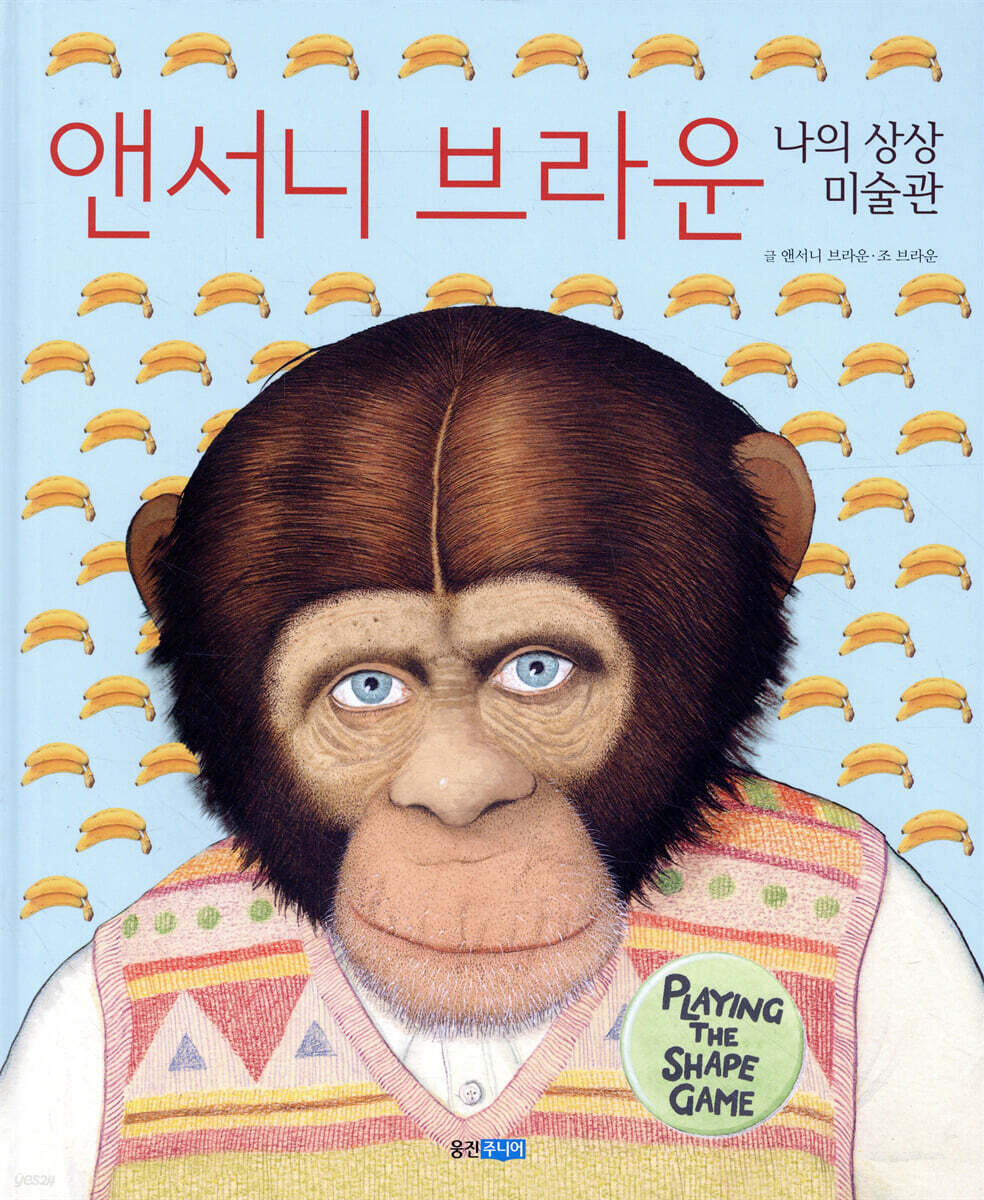
Anthony Browne's Museum of My Imagination
 |
Description
Book Introduction
Anthony Browne, the best British illustrator and winner of the Andersen Award!
He talks about how to read his own paintings, his life as an artist, and what he keeps in mind when drawing.
A book that contains everything about Anthony Browne, a subject that is usually difficult to access!
Anthony Browne! He is a master of children's books, having won the Hans Christian Andersen Award, the highest honor bestowed on children's authors, and the Kate Greenaway Medal, given annually to the best picture book published in the UK, twice.
He is the author most wanted to meet by Korean mothers and the number one power writer selected by children's book editors in Korea. In this book, he begins to tell stories about his life and picture books that he has never told before.
Anthony Brown, who was an ordinary child when he was young, vividly tells the story of how he became a picture book author, and the symbols and meanings in his works that we had not yet discovered.
We also introduce Anthony Browne's method of making picture books.
The book is presented in drawings and photographs, including several sketches that have never been made public and kept hidden, as well as the appearance of early dummy books and early characters.
The process of discovering how ordinary pictures are transformed into special and new stories is fascinating, and you will come to realize the serious and deep meaning contained in Anthony Browne's picture books that you would only read to your children without thinking.
In particular, it is said that the secret that allowed him to create over 40 masterpiece picture books was 'Playing the Shape Game'.
It is said to be a game in which one uses imagination to complete an abstract shape of a somewhat unclear form into a shape that everyone can recognize.
Anthony Browne admits that he got and developed the ideas for his picture books through his childhood play.
This game, which I'm sure children all over the world are already enjoying, is also a great tool for sparking imagination and creativity.
What is the meaning of family, which is often used as a theme in fairy tales, and why do gorillas appear so often?
In the book, you can meet a young boy named Anthony.
Anthony Brown was said to be an ordinary child who loved to draw and play rugby.
Anthony Browne's idol and influence must have been his father, who was a boxer but also loved drawing and acting, and his older brother, an all-round sportsman who spent all his childhood with him.
The sudden death of his idolized father led Anthony Browne into rebellion and existentialist thinking, but he still retained the love and affection of his family.
He conveys a message about family to children through various family stories.
The families that appear in Anthony Browne's works, such as [Pig Book], [Gorilla], [My Mom], and [My Brother], may seem somewhat lacking and unstable (especially the father), but if you look closely, they are all the other sides of families.
Through numerous works dealing with family, he tells children about the warmth and love of family.
You can also hear the author's answer to the question of why gorillas appear in the book.
- You can preview some of the book's contents.
Preview
index
prolog
Chapter 01 My Childhood
Chapter 02 Art College Days
Chapter 03 Medical Illustration and Card Design
Chapter 04 My First Picture Book
- Into the Mirror, Let's Be Friends, The Little Bear Meets the Hunter, Hansel and Gretel
Chapter 05 Gorilla, King Kong, and Willy
-Gorilla, Cowardly Willie, King Kong, Willie and Hugh
Chapter 06 Family Story Trilogy
-Pig Book, Zoo, My Dad is the Best, My Mom, My Brother
Chapter 07 Theme and Variations of My Picture Book
-It'll change. Tunnel
Chapter 08 Every picture tells a story
-Willy Dreaming · Willy Goes to the Art Museum
Chapter 09 How to Make a Picture Book
-Stories from the Park·Anthony Brown's Happy Art Museum
Chapter 10 Other People's Writings My Drawings
- Special Guests, Peter's Bizarre Dreams, Alice in Wonderland
Chapter 11 Things I learned from my travels
Chapter 12: Picture Book of Old Stories
-Into the forest, we are friends, you and me
Chapter 13 Shape Imagination Play
Detailed image

Into the book
It was Julia who taught me the essential lesson about picture books: to leave space between the pictures and the text.
The idea was that pictures should not simply be a visual reflection of the events described in the text.
The space between text and pictures should be left for the reader's imagination to fill in.
--- From "My First Picture Book"
Children live in a world dominated by adults.
In this world, children are often small, weak, sometimes ignorant, and powerless, being manipulated by older siblings, parents, and teachers.
Willy is definitely the most popular character in my books, and I have received hundreds of letters from young readers who identified with him. ---From "The Gorilla, King Kong, and Willy"
When children ask me how to draw well, I tell them to look closely and do their best.
This is, for me, the most important skill to learn to become an artist.
Great painters are those who have the ability to see the world with open eyes, the ability to see everything before their eyes 'truly'.
---From "Every Picture Tells a Story"
Publisher's Review
Welcome to Anthony Browne's Imagination Museum
Anthony Browne explains "How to Read My Picture Book"
Anthony Browne, a master of picture books who has won the Hans Christian Andersen Award, the highest honor awarded to children's book authors, and twice received the Kate Greenaway Medal, which is given annually to the best picture book published in the UK.
He is the author most wanted to meet by Korean mothers and the number one power writer chosen by children's book editors in Korea. He begins to tell stories about his life and picture books that he has never told before.
This book is an art gallery where all of Anthony Browne's works are displayed.
Anthony Browne becomes a kind curator, guiding readers into the world of his picture books.
Even the most ardent fans of Anthony Browne will be moved to a slap in the face when they hear vivid accounts of the inspiration, process, and intention behind each picture book.
You will discover symbols and meanings in the work that you had not noticed before, and you will be amazed by Anthony Browne's unique ideas and exquisite satire.
This book will serve as an excellent guide for parents of young children.
The moment you realize that such a serious and meaningful story is hidden in Anthony Browne's picture books that you used to just read to your child, you will want to open the books again and read them to your child so that he or she can feel the power of living imagination.
[Anthony Brown's Imagination Museum] also includes Anthony Brown's method of making picture books.
The book includes several sketches that were never made public and kept hidden, as well as illustrations and photographs of the early dummy books and their early characters, piquing readers' interest.
For general readers, it will be a fascinating experience to learn how picture books are created, and for those studying picture books or aspiring writers, it will be an opportunity to learn the know-how of a master of picture books.
“I’ll introduce you to how to read my picture book.”
This book introduces Anthony Brown's method of viewing picture books.
If you understand how the work was written, what the process was, and what the intention was, you can understand how to view the picture book.
Also, let's enjoy the fun of finding and learning about the common characteristics of his works.
Let's dissect the shape imagination game.
What is the secret that allowed Anthony Browne to create over 40 masterpiece picture books? The secret lies in 'Playing the Shape Game.'
It is a game where you use your imagination to create abstract shapes that are somewhat unclear and complete them into shapes that everyone can recognize.
Anthony Browne admits that he got and developed the ideas for his picture books through his childhood play.
I'm sure children all over the world are already enjoying it.
This game is a great tool to spark imagination and creativity.
The 'deformation' commonly seen in his works is also an example of the development of the play of imaginative shapes.
[Anthony Brown's Happy Museum] [It Will Change] is a work that fully displays this form of imaginative play.
The process of discovering how an ordinary picture is transformed into a special and new story is very interesting.
Don't miss the background details
One of the hallmarks of his work is the hidden jokes and small details in the background.
These details provide the pleasure of finding hidden stories in ordinary scenes, and also serve as tools to provide subtle hints to the progression of the story.
It also provides insight into the protagonist's mind, allowing us to understand additional meanings.
In an interview with BBC2, Anthony Browne answered the question, “Why do you paint hidden content in your paintings?”
Hidden details reflect the way children see the world.
Doesn't the advanced imagination of children make even the most ordinary things seem new and unfamiliar?
-Chapter 4 From my first picture book
Just as surrealists create new and unusual dreamlike worlds by placing unfamiliar objects in ordinary environments, the details of the paintings reflect children's perspectives on the world.
Let's play a game of find the difference
Readers who love Anthony Browne's picture books often find themselves drawn to another picture-finding game.
The author hid the story that he could not tell in the text.
The joy of finding that picture is a special and unique gift that can only be found in Anthony Browne's picture books.
All his paintings tell a story.
Even if it is not explained in the text, the storytelling function of the pictures is fully utilized, enriching the picture book.
A famous painting tells another story
Let's compare Anthony Browne's frequently cited masterpieces with actual masterpieces.
In [Dreaming Willie], the portraits of Van Dyck and works by Gainsborough are paintings that the author carefully selected to foreshadow the story.
The scene where Willy desperately tries to escape but fails in the scene where Balungo is chasing him resembles De Chirico's [The Poet's Uncertainty].
In this way, the author applies the stories and meanings of famous paintings to picture books, allowing children to enjoy the emotions that famous paintings give.
[Anthony Browne's Happy Art Museum] and [Willy Goes to the Art Museum] are books that directly introduce works of art so that children can more easily approach famous paintings.
Among the works cited, the fact that there are many works by Salvador, unlike René Magritte, shows that he was greatly influenced by surrealist painters.
The author said that if children are more impressed by a masterpiece after seeing it in his book, his intention will have been successful.
“I’ll teach you how to make a picture book in the Anthony Browne style.”
What does Anthony Browne's studio look like? How does he create such interesting and unique picture books? Let's take a look at the artist's entire process, from the initial idea to the book itself, through [Anthony Browne's Museum of My Imagination].
How to get ideas
Anthony Browne is said to have realized that trying to force ideas artificially was a futile effort.
While many people sit at their desks and brainstorm ideas, Anthony Browne waits for them to come naturally.
Then, let the idea pieces ripen in your head and then make them concrete.
These ideas come from my childhood, my family, and various recent experiences and travels.
In the case of [our brother], when he visited a Dutch school, he saw [our mother] and got hints from the work the children made.
[Anthony Browne's Happy Museum] was created as a result of a museum workshop with children at the Tate Gallery, and [Wimpy Billy] was born when he gave his mother a worry doll he received as a gift from a reader during a trip to South America.
Start like a film director
Bringing ideas to life is done in the same way as a film director.
Just as a film director creates a storyboard to plan the flow, composition, and direction of the visual image, Anthony Browne also designs the scenes of the story in the form of a storyboard, much like an animation.
After composing the scene according to the flow of time, think about the pictures and text together.
Creating a storyboard allows you to see both text and pictures at the same time.
Storyboarding is very important to Anthony Browne, who values the relationship between text and images and the space between them.
Afterwards, cut out the frame and make a stack of picture books up to page 32.
I discuss this dummy book with my editor and share ideas on how to improve the text, layout, and overall rhythm.
Discuss and discuss, revise and revise
Just because you make it with a dummy book doesn't mean it's a finished picture book.
The idea may be perfect, but the work may not go well, and you may have to go through several revisions while exchanging opinions with the editor.
[Pig Book] was the most long-term project among the books he created.
Although the initial idea was satisfactory, as the work progressed, the dummy book became less satisfactory.
In the end, I had to put it in a drawer for a long time, stop working on it, and then take it out again after a long time before I could finish the picture book.
Attitude toward other writers' writing
Anthony Browne also illustrated books written by other authors.
He tries to help the story with pictures.
Most writers want their illustrations to capture the most dramatic and grand moments in their stories.
Since these are paragraphs that have been described in great detail with the utmost care, I hope that they will be supplemented with pictures.
But Anthony Browne doesn't draw pictures of such paragraphs for that very reason.
He states the reason in the book as follows:
The author has already said everything in words, so why does he have to draw pictures?
Rather than perfectly completing the description, drawings in this area tend to distract the reader's attention from the drawing, thus diminishing the effort the author put into the description.
I believe that any illustration should follow the less obvious moments and visualize them.
-Chapter 10 Other People's Writings My Drawings
“My childhood, my family…the source of my picture books.”
The story of his journey from childhood to becoming a picture book author is a special exhibition that can only be found in this book.
All of the author's experiences are reflected in his work.
Examining the author's life provides a basic foundation for understanding the work.
Talking about the meaning of family
[Anthony Brown My Imagination Museum] features a young boy named Anthony.
Anthony Brown was an ordinary high school student who loved to draw and play rugby.
Anthony Browne's idols and influences were his father, who was a boxer but also enjoyed drawing and acting, and his older brother, an all-round sportsman who spent all his childhood with him.
The sudden death of his idolized father led Anthony Browne into rebellion and existentialist thinking, but he still retains the love and affection of his family.
He conveys a message about family to children through various family stories.
The families that appear in Anthony Browne's works, such as [Pig Book], [Gorilla], [Our Mom], and [Our Brother], may seem somewhat lacking and unstable (especially the father), but if you look closely, they are all the other sides of families.
Through numerous works dealing with family, he tells children about the warmth and love of family.
The Unusual Careers That Guided Us to Becoming a Children's Book Writer
After graduating from art school, Anthony Brown worked as a medical illustrator drawing human anatomy diagrams.
The idea was to go into the operating room, quickly sketch the complex surgical procedure, and then draw it in detail and in great detail so that it could be recognized.
Anthony Browne says that during this period, the technique of detailing was refined and there were tremendous technical advances.
Not only did I become a skilled drawing expert, I also learned how to tell difficult stories.
Also, during the time when I was wandering about becoming an artist, I drew pictures for greeting cards.
I was able to learn various painting styles and how to communicate with the public.
These experiences helped me build strong muscles to become a picture book illustrator.
To meet the need to diversify design, I was able to broaden my painting style considerably.
During this time, I became a more versatile illustrator.
Looking at some of the cards I made back then makes me cringe, but those cards were the guides that led me straight to children's books.
- Among medical illustrations and card designs
GOODS SPECIFICS
- Date of issue: April 25, 2011
- Format: Hardcover book binding method guide
- Page count, weight, size: 238 pages | 1,224g | 240*280*20mm
- ISBN13: 9788901121314
- ISBN10: 890112131X
You may also like
카테고리
korean


korean


