

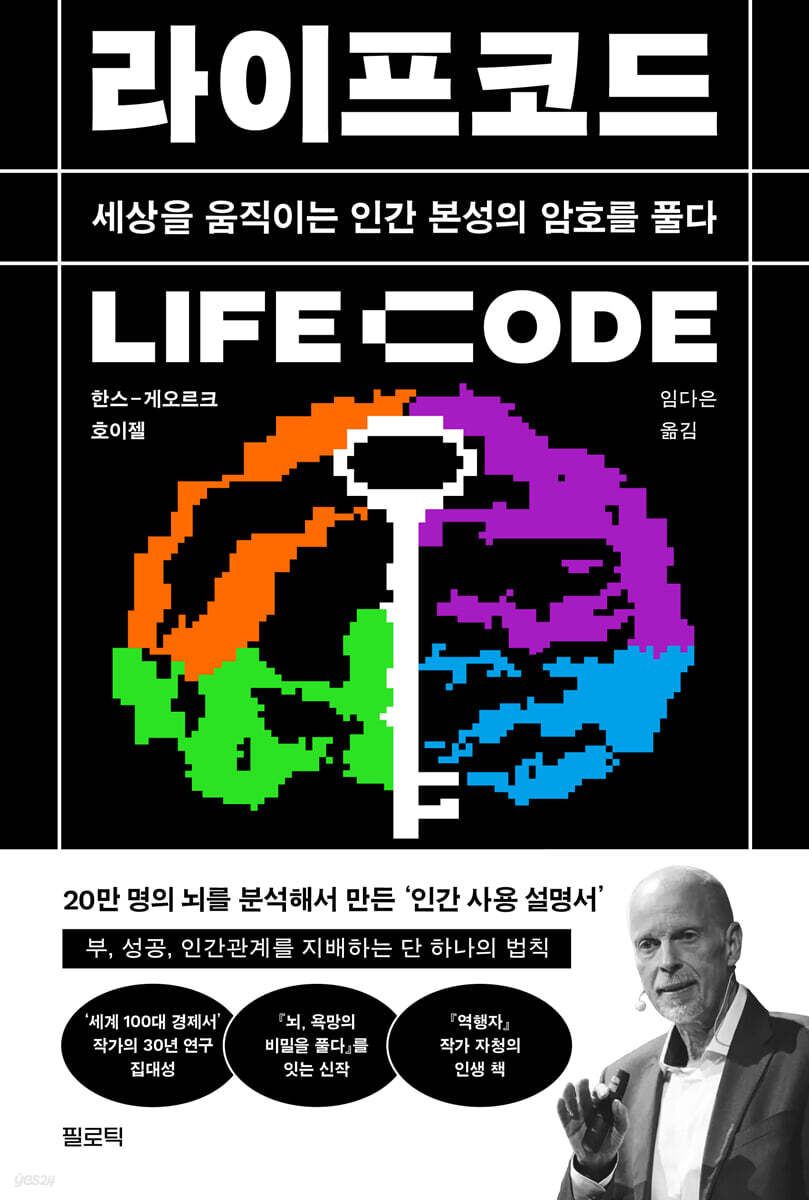
LIFE Code
 |
Description
Book Introduction
Porsche and BMW are already using it!
A "Human User Manual" Proven with Brain Data from 200,000 People
A book has been published by Dr. Hans-Georg Heusel, a leading German authority on neuromarketing, culminating in 30 years of brain science research.
Having captivated readers in 27 countries around the world with his book, "The Brain, Unraveling the Secrets of Desire," he now delves into the secrets of human nature that permeate our entire lives, beyond marketing.
Why do we keep making the same mistakes? Why do we always argue with our loved ones for the same reasons? Why do some people get promoted while I stay the same, despite the same efforts? Knowing money isn't everything, why do we go from heaven to hell based on our bank balances? Dr. Heusel analyzed the brains of 200,000 people and discovered a common principle underlying all these phenomena.
This book clearly explains everything in the world, from personal anxiety and human wars to personality differences, political conflicts, and even economic phenomena, through its principles.
The LifeCode discovered by Dr. Heusel is already being used as a standard for management strategies by global companies such as Porsche, BMW, and Lufthansa.
This book, which business influencer Ja-Cheong praised as "a life book that gave me the ability to read people's minds," serves as a psychological compass for those who have had difficulty understanding the minds of others, and is a key to self-analysis that finds the roots of irrational behavior that one regrets but repeats.
Furthermore, it presents relationship skills to effectively persuade others and reduce conflict.
A "Human User Manual" Proven with Brain Data from 200,000 People
A book has been published by Dr. Hans-Georg Heusel, a leading German authority on neuromarketing, culminating in 30 years of brain science research.
Having captivated readers in 27 countries around the world with his book, "The Brain, Unraveling the Secrets of Desire," he now delves into the secrets of human nature that permeate our entire lives, beyond marketing.
Why do we keep making the same mistakes? Why do we always argue with our loved ones for the same reasons? Why do some people get promoted while I stay the same, despite the same efforts? Knowing money isn't everything, why do we go from heaven to hell based on our bank balances? Dr. Heusel analyzed the brains of 200,000 people and discovered a common principle underlying all these phenomena.
This book clearly explains everything in the world, from personal anxiety and human wars to personality differences, political conflicts, and even economic phenomena, through its principles.
The LifeCode discovered by Dr. Heusel is already being used as a standard for management strategies by global companies such as Porsche, BMW, and Lufthansa.
This book, which business influencer Ja-Cheong praised as "a life book that gave me the ability to read people's minds," serves as a psychological compass for those who have had difficulty understanding the minds of others, and is a key to self-analysis that finds the roots of irrational behavior that one regrets but repeats.
Furthermore, it presents relationship skills to effectively persuade others and reduce conflict.
- You can preview some of the book's contents.
Preview
index
Recommendation
Introduction - The Worst Mistake a Neuroscientist Can Make
index
Part 1.
What moves you
Chapter 1: The Real Master Who Lives in Your Brain
Chapter 2.
Who Really Controls Your Choices?
Chapter 3.
The Four Desires That Move Humans
Chapter 4.
Why are we never satisfied?
Chapter 5.
Happiness lies between the accelerator and the brakes.
Part 2.
Why do we live differently?
Chapter 6.
A Personality User Manual for Me and Others
Chapter 7.
Your salary and hospital bills are already set.
Chapter 8.
Personality Modification: What You Can and Can't Change
Chapter 9.
Her secret that even her husband of 40 years didn't know
Chapter 10.
Time changes everything eventually.
Chapter 11.
Profiling technology that penetrates your psychology in just 5 minutes
(Take a break) Germans are cowards, Americans are adventurers?
Part 3.
How the world works
Chapter 12.
Money, the drug the brain craves
Chapter 13.
The Invisible Psychology That Opens Your Wallet
Chapter 14.
Why is the music my friend recommends so bad?
Chapter 15.
Why do politicians always fight?
Chapter 16.
Apple innovates every day, the church innovates once every 100 years.
Chapter 17.
The final key you need to understand the Life Code
Introduction - The Worst Mistake a Neuroscientist Can Make
index
Part 1.
What moves you
Chapter 1: The Real Master Who Lives in Your Brain
Chapter 2.
Who Really Controls Your Choices?
Chapter 3.
The Four Desires That Move Humans
Chapter 4.
Why are we never satisfied?
Chapter 5.
Happiness lies between the accelerator and the brakes.
Part 2.
Why do we live differently?
Chapter 6.
A Personality User Manual for Me and Others
Chapter 7.
Your salary and hospital bills are already set.
Chapter 8.
Personality Modification: What You Can and Can't Change
Chapter 9.
Her secret that even her husband of 40 years didn't know
Chapter 10.
Time changes everything eventually.
Chapter 11.
Profiling technology that penetrates your psychology in just 5 minutes
(Take a break) Germans are cowards, Americans are adventurers?
Part 3.
How the world works
Chapter 12.
Money, the drug the brain craves
Chapter 13.
The Invisible Psychology That Opens Your Wallet
Chapter 14.
Why is the music my friend recommends so bad?
Chapter 15.
Why do politicians always fight?
Chapter 16.
Apple innovates every day, the church innovates once every 100 years.
Chapter 17.
The final key you need to understand the Life Code
Detailed image

Into the book
We believe we make rational choices based on objective facts, but in reality, emotions and expectations often set the tone, and reason simply adds plausible justifications.
This shocking claim has been repeatedly confirmed by modern brain science.
More than 70% of the decisions we make are made unconsciously.
No matter how conservatively we estimate, this figure will not fall below 50%.
Some researchers claim that this percentage is as high as 95%.
At this point, we may have to rewrite Aristotle's proposition that "man is a rational animal."
We are much more emotional beings than we think.
Rational decisions are just the tip of the iceberg.
We are only aware of the small part that appears above the surface, while a huge mass of emotions controls everything beneath the surface.
--- "Chapter 1: The Real Master Who Lives Hidden in Your Brain"
A cold beer after working overtime.
At that moment, all fatigue disappears.
One boring weekend afternoon, I stumble upon an interesting documentary and lose track of time.
The common thread in all these experiences is clear.
It means moving away from the pain of fatigue and boredom and toward the reward of relief and satisfaction.
Ultimately, all our actions and emotions are a process of carrying out a simple command: 'Pleasure near, pain far away.'
And the four commanders who specifically execute this order are the 'Life Code'.
--- "Chapter 4: Why We Can Never Be Satisfied"
What does that intense desire to party more mean? It could be a defense mechanism to avoid an important lab class the next morning, or it could be a subconscious signal that the lab isn't a good fit for you.
Furthermore, it may be a sign that a "stimulus-seeking" tendency, which is interested in social settings such as parties or entertainment, may manifest itself as greater talent.
Only by deeply reflecting on oneself can one know which is true.
--- "Chapter 5: Happiness lies between the accelerator and the brakes."
Thomas Noll and Pascal Scherrer of the University of St. Gallen in Switzerland conducted a bold study to support this hypothesis.
They compared the elite who control the global financial world with the group of brutal criminals incarcerated in prisons (some of whom were diagnosed as psychopaths), and the results were shocking.
Surprisingly, the financial elite were, on average, more selfish, less empathetic, and more antisocial than the criminals, willing to go to any lengths to achieve their own gain.
--- "Chapter 6: A Personality User's Manual for Myself and Others"
Going to the gym once or twice won't suddenly give you a muscular body.
However, if you exercise consistently, the genes that create muscle are activated and your body begins to change.
The same goes for the spiral of victory.
Repeating small successes trains the confidence muscle in your brain.
Modern science calls this amazing phenomenon epigenetics.
This carries a hopeful message that our genes are not fixed from birth and remain constant throughout our lives, but that our experiences and environments can actually change our genes and transform our lives.
However, there is one crucial condition attached to the spiral of victory.
The thing about accidental success, achieved without any effort, is that it barely flips the switch in the brain.
Only the achievements achieved through overcoming difficulties through one's own will and effort become the most powerful force for changing the brain.
--- "Chapter 8: Personality Modification: What You Can and Can't Change"
Similar results have been repeatedly shown in numerous social psychology experiments.
For example, when making important decisions, groups comprised entirely of men often make decisions that are overly optimistic or underestimate risks, leading to disaster.
This is because potential risk factors are not properly considered or important details are overlooked.
Conversely, groups comprised entirely of women often become overly risk-averse or obsessed with details, which often results in suboptimal outcomes and missed opportunities.
Interestingly, mixed groups with a good mix of men and women often achieve the best results in decision-making.
--- "Chapter 9: Her Secret, Unknown Even to Her Husband of 40 Years"
The high risk-taking and impulsive aggression of young men has unfortunately been all too easily exploited throughout history in countless tragedies such as wars, civil wars, and genocides.
There are three main factors that cause a society to become violent.
ㆍ Poverty and extreme social inequality
ㆍ Ideology that incites hatred toward a specific group
ㆍ High proportion of young men in society as a whole
Gunnar Heinsohn, a German genocide researcher, compared the demographics and potential for conflict in 70 countries.
According to his research, when males between the ages of 15 and 30 make up more than 30 percent of a society's population, the risk of civil war or war increases dramatically with even minor political or economic triggers.
Iraq, Afghanistan, and Syria, which have experienced extreme conflict in recent years, all met or exceeded this standard.
For reference, Germany was very close to this critical figure of 30% at the outbreak of World War I (1914) and World War II (1939).
--- "Chapter 10: Time Changes Everything"
'The bait should suit the fish's taste, not the angler's.'
This old adage captures the essence of persuasion.
We often throw out our favorite bait and lament why the other person doesn't bite.
But the essence of persuasion is not raising my voice, but speaking to the other person in his or her language.
Easy to say, but difficult to do.
This is because everyone sees the world through their own lens, and unconsciously assumes that others have the same perspective as them.
It's fortunate if the other person has a similar life code type to you (e.g., the same emotional domain), but the real problem arises when you meet someone who is completely different from you.
It is not easy for a free-spirited explorer to fathom the mind of a stability-seeker who values stability and order.
--- "Chapter 11: Profiling Techniques that Penetrate Psychology in Just 5 Minutes"
Are you driven by money, or do you lead money?
If you've read this chapter carefully, you'll no longer find yourself thinking simple things like, "The more money the better!" or, "If I only had more money than I have now, I'd be happy!"
The brain quickly adapts to new wealth and immediately seeks out even richer comparisons, creating endless greed and dissatisfaction.
Ultimately, it's not the amount of money you have, but how you use it that matters.
--- "Chapter 12 Money, the Drug the Brain Craves"
Even if the cost of a coffee bean is only 1 cent (about 14 won), if you establish a strong brand image, its value increases sevenfold to 7 cents (about 100 won).
Add to this the special atmosphere of the café, the friendly service of the barista, the special experience you get while drinking coffee, and the feeling that you look cool when you drink a certain brand of coffee, and the value soars to 3.5 euros (about 5,000 won), a whopping 350 times more.
Emotions are the most powerful alchemy for creating money.
--- "Chapter 13: The Invisible Psychology That Opens Your Wallet"
New ideas or styles always feel unfamiliar and uncomfortable when they first appear.
Even Einstein's theory of relativity, which is now common knowledge, caused great confusion in the physics world when it was first announced.
When quantum computing was first proposed, most scientists scoffed, calling it “science fiction.”
Fashion styles that seem ordinary now caused social shock and controversy when they first appeared.
This was the case with the punk style that contained the anger and resistance of young people in the 1970s and the free-spirited hip-hop fashion of the 1990s.
(…) So why do we instinctively reject new things? The balance system is the first of the life codes to emerge, and it plays the most important role.
Because in the past, nothing was more important than safety to survive.
Unfamiliar food could be poisonous, and unfamiliar places could harbor hungry beasts.
Accordingly, the brain has evolved to be wary of new things and to feel rejection.
It is a defense instinct for survival.
--- "Chapter 14: Why Don't I Like the Music My Friends Recommend?"
The problem is that when most people choose their political leanings or the party they support, they do not carefully analyze each of the complex and difficult policies put forward by each party and make rational decisions.
Often decisions are made based on much more primal and emotional responses.
Research shows that voters make their choices based on emotional alignment—"Does this party belong to my group?" or "Does that candidate's ideas resemble mine?"—rather than through careful policy analysis.
So, a child raised in a conservative family is more likely to support the conservative party, and a child raised in a progressive family is more likely to support the progressive party.
--- "Chapter 15: Why Do Politicians Always Fight?"
Apple and the Catholic Church operate in very different ways, but they share a remarkable consistency in their respective life codes.
To call for a halt to innovation within Apple is suicidal, and to demand radical change from the Catholic Church is to deny 2,000 years of identity.
There is no single formula for success.
--- "Chapter 16: Apple Innovates Every Day, the Church Innovates Once a Century"
Humans have the ability to reflect on themselves and the world.
So, here I propose a new human image, that of the “perceptive human,” instead of the myth of the “perfectly rational human.”
An insightful person is someone who recognizes that they are not as rational as they think, understands how emotions work, and is not swayed by them without protection.
This is like the wisdom of a skilled sailor who reads the current and rows the boat instead of trying to stop the waves.
This shocking claim has been repeatedly confirmed by modern brain science.
More than 70% of the decisions we make are made unconsciously.
No matter how conservatively we estimate, this figure will not fall below 50%.
Some researchers claim that this percentage is as high as 95%.
At this point, we may have to rewrite Aristotle's proposition that "man is a rational animal."
We are much more emotional beings than we think.
Rational decisions are just the tip of the iceberg.
We are only aware of the small part that appears above the surface, while a huge mass of emotions controls everything beneath the surface.
--- "Chapter 1: The Real Master Who Lives Hidden in Your Brain"
A cold beer after working overtime.
At that moment, all fatigue disappears.
One boring weekend afternoon, I stumble upon an interesting documentary and lose track of time.
The common thread in all these experiences is clear.
It means moving away from the pain of fatigue and boredom and toward the reward of relief and satisfaction.
Ultimately, all our actions and emotions are a process of carrying out a simple command: 'Pleasure near, pain far away.'
And the four commanders who specifically execute this order are the 'Life Code'.
--- "Chapter 4: Why We Can Never Be Satisfied"
What does that intense desire to party more mean? It could be a defense mechanism to avoid an important lab class the next morning, or it could be a subconscious signal that the lab isn't a good fit for you.
Furthermore, it may be a sign that a "stimulus-seeking" tendency, which is interested in social settings such as parties or entertainment, may manifest itself as greater talent.
Only by deeply reflecting on oneself can one know which is true.
--- "Chapter 5: Happiness lies between the accelerator and the brakes."
Thomas Noll and Pascal Scherrer of the University of St. Gallen in Switzerland conducted a bold study to support this hypothesis.
They compared the elite who control the global financial world with the group of brutal criminals incarcerated in prisons (some of whom were diagnosed as psychopaths), and the results were shocking.
Surprisingly, the financial elite were, on average, more selfish, less empathetic, and more antisocial than the criminals, willing to go to any lengths to achieve their own gain.
--- "Chapter 6: A Personality User's Manual for Myself and Others"
Going to the gym once or twice won't suddenly give you a muscular body.
However, if you exercise consistently, the genes that create muscle are activated and your body begins to change.
The same goes for the spiral of victory.
Repeating small successes trains the confidence muscle in your brain.
Modern science calls this amazing phenomenon epigenetics.
This carries a hopeful message that our genes are not fixed from birth and remain constant throughout our lives, but that our experiences and environments can actually change our genes and transform our lives.
However, there is one crucial condition attached to the spiral of victory.
The thing about accidental success, achieved without any effort, is that it barely flips the switch in the brain.
Only the achievements achieved through overcoming difficulties through one's own will and effort become the most powerful force for changing the brain.
--- "Chapter 8: Personality Modification: What You Can and Can't Change"
Similar results have been repeatedly shown in numerous social psychology experiments.
For example, when making important decisions, groups comprised entirely of men often make decisions that are overly optimistic or underestimate risks, leading to disaster.
This is because potential risk factors are not properly considered or important details are overlooked.
Conversely, groups comprised entirely of women often become overly risk-averse or obsessed with details, which often results in suboptimal outcomes and missed opportunities.
Interestingly, mixed groups with a good mix of men and women often achieve the best results in decision-making.
--- "Chapter 9: Her Secret, Unknown Even to Her Husband of 40 Years"
The high risk-taking and impulsive aggression of young men has unfortunately been all too easily exploited throughout history in countless tragedies such as wars, civil wars, and genocides.
There are three main factors that cause a society to become violent.
ㆍ Poverty and extreme social inequality
ㆍ Ideology that incites hatred toward a specific group
ㆍ High proportion of young men in society as a whole
Gunnar Heinsohn, a German genocide researcher, compared the demographics and potential for conflict in 70 countries.
According to his research, when males between the ages of 15 and 30 make up more than 30 percent of a society's population, the risk of civil war or war increases dramatically with even minor political or economic triggers.
Iraq, Afghanistan, and Syria, which have experienced extreme conflict in recent years, all met or exceeded this standard.
For reference, Germany was very close to this critical figure of 30% at the outbreak of World War I (1914) and World War II (1939).
--- "Chapter 10: Time Changes Everything"
'The bait should suit the fish's taste, not the angler's.'
This old adage captures the essence of persuasion.
We often throw out our favorite bait and lament why the other person doesn't bite.
But the essence of persuasion is not raising my voice, but speaking to the other person in his or her language.
Easy to say, but difficult to do.
This is because everyone sees the world through their own lens, and unconsciously assumes that others have the same perspective as them.
It's fortunate if the other person has a similar life code type to you (e.g., the same emotional domain), but the real problem arises when you meet someone who is completely different from you.
It is not easy for a free-spirited explorer to fathom the mind of a stability-seeker who values stability and order.
--- "Chapter 11: Profiling Techniques that Penetrate Psychology in Just 5 Minutes"
Are you driven by money, or do you lead money?
If you've read this chapter carefully, you'll no longer find yourself thinking simple things like, "The more money the better!" or, "If I only had more money than I have now, I'd be happy!"
The brain quickly adapts to new wealth and immediately seeks out even richer comparisons, creating endless greed and dissatisfaction.
Ultimately, it's not the amount of money you have, but how you use it that matters.
--- "Chapter 12 Money, the Drug the Brain Craves"
Even if the cost of a coffee bean is only 1 cent (about 14 won), if you establish a strong brand image, its value increases sevenfold to 7 cents (about 100 won).
Add to this the special atmosphere of the café, the friendly service of the barista, the special experience you get while drinking coffee, and the feeling that you look cool when you drink a certain brand of coffee, and the value soars to 3.5 euros (about 5,000 won), a whopping 350 times more.
Emotions are the most powerful alchemy for creating money.
--- "Chapter 13: The Invisible Psychology That Opens Your Wallet"
New ideas or styles always feel unfamiliar and uncomfortable when they first appear.
Even Einstein's theory of relativity, which is now common knowledge, caused great confusion in the physics world when it was first announced.
When quantum computing was first proposed, most scientists scoffed, calling it “science fiction.”
Fashion styles that seem ordinary now caused social shock and controversy when they first appeared.
This was the case with the punk style that contained the anger and resistance of young people in the 1970s and the free-spirited hip-hop fashion of the 1990s.
(…) So why do we instinctively reject new things? The balance system is the first of the life codes to emerge, and it plays the most important role.
Because in the past, nothing was more important than safety to survive.
Unfamiliar food could be poisonous, and unfamiliar places could harbor hungry beasts.
Accordingly, the brain has evolved to be wary of new things and to feel rejection.
It is a defense instinct for survival.
--- "Chapter 14: Why Don't I Like the Music My Friends Recommend?"
The problem is that when most people choose their political leanings or the party they support, they do not carefully analyze each of the complex and difficult policies put forward by each party and make rational decisions.
Often decisions are made based on much more primal and emotional responses.
Research shows that voters make their choices based on emotional alignment—"Does this party belong to my group?" or "Does that candidate's ideas resemble mine?"—rather than through careful policy analysis.
So, a child raised in a conservative family is more likely to support the conservative party, and a child raised in a progressive family is more likely to support the progressive party.
--- "Chapter 15: Why Do Politicians Always Fight?"
Apple and the Catholic Church operate in very different ways, but they share a remarkable consistency in their respective life codes.
To call for a halt to innovation within Apple is suicidal, and to demand radical change from the Catholic Church is to deny 2,000 years of identity.
There is no single formula for success.
--- "Chapter 16: Apple Innovates Every Day, the Church Innovates Once a Century"
Humans have the ability to reflect on themselves and the world.
So, here I propose a new human image, that of the “perceptive human,” instead of the myth of the “perfectly rational human.”
An insightful person is someone who recognizes that they are not as rational as they think, understands how emotions work, and is not swayed by them without protection.
This is like the wisdom of a skilled sailor who reads the current and rows the boat instead of trying to stop the waves.
--- "The Final Key You Need to Understand Chapter 17: Life Code"
Publisher's Review
★★★ 30 Years of Brain Science, 200,000 Brains Reveal the Ultimate Answer to Human Nature ★★★
Author of "The Retrograde" Ja-Cheong praised the book, saying, "I gained the ability to read people's minds through this book."
Do you want to truly understand yourself and make better decisions? Do you want to gain genuine insight into your relationships? Why do we keep making foolish choices we know we'll regret? Why do we fight with loved ones over the same issues? Why do we never get promoted no matter how hard we work? Hans-Georg Heusel, a German neuroscientist who has analyzed the brains of 200,000 people for 30 years, presents the most scientific and chilling answers in his new book, "Lifecode."
He speaks firmly.
"If you want to live the life you truly desire, you must first understand what truly motivates you."
There was a 'real owner' in my head.
According to the authors, who analyzed the brains of 200,000 people over 30 years, 95% of our decisions are made in the unconscious realm, not in reason.
And what governs that unconsciousness is none other than emotion.
Emotions determine the 'why' of all actions.
Why did Beethoven want to create beautiful music? Why did Einstein want to unlock the secrets of the universe? Why did Steve Jobs want to create world-changing products? Artists are driven by a yearning for beauty, scientists are driven by a curiosity for truth, and entrepreneurs are driven by a passion to change the world.
Only when emotions determine the 'why' can our brain begin to consider the 'how'.
How to write a beautiful symphony, how to launch a rocket into space.
So what exactly are these emotions? Dr. Heusel discovered that all human behavior stems from four core emotional systems.
This was named 'Life Code'.
The combination and competition of these systems determines all our choices.
● Balanced System (The Guardian): “Safety first.” - Avoids risk and prefers familiarity.
● The Conqueror: "If you're not number one, it doesn't matter." - Thirsty for competition and power.
● The Explorer: "I have to try new things." - Addicted to adventure and change.
● The Connector: “We are together.” - We value a sense of connection and belonging.
Let's take the COVID-19 situation as an example.
When the government announced social distancing, people's reactions varied.
Some people were anxious, saying, “We need to buy food and necessities first” (Balance), while others were angry, saying, “Those who don’t follow the rules should be severely punished!” (Domination).
Another expressed frustration, saying, “Isn’t the government overreacting?” (provocation).
Even in the same situation, people perceive it very differently.
This is because each person's life code acts as a powerful filter for interpreting the world.
Clearly explain all aspects of human behavior
The real shock of this book begins here.
A large-scale German brain analysis study, "Best for Planning," found that a person's salary, health, and even favorite music can be surprisingly predictive of their lifecode type.
For example, in the high-income group with a monthly household income of over 7 million won, more than twice as many people with a strong dominance system were found as the average, while people with a developed harmonization system were almost impossible to find.
People with a strong balance system and a strong sense of health are actually more likely to be lazy about exercising and have a higher incidence of heart disease, while people with a strong stimulation system are less interested in health information but actually live healthier lives.
LifeCode is not just a personality type test.
This theory, developed by the author, is considered "the world's best decision-making analysis tool" and has already become a global standard in the fields of marketing and management consulting.
Based on this, the author leads the consulting firm 'Gruppe Nymphenburg' and provides consulting on branding and management strategies for leading global companies such as Porsche, BMW, and Lufthansa.
By accurately seeing through human nature, we can now perfectly read the minds of consumers.
But there is hope: the brain changes.
"So does my life code determine my entire life? Is it an unchangeable fate?"
To this question the author answers with a resounding “no.”
Because the brain changes throughout life.
Life Code tells us that the brain is not destiny, but can be changed through deliberate training called the "victory spiral."
Research on neuroplasticity shows that our brains can create new connections and reconfigure existing circuits until the moment we die.
Just as London taxi drivers have larger hippocampi than the average person, and musicians have more developed auditory cortices, conscious effort and repetition can sculpt our brains into the direction we want.
So what should you do? Why do you keep making the same mistakes? How can you connect more deeply with others? What inner buttons do you need to press to live the life you truly desire?
All the answers are in this book.
Ultimately, LifeCode isn't just a simple personality analysis book that categorizes you into a few types.
This practical user manual for humans provides insights that truly understand ourselves and others, and suggests strategies to maximize our potential. It contains specific strategies to turn the secrets of human nature, revealed through 30 years of brain science research, into weapons for life.
Author of "The Retrograde" Ja-Cheong praised the book, saying, "I gained the ability to read people's minds through this book."
Do you want to truly understand yourself and make better decisions? Do you want to gain genuine insight into your relationships? Why do we keep making foolish choices we know we'll regret? Why do we fight with loved ones over the same issues? Why do we never get promoted no matter how hard we work? Hans-Georg Heusel, a German neuroscientist who has analyzed the brains of 200,000 people for 30 years, presents the most scientific and chilling answers in his new book, "Lifecode."
He speaks firmly.
"If you want to live the life you truly desire, you must first understand what truly motivates you."
There was a 'real owner' in my head.
According to the authors, who analyzed the brains of 200,000 people over 30 years, 95% of our decisions are made in the unconscious realm, not in reason.
And what governs that unconsciousness is none other than emotion.
Emotions determine the 'why' of all actions.
Why did Beethoven want to create beautiful music? Why did Einstein want to unlock the secrets of the universe? Why did Steve Jobs want to create world-changing products? Artists are driven by a yearning for beauty, scientists are driven by a curiosity for truth, and entrepreneurs are driven by a passion to change the world.
Only when emotions determine the 'why' can our brain begin to consider the 'how'.
How to write a beautiful symphony, how to launch a rocket into space.
So what exactly are these emotions? Dr. Heusel discovered that all human behavior stems from four core emotional systems.
This was named 'Life Code'.
The combination and competition of these systems determines all our choices.
● Balanced System (The Guardian): “Safety first.” - Avoids risk and prefers familiarity.
● The Conqueror: "If you're not number one, it doesn't matter." - Thirsty for competition and power.
● The Explorer: "I have to try new things." - Addicted to adventure and change.
● The Connector: “We are together.” - We value a sense of connection and belonging.
Let's take the COVID-19 situation as an example.
When the government announced social distancing, people's reactions varied.
Some people were anxious, saying, “We need to buy food and necessities first” (Balance), while others were angry, saying, “Those who don’t follow the rules should be severely punished!” (Domination).
Another expressed frustration, saying, “Isn’t the government overreacting?” (provocation).
Even in the same situation, people perceive it very differently.
This is because each person's life code acts as a powerful filter for interpreting the world.
Clearly explain all aspects of human behavior
The real shock of this book begins here.
A large-scale German brain analysis study, "Best for Planning," found that a person's salary, health, and even favorite music can be surprisingly predictive of their lifecode type.
For example, in the high-income group with a monthly household income of over 7 million won, more than twice as many people with a strong dominance system were found as the average, while people with a developed harmonization system were almost impossible to find.
People with a strong balance system and a strong sense of health are actually more likely to be lazy about exercising and have a higher incidence of heart disease, while people with a strong stimulation system are less interested in health information but actually live healthier lives.
LifeCode is not just a personality type test.
This theory, developed by the author, is considered "the world's best decision-making analysis tool" and has already become a global standard in the fields of marketing and management consulting.
Based on this, the author leads the consulting firm 'Gruppe Nymphenburg' and provides consulting on branding and management strategies for leading global companies such as Porsche, BMW, and Lufthansa.
By accurately seeing through human nature, we can now perfectly read the minds of consumers.
But there is hope: the brain changes.
"So does my life code determine my entire life? Is it an unchangeable fate?"
To this question the author answers with a resounding “no.”
Because the brain changes throughout life.
Life Code tells us that the brain is not destiny, but can be changed through deliberate training called the "victory spiral."
Research on neuroplasticity shows that our brains can create new connections and reconfigure existing circuits until the moment we die.
Just as London taxi drivers have larger hippocampi than the average person, and musicians have more developed auditory cortices, conscious effort and repetition can sculpt our brains into the direction we want.
So what should you do? Why do you keep making the same mistakes? How can you connect more deeply with others? What inner buttons do you need to press to live the life you truly desire?
All the answers are in this book.
Ultimately, LifeCode isn't just a simple personality analysis book that categorizes you into a few types.
This practical user manual for humans provides insights that truly understand ourselves and others, and suggests strategies to maximize our potential. It contains specific strategies to turn the secrets of human nature, revealed through 30 years of brain science research, into weapons for life.
GOODS SPECIFICS
- Date of issue: September 3, 2025
- Page count, weight, size: 344 pages | 490g | 145*215*20mm
- ISBN13: 9791199383005
- ISBN10: 1199383007
You may also like
카테고리
korean


korean

![GQ KOREA Mark (Monthly): December [2025]](http://librairie.coreenne.fr/cdn/shop/files/8ef265dbbfbf186523ed75ba7319009d.jpg?v=1765340328&width=3840)


