

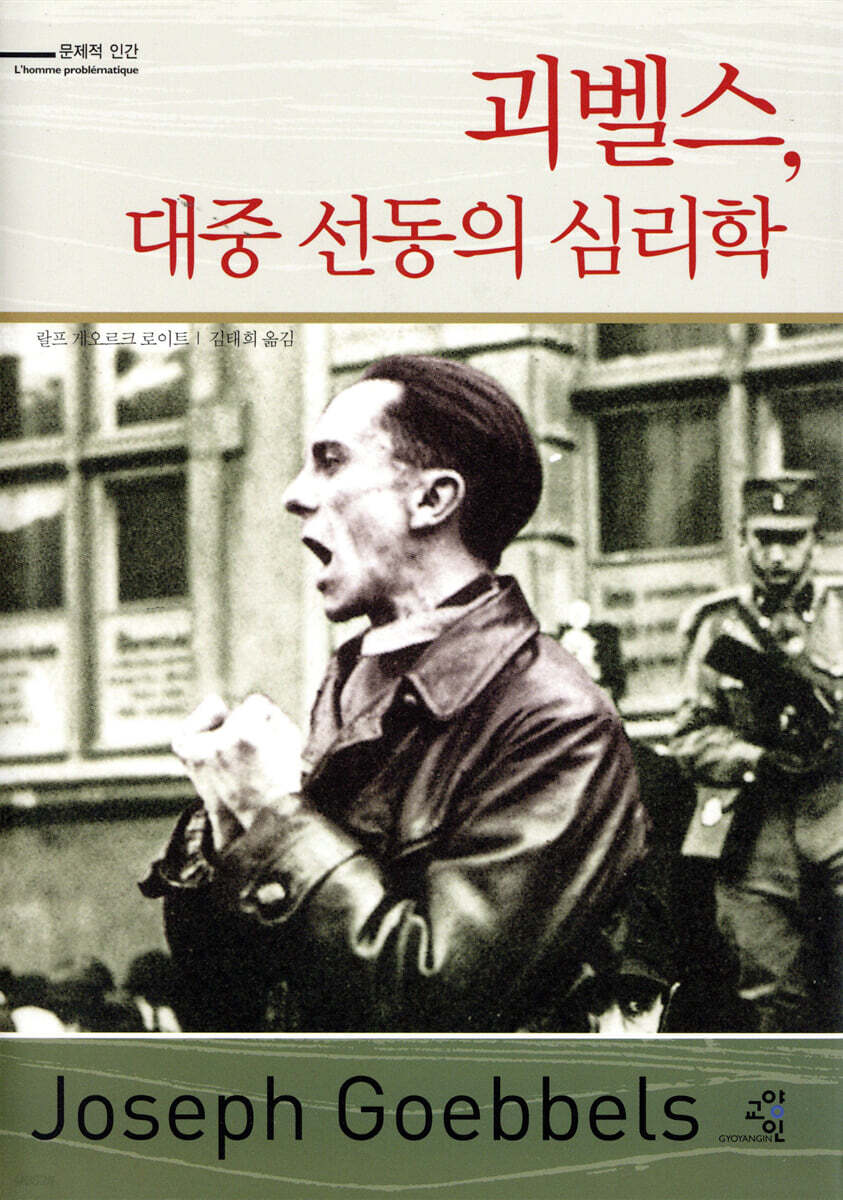
Goebbels, the psychology of mass propaganda
 |
Description
Book Introduction
Joseph Goebbels (1897-1945), the Minister of Propaganda and Plenipotentiary for 'total war' in the Third Reich under Nazi Germany, was the most ardent Hitler worshipper and the embodiment of Nazism.
This book, the first full-fledged biography of Goebbels to be introduced in Korea, is an excellent dissection of Nazi psychology that delves into the deepest parts of Goebbels' inner world by meticulously analyzing his vast collection of diaries, novels, speeches, and letters, which total over 80,000 pages.
A unique biographical study of the character of a secretive figure who has never shown himself to the public even once, leading him to open up and tell everything.
- You can preview some of the book's contents.
Preview
index
Chapter 1: Why Did God Make Him Despised and Ridiculed? (1897-1917)
Chapter 2: Chaos Within Me (1917–1921)
Chapter 3: Overcoming Skepticism
I Want to Be Strong and Believe (1921-1923)
Chapter 4: Who is this man? Half commoner, half god! (1924-1926)
Chapter 5: Berlin, the Pit of Sin! Must I Fall Into It? (1926-1928)
Chapter 6 We want to be revolutionaries.
Forever (1928-1930)
Chapter 7 Now we are legal.
It doesn't matter, but it's legal anyway (1930-1931)
Chapter 8: A Private First Class Heir to the Habsburg Dynasty: Isn't It a Miracle? (1931-1933)
Chapter 9 We Will Transform Humans Until Everyone Falls for Us (1933)
Chapter 10: Overcoming Crisis and Danger, We Go to Freedom (1934-1936)
Chapter 11: The President Commands and We Obey! (1936-1939)
Chapter 12: He is under the protection of the Almighty (1939-1941)
Chapter 13: Do You Want Total War? (1941-1944)
Chapter 14: Revenge is Our Virtue, Hatred is Our Duty! (1944-1945)
Chapter 15: Without the Führer and the Nazis, the World Would Be Unworthy (1945)
■ Epilogue
■ Notes
■ Translator's Note
■ Joseph Goebbels Chronology
■ Look up terms and names
Publisher's Review
“He who rules the masses rules the power!”
- Goebbels's mass propaganda reached the realm of art.
“A lie is first denied, then doubted, but if you repeat it, you will eventually believe it.”
“A proper mix of lies and truth is more effective than a 100% lie.”
“The victor is not questioned as to whether he told the truth.”
“Just give me one sentence.
Then anyone can be made a criminal.”
“Propaganda that turns a crisis into success is the true art of politics.”
“A propagandist must be an artist who understands the wavering soul of the people.”
“Propaganda is a matter of creative and productive imagination.”
“To confront an enemy who is bloodthirsty and thirsty for revenge, you must utilize boundless hatred above all else.”
“Politics is about creating miracles out of the impossible.”
“We will go down in history as the greatest statesmen of all time.
Or as the most vicious criminal.”
“To win the war, we must instill an optimistic outlook in our people.
So we need entertaining movies that relieve tension and provide enjoyment.
However, since film is a first-class means of national education, all films must be meticulously composed and organized.”
“It is a serious mistake to hide unpleasant news from the public.
While we should maintain a moderate level of optimism as our baseline attitude, we must also become more realistic in all areas.
The people can and must digest this.”
Creator of the 'Future President Myth'
From Horst Wessel, a martyr of the Nazi movement, to General Erwin Rommel, the "Desert Fox," Goebbels created countless heroes, impressing upon the German people the historical mission and greatness of Nazism and further fueling their will to fight.
But Goebbels' greatest creation was none other than Hitler himself.
His tireless propaganda created the 'Führer myth', making Hitler into a god who could not make mistakes.
He led the entire German people to submit to Hitler until the moment of their downfall.
The German people blamed other Nazi leaders, not Hitler, for the war, but for all the terrible, brutal, and insane things the Nazis did.
Because the 'President' was too noble a being to commit such a thing.
In fact, the majority of Germans came to worship the 'Führer'.
All the attributes of a superman were bestowed upon him.
He lives in a “space of life where he lives alone, like a god, not connected to anyone or anything,” a no-man’s land that exists only for him and no one else, especially women, can enter.
As a result, it was women who prayed to him, became intoxicated by seeing him in person, and even turned the “space for God” in one corner of their house into a “space for the Führer,” decorating it with pictures and flowers.
This cult of the 'Führer' was evident in the thousands of letters of admiration and flowers that arrived at Hitler's residence every day.
- Pages 577-578
Even when Hitler started World War II and forced Germany into a two-front war, only to experience defeat instead of victory, the Germans had no choice but to follow their 'Führer'.
… … The German people held Nazi representatives like Himmler and Goering responsible and guilty not only for the war but also for all the many terrible, cruel and vile things the Nazis committed, such as the Holocaust.
The Germans used expressions that absolved Hitler of all responsibility.
“If only the Führer knew!” This sentence symbolizes the power of the ‘Führer myth,’ and Goebbels’ historical significance lies in his being the creator of this myth.
- Page 922
“Reason is not necessary.
Appeal to emotions and instincts!”
From his earliest days in the Nazi movement, Goebbels was renowned for his captivating speeches, and it was he who, through his newspapers and magazines, confronted the Communist Party, the Nazi Party's main opponent and the most powerful political force in Germany at the time.
The core of Goebbels' political propaganda, delivered through speeches, writings, mass marches, and demonstrations, was simply this: "Stroke the emotions and instincts of the masses!"
Goebbels knew how to convey to his audience the sublimity of his so-called "ideology" and make them believers.
Nazism must be their heart (not their head).
This would not only make Nazism appear superior to other political lines, but would also make it stand out in a world of big cities that was judged to be materialistic and cold.
The propaganda rallies organized by Goebbels always appealed to the emotions and instincts of the audience.
- Page 187
(At the Sports Palace rally) When Goebbels, near the end of his speech, asked the audience whether they, like the Führer, believed in a final, all-out victory for the German army, and when he asked, “Do you want total war? Do you want a total war, if necessary, on a scale far more total and fundamental than we can now imagine?”, the Sports Palace spiraled out of control.
And when the Minister of Propaganda, in a passionate voice, exhausted yet focused, shouted the famous line to the frenzied crowd, “Come, nation, rise up, storm, storm!”, everything was thrown into “a state of madness and chaos.”
- Page 784
But above all, what made Goebbels' propaganda so destructive was that his words did not simply flow from his mouth, but came from his firm convictions.
Goebbels firmly believed that Hitler was "chosen by Providence" and that Hitler's success would strengthen himself and the German people.
Thus, even as Germany's defeat became a reality, Goebbels maintained his faith and kept his courage from the inexorable approach of events, and he hypnotized Hitler with his greatness and mission until the very last moment of destruction.
“The media should be the piano that the government plays!”
- Ruthless press control and media manipulation
It is a well-known fact that in modern Korean history, Japanese imperialism and dictatorial regimes such as Park Chung-hee and Chun Doo-hwan attempted to control and suppress cultural and artistic activities and turn them into servants of the regime.
Brainwashing the public and manipulating public opinion through media control is one of the characteristics of a dictatorship.
The pioneer of this type of political propaganda in 20th century modern history was Joseph Goebbels.
According to Goebbels, the press should be “a piano in the hands of the government” that “the government should play.” This was the “ideal state” he set out to achieve as one of his “primary tasks.”
… … Another decisive step forward in the standardization of the media was the ‘Editor’s Law’, which allowed editors to share the responsibility previously borne by publishers of newspapers and magazines.
Like publishers whose companies had become 'homogenized', editors, too, were subject to direct state interference through these measures.
Incurring Goebbels's displeasure could result in being struck off the job list, receiving a warning, or even being 'deported' to a concentration camp.
- From pages 415-416
Goebbels controlled all areas related to the production and distribution of public opinion, including the suppression of journalists using editorial laws and occupation lists, legislation to expel Jews from the cultural and artistic world, the standardization of the media through the abolition of left-wing newspapers and the merger of media companies, and the production of propaganda newsreels to promote the regime and entertainment films to blind the eyes and ears of the people.
Goebbels's political propaganda, including the use of mass media such as radio, film, political posters and leaflets, and control of the press through press guidelines, later became a textbook example.
GOODS SPECIFICS
- Date of issue: January 16, 2006
- Format: Hardcover book binding method guide
- Page count, weight, size: 1,055 pages | 1,564g | 153*224*60mm
- ISBN13: 9788991799134
- ISBN10: 8991799132
You may also like
카테고리
korean


korean


