

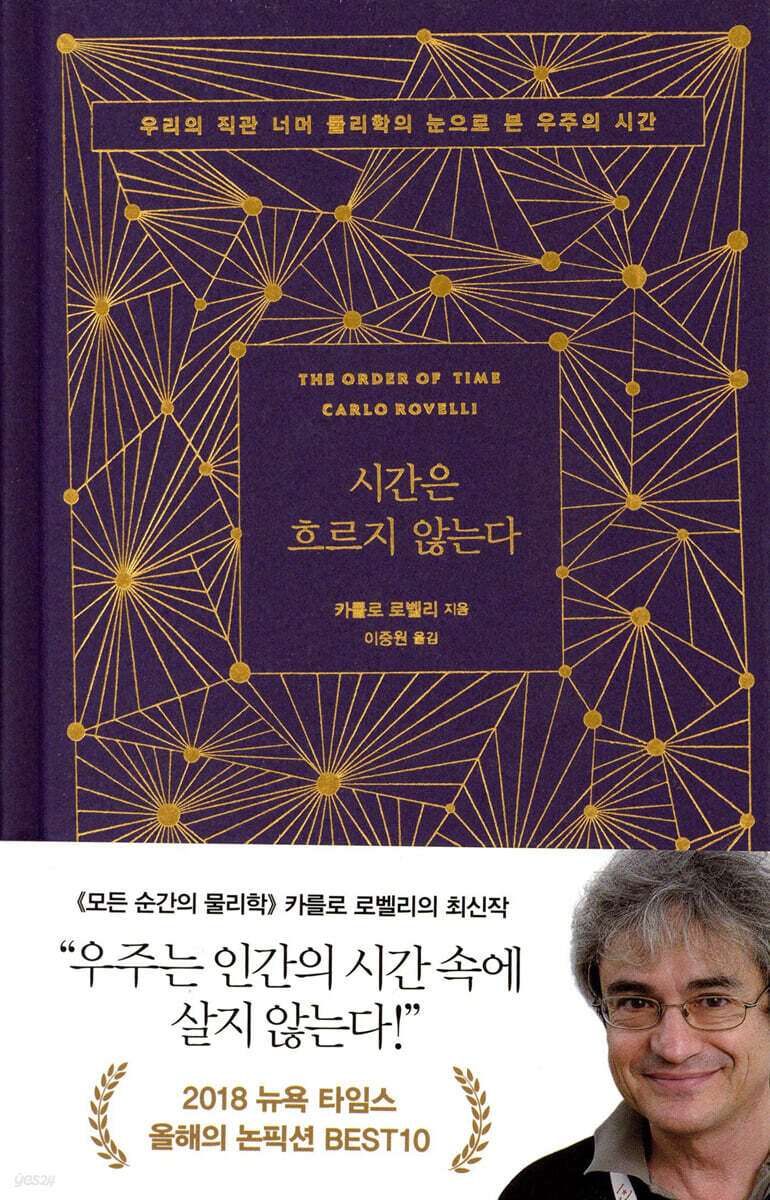
Time does not pass
 |
Description
Book Introduction
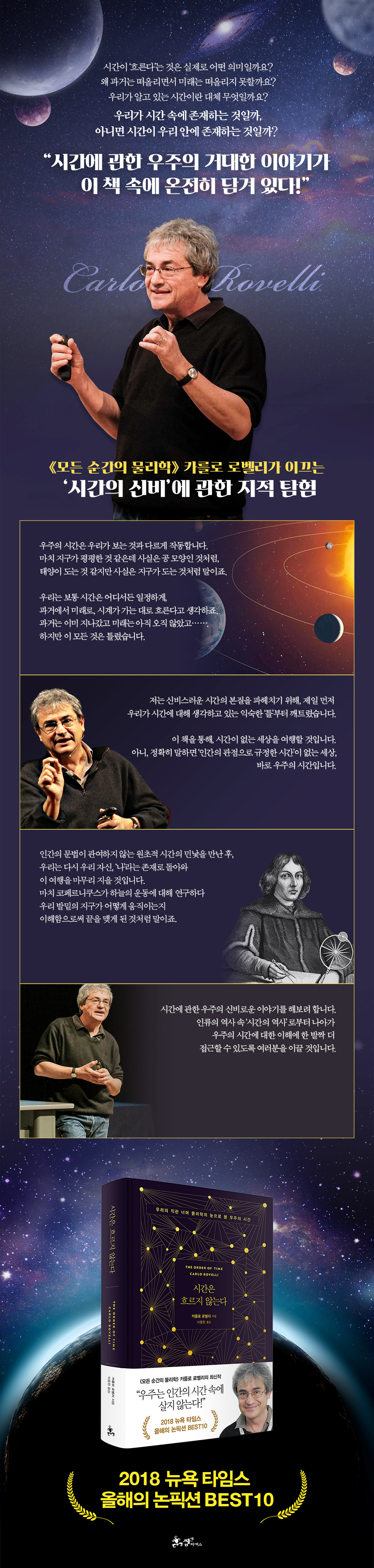
“The cosmic story of time is fully contained in this book!” "The Physics of Every Moment": An intellectual exploration of the "mystery of time" led by Carlo Rovelli. The third book by Carlo Rovelli, a pioneer in quantum gravity theory, has been published. Following 『Physics of Every Moment』 and 『The Visible World Is Not Real』, this book is about 'time' from the perspective of quantum gravity theory. 'What on earth is time?' 'What does it actually mean for time to pass?' 'Is the time we experience here different from time in the universe?' 'Why can we recall the past but not the future?'... . This book is Carlo Rovelli's faithful answer to these questions. Lobeli shatters our conventional notions of time to uncover the mysterious nature of time. That is, there is no single, unique time in the universe, time does not move in one direction from the past to the future, and it does not flow in a regular, constant manner. All of this, he says, is a product of our errors in perception of time and the peculiarities and approximations of the environment called Earth. This book contains the entire grand story of the universe regarding time. Through this book, we will learn how humans have understood time throughout human history, and furthermore, we will be able to overcome human limitations and come one step closer to understanding Earth's time, no, cosmic time, and the nature of time. Additionally, the beauty contained in every sentence, which blends physics, philosophy, and literature, is a rare blessing to find in science books. |
- You can preview some of the book's contents.
Preview
index
Introduction
Part 1: Digging into Time
01 Loss of Uniqueness
02 Loss of direction
03 The End of the Present
04 Loss of independence
05 hours of quantum
Part 2: A World Without Time
06 A world made of events, not things
07 Grammatical Inadequacies
08 Dynamics of Relationships
Part 3: The Source of Time
09 hours is ignorance
10 perspectives
11 Coming from Speciality
12 The Scent of Madeleines
13 hours of source
14 This is the time
Translator's Note
annotation
Part 1: Digging into Time
01 Loss of Uniqueness
02 Loss of direction
03 The End of the Present
04 Loss of independence
05 hours of quantum
Part 2: A World Without Time
06 A world made of events, not things
07 Grammatical Inadequacies
08 Dynamics of Relationships
Part 3: The Source of Time
09 hours is ignorance
10 perspectives
11 Coming from Speciality
12 The Scent of Madeleines
13 hours of source
14 This is the time
Translator's Note
annotation
Detailed image
Into the book
We usually think of time simply, fundamentally, as flowing equally everywhere, from past to future, as measured by clocks, to the indifference of everyone in the world.
It is believed that events in the universe occur in the order of past, present, and future in the flow of time.
The past is set, the future is open… … .
But it turned out that all of this was wrong.
Each and every characteristic aspect of time is a product of the errors and approximations of our vision.
Examples include the previously mentioned flatness of the Earth and the rotation of the Sun.
But as human knowledge grew, the concept of time gradually began to be unveiled.
What we call 'time' is a complex collection of structures, or layers.
As the research progressed deeper and deeper, time gradually lost this layer, piece by piece.
--- p.10~11
This is more important than the speed at which time passes.
This is the essence of time.
The secret of time lies in the vibrations of our pulse, in the riddles of our memories, in the anxiety about the future.
That's what it means to think about time.
So what exactly is the flow of time? How can it be defined within the grammar of the world? What, among the mechanisms of this world, distinguishes the past, which already existed, from the future, which has yet to come? Why are past and future so distinct? Physics of the 19th and 20th centuries confronted these questions, and to make matters worse, they were baffled by the unexpected fact that time flows at different speeds depending on the location.
Because in the fundamental laws that explain the mechanisms of the world, there is no difference between the past and the future (the difference between cause and effect, memory and hope, regret and will).
--- p.29
It is meaningless to ask which moment in the sister's life corresponds to the 'now' in Proxima b.
This is like asking which football team won the basketball championship, or how much money a lottery player made, or how much a musical note weighs.
Soccer teams play soccer, not basketball, swallows don't make money, and sound has no weight, so these are all wrong questions.
The basketball championship should be for basketball teams, not soccer teams.
Making money should be done for the people in society, not for the lotteries.
Likewise, the concept of 'present' should refer to something close to us, not something far away.
Our 'present' does not apply to the entire universe.
You can think of it as a bubble that is close to us now.
--- p.52
The world can be thought of as being made up of 'things'.
That it is made of matter, of something 'substantial', something that 'exists in the present'.
Or you could think of it as a world made up of 'events'.
It is a world that is seen as made up of something that happens by chance, through a process, through something that 'occurs'.
That which is not permanent, is constantly changing and impermanent.
In fundamental physics, the destruction of the concept of time is a collapse of the first of two perspectives, not the second.
It is not that stability in unchanging time has been realized, but rather that temporariness has come to exist anytime, anywhere.
Thinking of the world as a totality of events and processes is the best way to capture, understand, and explain the world.
This is the only way to reconcile it with the theory of relativity.
The world is a totality of events, not things.
--- p.105
The distinction between past, present, and future is not an illusion.
This is the temporary time structure of this world.
However, the temporal structure of the world is not the temporal structure of presentism.
The temporal relationships between events are much more complex than we previously thought, but that doesn't mean they don't exist.
Intimacy doesn't create world order, but it doesn't create illusions either.
Just because we are not all aligned doesn't mean there are no relationships between us.
Change and events are not illusions.
What we've found is that events don't happen according to one global order.
--- p.118
We could say that we measure time with a clock, but this is impossible.
Duration can be measured by looking at the clock at two different moments, because we are always in one moment, not two.
We see only the present in the present.
We can see what we interpret as 'traces' of the past, but there is a big difference between seeing traces of the past and perceiving the passage of time.
Augustine understood that the source of this difference was that the perception of the passage of time was internal.
It is a part of our inner self, a trace of the past that remains in our brain.
--- p.187~188
So, in the end, we can only speak of this single time, the uniform, universal, and ordered time we experience, rather than of the countless times that exist in the world.
This time is an approximation of an approximation of an approximation of an approximation of the world, described from our special perspective as humans, settled in the flow of time by the growth of entropy.
According to Ecclesiastes 128 in the Bible, there is a time for birth and a time for death.
Our time is a complex, multi-layered concept, with numerous distinct properties derived from various approximations.
The reason there are so many conflicting opinions about the concept of time is because we do not understand its complex and multi-layered aspects.
We are making the mistake of not seeing these different layers.
This is the physical structure of time that I have come to know after spending my entire life wandering around it.
It is believed that events in the universe occur in the order of past, present, and future in the flow of time.
The past is set, the future is open… … .
But it turned out that all of this was wrong.
Each and every characteristic aspect of time is a product of the errors and approximations of our vision.
Examples include the previously mentioned flatness of the Earth and the rotation of the Sun.
But as human knowledge grew, the concept of time gradually began to be unveiled.
What we call 'time' is a complex collection of structures, or layers.
As the research progressed deeper and deeper, time gradually lost this layer, piece by piece.
--- p.10~11
This is more important than the speed at which time passes.
This is the essence of time.
The secret of time lies in the vibrations of our pulse, in the riddles of our memories, in the anxiety about the future.
That's what it means to think about time.
So what exactly is the flow of time? How can it be defined within the grammar of the world? What, among the mechanisms of this world, distinguishes the past, which already existed, from the future, which has yet to come? Why are past and future so distinct? Physics of the 19th and 20th centuries confronted these questions, and to make matters worse, they were baffled by the unexpected fact that time flows at different speeds depending on the location.
Because in the fundamental laws that explain the mechanisms of the world, there is no difference between the past and the future (the difference between cause and effect, memory and hope, regret and will).
--- p.29
It is meaningless to ask which moment in the sister's life corresponds to the 'now' in Proxima b.
This is like asking which football team won the basketball championship, or how much money a lottery player made, or how much a musical note weighs.
Soccer teams play soccer, not basketball, swallows don't make money, and sound has no weight, so these are all wrong questions.
The basketball championship should be for basketball teams, not soccer teams.
Making money should be done for the people in society, not for the lotteries.
Likewise, the concept of 'present' should refer to something close to us, not something far away.
Our 'present' does not apply to the entire universe.
You can think of it as a bubble that is close to us now.
--- p.52
The world can be thought of as being made up of 'things'.
That it is made of matter, of something 'substantial', something that 'exists in the present'.
Or you could think of it as a world made up of 'events'.
It is a world that is seen as made up of something that happens by chance, through a process, through something that 'occurs'.
That which is not permanent, is constantly changing and impermanent.
In fundamental physics, the destruction of the concept of time is a collapse of the first of two perspectives, not the second.
It is not that stability in unchanging time has been realized, but rather that temporariness has come to exist anytime, anywhere.
Thinking of the world as a totality of events and processes is the best way to capture, understand, and explain the world.
This is the only way to reconcile it with the theory of relativity.
The world is a totality of events, not things.
--- p.105
The distinction between past, present, and future is not an illusion.
This is the temporary time structure of this world.
However, the temporal structure of the world is not the temporal structure of presentism.
The temporal relationships between events are much more complex than we previously thought, but that doesn't mean they don't exist.
Intimacy doesn't create world order, but it doesn't create illusions either.
Just because we are not all aligned doesn't mean there are no relationships between us.
Change and events are not illusions.
What we've found is that events don't happen according to one global order.
--- p.118
We could say that we measure time with a clock, but this is impossible.
Duration can be measured by looking at the clock at two different moments, because we are always in one moment, not two.
We see only the present in the present.
We can see what we interpret as 'traces' of the past, but there is a big difference between seeing traces of the past and perceiving the passage of time.
Augustine understood that the source of this difference was that the perception of the passage of time was internal.
It is a part of our inner self, a trace of the past that remains in our brain.
--- p.187~188
So, in the end, we can only speak of this single time, the uniform, universal, and ordered time we experience, rather than of the countless times that exist in the world.
This time is an approximation of an approximation of an approximation of an approximation of the world, described from our special perspective as humans, settled in the flow of time by the growth of entropy.
According to Ecclesiastes 128 in the Bible, there is a time for birth and a time for death.
Our time is a complex, multi-layered concept, with numerous distinct properties derived from various approximations.
The reason there are so many conflicting opinions about the concept of time is because we do not understand its complex and multi-layered aspects.
We are making the mistake of not seeing these different layers.
This is the physical structure of time that I have come to know after spending my entire life wandering around it.
--- p.203~204
Publisher's Review
Led by Carlo Rovelli
A Journey to a 'Timeless' Universe
"Time Does Not Pass" is the third book by Carlo Rovelli, a world-renowned physicist and pioneer of quantum gravity theory.
While previously published books, 『Physics of Every Moment』 and 『The Visible World Is Not Real』, discussed matter, energy, and space from the perspective of quantum gravity theory, this book discusses 'time.'
What exactly is the time we experience, feel, and know? What exactly does it mean for time to "flow"? Why can we recall the past but not the future? Is time in this world we live in the same as time in the universe? … In this book, Carlo Rovelli answers countless questions about time.
He says, “What appears to be a certain order or order in time is merely a special aspect of the universe as seen from the macroscopic world in which we live, not its universal essence.”
In the primordial time of the universe, which transcends the limits of human perception, there is no order, no flow, and no sequence based on it.
This book is largely divided into three parts.
Part 1 summarizes what modern physics has discovered about time so far.
As human knowledge grew, the concept of time gradually became veiled, and time, which was made up of complex layers, lost these layers one by one.
Basically, events that are thought to occur in the same order everywhere, past, present, and future, the common sense that the past has already been decided and the future has not yet arrived… .
It exposes one by one that all of these things are wrong.
In Part 2, we travel to a world without time.
A world made up of ‘events’ rather than ‘things’, a world without the variables of past-present-future and time that exist only in human grammar… .
Now space and time no longer take the form of a frame or container that contains the world.
In Part 3, we turn back the time we destroyed in Parts 1 and 2, find its source again, and return to the destination of this long journey as ourselves, as the existence of our country.
Just as Copernicus's study of the motions of the heavens ended with understanding how the Earth beneath our feet moves.
This ontological return is a truly beautiful fusion of physics and philosophy, something that can only be found in Carlo Rovelli's books.
We are a very small part of the world,
I only look at time from a human perspective.
To uncover the mysterious nature of time, Carlo Rovelli first breaks down the familiar 'frames' we have about time.
The common notions we have about time are largely threefold: 'uniqueness', 'direction', and 'independence'.
First, we believe that there is only one time in the universe.
I also think that time moves in one direction, from the past to the future.
Finally, time is considered to flow regularly and consistently, uninfluenced by any other entity.
But these are all wrong.
Each and every characteristic aspect of time is an error of our vision, a product of approximations.
The quantity called 'time', which we thought was unique, is shattered in the spider web of time.
This book will not explain how the world evolves over time.
Instead, we will look at how things evolve in different local times and how different local times evolve 'with each other'.
The world is not uniform like a military formation that moves to the commander's command.
Events that influence each other are intertwined like a net.
p.25
The world is very complicated.
Reality is not what it seems.
It seems like the sun is spinning, but in fact the Earth is spinning, and it seems like the Earth is flat, but in fact it is spherical.
There is no common present throughout the universe, and all events in the world do not proceed in the order of past-present-future.
There is a present around us, but in distant galaxies, it is not the 'present'.
In the end, we only see the world in the flow of time from the perspective of 'us', from the perspective of humans who are a small part of the world.
So, in the end, we can only speak of this single time, the uniform, universal, and ordered time we experience, rather than of the countless times that exist in the world.
This time is an approximation of an approximation of an approximation of an approximation of the world, described from our special perspective as humans, settled in the flow of time by the growth of entropy.
Our time is a complex, multi-layered concept, with numerous distinct properties derived from various approximations.
pp.203-204
The greatest mystery remaining in the world,
A universal story about 'time'
This book contains the history of human understanding of time, starting from the ancient Greek era.
How have advances in physics changed our concept of time since the advent of modern physics by Newton?
In that sense, this book is also a kind of 'history of time'.
Going further, Carlo Rovelli has expanded our understanding of 'so far' time by introducing a new theory of quantum gravity.
A universe without time (in the conventional sense we know it), yet one in which change is constantly occurring, a universe filled with events instead of things, a universe that changes due to the complex relationships between events.
However, humans still experience time as flowing orderly from past to future and live dependent on it.
The human world is not a 'universal' but a 'special' case to the universe.
This book contains the entire grand story of this universe about time.
We will learn how humans have understood time throughout human history, and we will be able to take a step closer to understanding the nature of time, not just Earth time, but cosmic time.
A Journey to a 'Timeless' Universe
"Time Does Not Pass" is the third book by Carlo Rovelli, a world-renowned physicist and pioneer of quantum gravity theory.
While previously published books, 『Physics of Every Moment』 and 『The Visible World Is Not Real』, discussed matter, energy, and space from the perspective of quantum gravity theory, this book discusses 'time.'
What exactly is the time we experience, feel, and know? What exactly does it mean for time to "flow"? Why can we recall the past but not the future? Is time in this world we live in the same as time in the universe? … In this book, Carlo Rovelli answers countless questions about time.
He says, “What appears to be a certain order or order in time is merely a special aspect of the universe as seen from the macroscopic world in which we live, not its universal essence.”
In the primordial time of the universe, which transcends the limits of human perception, there is no order, no flow, and no sequence based on it.
This book is largely divided into three parts.
Part 1 summarizes what modern physics has discovered about time so far.
As human knowledge grew, the concept of time gradually became veiled, and time, which was made up of complex layers, lost these layers one by one.
Basically, events that are thought to occur in the same order everywhere, past, present, and future, the common sense that the past has already been decided and the future has not yet arrived… .
It exposes one by one that all of these things are wrong.
In Part 2, we travel to a world without time.
A world made up of ‘events’ rather than ‘things’, a world without the variables of past-present-future and time that exist only in human grammar… .
Now space and time no longer take the form of a frame or container that contains the world.
In Part 3, we turn back the time we destroyed in Parts 1 and 2, find its source again, and return to the destination of this long journey as ourselves, as the existence of our country.
Just as Copernicus's study of the motions of the heavens ended with understanding how the Earth beneath our feet moves.
This ontological return is a truly beautiful fusion of physics and philosophy, something that can only be found in Carlo Rovelli's books.
We are a very small part of the world,
I only look at time from a human perspective.
To uncover the mysterious nature of time, Carlo Rovelli first breaks down the familiar 'frames' we have about time.
The common notions we have about time are largely threefold: 'uniqueness', 'direction', and 'independence'.
First, we believe that there is only one time in the universe.
I also think that time moves in one direction, from the past to the future.
Finally, time is considered to flow regularly and consistently, uninfluenced by any other entity.
But these are all wrong.
Each and every characteristic aspect of time is an error of our vision, a product of approximations.
The quantity called 'time', which we thought was unique, is shattered in the spider web of time.
This book will not explain how the world evolves over time.
Instead, we will look at how things evolve in different local times and how different local times evolve 'with each other'.
The world is not uniform like a military formation that moves to the commander's command.
Events that influence each other are intertwined like a net.
p.25
The world is very complicated.
Reality is not what it seems.
It seems like the sun is spinning, but in fact the Earth is spinning, and it seems like the Earth is flat, but in fact it is spherical.
There is no common present throughout the universe, and all events in the world do not proceed in the order of past-present-future.
There is a present around us, but in distant galaxies, it is not the 'present'.
In the end, we only see the world in the flow of time from the perspective of 'us', from the perspective of humans who are a small part of the world.
So, in the end, we can only speak of this single time, the uniform, universal, and ordered time we experience, rather than of the countless times that exist in the world.
This time is an approximation of an approximation of an approximation of an approximation of the world, described from our special perspective as humans, settled in the flow of time by the growth of entropy.
Our time is a complex, multi-layered concept, with numerous distinct properties derived from various approximations.
pp.203-204
The greatest mystery remaining in the world,
A universal story about 'time'
This book contains the history of human understanding of time, starting from the ancient Greek era.
How have advances in physics changed our concept of time since the advent of modern physics by Newton?
In that sense, this book is also a kind of 'history of time'.
Going further, Carlo Rovelli has expanded our understanding of 'so far' time by introducing a new theory of quantum gravity.
A universe without time (in the conventional sense we know it), yet one in which change is constantly occurring, a universe filled with events instead of things, a universe that changes due to the complex relationships between events.
However, humans still experience time as flowing orderly from past to future and live dependent on it.
The human world is not a 'universal' but a 'special' case to the universe.
This book contains the entire grand story of this universe about time.
We will learn how humans have understood time throughout human history, and we will be able to take a step closer to understanding the nature of time, not just Earth time, but cosmic time.
GOODS SPECIFICS
- Date of issue: June 10, 2019
- Format: Hardcover book binding method guide
- Page count, weight, size: 240 pages | 298g | 115*180*20mm
- ISBN13: 9788965708063
- ISBN10: 8965708060
You may also like
카테고리
korean


korean

![GQ KOREA Mark (Monthly): December [2025]](http://librairie.coreenne.fr/cdn/shop/files/8ef265dbbfbf186523ed75ba7319009d.jpg?v=1765340328&width=3840)


