

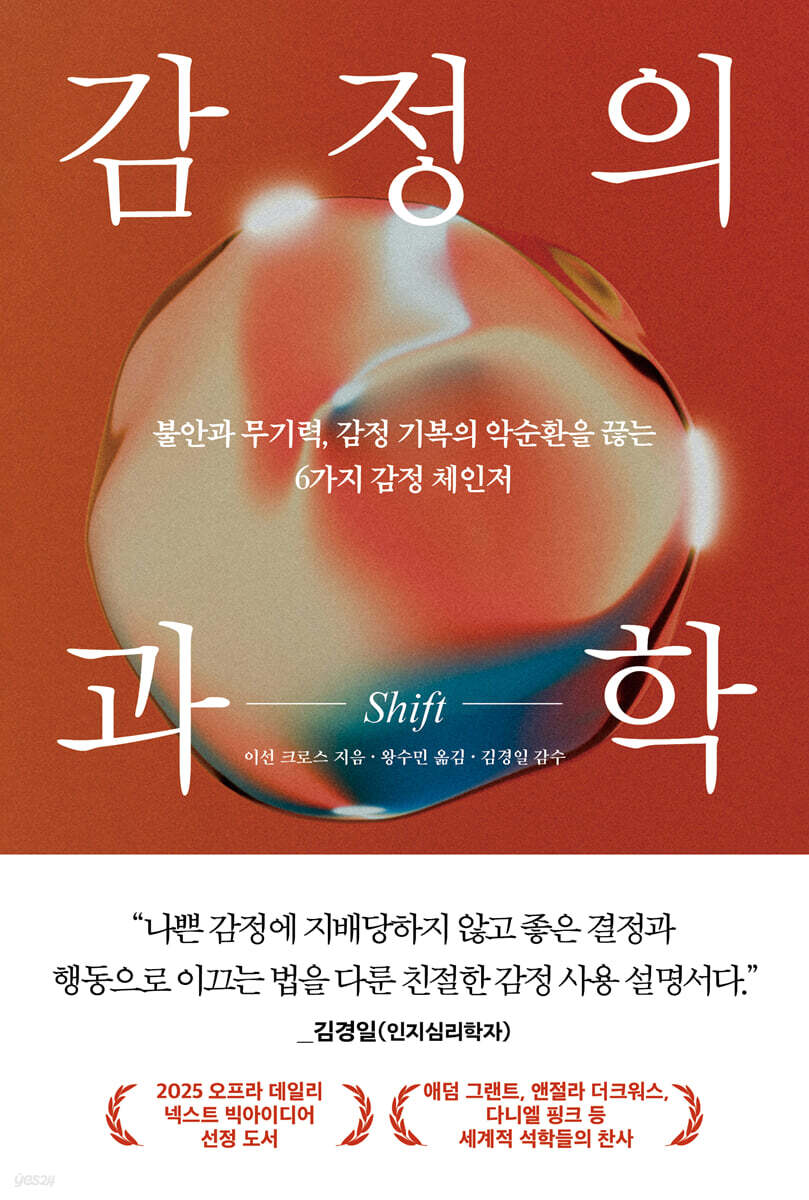
The Science of Emotions
 |
Description
Book Introduction
Praise from world-renowned scholars including Adam Grant, Angela Duckworth, and Daniel Pink
ㆍ2025 Oprah Daley Next Big Idea Book Selection
“Don’t be ruled by bad emotions and make good decisions.
“It’s a friendly user manual for emotions that teaches you how to lead to action.”
Kim Kyung-il (cognitive psychologist)
For those who want to break free from negative emotions and become the master of their emotions.
World-renowned psychologist Professor Ethan Cross's mind liberation class
Unexpected anxiety, depression, lethargy, and mood swings can sometimes have a devastating impact on our daily lives.
Couldn't we simply turn off these emotions, which permeate everything in our lives—from interpersonal relationships to finances, health, and longevity—with the flip of a switch? Ethan Cross, a professor of psychology at the University of Michigan, asserts that negative emotions are essential for human survival, not obstacles to be suppressed with reason or constantly confronted.
Rather, if you know how to properly 'switch' by turning the switch, emotions can become 'boosters' that propel you forward in life.
"The Science of Emotions" provides a friendly explanation of the dynamics of emotions, drawing on the latest research in psychology and neuroscience, along with practical, specific methods for managing them.
By actively utilizing the six emotional shifters in this book (body sensation, attention, perspective, space, relationships, and culture), anyone can create their own system for managing their emotions!
ㆍ2025 Oprah Daley Next Big Idea Book Selection
“Don’t be ruled by bad emotions and make good decisions.
“It’s a friendly user manual for emotions that teaches you how to lead to action.”
Kim Kyung-il (cognitive psychologist)
For those who want to break free from negative emotions and become the master of their emotions.
World-renowned psychologist Professor Ethan Cross's mind liberation class
Unexpected anxiety, depression, lethargy, and mood swings can sometimes have a devastating impact on our daily lives.
Couldn't we simply turn off these emotions, which permeate everything in our lives—from interpersonal relationships to finances, health, and longevity—with the flip of a switch? Ethan Cross, a professor of psychology at the University of Michigan, asserts that negative emotions are essential for human survival, not obstacles to be suppressed with reason or constantly confronted.
Rather, if you know how to properly 'switch' by turning the switch, emotions can become 'boosters' that propel you forward in life.
"The Science of Emotions" provides a friendly explanation of the dynamics of emotions, drawing on the latest research in psychology and neuroscience, along with practical, specific methods for managing them.
By actively utilizing the six emotional shifters in this book (body sensation, attention, perspective, space, relationships, and culture), anyone can create their own system for managing their emotions!
- You can preview some of the book's contents.
Preview
index
A Friendly Guide to the Wisdom of Distinguishing Between a Reader's Verbal Reaction and Decisions _ Cognitive Psychologist Kim Kyung-il
When you enter and ask 'why' about your emotions
The horrific war my grandmother endured | "Why" only leads to suffering | Ryu's history: A journey to find ways to regulate emotions | An era when loneliness has become a national problem | There is no one-size-fits-all solution.
Part 1: What are emotions?
Chapter 1 Why do we feel such emotions?
The Emotional Switch of the US Navy SEALs | The Beautiful and Messy Emotional Life | What Are Emotions? | The Positive Functions of Negative Emotions | 50 Years Later: A Child Who Couldn't Control Their Emotions | How to Play the Instrument of Emotions | If You Don't Know How to Control Them, You'll Be Controlled
Chapter 2 Emotions can be controlled
When You Can't Stop Anxious Thoughts | What We Can't Control | What We Can Control | The Power of Self-Efficacy
Part 2: Transition from Inside to Outside
Chapter 3: Creating Your Own Proust Effect
Tool ① Sensory Transformation
What 1980s Power Ballads Taught Us | The Amazing Power of Sensory Experience | Memories Conjured by a Piece of Madeleine | The Law of Least Labor | My Own Sensory Prescription
Chapter 4 Spotlight, Turn or Shine
Tool ② Attention shift
Evade or Face | Walking into the Fire | Basketball's Bad Boys' Evasion Strategies | Time heals wounds | Emotions also require flexibility | The smart way to use evasion and approach
Chapter 5: Changing the Filter Through which You View Emotions
Tool ③ Change of perspective
"Damn, that's easier said than done" | The ABC formula for changing your emotions | People addicted to first-person perspective | Why swearing in your native language hits harder | Distanced self-talk: "You can do it" | Take a mental time travel | You can choose your attitude
Part 3: The Transition from Outside to Inside
Chapter 6: Emotions Need an Oasis Too
Tool ④ Space Transition
A Happiness Expert with Depression | The Power of Space | Emotional Oasis: Move to a Different Location | The Power of Family Photos: More Powerful Than Willpower | Oasis is Everywhere
Chapter 7: Find an Emotional Counselor
Tool ⑤ Relationship Transition
The Old-Fashioned Leader and the Cheerleader | Emotions Are Like Viruses | Healthy Emotional Advice: "Talk to Me" | Exploiting the Joy-Thief of Comparison | Consideration Is More Contagious | Living in the Fabric of Relationships
Chapter 8: The Master Switch that Moves the Heart
Tool ⑥ Cultural Transformation
The Fired Alcoholic | The Power of Culture to Move Hearts | The Brooklynite Who Goes to the Tundra | Change Your Beliefs, Norms, and Practices
Part 4: Designing an Emotion Conversion System
Chapter 9: Design Your Own Automatic Switching System
Scenarios for Intense Emotions | The WOOP Technique for Defusing Emotional Bombs
Going out and living a healthy emotional life
Acknowledgements
main
When you enter and ask 'why' about your emotions
The horrific war my grandmother endured | "Why" only leads to suffering | Ryu's history: A journey to find ways to regulate emotions | An era when loneliness has become a national problem | There is no one-size-fits-all solution.
Part 1: What are emotions?
Chapter 1 Why do we feel such emotions?
The Emotional Switch of the US Navy SEALs | The Beautiful and Messy Emotional Life | What Are Emotions? | The Positive Functions of Negative Emotions | 50 Years Later: A Child Who Couldn't Control Their Emotions | How to Play the Instrument of Emotions | If You Don't Know How to Control Them, You'll Be Controlled
Chapter 2 Emotions can be controlled
When You Can't Stop Anxious Thoughts | What We Can't Control | What We Can Control | The Power of Self-Efficacy
Part 2: Transition from Inside to Outside
Chapter 3: Creating Your Own Proust Effect
Tool ① Sensory Transformation
What 1980s Power Ballads Taught Us | The Amazing Power of Sensory Experience | Memories Conjured by a Piece of Madeleine | The Law of Least Labor | My Own Sensory Prescription
Chapter 4 Spotlight, Turn or Shine
Tool ② Attention shift
Evade or Face | Walking into the Fire | Basketball's Bad Boys' Evasion Strategies | Time heals wounds | Emotions also require flexibility | The smart way to use evasion and approach
Chapter 5: Changing the Filter Through which You View Emotions
Tool ③ Change of perspective
"Damn, that's easier said than done" | The ABC formula for changing your emotions | People addicted to first-person perspective | Why swearing in your native language hits harder | Distanced self-talk: "You can do it" | Take a mental time travel | You can choose your attitude
Part 3: The Transition from Outside to Inside
Chapter 6: Emotions Need an Oasis Too
Tool ④ Space Transition
A Happiness Expert with Depression | The Power of Space | Emotional Oasis: Move to a Different Location | The Power of Family Photos: More Powerful Than Willpower | Oasis is Everywhere
Chapter 7: Find an Emotional Counselor
Tool ⑤ Relationship Transition
The Old-Fashioned Leader and the Cheerleader | Emotions Are Like Viruses | Healthy Emotional Advice: "Talk to Me" | Exploiting the Joy-Thief of Comparison | Consideration Is More Contagious | Living in the Fabric of Relationships
Chapter 8: The Master Switch that Moves the Heart
Tool ⑥ Cultural Transformation
The Fired Alcoholic | The Power of Culture to Move Hearts | The Brooklynite Who Goes to the Tundra | Change Your Beliefs, Norms, and Practices
Part 4: Designing an Emotion Conversion System
Chapter 9: Design Your Own Automatic Switching System
Scenarios for Intense Emotions | The WOOP Technique for Defusing Emotional Bombs
Going out and living a healthy emotional life
Acknowledgements
main
Detailed image

Into the book
The same goes for humans.
Our emotional needs change depending on the situation, person, time, and even from moment to moment.
A variety of tools are needed to meet these needs.
The good news is, you already have the tools! The first step to managing your emotions is understanding the emotional "shifter" we all carry within us.
If you just control your senses well, your emotions will change automatically.
Strategically allocating your attention can make it easier than ever to overcome fear or savor joyful experiences.
Additionally, changing your perspective on a difficult situation can make it much easier to manage painful emotional states.
These emotional transition devices help us move from one emotional state to another, either soothing or strengthening our emotions.
These internal switching mechanisms are also activated by external forces, such as the spaces we inhabit, the people we interact with, and the families, organizations, and cultural institutions we belong to.
Understanding how these external shifting mechanisms influence us allows us to make wise choices about how we interact with them, thus fully harnessing the power of our inner tools.
--- From "Entering"
A second source of confusion about emotions is the relationship between feeling and emotion.
Thoughts and emotions are often at odds, waging a never-ending war, yet people tend to think of feelings and emotions as largely the same thing, using them interchangeably.
But feelings are only part of the emotional experience we perceive.
We are always conscious of our feelings, but we are not always aware of other aspects of our emotional experience (such as instinctive grimaces or rapid fluctuations in hormone levels).
Feelings are like 'fever' of emotional response, a conscious expression of what is happening behind the scenes.
Because feelings are a unique expression of a person's emotional experience, no one else can 'feel' the same emotion as I do.
For some people, anger feels like a crushing pressure.
But to others, anger can feel like a hollow void in the heart.
The various components that make up our emotional responses operate within us in a seemingly infinite number of ways, influenced not only by the situations we face but also by our genes, environment, and personal history.
What the research team found was that emotional regulation skills predicted a lot of things throughout a person's life.
Among the results were some predictable: Children who had poor emotional regulation skills as children were more likely to abuse drugs later in life.
However, most of the newly discovered correlations in this study fell far beyond our expectations.
Children who struggled particularly with emotional regulation were more likely to drop out of school or commit crimes later in life.
Conversely, children who were skilled at emotional regulation later in life had better careers, saved more, prepared diligently for retirement, and were physically healthier.
Even brain imaging and physiological tests showed that their brains and organs aged more slowly! Emotional regulation skills in early childhood were a powerful factor in individual development, predicting future outcomes more significantly than a child's family's socioeconomic background or their intelligence level.
--- From "Chapter 1, Why Do We Feel Such Emotions"
The moment a negative thought or unpleasant physical sensation enters our awareness, we begin to be presented with a series of choices.
This is the emotional 'trajectory' that follows the initial trigger.
Opportunities pile up before your eyes to choose whether to delve deeper into that feeling, separate it from your heart, or nurture it further.
The outcomes we choose or don't choose heighten or subdue our emotions, and those outcomes in turn affect and influence our emotions.
The ripple effects of our ability to regulate our emotions on our well-being, health, and happiness are enormous.
This is precisely why I was quite disturbed when I saw in a previous study that 40% of the experimental group of adolescents felt they could not control their emotions.
If they believe they can't control their emotions, they won't even try to manage them in the first place.
--- From "Chapter 2, Emotions Can Be Controlled"
Emotion regulation tools that require separate effort are generally effective, but they also require time and focus.
On the other hand, using your senses is like boarding a high-speed train of the nervous system.
Numerous studies have shown that drinking sweet beverages can have an emotional effect on the body, even when the person is distracted.
Touching one's face can also have a calming effect while performing a memory task that requires recalling shapes.
Let's say you're on your way to a first date and you're so nervous that your stomach is pounding.
At this point, I don't have the time or the inclination to stop and write in my diary about how embarrassed I am.
But what if simply scrolling through a few photos of baby pandas on your smartphone could alleviate your anxiety? The pandas are the clear winners of this competition.
Transforming emotions based on sensory experiences is one of the easiest emotion regulation strategies presented in this book.
And when it comes to emotional transformation, the easiest methods are the most powerful.
But as with most good things in life, while tapping into your sensory system can help you regulate your emotions, there's a dark side to it.
--- From "Chapter 3, Creating Your Own Proust Effect"
There is no doubt that chronic avoidance is harmful.
Chronic avoidance is a crude tool that we use to try to solve various emotional problems.
It's like trying to tear down the whole house with just a hammer.
But there is something we keep forgetting.
For some jobs, a hammer is just right.
Of course, this isn't true for every task, and in fact, it's more likely not true for most, but there are certainly tasks where a hammer is useful, and this is where the field of psychology falls into the trap of oversimplifying things into just good and bad.
Emotion regulation techniques that involve facing emotions are usually viewed as positive, whereas coping mechanisms that involve avoiding emotions are viewed as negative.
But recent research has revealed much about how the body and brain work together to help regulate emotions, and the ability to look away from distressing situations is an evolutionary gift given to humans.
That amazing talent is called the 'psychological immune system'.
--- From "Chapter 4, Spotlight, Turn or Shine"
To reconstruct a situation, you often need to look at it from a different perspective.
Because only then can you change the direction of your thoughts.
The problem is that when we get caught up in negative emotions, our vision narrows and we become focused only on the problem in front of us.
This is also the way we have always responded when problems arise in life.
This zoom-in phenomenon can be seen simply by looking at the language we use when we are experiencing negative emotions.
For example, the overuse of words like 'I/me/my' becomes a linguistic marker that indicates a state of being overly absorbed in oneself.
This is similar to zooming in and focusing on yourself when taking a selfie.
While there's nothing wrong with using these words, research is increasingly revealing that they can also signal how self-absorbed you are.
One study analyzed over a million social media posts from people sharing their heartbreak stories on the online community platform Reddit.
The research team combed through users' social media posts for several years before and after a breakup, and based on the increased use of first-person pronouns in their posts, they were able to accurately predict when a user would experience a breakup.
Additionally, the longer users focused on themselves—that is, the more they continued to post about their experiences in the first person—the worse their condition was a year later.
A study conducted by another research team was able to predict a user's risk of developing depression based on their use of first-person pronouns in Facebook posts!
--- From "Chapter 5, Changing the Filter Through which You View Emotions"
There is another, lesser-known but very important factor in the relationship between emotions and environment.
This is something that Sean has unknowingly used to change his life: his personal attachment to a place.
This phenomenon even has a name: 'place attachment'.
What matters in place attachment is not whether the place has any special properties, but how the place resonates emotionally with the individual.
When I impromptu polled my friends about their "places of their dreams," I got responses like a secluded beach off the coast of Maine, the Sleeping Bear Dunes in northern Michigan, and a cafe overlooking the Los Angeles coast.
Couldn't we call these places 'sanctuaries of the mind' or 'spiritual homes'?
Whatever the name, these places are places that evoke strong feelings of satisfaction, happiness, and meaning in someone.
--- From Chapter 6, “Emotions Need an Oasis Too”
Within seconds, a significant difference emerged between the two groups.
The groups led by cheerleader-type leaders were bustling.
The crew laughed and chatted, exchanging suggestions and moving busily around the table in the middle.
When someone came up with a creative idea, we spontaneously praised them and literally patted each other on the back as we worked through the task.
Meanwhile, the atmosphere in the group led by the old-fashioned leader was like breaking a rock in a concentration camp.
Everyone had their heads down and their faces were stiff.
No one opened their mouth.
Occasionally someone would make a suggestion, but as soon as they finished speaking, silence would fall again.
No one made eye contact with anyone else, and no progress was made on the task.
None of the groups led by the old-fashioned leader were able to solve the puzzle.
(Omitted) If you are to take on the role of someone's 'emotional adviser,' start by listening, empathizing, acknowledging, and normalizing.
Let's say this to the other person.
“Tell me more about that.
It must have been difficult.
So what did you think? It's natural to feel that way." We should also keep an eye out for signs that the conversation is slipping into communal rumination.
I should not get as excited as the other person, nor should I allow myself to become absorbed in anger and sadness, to the point of amplifying those emotions.
--- From "Chapter 7, Find an Emotional Advisor"
Let's look at corporate culture as a simple example.
In startups that prioritize speed and action, a culture can develop in which anxiety and stress are perceived as natural emotional experiences to be endured.
On the other hand, companies with decades of tradition and a solid financial structure may focus on reducing turnover rates and emphasizing work-life balance and stress management to their employees.
As such, the feelings of stress and anxiety you experience can vary greatly depending on the corporate culture you work in.
That too is a world of difference.
Furthermore, how we feel our emotions influences how we regulate them, or even how we attempt to do so.
Many of us control our emotions by suppressing or avoiding them.
As we have seen, there is a climate in the United States that views this strategy negatively and places great importance on emotional expression.
But it's not like that everywhere.
In a collectivist culture (as seen in Japanese people), social harmony is important and the group tends to take precedence over the individual.
Therefore, individuals often suppress their emotions, and even view such behavior positively.
On the other hand, in individualistic cultures (as seen in European-Americans), social harmony takes a backseat.
So people tend to express themselves more.
--- From "Chapter 8, The Master Switch That Moves the Heart"
We've found that the most effective tools vary from person to person.
Some of the subjects used as many as a dozen tools a day, while others did not use any tools at all.
A tool that worked for one person may not work at all for the next.
Moreover, there were many people whose helpful tools changed from day to day.
That's why I encourage you to have a variety of emotional transformation tools at your disposal and try them out.
First, find the tools that work best for you, and then use WOOP to increase the likelihood that you'll be able to use those tools when you need them most.
Of course, no matter how much we learn, practice, and regulate our emotions, there will always be emotional experiences that are difficult to handle.
If dealing with emotions were as easy as eating cold porridge, emotions might actually become useless.
Because we are beings who can never just leave uncomfortable feelings alone.
Just like physical pain, there are reasons why we feel emotional pain.
The information we need is right there in that pain.
The goal of emotional transformation is not to completely banish emotional pain from your life or to reduce every conflict to a trivial matter.
Rather, our true goal is to listen to our own emotions and respond to them in a healthy way.
Our emotional needs change depending on the situation, person, time, and even from moment to moment.
A variety of tools are needed to meet these needs.
The good news is, you already have the tools! The first step to managing your emotions is understanding the emotional "shifter" we all carry within us.
If you just control your senses well, your emotions will change automatically.
Strategically allocating your attention can make it easier than ever to overcome fear or savor joyful experiences.
Additionally, changing your perspective on a difficult situation can make it much easier to manage painful emotional states.
These emotional transition devices help us move from one emotional state to another, either soothing or strengthening our emotions.
These internal switching mechanisms are also activated by external forces, such as the spaces we inhabit, the people we interact with, and the families, organizations, and cultural institutions we belong to.
Understanding how these external shifting mechanisms influence us allows us to make wise choices about how we interact with them, thus fully harnessing the power of our inner tools.
--- From "Entering"
A second source of confusion about emotions is the relationship between feeling and emotion.
Thoughts and emotions are often at odds, waging a never-ending war, yet people tend to think of feelings and emotions as largely the same thing, using them interchangeably.
But feelings are only part of the emotional experience we perceive.
We are always conscious of our feelings, but we are not always aware of other aspects of our emotional experience (such as instinctive grimaces or rapid fluctuations in hormone levels).
Feelings are like 'fever' of emotional response, a conscious expression of what is happening behind the scenes.
Because feelings are a unique expression of a person's emotional experience, no one else can 'feel' the same emotion as I do.
For some people, anger feels like a crushing pressure.
But to others, anger can feel like a hollow void in the heart.
The various components that make up our emotional responses operate within us in a seemingly infinite number of ways, influenced not only by the situations we face but also by our genes, environment, and personal history.
What the research team found was that emotional regulation skills predicted a lot of things throughout a person's life.
Among the results were some predictable: Children who had poor emotional regulation skills as children were more likely to abuse drugs later in life.
However, most of the newly discovered correlations in this study fell far beyond our expectations.
Children who struggled particularly with emotional regulation were more likely to drop out of school or commit crimes later in life.
Conversely, children who were skilled at emotional regulation later in life had better careers, saved more, prepared diligently for retirement, and were physically healthier.
Even brain imaging and physiological tests showed that their brains and organs aged more slowly! Emotional regulation skills in early childhood were a powerful factor in individual development, predicting future outcomes more significantly than a child's family's socioeconomic background or their intelligence level.
--- From "Chapter 1, Why Do We Feel Such Emotions"
The moment a negative thought or unpleasant physical sensation enters our awareness, we begin to be presented with a series of choices.
This is the emotional 'trajectory' that follows the initial trigger.
Opportunities pile up before your eyes to choose whether to delve deeper into that feeling, separate it from your heart, or nurture it further.
The outcomes we choose or don't choose heighten or subdue our emotions, and those outcomes in turn affect and influence our emotions.
The ripple effects of our ability to regulate our emotions on our well-being, health, and happiness are enormous.
This is precisely why I was quite disturbed when I saw in a previous study that 40% of the experimental group of adolescents felt they could not control their emotions.
If they believe they can't control their emotions, they won't even try to manage them in the first place.
--- From "Chapter 2, Emotions Can Be Controlled"
Emotion regulation tools that require separate effort are generally effective, but they also require time and focus.
On the other hand, using your senses is like boarding a high-speed train of the nervous system.
Numerous studies have shown that drinking sweet beverages can have an emotional effect on the body, even when the person is distracted.
Touching one's face can also have a calming effect while performing a memory task that requires recalling shapes.
Let's say you're on your way to a first date and you're so nervous that your stomach is pounding.
At this point, I don't have the time or the inclination to stop and write in my diary about how embarrassed I am.
But what if simply scrolling through a few photos of baby pandas on your smartphone could alleviate your anxiety? The pandas are the clear winners of this competition.
Transforming emotions based on sensory experiences is one of the easiest emotion regulation strategies presented in this book.
And when it comes to emotional transformation, the easiest methods are the most powerful.
But as with most good things in life, while tapping into your sensory system can help you regulate your emotions, there's a dark side to it.
--- From "Chapter 3, Creating Your Own Proust Effect"
There is no doubt that chronic avoidance is harmful.
Chronic avoidance is a crude tool that we use to try to solve various emotional problems.
It's like trying to tear down the whole house with just a hammer.
But there is something we keep forgetting.
For some jobs, a hammer is just right.
Of course, this isn't true for every task, and in fact, it's more likely not true for most, but there are certainly tasks where a hammer is useful, and this is where the field of psychology falls into the trap of oversimplifying things into just good and bad.
Emotion regulation techniques that involve facing emotions are usually viewed as positive, whereas coping mechanisms that involve avoiding emotions are viewed as negative.
But recent research has revealed much about how the body and brain work together to help regulate emotions, and the ability to look away from distressing situations is an evolutionary gift given to humans.
That amazing talent is called the 'psychological immune system'.
--- From "Chapter 4, Spotlight, Turn or Shine"
To reconstruct a situation, you often need to look at it from a different perspective.
Because only then can you change the direction of your thoughts.
The problem is that when we get caught up in negative emotions, our vision narrows and we become focused only on the problem in front of us.
This is also the way we have always responded when problems arise in life.
This zoom-in phenomenon can be seen simply by looking at the language we use when we are experiencing negative emotions.
For example, the overuse of words like 'I/me/my' becomes a linguistic marker that indicates a state of being overly absorbed in oneself.
This is similar to zooming in and focusing on yourself when taking a selfie.
While there's nothing wrong with using these words, research is increasingly revealing that they can also signal how self-absorbed you are.
One study analyzed over a million social media posts from people sharing their heartbreak stories on the online community platform Reddit.
The research team combed through users' social media posts for several years before and after a breakup, and based on the increased use of first-person pronouns in their posts, they were able to accurately predict when a user would experience a breakup.
Additionally, the longer users focused on themselves—that is, the more they continued to post about their experiences in the first person—the worse their condition was a year later.
A study conducted by another research team was able to predict a user's risk of developing depression based on their use of first-person pronouns in Facebook posts!
--- From "Chapter 5, Changing the Filter Through which You View Emotions"
There is another, lesser-known but very important factor in the relationship between emotions and environment.
This is something that Sean has unknowingly used to change his life: his personal attachment to a place.
This phenomenon even has a name: 'place attachment'.
What matters in place attachment is not whether the place has any special properties, but how the place resonates emotionally with the individual.
When I impromptu polled my friends about their "places of their dreams," I got responses like a secluded beach off the coast of Maine, the Sleeping Bear Dunes in northern Michigan, and a cafe overlooking the Los Angeles coast.
Couldn't we call these places 'sanctuaries of the mind' or 'spiritual homes'?
Whatever the name, these places are places that evoke strong feelings of satisfaction, happiness, and meaning in someone.
--- From Chapter 6, “Emotions Need an Oasis Too”
Within seconds, a significant difference emerged between the two groups.
The groups led by cheerleader-type leaders were bustling.
The crew laughed and chatted, exchanging suggestions and moving busily around the table in the middle.
When someone came up with a creative idea, we spontaneously praised them and literally patted each other on the back as we worked through the task.
Meanwhile, the atmosphere in the group led by the old-fashioned leader was like breaking a rock in a concentration camp.
Everyone had their heads down and their faces were stiff.
No one opened their mouth.
Occasionally someone would make a suggestion, but as soon as they finished speaking, silence would fall again.
No one made eye contact with anyone else, and no progress was made on the task.
None of the groups led by the old-fashioned leader were able to solve the puzzle.
(Omitted) If you are to take on the role of someone's 'emotional adviser,' start by listening, empathizing, acknowledging, and normalizing.
Let's say this to the other person.
“Tell me more about that.
It must have been difficult.
So what did you think? It's natural to feel that way." We should also keep an eye out for signs that the conversation is slipping into communal rumination.
I should not get as excited as the other person, nor should I allow myself to become absorbed in anger and sadness, to the point of amplifying those emotions.
--- From "Chapter 7, Find an Emotional Advisor"
Let's look at corporate culture as a simple example.
In startups that prioritize speed and action, a culture can develop in which anxiety and stress are perceived as natural emotional experiences to be endured.
On the other hand, companies with decades of tradition and a solid financial structure may focus on reducing turnover rates and emphasizing work-life balance and stress management to their employees.
As such, the feelings of stress and anxiety you experience can vary greatly depending on the corporate culture you work in.
That too is a world of difference.
Furthermore, how we feel our emotions influences how we regulate them, or even how we attempt to do so.
Many of us control our emotions by suppressing or avoiding them.
As we have seen, there is a climate in the United States that views this strategy negatively and places great importance on emotional expression.
But it's not like that everywhere.
In a collectivist culture (as seen in Japanese people), social harmony is important and the group tends to take precedence over the individual.
Therefore, individuals often suppress their emotions, and even view such behavior positively.
On the other hand, in individualistic cultures (as seen in European-Americans), social harmony takes a backseat.
So people tend to express themselves more.
--- From "Chapter 8, The Master Switch That Moves the Heart"
We've found that the most effective tools vary from person to person.
Some of the subjects used as many as a dozen tools a day, while others did not use any tools at all.
A tool that worked for one person may not work at all for the next.
Moreover, there were many people whose helpful tools changed from day to day.
That's why I encourage you to have a variety of emotional transformation tools at your disposal and try them out.
First, find the tools that work best for you, and then use WOOP to increase the likelihood that you'll be able to use those tools when you need them most.
Of course, no matter how much we learn, practice, and regulate our emotions, there will always be emotional experiences that are difficult to handle.
If dealing with emotions were as easy as eating cold porridge, emotions might actually become useless.
Because we are beings who can never just leave uncomfortable feelings alone.
Just like physical pain, there are reasons why we feel emotional pain.
The information we need is right there in that pain.
The goal of emotional transformation is not to completely banish emotional pain from your life or to reduce every conflict to a trivial matter.
Rather, our true goal is to listen to our own emotions and respond to them in a healthy way.
--- From "Chapter 9, Design Your Own Automatic Switching System"
Publisher's Review
“You too can be free from anxiety, trauma, and depression.”
A scientific mind management method suggested by world-renowned psychologist Professor Ethan Cross.
Have you ever thought, "If only my emotions had a switch, I could just turn them off!" after a day ruined by a flurry of emotions? Indeed, anxiety, depression, lethargy, and mood swings not only impact personal health, relationships, and finances, but also have a significant impact on national finances and public safety.
In his book, "Shift," Professor Ethan Cross, a psychologist and director of the Emotion and Self-Control Lab at the University of Michigan, emphasizes that emotions are not obstacles to be suppressed, but signals for survival.
Emotions are not necessarily enemies to be faced or fought against; rather, if you can channel them in the right way, they can become a driving force that moves you forward in life.
For example, in modern society, anxiety is stigmatized as a disease, but a life without anxiety is impossible to survive.
Because anxiety is a warning device that alerts us to an imminent threat and is a basic adaptive function that elicits an appropriate response.
The same goes for sadness and depression, which slow down the body and make us reflect on the situation.
Professor Lee Sun-kwon says we need to move beyond the conventional wisdom that negative thinking is the opposite of rational thinking or an unnecessary byproduct.
Just as the body's immune system reacts to a virus, emotions should also be approached as a type of immune response that operates through the process of physiological response, cognitive evaluation, and action.
The important thing is to understand how emotions work and find ways to 'regulate' them to our advantage in our lives.
"The ability to regulate emotions, which completes your emotional immune system, will change your future 50 years from now."
From Navy SEAL survival to academic success, how to turn negative emotions into motivation.
The ability to speed up or slow down emotional responses and control their intensity is called 'emotion regulation'.
It is not about turning off emotions to activate reason, but the ability to perceive emotions as signals and manage situations based on them.
For example, during the US Navy's SERE training, even when the soldiers' lives were threatened by isolation and starvation, emotions could be a booster that helped them overcome extreme situations.
The Navy SEALs the author interviewed reported that they overcame the situation by suppressing the fear and terror that came over them during training and instead shifting their thoughts to romantic feelings.
Avoiding anxiety and fear, you support yourself by replacing them with other emotions. (Chapter 1)
This ability to freely regulate and shift the intensity and duration of emotions strengthens our immune system and helps us lead a healthier emotional life.
A representative example proving this is the 'Dunedin Project' that began in New Zealand in 1972.
Researchers measured the emotional regulation abilities of 1,037 children and followed their development for more than 50 years.
Children who learned to manage their emotions were more likely to save money as adults, advance their careers, prepare for retirement, be healthier, and have slower brain and organ aging.
Conversely, children who were unable to control their emotions were more likely to suffer from crime, addiction, and health problems.
We cannot control external events, but we can choose how we perceive and deal with them.
Humans have the ability to control the trajectories of their thoughts, feelings, and emotions thanks to their developed prefrontal neural pathways.
The author systematically explains emotions using brain operating principles and experimental results, and presents six tools to control them.
Furthermore, the explanation is developed around two major axes: transition through the senses (from inside to outside) and transition through the environment (from outside to inside).
“If you can’t control your emotions, you will be controlled.”
6 Emotional Transformation Tools to Break the Vicious Cycle of Anxiety, Lethargy, and Mood Swings
A research team analyzed one million posts from people sharing their heartbreak stories on the online community Reddit and tracked their condition a year later.
The analysis found that people suffering from depression or similar emotional difficulties frequently used first-person pronouns like "I" and "me" when writing posts.
The more we "zoomed in" excessively on our own perspective, the more difficult it was to escape negative emotions (Chapter 5). This also aligns with the reason why modern people, accustomed to interacting with social media algorithms and generative AI, are prone to depression and anxiety disorders.
This is because they lack the ability to 'zoom out' their perspective.
What is needed at this time is a ‘change of perspective.’
Just as changing the filter on your smartphone camera or zooming in and out can reveal a completely different scene, looking at your emotions from a new perspective can make the process much easier.
The author cites the example of tennis player Novak Djokovic.
He was so nervous during the 2022 Wimbledon match that he ran into the locker room and said to himself in the mirror:
“You can do it!” This mantra, seeing himself through the eyes of others, brought him back onto the court, and he was able to eventually win the trophy.
This book presents six emotional transformation tools: body sensation, attention, perspective, space, relationships, and culture, providing a clear method for anyone to create and manage an emotional management system.
The most important axis in emotional transformation is the use of tools inherent in humans.
For example, the tool of 'sensory shifting', which utilizes specific physical stimuli such as eating something sweet or listening to your favorite music in situations of extreme stress, is the most traditional and effective method.
Like Marcel Proust's 'Madeleine Effect', the sensation evokes autobiographical memories and provides a sense of stability.
Olympic swimmer Michael Phelps is a prime example of how he relaxes and improves focus by listening to hip-hop music before competitions. (Chapter 3)
“What happened to the Jewish survivors who avoided the trauma of the Holocaust?”
If you find it difficult to confront your emotions, use external tools like places, relationships, and culture.
Psychologists have long considered confronting past emotions—think of them as "going through the stages of grief" or "looking into your inner child"—essential as a healthy way to deal with anxiety or trauma.
However, the author always says that facing it is not the only answer.
Rather, through the example of her grandmother, who enjoyed a healthy emotional life throughout her life by 'avoiding' the horrific memories of the Holocaust, she points out that the common belief that emotions must be unconditionally confronted may be nothing more than a 'myth of universal approach.'
Rather, using external factors like approaching or avoiding emotions as if turning a spotlight on them, flexibly dispersing your attention, moving locations, or seeking appropriate counsel can be more helpful in strengthening your psychological immune system.
Part 2 of this book broadly explores external emotional regulation tools: spatial shifts, relational shifts, and cultural shifts.
Emotions are not limited to personal issues; they are influenced by the space in which an individual lives, interpersonal relationships, and even cultural norms and customs.
This is because of the powerful emotional contagion effect.
Part 2 of this book broadly introduces external emotional transformation tools, including spatial transformation, relationship transformation, and cultural transformation, as well as their utilization and examples.
Human emotions are complex, but they can be moved by a simple change of location or even a single word of consideration and support for another person.
Cultural power also sustains individuals.
The recovery process of those recovering from alcoholism and the conflict-avoiding Tundra community illustrate how group norms and beliefs support individual emotions (Chapter 8).
“Turn on the automatic control system in your head that regulates your emotions.”
The science of emotions: designing your own transformation tools, like habits or systems.
The message of this book goes beyond simply knowing the tricks.
The important thing is that emotional regulation tools must become established as habits and systems.
One of the many techniques the author suggests is the WOOP (Wish, Result, Obstacle, Plan) technique.
This is a personal manual that automatically operates even in moments of extreme emotional outbursts. By incorporating anticipated obstacles into your planning, you can control the intensity and duration of your emotions.
Research shows that students who use WOOP achieve better academically, overcome negative emotions, and maintain healthy lifestyle habits (Chapter 9).
Emotions are like a Stradivarius instrument.
If you are not used to it, it is noise, but if you handle it properly, it becomes music that enriches your life.
We hope you can lead a healthy emotional life with "The Science of Emotions," a friendly guide that helps you make better decisions and move toward healthier behaviors by harnessing your emotions rather than suppressing them.
A scientific mind management method suggested by world-renowned psychologist Professor Ethan Cross.
Have you ever thought, "If only my emotions had a switch, I could just turn them off!" after a day ruined by a flurry of emotions? Indeed, anxiety, depression, lethargy, and mood swings not only impact personal health, relationships, and finances, but also have a significant impact on national finances and public safety.
In his book, "Shift," Professor Ethan Cross, a psychologist and director of the Emotion and Self-Control Lab at the University of Michigan, emphasizes that emotions are not obstacles to be suppressed, but signals for survival.
Emotions are not necessarily enemies to be faced or fought against; rather, if you can channel them in the right way, they can become a driving force that moves you forward in life.
For example, in modern society, anxiety is stigmatized as a disease, but a life without anxiety is impossible to survive.
Because anxiety is a warning device that alerts us to an imminent threat and is a basic adaptive function that elicits an appropriate response.
The same goes for sadness and depression, which slow down the body and make us reflect on the situation.
Professor Lee Sun-kwon says we need to move beyond the conventional wisdom that negative thinking is the opposite of rational thinking or an unnecessary byproduct.
Just as the body's immune system reacts to a virus, emotions should also be approached as a type of immune response that operates through the process of physiological response, cognitive evaluation, and action.
The important thing is to understand how emotions work and find ways to 'regulate' them to our advantage in our lives.
"The ability to regulate emotions, which completes your emotional immune system, will change your future 50 years from now."
From Navy SEAL survival to academic success, how to turn negative emotions into motivation.
The ability to speed up or slow down emotional responses and control their intensity is called 'emotion regulation'.
It is not about turning off emotions to activate reason, but the ability to perceive emotions as signals and manage situations based on them.
For example, during the US Navy's SERE training, even when the soldiers' lives were threatened by isolation and starvation, emotions could be a booster that helped them overcome extreme situations.
The Navy SEALs the author interviewed reported that they overcame the situation by suppressing the fear and terror that came over them during training and instead shifting their thoughts to romantic feelings.
Avoiding anxiety and fear, you support yourself by replacing them with other emotions. (Chapter 1)
This ability to freely regulate and shift the intensity and duration of emotions strengthens our immune system and helps us lead a healthier emotional life.
A representative example proving this is the 'Dunedin Project' that began in New Zealand in 1972.
Researchers measured the emotional regulation abilities of 1,037 children and followed their development for more than 50 years.
Children who learned to manage their emotions were more likely to save money as adults, advance their careers, prepare for retirement, be healthier, and have slower brain and organ aging.
Conversely, children who were unable to control their emotions were more likely to suffer from crime, addiction, and health problems.
We cannot control external events, but we can choose how we perceive and deal with them.
Humans have the ability to control the trajectories of their thoughts, feelings, and emotions thanks to their developed prefrontal neural pathways.
The author systematically explains emotions using brain operating principles and experimental results, and presents six tools to control them.
Furthermore, the explanation is developed around two major axes: transition through the senses (from inside to outside) and transition through the environment (from outside to inside).
“If you can’t control your emotions, you will be controlled.”
6 Emotional Transformation Tools to Break the Vicious Cycle of Anxiety, Lethargy, and Mood Swings
A research team analyzed one million posts from people sharing their heartbreak stories on the online community Reddit and tracked their condition a year later.
The analysis found that people suffering from depression or similar emotional difficulties frequently used first-person pronouns like "I" and "me" when writing posts.
The more we "zoomed in" excessively on our own perspective, the more difficult it was to escape negative emotions (Chapter 5). This also aligns with the reason why modern people, accustomed to interacting with social media algorithms and generative AI, are prone to depression and anxiety disorders.
This is because they lack the ability to 'zoom out' their perspective.
What is needed at this time is a ‘change of perspective.’
Just as changing the filter on your smartphone camera or zooming in and out can reveal a completely different scene, looking at your emotions from a new perspective can make the process much easier.
The author cites the example of tennis player Novak Djokovic.
He was so nervous during the 2022 Wimbledon match that he ran into the locker room and said to himself in the mirror:
“You can do it!” This mantra, seeing himself through the eyes of others, brought him back onto the court, and he was able to eventually win the trophy.
This book presents six emotional transformation tools: body sensation, attention, perspective, space, relationships, and culture, providing a clear method for anyone to create and manage an emotional management system.
The most important axis in emotional transformation is the use of tools inherent in humans.
For example, the tool of 'sensory shifting', which utilizes specific physical stimuli such as eating something sweet or listening to your favorite music in situations of extreme stress, is the most traditional and effective method.
Like Marcel Proust's 'Madeleine Effect', the sensation evokes autobiographical memories and provides a sense of stability.
Olympic swimmer Michael Phelps is a prime example of how he relaxes and improves focus by listening to hip-hop music before competitions. (Chapter 3)
“What happened to the Jewish survivors who avoided the trauma of the Holocaust?”
If you find it difficult to confront your emotions, use external tools like places, relationships, and culture.
Psychologists have long considered confronting past emotions—think of them as "going through the stages of grief" or "looking into your inner child"—essential as a healthy way to deal with anxiety or trauma.
However, the author always says that facing it is not the only answer.
Rather, through the example of her grandmother, who enjoyed a healthy emotional life throughout her life by 'avoiding' the horrific memories of the Holocaust, she points out that the common belief that emotions must be unconditionally confronted may be nothing more than a 'myth of universal approach.'
Rather, using external factors like approaching or avoiding emotions as if turning a spotlight on them, flexibly dispersing your attention, moving locations, or seeking appropriate counsel can be more helpful in strengthening your psychological immune system.
Part 2 of this book broadly explores external emotional regulation tools: spatial shifts, relational shifts, and cultural shifts.
Emotions are not limited to personal issues; they are influenced by the space in which an individual lives, interpersonal relationships, and even cultural norms and customs.
This is because of the powerful emotional contagion effect.
Part 2 of this book broadly introduces external emotional transformation tools, including spatial transformation, relationship transformation, and cultural transformation, as well as their utilization and examples.
Human emotions are complex, but they can be moved by a simple change of location or even a single word of consideration and support for another person.
Cultural power also sustains individuals.
The recovery process of those recovering from alcoholism and the conflict-avoiding Tundra community illustrate how group norms and beliefs support individual emotions (Chapter 8).
“Turn on the automatic control system in your head that regulates your emotions.”
The science of emotions: designing your own transformation tools, like habits or systems.
The message of this book goes beyond simply knowing the tricks.
The important thing is that emotional regulation tools must become established as habits and systems.
One of the many techniques the author suggests is the WOOP (Wish, Result, Obstacle, Plan) technique.
This is a personal manual that automatically operates even in moments of extreme emotional outbursts. By incorporating anticipated obstacles into your planning, you can control the intensity and duration of your emotions.
Research shows that students who use WOOP achieve better academically, overcome negative emotions, and maintain healthy lifestyle habits (Chapter 9).
Emotions are like a Stradivarius instrument.
If you are not used to it, it is noise, but if you handle it properly, it becomes music that enriches your life.
We hope you can lead a healthy emotional life with "The Science of Emotions," a friendly guide that helps you make better decisions and move toward healthier behaviors by harnessing your emotions rather than suppressing them.
GOODS SPECIFICS
- Date of issue: September 12, 2025
- Page count, weight, size: 376 pages | 504g | 145*215*23mm
- ISBN13: 9788901297477
- ISBN10: 8901297477
You may also like
카테고리
korean


korean

![GQ KOREA Mark (Monthly): December [2025]](http://librairie.coreenne.fr/cdn/shop/files/8ef265dbbfbf186523ed75ba7319009d.jpg?v=1765340328&width=3840)


