

Abitus
 |
Description
Book Introduction
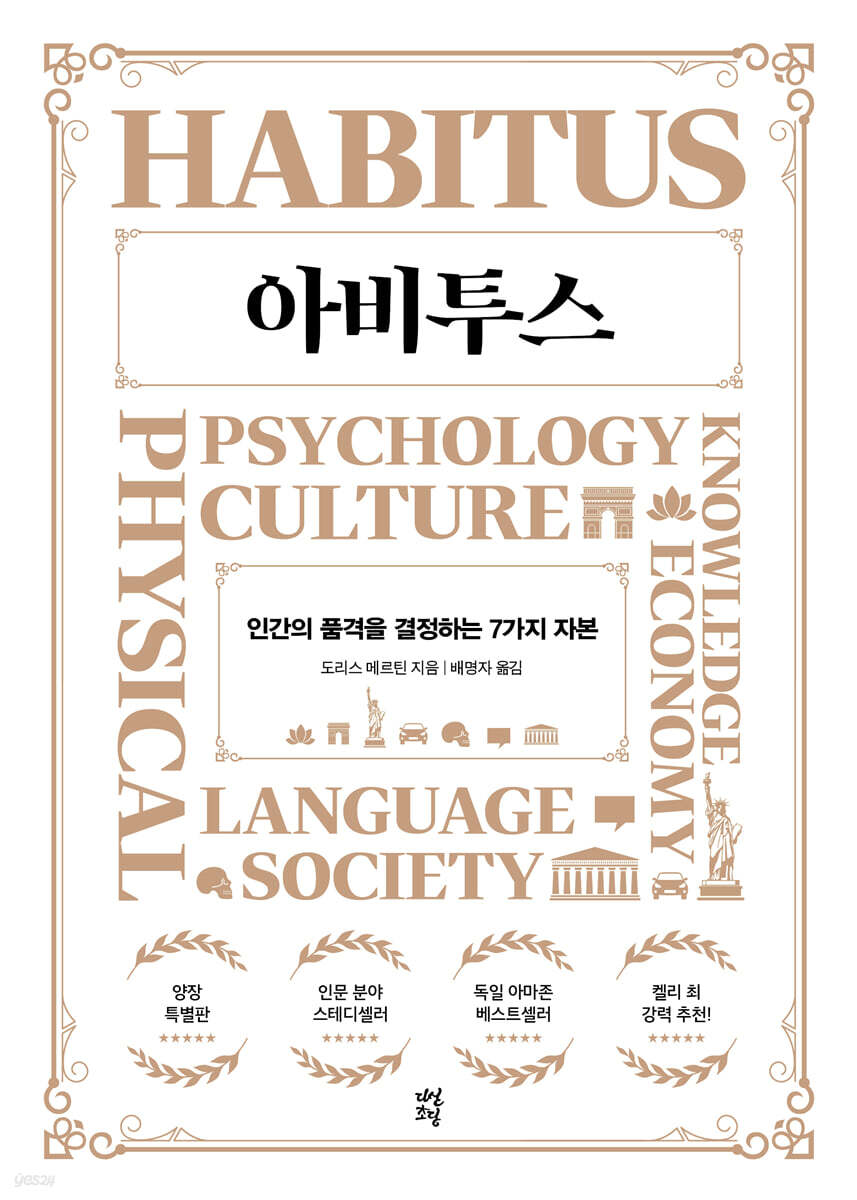
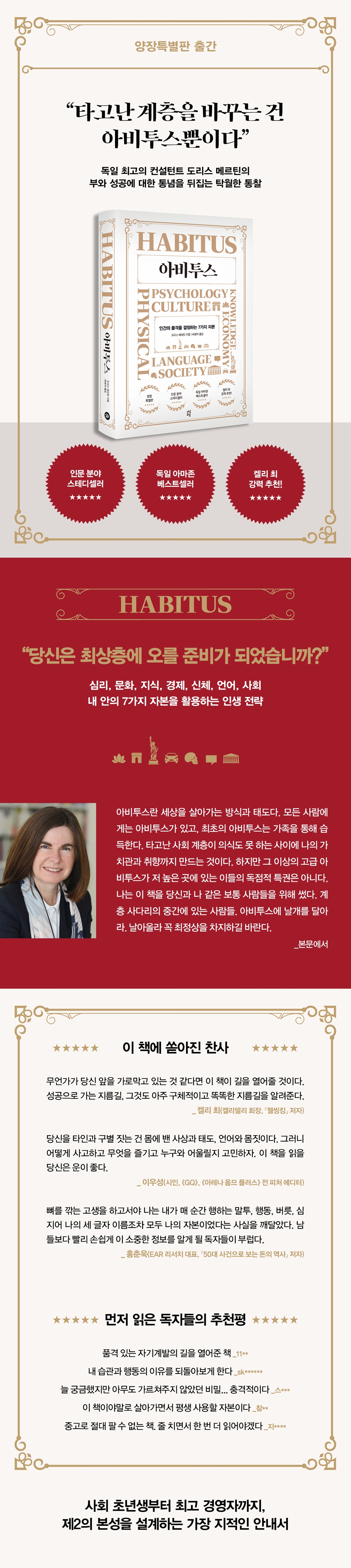
A special edition of the humanities bestseller 『Abitus』 has been published! Doris Mertin, Germany's top consultant A brilliant insight that overturns conventional wisdom about wealth and success. “Are you ready to climb to the top?” "Abitus," which became a bestseller in the humanities category immediately after its publication in 2020 and caused a sensation, has been republished in a special hardcover edition. This special edition adds a Korean preface and enhances its collection value with a luxurious hardcover. Doris Mertin, a top German consultant recommended by interviewer Jisoo Kim, who conveys the wisdom of the best scholars at home and abroad, and praised by top influencers in the self-development field such as Kelly Choi, Drawnrew, and Hong Chun-wook, analyzes the critical difference that separates the top class through the concept of 'habitus', which is unfamiliar to Korean readers. Having met countless people from all walks of life for 20 years, the author discovers the core secrets of elites who achieve everything they desire: wealth, success, health, connections, knowledge, and more. That is, having the best habitus. Habitus is a concept first proposed by French philosopher Bourdieu, and refers to a second nature determined by the sociocultural environment, that is, the tastes, habits, and aura that distinguish me from others. In 『Habitus』, the author talks about how to acquire the best habitus using the seven capitals that determine human character. It contains outstanding insights that have moved readers, such as, “I found a way to overcome my innate conditions,” “The secret to success that I was curious about but no one taught me,” and “This book enables dignified self-reflection.” Let's discover a life strategy that utilizes everything I have, from my momentary attitude to the knowledge and connections I've accumulated throughout my life, as capital. |
- You can preview some of the book's contents.
Preview
index
Praise poured in for this book
Special Edition Preface: The Only Power to Change Your Innate Class
Preface to the First Edition: Abitus Reveals Who You Are
Chapter 1: Habitus Determines Life, Opportunity, and Status
Being born into high status
Acknowledging the unfair reality
Not everything is decided by money.
Seven criteria for class division
You can escape your background
Where is the real 'top'?
Advanced Abitus that Makes Leaping Possible
Chapter 2: Psychological Capital: How We Think and How Far We Imagine
Don't stay in the same place all the time
The Importance of Resilience
Don't show your tension and don't complain
Ambition creates possibility
Generosity attracts dignity and wealth.
High goals are created in a safe environment.
The right character sustains success
Success must remain after death.
Interview: "Those who do what they love are most successful."
Chapter 3: Cultural Capital: What We Enjoy in Life
The most difficult capital to obtain
Status determines taste
Organic and bicycles instead of Prada and Chanel
French, piano, soccer vs. Greek, violin, golf
Formalism and rudeness
The world as home, the region as home
Technology that looks easygoing
Spread your wings and fly, but acknowledge your roots.
Interview: "Give Meaning to Your Life with Your Own Uniqueness"
Chapter 4: Knowledge Capital: What Can You Do?
The importance of a good education
A diploma is more important than you think
Until knowledge becomes power
What makes my heart beat
Broad interests broaden your horizons
Creativity is not a gift from God.
Access information that others don't know about
Expand your knowledge in all dimensions
Interview: "Even the second generation of chaebols must prove what they can do."
Chapter 5: Economic Capital: How Much Do You Have?
Everyone says 'it's not enough'
Anyway, if you don't have money, you're unhappy.
How you handle money determines your character.
Money gives you freedom, not luxury bags.
Think like a millionaire
The rich guy next door doesn't drive a luxury SUV.
Consumption to acquire the other six types of capital
Get support, but don't rely on it.
To leap forward, you must first become self-reliant.
Interview: "The Super Rich Don't Think or Act Like You"
Chapter 6: Physical Capital: How to Wear, Walk, and Manage It
Life is a game that favors those with outstanding looks.
Moderately loose or tight and neat
No need for show or status symbols
The virtue of natural wrinkles
A true boss enjoys marathons.
Treat your body as your most precious capital.
Interview: "As we age, well-maintained harmony becomes more important."
Chapter 7: Linguistic Capital: How to Speak
The language I use reveals my status.
What to say, how far to say it, and how to say it
Show, don't tell
Specifically, favorably, and solution-oriented
Clear content, polite voice
Small talk with the leader
Securing linguistic space
Increase the value of yourself and others at the same time
Interview: "Those at the top communicate without jealousy or impatience."
Chapter 8 Social Capital: Who You Hang Out With
Accept your natural origins
The people around you complete you.
The skill of naturally belonging to a group
gangs and collusion or alliances and communities
What's more important than the number of contacts
A hand pushing from behind, a mentor
If you want influence, stand out.
Power, Status, and Visibility: The Sphere of Influence
Build relationships to leap forward
Interview: "Without intention, with honesty, this is the magic spell to reach the top."
Concluding Remarks: Changing Habitus is Possible Anytime, Anywhere
Acknowledgments / Notes / References
Special Edition Preface: The Only Power to Change Your Innate Class
Preface to the First Edition: Abitus Reveals Who You Are
Chapter 1: Habitus Determines Life, Opportunity, and Status
Being born into high status
Acknowledging the unfair reality
Not everything is decided by money.
Seven criteria for class division
You can escape your background
Where is the real 'top'?
Advanced Abitus that Makes Leaping Possible
Chapter 2: Psychological Capital: How We Think and How Far We Imagine
Don't stay in the same place all the time
The Importance of Resilience
Don't show your tension and don't complain
Ambition creates possibility
Generosity attracts dignity and wealth.
High goals are created in a safe environment.
The right character sustains success
Success must remain after death.
Interview: "Those who do what they love are most successful."
Chapter 3: Cultural Capital: What We Enjoy in Life
The most difficult capital to obtain
Status determines taste
Organic and bicycles instead of Prada and Chanel
French, piano, soccer vs. Greek, violin, golf
Formalism and rudeness
The world as home, the region as home
Technology that looks easygoing
Spread your wings and fly, but acknowledge your roots.
Interview: "Give Meaning to Your Life with Your Own Uniqueness"
Chapter 4: Knowledge Capital: What Can You Do?
The importance of a good education
A diploma is more important than you think
Until knowledge becomes power
What makes my heart beat
Broad interests broaden your horizons
Creativity is not a gift from God.
Access information that others don't know about
Expand your knowledge in all dimensions
Interview: "Even the second generation of chaebols must prove what they can do."
Chapter 5: Economic Capital: How Much Do You Have?
Everyone says 'it's not enough'
Anyway, if you don't have money, you're unhappy.
How you handle money determines your character.
Money gives you freedom, not luxury bags.
Think like a millionaire
The rich guy next door doesn't drive a luxury SUV.
Consumption to acquire the other six types of capital
Get support, but don't rely on it.
To leap forward, you must first become self-reliant.
Interview: "The Super Rich Don't Think or Act Like You"
Chapter 6: Physical Capital: How to Wear, Walk, and Manage It
Life is a game that favors those with outstanding looks.
Moderately loose or tight and neat
No need for show or status symbols
The virtue of natural wrinkles
A true boss enjoys marathons.
Treat your body as your most precious capital.
Interview: "As we age, well-maintained harmony becomes more important."
Chapter 7: Linguistic Capital: How to Speak
The language I use reveals my status.
What to say, how far to say it, and how to say it
Show, don't tell
Specifically, favorably, and solution-oriented
Clear content, polite voice
Small talk with the leader
Securing linguistic space
Increase the value of yourself and others at the same time
Interview: "Those at the top communicate without jealousy or impatience."
Chapter 8 Social Capital: Who You Hang Out With
Accept your natural origins
The people around you complete you.
The skill of naturally belonging to a group
gangs and collusion or alliances and communities
What's more important than the number of contacts
A hand pushing from behind, a mentor
If you want influence, stand out.
Power, Status, and Visibility: The Sphere of Influence
Build relationships to leap forward
Interview: "Without intention, with honesty, this is the magic spell to reach the top."
Concluding Remarks: Changing Habitus is Possible Anytime, Anywhere
Acknowledgments / Notes / References
Detailed image
Into the book
Anyway, it's not decided by money alone.
Other resources are just as crucial as money in creating a meaningful life, influencing influence, and fulfilling oneself.
Bourdieu sees capital as a prerequisite for excellence, but the capital he speaks of includes much more than money and ability.
Background and connections are also capital.
Education, the way you relate, your aesthetic sense, your eloquence and appropriate tone of voice, and your confident demeanor are all capital.
And above all, optimism and a stable mind are also capital.
---From "Chapter 1 | Habitus Determines Life, Opportunity, and Status, p. 26"
The anxiety that comes with every new environment is also an encouragement to leap beyond your own shadow and reach higher levels.
It is helpful to know the seven types of capital at this time.
It systematically increases as a material and immaterial resource and directly affects our habitus.
It's basically similar to a computer game.
Obtain items such as swords and herbs and use them to increase your range of activity and ambition.
---From "Chapter 1 | Habitus Determines Life, Opportunity, and Status, pp. 34-35"
When we say about someone that they are "in a different class," we rarely mean money, looks, or background.
Usually, 'level' refers to the size of a person's heart, or 'vessel'.
Grade is determined by personality and attitude.
For example, a brain tumor patient who lives happily and cares about others despite having an incurable disease.
A politician who admits his foolish mistakes and resigns from his position.
A soccer player who gives his all until the end and eventually scores the winning goal, even when all other players have given up.
---From "Chapter 2 | Psychological Capital: How We Think and How Far We Imagine, p. 43"
The skills you need when you're under pressure—loss, illness, stress—are significantly different from the skills you need when things are going well.
During difficult times in life, it is necessary to endure harsh criticism, allow mistakes, let go of vain hopes, and not be discouraged.
(…) Resilience can be developed through training.
Every time we face a difficult situation, we have a valuable opportunity to train our resilience.
---From "Chapter 2 | Psychological Capital: How We Think and How Far We Imagine, p. 49"
Sociologists have identified three emerging trends you must keep in mind if you want to succeed at the top of the league.
First, quiet wealth.
Second, inconspicuous consumption.
Third, show off without trying too hard to show off.
He who keeps these three things shines by not shining.
---From "Chapter 3 | Cultural Capital: What We Enjoy in Life, p. 110"
Nowadays, it's not the best person who wins, but the one who's faster.
So, don't hesitate too long, and when a suitable offer comes along, be bold and believe in yourself more confidently.
And instead of constantly asking “Why can’t I?” we should focus on “Why should I do this?”
---From "Chapter 4 | Intellectual Capital: What Can Be Done, pp. 160-161"
Bourdieu defined habitus as “the history of the body, recorded not only in the brain but also in wrinkles, gestures, speech patterns, intonations, pronunciations, mannerisms, and everything else that marks us.”
In other words, our social status is engraved on our bodies.
Our bodies reveal our lives and our upbringing more clearly than penthouses, Porsches, or celebrity friends.
---From "Chapter 6 | Physical Capital: How to Wear, Walk, and Manage Yourself," pp. 211-212
People of high status respond calmly even when others interrupt them.
Just ignore the person who interferes, or stop them quietly without emotional agitation.
Then he continues talking as if nothing happened.
This attitude sends the following message to the audience:
“I don’t need to ask you to listen to me.
“You have no choice but to listen to what I have to say.”
---From "Chapter 7 | Linguistic Capital: How to Speak, p. 261"
The people around us influence our habitus.
We don't have to make any special effort.
Because habitus is contagious.
You will naturally become aware of how other people live their lives, what they wear, what they decorate their homes with, and what they consider desirable, beautiful, and legitimate.
We soon become infected with it.
Like children, we learn little by little by watching examples.
---From "Chapter 8 | Social Capital: Who You Hang Out With, p. 298"
Changes in habitus are possible anytime, anywhere.
Are you the only college graduate in your family? Do you work in a field where a unique, ingrained sense of style is valued as much as elegant solutions? Are you well on your way to the top, yet still feel like something is missing? Do you strive to perform at the same level as the best and realize that self-improvement is never-ending? Whatever your interests or ambitions, I hope you achieve what you consider to be the best.
Other resources are just as crucial as money in creating a meaningful life, influencing influence, and fulfilling oneself.
Bourdieu sees capital as a prerequisite for excellence, but the capital he speaks of includes much more than money and ability.
Background and connections are also capital.
Education, the way you relate, your aesthetic sense, your eloquence and appropriate tone of voice, and your confident demeanor are all capital.
And above all, optimism and a stable mind are also capital.
---From "Chapter 1 | Habitus Determines Life, Opportunity, and Status, p. 26"
The anxiety that comes with every new environment is also an encouragement to leap beyond your own shadow and reach higher levels.
It is helpful to know the seven types of capital at this time.
It systematically increases as a material and immaterial resource and directly affects our habitus.
It's basically similar to a computer game.
Obtain items such as swords and herbs and use them to increase your range of activity and ambition.
---From "Chapter 1 | Habitus Determines Life, Opportunity, and Status, pp. 34-35"
When we say about someone that they are "in a different class," we rarely mean money, looks, or background.
Usually, 'level' refers to the size of a person's heart, or 'vessel'.
Grade is determined by personality and attitude.
For example, a brain tumor patient who lives happily and cares about others despite having an incurable disease.
A politician who admits his foolish mistakes and resigns from his position.
A soccer player who gives his all until the end and eventually scores the winning goal, even when all other players have given up.
---From "Chapter 2 | Psychological Capital: How We Think and How Far We Imagine, p. 43"
The skills you need when you're under pressure—loss, illness, stress—are significantly different from the skills you need when things are going well.
During difficult times in life, it is necessary to endure harsh criticism, allow mistakes, let go of vain hopes, and not be discouraged.
(…) Resilience can be developed through training.
Every time we face a difficult situation, we have a valuable opportunity to train our resilience.
---From "Chapter 2 | Psychological Capital: How We Think and How Far We Imagine, p. 49"
Sociologists have identified three emerging trends you must keep in mind if you want to succeed at the top of the league.
First, quiet wealth.
Second, inconspicuous consumption.
Third, show off without trying too hard to show off.
He who keeps these three things shines by not shining.
---From "Chapter 3 | Cultural Capital: What We Enjoy in Life, p. 110"
Nowadays, it's not the best person who wins, but the one who's faster.
So, don't hesitate too long, and when a suitable offer comes along, be bold and believe in yourself more confidently.
And instead of constantly asking “Why can’t I?” we should focus on “Why should I do this?”
---From "Chapter 4 | Intellectual Capital: What Can Be Done, pp. 160-161"
Bourdieu defined habitus as “the history of the body, recorded not only in the brain but also in wrinkles, gestures, speech patterns, intonations, pronunciations, mannerisms, and everything else that marks us.”
In other words, our social status is engraved on our bodies.
Our bodies reveal our lives and our upbringing more clearly than penthouses, Porsches, or celebrity friends.
---From "Chapter 6 | Physical Capital: How to Wear, Walk, and Manage Yourself," pp. 211-212
People of high status respond calmly even when others interrupt them.
Just ignore the person who interferes, or stop them quietly without emotional agitation.
Then he continues talking as if nothing happened.
This attitude sends the following message to the audience:
“I don’t need to ask you to listen to me.
“You have no choice but to listen to what I have to say.”
---From "Chapter 7 | Linguistic Capital: How to Speak, p. 261"
The people around us influence our habitus.
We don't have to make any special effort.
Because habitus is contagious.
You will naturally become aware of how other people live their lives, what they wear, what they decorate their homes with, and what they consider desirable, beautiful, and legitimate.
We soon become infected with it.
Like children, we learn little by little by watching examples.
---From "Chapter 8 | Social Capital: Who You Hang Out With, p. 298"
Changes in habitus are possible anytime, anywhere.
Are you the only college graduate in your family? Do you work in a field where a unique, ingrained sense of style is valued as much as elegant solutions? Are you well on your way to the top, yet still feel like something is missing? Do you strive to perform at the same level as the best and realize that self-improvement is never-ending? Whatever your interests or ambitions, I hope you achieve what you consider to be the best.
---From "Closing Note: Changing Habitus is Possible Anytime, Anywhere, p. 349"
Publisher's Review
“Why do I speak, enjoy, and think like this?”
The power of habitus is stronger than habit
Everyone has probably tried to change their habits after reading a book or watching a video about habits.
The list of habits we need to change is endless: quitting smoking, dieting, learning English, the way we speak, etc.
But most resolutions don't last long, and they don't seem to be rewarded for the effort, so we quickly become frustrated and give up.
They say that all you have to do is change your habits, but changing those habits isn't as easy as it sounds.
It is at this point that Doris Mertin, the author of this book, proposes a completely new solution.
That's Abitus.
Habitus is a concept first proposed by French philosopher Bourdieu, and refers to a second nature determined by the sociocultural environment.
In short, the class I belong to, the people I meet, the hobbies I enjoy, and all the tasks I accomplish create my habitus, so simply trying to change my habits will never achieve what I want.
The idea that you can live the life you truly want only by changing your habitus, a concept more fundamental than your habits.
Fortunately, according to the author, Abitus was not carved in stone.
If you know exactly where you need to go and put in the right effort, you can change your habitus.
This book, "Habitus," is a book that provides knowledge about the seven capitals (psychology, culture, knowledge, economy, body, language, and society) that are important in our lives, but ultimately, it tells us about the ultimate method to make ourselves a little better.
If we realize the true power of habitus, which is stronger than habit, and work to reconstruct the many things that make us who we are, we will live a more satisfying life in all areas of our lives.
“What leads us to the top is
“It is excellence that has become a habit.”
There is a person who has gained international recognition for over 20 years by consulting and lecturing to companies and individuals based on a deep understanding of language and literature.
This is Doris Mertin, the author of 『Abitus』.
He has been analyzing the intimate codes contained within human language to connect each person's attitude and personality to their potential and success.
Every book he published with his outstanding insight became a world-wide bestseller.
In particular, 『Abitus』 received even more enthusiastic attention from readers around the world by honestly revealing the uncomfortable truths of life that had been vaguely felt but never clearly spoken about anywhere.
It clearly distinguishes between the upper and lower classes, and realistically explains the value of a college diploma and the power of appearance.
The author's talent for presenting a sharp perspective on wealth and success without hesitation naturally forces readers to confront uncomfortable truths they might otherwise prefer not to acknowledge.
At the end of each chapter, interviews with various experts, including psychologists, sociologists, headhunters, and future researchers, reinforce the content explained above and summarize the seven capitals.
This will help you answer many of your questions and provide specific tips that you can apply in your real life.
The countless examples of people who have overcome adversity give us a sense of hope we never had before.
The combination of constantly motivating self-improvement messages and humanistic analysis using cases and concepts from philosophy and sociology provides a powerful force that challenges our preconceptions and inspires change "right now."
It's time to reconfigure all your resources and fly higher.
From fresh graduates to CEOs,
7 Weapons with All the Strategies You Need for Life
Habitus is determined by minor differences.
For example, a father's calm response when his daughter gets hurt is not a cold parenting style, but rather an upper-class habitus that fosters resilience in his daughter.
Through her father's calm demeanor, the daughter learns that 'all hardships are trivial and no situation has to be tragic.'
Instead of flaunting their class with shiny gold watches and flashy foreign cars, the attitude of displaying class through subtle cultural tastes also functions as the habitus of successful people.
In "That High Place," newcomers can only truly become members when they demonstrate a cautious attitude toward reading the code of the place, rather than trying too hard or trying to stand out, and when they create a natural glow through consistent care, rather than hiding their shabbiness behind plastic surgery or luxury handbags.
Things that can be had with money are merely temporary status symbols and can never be replaced by habitus.
However, the ability to choose quality items and the act of enjoying a high level of cultural life are high-class habitus that create class, and considering them as luxuries is nothing more than an act that exposes one's limitations.
The code of Abitus that completes me in this way is very complex and subtle.
The author keenly perceives these subtle differences and conveys them clearly.
We just have to be prepared to struggle through this complex code.
Whether you're a newbie just starting out or a manager struggling to find your footing, a quality habitus will solidify you and help you shine on the high ground.
The power of habitus is stronger than habit
Everyone has probably tried to change their habits after reading a book or watching a video about habits.
The list of habits we need to change is endless: quitting smoking, dieting, learning English, the way we speak, etc.
But most resolutions don't last long, and they don't seem to be rewarded for the effort, so we quickly become frustrated and give up.
They say that all you have to do is change your habits, but changing those habits isn't as easy as it sounds.
It is at this point that Doris Mertin, the author of this book, proposes a completely new solution.
That's Abitus.
Habitus is a concept first proposed by French philosopher Bourdieu, and refers to a second nature determined by the sociocultural environment.
In short, the class I belong to, the people I meet, the hobbies I enjoy, and all the tasks I accomplish create my habitus, so simply trying to change my habits will never achieve what I want.
The idea that you can live the life you truly want only by changing your habitus, a concept more fundamental than your habits.
Fortunately, according to the author, Abitus was not carved in stone.
If you know exactly where you need to go and put in the right effort, you can change your habitus.
This book, "Habitus," is a book that provides knowledge about the seven capitals (psychology, culture, knowledge, economy, body, language, and society) that are important in our lives, but ultimately, it tells us about the ultimate method to make ourselves a little better.
If we realize the true power of habitus, which is stronger than habit, and work to reconstruct the many things that make us who we are, we will live a more satisfying life in all areas of our lives.
“What leads us to the top is
“It is excellence that has become a habit.”
There is a person who has gained international recognition for over 20 years by consulting and lecturing to companies and individuals based on a deep understanding of language and literature.
This is Doris Mertin, the author of 『Abitus』.
He has been analyzing the intimate codes contained within human language to connect each person's attitude and personality to their potential and success.
Every book he published with his outstanding insight became a world-wide bestseller.
In particular, 『Abitus』 received even more enthusiastic attention from readers around the world by honestly revealing the uncomfortable truths of life that had been vaguely felt but never clearly spoken about anywhere.
It clearly distinguishes between the upper and lower classes, and realistically explains the value of a college diploma and the power of appearance.
The author's talent for presenting a sharp perspective on wealth and success without hesitation naturally forces readers to confront uncomfortable truths they might otherwise prefer not to acknowledge.
At the end of each chapter, interviews with various experts, including psychologists, sociologists, headhunters, and future researchers, reinforce the content explained above and summarize the seven capitals.
This will help you answer many of your questions and provide specific tips that you can apply in your real life.
The countless examples of people who have overcome adversity give us a sense of hope we never had before.
The combination of constantly motivating self-improvement messages and humanistic analysis using cases and concepts from philosophy and sociology provides a powerful force that challenges our preconceptions and inspires change "right now."
It's time to reconfigure all your resources and fly higher.
From fresh graduates to CEOs,
7 Weapons with All the Strategies You Need for Life
Habitus is determined by minor differences.
For example, a father's calm response when his daughter gets hurt is not a cold parenting style, but rather an upper-class habitus that fosters resilience in his daughter.
Through her father's calm demeanor, the daughter learns that 'all hardships are trivial and no situation has to be tragic.'
Instead of flaunting their class with shiny gold watches and flashy foreign cars, the attitude of displaying class through subtle cultural tastes also functions as the habitus of successful people.
In "That High Place," newcomers can only truly become members when they demonstrate a cautious attitude toward reading the code of the place, rather than trying too hard or trying to stand out, and when they create a natural glow through consistent care, rather than hiding their shabbiness behind plastic surgery or luxury handbags.
Things that can be had with money are merely temporary status symbols and can never be replaced by habitus.
However, the ability to choose quality items and the act of enjoying a high level of cultural life are high-class habitus that create class, and considering them as luxuries is nothing more than an act that exposes one's limitations.
The code of Abitus that completes me in this way is very complex and subtle.
The author keenly perceives these subtle differences and conveys them clearly.
We just have to be prepared to struggle through this complex code.
Whether you're a newbie just starting out or a manager struggling to find your footing, a quality habitus will solidify you and help you shine on the high ground.
GOODS SPECIFICS
- Date of issue: March 24, 2023
- Format: Hardcover book binding method guide
- Page count, weight, size: 372 pages | 724g | 152*215*25mm
- ISBN13: 9791130698366
- ISBN10: 113069836X
You may also like
카테고리
korean


korean

![ELLE 엘르 스페셜 에디션 A형 : 12월 [2025]](http://librairie.coreenne.fr/cdn/shop/files/b8e27a3de6c9538896439686c6b0e8fb.jpg?v=1766436872&width=3840)


