

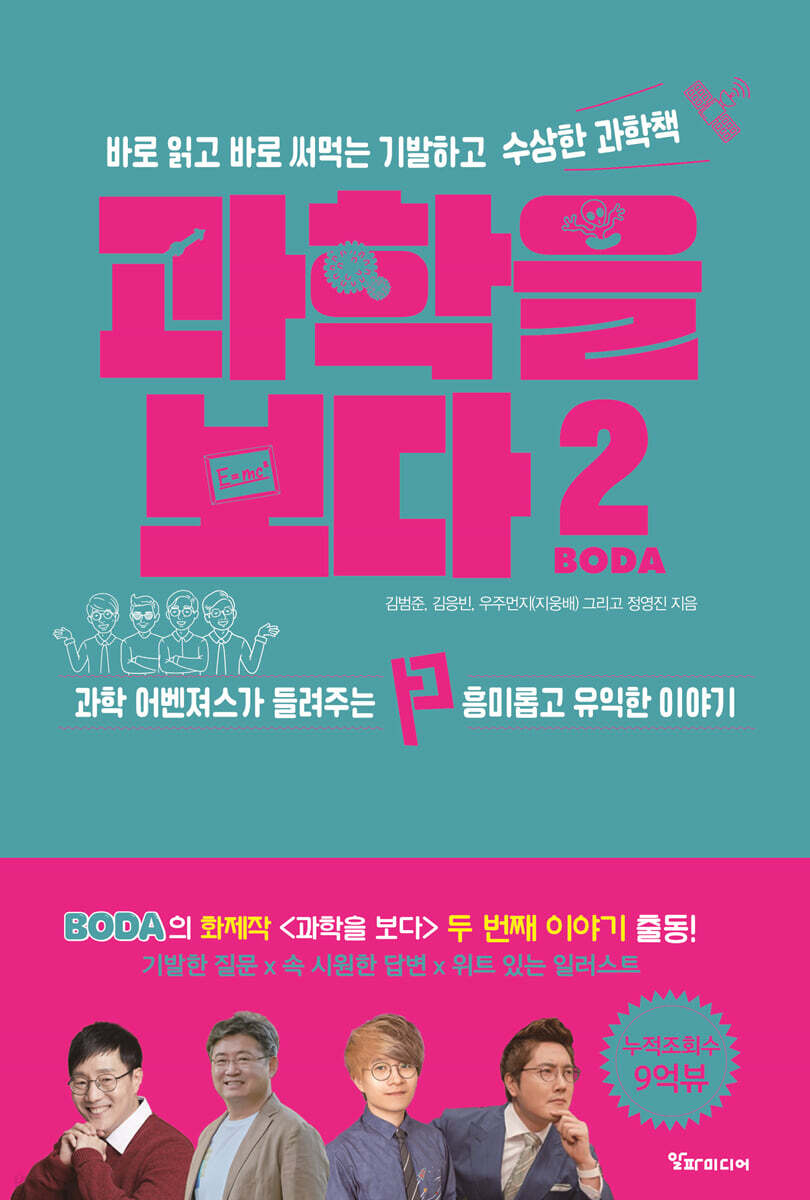
See Science 2
 |
Description
Book Introduction
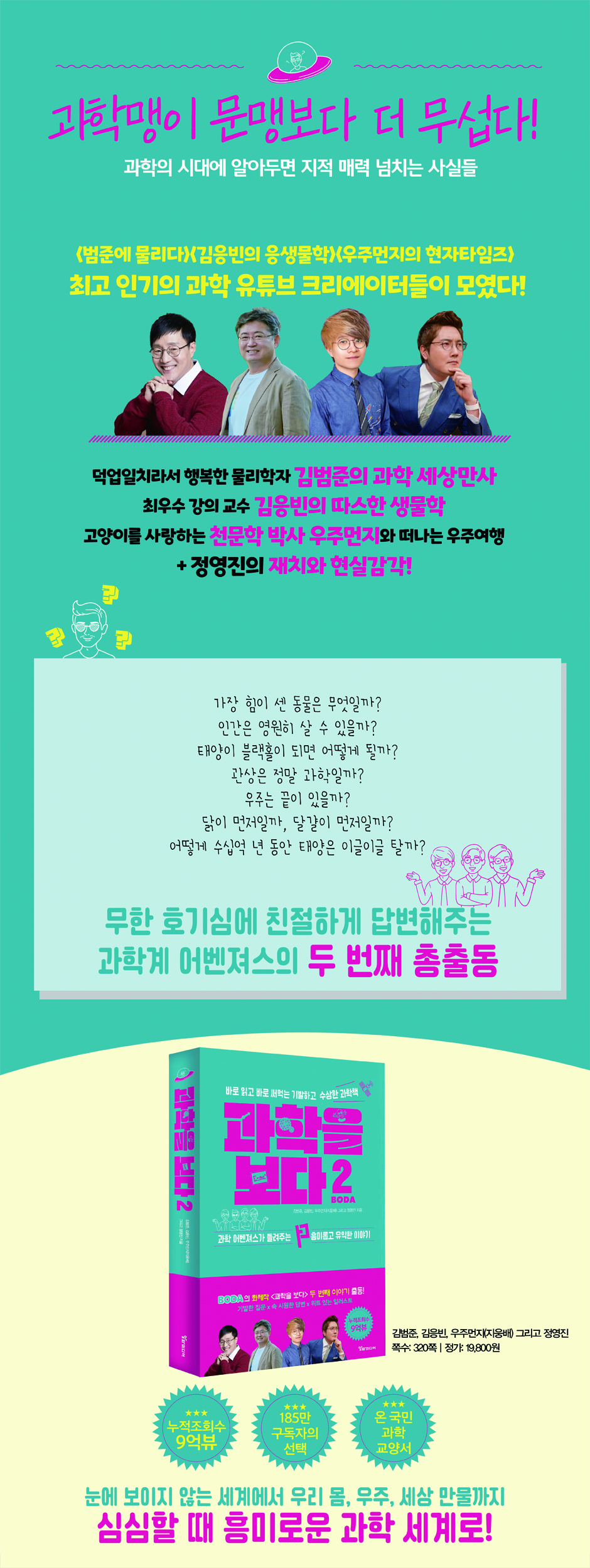
BODA's hit series "See Science" with 900 million cumulative views Facts that will explode with intellectual fascination in the age of science The science world of physicist Kim Beom-jun, who is happy because his hobby matches his job. Warm Biology by Professor Kim Eung-bin, the best lecturer A space journey with cat-loving astronomer Dr. Woo Joo-Dum, a space duster. + Jeong Yeong-jin's wit and sense of reality! The second volume of the best-selling 『See Science』 series, beloved by readers, has finally been published. The "See Science" series is a book published based on the popular content "See Science" from the YouTube channel "BODA", adding interesting facts and detailed explanations that were not fully introduced in the video. The YouTube series "See Science" has been receiving more and more praise from netizens over time, and has accumulated over 900 million views. It is no exaggeration to say that it has established itself as our country's best scientific content across all media. However, viewers were hungry for more in-depth and detailed information on the relevant topics, as the YouTube video "See Science" is a discussion format with a time limit. This thirst among viewers led to the creation of the best-selling series “See Science.” In this installment of 『Seeing Science 2』, biologist Professor Kim Eung-bin joins the team as a new author to tell us about the mysterious world of microorganisms and various life phenomena. Historically, advances in science and technology have greatly improved human life. Especially in the present era in which we live, science has become more important than any other time in the past. It seems like we hear news of new scientific discoveries or inventions almost every week. We have entered an era where basic scientific knowledge is essential for personal growth, regardless of the occupation. Science is a common topic of conversation at work or at gatherings with friends. However, this book is a customized prescription for those who are too ignorant to open their mouths or have difficulty understanding the latest scientific knowledge or information. If you follow along with a light heart as our country's top scientists give witty answers to witty questions based on everyday life, your scientific knowledge will gradually increase. "Science Seen 2" covers everything from the invisible world to the curiosity of all things in the world. If you keep it by your side and look at it from time to time, you will find yourself exploding with intellectual charm. |
- You can preview some of the book's contents.
Preview
index
Entering
Part 1.
The Amazing Mystery of Life
1 What are the characteristics of long-lived organisms?
2 Is it true that in America you can make money just by pooping?
3 When did mosquitoes start to exist?
4 Why are cockroaches so resilient?
5 Who is the strongest life form in the universe?
6 Which came first, the chicken or the egg?
7 How do spiders know how to build their webs?
8 Can plants hear and speak?
9 Are mushrooms really molds?
10 What happens when an ancient virus awakens?
11 Are there scary microbes?
12 Why did the bedbugs reappear?
13 Why do large animals move slowly?
14 What is the strongest animal?
15 The sea is the origin of all life?
16 Did the seeds of life come from space?
Subscribers' various questions 1
Part 2.
The Amazing and Useful Story of My Body
If I eat 1kg, will my weight also increase by 1kg?
2 Do zombies really exist?
3 Can humans live forever or not?
4 What if there was a pill that would fill you up just by taking one?
5 Why do humans use their right hand more?
6 You said you did an experiment to bring the dead back to life?
7 What is the most terrifying epidemic in human history?
8 Is it true that you don't catch a cold because you're cold?
9 How long can humans survive in space?
10 Does your brain function decline as you age?
Subscribers' various questions 2
Part 3.
Newly Revealed Secrets of the Universe
1 Is there an end to the universe?
What is 2 hours?
3 Gravitational waves are tremors in spacetime?
4 Why are gravitational waves important?
Can you tell a difference smaller than the width of a hair across billions of light years?
Why send someone back every 6 months?
Can humans survive on the 7th moon?
8 Mysterious vortexes discovered on the lunar surface?
9 How does the sun burn for billions of years?
10 What would happen if the sun became a black hole?
11 Is it true that there is a black hole smaller than a human fingernail?
12 Are we the product of a supernova explosion?
13 Could there be alien life that doesn't need water?
14 Signs of life discovered in space?
15 What would happen if the Earth stopped rotating?
16 What is the structure of the universe?
Subscribers' various questions 3
Part 4.
The science of all things in the world
1 Why does it feel cool when you turn on a fan when it's hot?
2 Why does the light from a laser pointer go straight instead of spreading out?
3 What does it mean to travel at the speed of light?
4 How do hospital X-rays take pictures of the inside of the body?
5. Is it true that germanium bracelets are good for your health?
6 Do you believe in superstitions?
7 Do you still believe the Earth is flat?
8 Is physiognomy really a science?
9 The Pauli effect that causes everything to break down
10 How much do we use our brains?
11 Are you being held down by scissors because of a ghost?
12 Are the symptoms that appear just before death true?
13 Strange substances that exist in the world
Subscribers' various questions 4
Part 1.
The Amazing Mystery of Life
1 What are the characteristics of long-lived organisms?
2 Is it true that in America you can make money just by pooping?
3 When did mosquitoes start to exist?
4 Why are cockroaches so resilient?
5 Who is the strongest life form in the universe?
6 Which came first, the chicken or the egg?
7 How do spiders know how to build their webs?
8 Can plants hear and speak?
9 Are mushrooms really molds?
10 What happens when an ancient virus awakens?
11 Are there scary microbes?
12 Why did the bedbugs reappear?
13 Why do large animals move slowly?
14 What is the strongest animal?
15 The sea is the origin of all life?
16 Did the seeds of life come from space?
Subscribers' various questions 1
Part 2.
The Amazing and Useful Story of My Body
If I eat 1kg, will my weight also increase by 1kg?
2 Do zombies really exist?
3 Can humans live forever or not?
4 What if there was a pill that would fill you up just by taking one?
5 Why do humans use their right hand more?
6 You said you did an experiment to bring the dead back to life?
7 What is the most terrifying epidemic in human history?
8 Is it true that you don't catch a cold because you're cold?
9 How long can humans survive in space?
10 Does your brain function decline as you age?
Subscribers' various questions 2
Part 3.
Newly Revealed Secrets of the Universe
1 Is there an end to the universe?
What is 2 hours?
3 Gravitational waves are tremors in spacetime?
4 Why are gravitational waves important?
Can you tell a difference smaller than the width of a hair across billions of light years?
Why send someone back every 6 months?
Can humans survive on the 7th moon?
8 Mysterious vortexes discovered on the lunar surface?
9 How does the sun burn for billions of years?
10 What would happen if the sun became a black hole?
11 Is it true that there is a black hole smaller than a human fingernail?
12 Are we the product of a supernova explosion?
13 Could there be alien life that doesn't need water?
14 Signs of life discovered in space?
15 What would happen if the Earth stopped rotating?
16 What is the structure of the universe?
Subscribers' various questions 3
Part 4.
The science of all things in the world
1 Why does it feel cool when you turn on a fan when it's hot?
2 Why does the light from a laser pointer go straight instead of spreading out?
3 What does it mean to travel at the speed of light?
4 How do hospital X-rays take pictures of the inside of the body?
5. Is it true that germanium bracelets are good for your health?
6 Do you believe in superstitions?
7 Do you still believe the Earth is flat?
8 Is physiognomy really a science?
9 The Pauli effect that causes everything to break down
10 How much do we use our brains?
11 Are you being held down by scissors because of a ghost?
12 Are the symptoms that appear just before death true?
13 Strange substances that exist in the world
Subscribers' various questions 4
Detailed image
Into the book
Have you ever heard of biomimetics? It's a field that develops new technologies by leveraging the structures and characteristics of all living organisms on Earth.
It is a compound word of the words 'bio' and 'mimetics', and it refers to imitating and utilizing scientific principles that have evolved through trial and error in natural life over a long period of time.
After all, airplanes are modeled after bird wings.
Many novel products are being developed, such as self-cleaning fabrics that utilize the principle of lotus leaves rolling water droplets, and painless skin-piercing needles using mosquito proboscises.
--- p.57
Many people probably think of elephants as the strongest animal.
The true power lies in the sea.
It's a blue whale.
It is also called the blue whale, and its English name is 'Blue Whale' because of the blue color of its body.
It is so large that a specimen measuring as much as 33 meters in length has been discovered.
It is believed to be the largest species of animal that has ever existed on Earth, including dinosaurs.
It is truly amazing that a newborn calf can grow to be 7 meters long and weigh 2.5 tons, and gain 100 kg per day during its growth period.
It's difficult to accurately measure the strength of a blue whale, but it's no match for an elephant on land.
An elephant weighs about 2 tons on average, but a blue whale's tongue alone weighs 4 tons.
--- p91~92
Have you ever heard the term "other-handed"? It's a term used to describe someone who is more skilled at certain tasks, as opposed to being ambidextrous.
An ambidextrous person is someone who can write with equal skill with both hands, while an ambidextrous person is someone who writes with their left hand but eats with their right hand.
What this means is that although people are born with a hand they are more likely to use, they can learn to use both hands freely as much as they want later on through training.
--- p.132
There is a representative study conducted on taxi drivers in London, England.
London is famous for its very complex city center.
They say that to get a real London taxi license, you have to memorize every alleyway within a 10km radius of central London and memorize every nook and cranny of the city.
And while driving a taxi, you have to find shortcuts to destinations that are irregularly determined depending on the passenger, and to do this, you have to constantly and quickly process information in your head about how the complex alleys are connected to each other.
A research team led by Professor Eleanor Maguire of University College London analyzed their brains using MRI (magnetic resonance imaging).
Despite being a group with a considerable age range, the hippocampus, the part of the brain responsible for spatial memory, was well developed.
Professor Eleanor Maguire says, “The human brain continues to change as we acquire new skills and knowledge, even after we reach adulthood.”
--- p.161
What would happen in Earth's sky would be a black hole, a large black hole, and in the opposite direction a brightly shining disk, as if there were a sun.
Astronomers call this a pseudo sun created by a black hole.
One interesting thought that comes to mind here is that if there were a planet around a black hole, it might seem like a terrible environment for life, but if it were located far enough away, it could receive light from a fake sun created by the distorted spacetime of the black hole, maintaining a suitable temperature like Earth, and support life.
In the movie Interstellar, there is a planet around a black hole where the main character lands.
The interesting premise that real people could live there is not scientifically impossible either.
--- p.221~222
Many people underestimate the influence of pseudoscience like physiognomy.
If you repeatedly tell your young child something like, “You have this kind of face, so you would be suited for this kind of job,” you could end up forming some really absurd subconscious thoughts in the child.
I'm not that tall.
If you've been told repeatedly since childhood that "only tall people can become CEOs of big companies," you'll likely lose the desire to start a business and become an entrepreneur.
The MBTI personality analysis, which is so indiscriminately popular these days, also carries the same risk.
Many psychologists point out that MBTI analysis has limitations in oversimplifying a person's complex and multifaceted personality.
It is a compound word of the words 'bio' and 'mimetics', and it refers to imitating and utilizing scientific principles that have evolved through trial and error in natural life over a long period of time.
After all, airplanes are modeled after bird wings.
Many novel products are being developed, such as self-cleaning fabrics that utilize the principle of lotus leaves rolling water droplets, and painless skin-piercing needles using mosquito proboscises.
--- p.57
Many people probably think of elephants as the strongest animal.
The true power lies in the sea.
It's a blue whale.
It is also called the blue whale, and its English name is 'Blue Whale' because of the blue color of its body.
It is so large that a specimen measuring as much as 33 meters in length has been discovered.
It is believed to be the largest species of animal that has ever existed on Earth, including dinosaurs.
It is truly amazing that a newborn calf can grow to be 7 meters long and weigh 2.5 tons, and gain 100 kg per day during its growth period.
It's difficult to accurately measure the strength of a blue whale, but it's no match for an elephant on land.
An elephant weighs about 2 tons on average, but a blue whale's tongue alone weighs 4 tons.
--- p91~92
Have you ever heard the term "other-handed"? It's a term used to describe someone who is more skilled at certain tasks, as opposed to being ambidextrous.
An ambidextrous person is someone who can write with equal skill with both hands, while an ambidextrous person is someone who writes with their left hand but eats with their right hand.
What this means is that although people are born with a hand they are more likely to use, they can learn to use both hands freely as much as they want later on through training.
--- p.132
There is a representative study conducted on taxi drivers in London, England.
London is famous for its very complex city center.
They say that to get a real London taxi license, you have to memorize every alleyway within a 10km radius of central London and memorize every nook and cranny of the city.
And while driving a taxi, you have to find shortcuts to destinations that are irregularly determined depending on the passenger, and to do this, you have to constantly and quickly process information in your head about how the complex alleys are connected to each other.
A research team led by Professor Eleanor Maguire of University College London analyzed their brains using MRI (magnetic resonance imaging).
Despite being a group with a considerable age range, the hippocampus, the part of the brain responsible for spatial memory, was well developed.
Professor Eleanor Maguire says, “The human brain continues to change as we acquire new skills and knowledge, even after we reach adulthood.”
--- p.161
What would happen in Earth's sky would be a black hole, a large black hole, and in the opposite direction a brightly shining disk, as if there were a sun.
Astronomers call this a pseudo sun created by a black hole.
One interesting thought that comes to mind here is that if there were a planet around a black hole, it might seem like a terrible environment for life, but if it were located far enough away, it could receive light from a fake sun created by the distorted spacetime of the black hole, maintaining a suitable temperature like Earth, and support life.
In the movie Interstellar, there is a planet around a black hole where the main character lands.
The interesting premise that real people could live there is not scientifically impossible either.
--- p.221~222
Many people underestimate the influence of pseudoscience like physiognomy.
If you repeatedly tell your young child something like, “You have this kind of face, so you would be suited for this kind of job,” you could end up forming some really absurd subconscious thoughts in the child.
I'm not that tall.
If you've been told repeatedly since childhood that "only tall people can become CEOs of big companies," you'll likely lose the desire to start a business and become an entrepreneur.
The MBTI personality analysis, which is so indiscriminately popular these days, also carries the same risk.
Many psychologists point out that MBTI analysis has limitations in oversimplifying a person's complex and multifaceted personality.
--- p.295
Publisher's Review
The second installment of the Avengers of Science's full mobilization.
The most authoritative scientists in the country tell us
Life, nature, the universe and all things in the world
Science is fun! Yet, for some reason, surprisingly many people find it not only difficult, but also boring and tedious.
The "See Science" series is a book for science idiots who misunderstand science.
This book does not hide the questions.
Why doesn't your weight increase by the weight of the food you eat? Is it true that people get paid to poop? Do scary zombies actually exist in reality? Who is the strongest life form in the universe? These are just raw, primal questions, without any pretense or pretense.
The curiosity we harbored in our hearts, which we had never dared to ask, is now being sincerely answered by the country's most authoritative scientists.
Listening to the scientists' friendly explanations, you can realize that science is such an exciting and fun field that you lose track of time.
Humans have many desires, such as appetite, sex, and sleep, but curiosity is also an instinctive desire that cannot be suppressed.
In particular, by following the process of scientists systematically and rationally thinking through each paragraph to find the right answer to a question that may seem absurd, you will naturally develop the attitude to rationally analyze and correctly solve problems related to yourself.
If you enjoy science, you can improve and grow your own life.
〈Bitten by Beomjun〉〈Kim Eungbin's Response Biology〉〈Space Dust's Sage Times〉
The most popular science YouTube creators gathered together!
"Knowing science makes the world a better place."
“Immerse yourself in the stories of these quirky and amazing scientists.”
· What is the strongest animal?
· Can humans live forever?
· What would happen if the sun became a black hole?
· Is physiognomy really a science?
· Does the universe have an end?
· Which came first, the chicken or the egg?
This book consists of four chapters.
Chapters 1 and 2 cover the amazing mysteries of life and the wonderful and useful story of my body.
Professor Kim Eung-bin, a biologist with a warm and caring demeanor like a kind neighbor, tells the story of life, a mysterious yet fascinating subject, with vivid descriptions that make you feel as if you are seeing it with your own eyes.
How can spiders build such complex structures without being taught by anyone? What would happen to humanity if an ancient virus dormant in the ice were to awaken due to global warming? Do the terrifying zombies that often appear in movies actually exist in the real world? These questions are answered with humor and easy-to-understand logic.
It also reveals new facts about our own bodies, which we all cherish but do not know in detail, such as why do humans use their right hand more than their two equally-sized hands? As other bodily functions gradually decline with age, does the brain do the same? Is it possible for humans to live forever without dying with the advancement of science and technology?
In Chapter 3, astronomer Dr. Cosmic Dust answers our eternal curiosity about the universe.
The news that the high-performance James Webb Space Telescope, introduced in Volume 1 of "Science Through the Eyes," has revealed new secrets of the universe and that it plans to send a spacecraft carrying humans to the moon again in 2025 excites us.
The reason why the cosmic stories that cosmic dust unravels for us are so fascinating is probably because I am truly in love with space.
When he reveals the mysterious secrets of the universe, such as the existence of black holes smaller than a human fingernail, readers will have a hard time taking their eyes off the book.
In Chapter 4, Professor Kim Beom-jun, a physicist who has always been happy because his passion has become his job, talks about the science of all things in the world.
It tells us about the science in our daily lives that we take for granted.
We explain the scientific principles that can actually help us, such as why we feel cool when we turn on the fan, how hospital X-rays take pictures of the inside of our body, and whether germanium bracelets, magnetic necklaces, and negative ion beds are really good for our health or, in fact, harmful to our health.
Its logical and scientific approach can also help us solve life's problems as we go through life.
This volume, "Seeing Science 2," contains more novel and informative topics and more faithful content than the first volume, which was enthusiastically received by readers.
And witty illustrations throughout help you understand the content.
I hope that more readers will be able to embark on an enjoyable scientific journey with 『See Science 2』.
The most authoritative scientists in the country tell us
Life, nature, the universe and all things in the world
Science is fun! Yet, for some reason, surprisingly many people find it not only difficult, but also boring and tedious.
The "See Science" series is a book for science idiots who misunderstand science.
This book does not hide the questions.
Why doesn't your weight increase by the weight of the food you eat? Is it true that people get paid to poop? Do scary zombies actually exist in reality? Who is the strongest life form in the universe? These are just raw, primal questions, without any pretense or pretense.
The curiosity we harbored in our hearts, which we had never dared to ask, is now being sincerely answered by the country's most authoritative scientists.
Listening to the scientists' friendly explanations, you can realize that science is such an exciting and fun field that you lose track of time.
Humans have many desires, such as appetite, sex, and sleep, but curiosity is also an instinctive desire that cannot be suppressed.
In particular, by following the process of scientists systematically and rationally thinking through each paragraph to find the right answer to a question that may seem absurd, you will naturally develop the attitude to rationally analyze and correctly solve problems related to yourself.
If you enjoy science, you can improve and grow your own life.
〈Bitten by Beomjun〉〈Kim Eungbin's Response Biology〉〈Space Dust's Sage Times〉
The most popular science YouTube creators gathered together!
"Knowing science makes the world a better place."
“Immerse yourself in the stories of these quirky and amazing scientists.”
· What is the strongest animal?
· Can humans live forever?
· What would happen if the sun became a black hole?
· Is physiognomy really a science?
· Does the universe have an end?
· Which came first, the chicken or the egg?
This book consists of four chapters.
Chapters 1 and 2 cover the amazing mysteries of life and the wonderful and useful story of my body.
Professor Kim Eung-bin, a biologist with a warm and caring demeanor like a kind neighbor, tells the story of life, a mysterious yet fascinating subject, with vivid descriptions that make you feel as if you are seeing it with your own eyes.
How can spiders build such complex structures without being taught by anyone? What would happen to humanity if an ancient virus dormant in the ice were to awaken due to global warming? Do the terrifying zombies that often appear in movies actually exist in the real world? These questions are answered with humor and easy-to-understand logic.
It also reveals new facts about our own bodies, which we all cherish but do not know in detail, such as why do humans use their right hand more than their two equally-sized hands? As other bodily functions gradually decline with age, does the brain do the same? Is it possible for humans to live forever without dying with the advancement of science and technology?
In Chapter 3, astronomer Dr. Cosmic Dust answers our eternal curiosity about the universe.
The news that the high-performance James Webb Space Telescope, introduced in Volume 1 of "Science Through the Eyes," has revealed new secrets of the universe and that it plans to send a spacecraft carrying humans to the moon again in 2025 excites us.
The reason why the cosmic stories that cosmic dust unravels for us are so fascinating is probably because I am truly in love with space.
When he reveals the mysterious secrets of the universe, such as the existence of black holes smaller than a human fingernail, readers will have a hard time taking their eyes off the book.
In Chapter 4, Professor Kim Beom-jun, a physicist who has always been happy because his passion has become his job, talks about the science of all things in the world.
It tells us about the science in our daily lives that we take for granted.
We explain the scientific principles that can actually help us, such as why we feel cool when we turn on the fan, how hospital X-rays take pictures of the inside of our body, and whether germanium bracelets, magnetic necklaces, and negative ion beds are really good for our health or, in fact, harmful to our health.
Its logical and scientific approach can also help us solve life's problems as we go through life.
This volume, "Seeing Science 2," contains more novel and informative topics and more faithful content than the first volume, which was enthusiastically received by readers.
And witty illustrations throughout help you understand the content.
I hope that more readers will be able to embark on an enjoyable scientific journey with 『See Science 2』.
GOODS SPECIFICS
- Date of issue: June 21, 2024
- Page count, weight, size: 320 pages | 502g | 140*210*20mm
- ISBN13: 9791191122633
- ISBN10: 1191122638
You may also like
카테고리
korean


korean

![GQ KOREA Mark (Monthly): December [2025]](http://librairie.coreenne.fr/cdn/shop/files/8ef265dbbfbf186523ed75ba7319009d.jpg?v=1765340328&width=3840)


