

The Prince, first edition
 |
Description
Book Introduction
A controversial work dedicated to the Medici family, the monarchs of Florence.
Machiavelli's The Prince
“A leader must know when to be generous and when to be firm!”
Books from the broadcast 'Reading Books at Today's Bookstore'!
A book that was misunderstood as 'a shameless schemer who does not care about the means and methods to achieve his goal.'
A forbidden book that aroused the wrath of the Vatican with its statement that "there is no such thing as the implementation of divine providence in the world, only the victory or defeat of the struggle for power."
A controversial work that even earned the author the ignominious neologism of “Machiavellian” (scheming, despicable).
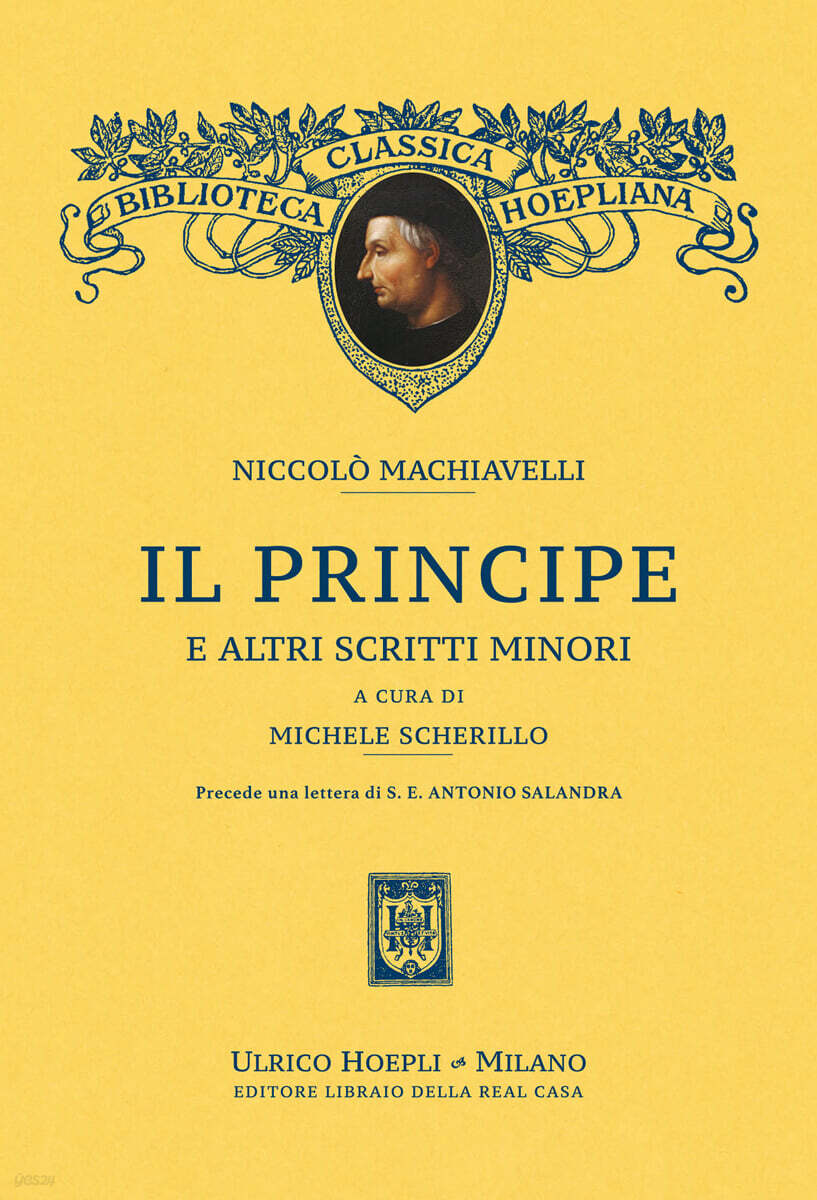
However, those who knew about it, one by one, sought it out and read it, and now, "The Prince" has become a must-read for not only leaders but also all of us, the "masters of our own lives." Niccolo Machiavelli's painstakingly written "The Prince" is presented through The Story, featuring the original first edition cover.
Machiavelli's The Prince
“A leader must know when to be generous and when to be firm!”
Books from the broadcast 'Reading Books at Today's Bookstore'!
A book that was misunderstood as 'a shameless schemer who does not care about the means and methods to achieve his goal.'
A forbidden book that aroused the wrath of the Vatican with its statement that "there is no such thing as the implementation of divine providence in the world, only the victory or defeat of the struggle for power."
A controversial work that even earned the author the ignominious neologism of “Machiavellian” (scheming, despicable).
However, those who knew about it, one by one, sought it out and read it, and now, "The Prince" has become a must-read for not only leaders but also all of us, the "masters of our own lives." Niccolo Machiavelli's painstakingly written "The Prince" is presented through The Story, featuring the original first edition cover.
index
Dedication: A Letter from Niccolò Machiavelli to His Majesty the Magnificent Lorenzo de' Medici
Chapter 1.
The different types of monarchies and the methods of acquiring them
Chapter 2.
hereditary monarchy
Chapter 3.
composite monarchy
Chapter 4.
Why didn't the kingdom of Darius, conquered by Alexander the Great, rebel against his successors even after his death?
Chapter 5.
If you conquer a city or principality that has lived by its own laws, how should you govern it?
Chapter 6.
A new monarchy won by one's own army and courage
Chapter 7.
A new monarchy obtained through the armies of others and good fortune
Chapter 8.
People who became monarchs through heinous acts
Chapter 9.
civil monarchy
Chapter 10.
How is the power of a monarchy measured?
Chapter 11.
ecclesiastical monarchy
Chapter 12.
Different types of troops and mercenaries
Chapter 13.
reinforcements, mixed forces, and domestic forces
Chapter 14.
What a monarch should do regarding military affairs
Chapter 15.
Actions of people, especially monarchs, for which they are praised or criticized
Chapter 16.
Generosity and stinginess
Chapter 17.
Kindness and Cruelty: Will You Be Loved or Feared?
Chapter 18.
How to keep promises
Chapter 19.
How to avoid contempt and hatred
Chapter 20.
Are many of the policies that monarchs routinely implement, such as building fortresses, useful or harmful?
Chapter 21.
What must a monarch do to be respected?
Chapter 22.
The monarch's close ministers
Chapter 23.
How to Avoid Flatterers
Chapter 24.
Why the Italian monarchs lost their countries
Chapter 25.
How many human lives are swayed by fate, and how can we deal with it?
Chapter 26.
An earnest appeal to take and liberate Italy from the domination of the barbarians.
Commentary: Are unscrupulous criminals failures who never won?
A banned book of the 16th century, a must-read of the 21st: Machiavelli's The Prince
Author's chronology
Chapter 1.
The different types of monarchies and the methods of acquiring them
Chapter 2.
hereditary monarchy
Chapter 3.
composite monarchy
Chapter 4.
Why didn't the kingdom of Darius, conquered by Alexander the Great, rebel against his successors even after his death?
Chapter 5.
If you conquer a city or principality that has lived by its own laws, how should you govern it?
Chapter 6.
A new monarchy won by one's own army and courage
Chapter 7.
A new monarchy obtained through the armies of others and good fortune
Chapter 8.
People who became monarchs through heinous acts
Chapter 9.
civil monarchy
Chapter 10.
How is the power of a monarchy measured?
Chapter 11.
ecclesiastical monarchy
Chapter 12.
Different types of troops and mercenaries
Chapter 13.
reinforcements, mixed forces, and domestic forces
Chapter 14.
What a monarch should do regarding military affairs
Chapter 15.
Actions of people, especially monarchs, for which they are praised or criticized
Chapter 16.
Generosity and stinginess
Chapter 17.
Kindness and Cruelty: Will You Be Loved or Feared?
Chapter 18.
How to keep promises
Chapter 19.
How to avoid contempt and hatred
Chapter 20.
Are many of the policies that monarchs routinely implement, such as building fortresses, useful or harmful?
Chapter 21.
What must a monarch do to be respected?
Chapter 22.
The monarch's close ministers
Chapter 23.
How to Avoid Flatterers
Chapter 24.
Why the Italian monarchs lost their countries
Chapter 25.
How many human lives are swayed by fate, and how can we deal with it?
Chapter 26.
An earnest appeal to take and liberate Italy from the domination of the barbarians.
Commentary: Are unscrupulous criminals failures who never won?
A banned book of the 16th century, a must-read of the 21st: Machiavelli's The Prince
Author's chronology
Into the book
Duke Valentino (Cesare Borgia) possessed a strong mind and outstanding abilities, and he knew exactly that 'people must be won over or completely destroyed', so he successfully built a power base, albeit in a short period of time.
---From "Chapter 7: New Monarchies Obtained Through Other People's Armies and Fortune"
If you cannot maintain your position without vice, you should not mind the bad reputation that comes with that vice.
For, when all things are carefully considered, there are cases where the performance of something that appears to be virtuous may result in one's own ruin, while the performance of something that appears to be vice may result in one's own safety and the prosperity of the nation.
---From Chapter 15, “The Actions of People, Especially Princes, for Which They Are Praised or Blamed”
Since there is a great difference between 'how people actually live' and 'how people ought to live,' a ruler who insists on doing what ought to be done rather than doing what is usually done in human affairs will lose power.
Anyone who insists on being good in all circumstances will soon be surrounded by many bad people and will soon fall.
Therefore, if a prince wishes to preserve himself, he must learn to act unfavorably according to the circumstances, and use or refrain from using it as the need arises.
---From Chapter 15, “The Actions of People, Especially Princes, for Which They Are Praised or Blamed”
A monarch cannot and should not keep his promises if doing so would be detrimental to him or if the reason for making the promise would disappear.
If all humans were good, this advice would be inadequate.
But since men are wicked and unwilling to keep their promises to their princes, princes should not be bound by the promises they have made to them.
---From "Chapter 7: New Monarchies Obtained Through Other People's Armies and Fortune"
If you cannot maintain your position without vice, you should not mind the bad reputation that comes with that vice.
For, when all things are carefully considered, there are cases where the performance of something that appears to be virtuous may result in one's own ruin, while the performance of something that appears to be vice may result in one's own safety and the prosperity of the nation.
---From Chapter 15, “The Actions of People, Especially Princes, for Which They Are Praised or Blamed”
Since there is a great difference between 'how people actually live' and 'how people ought to live,' a ruler who insists on doing what ought to be done rather than doing what is usually done in human affairs will lose power.
Anyone who insists on being good in all circumstances will soon be surrounded by many bad people and will soon fall.
Therefore, if a prince wishes to preserve himself, he must learn to act unfavorably according to the circumstances, and use or refrain from using it as the need arises.
---From Chapter 15, “The Actions of People, Especially Princes, for Which They Are Praised or Blamed”
A monarch cannot and should not keep his promises if doing so would be detrimental to him or if the reason for making the promise would disappear.
If all humans were good, this advice would be inadequate.
But since men are wicked and unwilling to keep their promises to their princes, princes should not be bound by the promises they have made to them.
---From Chapter 18, “How to Keep Promises”
Publisher's Review
What kind of book is The Prince?
A book that was misunderstood as 'a shameless schemer who does not care about the means and methods to achieve his goal.'
A forbidden book that aroused the wrath of the Vatican with its statement that "there is no such thing as the implementation of divine providence in the world, only the victory or defeat of the struggle for power."
A controversial work that even earned the author the ignominious neologism of “Machiavellian” (scheming, despicable).
However, those who knew about it, one by one, sought it out and read it, and now, "The Prince" has become a must-read for not only leaders but also all of us, the "masters of our own lives." Niccolo Machiavelli's painstakingly written "The Prince" is presented through The Story, featuring the original first edition cover.
The Prince, once a banned book, is full of words that are easily misunderstood.
'Humans are ungrateful, impatient, ungrateful, opportunistic, self-serving, and self-indulgent.
So, if necessary, a leader can deceive like a fox, attack like a lion, break promises, and commit evil.' To avoid misunderstanding, the following words must be added.
"If the goal of a leader is peace and stability in the community!" In fact, "The Prince" is a faithful book that earnestly hopes for peace to come through the strong rule of a strong leader.
So why did Machiavelli, by spilling out uncomfortable truths that were difficult to speak out, invite misunderstanding? As a diplomat in Florence, a country with little governing power at the time, he desperately navigated the world of great powers, trying to save his country from the straits of the past. He witnessed the brutal, unseen reality of international politics, firsthand.
Meanwhile, I watched Cesare Borgia, Louis XII, Maximilian I, and Ludovico Sforza from close by, and I saw countless times that great disasters befall the country and the people when the monarch did not look at reality accurately and made decisions based on vague optimism, pity, or the pride of 'I am good and right'.
So, he did not define human nature as 'good and evil', but looked at it as it was and considered 'what should be done to bring about desirable results for the community', and he put his reflections into 'The Prince' and dedicated it to the new prince of Florence.
Chapters 1-14 (14 chapters in total) are about principalities, and chapters 15-26 (12 chapters in total) are about monarchs, and the writing ends with praise: “The great time to liberate Italy from foreign powers, the great monarch is now, Lorenzo of Florence!”
But unfortunately, Lorenzo did not read The Prince, and because of that, Italy was not unified until the end of the 19th century and was constantly in conflict.
Cesare Borgia, Alexander VI, Lorenzo the Magnificent, Leo X, il Moro… …
What happened in Italy between 1494 and 1513?
What did the Florentine diplomat Machiavelli witness?
Around the 16th century, the Italian Peninsula was a battleground for power games between the most powerful nations.
During the first revival since the decline of the Roman Empire, the five great powers (the Republic of Florence, the Republic of Venice, the Kingdom of Naples, the Duchy of Milan, and the Papal States) fought to become the masters of the peninsula.
The problem was that these forces were so equally strong that neither could overcome the other, and as the confrontation dragged on, foreign powers (the Kingdom of France, the Kingdom of Spain, and the Holy Roman Empire), which had already achieved unification, took advantage of the gap and targeted the peninsula.
Beginning with the invasion of Charles VIII of France in 1494, subsequent invasions of Italy by Louis XII, Ferdinand II of Spain, and Maximilian I of Germany continued without pause.
Florence suffered the most.
It was located at the crossroads connecting the north and south of the peninsula, was extremely wealthy, had no military, was easy to defeat, and had no ruler.
Because it is advice derived from the experience of a diplomat who had to survive by tightrope walking while keeping an eye on the mood of the other country, the advice in The Prince is extremely cold and realistic.
A book that was misunderstood as 'a shameless schemer who does not care about the means and methods to achieve his goal.'
A forbidden book that aroused the wrath of the Vatican with its statement that "there is no such thing as the implementation of divine providence in the world, only the victory or defeat of the struggle for power."
A controversial work that even earned the author the ignominious neologism of “Machiavellian” (scheming, despicable).
However, those who knew about it, one by one, sought it out and read it, and now, "The Prince" has become a must-read for not only leaders but also all of us, the "masters of our own lives." Niccolo Machiavelli's painstakingly written "The Prince" is presented through The Story, featuring the original first edition cover.
The Prince, once a banned book, is full of words that are easily misunderstood.
'Humans are ungrateful, impatient, ungrateful, opportunistic, self-serving, and self-indulgent.
So, if necessary, a leader can deceive like a fox, attack like a lion, break promises, and commit evil.' To avoid misunderstanding, the following words must be added.
"If the goal of a leader is peace and stability in the community!" In fact, "The Prince" is a faithful book that earnestly hopes for peace to come through the strong rule of a strong leader.
So why did Machiavelli, by spilling out uncomfortable truths that were difficult to speak out, invite misunderstanding? As a diplomat in Florence, a country with little governing power at the time, he desperately navigated the world of great powers, trying to save his country from the straits of the past. He witnessed the brutal, unseen reality of international politics, firsthand.
Meanwhile, I watched Cesare Borgia, Louis XII, Maximilian I, and Ludovico Sforza from close by, and I saw countless times that great disasters befall the country and the people when the monarch did not look at reality accurately and made decisions based on vague optimism, pity, or the pride of 'I am good and right'.
So, he did not define human nature as 'good and evil', but looked at it as it was and considered 'what should be done to bring about desirable results for the community', and he put his reflections into 'The Prince' and dedicated it to the new prince of Florence.
Chapters 1-14 (14 chapters in total) are about principalities, and chapters 15-26 (12 chapters in total) are about monarchs, and the writing ends with praise: “The great time to liberate Italy from foreign powers, the great monarch is now, Lorenzo of Florence!”
But unfortunately, Lorenzo did not read The Prince, and because of that, Italy was not unified until the end of the 19th century and was constantly in conflict.
Cesare Borgia, Alexander VI, Lorenzo the Magnificent, Leo X, il Moro… …
What happened in Italy between 1494 and 1513?
What did the Florentine diplomat Machiavelli witness?
Around the 16th century, the Italian Peninsula was a battleground for power games between the most powerful nations.
During the first revival since the decline of the Roman Empire, the five great powers (the Republic of Florence, the Republic of Venice, the Kingdom of Naples, the Duchy of Milan, and the Papal States) fought to become the masters of the peninsula.
The problem was that these forces were so equally strong that neither could overcome the other, and as the confrontation dragged on, foreign powers (the Kingdom of France, the Kingdom of Spain, and the Holy Roman Empire), which had already achieved unification, took advantage of the gap and targeted the peninsula.
Beginning with the invasion of Charles VIII of France in 1494, subsequent invasions of Italy by Louis XII, Ferdinand II of Spain, and Maximilian I of Germany continued without pause.
Florence suffered the most.
It was located at the crossroads connecting the north and south of the peninsula, was extremely wealthy, had no military, was easy to defeat, and had no ruler.
Because it is advice derived from the experience of a diplomat who had to survive by tightrope walking while keeping an eye on the mood of the other country, the advice in The Prince is extremely cold and realistic.
GOODS SPECIFICS
- Date of publication: August 20, 2020
- Page count, weight, size: 240 pages | 310g | 128*188*20mm
- ISBN13: 9791164453085
- ISBN10: 1164453084
You may also like
카테고리
korean


korean

![GQ KOREA Mark (Monthly): December [2025]](http://librairie.coreenne.fr/cdn/shop/files/8ef265dbbfbf186523ed75ba7319009d.jpg?v=1765340328&width=3840)


