

A very strange math book
 |
Description
Book Introduction
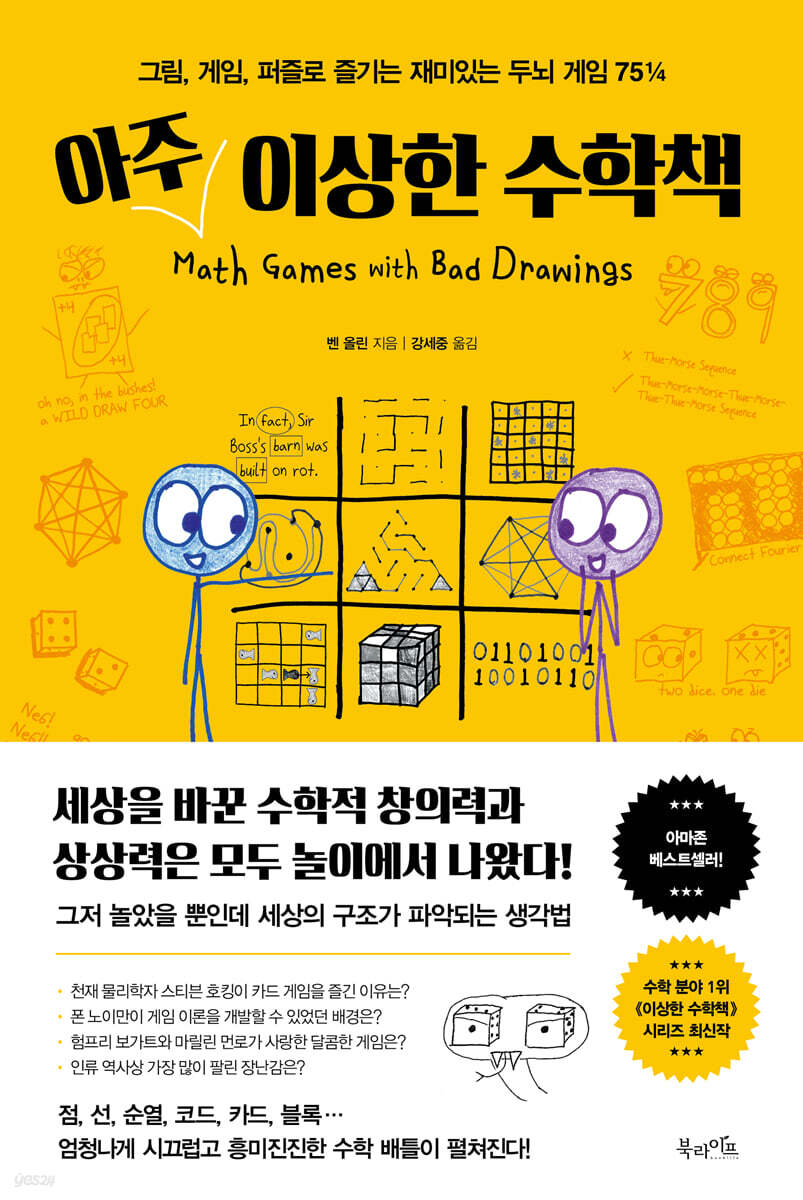
“Why do geniuses get addicted to games, and how does mathematics play the world?” 75 and a quarter ways to understand the world through games, puzzles, and mystery! * Amazon Bestseller * The latest in the #1 math series, “Strange Math Book”! An experience where play becomes learning and learning becomes fun! A very strange math book that brings out the best imagination in games! The latest installment in Ben Olin's shockingly funny and entertaining "The Weird Math Book" series, "The Weird Math Book," has been published. His debut work, "The Strange Math Book," which deals with mathematical concepts and principles in everyday life, provided the joy of understanding mathematics without a single math problem or explanation. It became an Amazon bestseller immediately after its publication, and has also received steady interest and love from readers in Korea since its publication in 2020. The second book published subsequently, "The Stranger Math Book," was a step further from the first book and dealt with calculus, the flower and main dish of mathematics. It helped me understand calculus as another language that expresses the 'change' of everything we experience in our daily lives, such as joy, love, popularity, power, wealth, and time, in mathematics. This book also became a bestseller in several European and Asian countries, and was selected as the 'best mathematics book' of the year by numerous professional academic journals, universities, and institutions. While the previous two books focused on explaining mathematical concepts and principles, this time we've completely changed course and come to you with brain games that anyone can enjoy in their daily lives. Why games? Because serious mathematics often arises from childish play. Also, most games are based on mathematical thinking. Ben Olin takes mathematics out of the confines of textbooks and classrooms and invites us into a world of imagination and creativity, explaining: “This book is for playing games. A human playing with mathematics is like an elephant playing with its trunk, a bird playing with its wings, or Batman playing with his fancy car. It is also a creature that acts as it is born to do. Your mathematical thinking ability is a special talent of unparalleled quality in the animal kingdom. …take out the gift and play with it. Or at least play with the wrapping paper like a cat.” It is no exaggeration to say that the universe is full of mathematical principles, and that every area of life is comprised of mathematics. In particular, most types of play, such as games, puzzles, and reasoning, are based on mathematical principles and thinking. So, for a mathematician, there is probably nothing more interesting than games. Ben Olin tried to weave together games about logic, strategy, space, and reasoning. Furthermore, we selected games based on three criteria: they were fun, easy to play, and made us think mathematically. The author has carefully selected games that transcend time and encourage simple, yet elegant mathematical thinking. He unravels the origins of the games and the mathematical principles hidden within them through captivating storytelling. As you turn the pages, captivated by the author's signature wit, extensive knowledge, and witty illustrations, you'll find yourself transcending the game's principles and confronting the structure of the world. |
- You can preview some of the book's contents.
Preview
index
Starting this book
Part 1: Space Games
“Every word projects power.
“Rays of light and darkness stretch across the board.”
INTRO
Chapter 1: Dots and Boxes: Profundity comes from play, and science comes from silliness.
Chapter 2 Bean Sprouts: The Prettiest Child Born from the Marriage of Simplicity and Complexity
Chapter 3: Ultimate Tic-Tac-Toe: A Fractal World That Shakes, Staggers, and Moves Alive
Chapter 4: Dandelion: Spatial Structure and Temporal Sophistication Meet
Chapter 5: Quantum Tic-Tac-Toe: The Foggy Elegance of Being Everywhere at Once
Chapter 6: Constellations of Space Games - Floating beautifully, embroidering space like stars in the universe.
Part 2: The Number Game
“One bad move nullifies forty good moves.”
INTRO
Chapter 7: Chopsticks: Born on a Japanese School Playground, Captivating Students Worldwide
Chapter 8: Suyeon_ The fun of twisting like storm clouds and tangling like vines
Chapter 9: Between 33 and 99_ Sometimes the underdog wins the game.
Chapter 10: Spinning a Coin: Understanding Mathematical Concepts for Economic Life through Spinning a Coin
Chapter 11 Prophecy_ How thrilling is a self-destructive prophecy?
Chapter 12: Various Number Games: Playing in the Land of Numbers, the Untouchables' Playground
Part 3 Combination Game
“Start like a book, play like a magician, and finish like a machine.”
INTRO
Chapter 13: The Heart: How to Give the Universe a Headache with Six Points
Chapter 14: Tico: The Sweet Game Loved by Humphrey Bogart and Marilyn Monroe
Chapter 15: Neighborhood: The Amazing Diversity Created by Simple Combinations
Chapter 16: Vertex_ A delicious game like wine, where different flavors are balanced
Chapter 17 Amazon - What's the best way to make interesting and meaningful decisions?
Chapter 18: A Wide and Deep Combination Game: Exploring the Deep Sea of Combinations and Awakening Your Mathematical Instinct
Part 4: The Risk and Reward Game
“Will you lose the game by keeping one word?”
INTRO
Chapter 19: The Power of Thinking Freely, Breaking Free from Clinging to Preconceived Ideas
Chapter 20: Arpeggio: Changing Your Perspective and Questions Leads to Different Choices
Chapter 21: Beyond Common Sense_ Idiot, the important thing is to know what you don't know.
Chapter 22 Paper Boxing - Is 'losing big and winning small' the true victory?
Chapter 23: Race Track: Just Playing a Game and Suddenly Understanding Physics Theory
Chapter 24: A Quick Look at Risk and Reward Games: How Can Simple Games Capture the Complex Truths of Life?
Part 5 Information Game
“If you are winning, make it clear.
If you're losing, complicate things."
INTRO
Chapter 25: Baseball by Numbers - How to find meaningful information in the sea of information?
Chapter 26: The Buyer's Risk Principle: How to Avoid the Winner's Curse: Winning is Worse Than Losing
Chapter 27: LAP: The Uncomfortable Encounter of the Isolated and Open Worlds
Chapter 28: Quantum Fishing: Sometimes, games can help you discover your inner magic.
Chapter 29: Saisara: Creativity and Experimentation Explode Through Logical Structure
Chapter 30: Information Game Transmission_ Between Intuition and Insight, Bravado and Boldness
conclusion
In closing this book
Frequently Asked Questions
annotation
References
Game name
Part 1: Space Games
“Every word projects power.
“Rays of light and darkness stretch across the board.”
INTRO
Chapter 1: Dots and Boxes: Profundity comes from play, and science comes from silliness.
Chapter 2 Bean Sprouts: The Prettiest Child Born from the Marriage of Simplicity and Complexity
Chapter 3: Ultimate Tic-Tac-Toe: A Fractal World That Shakes, Staggers, and Moves Alive
Chapter 4: Dandelion: Spatial Structure and Temporal Sophistication Meet
Chapter 5: Quantum Tic-Tac-Toe: The Foggy Elegance of Being Everywhere at Once
Chapter 6: Constellations of Space Games - Floating beautifully, embroidering space like stars in the universe.
Part 2: The Number Game
“One bad move nullifies forty good moves.”
INTRO
Chapter 7: Chopsticks: Born on a Japanese School Playground, Captivating Students Worldwide
Chapter 8: Suyeon_ The fun of twisting like storm clouds and tangling like vines
Chapter 9: Between 33 and 99_ Sometimes the underdog wins the game.
Chapter 10: Spinning a Coin: Understanding Mathematical Concepts for Economic Life through Spinning a Coin
Chapter 11 Prophecy_ How thrilling is a self-destructive prophecy?
Chapter 12: Various Number Games: Playing in the Land of Numbers, the Untouchables' Playground
Part 3 Combination Game
“Start like a book, play like a magician, and finish like a machine.”
INTRO
Chapter 13: The Heart: How to Give the Universe a Headache with Six Points
Chapter 14: Tico: The Sweet Game Loved by Humphrey Bogart and Marilyn Monroe
Chapter 15: Neighborhood: The Amazing Diversity Created by Simple Combinations
Chapter 16: Vertex_ A delicious game like wine, where different flavors are balanced
Chapter 17 Amazon - What's the best way to make interesting and meaningful decisions?
Chapter 18: A Wide and Deep Combination Game: Exploring the Deep Sea of Combinations and Awakening Your Mathematical Instinct
Part 4: The Risk and Reward Game
“Will you lose the game by keeping one word?”
INTRO
Chapter 19: The Power of Thinking Freely, Breaking Free from Clinging to Preconceived Ideas
Chapter 20: Arpeggio: Changing Your Perspective and Questions Leads to Different Choices
Chapter 21: Beyond Common Sense_ Idiot, the important thing is to know what you don't know.
Chapter 22 Paper Boxing - Is 'losing big and winning small' the true victory?
Chapter 23: Race Track: Just Playing a Game and Suddenly Understanding Physics Theory
Chapter 24: A Quick Look at Risk and Reward Games: How Can Simple Games Capture the Complex Truths of Life?
Part 5 Information Game
“If you are winning, make it clear.
If you're losing, complicate things."
INTRO
Chapter 25: Baseball by Numbers - How to find meaningful information in the sea of information?
Chapter 26: The Buyer's Risk Principle: How to Avoid the Winner's Curse: Winning is Worse Than Losing
Chapter 27: LAP: The Uncomfortable Encounter of the Isolated and Open Worlds
Chapter 28: Quantum Fishing: Sometimes, games can help you discover your inner magic.
Chapter 29: Saisara: Creativity and Experimentation Explode Through Logical Structure
Chapter 30: Information Game Transmission_ Between Intuition and Insight, Bravado and Boldness
conclusion
In closing this book
Frequently Asked Questions
annotation
References
Game name
Detailed image

Into the book
This book is divided into five parts: spatial games, number games, combinatorial games, risk and reward games, and information games.
But remember, there's something odd about this classification.
Rather than being a perfectly organized, well-organized taxonomy, each sample is more like a mood light highlighting the unique features of each game.
For example, 〈Chess〉 fits into any of the five categories, but it can look slightly different depending on the lighting.
Each section begins with an engaging essay on a relevant area of mathematics.
After that, five recommended games are listed, and the complexity generally increases as you go further.
However, the complexity also resets each time a new chapter is started.
The last chapter of each section briefly describes related games, including some of my favorites.
--- From "Beginning this Book"
Here a question arises.
Why would students from a prestigious university spend time creating a children's game? And why would a respected scholar like Edouard Lucas decide to publish it as a book? The answer is simple.
Because serious mathematics is often born from childish play.
This pattern is also evident in Lucas's career.
His most famous work is the Fibonacci sequence, in which each number is the sum of the two preceding numbers (this classic sequence begins with 1, 1, 2, 3, 5, 8, etc.).
Fibonacci numbers may seem like a silly game at first glance.
But when you start counting the bumps on pinecones, the petals on daisies, and the tiny fruit on pineapples, you realize that this silly game is played not only by children and vaguely mature adults, but also by nature itself.
--- From "Chapter 1: Points and Boxes"
Plato would have hated fractals.
This ancient philosopher firmly believed in pure Euclidean geometry.
In one of his books, Dialogues, he postulates that the entire universe is made up of triangles, especially two 'special right triangles' that are the nightmare of trigonometry students.
Well, well.
I want to tell him this.
Plato, check out your favorite 'nature' account on Instagram.
How many triangles can you find with angles of 30, 60, and 90 degrees? Now, try to find a fractal.
Isn't it more common? Nature is a garden of fractals.
On the mountain, there is a small pile of rocks on top of a jagged pile of rocks, and on top of that, an even smaller pile of rocks.
The lungs begin in the trachea, which branches into bronchi, which branch and branch again, an average of 23 times, ending in small, balloon-shaped alveoli that supply oxygen to the blood.
In short, you breathe fractally.
--- From "Chapter 3: Ultimate Tic-Tac-Toe"
I don't support a critical view of marriage, but I like the tension this game creates.
Suddenly, I want to get married quickly, I want to marry someone who is a good fit, and if possible, I want to marry someone with better conditions.
These impulses confront each other and pose difficult questions.
For example, it is like this.
Is 1 a good card? For one thing, upward marriage is guaranteed.
However, the most similar numbers (e.g. 2, 3, 4) may reject you, as they too wish to marry upward.
As with real marriage, no strategy can be judged "good" or "bad" on its own.
The value of a strategy depends on the overall context of what choices everyone else makes.
--- From "Chapter 12 Various Number Games"
Skani came from an underground gambling den.
Despite being America's greatest card magician, a friend of the famed escape artist Harry Houdini, and a regular on television variety shows, his shabby past haunted him like a shadow (at least that's how he felt).
So Skani chose Tico, a sweet and wholesome family game.
A game without cheats or mafia.
In the 1950s, it seemed as though Skani's bold ambitions would be realized, as "Tico" attracted the attention of celebrities like Humphrey Bogart and Marilyn Monroe.
But the heyday is over.
Today, the game has faded into obscurity, known only to a small number of dedicated gamers.
Of course, you all know this now.
In any case, it is far from being a replacement for Chess, as Skani had hoped.
--- From "Chapter 14: Tico"
In short, the “peak” is like a wine where different flavors are balanced.
And that's not all.
It's a game that tastes better after a while, like wine.
At first, threats and opportunities may be hidden, not easily visible.
You scan the dotted yard with your eyes as if looking through an old magic eye pattern.
For those unfamiliar with Magic Eye, let me explain: it's a hallucinatory wallpaper that never looks as advertised.
Early in the game, the soundtrack is filled with “Oh my, I didn’t see that!” and “Wait, how did I miss that?”
But just give yourself to time.
Soon a square will pop out unexpectedly.
Learning the game of 〈Vertex〉 is like learning a whole new perspective.
In that sense, “Vertex,” like all other games, is a training ground for our perception.
--- From "Chapter 16: The Vertex"
With its painful collisions and close calls, "Raceway" is perhaps the most exciting fate you can experience on graph paper.
What's even better is that once you master the rules, the game starts to invoke real physics.
Of course, it may take some patience to get there.
Why can't I move four spaces to the right and then three spaces to the left on the next turn? It's the same reason I can't make a quick U-turn on the highway.
--- From "Chapter 23: The Racecourse"
Why does this winner's curse exist? After all, under the right conditions, we humans are capable of remarkably sharp inferences.
There is a very appropriate example.
In the early history of statistics, 787 people at a county fair in the United States attempted to guess the weight of an ox.
These were not cattle experts.
That doesn't mean I was a master at guessing weights.
They were just ordinary, fair people.
In any case, the average of their guesses (547 kilograms) was not even 1 percent different from the truth (543 kilograms).
Impressively, that is.
--- From Chapter 26, “Principle of Buyer Risk”
The true champion is this glorious monster called "Quantum Fishing."
I think of this game as a cross between a logic puzzle, an improv comedy session, and a group hallucination.
To be honest, I'm still wrapping my head around this game.
Quantum Fishing is a true game of its own, with a core fan base of math PhD students.
In any case, there is no better candidate than Quantum Fishing to culminate this book, which began with a game I played as a child.
But remember, there's something odd about this classification.
Rather than being a perfectly organized, well-organized taxonomy, each sample is more like a mood light highlighting the unique features of each game.
For example, 〈Chess〉 fits into any of the five categories, but it can look slightly different depending on the lighting.
Each section begins with an engaging essay on a relevant area of mathematics.
After that, five recommended games are listed, and the complexity generally increases as you go further.
However, the complexity also resets each time a new chapter is started.
The last chapter of each section briefly describes related games, including some of my favorites.
--- From "Beginning this Book"
Here a question arises.
Why would students from a prestigious university spend time creating a children's game? And why would a respected scholar like Edouard Lucas decide to publish it as a book? The answer is simple.
Because serious mathematics is often born from childish play.
This pattern is also evident in Lucas's career.
His most famous work is the Fibonacci sequence, in which each number is the sum of the two preceding numbers (this classic sequence begins with 1, 1, 2, 3, 5, 8, etc.).
Fibonacci numbers may seem like a silly game at first glance.
But when you start counting the bumps on pinecones, the petals on daisies, and the tiny fruit on pineapples, you realize that this silly game is played not only by children and vaguely mature adults, but also by nature itself.
--- From "Chapter 1: Points and Boxes"
Plato would have hated fractals.
This ancient philosopher firmly believed in pure Euclidean geometry.
In one of his books, Dialogues, he postulates that the entire universe is made up of triangles, especially two 'special right triangles' that are the nightmare of trigonometry students.
Well, well.
I want to tell him this.
Plato, check out your favorite 'nature' account on Instagram.
How many triangles can you find with angles of 30, 60, and 90 degrees? Now, try to find a fractal.
Isn't it more common? Nature is a garden of fractals.
On the mountain, there is a small pile of rocks on top of a jagged pile of rocks, and on top of that, an even smaller pile of rocks.
The lungs begin in the trachea, which branches into bronchi, which branch and branch again, an average of 23 times, ending in small, balloon-shaped alveoli that supply oxygen to the blood.
In short, you breathe fractally.
--- From "Chapter 3: Ultimate Tic-Tac-Toe"
I don't support a critical view of marriage, but I like the tension this game creates.
Suddenly, I want to get married quickly, I want to marry someone who is a good fit, and if possible, I want to marry someone with better conditions.
These impulses confront each other and pose difficult questions.
For example, it is like this.
Is 1 a good card? For one thing, upward marriage is guaranteed.
However, the most similar numbers (e.g. 2, 3, 4) may reject you, as they too wish to marry upward.
As with real marriage, no strategy can be judged "good" or "bad" on its own.
The value of a strategy depends on the overall context of what choices everyone else makes.
--- From "Chapter 12 Various Number Games"
Skani came from an underground gambling den.
Despite being America's greatest card magician, a friend of the famed escape artist Harry Houdini, and a regular on television variety shows, his shabby past haunted him like a shadow (at least that's how he felt).
So Skani chose Tico, a sweet and wholesome family game.
A game without cheats or mafia.
In the 1950s, it seemed as though Skani's bold ambitions would be realized, as "Tico" attracted the attention of celebrities like Humphrey Bogart and Marilyn Monroe.
But the heyday is over.
Today, the game has faded into obscurity, known only to a small number of dedicated gamers.
Of course, you all know this now.
In any case, it is far from being a replacement for Chess, as Skani had hoped.
--- From "Chapter 14: Tico"
In short, the “peak” is like a wine where different flavors are balanced.
And that's not all.
It's a game that tastes better after a while, like wine.
At first, threats and opportunities may be hidden, not easily visible.
You scan the dotted yard with your eyes as if looking through an old magic eye pattern.
For those unfamiliar with Magic Eye, let me explain: it's a hallucinatory wallpaper that never looks as advertised.
Early in the game, the soundtrack is filled with “Oh my, I didn’t see that!” and “Wait, how did I miss that?”
But just give yourself to time.
Soon a square will pop out unexpectedly.
Learning the game of 〈Vertex〉 is like learning a whole new perspective.
In that sense, “Vertex,” like all other games, is a training ground for our perception.
--- From "Chapter 16: The Vertex"
With its painful collisions and close calls, "Raceway" is perhaps the most exciting fate you can experience on graph paper.
What's even better is that once you master the rules, the game starts to invoke real physics.
Of course, it may take some patience to get there.
Why can't I move four spaces to the right and then three spaces to the left on the next turn? It's the same reason I can't make a quick U-turn on the highway.
--- From "Chapter 23: The Racecourse"
Why does this winner's curse exist? After all, under the right conditions, we humans are capable of remarkably sharp inferences.
There is a very appropriate example.
In the early history of statistics, 787 people at a county fair in the United States attempted to guess the weight of an ox.
These were not cattle experts.
That doesn't mean I was a master at guessing weights.
They were just ordinary, fair people.
In any case, the average of their guesses (547 kilograms) was not even 1 percent different from the truth (543 kilograms).
Impressively, that is.
--- From Chapter 26, “Principle of Buyer Risk”
The true champion is this glorious monster called "Quantum Fishing."
I think of this game as a cross between a logic puzzle, an improv comedy session, and a group hallucination.
To be honest, I'm still wrapping my head around this game.
Quantum Fishing is a true game of its own, with a core fan base of math PhD students.
In any case, there is no better candidate than Quantum Fishing to culminate this book, which began with a game I played as a child.
--- From Chapter 28, Quantum Fishing
Publisher's Review
Ben Olin's books are a deadly delight that will have you giggling and then bursting into laughter before you know it.
_National Mathematical Association
A book so charming you'll want to take it to the beach, and also great to read in the bathroom!
_American Scientist
“The greatest geniuses were game maniacs!”
Dots, lines, permutations, codes, cards, blocks… A wildly noisy and exciting math battle unfolds!
The genius physicist Stephen Hawking is famous for enjoying the card game Set.
Pascal gave birth to probability theory by solving a riddle posed by a gambler, and von Neumann developed game theory by analyzing poker.
Erno Rubik played with blocks and invented the best-selling toy in human history, and Euler played with bridges and became the founder of graph theory.
Humphrey Bogart and Marilyn Monroe loved the sweet, family-friendly game of Tico.
Although not mentioned in this book, the chess match between Einstein and Oppenheimer that took place at Princeton University in 1933 is a famous historical event.
Einstein's winning score was so beautiful and logical that it was recorded.
The great writer Michel Foucault is also well known for borrowing chess to complete his structuralist works.
In this way, geniuses enjoyed games, and mathematical principles broadened their perspective on the world.
In fact, people often view mathematics as a finite game.
By asking questions, finding answers in riddles, and making proofs in theorems.
But Ben Olin says, "In sum, mathematics forms a vast and endless game, encompassing the thoughts of all intelligent apes."
In other words, mathematics goes beyond deriving and proving answers and provides a new and insightful perspective for understanding the world.
This is in line with what mathematician Rosa Peter emphasized.
“I love math.
Because humans have breathed the spirit of play into mathematics, and mathematics has embraced infinity, the greatest game for humans.”
“Ultimate Tic-Tac-Toe” makes us realize that the world we live in is not Euclidean but fractal.
“The Floor is Lava!” shows how great the synergy that human cooperation can create.
“Out of Common Sense” reminds us of the value of knowledge and discernment that distinguishes between truth and falsehood.
Chopsticks, a game that teaches the principles of calculation.
The Buyer's Risk Principle: An economic principle that can be understood without taking an investment class.
Love and Marriage, which provides insight into the issues of love, marriage, and relationships.
Ben Olin also covers a variety of games, and through them he imparts not only mathematical principles but also wisdom for living life.
The book "The Very Strange Book of Math" contains over 200 games, including 75 and 1/4 carefully selected games based on logic and regularity, as well as some that are only briefly mentioned.
In this book, points, lines, planes, space, time, and numbers dance, and logic, strategy, and reasoning come to life.
Join us for a wildly exciting and exciting math battle!
All you need is a piece of paper and a pencil.
As you enjoy the game, you can also get the bonus of improving your creativity, imagination, thinking skills, and problem-solving skills.
The Lazy Art of Geniuses: The Secret of 'Play'
Make the complex simple and the difficult easy!
Chess came from India, Go came from China, and Panorona came from Madagascar.
Math games exist all over the world.
This means that games that require brain play are so closely linked to our daily lives that they cannot be separated.
Moreover, play is a source of magic that expands human thinking and explodes imagination, to the point that it can be said to be the lazy art of geniuses.
《The Very Strange Math Book》 is divided into five major categories of games: spatial games, number games, combinatorial games, risk and reward games, and information games.
· Part 1: Space Game: Float through space and time and break free from stereotypical thinking.
· Part 2 Number Game: Play with numbers and learn the principles of mathematics.
· 3-part combination game: Experience the best results created by strategic choices.
· Part 4: Risk and Reward Game: Become a gambler who takes risks but reaps maximum rewards.
· Part 5 Information Games: Develop your logic, analysis, intuition, and insight through brain games.
Each section begins with an engaging essay on a relevant mathematical topic and introduces five recommended games.
The recommended games were written with the same structure.
First, 'How to Play' explains the basic mechanics of the game along with the materials required.
Second, the 'Taste Notes' help you feel the thrill of the gameplay and its unique atmosphere.
Third, 'The Origin of the Game' tells the origin of the game and interesting behind-the-scenes stories.
Fourth, in 'Why It Matters', we examine how and what each game draws on in the realm of human thought.
Fifth, 'Variants and Related Games' introduces a variety of games that readers can enjoy exploring.
This book differs from its two predecessors in that it deals with games.
But the advantages have been further strengthened.
Ben Olin's signature witty banter and cheerful energy have been further upgraded, and his lively and energetic drawings, drawn by himself, help readers intuitively understand the game's principles.
If you follow the author's instructions and illustrations, you will soon find yourself completely absorbed in the games he introduces and enjoying them.
This book is sure to be loved by everyone: educators who want to teach mathematical principles through games, students and parents who want to foster creativity, imagination, critical thinking, and problem-solving skills, and anyone who enjoys challenging themselves with brain games.
_National Mathematical Association
A book so charming you'll want to take it to the beach, and also great to read in the bathroom!
_American Scientist
“The greatest geniuses were game maniacs!”
Dots, lines, permutations, codes, cards, blocks… A wildly noisy and exciting math battle unfolds!
The genius physicist Stephen Hawking is famous for enjoying the card game Set.
Pascal gave birth to probability theory by solving a riddle posed by a gambler, and von Neumann developed game theory by analyzing poker.
Erno Rubik played with blocks and invented the best-selling toy in human history, and Euler played with bridges and became the founder of graph theory.
Humphrey Bogart and Marilyn Monroe loved the sweet, family-friendly game of Tico.
Although not mentioned in this book, the chess match between Einstein and Oppenheimer that took place at Princeton University in 1933 is a famous historical event.
Einstein's winning score was so beautiful and logical that it was recorded.
The great writer Michel Foucault is also well known for borrowing chess to complete his structuralist works.
In this way, geniuses enjoyed games, and mathematical principles broadened their perspective on the world.
In fact, people often view mathematics as a finite game.
By asking questions, finding answers in riddles, and making proofs in theorems.
But Ben Olin says, "In sum, mathematics forms a vast and endless game, encompassing the thoughts of all intelligent apes."
In other words, mathematics goes beyond deriving and proving answers and provides a new and insightful perspective for understanding the world.
This is in line with what mathematician Rosa Peter emphasized.
“I love math.
Because humans have breathed the spirit of play into mathematics, and mathematics has embraced infinity, the greatest game for humans.”
“Ultimate Tic-Tac-Toe” makes us realize that the world we live in is not Euclidean but fractal.
“The Floor is Lava!” shows how great the synergy that human cooperation can create.
“Out of Common Sense” reminds us of the value of knowledge and discernment that distinguishes between truth and falsehood.
Chopsticks, a game that teaches the principles of calculation.
The Buyer's Risk Principle: An economic principle that can be understood without taking an investment class.
Love and Marriage, which provides insight into the issues of love, marriage, and relationships.
Ben Olin also covers a variety of games, and through them he imparts not only mathematical principles but also wisdom for living life.
The book "The Very Strange Book of Math" contains over 200 games, including 75 and 1/4 carefully selected games based on logic and regularity, as well as some that are only briefly mentioned.
In this book, points, lines, planes, space, time, and numbers dance, and logic, strategy, and reasoning come to life.
Join us for a wildly exciting and exciting math battle!
All you need is a piece of paper and a pencil.
As you enjoy the game, you can also get the bonus of improving your creativity, imagination, thinking skills, and problem-solving skills.
The Lazy Art of Geniuses: The Secret of 'Play'
Make the complex simple and the difficult easy!
Chess came from India, Go came from China, and Panorona came from Madagascar.
Math games exist all over the world.
This means that games that require brain play are so closely linked to our daily lives that they cannot be separated.
Moreover, play is a source of magic that expands human thinking and explodes imagination, to the point that it can be said to be the lazy art of geniuses.
《The Very Strange Math Book》 is divided into five major categories of games: spatial games, number games, combinatorial games, risk and reward games, and information games.
· Part 1: Space Game: Float through space and time and break free from stereotypical thinking.
· Part 2 Number Game: Play with numbers and learn the principles of mathematics.
· 3-part combination game: Experience the best results created by strategic choices.
· Part 4: Risk and Reward Game: Become a gambler who takes risks but reaps maximum rewards.
· Part 5 Information Games: Develop your logic, analysis, intuition, and insight through brain games.
Each section begins with an engaging essay on a relevant mathematical topic and introduces five recommended games.
The recommended games were written with the same structure.
First, 'How to Play' explains the basic mechanics of the game along with the materials required.
Second, the 'Taste Notes' help you feel the thrill of the gameplay and its unique atmosphere.
Third, 'The Origin of the Game' tells the origin of the game and interesting behind-the-scenes stories.
Fourth, in 'Why It Matters', we examine how and what each game draws on in the realm of human thought.
Fifth, 'Variants and Related Games' introduces a variety of games that readers can enjoy exploring.
This book differs from its two predecessors in that it deals with games.
But the advantages have been further strengthened.
Ben Olin's signature witty banter and cheerful energy have been further upgraded, and his lively and energetic drawings, drawn by himself, help readers intuitively understand the game's principles.
If you follow the author's instructions and illustrations, you will soon find yourself completely absorbed in the games he introduces and enjoying them.
This book is sure to be loved by everyone: educators who want to teach mathematical principles through games, students and parents who want to foster creativity, imagination, critical thinking, and problem-solving skills, and anyone who enjoys challenging themselves with brain games.
GOODS SPECIFICS
- Date of issue: February 20, 2024
- Format: Hardcover book binding method guide
- Page count, weight, size: 520 pages | 1,030g | 152*225*35mm
- ISBN13: 9791191013597
- ISBN10: 1191013596
You may also like
카테고리
korean


korean

![GQ KOREA Mark (Monthly): December [2025]](http://librairie.coreenne.fr/cdn/shop/files/8ef265dbbfbf186523ed75ba7319009d.jpg?v=1765340328&width=3840)


