

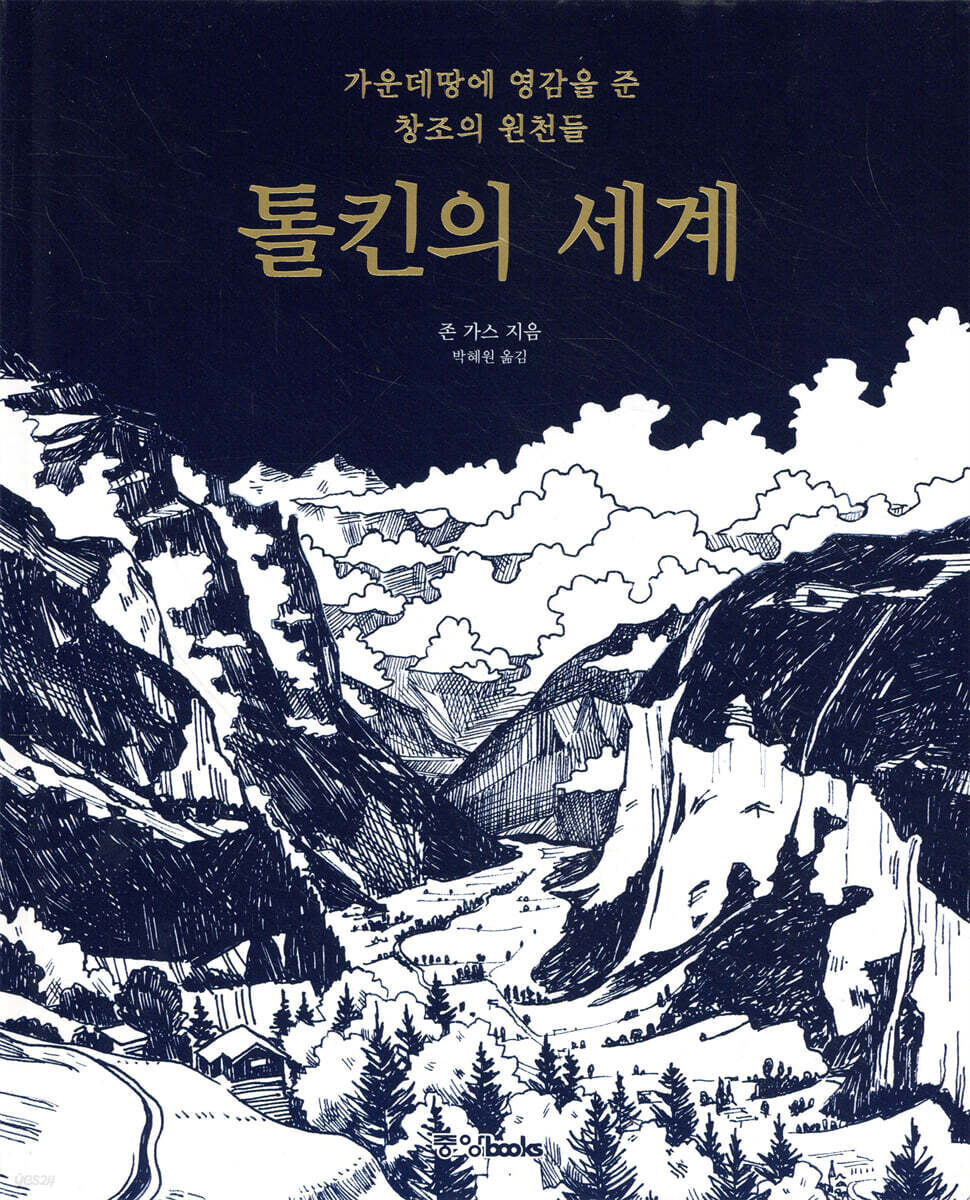
Tolkien's world
 |
Description
Book Introduction
Author of The Lord of the Rings, The Hobbit, and The Silmarillion,
JRR, the king of fantasy literature and a great creator
Tolkien
We delve into the creative inspiration behind that vast worldview!
Elves, orcs, dwarves… JRR created a fantasy adventure world now familiar to people around the world.
A book titled "Tolkien's World," which traces the lifelong inspiration Tolkien received during his creative process, has been published.
In this book, readers are guided by the author on a journey through the English countryside and cities, the seas and rivers, the icy plains of the Arctic, the mountains of the Alps, the ancient great forests of Europe, the sunken lands, the battlefields, and the factories of the Industrial Revolution that inspired Tolkien's creation.
Renowned Tolkien scholar John Garth traces Tolkien's life, works, and lectures to identify and present the sources of his influence, one by one.
To bring this to life, we included drawings by Tolkien himself, photographs of actual locations, and drawings by other related authors.
This book is the ultimate guide for both readers just beginning to delve into Tolkien's world and those who have long enjoyed his world deeply.
It will also serve as an excellent reference for fantasy writers who are curious about how great creators create their grand worldviews.
JRR, the king of fantasy literature and a great creator
Tolkien
We delve into the creative inspiration behind that vast worldview!
Elves, orcs, dwarves… JRR created a fantasy adventure world now familiar to people around the world.
A book titled "Tolkien's World," which traces the lifelong inspiration Tolkien received during his creative process, has been published.
In this book, readers are guided by the author on a journey through the English countryside and cities, the seas and rivers, the icy plains of the Arctic, the mountains of the Alps, the ancient great forests of Europe, the sunken lands, the battlefields, and the factories of the Industrial Revolution that inspired Tolkien's creation.
Renowned Tolkien scholar John Garth traces Tolkien's life, works, and lectures to identify and present the sources of his influence, one by one.
To bring this to life, we included drawings by Tolkien himself, photographs of actual locations, and drawings by other related authors.
This book is the ultimate guide for both readers just beginning to delve into Tolkien's world and those who have long enjoyed his world deeply.
It will also serve as an excellent reference for fantasy writers who are curious about how great creators create their grand worldviews.
index
ingress
From England to the Shire
Four Winds
Land of Lucien
coast and sea
Roots of the Mountain
Rivers, lakes and wetlands
land woven with trees
Ancient traces
Constant vigilance
Places of war
Crafts and Industry
supplement
Americas
References
index
Acknowledgements
Image source
From England to the Shire
Four Winds
Land of Lucien
coast and sea
Roots of the Mountain
Rivers, lakes and wetlands
land woven with trees
Ancient traces
Constant vigilance
Places of war
Crafts and Industry
supplement
Americas
References
index
Acknowledgements
Image source
Detailed image
.jpg)
Into the book
“The English countryside was absolutely stunning.
If you ask what Middle-earth is based on, it's the original form.
I would answer that it was based particularly on the awe and delight I felt in a pristine land.” This meant that the “northwestern atmosphere” of Britain and all of Europe was for Tolkien “both ‘home’ and ‘discovered’.”
---From "From England to the Shire"
Tolkien said that Welsh was the inspiration for The Lord of the Rings.
He felt that Sindarin, a language inspired by Welsh, “could give readers more enjoyment than anything else.”
It was really wishful thinking.
But just as the words 'Senghenid' and 'Tredegar' written on coal trucks drew Tolkien into Welsh, I'm sure 'Gondor', 'Anduin', 'Lothlorien', and other names on his maps drew me right into his epic.
---From "The Four Winds"
All of this adds up to a rich, elegant, and consistent picture of the world, giving us something of the kind of faith we place in the real world.
Tolkien called this a 'secondary belief'.
The storyteller “creates a secondary world in which you can empathize.
What the storyteller says in it is ‘truth.’”
---From "Land of Lucien"
Tolkien credits Lauterbrunnen with giving him names like Deepwater, Laudwater, and Bruinen.
Among the finest works he painted for The Hobbit, the six paintings of the Deep Valley, perhaps the pinnacle, have been repeatedly revised to capture the essence of the Swiss valleys.
---From "Roots of the Mountain"
But the machines and Uruk-hai beneath Isengard are probably H.
It could be said that it was inspired by the “gloomy Molochs who tinker with their machines” in G. Wells’s The Time Machine.
Tolkien initially placed the giant spiders underground after reading and finding "somewhat amusing" another science fiction thriller, Joseph O'Neill's 1935 The Land Beneath England.
---From "Roots of the Mountain"
Tolkien recalled that he devised much of the early legendarium "in gloomy canteens, in lectures in the cold fog, in barracks filled with swearing and obscenities, or by candlelight in bell-tents, or even beneath trenches under artillery fire."
He didn't simply escape to fairyland.
At the time, and later, Tolkien wrote “to express ‘feelings’ about good and evil, fairness and injustice, to explain them rationally, and simply not to get bored.”
---From "Places of War"
Middle-earth was created to reflect what Tolkien loved most and hated most about his own world.
It is created by bringing together numerous real landscapes and places, ancient and modern, wild and cultivated, and destroyed.
Indeed, one could say that the landscape itself placed on the Legendarium page conveys a moving message.
If you ask what Middle-earth is based on, it's the original form.
I would answer that it was based particularly on the awe and delight I felt in a pristine land.” This meant that the “northwestern atmosphere” of Britain and all of Europe was for Tolkien “both ‘home’ and ‘discovered’.”
---From "From England to the Shire"
Tolkien said that Welsh was the inspiration for The Lord of the Rings.
He felt that Sindarin, a language inspired by Welsh, “could give readers more enjoyment than anything else.”
It was really wishful thinking.
But just as the words 'Senghenid' and 'Tredegar' written on coal trucks drew Tolkien into Welsh, I'm sure 'Gondor', 'Anduin', 'Lothlorien', and other names on his maps drew me right into his epic.
---From "The Four Winds"
All of this adds up to a rich, elegant, and consistent picture of the world, giving us something of the kind of faith we place in the real world.
Tolkien called this a 'secondary belief'.
The storyteller “creates a secondary world in which you can empathize.
What the storyteller says in it is ‘truth.’”
---From "Land of Lucien"
Tolkien credits Lauterbrunnen with giving him names like Deepwater, Laudwater, and Bruinen.
Among the finest works he painted for The Hobbit, the six paintings of the Deep Valley, perhaps the pinnacle, have been repeatedly revised to capture the essence of the Swiss valleys.
---From "Roots of the Mountain"
But the machines and Uruk-hai beneath Isengard are probably H.
It could be said that it was inspired by the “gloomy Molochs who tinker with their machines” in G. Wells’s The Time Machine.
Tolkien initially placed the giant spiders underground after reading and finding "somewhat amusing" another science fiction thriller, Joseph O'Neill's 1935 The Land Beneath England.
---From "Roots of the Mountain"
Tolkien recalled that he devised much of the early legendarium "in gloomy canteens, in lectures in the cold fog, in barracks filled with swearing and obscenities, or by candlelight in bell-tents, or even beneath trenches under artillery fire."
He didn't simply escape to fairyland.
At the time, and later, Tolkien wrote “to express ‘feelings’ about good and evil, fairness and injustice, to explain them rationally, and simply not to get bored.”
---From "Places of War"
Middle-earth was created to reflect what Tolkien loved most and hated most about his own world.
It is created by bringing together numerous real landscapes and places, ancient and modern, wild and cultivated, and destroyed.
Indeed, one could say that the landscape itself placed on the Legendarium page conveys a moving message.
---From "Crafts and Industry"
Publisher's Review
Even Tolkien, whose imagination was so extraordinary, needed fuel.
He said this:
“I, like others, borrow references.
“In the ‘life’ I know.”
―p.
6. From "Enter"
John Gass provides a grounded account of Tolkien's sources of inspiration, a subject that has puzzled readers and scholars alike since the publication of his books.
He excluded claims based on subjective feelings as much as possible and created conclusions from a broad perspective that included the places Tolkien visited, the news and books he read, and even his own research.
Because Tolkien himself was so knowledgeable in so many ways, this book, which traces his inspirations, can be a very convenient starting point for gaining a proper understanding of the geography and culture of Britain and Northern Europe, which are less familiar to us.
Thanks to the author's efforts, readers have the opportunity to briefly explore the literature, geography, and history of Britain in one book.
The author has organized this complex material into an easily understandable text, dividing it into categories based on the nature of the places that influenced Tolkien.
The first chapter, "From Britain to the Shire," introduces the English countryside of his childhood, which was Tolkien's greatest inspiration; the second chapter, "The Four Winds," divides the cultural spheres that influenced Tolkien into the four cardinal directions of the map; and the third chapter, "The Land of Lucien," explores his efforts to geographically mythologize the lands of Britain.
From the next chapter onwards, the titles and contents are intuitively understandable.
The ultimate book for the fun of tracing the details in Tolkien's works!
"Tolkien's World" is a book that answers readers' questions that have been piling up for a long time.
How did the world wars Tolkien endure influence his work? What do north, east, west, and south mean in his world? Where did the terrifying landscapes of Mordor and the idea of a paradise across the sea come from? What was the source of his immense love of forests, which he left behind in the fantasy genre? Why were the caves in his works so beautifully depicted? Do the Two Towers actually exist? Did the ring that inspired the One Ring actually exist?
The author's answers to these numerous questions will be a great pleasure for readers familiar with Tolkien's works, but they also serve as a guide for readers who wish to begin reading step by step.
This is why "Tolkien's World" is the pinnacle of Tolkien studies, condensing and summarizing Tolkien's biographies, letters, art books, and other reference books.
As we trace Tolkien's inspiration through this book, we may find ourselves wanting to look closely at our own surroundings, and perhaps find our own inspiration.
He said this:
“I, like others, borrow references.
“In the ‘life’ I know.”
―p.
6. From "Enter"
John Gass provides a grounded account of Tolkien's sources of inspiration, a subject that has puzzled readers and scholars alike since the publication of his books.
He excluded claims based on subjective feelings as much as possible and created conclusions from a broad perspective that included the places Tolkien visited, the news and books he read, and even his own research.
Because Tolkien himself was so knowledgeable in so many ways, this book, which traces his inspirations, can be a very convenient starting point for gaining a proper understanding of the geography and culture of Britain and Northern Europe, which are less familiar to us.
Thanks to the author's efforts, readers have the opportunity to briefly explore the literature, geography, and history of Britain in one book.
The author has organized this complex material into an easily understandable text, dividing it into categories based on the nature of the places that influenced Tolkien.
The first chapter, "From Britain to the Shire," introduces the English countryside of his childhood, which was Tolkien's greatest inspiration; the second chapter, "The Four Winds," divides the cultural spheres that influenced Tolkien into the four cardinal directions of the map; and the third chapter, "The Land of Lucien," explores his efforts to geographically mythologize the lands of Britain.
From the next chapter onwards, the titles and contents are intuitively understandable.
The ultimate book for the fun of tracing the details in Tolkien's works!
"Tolkien's World" is a book that answers readers' questions that have been piling up for a long time.
How did the world wars Tolkien endure influence his work? What do north, east, west, and south mean in his world? Where did the terrifying landscapes of Mordor and the idea of a paradise across the sea come from? What was the source of his immense love of forests, which he left behind in the fantasy genre? Why were the caves in his works so beautifully depicted? Do the Two Towers actually exist? Did the ring that inspired the One Ring actually exist?
The author's answers to these numerous questions will be a great pleasure for readers familiar with Tolkien's works, but they also serve as a guide for readers who wish to begin reading step by step.
This is why "Tolkien's World" is the pinnacle of Tolkien studies, condensing and summarizing Tolkien's biographies, letters, art books, and other reference books.
As we trace Tolkien's inspiration through this book, we may find ourselves wanting to look closely at our own surroundings, and perhaps find our own inspiration.
GOODS SPECIFICS
- Date of issue: November 22, 2024
- Format: Hardcover book binding method guide
- Page count, weight, size: 216 pages | 932g | 218*267*16mm
- ISBN13: 9788927813262
- ISBN10: 892781326X
You may also like
카테고리
korean


korean

![GQ KOREA Mark (Monthly): December [2025]](http://librairie.coreenne.fr/cdn/shop/files/8ef265dbbfbf186523ed75ba7319009d.jpg?v=1765340328&width=3840)


