

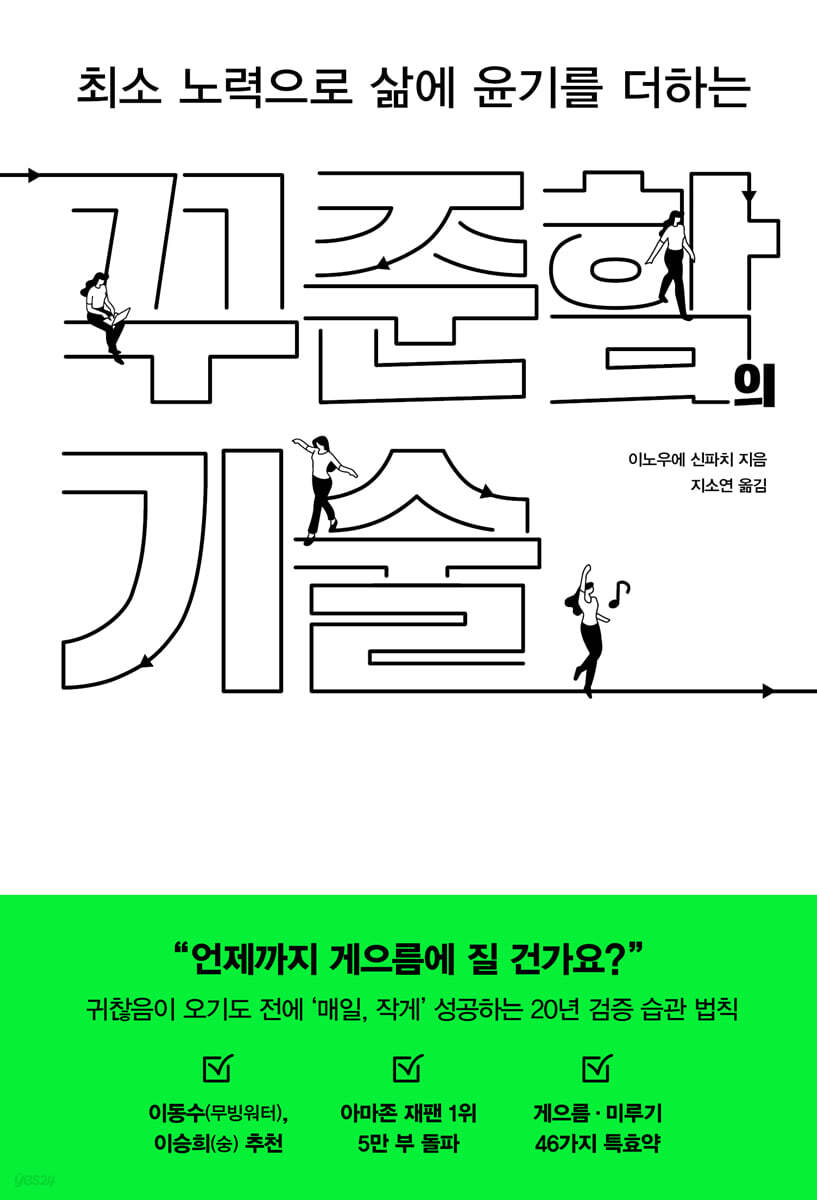
The art of consistency
 |
Description
Book Introduction
- A word from MD
-
How long are you going to be lazy?Consistency is never innate.
The author, who has made consistent effort a hobby, has systematically structured his habits over the past 20 years to ensure that he can maintain his daily routine without difficulty.
The skill of consistency, which helps us grow little by little every day before the hassle sets in, changes our daily lives from being just resolutions.
March 14, 2025. Self-Development PD Oh Da-eun
“How long are you going to be lazy?”
The 20-Year-Proven Habit Rule for "Small, Everyday" Success Before You Get Tired
* The #1 habit book sweeping Japanese bookstores * #1 on Amazon Japan, selling over 50,000 copies
* 46 Remedies for Laziness and Procrastination * Highly Recommended by Moving Water, Seunghee Lee, and Masanori Kanda
A perseverance booster for me who can't do anything consistently!
The star of the popular "Monster Routine" reveals the art of consistency.
If you start off with great ambitions but your plans always fall through, pay attention.
The simplest habit guide has arrived for those of you who think 'doing it consistently' is the most difficult.
The author is a book designer with 20 years of experience, and is a 'master of consistency' who designs 200 books a year and maintains a daily routine of jogging for 25 years, writing a diary for 22 years, blogging for 9 years, practicing dance for 3 years, and reading a book for 3 years.
After an article about his life was published, it became a hot topic through word of mouth as a 'monster routine', and his first book, 'The Art of Consistency', immediately rose to number one in the habits category on Amazon Japan and sold over 50,000 copies.
Nowadays, it's become a given to see things through to the end, but in the past, the author, who easily gave up on anything, experimented with 'how to do it consistently' for 20 years and thoroughly designed daily habits.
As a result, I discovered that it was surprisingly simple to do consistently.
This book introduces the author's daily routine and the secrets of forming habits, and teaches methods to maintain consistency as if breathing, such as 'building a structure of habits rather than relying on willpower', 'continuing with small tasks rather than doing them properly', and 'creating sets of small tasks'.
It also covers how to reduce the pain of not wanting to do something, and how to enjoy your life.
“If you want to achieve your goals, give up your goals,” he says, breaking away from conventional wisdom and providing easy-to-understand techniques that anyone can use to become consistent.
If you are a reader who wants to make a difference this year by consistently doing at least one thing you've resolved to do every year, whether it be exercising, studying English, or reading, this book will be the perfect gift.
The 20-Year-Proven Habit Rule for "Small, Everyday" Success Before You Get Tired
* The #1 habit book sweeping Japanese bookstores * #1 on Amazon Japan, selling over 50,000 copies
* 46 Remedies for Laziness and Procrastination * Highly Recommended by Moving Water, Seunghee Lee, and Masanori Kanda
A perseverance booster for me who can't do anything consistently!
The star of the popular "Monster Routine" reveals the art of consistency.
If you start off with great ambitions but your plans always fall through, pay attention.
The simplest habit guide has arrived for those of you who think 'doing it consistently' is the most difficult.
The author is a book designer with 20 years of experience, and is a 'master of consistency' who designs 200 books a year and maintains a daily routine of jogging for 25 years, writing a diary for 22 years, blogging for 9 years, practicing dance for 3 years, and reading a book for 3 years.
After an article about his life was published, it became a hot topic through word of mouth as a 'monster routine', and his first book, 'The Art of Consistency', immediately rose to number one in the habits category on Amazon Japan and sold over 50,000 copies.
Nowadays, it's become a given to see things through to the end, but in the past, the author, who easily gave up on anything, experimented with 'how to do it consistently' for 20 years and thoroughly designed daily habits.
As a result, I discovered that it was surprisingly simple to do consistently.
This book introduces the author's daily routine and the secrets of forming habits, and teaches methods to maintain consistency as if breathing, such as 'building a structure of habits rather than relying on willpower', 'continuing with small tasks rather than doing them properly', and 'creating sets of small tasks'.
It also covers how to reduce the pain of not wanting to do something, and how to enjoy your life.
“If you want to achieve your goals, give up your goals,” he says, breaking away from conventional wisdom and providing easy-to-understand techniques that anyone can use to become consistent.
If you are a reader who wants to make a difference this year by consistently doing at least one thing you've resolved to do every year, whether it be exercising, studying English, or reading, this book will be the perfect gift.
- You can preview some of the book's contents.
Preview
index
prolog
Introduction
Chapter 0.
Consistency is a hobby
One day, a word came to me like lightning.
26 Things I Do Consistently
The joy of 'doing it consistently'
Chapter 1.
If you do it consistently, it's not a big deal.
Stop trying 'properly'
Don't expect efficiency from the start
You are the one who decided to do it
Whatever it is, let's start
Think about 'structure' before 'purpose'
Chapter 2.
Consistency is all about 'structure'
The best way to keep going no matter what
First, be conscious of small actions.
Let's start with small things
'Continue small' rather than 'do it right'
Make it into a form that can be done in 5 minutes
Two little things combined into a set
Harnessing the power of 'moderateness'
Create a small prerequisite
Decide specifically when to do it
Make time in the morning when you don't have it
Adding fun to your records
Connect the dots and your day will change.
A very simple way to create a structure
Paste and paste to create a routine
Chapter 2 Summary
Chapter 3.
If you are consistent, you will gain the strength to see it through to the end.
I think it's okay to quit at any time
Just pretending to do it is a success
The magical words, "Let's rest tomorrow."
Sometimes you need to escape reality.
Don't try your best at first
How to have fun and adventure every day
Make your day a game with small accomplishments
The strength to see it through to the end comes naturally.
Chapter 4.
If you are consistent, you will meet a changed 'me'.
People who have consistently done it on their own
Change is already happening
If you want to change big, start small.
It doesn't have to be easy to be fun
If you do it as you please, it will turn out surprisingly well.
Get help from yesterday's me
Consistency is a savings account for the future
The only way to go far is by yourself
If you want to achieve your goals, give up on them.
Chapter 5.
Find what you love through consistency
Cherish 'just because', not 'why'
As long as it's useful only to me, that's fine.
When you don't want to do something, it's actually an opportunity.
Record your own tastes
Record your daily activities
Strive to continue liking what you like
Chapter 6.
Things I discovered through persistence
5 minutes a day, making the impossible possible
The meaning will become clear later.
Challenge yourself to read one book a day
Discovering myself through consistent writing
Epilogue.
Let's keep going for now
Outgoing post
Materials and References
Introduction
Chapter 0.
Consistency is a hobby
One day, a word came to me like lightning.
26 Things I Do Consistently
The joy of 'doing it consistently'
Chapter 1.
If you do it consistently, it's not a big deal.
Stop trying 'properly'
Don't expect efficiency from the start
You are the one who decided to do it
Whatever it is, let's start
Think about 'structure' before 'purpose'
Chapter 2.
Consistency is all about 'structure'
The best way to keep going no matter what
First, be conscious of small actions.
Let's start with small things
'Continue small' rather than 'do it right'
Make it into a form that can be done in 5 minutes
Two little things combined into a set
Harnessing the power of 'moderateness'
Create a small prerequisite
Decide specifically when to do it
Make time in the morning when you don't have it
Adding fun to your records
Connect the dots and your day will change.
A very simple way to create a structure
Paste and paste to create a routine
Chapter 2 Summary
Chapter 3.
If you are consistent, you will gain the strength to see it through to the end.
I think it's okay to quit at any time
Just pretending to do it is a success
The magical words, "Let's rest tomorrow."
Sometimes you need to escape reality.
Don't try your best at first
How to have fun and adventure every day
Make your day a game with small accomplishments
The strength to see it through to the end comes naturally.
Chapter 4.
If you are consistent, you will meet a changed 'me'.
People who have consistently done it on their own
Change is already happening
If you want to change big, start small.
It doesn't have to be easy to be fun
If you do it as you please, it will turn out surprisingly well.
Get help from yesterday's me
Consistency is a savings account for the future
The only way to go far is by yourself
If you want to achieve your goals, give up on them.
Chapter 5.
Find what you love through consistency
Cherish 'just because', not 'why'
As long as it's useful only to me, that's fine.
When you don't want to do something, it's actually an opportunity.
Record your own tastes
Record your daily activities
Strive to continue liking what you like
Chapter 6.
Things I discovered through persistence
5 minutes a day, making the impossible possible
The meaning will become clear later.
Challenge yourself to read one book a day
Discovering myself through consistent writing
Epilogue.
Let's keep going for now
Outgoing post
Materials and References
Detailed image

Into the book
What revolutionizes your life is not innate talent, amazing inventions, or genius ideas, but small actions taken day after day.
--- p.25
People say that to achieve good results, you need to put in 'proper effort'.
It means setting clear goals and making efforts to achieve them properly.
"If you don't put in the effort, it's meaningless." Is that really true? If you put in "wrong effort," will you end up with nothing? That's impossible.
It doesn't matter if the results don't turn out the way you want.
If you do it consistently, some kind of 'change' will definitely occur.
Just believe in that fact and keep doing something consistently.
--- p.50
You can just divide it into as small a line as possible without trying to make it clearly conscious.
Pick up the book and open it.
This alone is really enough.
To do that, you need to place the book in a visible place.
So that the conscious desire to pick up a book naturally comes into play.
That alone is enough to get the job done.
Now, let's stop making fun of that habit and keep doing it for a month.
--- p.78
Things that are easy to forget when there is only one thing become difficult to forget when there are two things in a set.
If you keep your diary and thermometer in the same place, take your temperature, and then write in your diary, you can create a routine so that you don't forget and can put everything into practice.
Because if you remember one of them, the other one will come to mind automatically.
All you have to do is create a small device like this and place it so that it can be used naturally in everyday life.
--- p.87
You must clearly define 'when'.
You just need to decide specifically on the timing, whether it's 'after' doing what you always do, or 'along with' what you always do.
Rather than setting a time like “I have to do it at this time,” it is much more specific and realistic to think of it as the before and after of an action.
--- p.95
Things you do consistently become more enjoyable when you keep a record of them.
Collecting things like books, comics, games, plastic models, idol goods, and movie-related merchandise is a lot of fun.
People diligently collect things they like and fill their shelves with their favorite items.
The more things I like, the more my heart fills with joy.
Collecting is such a joyful and enjoyable thing.
So to speak, recording is an act of making consistency into a kind of collection.
--- p.101
How can we evoke the desire to do something? They say the desire to do something simply arises when you "do it."
It's written like that in a brain science book.
The desire to do something, the will, is something that will not arise if you do not do it.
If you want to have the ‘will to do something’, you have no choice but to ‘do it’.
It is truly an eternal paradox.
So let's just take the first step.
Don't try, don't overthink, just try it.
That alone is enough.
If there is a 'motivation switch', it might be 'pretending to do it'.
I don't have the resolve to do everything right.
Just pretending.
--- pp.131-132
‘Seeing things through to the end’ is a series of ‘small endings’.
When consistency becomes natural, everything happens naturally.
‘Seeing it through to the end’ becomes a given.
--- p.156
Since it doesn't seem to bear fruit, I start to wonder what I'm doing all this for.
“I wonder if there’s any point to this?” It’s starting to feel more and more stupid.
'It doesn't increase at all, I don't know why I'm doing it.
Should we stop now…?'
With that thought in mind, I ended up quitting.
It's a common occurrence.
So, how about first trying to distance yourself from those very thoughts? 'My skills will improve,' 'I'll achieve something,' 'something good will happen.'
Let's give up the idea that we can achieve such things through consistent effort.
It's about stopping the idea that you have to aim for some 'goal'.
--- p.168
Cleaning gets better and books get better.
Things I didn't like became good.
What on earth could it have been for?
What could have been there?
“I took my time.” Isn’t that it?
I came to like it because I spent time with it and kept seeing it every day.
--- p.25
People say that to achieve good results, you need to put in 'proper effort'.
It means setting clear goals and making efforts to achieve them properly.
"If you don't put in the effort, it's meaningless." Is that really true? If you put in "wrong effort," will you end up with nothing? That's impossible.
It doesn't matter if the results don't turn out the way you want.
If you do it consistently, some kind of 'change' will definitely occur.
Just believe in that fact and keep doing something consistently.
--- p.50
You can just divide it into as small a line as possible without trying to make it clearly conscious.
Pick up the book and open it.
This alone is really enough.
To do that, you need to place the book in a visible place.
So that the conscious desire to pick up a book naturally comes into play.
That alone is enough to get the job done.
Now, let's stop making fun of that habit and keep doing it for a month.
--- p.78
Things that are easy to forget when there is only one thing become difficult to forget when there are two things in a set.
If you keep your diary and thermometer in the same place, take your temperature, and then write in your diary, you can create a routine so that you don't forget and can put everything into practice.
Because if you remember one of them, the other one will come to mind automatically.
All you have to do is create a small device like this and place it so that it can be used naturally in everyday life.
--- p.87
You must clearly define 'when'.
You just need to decide specifically on the timing, whether it's 'after' doing what you always do, or 'along with' what you always do.
Rather than setting a time like “I have to do it at this time,” it is much more specific and realistic to think of it as the before and after of an action.
--- p.95
Things you do consistently become more enjoyable when you keep a record of them.
Collecting things like books, comics, games, plastic models, idol goods, and movie-related merchandise is a lot of fun.
People diligently collect things they like and fill their shelves with their favorite items.
The more things I like, the more my heart fills with joy.
Collecting is such a joyful and enjoyable thing.
So to speak, recording is an act of making consistency into a kind of collection.
--- p.101
How can we evoke the desire to do something? They say the desire to do something simply arises when you "do it."
It's written like that in a brain science book.
The desire to do something, the will, is something that will not arise if you do not do it.
If you want to have the ‘will to do something’, you have no choice but to ‘do it’.
It is truly an eternal paradox.
So let's just take the first step.
Don't try, don't overthink, just try it.
That alone is enough.
If there is a 'motivation switch', it might be 'pretending to do it'.
I don't have the resolve to do everything right.
Just pretending.
--- pp.131-132
‘Seeing things through to the end’ is a series of ‘small endings’.
When consistency becomes natural, everything happens naturally.
‘Seeing it through to the end’ becomes a given.
--- p.156
Since it doesn't seem to bear fruit, I start to wonder what I'm doing all this for.
“I wonder if there’s any point to this?” It’s starting to feel more and more stupid.
'It doesn't increase at all, I don't know why I'm doing it.
Should we stop now…?'
With that thought in mind, I ended up quitting.
It's a common occurrence.
So, how about first trying to distance yourself from those very thoughts? 'My skills will improve,' 'I'll achieve something,' 'something good will happen.'
Let's give up the idea that we can achieve such things through consistent effort.
It's about stopping the idea that you have to aim for some 'goal'.
--- p.168
Cleaning gets better and books get better.
Things I didn't like became good.
What on earth could it have been for?
What could have been there?
“I took my time.” Isn’t that it?
I came to like it because I spent time with it and kept seeing it every day.
--- p.302
Publisher's Review
“Consistency is a hobby.”
The secret to doing it painlessly, easily, and as easily as breathing
At 4 a.m., the author's day begins.
Every morning, I take pictures of the sky, stretch, jog, do strength training, practice dancing, and even read a book a day before breakfast.
It's a routine that has been refined over 20 years and is now practiced as if breathing.
The author first started practicing the 'Monster Routine' to make a living.
For him, who became a freelancer after leaving his job, consistent self-management was essential.
Then, gradually, doing it consistently became a hobby in itself.
His secret to consistency is to “not overdo it,” as he enjoys thinking about how to continue when starting something.
If you feel pressured to do something you want to do, as if someone else told you to, you will never be able to do it for long.
What is needed for consistency is not great will, but a light heart.
His secret starts in just 10 seconds.
Starting with something as simple as 'picking up a book', the starting point is to mentally think, 'I did it today too.'
Start naturally, like breathing, and increase the difficulty very slowly.
The book also introduces the author's detailed routine and the specific steps to create that habit.
“Will has its limits.”
What's needed is not 'willpower' but the 'structure' of consistency.
"Oh, I can't miss working out today..." Do you always lose in your own battles? You're a weak-willed person.
That doesn't mean I'm someone who can't do it consistently.
Willpower alone always has its limits.
Even if you have been consistently good at something, if your skills stop improving at some point, you will lose motivation.
Therefore, the author suggests creating a 'structure' of consistency rather than willpower.
If you have become accustomed to the 'consciousness' that you have accomplished something today, the next step is to take action.
If your goal is to read, try 'opening a book before going to bed' for a month.
Once you're comfortable with it, try reading one page at a time, gradually increasing the amount.
Another way is to 'create a set'.
Before reading a book, you can use small tasks like making tea as a set to act as a switch for your next action.
Through the author's 20 years of trial and error, readers can gain realistic and specific advice.
In addition to how to create a 'structure', it is full of ideas that change existing thinking.
It contains mental skills that come from real-life experiences, such as, “The meaning of work is found as you do it,” “The biggest enemy of consistency is a sense of accomplishment,” and “Even if you pretend to do it when you don’t want to, you can still succeed.”
“Consistency is synonymous with change.”
How to build a better you with small, sustained efforts and live a more enjoyable life
The author says that you have to do what you like consistently to continue to like it.
The reality is that even enjoyable hobbies like reading comics can become distant at some point as we get caught up in the world's affairs.
The author says that he found joy in life again by taking a little time every day to read comics, which he had stopped reading.
If you do something consistently, you gain more than you think.
If you continue to pursue small hobbies in addition to your main job and self-development, you will gain precious joy.
The author has been giving gifts to the character 'Laramie' in the game 'Animal Crossing: New Horizons' every day for over 10 years.
It may seem useless to others, but to you, it can add an element of enjoyment to your life, and it can even become your individuality.
If you use consistency as your weapon and achieve your goals one by one, you will soon discover that you have changed significantly.
"The Art of Consistency" is a book that generously shares the mindset and techniques of a senior who has already achieved the realm of consistency with all modern people who simultaneously live in their hearts as "greedy people" who want to do many things and as "lazy people" whose bodies cannot keep up.
“When consistency becomes a hobby, people change through the things they have steadily accumulated.
“The number of promises I have kept tells me that I am a person who knows how to see things through to the end.” _From the text
The secret to doing it painlessly, easily, and as easily as breathing
At 4 a.m., the author's day begins.
Every morning, I take pictures of the sky, stretch, jog, do strength training, practice dancing, and even read a book a day before breakfast.
It's a routine that has been refined over 20 years and is now practiced as if breathing.
The author first started practicing the 'Monster Routine' to make a living.
For him, who became a freelancer after leaving his job, consistent self-management was essential.
Then, gradually, doing it consistently became a hobby in itself.
His secret to consistency is to “not overdo it,” as he enjoys thinking about how to continue when starting something.
If you feel pressured to do something you want to do, as if someone else told you to, you will never be able to do it for long.
What is needed for consistency is not great will, but a light heart.
His secret starts in just 10 seconds.
Starting with something as simple as 'picking up a book', the starting point is to mentally think, 'I did it today too.'
Start naturally, like breathing, and increase the difficulty very slowly.
The book also introduces the author's detailed routine and the specific steps to create that habit.
“Will has its limits.”
What's needed is not 'willpower' but the 'structure' of consistency.
"Oh, I can't miss working out today..." Do you always lose in your own battles? You're a weak-willed person.
That doesn't mean I'm someone who can't do it consistently.
Willpower alone always has its limits.
Even if you have been consistently good at something, if your skills stop improving at some point, you will lose motivation.
Therefore, the author suggests creating a 'structure' of consistency rather than willpower.
If you have become accustomed to the 'consciousness' that you have accomplished something today, the next step is to take action.
If your goal is to read, try 'opening a book before going to bed' for a month.
Once you're comfortable with it, try reading one page at a time, gradually increasing the amount.
Another way is to 'create a set'.
Before reading a book, you can use small tasks like making tea as a set to act as a switch for your next action.
Through the author's 20 years of trial and error, readers can gain realistic and specific advice.
In addition to how to create a 'structure', it is full of ideas that change existing thinking.
It contains mental skills that come from real-life experiences, such as, “The meaning of work is found as you do it,” “The biggest enemy of consistency is a sense of accomplishment,” and “Even if you pretend to do it when you don’t want to, you can still succeed.”
“Consistency is synonymous with change.”
How to build a better you with small, sustained efforts and live a more enjoyable life
The author says that you have to do what you like consistently to continue to like it.
The reality is that even enjoyable hobbies like reading comics can become distant at some point as we get caught up in the world's affairs.
The author says that he found joy in life again by taking a little time every day to read comics, which he had stopped reading.
If you do something consistently, you gain more than you think.
If you continue to pursue small hobbies in addition to your main job and self-development, you will gain precious joy.
The author has been giving gifts to the character 'Laramie' in the game 'Animal Crossing: New Horizons' every day for over 10 years.
It may seem useless to others, but to you, it can add an element of enjoyment to your life, and it can even become your individuality.
If you use consistency as your weapon and achieve your goals one by one, you will soon discover that you have changed significantly.
"The Art of Consistency" is a book that generously shares the mindset and techniques of a senior who has already achieved the realm of consistency with all modern people who simultaneously live in their hearts as "greedy people" who want to do many things and as "lazy people" whose bodies cannot keep up.
“When consistency becomes a hobby, people change through the things they have steadily accumulated.
“The number of promises I have kept tells me that I am a person who knows how to see things through to the end.” _From the text
GOODS SPECIFICS
- Date of issue: March 5, 2025
- Page count, weight, size: 320 pages | 398g | 128*188*18mm
- ISBN13: 9788925573991
- ISBN10: 8925573997
You may also like
카테고리
korean


korean

![GQ KOREA Mark (Monthly): December [2025]](http://librairie.coreenne.fr/cdn/shop/files/8ef265dbbfbf186523ed75ba7319009d.jpg?v=1765340328&width=3840)


