

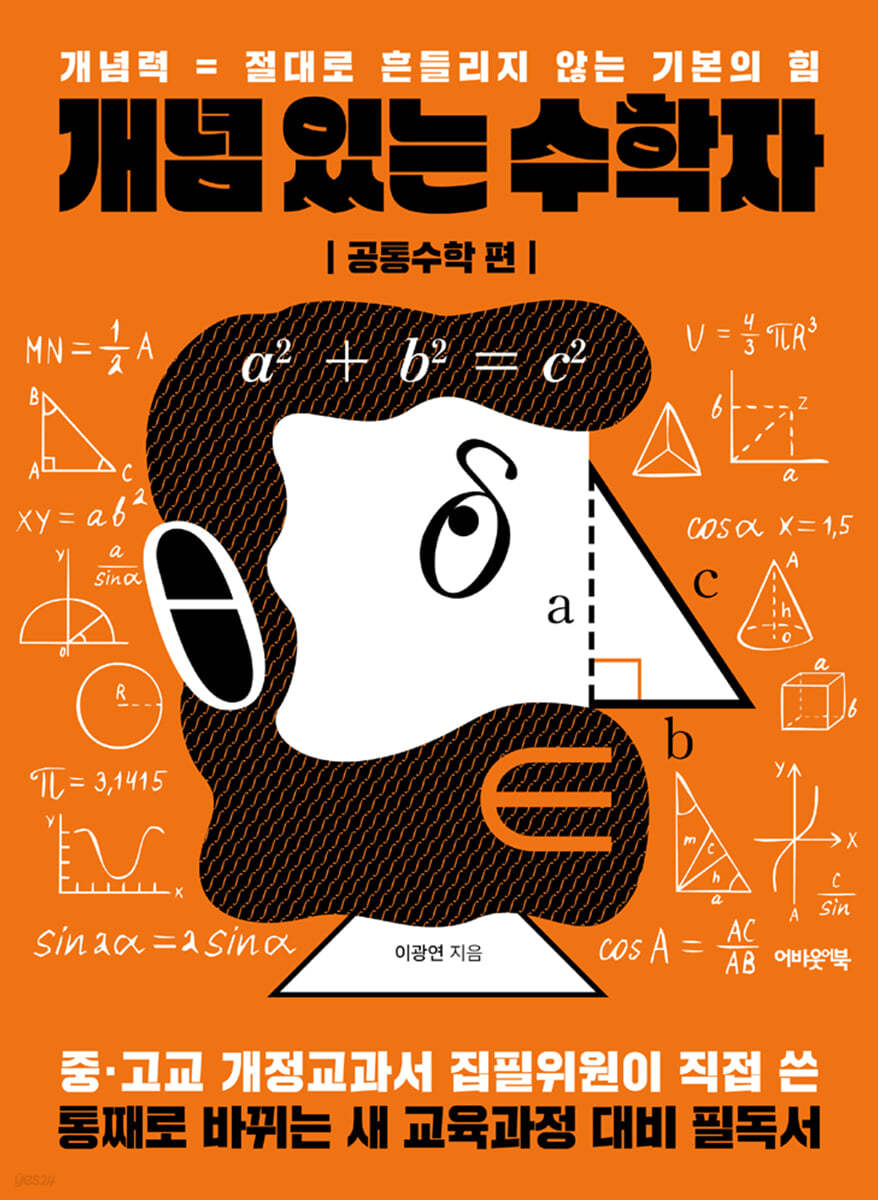
The Conceptual Mathematician: Common Mathematics
 |
Description
Book Introduction
Concepts are a window that penetrates any type of problem precisely!
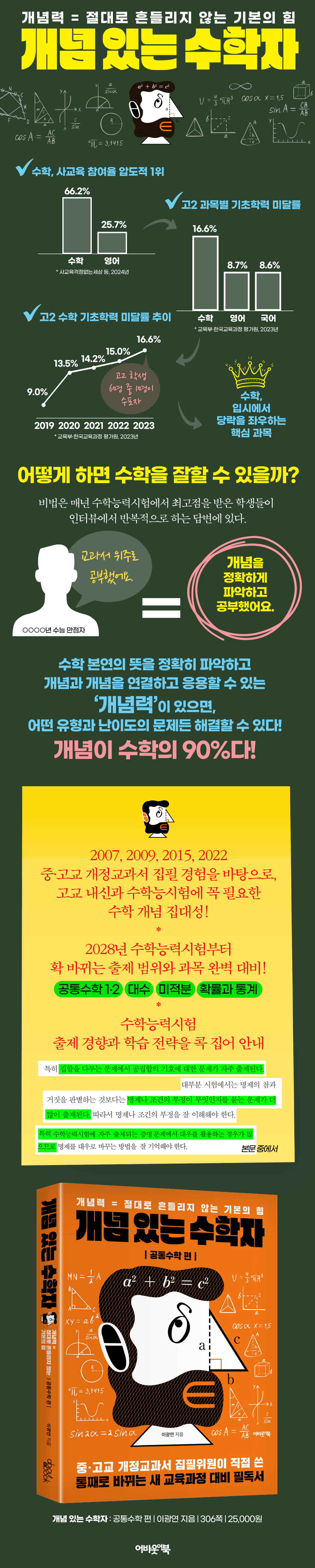
Concepts are 90% of math.
A must-read for the new curriculum, written by a member of the middle and high school textbook revision committee.
Prepare for the drastically changing scope and subjects of the 2028 College Scholastic Ability Test!
Based on experience in preparing major exams, we provide guidance on exam trends and study strategies.
In our country, the students who suffer the most from math bullying are those who have to solve math ability test problems.
Our reality is that students who solve at least one more math problem go to a good university.
As evidence of this, mathematics is the subject with the highest participation rate in private education.
As mathematics becomes established as a core subject that determines college entrance exams, students and parents' fear of mathematics is growing.
How can I excel in math? We can find hints in the study methods of students who have overcome their fear of math.
Every year, students who score highest on the College Scholastic Ability Test always answer in interviews, “I studied mainly from the textbook.”
The true meaning of this statement, which we overlook as a formal response, is “I have studied and understood the concept accurately.”
The author, who has been participating in textbook writing committees for many years and has been researching and contemplating methods for studying mathematics, also shares the same thoughts.
“Concepts are 90% of math.”
If you have the 'conceptual power' to accurately understand the original meaning of mathematics and to connect and apply concepts, you can solve problems of any type and difficulty.
However, many students are in a hurry to solve problems by simply following the types of math problems.
As a result, even if the concept remains the same and only the packaging of the problem is slightly changed, it is perceived as a new problem and collapses helplessly.
If you have a firm grasp of the concept, you will never be shaken.
In mathematics, concepts are more important than types.
The subject that will undergo the biggest change with the 11th revision of the curriculum, which will be applied to first-year high school students starting in 2025, is mathematics.
The biggest change is that 'Geometry' has been removed from the elective subjects of 'Probability and Statistics', 'Calculus', and 'Geometry' in the College Scholastic Ability Test, and 'Probability and Statistics' and 'Calculus' have become common subjects.
In other words, the scope and subjects of the exam are significantly different.
This book quickly dissects the revised textbooks, detailing them in detail, and compiles the mathematical concepts essential for high school grades and the College Scholastic Ability Test.
Mathematical concepts are delved into from the root, the most basic of terms.
The formula explains how, why, and where it comes from, and where and how it is used.
Additionally, by revising the curriculum and restoring explanations that were omitted but are essential for understanding higher-level concepts, we fill in the conceptual gaps in textbooks.
Mathematics is a hierarchical discipline where you have to know one thing to understand the next, so if you lose even one concept, you cannot move forward.
This is why once you distance yourself from mathematics, it is difficult to get closer again.
Although this book covers high school mathematics, it goes back to middle school and elementary school levels and explains concepts from the very bottom, such as the 'root formula', 'discriminant', 'division', and 'trigonometric ratios'.
Additionally, the latter part of the concept explanation provides guidance on the trend of questions and learning strategies, thereby suggesting a direction for studying mathematics.
Concepts are 90% of math.
A must-read for the new curriculum, written by a member of the middle and high school textbook revision committee.
Prepare for the drastically changing scope and subjects of the 2028 College Scholastic Ability Test!
Based on experience in preparing major exams, we provide guidance on exam trends and study strategies.
In our country, the students who suffer the most from math bullying are those who have to solve math ability test problems.
Our reality is that students who solve at least one more math problem go to a good university.
As evidence of this, mathematics is the subject with the highest participation rate in private education.
As mathematics becomes established as a core subject that determines college entrance exams, students and parents' fear of mathematics is growing.
How can I excel in math? We can find hints in the study methods of students who have overcome their fear of math.
Every year, students who score highest on the College Scholastic Ability Test always answer in interviews, “I studied mainly from the textbook.”
The true meaning of this statement, which we overlook as a formal response, is “I have studied and understood the concept accurately.”
The author, who has been participating in textbook writing committees for many years and has been researching and contemplating methods for studying mathematics, also shares the same thoughts.
“Concepts are 90% of math.”
If you have the 'conceptual power' to accurately understand the original meaning of mathematics and to connect and apply concepts, you can solve problems of any type and difficulty.
However, many students are in a hurry to solve problems by simply following the types of math problems.
As a result, even if the concept remains the same and only the packaging of the problem is slightly changed, it is perceived as a new problem and collapses helplessly.
If you have a firm grasp of the concept, you will never be shaken.
In mathematics, concepts are more important than types.
The subject that will undergo the biggest change with the 11th revision of the curriculum, which will be applied to first-year high school students starting in 2025, is mathematics.
The biggest change is that 'Geometry' has been removed from the elective subjects of 'Probability and Statistics', 'Calculus', and 'Geometry' in the College Scholastic Ability Test, and 'Probability and Statistics' and 'Calculus' have become common subjects.
In other words, the scope and subjects of the exam are significantly different.
This book quickly dissects the revised textbooks, detailing them in detail, and compiles the mathematical concepts essential for high school grades and the College Scholastic Ability Test.
Mathematical concepts are delved into from the root, the most basic of terms.
The formula explains how, why, and where it comes from, and where and how it is used.
Additionally, by revising the curriculum and restoring explanations that were omitted but are essential for understanding higher-level concepts, we fill in the conceptual gaps in textbooks.
Mathematics is a hierarchical discipline where you have to know one thing to understand the next, so if you lose even one concept, you cannot move forward.
This is why once you distance yourself from mathematics, it is difficult to get closer again.
Although this book covers high school mathematics, it goes back to middle school and elementary school levels and explains concepts from the very bottom, such as the 'root formula', 'discriminant', 'division', and 'trigonometric ratios'.
Additionally, the latter part of the concept explanation provides guidance on the trend of questions and learning strategies, thereby suggesting a direction for studying mathematics.
- You can preview some of the book's contents.
Preview
index
Preface _ When math is overwhelming you, go back to the concepts!
[ Polynomial ]
01.
Polynomial theorem (descending, ascending)
: The number of solutions to equations at a glance!
02.
Division of polynomials
Division of polynomials that even elementary school students can understand
03.
Identities and the method of undetermined coefficients
: always true no matter what x is
04.
Remainder theorem and factor theorem
: Finding the remainder without dividing the polynomial directly
05.
Assembly method
: The easiest way to find the quotient and remainder of (polynomial ÷ linear equation)
06.
Factorization
: Factoring with pictures
07.
Quadratic equation root formula and discriminant
: A compass essential for navigating the sea of mathematics
[ Equations and Inequalities ]
08.
complex number
: A number that becomes -1 when squared
09.
Complex number operations
: Real numbers and imaginary numbers that don't mix like water and oil
10.
Relationship between roots and coefficients of quadratic equations
: The relationship between the roots and coefficients
11.
Quadratic function
: The graph of a quadratic function is always a decalcomania
12.
Quadratic equations and quadratic functions
: Knowing the positional relationship between the graph and the x-axis using the discriminant
13.
Maximum and minimum of quadratic functions
: Predicting the situation when Baekdu Mountain erupts using a quadratic function
14.
Cubic and quartic equations
: Cubic equation in court
15.
linear inequality
: Using inequalities to express the relationship between numbers or expressions
16.
simultaneous linear inequalities
: Simultaneous inequalities become easier when solved with pictures
17.
Quadratic inequalities and simultaneous quadratic inequalities
: Focus more on how to solve equations rather than inequalities.
[ Number of cases ]
18.
Law of Sum and Law of Multiplication
: The number of cases in which events A and B occur simultaneously or separately
19.
permutation
: List in 'order'
20.
mixture
: Cases where the order is not considered
[ matrix ]
21.
procession
: From solving simultaneous equations to AI, the usefulness of matrices
22.
Addition and subtraction of matrices
: The secret behind vivid images on the LCD screen
23.
Matrix multiplication
: Product of m×k matrix A and k×n matrix B
[ Equation of a shape ]
24.
distance between two points
: Finding the distance between two points on a coordinate plane using the Pythagorean theorem
25.
Internal division of a line segment on a vertical line
Why a NASA Engineer Got Hooked on Origami
26.
Internal division of a line segment on the coordinate plane
: The great discovery of the philosopher who thought to exist
27.
Equations of linear functions and lines
: Predicting electricity demand using linear functions
28.
Parallel of two lines
Thales, who penetrated the universe and space with his intellect
29.
Perpendicular of two lines
: If you remember the Pythagorean theorem, half the problem is solved.
30.
Distance between a point and a line
: Finding the distance between two points on a coordinate plane using the Pythagorean theorem
31.
Equation of a circle
: Knowing just one formula is enough
32.
Positional relationship between circles and lines
: Universal key discriminant
[ set ]
33.
set
: A set must be able to clearly define the target
34.
Inclusion relationship between sets
: When all elements of A belong to B, A⊂B
35.
Union and intersection
: Finding union and intersection
36.
Laws of set operations
: Three laws that apply regardless of order
37.
Complement and difference
: “Draw a circle with your fingertips.
How do you express “I love you as much as that” as a set?
38.
De Morgan's Law
: The 19th-century formula that laid the foundation for the digital age
39.
Propositions and Conditions
: What is the negation of a sentence or expression?
40.
Propositions containing 'all' and 'some'
: Understanding Mark Twain's Satire
41.
Relationships between propositions
: What happens when p pokes q with an arrow
42.
Converse and contrapositive of a proposition
: A clever way to solve a difficult problem like Don Quixote
43.
Necessary and sufficient conditions
: Why Socrates had to die
[ Function ]
44.
react
: The mathematical meaning of 'pair'
45.
function
: “Sangsoo? Who is that?” For Deokseon by our side.
46.
Graph of a function
: Only one element of the codomain corresponds to an element of the domain.
47.
One-to-one functions and one-to-one correspondences
: One-to-one correspondence ⊂ One-to-one function
48.
composite function
: A new function created by combining two functions
49.
Inverse function
: The graphs of the original function and the inverse function are decalcomania
50.
rational function
: Understanding the principles of functions while boiling ramen
51.
Irrational function
: “It is impossible to express it in a glassy way.”
References
Bonus Stage _ Essential Math Formulas That Always Appear on the Exam
[ Polynomial ]
01.
Polynomial theorem (descending, ascending)
: The number of solutions to equations at a glance!
02.
Division of polynomials
Division of polynomials that even elementary school students can understand
03.
Identities and the method of undetermined coefficients
: always true no matter what x is
04.
Remainder theorem and factor theorem
: Finding the remainder without dividing the polynomial directly
05.
Assembly method
: The easiest way to find the quotient and remainder of (polynomial ÷ linear equation)
06.
Factorization
: Factoring with pictures
07.
Quadratic equation root formula and discriminant
: A compass essential for navigating the sea of mathematics
[ Equations and Inequalities ]
08.
complex number
: A number that becomes -1 when squared
09.
Complex number operations
: Real numbers and imaginary numbers that don't mix like water and oil
10.
Relationship between roots and coefficients of quadratic equations
: The relationship between the roots and coefficients
11.
Quadratic function
: The graph of a quadratic function is always a decalcomania
12.
Quadratic equations and quadratic functions
: Knowing the positional relationship between the graph and the x-axis using the discriminant
13.
Maximum and minimum of quadratic functions
: Predicting the situation when Baekdu Mountain erupts using a quadratic function
14.
Cubic and quartic equations
: Cubic equation in court
15.
linear inequality
: Using inequalities to express the relationship between numbers or expressions
16.
simultaneous linear inequalities
: Simultaneous inequalities become easier when solved with pictures
17.
Quadratic inequalities and simultaneous quadratic inequalities
: Focus more on how to solve equations rather than inequalities.
[ Number of cases ]
18.
Law of Sum and Law of Multiplication
: The number of cases in which events A and B occur simultaneously or separately
19.
permutation
: List in 'order'
20.
mixture
: Cases where the order is not considered
[ matrix ]
21.
procession
: From solving simultaneous equations to AI, the usefulness of matrices
22.
Addition and subtraction of matrices
: The secret behind vivid images on the LCD screen
23.
Matrix multiplication
: Product of m×k matrix A and k×n matrix B
[ Equation of a shape ]
24.
distance between two points
: Finding the distance between two points on a coordinate plane using the Pythagorean theorem
25.
Internal division of a line segment on a vertical line
Why a NASA Engineer Got Hooked on Origami
26.
Internal division of a line segment on the coordinate plane
: The great discovery of the philosopher who thought to exist
27.
Equations of linear functions and lines
: Predicting electricity demand using linear functions
28.
Parallel of two lines
Thales, who penetrated the universe and space with his intellect
29.
Perpendicular of two lines
: If you remember the Pythagorean theorem, half the problem is solved.
30.
Distance between a point and a line
: Finding the distance between two points on a coordinate plane using the Pythagorean theorem
31.
Equation of a circle
: Knowing just one formula is enough
32.
Positional relationship between circles and lines
: Universal key discriminant
[ set ]
33.
set
: A set must be able to clearly define the target
34.
Inclusion relationship between sets
: When all elements of A belong to B, A⊂B
35.
Union and intersection
: Finding union and intersection
36.
Laws of set operations
: Three laws that apply regardless of order
37.
Complement and difference
: “Draw a circle with your fingertips.
How do you express “I love you as much as that” as a set?
38.
De Morgan's Law
: The 19th-century formula that laid the foundation for the digital age
39.
Propositions and Conditions
: What is the negation of a sentence or expression?
40.
Propositions containing 'all' and 'some'
: Understanding Mark Twain's Satire
41.
Relationships between propositions
: What happens when p pokes q with an arrow
42.
Converse and contrapositive of a proposition
: A clever way to solve a difficult problem like Don Quixote
43.
Necessary and sufficient conditions
: Why Socrates had to die
[ Function ]
44.
react
: The mathematical meaning of 'pair'
45.
function
: “Sangsoo? Who is that?” For Deokseon by our side.
46.
Graph of a function
: Only one element of the codomain corresponds to an element of the domain.
47.
One-to-one functions and one-to-one correspondences
: One-to-one correspondence ⊂ One-to-one function
48.
composite function
: A new function created by combining two functions
49.
Inverse function
: The graphs of the original function and the inverse function are decalcomania
50.
rational function
: Understanding the principles of functions while boiling ramen
51.
Irrational function
: “It is impossible to express it in a glassy way.”
References
Bonus Stage _ Essential Math Formulas That Always Appear on the Exam
Detailed image
Publisher's Review
Concepts are a window that penetrates any type of problem precisely!
Concepts are 90% of math.
In our country, the students who suffer the most from math bullying are those who have to solve math ability test problems.
If you are on the verge of taking the college entrance exam, whether you are good at math or not, you will be suffering from math.
It is an undeniable fact that students who solve even one more math problem, especially one that is extremely difficult, go to better universities.
In addition, the phenomenon of science students with high math standard scores invading humanities under the integrated humanities and science college entrance exam is becoming increasingly severe.
As mathematics becomes established as a core subject that determines college entrance exams, students and parents' fear of mathematics is growing.
How can you excel in math? Find hints in the study methods of students who overcame their fear of math.
Every year, students who score highest on the College Scholastic Ability Test always answer in interviews, “I studied mainly from textbooks.”
The essence of studying mathematics is contained in this obvious answer that has been repeated for decades since the days of college entrance exams.
The true meaning of this statement is, “I studied with a clear understanding of the concept.”
The author of the revised middle and high school mathematics textbooks for the 2007, 2009, 2015, and 2022 curriculums shares the same view.
“Concepts are 90% of math.”
If you have the 'conceptual power' to accurately understand the original meaning of mathematics and to connect and apply concepts, you can solve problems of any type and difficulty.
However, many students are in a hurry to solve problems by simply following the types of math problems.
As a result, even if the concept remains the same and only the packaging of the problem is slightly changed, it is perceived as a new problem and collapses helplessly.
If you have a firm grasp of the concept, you will never be shaken.
The only thing that can 'kill' extremely difficult questions is 'conceptual power'.
Middle and high school revised textbook writing committee
A compilation of mathematical concepts essential for high school grades and the College Scholastic Ability Test.
The subject that will undergo the biggest change with the 11th curriculum revision is mathematics.
The biggest change is that mathematics in the College Scholastic Ability Test will change from a common + elective subject system to a common subject system.
Until 2027, students will solve Math 1 and 2 as common subjects and then choose one subject among ‘Calculus’, ‘Probability and Statistics’, and ‘Geometry’.
However, starting from the 2028 College Scholastic Ability Test, ‘Geometry’ will be removed, and ‘Probability and Statistics’ and ‘Calculus’ will become common subjects.
In other words, the scope and subjects of the exam are significantly different.
Starting in 2025, first-year high school students will study using revised textbooks that reflect these changes.
There are many books on the market that claim to be textbooks on mathematics concepts, but most of them are either translated books that are out of sync with our curriculum or are based on textbooks that were revised before the revision.
This book, written by the author of the latest revised textbook, quickly and thoroughly dissects the revised textbook, compiling the mathematical concepts essential for high school grades and the College Scholastic Ability Test.
"Most exams ask more questions about the negation of a proposition or condition than about determining the truth or falsity of a proposition." These trends in exam questions and learning strategies, found at the end of the concept explanations, are invaluable information that only the author, who served on a major exam committee, could provide.
Mathematical terms are easily explained with their etymology and origin.
We go back to elementary school and solidify the concept from the ground up!
The proportion of questions measuring thinking ability in math tests is increasing, and 'literacy' is considered an essential ability to do well in math, along with 'conceptual ability'.
This book begins by providing various real-life examples of how each concept is applied, such as MBTI, the eruption of Mount Baekdu, the speed of a freely falling object, quantum mechanics, penalty shootouts, skid marks, and the brightness of stars, to explain why each concept is necessary.
These conceptually engaging texts not only help us realize how deeply mathematics permeates our lives, but are also excellent reading materials that foster literacy skills in their own right.
There is an episode related to mathematical terms in the drama Reply 1988.
Deokseon, who has decided to study math late in life, runs into a wall of terminology before even solving the problem.
“Sangsu? Who is that? There’s nothing there.
“Why do you use such difficult terms?” This book delves into the roots of mathematical concepts, including their etymology and origin, to make them easier to understand.
We do not force you to memorize the formula unconditionally.
Because memorized formulas are of no help in solving problems.
This book explains in detail how, why, and where the formula comes from, and where and how it is used.
Additionally, by revising the curriculum and restoring explanations that were omitted but are essential for understanding higher-level concepts, we fill in the conceptual gaps in textbooks.
Mathematics is a hierarchical discipline where you have to know one thing to know the next.
So, if there is a conceptual deficit in even one part, you cannot move forward.
Although this book covers high school mathematics, it goes back to middle school and elementary school levels and covers concepts from the very bottom, such as the 'root formula', 'discriminant', 'division', and 'trigonometric ratios'.
Concepts are 90% of math.
In our country, the students who suffer the most from math bullying are those who have to solve math ability test problems.
If you are on the verge of taking the college entrance exam, whether you are good at math or not, you will be suffering from math.
It is an undeniable fact that students who solve even one more math problem, especially one that is extremely difficult, go to better universities.
In addition, the phenomenon of science students with high math standard scores invading humanities under the integrated humanities and science college entrance exam is becoming increasingly severe.
As mathematics becomes established as a core subject that determines college entrance exams, students and parents' fear of mathematics is growing.
How can you excel in math? Find hints in the study methods of students who overcame their fear of math.
Every year, students who score highest on the College Scholastic Ability Test always answer in interviews, “I studied mainly from textbooks.”
The essence of studying mathematics is contained in this obvious answer that has been repeated for decades since the days of college entrance exams.
The true meaning of this statement is, “I studied with a clear understanding of the concept.”
The author of the revised middle and high school mathematics textbooks for the 2007, 2009, 2015, and 2022 curriculums shares the same view.
“Concepts are 90% of math.”
If you have the 'conceptual power' to accurately understand the original meaning of mathematics and to connect and apply concepts, you can solve problems of any type and difficulty.
However, many students are in a hurry to solve problems by simply following the types of math problems.
As a result, even if the concept remains the same and only the packaging of the problem is slightly changed, it is perceived as a new problem and collapses helplessly.
If you have a firm grasp of the concept, you will never be shaken.
The only thing that can 'kill' extremely difficult questions is 'conceptual power'.
Middle and high school revised textbook writing committee
A compilation of mathematical concepts essential for high school grades and the College Scholastic Ability Test.
The subject that will undergo the biggest change with the 11th curriculum revision is mathematics.
The biggest change is that mathematics in the College Scholastic Ability Test will change from a common + elective subject system to a common subject system.
Until 2027, students will solve Math 1 and 2 as common subjects and then choose one subject among ‘Calculus’, ‘Probability and Statistics’, and ‘Geometry’.
However, starting from the 2028 College Scholastic Ability Test, ‘Geometry’ will be removed, and ‘Probability and Statistics’ and ‘Calculus’ will become common subjects.
In other words, the scope and subjects of the exam are significantly different.
Starting in 2025, first-year high school students will study using revised textbooks that reflect these changes.
There are many books on the market that claim to be textbooks on mathematics concepts, but most of them are either translated books that are out of sync with our curriculum or are based on textbooks that were revised before the revision.
This book, written by the author of the latest revised textbook, quickly and thoroughly dissects the revised textbook, compiling the mathematical concepts essential for high school grades and the College Scholastic Ability Test.
"Most exams ask more questions about the negation of a proposition or condition than about determining the truth or falsity of a proposition." These trends in exam questions and learning strategies, found at the end of the concept explanations, are invaluable information that only the author, who served on a major exam committee, could provide.
Mathematical terms are easily explained with their etymology and origin.
We go back to elementary school and solidify the concept from the ground up!
The proportion of questions measuring thinking ability in math tests is increasing, and 'literacy' is considered an essential ability to do well in math, along with 'conceptual ability'.
This book begins by providing various real-life examples of how each concept is applied, such as MBTI, the eruption of Mount Baekdu, the speed of a freely falling object, quantum mechanics, penalty shootouts, skid marks, and the brightness of stars, to explain why each concept is necessary.
These conceptually engaging texts not only help us realize how deeply mathematics permeates our lives, but are also excellent reading materials that foster literacy skills in their own right.
There is an episode related to mathematical terms in the drama Reply 1988.
Deokseon, who has decided to study math late in life, runs into a wall of terminology before even solving the problem.
“Sangsu? Who is that? There’s nothing there.
“Why do you use such difficult terms?” This book delves into the roots of mathematical concepts, including their etymology and origin, to make them easier to understand.
We do not force you to memorize the formula unconditionally.
Because memorized formulas are of no help in solving problems.
This book explains in detail how, why, and where the formula comes from, and where and how it is used.
Additionally, by revising the curriculum and restoring explanations that were omitted but are essential for understanding higher-level concepts, we fill in the conceptual gaps in textbooks.
Mathematics is a hierarchical discipline where you have to know one thing to know the next.
So, if there is a conceptual deficit in even one part, you cannot move forward.
Although this book covers high school mathematics, it goes back to middle school and elementary school levels and covers concepts from the very bottom, such as the 'root formula', 'discriminant', 'division', and 'trigonometric ratios'.
GOODS SPECIFICS
- Date of issue: December 6, 2024
- Page count, weight, size: 306 pages | 550g | 172*235*20mm
- ISBN13: 9791192229485
- ISBN10: 1192229487
You may also like
카테고리
korean


korean

![GQ KOREA Mark (Monthly): December [2025]](http://librairie.coreenne.fr/cdn/shop/files/8ef265dbbfbf186523ed75ba7319009d.jpg?v=1765340328&width=3840)


