

Why do I get tired more easily than others?
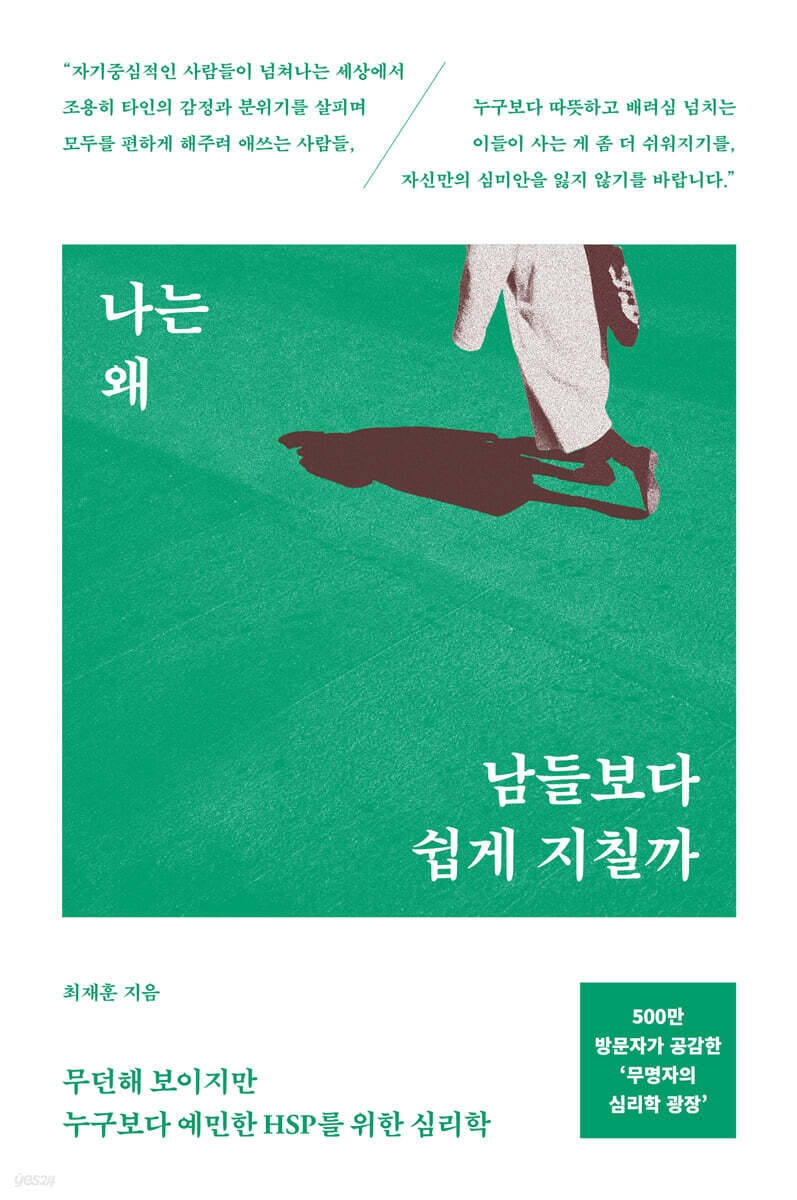 |
Description
Book Introduction
★ 'The Psychology of the Anonymous', which resonated with 5 million visitors
“A truly sensitive person doesn’t reveal their sensitivity.”
Psychology for those who seem indifferent but are more sensitive than anyone else.
When we think of a sensitive person, we often think of sharp and nervous behavior, but the behavioral patterns of a "sensitive temperament" as defined in personality psychology are quite the opposite.
In reality, people with sensitive temperaments feel the pain of conflict very strongly, so they always try to be patient and accommodating, make an effort to make everyone comfortable, and do not hesitate to help and be considerate of others. However, they do not want to be a burden to others, so they try to solve everything on their own.
This is why sensitive people get tired more easily than others.
They don't show their discomfort, they always smile and try to get things done well, so to those around them they seem like indifferent and bearish people, but behind that, there is a hidden struggle that no one knows about.
If this kind of daily life continues, it becomes difficult for even the individual to properly understand his or her own personality, and the resulting sense of disconnect leads to emotional exhaustion and burnout several times more severe than that of others.
This book is for those who, due to their sensitive nature, quickly become exhausted after meeting someone and always feel lacking energy in their daily lives. It teaches them how to understand the characteristics of sensitivity and find balance in life by escaping tension, anxiety, and stress.
The author says:
“I wish the world would recognize that being highly sensitive means being sensitive to not only your own emotions but also the emotions of others, and that, contrary to the negative connotations that the word ‘sensitive’ carries, it is actually a great team player,” he said.
I hope that through this book, those who are warmer and more considerate than anyone else will find life a little easier for those who are sensitive, and that they will be able to solidify their own daily lives.
“A truly sensitive person doesn’t reveal their sensitivity.”
Psychology for those who seem indifferent but are more sensitive than anyone else.
When we think of a sensitive person, we often think of sharp and nervous behavior, but the behavioral patterns of a "sensitive temperament" as defined in personality psychology are quite the opposite.
In reality, people with sensitive temperaments feel the pain of conflict very strongly, so they always try to be patient and accommodating, make an effort to make everyone comfortable, and do not hesitate to help and be considerate of others. However, they do not want to be a burden to others, so they try to solve everything on their own.
This is why sensitive people get tired more easily than others.
They don't show their discomfort, they always smile and try to get things done well, so to those around them they seem like indifferent and bearish people, but behind that, there is a hidden struggle that no one knows about.
If this kind of daily life continues, it becomes difficult for even the individual to properly understand his or her own personality, and the resulting sense of disconnect leads to emotional exhaustion and burnout several times more severe than that of others.
This book is for those who, due to their sensitive nature, quickly become exhausted after meeting someone and always feel lacking energy in their daily lives. It teaches them how to understand the characteristics of sensitivity and find balance in life by escaping tension, anxiety, and stress.
The author says:
“I wish the world would recognize that being highly sensitive means being sensitive to not only your own emotions but also the emotions of others, and that, contrary to the negative connotations that the word ‘sensitive’ carries, it is actually a great team player,” he said.
I hope that through this book, those who are warmer and more considerate than anyone else will find life a little easier for those who are sensitive, and that they will be able to solidify their own daily lives.
- You can preview some of the book's contents.
Preview
index
Chapter 1: Others Don't Know I'm Sensitive
Life as an HSP
Not everyone who is sensitive is an HSP.
A truly sensitive person doesn't show his sensitivity.
Why Sensitive People Always Repay Kindness
If I don't want my deep thoughts to become poisonous,
People-loving, extroverted HSPs have a harder time
Why Sensitive People Appear Indifferent
It's normal to become more sensitive as you get older.
If you start to get angry more and more often
Chapter 2: Why Relationships Are Hell for Sensitive People
People who find it particularly difficult to watch violent scenes
Why is it so hard for me to ask for something?
What kind of people should a sensitive person meet?
The real 'me' and the 'gentle bear' persona
Are you quick-witted or do you just pay attention to things?
The fate of the Giver
A compatible personality vs. a personality that adapts well
Who will stay by my side till the end?
Should I get married or not?
Chapter 3: How to Protect Yourself by Blocking Unnecessary Input
Why Environment Matters to Sensitive People
How to protect myself in a place full of negative stimuli
A sensitive person must be good at running away.
Why I'm Tired Even When I Do Nothing
Why do I keep putting things off?
The 'avoidance' of a sensitive person
Why do I hate driving like this?
Live like a caveman
Chapter 4: How to avoid being swayed by other people's emotions
Influence bias and focalism
It takes energy to endure
How to let your emotions flow gracefully without fighting them
Break free from harsh self-evaluation
Liberating my wounded and self-conscious self
Two notebooks to take charge of your mental health
Leisure creates manners.
Chapter 5: Now is the time for me to be on my own side.
Life is an RPG game
I will make choices that will not make me unhappy
5 Signs You're Growing Up
The unique strengths of sensitive people
Watering the meadow called 'me' regularly
Life as an HSP
Not everyone who is sensitive is an HSP.
A truly sensitive person doesn't show his sensitivity.
Why Sensitive People Always Repay Kindness
If I don't want my deep thoughts to become poisonous,
People-loving, extroverted HSPs have a harder time
Why Sensitive People Appear Indifferent
It's normal to become more sensitive as you get older.
If you start to get angry more and more often
Chapter 2: Why Relationships Are Hell for Sensitive People
People who find it particularly difficult to watch violent scenes
Why is it so hard for me to ask for something?
What kind of people should a sensitive person meet?
The real 'me' and the 'gentle bear' persona
Are you quick-witted or do you just pay attention to things?
The fate of the Giver
A compatible personality vs. a personality that adapts well
Who will stay by my side till the end?
Should I get married or not?
Chapter 3: How to Protect Yourself by Blocking Unnecessary Input
Why Environment Matters to Sensitive People
How to protect myself in a place full of negative stimuli
A sensitive person must be good at running away.
Why I'm Tired Even When I Do Nothing
Why do I keep putting things off?
The 'avoidance' of a sensitive person
Why do I hate driving like this?
Live like a caveman
Chapter 4: How to avoid being swayed by other people's emotions
Influence bias and focalism
It takes energy to endure
How to let your emotions flow gracefully without fighting them
Break free from harsh self-evaluation
Liberating my wounded and self-conscious self
Two notebooks to take charge of your mental health
Leisure creates manners.
Chapter 5: Now is the time for me to be on my own side.
Life is an RPG game
I will make choices that will not make me unhappy
5 Signs You're Growing Up
The unique strengths of sensitive people
Watering the meadow called 'me' regularly
Detailed image

Into the book
If this emotional exhaustion and psychological distress persist without understanding the temperamental trait of "sensitivity," tension and anxiety can increase, leading to chronic depression or anxiety disorders. This is why it's crucial for HSPs to understand their temperamental traits.
--- From the "Prologue"
Because of this hyper-emotional trait that encompasses the emotions of others, HSPs are incredibly perceptive and exceptionally sensitive.
This can be an advantage or a disadvantage depending on the environment.
For example, in a friendly environment, you can live as a person with a good sense of humor who knows how to understand other people's feelings.
On the other hand, in a negative environment, HSPs can end up burning out and becoming apathetic due to worrying about what others think, or they can end up taking on the pain and stress of others, which can lead to the worst outcomes. Therefore, HSPs must always make the best choices in the groups and environments they belong to.
--- From "Life as an HSP"
The reason HSPs are actually good people to get along with is that, due to this guilt tendency, they are not only conscientious, but also have a strong spirit of reciprocity, so they know how to give back as much as they receive, or even more.
When someone does a favor for you, the feeling of indebtedness that comes from not being able to repay the favor can be very uncomfortable for HSPs, so they want to repay the favor as soon as possible.
…When I receive a gift, rather than feeling happy, I feel burdened by not knowing how to repay it.
Because of this tendency, they are not good at asking for favors from others, but they are very good at listening to other people's requests.
--- From "Why Sensitive People Always Repay Kindness"
The reason relationships are hell for sensitive people is because they often end up ruining their day by getting caught up in other people's emotions that aren't even their own.
Do you have a family member, coworker, or friend who gets irritated or angry easily? Sensitive people automatically become infected with that irritation and anger.
And I end up wasting all my energy dealing with that irritation and anger that isn't even mine.
Because they have no choice but to live each day carrying all the emotions of those around them, sensitive people endure and endure until they eventually choose to live as avoidant people who completely let go of human relationships.
--- Among “People Who Have a Hard Time Seeing Violent Scenes”
For example, people with an introverted sense of smell tend to interpret social cues in a way that points them in the direction of their perception.
On the other hand, people with extroverted perception tend to interpret social cues in a way that is oriented towards others.
Simply put, people with an introverted perspective think about how they can use this clue to make themselves more comfortable, while people with an extroverted perspective think about how they can make that person more comfortable.
--- From "Are you quick-witted or are you just very perceptive?"
Especially when you're sensitive and caught up in intense emotions, the source of those emotions can seem like the most important factor of all.
All the focus on decision making is on how I feel.
But every time I do that, I have to recognize that I am in an overheated state.
First, the illusion that the feelings we are feeling now will last forever (influence bias).
Second, the illusion (focus) that the cause of this emotion will control my life going forward.
I am now in a very unstable state where I can make two mistakes.
--- "Influence Bias and Focalism"
The reason I can't accept myself is because I never want to admit that I'm someone who doesn't deserve to be accepted by others.
Even I, who am more important than anything else, must look good in the eyes of others before I can be recognized as myself.
--- From the "Prologue"
Because of this hyper-emotional trait that encompasses the emotions of others, HSPs are incredibly perceptive and exceptionally sensitive.
This can be an advantage or a disadvantage depending on the environment.
For example, in a friendly environment, you can live as a person with a good sense of humor who knows how to understand other people's feelings.
On the other hand, in a negative environment, HSPs can end up burning out and becoming apathetic due to worrying about what others think, or they can end up taking on the pain and stress of others, which can lead to the worst outcomes. Therefore, HSPs must always make the best choices in the groups and environments they belong to.
--- From "Life as an HSP"
The reason HSPs are actually good people to get along with is that, due to this guilt tendency, they are not only conscientious, but also have a strong spirit of reciprocity, so they know how to give back as much as they receive, or even more.
When someone does a favor for you, the feeling of indebtedness that comes from not being able to repay the favor can be very uncomfortable for HSPs, so they want to repay the favor as soon as possible.
…When I receive a gift, rather than feeling happy, I feel burdened by not knowing how to repay it.
Because of this tendency, they are not good at asking for favors from others, but they are very good at listening to other people's requests.
--- From "Why Sensitive People Always Repay Kindness"
The reason relationships are hell for sensitive people is because they often end up ruining their day by getting caught up in other people's emotions that aren't even their own.
Do you have a family member, coworker, or friend who gets irritated or angry easily? Sensitive people automatically become infected with that irritation and anger.
And I end up wasting all my energy dealing with that irritation and anger that isn't even mine.
Because they have no choice but to live each day carrying all the emotions of those around them, sensitive people endure and endure until they eventually choose to live as avoidant people who completely let go of human relationships.
--- Among “People Who Have a Hard Time Seeing Violent Scenes”
For example, people with an introverted sense of smell tend to interpret social cues in a way that points them in the direction of their perception.
On the other hand, people with extroverted perception tend to interpret social cues in a way that is oriented towards others.
Simply put, people with an introverted perspective think about how they can use this clue to make themselves more comfortable, while people with an extroverted perspective think about how they can make that person more comfortable.
--- From "Are you quick-witted or are you just very perceptive?"
Especially when you're sensitive and caught up in intense emotions, the source of those emotions can seem like the most important factor of all.
All the focus on decision making is on how I feel.
But every time I do that, I have to recognize that I am in an overheated state.
First, the illusion that the feelings we are feeling now will last forever (influence bias).
Second, the illusion (focus) that the cause of this emotion will control my life going forward.
I am now in a very unstable state where I can make two mistakes.
--- "Influence Bias and Focalism"
The reason I can't accept myself is because I never want to admit that I'm someone who doesn't deserve to be accepted by others.
Even I, who am more important than anything else, must look good in the eyes of others before I can be recognized as myself.
--- From "Freeing My Hurt and Self-conscious"
Publisher's Review
“Sensitive people are actually the most sensible altruists!”
You feel uneasy all day long over things that others don't even care about.
By understanding your innate tendencies, you can live comfortably without emotional exhaustion starting today!
For those who are highly sensitive, especially those who are highly sensitive (HSPs), which make up the 16 percent of the general population, understanding the inherent trait of sensitivity can be a significant help in protecting yourself and empowering you in everyday life. The three most prominent traits of HSPs are extrasensory perception, extrasensory emotion, and an eye for aesthetics.
First, people with extrasensory characteristics have such a low sensory threshold that they absorb all the stimuli around them like a sponge.
All kinds of information come pouring in like a tidal wave, and we often feel overwhelmed by the flood of stimuli.
This is why we always come home exhausted from all the stimuli that pour in from work, school, and everyday life.
Second, due to their hyper-emotional nature, they are easily influenced by not only their own emotions but also those of others.
Whether it's positive or negative emotions, they tend to fall deeply and strongly into something, so when they're happy, they feel indescribably happy, but when they're not happy, they hate the other person so much that it's hard to bear, and this is also why they find it difficult to watch violent scenes.
Third, HSPs are very artistic and have strong subjective opinions and standards, and their likes and dislikes are clear.
They tend to pursue their own values in numerous cultural and artistic fields, and this can be seen as a very important internal activity that is directly related to their quality of life.
Considering these three characteristics, it is most important for HSPs to create an environment that minimizes unnecessary stimulation, and they need to practice letting go of negative emotions rather than absorbing them.
And filling your daily life with activities that satisfy your own aesthetic is an important way to forge your own path without losing yourself.
“Sensitive people should be good at running away!”
How to escape from all the stimuli that shake my mentality
This book consists of a total of five chapters.
In Chapter 1, “Others Don’t Know I’m Sensitive,” we look at the common behaviors of sensitive people in their daily lives and the reasons for them, focusing on temperamental characteristics, such as “Life as an HSP” and “Why Sensitive People Always Repay Kindness.”
Chapter 2, “Why Relationships Are Hell for Sensitive People,” explains the difficulties that sensitive people face in relationships, such as “Why is it so hard for me to ask for something?” and “What kind of person should a sensitive person date?” It also looks into specifics such as what type of person is best to date and how marriage and childcare affect sensitive people.
In Chapter 3, 'How to Protect Myself by Blocking Unnecessary Input', it explains how to protect myself from psychological problems caused by extrasensory perception and from all kinds of stimuli that constantly come rushing in, such as 'How to Protect Myself in a Place Full of Negative Stimuli', 'Why I Feel Tired Even When I Do Nothing', and 'Why Do I Keep Procrastinating?', with examples.
In Chapter 4, “How to avoid being swayed by other people’s emotions,” “It takes energy to endure,”
It provides information on how to deal with the hyper-emotional characteristics that significantly affect the energy consumption of HSPs, such as 'escaping harsh self-evaluation', and at the same time, it presents specific methods that can be applied to real life based on various experimental results.
The final chapter, "Chapter 5: Now It's Time for Me to Be My Own Side," provides a big picture of how to navigate life by showing you how to anticipate and avoid risks so that you don't experience burnout again as you go forward.
As someone who has lived as an HSP all his life, the author knows better than anyone the problems and psychological difficulties that highly sensitive people face. He says that this book is full of stories that will help highly sensitive people understand the many problems that have caused them difficulties and establish their own identity.
Through the stories the author tells, I hope you will understand why each day has been so tiring and difficult, and that you will have a meaningful time getting to know yourself, and that your inner self will become stronger.
You feel uneasy all day long over things that others don't even care about.
By understanding your innate tendencies, you can live comfortably without emotional exhaustion starting today!
For those who are highly sensitive, especially those who are highly sensitive (HSPs), which make up the 16 percent of the general population, understanding the inherent trait of sensitivity can be a significant help in protecting yourself and empowering you in everyday life. The three most prominent traits of HSPs are extrasensory perception, extrasensory emotion, and an eye for aesthetics.
First, people with extrasensory characteristics have such a low sensory threshold that they absorb all the stimuli around them like a sponge.
All kinds of information come pouring in like a tidal wave, and we often feel overwhelmed by the flood of stimuli.
This is why we always come home exhausted from all the stimuli that pour in from work, school, and everyday life.
Second, due to their hyper-emotional nature, they are easily influenced by not only their own emotions but also those of others.
Whether it's positive or negative emotions, they tend to fall deeply and strongly into something, so when they're happy, they feel indescribably happy, but when they're not happy, they hate the other person so much that it's hard to bear, and this is also why they find it difficult to watch violent scenes.
Third, HSPs are very artistic and have strong subjective opinions and standards, and their likes and dislikes are clear.
They tend to pursue their own values in numerous cultural and artistic fields, and this can be seen as a very important internal activity that is directly related to their quality of life.
Considering these three characteristics, it is most important for HSPs to create an environment that minimizes unnecessary stimulation, and they need to practice letting go of negative emotions rather than absorbing them.
And filling your daily life with activities that satisfy your own aesthetic is an important way to forge your own path without losing yourself.
“Sensitive people should be good at running away!”
How to escape from all the stimuli that shake my mentality
This book consists of a total of five chapters.
In Chapter 1, “Others Don’t Know I’m Sensitive,” we look at the common behaviors of sensitive people in their daily lives and the reasons for them, focusing on temperamental characteristics, such as “Life as an HSP” and “Why Sensitive People Always Repay Kindness.”
Chapter 2, “Why Relationships Are Hell for Sensitive People,” explains the difficulties that sensitive people face in relationships, such as “Why is it so hard for me to ask for something?” and “What kind of person should a sensitive person date?” It also looks into specifics such as what type of person is best to date and how marriage and childcare affect sensitive people.
In Chapter 3, 'How to Protect Myself by Blocking Unnecessary Input', it explains how to protect myself from psychological problems caused by extrasensory perception and from all kinds of stimuli that constantly come rushing in, such as 'How to Protect Myself in a Place Full of Negative Stimuli', 'Why I Feel Tired Even When I Do Nothing', and 'Why Do I Keep Procrastinating?', with examples.
In Chapter 4, “How to avoid being swayed by other people’s emotions,” “It takes energy to endure,”
It provides information on how to deal with the hyper-emotional characteristics that significantly affect the energy consumption of HSPs, such as 'escaping harsh self-evaluation', and at the same time, it presents specific methods that can be applied to real life based on various experimental results.
The final chapter, "Chapter 5: Now It's Time for Me to Be My Own Side," provides a big picture of how to navigate life by showing you how to anticipate and avoid risks so that you don't experience burnout again as you go forward.
As someone who has lived as an HSP all his life, the author knows better than anyone the problems and psychological difficulties that highly sensitive people face. He says that this book is full of stories that will help highly sensitive people understand the many problems that have caused them difficulties and establish their own identity.
Through the stories the author tells, I hope you will understand why each day has been so tiring and difficult, and that you will have a meaningful time getting to know yourself, and that your inner self will become stronger.
GOODS SPECIFICS
- Date of issue: July 10, 2024
- Page count, weight, size: 256 pages | 280g | 125*188*15mm
- ISBN13: 9791193388075
- ISBN10: 1193388074
You may also like
카테고리
korean


korean

![ELLE 엘르 스페셜 에디션 A형 : 12월 [2025]](http://librairie.coreenne.fr/cdn/shop/files/b8e27a3de6c9538896439686c6b0e8fb.jpg?v=1766436872&width=3840)


