

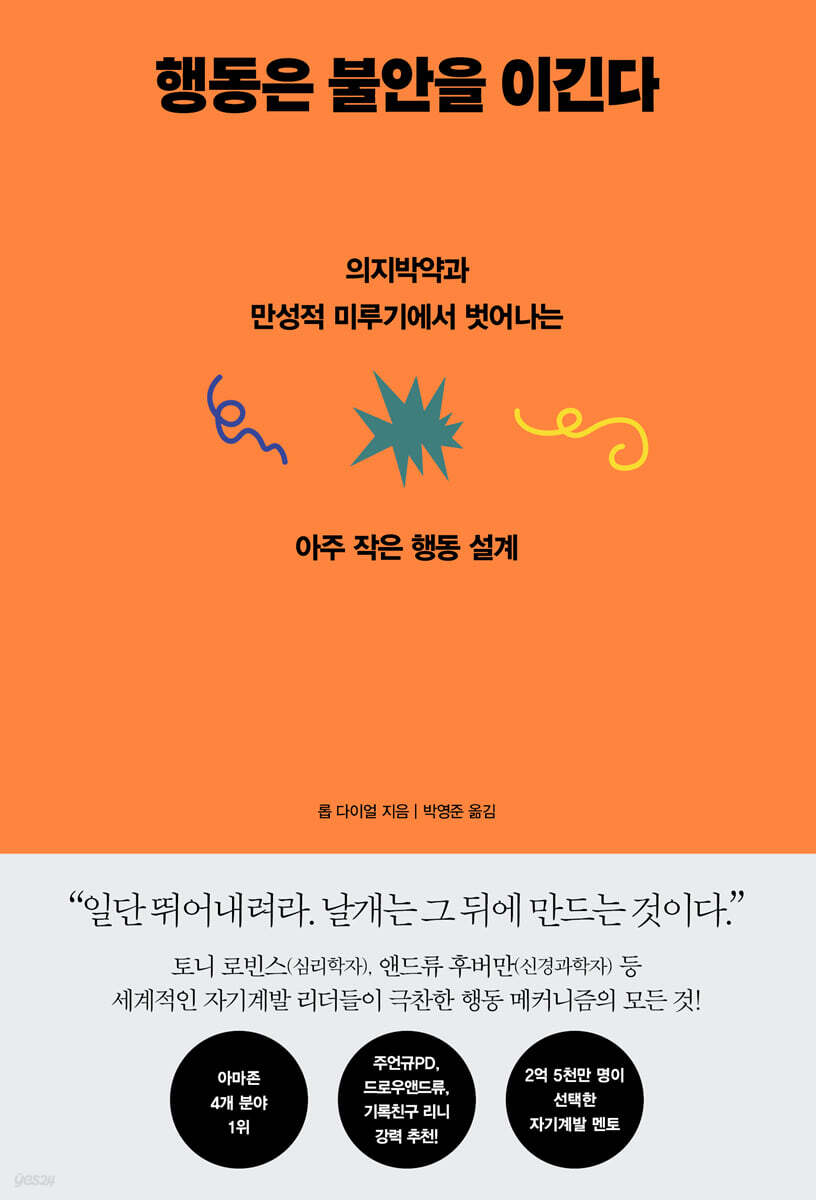
Action conquers anxiety
 |
Description
Book Introduction
Rob Dial, one of America's most popular self-development mentors and motivational experts, has published "Action Beats Anxiety" to analyze the problems of those who hesitate to take action and to offer practical ways to overcome them.
This book, which became a bestseller by reaching number one in four categories on Amazon immediately after its publication, received rave reviews from domestic and international self-development leaders such as Tony Robbins, Andrew Huberman, PD Joo Eun-gyu, Draw Andrew, and Record Friend Linny, and introduces the 'very small action design method', a solution to overcoming weak willpower and chronic procrastination.
This book conveys just two key points needed for very small behavioral design.
Let go of the mind that is deceived by non-existent fears and anxieties and settles for reality.
And the body will learn the behavioral automation patterns that move first.
Only by completing the methods presented in this book one by one and becoming accustomed to them will you be able to move beyond weak willpower and chronic procrastination and move toward a life of action.
Words alone cannot change a life.
Just as the day begins the moment you overcome your annoyance and step out of bed, just as the day's tasks begin the moment you turn on your laptop, just as you begin reading the moment you turn the first page of a book, a 1% change in behavior that your body reacts to first will create a different life from now.
I hope that through the 'behavioral automation patterns' personally proven by the author, you will be able to unleash your hidden potential and achieve your desired goals.
This book, which became a bestseller by reaching number one in four categories on Amazon immediately after its publication, received rave reviews from domestic and international self-development leaders such as Tony Robbins, Andrew Huberman, PD Joo Eun-gyu, Draw Andrew, and Record Friend Linny, and introduces the 'very small action design method', a solution to overcoming weak willpower and chronic procrastination.
This book conveys just two key points needed for very small behavioral design.
Let go of the mind that is deceived by non-existent fears and anxieties and settles for reality.
And the body will learn the behavioral automation patterns that move first.
Only by completing the methods presented in this book one by one and becoming accustomed to them will you be able to move beyond weak willpower and chronic procrastination and move toward a life of action.
Words alone cannot change a life.
Just as the day begins the moment you overcome your annoyance and step out of bed, just as the day's tasks begin the moment you turn on your laptop, just as you begin reading the moment you turn the first page of a book, a 1% change in behavior that your body reacts to first will create a different life from now.
I hope that through the 'behavioral automation patterns' personally proven by the author, you will be able to unleash your hidden potential and achieve your desired goals.
- You can preview some of the book's contents.
Preview
index
To you who are still sitting there complaining and complaining
Part 1: Why You Don't Take Action
Chapter 1.
Fear | All worries and fears are false
What is real fear? | The reality of the fear that plagues you | Embrace fear instead of trying to eliminate it | How to make fear your ally | What pain do you want to avoid in the future? | How to overcome invisible fears | Fear becomes a true catalyst for growth | How wide is your comfort zone? · Prescription for action that moves the body first
Chapter 2.
Identity | The inner story you've been ignoring
You need a new character in your life | What do you tell yourself? | The illusion that motivation is necessary | To change your identity, change your behavior first | Who will you look at and what will you learn? | Follow your thoughts and words | Live a day as the person you want to be | What kind of person do you want to be remembered as right before you die? A prescription for behavior that moves your body first
Chapter 3.
Purpose | What do you truly want?
The goal you set is worth zero points | What do we live for? | If you had money to live off of for the rest of your life, what would you do? | Asking "Why?" | People with goals don't look back · Prescription for action that moves the body first
Chapter 4.
Visualization | A Link to Action
Your brain already knows what you want | Normalize the future you want | Rewrite your visualization scenario | How to visualize easily | Normalization, the power to make imagination a reality | The habit of visualization | Draw energy from a positive future · Prescription for action that moves the body first
Part 2: The Secret of Tiny Action Design
Chapter 5.
Direction | Set your inner GPS
Direction: Where is your destination? | Action: Start, Stop, Continue | Time: Prepare for the long haul | A life of ease now and hardship later, or a life of difficulty now and ease later | Why choose delayed gratification | Life is a game of trade-offs · Prescription for actions that move the body first
Chapter 6.
Clear Obstacles | Distractions
The thing that takes up the most time | Notifications that go off dozens of times a day | Important but distant relationships | Designing an environment just for me | Who surrounds successful people? Prescriptions for behavior that make the body move first.
Chapter 7.
Experiencing Small Victories | How to Get Everything Done Without Missing a Thing
Start your day with small victories | Don't confuse a productive day with a busy day | What's your energy level? | How to distribute your energy | Always take breaks · Prescriptions that put your body first
Chapter 8.
Concentration | The Secret to Productivity
Pomodoro Technique: Focus on One | Eyesight: Practice Visual Focus | Lighting: Seeing Light Improves Memory | Sound: Find the Right Background Noise | Companions: Find an Accountability Partner to Run With | Movement: Create New Motivation | Cold Bath: How to Intentionally Use Dopamine · Prescription for Action That Gets Your Body Moving First
Part 3: The Power of Sustaining Small Changes
Chapter 9.
Consistency | How to Act Every Day Without Fail
The Secret of Rules | The 3-Second Rule that Opens the Door to Action | People Who Achieve Freedom Through Consciousness | Develop Consciousness to Automate Action | Accumulate Small Achievements Through Small Actions | If You Want a Different Future Than Today, You Need Different Actions Than Today | Pursue Consistency Over Perfection | A Prescription for Action That Makes Your Body Move First
Chapter 10.
Habits | How to Create Automated Behavior Patterns
Identify Your Habits | Keystone Habits | Linking Habits | Change Your Standards Before Thinking About Habits | Standards are Your Identity and the Key to Changing Yourself · Prescription for Action That Moves Your Body First
Chapter 11.
Neuroplasticity | The Science of Changing Your Brain
Passive Plasticity: The Power to Change the Brain's Structure on Itself | Maladaptive Plasticity: The Brain Changes with Just a Single Event | Adaptive Plasticity: The Power to Change the Brain Through Repetition | Do Something Different from Yesterday | Acknowledge Difficulties | Sleep: The Time When All Changes Happen | Which is More Important, Talent or Skill? · Prescription for Action That Moves the Body First
Chapter 12.
The Dopamine Reward System | Love the Process More Than the End
The Bottom Line: Dopamine | Leverage the Dopamine Reward System | Various Methods Using the Dopamine Reward System } The Power of Behavior-Based Goals · Prescriptions for Actions That Get Your Body Moving First
In closing, I want to join you on your journey of self-development.
Part 1: Why You Don't Take Action
Chapter 1.
Fear | All worries and fears are false
What is real fear? | The reality of the fear that plagues you | Embrace fear instead of trying to eliminate it | How to make fear your ally | What pain do you want to avoid in the future? | How to overcome invisible fears | Fear becomes a true catalyst for growth | How wide is your comfort zone? · Prescription for action that moves the body first
Chapter 2.
Identity | The inner story you've been ignoring
You need a new character in your life | What do you tell yourself? | The illusion that motivation is necessary | To change your identity, change your behavior first | Who will you look at and what will you learn? | Follow your thoughts and words | Live a day as the person you want to be | What kind of person do you want to be remembered as right before you die? A prescription for behavior that moves your body first
Chapter 3.
Purpose | What do you truly want?
The goal you set is worth zero points | What do we live for? | If you had money to live off of for the rest of your life, what would you do? | Asking "Why?" | People with goals don't look back · Prescription for action that moves the body first
Chapter 4.
Visualization | A Link to Action
Your brain already knows what you want | Normalize the future you want | Rewrite your visualization scenario | How to visualize easily | Normalization, the power to make imagination a reality | The habit of visualization | Draw energy from a positive future · Prescription for action that moves the body first
Part 2: The Secret of Tiny Action Design
Chapter 5.
Direction | Set your inner GPS
Direction: Where is your destination? | Action: Start, Stop, Continue | Time: Prepare for the long haul | A life of ease now and hardship later, or a life of difficulty now and ease later | Why choose delayed gratification | Life is a game of trade-offs · Prescription for actions that move the body first
Chapter 6.
Clear Obstacles | Distractions
The thing that takes up the most time | Notifications that go off dozens of times a day | Important but distant relationships | Designing an environment just for me | Who surrounds successful people? Prescriptions for behavior that make the body move first.
Chapter 7.
Experiencing Small Victories | How to Get Everything Done Without Missing a Thing
Start your day with small victories | Don't confuse a productive day with a busy day | What's your energy level? | How to distribute your energy | Always take breaks · Prescriptions that put your body first
Chapter 8.
Concentration | The Secret to Productivity
Pomodoro Technique: Focus on One | Eyesight: Practice Visual Focus | Lighting: Seeing Light Improves Memory | Sound: Find the Right Background Noise | Companions: Find an Accountability Partner to Run With | Movement: Create New Motivation | Cold Bath: How to Intentionally Use Dopamine · Prescription for Action That Gets Your Body Moving First
Part 3: The Power of Sustaining Small Changes
Chapter 9.
Consistency | How to Act Every Day Without Fail
The Secret of Rules | The 3-Second Rule that Opens the Door to Action | People Who Achieve Freedom Through Consciousness | Develop Consciousness to Automate Action | Accumulate Small Achievements Through Small Actions | If You Want a Different Future Than Today, You Need Different Actions Than Today | Pursue Consistency Over Perfection | A Prescription for Action That Makes Your Body Move First
Chapter 10.
Habits | How to Create Automated Behavior Patterns
Identify Your Habits | Keystone Habits | Linking Habits | Change Your Standards Before Thinking About Habits | Standards are Your Identity and the Key to Changing Yourself · Prescription for Action That Moves Your Body First
Chapter 11.
Neuroplasticity | The Science of Changing Your Brain
Passive Plasticity: The Power to Change the Brain's Structure on Itself | Maladaptive Plasticity: The Brain Changes with Just a Single Event | Adaptive Plasticity: The Power to Change the Brain Through Repetition | Do Something Different from Yesterday | Acknowledge Difficulties | Sleep: The Time When All Changes Happen | Which is More Important, Talent or Skill? · Prescription for Action That Moves the Body First
Chapter 12.
The Dopamine Reward System | Love the Process More Than the End
The Bottom Line: Dopamine | Leverage the Dopamine Reward System | Various Methods Using the Dopamine Reward System } The Power of Behavior-Based Goals · Prescriptions for Actions That Get Your Body Moving First
In closing, I want to join you on your journey of self-development.
Detailed image

Into the book
Life is pretty simple.
Either you achieve your goal or you don't.
The difference between the two can only be reduced to the question of whether or not you have taken the actions necessary to achieve what you want.
This is the part that so many people miss.
This book provides a step-by-step blueprint to help you take the actions necessary to achieve your goals, every single day.
Through that action, you will be able to break free from anxiety and create the life you truly desire.
--- p.17, from “To You Who Still Sits Down and Complains”
Fear is designed to help us avoid future dangers, but it also hinders our actions by evoking the imagination of future suffering.
But if I were to make one prophecy for you, it would be that future suffering is inevitable for those who do not act.
Everything in life has a price.
You will inevitably pay the price for your 'inaction'.
Whether it's not reaching your full potential, ignoring the whisperings of your heart, not giving your children the opportunities they deserve, or lying on your deathbed realizing you've wasted your life, you'll have to bear the consequences.
By the time you realize what has happened to you, it may already be too late.
--- pp.41-42, from “Fear Becomes the Trigger of True Growth”
If you hear a voice in your head all day long complaining, "My life is miserable because of the way I am," it's evidence that you're stuck in a vicious cycle of negativity and can't move.
If you are experiencing failure in relationships, it is because you believe that you are either bad at relationships or that there are no worthy people in the world and that you would rather ruin your relationships.
Everyone has a story to tell.
Of course, none of these stories are true, but we live each day relying on them.
Why is that? It's because of the "identity triangle" mentioned earlier.
Identity influences behavior, behavior produces outcomes, and outcomes provide feedback to identity.
We believe we are that kind of person, so we act in a way that aligns with that identity, and our actions have the effect of further reinforcing that identity.
The only way to avoid this is to identify the story you're hearing in your head and change the content of that story to better suit your desired outcome.
--- p.59, from “What Do You Tell Yourself?”
Many people dream of business success, but when asked what exactly "success" means, few can give a clear answer.
Can someone who doesn't even know what success is really achieve it? The problem with setting vague goals is that they can mean completely different things to different people.
What exactly do words like financial freedom, peace of mind, inner peace, healthy relationships, and self-satisfaction truly mean? These words are completely unspecific.
What might bring you financial freedom might mean financial setbacks for someone else.
We must always be specific about what success means.
From now on, you need to practice visualizing yourself as successful.
--- pp.90-91, from “The goal you set is worth zero points”
“It’s better to say out loud that you’re not interested in your goal than to make excuses about not having time.” This may be a bit harsh, but it’s something everyone should take to heart.
People somehow make time for important things.
Saying you don't have time to exercise means it's not that important.
Saying you don't have enough time to build your business may mean that your business isn't that important to you.
If you find yourself unable to make time for your spouse or children or lack the time to build healthy relationships, it may be because family and relationships aren't very important to you.
If something is truly important to you, you will find a 'way' to do it, but if it is not important, you will find an 'excuse' not to do it.
--- p.103, from “Those who have a goal do not look back”
Do you think you're lazy? No.
You just chose a lazy lifestyle.
Do you consider yourself a procrastinator? No.
I just chose to be a procrastinator.
At first glance, there may not seem to be much difference between the two, but the first sentence represents your identity and the second sentence represents a choice.
It was also mentioned in Chapter 1 that if we have the identity of a lazy or procrastinator, we will behave accordingly.
Did.
The door to a different path is wide open before you.
There is always a moment of choice before taking a specific action.
Lying on the sofa and doing nothing is also an action and a choice.
But those who enjoy a lazy life have to bear the consequences.
Because that means you've chosen an easy life now and a difficult life later.
--- p.144, from “Why We Choose Delayed Gratification”
Each person has a different innate ability to concentrate.
But there are definitely ways to raise that bar.
What should we do? The method is simple.
Something to practice every day.
It's just practice.
The problem is that we are often unaware that our concentration is being distracted by the clutter around us.
Therefore, the first step to solving the problem is to understand exactly who the enemy is that I have to fight.
It may be difficult to take action until you eliminate the distractions around you, but the more you become aware of the behaviors that disrupt your focus, the easier it will be to correct them.
First, let's look at the most common distractions—your smartphone, notifications, people around you, your physical environment, and your social environment—and think about how to deal with them.
--- pp.153-154, from "Removing Obstacles: Things That Distract You from Focusing"
"How do you find the time to do all that? Did you learn that in the military? What's your secret?"
“It’s thanks to learning how to live by putting strength in one’s front legs.”
The guy said that people can live by putting their strength on their front legs or their back legs.
When we put strength into our front legs, we naturally take a forward-moving action, and that attitude is one that takes control of the situation and upgrades our lives.
On the other hand, if you put your weight on your back foot, you will inevitably take a backward step without realizing it.
It is difficult to move forward with this passive attitude.
--- p.175, from “Experiencing Small Victories: How to Get Everything Done Without Missing Anything”
Achieving small victories every now and then is like toppling dominoes.
When you knock over the first domino, the rest of the domino pieces fall in a row.
Whatever your goal, it's important to achieve a series of small victories.
One victory inevitably leads to another.
People think of success as one big event, but they don't realize that it's actually a series of micro-actions that add up to a big result.
Success is achieved by doing small things every day and building momentum little by little each week until you get to wherever you want to go.
--- pp.183-184, from “Start the Day with Small Victories”
Don't expect your mind to always be brimming with motivation.
There will be days when you don't feel like working or are unmotivated.
An accountability partner is there to pat you on the shoulder and push you back every time you need to get things done.
There is no rule that says you have to have only one person as your responsibility partner.
The more companions you have to support you in achieving your goals, the better.
--- pp.219-220, from “Colleagues: Finding Responsible Partners to Run With”
One of the simplest ways to cultivate consistency is to develop awareness.
A ritual is a meaningful practice or routine consisting of a set of step-by-step processes.
By strategically and repeatedly utilizing this intentional and planned ritual, you can get one step closer to your goals.
Some people resist practicing rituals because they feel they restrict their actions and cause boredom.
Everyone loves new things and wants to change their routine.
Of course, there are times when that is necessary.
But the most successful people are those who understand best that consciousness creates freedom.
As I've emphasized throughout this book, the best secret to success is to work hard at the beginning to pave the way smoothly and make the later stages of the journey easier.
The rituals you practice now will create more freedom in the future.
--- p.238, from “People Who Gained Freedom Through Consciousness”
“People don’t decide their own future.
“They just decide their habits, and their habits decide their future.” If you can get your brain to create habits that work for you in your daily life, you will gain a new superpower.
The brain processes habits unconsciously.
The problem is that not all habits or patterns ingrained in the brain are as harmless as simply driving home.
In other words, not all habits are positive.
How many of the countless habits you naturally repeat are hindering you from achieving your long-term goals? How many habits are unknowingly hindering your progress? If you untangle the tangled mess in your brain and understand what thoughts you're thinking and where they come from, you'll uncover countless negative patterns you need to address.
But don't worry.
Good and bad fates are not given to us in advance.
The brain is quite controllable.
--- p.261, from “Habits: How to Create Automated Patterns of Behavior”
The brain's neuroplasticity can also help us change the content of our thoughts.
There is ample scientific evidence behind the phrase “the power of positive thinking.”
In the brains of people who think positively, areas of the brain associated with self-awareness and reward systems are activated.
Additionally, positive thinking and an optimistic attitude reduce stress and lower cortisol levels.
Research even shows that a positive mindset improves cardiovascular health and reduces other health risks.
The question is how to make a positive mindset a habit.
As someone who used to be a pessimist, I know how difficult it is to change your mindset when you're used to seeing the world through negative eyes.
But while it's difficult to control the first thought that pops into your head, you can certainly control the second thought.
This means that if you develop the habit of breaking this pattern by thinking of a positive thought afterward, even when a negative thought suddenly pops up in your mind, you can strengthen new neural pathways.
--- pp.292-293, from “Do something different from yesterday”
Think of a time when you were feeling miserable or depressed and someone's joke made you feel better and brightened your day.
Laughter gives people more energy and makes them feel like not everything in the world is so bad.
There is also a lot of research on the medical benefits of laughter.
It is said that when people burst into laughter, they feel a refreshing feeling, like a sense of accomplishment.
The next time you're feeling stressed or frustrated during the day, take five minutes to watch a video featuring your favorite comedian.
Laughter triggers the dopamine reward system, which lowers adrenaline levels and gives you the energy to keep moving toward your goals.
--- p.317, from “Various Methods Using the Dopamine Reward System”
If someone dreams of self-improvement, they must start by improving their ego.
But most people don't know this fact.
Here's a simple explanation of why this task should be a priority:
Imagine you are walking down the street and come across an abandoned house.
The house is so old it looks like it could collapse at any moment, and when you go upstairs, you see a dusty attic that looks like no one has set foot in it for decades.
In one corner of the room there is a mirror covered in dust and stains.
The mirror is so dirty that you can hardly recognize yourself.
The moment I sweep my hand down to clean the mirror, a cloud of dust rises and covers my face.
To see your face in the mirror, you have to remove a huge amount of dust.
For those who wish to improve themselves, the first step is to clear away the dust.
We call that work self-improvement.
Our true selves beneath the surface are all clear mirrors.
That is the true self.
But we each develop and pile on all sorts of habits, programs, and systems that society dictates to us about what kind of people we should be and how we should behave.
All of these are factors that block our true potential.
Now we are trying to remove that dust.
Everyone is covered in dust.
They just don't know that fact.
Either you achieve your goal or you don't.
The difference between the two can only be reduced to the question of whether or not you have taken the actions necessary to achieve what you want.
This is the part that so many people miss.
This book provides a step-by-step blueprint to help you take the actions necessary to achieve your goals, every single day.
Through that action, you will be able to break free from anxiety and create the life you truly desire.
--- p.17, from “To You Who Still Sits Down and Complains”
Fear is designed to help us avoid future dangers, but it also hinders our actions by evoking the imagination of future suffering.
But if I were to make one prophecy for you, it would be that future suffering is inevitable for those who do not act.
Everything in life has a price.
You will inevitably pay the price for your 'inaction'.
Whether it's not reaching your full potential, ignoring the whisperings of your heart, not giving your children the opportunities they deserve, or lying on your deathbed realizing you've wasted your life, you'll have to bear the consequences.
By the time you realize what has happened to you, it may already be too late.
--- pp.41-42, from “Fear Becomes the Trigger of True Growth”
If you hear a voice in your head all day long complaining, "My life is miserable because of the way I am," it's evidence that you're stuck in a vicious cycle of negativity and can't move.
If you are experiencing failure in relationships, it is because you believe that you are either bad at relationships or that there are no worthy people in the world and that you would rather ruin your relationships.
Everyone has a story to tell.
Of course, none of these stories are true, but we live each day relying on them.
Why is that? It's because of the "identity triangle" mentioned earlier.
Identity influences behavior, behavior produces outcomes, and outcomes provide feedback to identity.
We believe we are that kind of person, so we act in a way that aligns with that identity, and our actions have the effect of further reinforcing that identity.
The only way to avoid this is to identify the story you're hearing in your head and change the content of that story to better suit your desired outcome.
--- p.59, from “What Do You Tell Yourself?”
Many people dream of business success, but when asked what exactly "success" means, few can give a clear answer.
Can someone who doesn't even know what success is really achieve it? The problem with setting vague goals is that they can mean completely different things to different people.
What exactly do words like financial freedom, peace of mind, inner peace, healthy relationships, and self-satisfaction truly mean? These words are completely unspecific.
What might bring you financial freedom might mean financial setbacks for someone else.
We must always be specific about what success means.
From now on, you need to practice visualizing yourself as successful.
--- pp.90-91, from “The goal you set is worth zero points”
“It’s better to say out loud that you’re not interested in your goal than to make excuses about not having time.” This may be a bit harsh, but it’s something everyone should take to heart.
People somehow make time for important things.
Saying you don't have time to exercise means it's not that important.
Saying you don't have enough time to build your business may mean that your business isn't that important to you.
If you find yourself unable to make time for your spouse or children or lack the time to build healthy relationships, it may be because family and relationships aren't very important to you.
If something is truly important to you, you will find a 'way' to do it, but if it is not important, you will find an 'excuse' not to do it.
--- p.103, from “Those who have a goal do not look back”
Do you think you're lazy? No.
You just chose a lazy lifestyle.
Do you consider yourself a procrastinator? No.
I just chose to be a procrastinator.
At first glance, there may not seem to be much difference between the two, but the first sentence represents your identity and the second sentence represents a choice.
It was also mentioned in Chapter 1 that if we have the identity of a lazy or procrastinator, we will behave accordingly.
Did.
The door to a different path is wide open before you.
There is always a moment of choice before taking a specific action.
Lying on the sofa and doing nothing is also an action and a choice.
But those who enjoy a lazy life have to bear the consequences.
Because that means you've chosen an easy life now and a difficult life later.
--- p.144, from “Why We Choose Delayed Gratification”
Each person has a different innate ability to concentrate.
But there are definitely ways to raise that bar.
What should we do? The method is simple.
Something to practice every day.
It's just practice.
The problem is that we are often unaware that our concentration is being distracted by the clutter around us.
Therefore, the first step to solving the problem is to understand exactly who the enemy is that I have to fight.
It may be difficult to take action until you eliminate the distractions around you, but the more you become aware of the behaviors that disrupt your focus, the easier it will be to correct them.
First, let's look at the most common distractions—your smartphone, notifications, people around you, your physical environment, and your social environment—and think about how to deal with them.
--- pp.153-154, from "Removing Obstacles: Things That Distract You from Focusing"
"How do you find the time to do all that? Did you learn that in the military? What's your secret?"
“It’s thanks to learning how to live by putting strength in one’s front legs.”
The guy said that people can live by putting their strength on their front legs or their back legs.
When we put strength into our front legs, we naturally take a forward-moving action, and that attitude is one that takes control of the situation and upgrades our lives.
On the other hand, if you put your weight on your back foot, you will inevitably take a backward step without realizing it.
It is difficult to move forward with this passive attitude.
--- p.175, from “Experiencing Small Victories: How to Get Everything Done Without Missing Anything”
Achieving small victories every now and then is like toppling dominoes.
When you knock over the first domino, the rest of the domino pieces fall in a row.
Whatever your goal, it's important to achieve a series of small victories.
One victory inevitably leads to another.
People think of success as one big event, but they don't realize that it's actually a series of micro-actions that add up to a big result.
Success is achieved by doing small things every day and building momentum little by little each week until you get to wherever you want to go.
--- pp.183-184, from “Start the Day with Small Victories”
Don't expect your mind to always be brimming with motivation.
There will be days when you don't feel like working or are unmotivated.
An accountability partner is there to pat you on the shoulder and push you back every time you need to get things done.
There is no rule that says you have to have only one person as your responsibility partner.
The more companions you have to support you in achieving your goals, the better.
--- pp.219-220, from “Colleagues: Finding Responsible Partners to Run With”
One of the simplest ways to cultivate consistency is to develop awareness.
A ritual is a meaningful practice or routine consisting of a set of step-by-step processes.
By strategically and repeatedly utilizing this intentional and planned ritual, you can get one step closer to your goals.
Some people resist practicing rituals because they feel they restrict their actions and cause boredom.
Everyone loves new things and wants to change their routine.
Of course, there are times when that is necessary.
But the most successful people are those who understand best that consciousness creates freedom.
As I've emphasized throughout this book, the best secret to success is to work hard at the beginning to pave the way smoothly and make the later stages of the journey easier.
The rituals you practice now will create more freedom in the future.
--- p.238, from “People Who Gained Freedom Through Consciousness”
“People don’t decide their own future.
“They just decide their habits, and their habits decide their future.” If you can get your brain to create habits that work for you in your daily life, you will gain a new superpower.
The brain processes habits unconsciously.
The problem is that not all habits or patterns ingrained in the brain are as harmless as simply driving home.
In other words, not all habits are positive.
How many of the countless habits you naturally repeat are hindering you from achieving your long-term goals? How many habits are unknowingly hindering your progress? If you untangle the tangled mess in your brain and understand what thoughts you're thinking and where they come from, you'll uncover countless negative patterns you need to address.
But don't worry.
Good and bad fates are not given to us in advance.
The brain is quite controllable.
--- p.261, from “Habits: How to Create Automated Patterns of Behavior”
The brain's neuroplasticity can also help us change the content of our thoughts.
There is ample scientific evidence behind the phrase “the power of positive thinking.”
In the brains of people who think positively, areas of the brain associated with self-awareness and reward systems are activated.
Additionally, positive thinking and an optimistic attitude reduce stress and lower cortisol levels.
Research even shows that a positive mindset improves cardiovascular health and reduces other health risks.
The question is how to make a positive mindset a habit.
As someone who used to be a pessimist, I know how difficult it is to change your mindset when you're used to seeing the world through negative eyes.
But while it's difficult to control the first thought that pops into your head, you can certainly control the second thought.
This means that if you develop the habit of breaking this pattern by thinking of a positive thought afterward, even when a negative thought suddenly pops up in your mind, you can strengthen new neural pathways.
--- pp.292-293, from “Do something different from yesterday”
Think of a time when you were feeling miserable or depressed and someone's joke made you feel better and brightened your day.
Laughter gives people more energy and makes them feel like not everything in the world is so bad.
There is also a lot of research on the medical benefits of laughter.
It is said that when people burst into laughter, they feel a refreshing feeling, like a sense of accomplishment.
The next time you're feeling stressed or frustrated during the day, take five minutes to watch a video featuring your favorite comedian.
Laughter triggers the dopamine reward system, which lowers adrenaline levels and gives you the energy to keep moving toward your goals.
--- p.317, from “Various Methods Using the Dopamine Reward System”
If someone dreams of self-improvement, they must start by improving their ego.
But most people don't know this fact.
Here's a simple explanation of why this task should be a priority:
Imagine you are walking down the street and come across an abandoned house.
The house is so old it looks like it could collapse at any moment, and when you go upstairs, you see a dusty attic that looks like no one has set foot in it for decades.
In one corner of the room there is a mirror covered in dust and stains.
The mirror is so dirty that you can hardly recognize yourself.
The moment I sweep my hand down to clean the mirror, a cloud of dust rises and covers my face.
To see your face in the mirror, you have to remove a huge amount of dust.
For those who wish to improve themselves, the first step is to clear away the dust.
We call that work self-improvement.
Our true selves beneath the surface are all clear mirrors.
That is the true self.
But we each develop and pile on all sorts of habits, programs, and systems that society dictates to us about what kind of people we should be and how we should behave.
All of these are factors that block our true potential.
Now we are trying to remove that dust.
Everyone is covered in dust.
They just don't know that fact.
--- pp.324-325, from “I want to accompany you on your future journey of self-development”
Publisher's Review
“There is no problem with taking action.
Action actually solves problems.”
I have already gained a lot of insight from just this one sentence in the book.
― Producer Joo Eon-gyu
★ #1 Amazon Bestseller in 4 Categories
★ Recommended by domestic and international experts including Tony Robbins, PD Joo Eun-gyu, Draw Andrew, and Linny!
From a penniless minimum wage worker to a billionaire sought after by 250 million people worldwide.
Everything You Need to Know About the "Action Mechanism" Praised by Global Self-Development Leaders
Everyone wants to live a better life.
They want to move to a better job and dream big dreams of starting a business and achieving great success.
I hope your diet is successful and that your complicated interpersonal relationship problems are resolved.
But why do we still live the same life as yesterday? Why don't we take action to live a better life? This book offers the clearest answers to these age-old questions.
Let go of the mindset of settling for reality, deceived by non-existent fears and anxieties.
And the body will learn the behavioral automation patterns that move first.
These two practices will guide you on a path to freedom from chronic anxiety and habitual procrastination.
Rob Dial is one of America's most sought-after consulting professionals, attracting global attention.
But his life wasn't smooth sailing from the beginning.
He started delivering pizzas at the age of 19 due to his alcoholic father, and he dedicated himself to the job, working 110 hours a week and training 2,000 salespeople.
But a few years later, he was faced with the harsh reality of a worn-out body, a ruined company, and the loss of all his investment funds.
Days passed without sleep, filled with anxiety as he watched his life crumble in an instant, but even then, he was unable to take action.
Looking back on the past, he says:
“The inner anxiety that ‘I am a person lacking in some way’ was automatically writing the scenario of my ruined life.” After realizing this, he became convinced that only by taking bold action could he overcome his anxiety.
So, every morning when the alarm goes off, I wake up right away without pressing the snooze button, make the bed right after waking up, and have coffee with my wife for an hour every morning. I started repeating very small actions, and through all that trial and error, I personally learned the behavioral mechanism that makes my body move first.
As such, life is not changed by big events.
Rather, it is changed by the countless small actions you repeat every day, called 'micro actions'.
So, try changing just 1%.
Just as the day begins automatically the moment you overcome your annoyance and step out of bed, just as the day's work begins the moment you turn on your laptop, just as the reading begins automatically when you turn the first page of a book, a 1% change in behavior that your body reacts to first can change your life.
We hope that you will be able to unleash your hidden potential and achieve your desired goals through the 'Behavioral Automation Pattern', which has been highly praised by world-renowned self-development experts such as Tony Robbins and Andrew Huberman.
'What if I try again and fail?'
'What if people laugh at me for failing?'
Don't waste your time wallowing in pointless anxiety and self-reproach!
▶ How to escape the invisible hand of evil and adopt an 'action mindset'
What's the first task you need to tackle if you're unable to take action? It's to break free from the anxiety and fear that's holding you back.
The human brain learns fear just by imagining it, without having to experience it directly, and has a habit of assuming the worst-case scenario to survive at any moment.
Because of this, we are always held back by non-existent fears and are afraid to take action.
If we start something blindly, we are afraid of failure, and if we give up, we are anxious about falling behind, so we often end up wasting time tied down in one place.
The author tells them:
“There is no way to eliminate fear that does not exist.
“Fear is rather a signpost that tells you what you need to overcome.”
In this way, fear is something that holds you back, but at the same time, it is also a catalyst that promotes your growth.
Just as children overcome their fear of falling to learn how to walk, or overcome their fear of losing to participate in sports, or take a new class in an unfamiliar field, we have always expanded our comfort zones by overcoming anxiety and fear.
If you can easily accomplish something that others find difficult, it is because you have expanded your comfort zone by repeatedly taking on challenges.
If anxiety and fear come over you again, don't avoid them, face them.
And remember, the secret to growth lies in what we instinctively fear.
Don't let fear limit your potential.
Only when you break free from this fear and anxiety and face yourself will you have the mindset to take action.
Once you have an 'action mindset', the rest is easy.
Breaking down your inner weak-willed character, resetting your zero-point goals, and tricking and rewiring your brain through visualization to 'complete automated patterns of behavior.'
You can gradually make the action mechanism that the author personally experienced and perfected your own.
In particular, the 'Body-Move-First Action Prescription' included at the end of each chapter will help you learn and practice all the steps more easily.
“From a life of words to a life of action!”
Repeat one very small action.
That 1% behavior change can change your life!
▶ How to perfect behavioral automation patterns that put your body first through brain rewiring
The author, who has long explored neuroscience and brain science, has directly applied scientific data to his own life and developed a "behavioral automation pattern" that anyone can put into practice.
The key to this method is to ‘redesign the brain.’
The human brain has a characteristic called 'neuroplasticity', which allows it to change its structure through numerous repetitions.
This means that you can rewire your brain's detailed structure to 'automatically perform' the actions or healthy habits needed to achieve your goals.
The method is easy.
Understand how your brain functions and try doing one thing differently than you did yesterday.
And repeat that action until the change takes place.
But repetition is boring, and continuing it until your brain changes is too difficult for your weak willpower.
What the author uses at this time is the ‘dopamine reward system.’
It is like giving a reward to the brain called 'dopamine' to do something you don't want to do, like saying, "If you exercise today, you can eat chicken on the weekend."
Giving a dopamine hit through an action, and making you want to repeat that action again through dopamine.
If you realize and practice this simple principle, your behavioral automation patterns will finally reach perfection.
People live their lives pursuing their own goals.
Everyone works tirelessly to achieve their goals, but only a very small number of people achieve success and happiness despite their efforts.
The reason is simple.
Because you can't move even a single step away from the way you've been living.
Do you want to change? If so, let's move beyond the life of mere words and embrace a life of action.
If you find it difficult to concentrate for even five minutes, are lost and don't know where to start, or are trembling with the invisible fear of 'failure,' this book will be your guide.
For those of you who are still hesitating, I would like to add a word from the author.
“Motivation is an illusion.
Victory or defeat depends on ‘action’.
Should I try or should I give up?
“The choice is yours.”
Action actually solves problems.”
I have already gained a lot of insight from just this one sentence in the book.
― Producer Joo Eon-gyu
★ #1 Amazon Bestseller in 4 Categories
★ Recommended by domestic and international experts including Tony Robbins, PD Joo Eun-gyu, Draw Andrew, and Linny!
From a penniless minimum wage worker to a billionaire sought after by 250 million people worldwide.
Everything You Need to Know About the "Action Mechanism" Praised by Global Self-Development Leaders
Everyone wants to live a better life.
They want to move to a better job and dream big dreams of starting a business and achieving great success.
I hope your diet is successful and that your complicated interpersonal relationship problems are resolved.
But why do we still live the same life as yesterday? Why don't we take action to live a better life? This book offers the clearest answers to these age-old questions.
Let go of the mindset of settling for reality, deceived by non-existent fears and anxieties.
And the body will learn the behavioral automation patterns that move first.
These two practices will guide you on a path to freedom from chronic anxiety and habitual procrastination.
Rob Dial is one of America's most sought-after consulting professionals, attracting global attention.
But his life wasn't smooth sailing from the beginning.
He started delivering pizzas at the age of 19 due to his alcoholic father, and he dedicated himself to the job, working 110 hours a week and training 2,000 salespeople.
But a few years later, he was faced with the harsh reality of a worn-out body, a ruined company, and the loss of all his investment funds.
Days passed without sleep, filled with anxiety as he watched his life crumble in an instant, but even then, he was unable to take action.
Looking back on the past, he says:
“The inner anxiety that ‘I am a person lacking in some way’ was automatically writing the scenario of my ruined life.” After realizing this, he became convinced that only by taking bold action could he overcome his anxiety.
So, every morning when the alarm goes off, I wake up right away without pressing the snooze button, make the bed right after waking up, and have coffee with my wife for an hour every morning. I started repeating very small actions, and through all that trial and error, I personally learned the behavioral mechanism that makes my body move first.
As such, life is not changed by big events.
Rather, it is changed by the countless small actions you repeat every day, called 'micro actions'.
So, try changing just 1%.
Just as the day begins automatically the moment you overcome your annoyance and step out of bed, just as the day's work begins the moment you turn on your laptop, just as the reading begins automatically when you turn the first page of a book, a 1% change in behavior that your body reacts to first can change your life.
We hope that you will be able to unleash your hidden potential and achieve your desired goals through the 'Behavioral Automation Pattern', which has been highly praised by world-renowned self-development experts such as Tony Robbins and Andrew Huberman.
'What if I try again and fail?'
'What if people laugh at me for failing?'
Don't waste your time wallowing in pointless anxiety and self-reproach!
▶ How to escape the invisible hand of evil and adopt an 'action mindset'
What's the first task you need to tackle if you're unable to take action? It's to break free from the anxiety and fear that's holding you back.
The human brain learns fear just by imagining it, without having to experience it directly, and has a habit of assuming the worst-case scenario to survive at any moment.
Because of this, we are always held back by non-existent fears and are afraid to take action.
If we start something blindly, we are afraid of failure, and if we give up, we are anxious about falling behind, so we often end up wasting time tied down in one place.
The author tells them:
“There is no way to eliminate fear that does not exist.
“Fear is rather a signpost that tells you what you need to overcome.”
In this way, fear is something that holds you back, but at the same time, it is also a catalyst that promotes your growth.
Just as children overcome their fear of falling to learn how to walk, or overcome their fear of losing to participate in sports, or take a new class in an unfamiliar field, we have always expanded our comfort zones by overcoming anxiety and fear.
If you can easily accomplish something that others find difficult, it is because you have expanded your comfort zone by repeatedly taking on challenges.
If anxiety and fear come over you again, don't avoid them, face them.
And remember, the secret to growth lies in what we instinctively fear.
Don't let fear limit your potential.
Only when you break free from this fear and anxiety and face yourself will you have the mindset to take action.
Once you have an 'action mindset', the rest is easy.
Breaking down your inner weak-willed character, resetting your zero-point goals, and tricking and rewiring your brain through visualization to 'complete automated patterns of behavior.'
You can gradually make the action mechanism that the author personally experienced and perfected your own.
In particular, the 'Body-Move-First Action Prescription' included at the end of each chapter will help you learn and practice all the steps more easily.
“From a life of words to a life of action!”
Repeat one very small action.
That 1% behavior change can change your life!
▶ How to perfect behavioral automation patterns that put your body first through brain rewiring
The author, who has long explored neuroscience and brain science, has directly applied scientific data to his own life and developed a "behavioral automation pattern" that anyone can put into practice.
The key to this method is to ‘redesign the brain.’
The human brain has a characteristic called 'neuroplasticity', which allows it to change its structure through numerous repetitions.
This means that you can rewire your brain's detailed structure to 'automatically perform' the actions or healthy habits needed to achieve your goals.
The method is easy.
Understand how your brain functions and try doing one thing differently than you did yesterday.
And repeat that action until the change takes place.
But repetition is boring, and continuing it until your brain changes is too difficult for your weak willpower.
What the author uses at this time is the ‘dopamine reward system.’
It is like giving a reward to the brain called 'dopamine' to do something you don't want to do, like saying, "If you exercise today, you can eat chicken on the weekend."
Giving a dopamine hit through an action, and making you want to repeat that action again through dopamine.
If you realize and practice this simple principle, your behavioral automation patterns will finally reach perfection.
People live their lives pursuing their own goals.
Everyone works tirelessly to achieve their goals, but only a very small number of people achieve success and happiness despite their efforts.
The reason is simple.
Because you can't move even a single step away from the way you've been living.
Do you want to change? If so, let's move beyond the life of mere words and embrace a life of action.
If you find it difficult to concentrate for even five minutes, are lost and don't know where to start, or are trembling with the invisible fear of 'failure,' this book will be your guide.
For those of you who are still hesitating, I would like to add a word from the author.
“Motivation is an illusion.
Victory or defeat depends on ‘action’.
Should I try or should I give up?
“The choice is yours.”
GOODS SPECIFICS
- Date of issue: April 16, 2025
- Page count, weight, size: 344 pages | 464g | 142*210*22mm
- ISBN13: 9791193904152
- ISBN10: 1193904153
You may also like
카테고리
korean


korean

![GQ KOREA Mark (Monthly): December [2025]](http://librairie.coreenne.fr/cdn/shop/files/8ef265dbbfbf186523ed75ba7319009d.jpg?v=1765340328&width=3840)


