

Anatomy of a Genre
 |
Description
Book Introduction
“Only those who understand the genre
You can complete your own story!”
Star Wars, Harry Potter, Parasite, 500 Days of Summer…
Story principles and techniques discovered in masterpieces that have become part of our lives.
In an era where one piece of content is distributed across multiple media, works that are loved by the public are expanding beyond movies, games, TV, and books to various other media.
Works like "Squid Game," which were created based on Korean culture, have already become popular not only in Korea but also around the world.
"K-Pop Demon Hunters" has surpassed 300 million views on Netflix, and its OST "Golden" has been at the top of the Billboard charts for a long time.
This work demonstrated the power of K-content, and its success is leading to the global spread of Korean culture.
What genre grammar is hidden in successful K-content?
"K-Pop Demon Hunters" is the story of the K-Pop idol group Huntrix, who defeat evil spirits and protect the world with song.
It features interesting Korean elements such as K-pop idols and shamanism.
What is noteworthy is that this work is a mix of various genres, including action, fantasy, and growth.
Huntrix's portrayal of exorcising evil spirits can be seen as action and fantasy, while the storyline of accepting oneself as one is characteristic of a coming-of-age story.
"K-Pop Demon Hunters" blends various genres, sometimes following the genre's formula for success and grammar, and sometimes avoiding genre clichés to present a fresh and sensational storytelling.
Through this, "K-Pop Demon Hunters" has thrilled viewers around the world and is rewriting the history of Netflix and Billboard charts.
John Truby, Hollywood's top story consultant and world-renowned screenwriter, is a legendary figure who has worked on over 1,000 film scripts over 30 years.
He says that to survive in a market where countless contents are competing, you have to delve into each genre.
This is because stories that attract the public have common storytelling rules.
Screenwriter John Truby offers a step-by-step guide to understanding and leveraging the genre's fundamental building blocks.
By analyzing 14 major genres and the beats that define each genre, we've clearly outlined the essential elements for a successful story.
He also says that the world's biggest box office hits have all attempted to cross genre boundaries and blend genres, showing how the best writers have used this combination to create distinctive stories.
Examining how different genres appeal to different human needs and desires can create more compelling and engaging storytelling.
As you immerse yourself in his eloquence, analyzing over 1,300 works, genres, and stories, you'll gain insight into life and the world beyond genre.
If you're a creator looking to create your own story, be sure to check out John Truby's must-read book on genre storytelling.
You can complete your own story!”
Star Wars, Harry Potter, Parasite, 500 Days of Summer…
Story principles and techniques discovered in masterpieces that have become part of our lives.
In an era where one piece of content is distributed across multiple media, works that are loved by the public are expanding beyond movies, games, TV, and books to various other media.
Works like "Squid Game," which were created based on Korean culture, have already become popular not only in Korea but also around the world.
"K-Pop Demon Hunters" has surpassed 300 million views on Netflix, and its OST "Golden" has been at the top of the Billboard charts for a long time.
This work demonstrated the power of K-content, and its success is leading to the global spread of Korean culture.
What genre grammar is hidden in successful K-content?
"K-Pop Demon Hunters" is the story of the K-Pop idol group Huntrix, who defeat evil spirits and protect the world with song.
It features interesting Korean elements such as K-pop idols and shamanism.
What is noteworthy is that this work is a mix of various genres, including action, fantasy, and growth.
Huntrix's portrayal of exorcising evil spirits can be seen as action and fantasy, while the storyline of accepting oneself as one is characteristic of a coming-of-age story.
"K-Pop Demon Hunters" blends various genres, sometimes following the genre's formula for success and grammar, and sometimes avoiding genre clichés to present a fresh and sensational storytelling.
Through this, "K-Pop Demon Hunters" has thrilled viewers around the world and is rewriting the history of Netflix and Billboard charts.
John Truby, Hollywood's top story consultant and world-renowned screenwriter, is a legendary figure who has worked on over 1,000 film scripts over 30 years.
He says that to survive in a market where countless contents are competing, you have to delve into each genre.
This is because stories that attract the public have common storytelling rules.
Screenwriter John Truby offers a step-by-step guide to understanding and leveraging the genre's fundamental building blocks.
By analyzing 14 major genres and the beats that define each genre, we've clearly outlined the essential elements for a successful story.
He also says that the world's biggest box office hits have all attempted to cross genre boundaries and blend genres, showing how the best writers have used this combination to create distinctive stories.
Examining how different genres appeal to different human needs and desires can create more compelling and engaging storytelling.
As you immerse yourself in his eloquence, analyzing over 1,300 works, genres, and stories, you'll gain insight into life and the world beyond genre.
If you're a creator looking to create your own story, be sure to check out John Truby's must-read book on genre storytelling.
- You can preview some of the book's contents.
Preview
index
Introduction: The World as a Story
1.
Horror: Religion
2.
Action: Success
3.
Myth: The Course of Life
4.
Memoir and Coming-of-Age: Creating Self through Fiction and Nonfiction
5. Science Fiction: Science, Society, and Culture
6.
Crime: Morality and Justice
7.
Comedy: Manners and Morality
8.
Westerns: The Rise and Fall of Civilization
9.
Gangsters: Corruption in Business and Politics
10.
Fantasy: The Art of Living
11.
Mystery and Thriller: The Human Mind and Truth
12.
Romance: The Art of Happiness
supplement
Acknowledgements
1.
Horror: Religion
2.
Action: Success
3.
Myth: The Course of Life
4.
Memoir and Coming-of-Age: Creating Self through Fiction and Nonfiction
5. Science Fiction: Science, Society, and Culture
6.
Crime: Morality and Justice
7.
Comedy: Manners and Morality
8.
Westerns: The Rise and Fall of Civilization
9.
Gangsters: Corruption in Business and Politics
10.
Fantasy: The Art of Living
11.
Mystery and Thriller: The Human Mind and Truth
12.
Romance: The Art of Happiness
supplement
Acknowledgements
Detailed image

Into the book
I believe that everyone has a yearning to understand life more deeply.
Therefore, the greater purpose of this book is to provide people with a profound model for understanding this world.
By exploring philosophical concepts and ideas, we can enrich our journey through life.
"Anatomy of a Genre" will lead us from the poetics of storytelling to the poetics of life.
Join me as I explore a multidimensional map of humanity that will help you navigate life.
--- From the "Preface"
The logical and ultimate conclusion presented by the dark genre of horror is a double ending.
The monster appears to be dead or gone.
The viewer catches his breath and feels a glimmer of hope that all the hardships are finally over.
At this point, the monster reappears, following the classic false alarm technique but launching a real attack.
This includes many episodes, including the Myth of Sisyphus, "A Nightmare", and "Shadow Play" from "The Twilight Zone."
A work that unfolds this into a comical nightmare is “Black Hole of Love.”
The horror's double ending is a dark interpretation of Friedrich Nietzsche's concept of eternal recurrence.
For Nietzsche, the thought experiment that humans repeat everything in life forever gave him a great sense of liberation.
Why? Because if a person's entire life were to repeat itself forever, every choice they had to make would be approached consciously.
But horror is based on the idea that people are cursed to repeat their mistakes, suffer terribly, and that this fate will repeat itself not just until they die, but over and over again.
This is the basis of the core theme of being and becoming in the horror genre.
--- From "1 Horror"
The action genre, where heroes and enemies clash for victory or defeat, features intense conflict.
But, as with horror, the genre's biggest problem is its lack of plot.
This is for several technical reasons.
ㆍ Plot is more than just conflict.
The plot arises from changes in behavior and surprising discoveries made through 'Reveal'.
In ordinary action stories, conflicts involving offense and defense often appear.
However, since it is essentially a structure where the same actions are repeated, a plot error called 'the same beat is repeated' occurs.
ㆍThe protagonist charges towards the goal at full speed.
Because of this, there is little room for plot twists and the antagonist is often absent from the story for long periods of time.
ㆍ There are many complex action scenes with high directing, but these scenes usually last a long time and the results do not come quickly.
This causes the plot to stall until a conclusion is reached.
ㆍ Everything is resolved in the final battle.
Since the audience is also aware of this format, they perceive all conflicts before the final battle as a waste of time.
--- From "2 Actions"
Steps to creating a story world
Step 1.
Decide on the arena where the entire story will unfold
An arena is a single, unified space surrounded by something similar to a wall.
Tolkien J.
R. R Tolkien's The Lord of the Rings is a modern British cosmology and mythology.
It is based on Greek and Norse mythology, Christianity, fantasy tales, Arthurian legends, and stories of knights seeking adventure.
A big reason why The Lord of the Rings was able to achieve such great success is because of the grand story world of Middle Earth.
The setting in which the story unfolds is a vast but limited space, a space where infinite subworlds are possible.
This setting serves as two strengths to the story.
It is a subplot derived from unity and specificity, diversity and sub-worlds.
"The Wonderful Wizard of Oz" (the film's title is "The Wizard of Oz") is a fantasy work in which the main character enters a magical world and returns home transformed through some experience.
This work is also a female myth.
In fact, two myths coexist in "The Wizard of Oz."
First, the story, set in a black-and-white world on a barren Kansas farm, fulfills all the basic beats of the myth.
Dorothy Gale has a weakness and a desire to go to the world beyond the rainbow.
He also fights with his neighbor, Miss Gulchi, over his puppy, Toto.
Dorothy leaves home, meets a wandering fortune teller, and returns home.
Afterwards, Dorothy is swept away by a tornado and enters the magical world of Oz, and a long myth begins.
This is the beginning of a journey to defeat the evil witch and return home.
With this structure, the story unfolds in two arenas.
Dorothy's Kansas farm and the Land of Oz, surrounded by deadly deserts.
--- From "3 Myths"
The ultimate myth-drama technique
ㆍStories based on specific myths also hide the form of the myth.
We can maintain the power of myth while adding a sense of realism.
ㆍYou must give your protagonist a strong goal to maintain the narrative's core in dramatic conflict situations.
The protagonist's line of desire is the central axis.
Without a solid foundation, the story falls apart with distracting elements.
ㆍIf possible, have the family accompany the protagonist on his journey.
This way, the conflict within the family becomes the core, allowing the story to be built up without being episodic.
ㆍ Include at least three or four mythological elements in each drama scene.
This way, the narrative momentum remains strong.
The mythic beat is that during the journey, you encounter strange adversaries as unusual opportunities.
It corresponds to the drama beat of conflict with close friends such as family.
ㆍ The protagonist faces increasingly difficult moral tests during his journey.
The pressure the protagonist feels may continue to increase.
--- From "4 Memoirs and Coming of Age"
After Darwin, we were forced to view the world as a godless land.
In the process, two important forms of expressing the human spirit were adopted.
It's science and art.
The two thought forms are now separate kingdoms.
Neither side understands the other.
To prove this, Snow C.
P. Snow conducted a social experiment and published it in his famous essay, The Two Cultures.
He asked his artist friends if they knew the second law of thermodynamics.
He thought that the second law of thermodynamics would be to a scientist what Shakespeare's works are to an artist.
If you don't understand the fundamental laws that govern the world, then you're simply ignorant. Science fiction is a narrative form that connects these two perspectives.
It shows that the distinction between science and story is wrong.
Science is also a story.
E=mc² is not just an equation, it's a true story.
Darwin's theory can also be said to be a story about the changes in life.
What value is there in adding science to fiction? Perhaps humanity has made such great progress in utilizing technology that we need a story format that connects technology with human emotions.
Or perhaps it's because only by combining two opposing systems of consciousness can we fully understand how the world works.
From now on, we will find out the reason.
--- From "5 SF"
A famous scene from "The Dark Knight" perfectly illustrates the police crossing the line.
This is a scene where Batman interrogates the Joker in a police station interrogation room.
Batman: Then why are you trying to kill me?
Joker: I don't want to kill you! What would I do without you? Go back to preying on mafia drug dealers? No, no.
No, no.
You, you complete me.
Batman: You're a piece of trash who kills people for money.
Joker: Don't talk like them.
You're different! Even if you want to be like them.
To them, you're just a stone.
Just like me.
They need you right now too.
But the moment you're no longer needed, I'll kick you out like a leper. Look at their morals and rules.
That's complete nonsense.
Because if I feel like there's trouble, I just let it go.
They are people who are only as good as the world allows them to be.
I'll show you.
When we run out of food… .
These so-called civilized humans will eat each other? I'm not a monster.
It's just ahead of its time.
However, this technique also creates the biggest problem writers face in crime story plots.
Police officers crossing the line have become so commonplace that everyone expects it.
We all know that police will break the law for the higher good of catching criminals.
Because of this, the plot becomes predictable.
The best way to overcome the predictability of a plot is through deception.
--- From "6 Crimes"
The sense of existence that is talked about in comedy is fundamentally different from other genres due to the unique worldview of the comedy genre.
Other genres are based on the belief that the world works well.
I don't think comedy is like that.
While other genres see human life as a "glass half full," comedy sees it as "half empty."
While other genres see the greatness of how everything in this world works together, comedy sees the misalignment and the cracks, the precariousness of everything on the verge of collapse.
The sensibility of comedy is to recognize how things should be and to keenly grasp that they are not.
But comedy makes us laugh, not cry, because it makes us believe that abnormal situations are normal.
Comedy is about enduring everyday indignities, both minor and significant.
All we can rely on is the comfort we find in laughter and the belief that everything will work out in the end.
Like the horror genre, comedy tells us that humans are full of weaknesses, contradictions, and foolishness.
We are beings who are especially conscious of our own foolishness.
Therefore, everyday life is a continuous effort to project images of oneself onto a positive externality in order to hide one's own terrifying nature.
In that sense, comedy shows the most self-aware aspect of the human animal.
Comedy also highlights the human nature of lying.
Because he knows better than anyone the gap between his outwardly presented self and his true self, he is keenly aware of the dilemma of truth.
Humans struggle to accept in harmony the unreasonable and false images presented by others.
We also constantly struggle to balance the false images of others with the truth that is so obvious and painful to us.
This fact is clearly evident in the way people treat each other.
Comedy is a genre that expresses practical morality in story form, illuminating the endless immoral acts that everyone commits against one another.
--- From "7 Comedies"
The protagonist of a Western film is someone who deeply loves nature and wants to live with nature rather than with people.
But in situations where someone must be saved, human life is prioritized over nature and solitude.
In this way, the Western genre demonstrates a prioritization of values, saying that nature is precious, but not as precious as humans.
The Western, while questioning the very concept of society, ultimately celebrates it.
In fact, the protagonist of the Western, the cowboy, is a deeply flawed human being.
The genre reveals the true value of being a social human being by showing the human condition in extreme environments.
The laws of the West encapsulate the values of the cowboy.
This rule was created based on the cowboy's physical abilities and the fact that he lived on the frontier.
Historian Frederick Jackson Turner first defined how the frontier gave birth to the cowboy's moral system and the American identity as a whole in an essay later known as "The Frontier Officer."
This theory will be discussed in detail later.
To put it simply, Turner argued that individualism and self-reliance became defining characteristics of Americans because of the pioneers who lived on the edge of the wilderness.
The Laws of the West are a set of complementary moral values that guide life on the frontier.
This rule also contains a binary standard called 'white hat-black hat (good and evil - translator's note)'.
This dualism also arose on the Frontier, where dualistic values naturally emerged as people fought to build a village in the wasteland.
--- From "8 Westerns"
The reason we are now exploring the gangster genre in this genre exploration journey is because this genre shows the world of social and cultural stages since the Wild West era.
Unlike the Western, the quintessentially American gangster story has spread around the world.
The two genres are more than just stories representing a country.
These genres are stories that represent official history and show how society should evolve.
If Westerns show landscapes and social stages long gone, gangster stories reveal the inner workings of the oppressive cities we live in today.
A more important reason why we are now addressing the gangster genre in this order is that the very best gangster works explore the mechanics of business and politics, and how far they are from the ideals espoused by capitalism and the republic.
The gangster genre, which adds political philosophy to the moral philosophy of crime and the social philosophy of science fiction, clearly reveals the principles of the modern world.
Therefore, the greater purpose of this book is to provide people with a profound model for understanding this world.
By exploring philosophical concepts and ideas, we can enrich our journey through life.
"Anatomy of a Genre" will lead us from the poetics of storytelling to the poetics of life.
Join me as I explore a multidimensional map of humanity that will help you navigate life.
--- From the "Preface"
The logical and ultimate conclusion presented by the dark genre of horror is a double ending.
The monster appears to be dead or gone.
The viewer catches his breath and feels a glimmer of hope that all the hardships are finally over.
At this point, the monster reappears, following the classic false alarm technique but launching a real attack.
This includes many episodes, including the Myth of Sisyphus, "A Nightmare", and "Shadow Play" from "The Twilight Zone."
A work that unfolds this into a comical nightmare is “Black Hole of Love.”
The horror's double ending is a dark interpretation of Friedrich Nietzsche's concept of eternal recurrence.
For Nietzsche, the thought experiment that humans repeat everything in life forever gave him a great sense of liberation.
Why? Because if a person's entire life were to repeat itself forever, every choice they had to make would be approached consciously.
But horror is based on the idea that people are cursed to repeat their mistakes, suffer terribly, and that this fate will repeat itself not just until they die, but over and over again.
This is the basis of the core theme of being and becoming in the horror genre.
--- From "1 Horror"
The action genre, where heroes and enemies clash for victory or defeat, features intense conflict.
But, as with horror, the genre's biggest problem is its lack of plot.
This is for several technical reasons.
ㆍ Plot is more than just conflict.
The plot arises from changes in behavior and surprising discoveries made through 'Reveal'.
In ordinary action stories, conflicts involving offense and defense often appear.
However, since it is essentially a structure where the same actions are repeated, a plot error called 'the same beat is repeated' occurs.
ㆍThe protagonist charges towards the goal at full speed.
Because of this, there is little room for plot twists and the antagonist is often absent from the story for long periods of time.
ㆍ There are many complex action scenes with high directing, but these scenes usually last a long time and the results do not come quickly.
This causes the plot to stall until a conclusion is reached.
ㆍ Everything is resolved in the final battle.
Since the audience is also aware of this format, they perceive all conflicts before the final battle as a waste of time.
--- From "2 Actions"
Steps to creating a story world
Step 1.
Decide on the arena where the entire story will unfold
An arena is a single, unified space surrounded by something similar to a wall.
Tolkien J.
R. R Tolkien's The Lord of the Rings is a modern British cosmology and mythology.
It is based on Greek and Norse mythology, Christianity, fantasy tales, Arthurian legends, and stories of knights seeking adventure.
A big reason why The Lord of the Rings was able to achieve such great success is because of the grand story world of Middle Earth.
The setting in which the story unfolds is a vast but limited space, a space where infinite subworlds are possible.
This setting serves as two strengths to the story.
It is a subplot derived from unity and specificity, diversity and sub-worlds.
"The Wonderful Wizard of Oz" (the film's title is "The Wizard of Oz") is a fantasy work in which the main character enters a magical world and returns home transformed through some experience.
This work is also a female myth.
In fact, two myths coexist in "The Wizard of Oz."
First, the story, set in a black-and-white world on a barren Kansas farm, fulfills all the basic beats of the myth.
Dorothy Gale has a weakness and a desire to go to the world beyond the rainbow.
He also fights with his neighbor, Miss Gulchi, over his puppy, Toto.
Dorothy leaves home, meets a wandering fortune teller, and returns home.
Afterwards, Dorothy is swept away by a tornado and enters the magical world of Oz, and a long myth begins.
This is the beginning of a journey to defeat the evil witch and return home.
With this structure, the story unfolds in two arenas.
Dorothy's Kansas farm and the Land of Oz, surrounded by deadly deserts.
--- From "3 Myths"
The ultimate myth-drama technique
ㆍStories based on specific myths also hide the form of the myth.
We can maintain the power of myth while adding a sense of realism.
ㆍYou must give your protagonist a strong goal to maintain the narrative's core in dramatic conflict situations.
The protagonist's line of desire is the central axis.
Without a solid foundation, the story falls apart with distracting elements.
ㆍIf possible, have the family accompany the protagonist on his journey.
This way, the conflict within the family becomes the core, allowing the story to be built up without being episodic.
ㆍ Include at least three or four mythological elements in each drama scene.
This way, the narrative momentum remains strong.
The mythic beat is that during the journey, you encounter strange adversaries as unusual opportunities.
It corresponds to the drama beat of conflict with close friends such as family.
ㆍ The protagonist faces increasingly difficult moral tests during his journey.
The pressure the protagonist feels may continue to increase.
--- From "4 Memoirs and Coming of Age"
After Darwin, we were forced to view the world as a godless land.
In the process, two important forms of expressing the human spirit were adopted.
It's science and art.
The two thought forms are now separate kingdoms.
Neither side understands the other.
To prove this, Snow C.
P. Snow conducted a social experiment and published it in his famous essay, The Two Cultures.
He asked his artist friends if they knew the second law of thermodynamics.
He thought that the second law of thermodynamics would be to a scientist what Shakespeare's works are to an artist.
If you don't understand the fundamental laws that govern the world, then you're simply ignorant. Science fiction is a narrative form that connects these two perspectives.
It shows that the distinction between science and story is wrong.
Science is also a story.
E=mc² is not just an equation, it's a true story.
Darwin's theory can also be said to be a story about the changes in life.
What value is there in adding science to fiction? Perhaps humanity has made such great progress in utilizing technology that we need a story format that connects technology with human emotions.
Or perhaps it's because only by combining two opposing systems of consciousness can we fully understand how the world works.
From now on, we will find out the reason.
--- From "5 SF"
A famous scene from "The Dark Knight" perfectly illustrates the police crossing the line.
This is a scene where Batman interrogates the Joker in a police station interrogation room.
Batman: Then why are you trying to kill me?
Joker: I don't want to kill you! What would I do without you? Go back to preying on mafia drug dealers? No, no.
No, no.
You, you complete me.
Batman: You're a piece of trash who kills people for money.
Joker: Don't talk like them.
You're different! Even if you want to be like them.
To them, you're just a stone.
Just like me.
They need you right now too.
But the moment you're no longer needed, I'll kick you out like a leper. Look at their morals and rules.
That's complete nonsense.
Because if I feel like there's trouble, I just let it go.
They are people who are only as good as the world allows them to be.
I'll show you.
When we run out of food… .
These so-called civilized humans will eat each other? I'm not a monster.
It's just ahead of its time.
However, this technique also creates the biggest problem writers face in crime story plots.
Police officers crossing the line have become so commonplace that everyone expects it.
We all know that police will break the law for the higher good of catching criminals.
Because of this, the plot becomes predictable.
The best way to overcome the predictability of a plot is through deception.
--- From "6 Crimes"
The sense of existence that is talked about in comedy is fundamentally different from other genres due to the unique worldview of the comedy genre.
Other genres are based on the belief that the world works well.
I don't think comedy is like that.
While other genres see human life as a "glass half full," comedy sees it as "half empty."
While other genres see the greatness of how everything in this world works together, comedy sees the misalignment and the cracks, the precariousness of everything on the verge of collapse.
The sensibility of comedy is to recognize how things should be and to keenly grasp that they are not.
But comedy makes us laugh, not cry, because it makes us believe that abnormal situations are normal.
Comedy is about enduring everyday indignities, both minor and significant.
All we can rely on is the comfort we find in laughter and the belief that everything will work out in the end.
Like the horror genre, comedy tells us that humans are full of weaknesses, contradictions, and foolishness.
We are beings who are especially conscious of our own foolishness.
Therefore, everyday life is a continuous effort to project images of oneself onto a positive externality in order to hide one's own terrifying nature.
In that sense, comedy shows the most self-aware aspect of the human animal.
Comedy also highlights the human nature of lying.
Because he knows better than anyone the gap between his outwardly presented self and his true self, he is keenly aware of the dilemma of truth.
Humans struggle to accept in harmony the unreasonable and false images presented by others.
We also constantly struggle to balance the false images of others with the truth that is so obvious and painful to us.
This fact is clearly evident in the way people treat each other.
Comedy is a genre that expresses practical morality in story form, illuminating the endless immoral acts that everyone commits against one another.
--- From "7 Comedies"
The protagonist of a Western film is someone who deeply loves nature and wants to live with nature rather than with people.
But in situations where someone must be saved, human life is prioritized over nature and solitude.
In this way, the Western genre demonstrates a prioritization of values, saying that nature is precious, but not as precious as humans.
The Western, while questioning the very concept of society, ultimately celebrates it.
In fact, the protagonist of the Western, the cowboy, is a deeply flawed human being.
The genre reveals the true value of being a social human being by showing the human condition in extreme environments.
The laws of the West encapsulate the values of the cowboy.
This rule was created based on the cowboy's physical abilities and the fact that he lived on the frontier.
Historian Frederick Jackson Turner first defined how the frontier gave birth to the cowboy's moral system and the American identity as a whole in an essay later known as "The Frontier Officer."
This theory will be discussed in detail later.
To put it simply, Turner argued that individualism and self-reliance became defining characteristics of Americans because of the pioneers who lived on the edge of the wilderness.
The Laws of the West are a set of complementary moral values that guide life on the frontier.
This rule also contains a binary standard called 'white hat-black hat (good and evil - translator's note)'.
This dualism also arose on the Frontier, where dualistic values naturally emerged as people fought to build a village in the wasteland.
--- From "8 Westerns"
The reason we are now exploring the gangster genre in this genre exploration journey is because this genre shows the world of social and cultural stages since the Wild West era.
Unlike the Western, the quintessentially American gangster story has spread around the world.
The two genres are more than just stories representing a country.
These genres are stories that represent official history and show how society should evolve.
If Westerns show landscapes and social stages long gone, gangster stories reveal the inner workings of the oppressive cities we live in today.
A more important reason why we are now addressing the gangster genre in this order is that the very best gangster works explore the mechanics of business and politics, and how far they are from the ideals espoused by capitalism and the republic.
The gangster genre, which adds political philosophy to the moral philosophy of crime and the social philosophy of science fiction, clearly reveals the principles of the modern world.
--- From "9 Gangsters"
Publisher's Review
**『Severe Trauma Center』 Highly recommended by author Hansan!**
**Story Lessons from Hollywood Writer's Teacher John Truby**
**A must-read for genre creators**
I have a brilliant idea, but
What if you don't know how to develop the story?
Hollywood's guaranteed box office hit
When you meet John Truby, you see the rules of the genre!
When I look back at the article I wrote passionately last night in the morning, I feel a sense of self-loathing and wonder, “What on earth was I thinking when I wrote this?”
If you have good material and ideas, but are struggling to figure out how to present them in an engaging and coherent way, it is ultimately because you lack an understanding of the genre.
The genre is not limited to mere entertainment or diversion.
When people understand unfamiliar worlds or experiences that they have not experienced directly, they look at and interpret life and the world through indirect experiences called stories.
A well-crafted genre is a window that reflects each philosophy, emotion, and human desire.
If I read and use the genre properly, my story becomes much richer and more clearly conveyed to the reader.
The author of this book, John Truby, is renowned as one of Hollywood's top story consultants, having worked with major studios such as Disney, Sony Pictures, Fox, and HBO for 30 years, applying genre-specific techniques and consulting on over 1,000 screenplays and dramas.
He presents three creative principles that must be followed for successful genre writing, along with a detailed analysis of 14 representative genres and the core plot "beats" that define each genre.
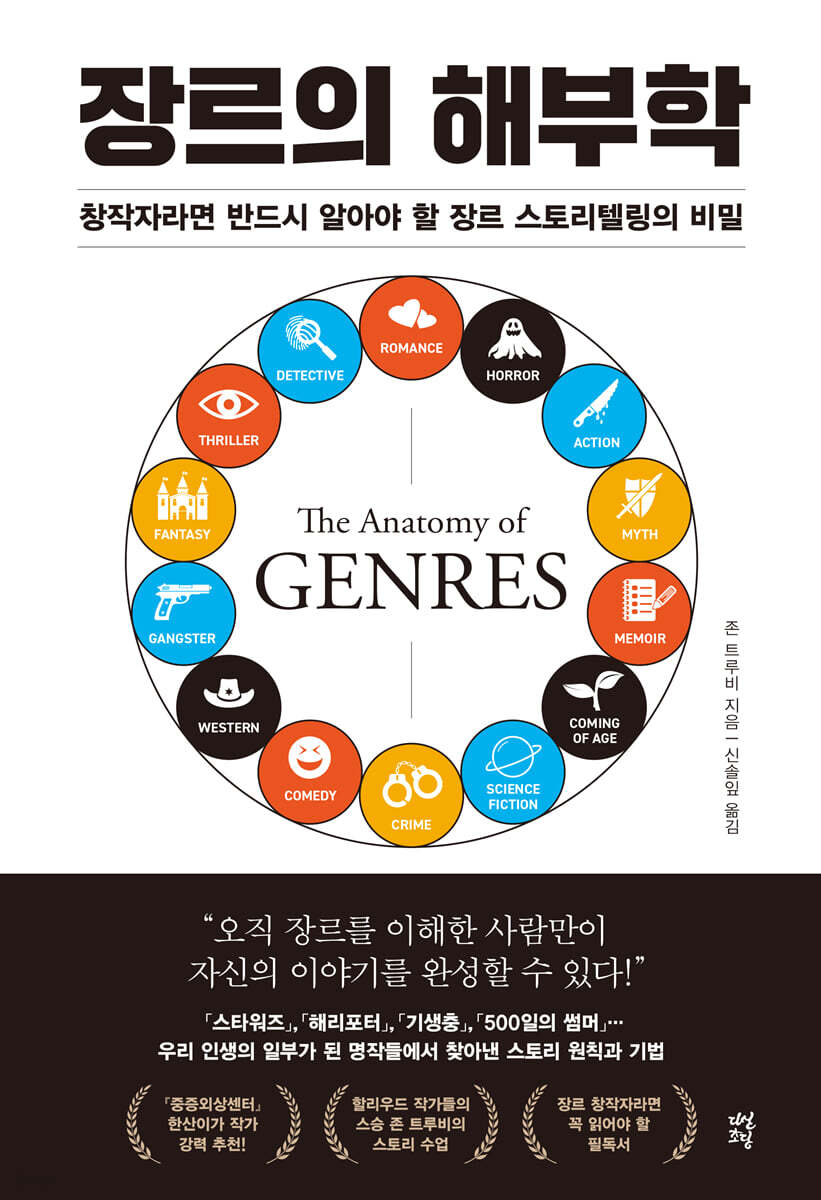
John Truby divides genres into 14 categories.
Horror, action, mythology, memoir, coming-of-age, science fiction, crime, comedy, western, gangster, fantasy, thriller, mystery, romance.
A writer must know the principles of all genres, but some knowledge is necessary to write better in a particular genre.
If you can combine multiple genres to present something that has never been seen before, your chances of being chosen by the public increase.
For example, in action games, we often expect conflict, potentially fatal missions, or flashy battle scenes with explosive effects, with the protagonist ultimately achieving his goal.
However, by mixing action with genres like romance, thriller, and comedy, and expressing the philosophy of life that only that genre can offer based on its characteristics, and exploring the genre's unique life story style, a better work can be created.
"Inception" combines science fiction and caper (a subgenre of action and crime), while "Men in Black" combines science fiction, action, and comedy.
"Silmido," the first Korean film to surpass 10 million viewers, combined action, thriller, and mythology, and "Taegukgi" also achieved success by combining three genres.
Each of the 14 genres delivers a core message necessary for life.
Expressing the philosophy of the genre is key to any story, and when this perspective is combined with dramatic drama, the emotional power of the genre's message becomes stronger, creating a better story.
ㆍHorror: Confront death and face the ghosts of the past.
ㆍAction: 90 percent of success begins with action.
ㆍMyth: Find your destiny in life and pursue immortality.
ㆍMemoirs and Coming-of-Age Stories: Reflect on your life and find your true self.
ㆍSF: Make the right choice now for a better future for everyone.
ㆍCrime: Protect the weak and bring the guilty to justice.
Comedy: Success comes when you throw away all your masks and reveal your true self.
ㆍWestern: Helping others build their homes is building a civilization where everyone can enjoy the best life possible.
ㆍGangster: Must not be subservient to absolute power and money.
If you do that, you will pay the price.
ㆍFantasy: Discover the magic within yourself that will make life itself a work of art.
ㆍMystery and Thriller: Take risks to uncover the truth and be held accountable for your crimes.
ㆍRomance: Learning how to love is the key to happiness.
The order of the 14 genres also has its own meaning.
Horror is the first genre to appear because the most important thing that affects human existence is life and death.
But to answer the fundamental question, "What should we do?", we need to look at action a second time.
Because it deals with a fundamental topic that shows the message that action is important.
While horror speaks of death, which we cannot control, action reflects life, which we can control, and presents a philosophy of life that goes one step further than horror.
The life philosophy that Action speaks of is effective in achieving success in areas that can be quantified.
Action may lead to high achievements, but it does not guarantee a rich and fulfilling life.
So, to dream of a meaningful life, we must look to the third genre: mythology.
Because myths show us how we should grow as we live.
In this way, genres complement their shortcomings and offer new insights through ladders that connect with their own characteristics.
Stories teach us about others, ourselves, and the value of life.
How wonderful it is that fictional stories can shape our reality.
Unravel your own world with this book, which delves into the strategies, techniques, and core of the genre.
"Game of Thrones", which created the all-night binge-watching myth
Why did it crash in the end?
You can't perfect a genre if you ignore the rules of the genre!
"Game of Thrones," which created the legend of all-night binge-watching, disappointed fans' expectations in its final season, leaving behind a classic "blowjob ending."
What was the cause of this tragedy? "Game of Thrones" captivated viewers worldwide from its first season with its successive deaths of key characters, its medieval and feudal setting, and its unique characterization.
In fact, each character utilizes the 'tournament structure' to reveal different desires, philosophies, and traumas, and unfolds their true leadership and behavioral patterns within a tight structure of confrontation.
This multi-layered character design and solid narrative organically connect to allow viewers to experience both immersion and catharsis.
But the problem was the final ending.
If the series had faithfully followed the structural rules of the genre, it should have shown a winning ending for the main character who had grown throughout all the seasons.
That is, in terms of the genre structure, the 'final winner' of the tournament must be a character who symbolizes the theme of the work, and the logic of the long-term narrative must be consistent even in the ending.
However, the final winner was an unexpected figure, and the logic of character rewards was ignored, leading to harsh criticism that viewers were not rewarded for their long-time emotional investment.
The growth narratives of the main characters also do not conclude meaningfully, violating the genre's core formula, and it ignores the tournament-style story of power succession and the symbolic completion of leadership.
Ultimately, "Game of Thrones" became a work that more powerfully demonstrated the power of storytelling and the importance of endings than any other work, and left the lesson that a sloppy ending can lead to the loss of all the narrative value built up over time.
Why has "Star Wars" become a must-see classic for sci-fi fans?
Humanistic insights that cross genre boundaries to understand life and the world.
"Star Wars" is a classic and masterpiece in the world of science fiction, and is still loved to this day.
Everyone who saw "Star Wars" in the cinema was deeply overwhelmed by its grandeur.
Until then, the story had been predictable, but "Star Wars" was different.
The fantasy set in outer space had elements of science fiction, but it also represented the quintessence of genre fusion, encompassing a western set in space, a grand myth, and even action.
Since then, it has become increasingly important for any medium around the world to provide more stories to captivate consumers, and "Star Wars" has become a classic of science fiction.
"Mad Max 4: Fury Road" is structured as a straight line leading to a dead end and a straight line returning from that road, as the title suggests, but it is tightly structured as a vortex toward the climax.
Max, Immortan Joe and the War Boy Army, Furiosa, Nux and the Cannibals and the Weapon Farmer each take different positions, forming four opposing sides.
Even if not overtly revealed, hidden conflicts increase the likelihood that the antagonist will surprise and harm the protagonist, and the rapid onslaught of attacks on the protagonist from multiple locations creates tension.
The change from a linear to a spiral structure, the four opposing points, and the relationship with the antagonist enrich the story beyond simple fighting.
"Mad Max: Fury Road" was able to become a masterpiece because it combined science fiction and thriller within the larger framework of action, combining the characteristics, structure, and techniques of each genre.
To combine these different genres, a writer must know the beats of each genre they choose to write about, and be able to incorporate the techniques of each genre to create their own unique story.
That's why you need to know the beats of every genre and think carefully about which genres you can combine with the settings you've conceived to develop the story.
The bible for aspiring screenwriters
“I highly recommend this book as a must-read for any creator.” - Hansan Lee, author of “Center for Severe Trauma”
Everything you need to know about life can be found in stories.
Because stories define life.
So understanding the structure of a story isn't just a matter of writing; it's also connected to understanding and realizing how to live life.
Once we understand that life is a form of story, genres become gateways to this world.
Many people believe that 'character' is the most important element of a successful story, but John Truby says that understanding 'genre' is more important to writing a truly successful story.
Understanding the "beats" that are essential to a successful story is key to understanding genre structure.
John Truby has worked with major studios and has been at the forefront of applying genre-specific techniques, working on over 1,000 screenplays.
Through the genre characteristics and various examples of works he explains in this book, readers can gain a broad understanding of the entire genre in just one volume.
John Truby has incorporated his expertise and in-depth analysis of genre structures and experiences gained through his participation in numerous works into his book, Anatomy of a Genre.
This book, which has already received rave reviews from numerous international authors, helps anyone systematically understand the genre.
Genre is not a simple classification.
It is the 'lens' through which the writer views the world, and the 'ultimate comprehensive gift set' that creates his own world.
In this age of content-driven innovation, I recommend this book as a must-read for anyone aspiring to become a writer.
**Story Lessons from Hollywood Writer's Teacher John Truby**
**A must-read for genre creators**
I have a brilliant idea, but
What if you don't know how to develop the story?
Hollywood's guaranteed box office hit
When you meet John Truby, you see the rules of the genre!
When I look back at the article I wrote passionately last night in the morning, I feel a sense of self-loathing and wonder, “What on earth was I thinking when I wrote this?”
If you have good material and ideas, but are struggling to figure out how to present them in an engaging and coherent way, it is ultimately because you lack an understanding of the genre.
The genre is not limited to mere entertainment or diversion.
When people understand unfamiliar worlds or experiences that they have not experienced directly, they look at and interpret life and the world through indirect experiences called stories.
A well-crafted genre is a window that reflects each philosophy, emotion, and human desire.
If I read and use the genre properly, my story becomes much richer and more clearly conveyed to the reader.
The author of this book, John Truby, is renowned as one of Hollywood's top story consultants, having worked with major studios such as Disney, Sony Pictures, Fox, and HBO for 30 years, applying genre-specific techniques and consulting on over 1,000 screenplays and dramas.
He presents three creative principles that must be followed for successful genre writing, along with a detailed analysis of 14 representative genres and the core plot "beats" that define each genre.
John Truby divides genres into 14 categories.
Horror, action, mythology, memoir, coming-of-age, science fiction, crime, comedy, western, gangster, fantasy, thriller, mystery, romance.
A writer must know the principles of all genres, but some knowledge is necessary to write better in a particular genre.
If you can combine multiple genres to present something that has never been seen before, your chances of being chosen by the public increase.
For example, in action games, we often expect conflict, potentially fatal missions, or flashy battle scenes with explosive effects, with the protagonist ultimately achieving his goal.
However, by mixing action with genres like romance, thriller, and comedy, and expressing the philosophy of life that only that genre can offer based on its characteristics, and exploring the genre's unique life story style, a better work can be created.
"Inception" combines science fiction and caper (a subgenre of action and crime), while "Men in Black" combines science fiction, action, and comedy.
"Silmido," the first Korean film to surpass 10 million viewers, combined action, thriller, and mythology, and "Taegukgi" also achieved success by combining three genres.
Each of the 14 genres delivers a core message necessary for life.
Expressing the philosophy of the genre is key to any story, and when this perspective is combined with dramatic drama, the emotional power of the genre's message becomes stronger, creating a better story.
ㆍHorror: Confront death and face the ghosts of the past.
ㆍAction: 90 percent of success begins with action.
ㆍMyth: Find your destiny in life and pursue immortality.
ㆍMemoirs and Coming-of-Age Stories: Reflect on your life and find your true self.
ㆍSF: Make the right choice now for a better future for everyone.
ㆍCrime: Protect the weak and bring the guilty to justice.
Comedy: Success comes when you throw away all your masks and reveal your true self.
ㆍWestern: Helping others build their homes is building a civilization where everyone can enjoy the best life possible.
ㆍGangster: Must not be subservient to absolute power and money.
If you do that, you will pay the price.
ㆍFantasy: Discover the magic within yourself that will make life itself a work of art.
ㆍMystery and Thriller: Take risks to uncover the truth and be held accountable for your crimes.
ㆍRomance: Learning how to love is the key to happiness.
The order of the 14 genres also has its own meaning.
Horror is the first genre to appear because the most important thing that affects human existence is life and death.
But to answer the fundamental question, "What should we do?", we need to look at action a second time.
Because it deals with a fundamental topic that shows the message that action is important.
While horror speaks of death, which we cannot control, action reflects life, which we can control, and presents a philosophy of life that goes one step further than horror.
The life philosophy that Action speaks of is effective in achieving success in areas that can be quantified.
Action may lead to high achievements, but it does not guarantee a rich and fulfilling life.
So, to dream of a meaningful life, we must look to the third genre: mythology.
Because myths show us how we should grow as we live.
In this way, genres complement their shortcomings and offer new insights through ladders that connect with their own characteristics.
Stories teach us about others, ourselves, and the value of life.
How wonderful it is that fictional stories can shape our reality.
Unravel your own world with this book, which delves into the strategies, techniques, and core of the genre.
"Game of Thrones", which created the all-night binge-watching myth
Why did it crash in the end?
You can't perfect a genre if you ignore the rules of the genre!
"Game of Thrones," which created the legend of all-night binge-watching, disappointed fans' expectations in its final season, leaving behind a classic "blowjob ending."
What was the cause of this tragedy? "Game of Thrones" captivated viewers worldwide from its first season with its successive deaths of key characters, its medieval and feudal setting, and its unique characterization.
In fact, each character utilizes the 'tournament structure' to reveal different desires, philosophies, and traumas, and unfolds their true leadership and behavioral patterns within a tight structure of confrontation.
This multi-layered character design and solid narrative organically connect to allow viewers to experience both immersion and catharsis.
But the problem was the final ending.
If the series had faithfully followed the structural rules of the genre, it should have shown a winning ending for the main character who had grown throughout all the seasons.
That is, in terms of the genre structure, the 'final winner' of the tournament must be a character who symbolizes the theme of the work, and the logic of the long-term narrative must be consistent even in the ending.
However, the final winner was an unexpected figure, and the logic of character rewards was ignored, leading to harsh criticism that viewers were not rewarded for their long-time emotional investment.
The growth narratives of the main characters also do not conclude meaningfully, violating the genre's core formula, and it ignores the tournament-style story of power succession and the symbolic completion of leadership.
Ultimately, "Game of Thrones" became a work that more powerfully demonstrated the power of storytelling and the importance of endings than any other work, and left the lesson that a sloppy ending can lead to the loss of all the narrative value built up over time.
Why has "Star Wars" become a must-see classic for sci-fi fans?
Humanistic insights that cross genre boundaries to understand life and the world.
"Star Wars" is a classic and masterpiece in the world of science fiction, and is still loved to this day.
Everyone who saw "Star Wars" in the cinema was deeply overwhelmed by its grandeur.
Until then, the story had been predictable, but "Star Wars" was different.
The fantasy set in outer space had elements of science fiction, but it also represented the quintessence of genre fusion, encompassing a western set in space, a grand myth, and even action.
Since then, it has become increasingly important for any medium around the world to provide more stories to captivate consumers, and "Star Wars" has become a classic of science fiction.
"Mad Max 4: Fury Road" is structured as a straight line leading to a dead end and a straight line returning from that road, as the title suggests, but it is tightly structured as a vortex toward the climax.
Max, Immortan Joe and the War Boy Army, Furiosa, Nux and the Cannibals and the Weapon Farmer each take different positions, forming four opposing sides.
Even if not overtly revealed, hidden conflicts increase the likelihood that the antagonist will surprise and harm the protagonist, and the rapid onslaught of attacks on the protagonist from multiple locations creates tension.
The change from a linear to a spiral structure, the four opposing points, and the relationship with the antagonist enrich the story beyond simple fighting.
"Mad Max: Fury Road" was able to become a masterpiece because it combined science fiction and thriller within the larger framework of action, combining the characteristics, structure, and techniques of each genre.
To combine these different genres, a writer must know the beats of each genre they choose to write about, and be able to incorporate the techniques of each genre to create their own unique story.
That's why you need to know the beats of every genre and think carefully about which genres you can combine with the settings you've conceived to develop the story.
The bible for aspiring screenwriters
“I highly recommend this book as a must-read for any creator.” - Hansan Lee, author of “Center for Severe Trauma”
Everything you need to know about life can be found in stories.
Because stories define life.
So understanding the structure of a story isn't just a matter of writing; it's also connected to understanding and realizing how to live life.
Once we understand that life is a form of story, genres become gateways to this world.
Many people believe that 'character' is the most important element of a successful story, but John Truby says that understanding 'genre' is more important to writing a truly successful story.
Understanding the "beats" that are essential to a successful story is key to understanding genre structure.
John Truby has worked with major studios and has been at the forefront of applying genre-specific techniques, working on over 1,000 screenplays.
Through the genre characteristics and various examples of works he explains in this book, readers can gain a broad understanding of the entire genre in just one volume.
John Truby has incorporated his expertise and in-depth analysis of genre structures and experiences gained through his participation in numerous works into his book, Anatomy of a Genre.
This book, which has already received rave reviews from numerous international authors, helps anyone systematically understand the genre.
Genre is not a simple classification.
It is the 'lens' through which the writer views the world, and the 'ultimate comprehensive gift set' that creates his own world.
In this age of content-driven innovation, I recommend this book as a must-read for anyone aspiring to become a writer.
GOODS SPECIFICS
- Date of issue: October 20, 2025
- Format: Hardcover book binding method guide
- Page count, weight, size: 892 pages | 152*225*40mm
- ISBN13: 9791130670317
- ISBN10: 1130670317
You may also like
카테고리
korean


korean

![ELLE 엘르 스페셜 에디션 A형 : 12월 [2025]](http://librairie.coreenne.fr/cdn/shop/files/b8e27a3de6c9538896439686c6b0e8fb.jpg?v=1766436872&width=3840)


