

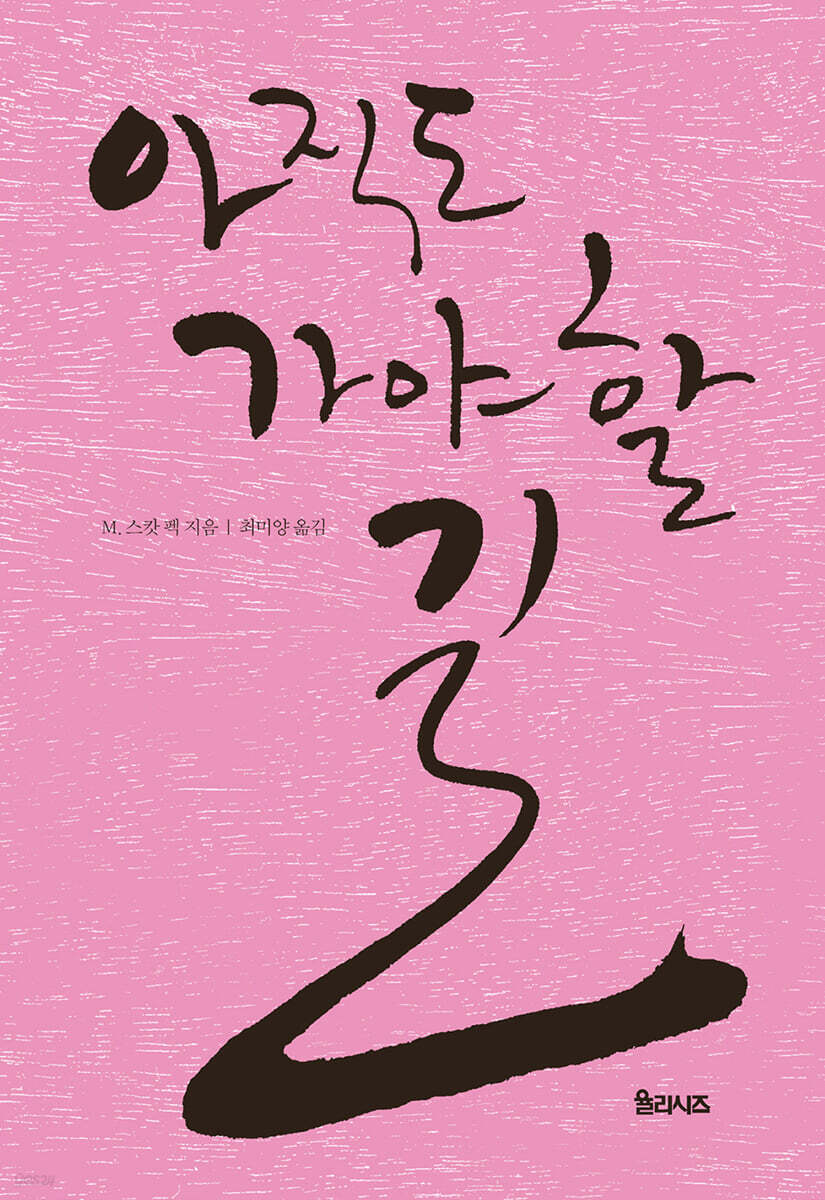
Still a long way to go
 |
Description
Book Introduction
The most beautiful combination of psychology and spirituality
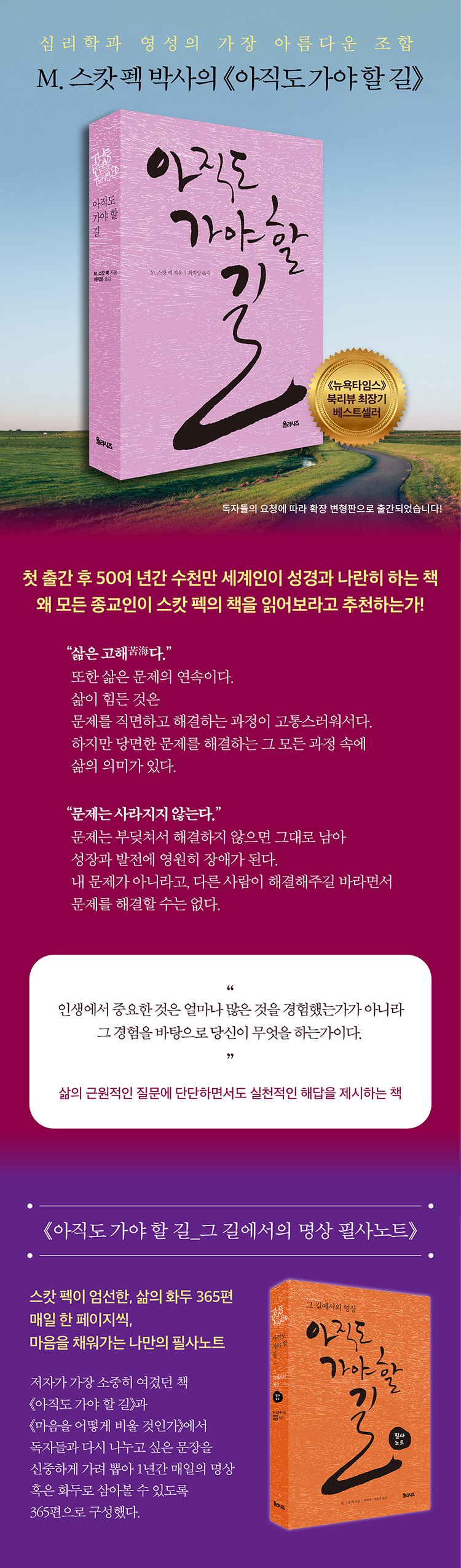
A 50-year bestseller that has been read alongside the Bible by tens of millions of people around the world.
Since its publication in 1978, M. has had a profound impact on the lives of tens of millions of readers around the world.
Scott Peck's The Road Less Traveled is now available in a revised edition (with a new national edition) in response to reader requests.
The author, a psychiatrist and thinker, draws on his extensive clinical experience to explore one crucial question: "How do we face and resolve life's challenges while growing spiritually?"
This book is more than just a simple psychology guide; it is considered a "compass for spiritual growth and a companion for self-reflection," and has been loved by people of all religions and beliefs.
This is why it has remained a steady seller with readers around the world for nearly 50 years.
Even in these uncertain and confusing times, "The Road Less Traveled" offers the wise "self-discipline" needed to face and overcome the pain we encounter in life head-on, rather than avoiding it.
It is a warm guide to our inner growth, guiding us on a journey of growing up step by step through courage that doesn't run away from problems, true love, healthy discipline, and the grace that life gives.
A 50-year bestseller that has been read alongside the Bible by tens of millions of people around the world.
Since its publication in 1978, M. has had a profound impact on the lives of tens of millions of readers around the world.
Scott Peck's The Road Less Traveled is now available in a revised edition (with a new national edition) in response to reader requests.
The author, a psychiatrist and thinker, draws on his extensive clinical experience to explore one crucial question: "How do we face and resolve life's challenges while growing spiritually?"
This book is more than just a simple psychology guide; it is considered a "compass for spiritual growth and a companion for self-reflection," and has been loved by people of all religions and beliefs.
This is why it has remained a steady seller with readers around the world for nearly 50 years.
Even in these uncertain and confusing times, "The Road Less Traveled" offers the wise "self-discipline" needed to face and overcome the pain we encounter in life head-on, rather than avoiding it.
It is a warm guide to our inner growth, guiding us on a journey of growing up step by step through courage that doesn't run away from problems, true love, healthy discipline, and the grace that life gives.
- You can preview some of the book's contents.
Preview
index
Part 1 Discipline
Life is a series of problems and pains/Can you postpone pleasure?/The most valuable gift parents can leave you/Problems can be solved if you are willing to take the time/It's not my fault/Neurosis and personality disorders/Escape from freedom/Seeing reality straight and recognizing it straight/Transfer: Transferring old maps/Dare to challenge: The path of self-reflection/Hiding the truth is like lying/Balance/Normal and healthy depression/Gaining more by giving everything up
Part 2 Love
What is love? / Falling in love / The myth of romantic love / Love is the expansion of the self-sphere / Beware of dependence / Attachment without love / Love is not self-sacrifice / Love is not a feeling / Love is putting interest into action / The adventure called love: loss / The adventure called love: independence / The adventure called love: devotion / The adventure called love: advice / Love is discipline / Love is separation / Love is psychotherapy / The mystery called love
Part 3: Growth and Religion
Different worldviews of the universe, and religion/science is a religion of skepticism/Cathy's case/Marcia's case/Theodore's case/Baby and bathwater/Trapped in the tunnel called science
Part 4 Grace
The Miracle of Health/The Miracle of the Unconscious/The Miracle of Accidental Enlightenment/What is Grace/The Miracle of Evolution/Alpha and Omega/Entropy, Laziness, and Original Sin/What is Evil/The Evolution of Consciousness/What is Power/Grace and Mental Illness: The Myth of Orestes/Those Who Resist Grace/To Welcome Grace
Life is a series of problems and pains/Can you postpone pleasure?/The most valuable gift parents can leave you/Problems can be solved if you are willing to take the time/It's not my fault/Neurosis and personality disorders/Escape from freedom/Seeing reality straight and recognizing it straight/Transfer: Transferring old maps/Dare to challenge: The path of self-reflection/Hiding the truth is like lying/Balance/Normal and healthy depression/Gaining more by giving everything up
Part 2 Love
What is love? / Falling in love / The myth of romantic love / Love is the expansion of the self-sphere / Beware of dependence / Attachment without love / Love is not self-sacrifice / Love is not a feeling / Love is putting interest into action / The adventure called love: loss / The adventure called love: independence / The adventure called love: devotion / The adventure called love: advice / Love is discipline / Love is separation / Love is psychotherapy / The mystery called love
Part 3: Growth and Religion
Different worldviews of the universe, and religion/science is a religion of skepticism/Cathy's case/Marcia's case/Theodore's case/Baby and bathwater/Trapped in the tunnel called science
Part 4 Grace
The Miracle of Health/The Miracle of the Unconscious/The Miracle of Accidental Enlightenment/What is Grace/The Miracle of Evolution/Alpha and Omega/Entropy, Laziness, and Original Sin/What is Evil/The Evolution of Consciousness/What is Power/Grace and Mental Illness: The Myth of Orestes/Those Who Resist Grace/To Welcome Grace
Detailed image
Into the book
The meaning of life lies in this whole process of solving the problems we face.
These are the issues that determine the success or failure of life.
When faced with problems, courage and wisdom are needed.
In fact, this is where courage and wisdom come from.
It is only through problems that we can grow mentally and spiritually.
--- p.20
Our view of reality is like a map that helps us navigate the realms of life.
If the map is true and accurate, we will basically know our current location and, once we decide where we want to go, we will know how to get there.
If the map is wrong and inaccurate, you will most likely get lost.
--- p.62
Discipline can be defined as a system of techniques that constructively address the pain of problem solving, rather than avoiding it.
This way, all the problems in life can be solved.
So far, we have explained in detail the characteristics of four basic technologies.
That is, putting off the fun, taking responsibility, committing to truth and reality, and finding balance.
--- p.109
Love is love when it is expressed in action.
Love is an act of will, or in other words, the result of a combination of intention and action.
Will also implies choice.
We choose to love.
No matter how much we think we love someone, if we don't actually love them, then we have chosen not to love.
--- p.117
Of all the misconceptions about love, the most powerful and widely known is the belief that falling in love is true love, or at least one of its signs.
--- p.118
Dependency is the force that makes people become fiercely attached to others.
So you might mistake it for love.
But in reality, it is not love.
Rather, it is the exact opposite of love.
--- p.150
Love is giving with discernment, and equally withholding with discretion.
It is about praising with discernment and criticizing with discernment.
It is about making the other person comfortable, as well as arguing, fighting, confronting, pushing, and pulling with discernment.
--- p.158
Love is not a feeling.
So many people feel love and then react in a ruthless and destructive manner.
--- p.167
We call it effort to move forward while fighting against the inertia of one's own expansion or laziness.
Facing fear and moving forward is called courage.
If you look at it that way, love is a kind of effort or courage.
Love, in particular, is the effort and courage to try for the spiritual growth of oneself or another.
--- p.172
A person who truly loves respects the individuality and differences of the object of their love, and so actually says, “I am right and you are wrong.”
I refuse to think, “I know what’s good for you better than you do.”
--- p.218
We begin our spiritual growth by fundamentally questioning old ways of thinking, actively seeking out the fearful and unfamiliar, and boldly challenging the values we have previously learned and cherished.
The path to holiness begins with questioning ‘everything.’
--- p.279
If we assume the existence of a loving God and seriously explore it, we will ultimately arrive at one frightening conclusion.
What God wants is for us to become like Him.
We are moving towards the realm of God.
God is the purpose of evolution.
--- p.390
In this one respect all human beings are equal.
That is, deep within each of us, both a sick self and a healthy self operate simultaneously.
Each of us represents all of humanity.
Within each of us lies humanity's persistent desire and instinct to reach the realm of God.
At the same time, there is the original sin of laziness, the force of entropy that seeks to regress man and return him to the swamp from which he was born.
--- p.400
This stepping stone called the universe was created to prepare our path.
But each and every person must overcome it on their own.
By grace we can remain unshaken, and by grace we know that we are welcome.
What more could you ask for?
These are the issues that determine the success or failure of life.
When faced with problems, courage and wisdom are needed.
In fact, this is where courage and wisdom come from.
It is only through problems that we can grow mentally and spiritually.
--- p.20
Our view of reality is like a map that helps us navigate the realms of life.
If the map is true and accurate, we will basically know our current location and, once we decide where we want to go, we will know how to get there.
If the map is wrong and inaccurate, you will most likely get lost.
--- p.62
Discipline can be defined as a system of techniques that constructively address the pain of problem solving, rather than avoiding it.
This way, all the problems in life can be solved.
So far, we have explained in detail the characteristics of four basic technologies.
That is, putting off the fun, taking responsibility, committing to truth and reality, and finding balance.
--- p.109
Love is love when it is expressed in action.
Love is an act of will, or in other words, the result of a combination of intention and action.
Will also implies choice.
We choose to love.
No matter how much we think we love someone, if we don't actually love them, then we have chosen not to love.
--- p.117
Of all the misconceptions about love, the most powerful and widely known is the belief that falling in love is true love, or at least one of its signs.
--- p.118
Dependency is the force that makes people become fiercely attached to others.
So you might mistake it for love.
But in reality, it is not love.
Rather, it is the exact opposite of love.
--- p.150
Love is giving with discernment, and equally withholding with discretion.
It is about praising with discernment and criticizing with discernment.
It is about making the other person comfortable, as well as arguing, fighting, confronting, pushing, and pulling with discernment.
--- p.158
Love is not a feeling.
So many people feel love and then react in a ruthless and destructive manner.
--- p.167
We call it effort to move forward while fighting against the inertia of one's own expansion or laziness.
Facing fear and moving forward is called courage.
If you look at it that way, love is a kind of effort or courage.
Love, in particular, is the effort and courage to try for the spiritual growth of oneself or another.
--- p.172
A person who truly loves respects the individuality and differences of the object of their love, and so actually says, “I am right and you are wrong.”
I refuse to think, “I know what’s good for you better than you do.”
--- p.218
We begin our spiritual growth by fundamentally questioning old ways of thinking, actively seeking out the fearful and unfamiliar, and boldly challenging the values we have previously learned and cherished.
The path to holiness begins with questioning ‘everything.’
--- p.279
If we assume the existence of a loving God and seriously explore it, we will ultimately arrive at one frightening conclusion.
What God wants is for us to become like Him.
We are moving towards the realm of God.
God is the purpose of evolution.
--- p.390
In this one respect all human beings are equal.
That is, deep within each of us, both a sick self and a healthy self operate simultaneously.
Each of us represents all of humanity.
Within each of us lies humanity's persistent desire and instinct to reach the realm of God.
At the same time, there is the original sin of laziness, the force of entropy that seeks to regress man and return him to the swamp from which he was born.
--- p.400
This stepping stone called the universe was created to prepare our path.
But each and every person must overcome it on their own.
By grace we can remain unshaken, and by grace we know that we are welcome.
What more could you ask for?
--- p.450
Publisher's Review
Insights gleaned from psychotherapy practice
Solid, practical answers to life's fundamental questions.
“Life is a sea of suffering.”
When you truly understand and accept that life is suffering, life is no longer difficult.
Life is also a series of problems.
Life is difficult because the process of facing and solving problems is painful.
But in all this process of solving the problems at hand lies the meaning of life.
The only way to grow mentally and spiritually is through problems.
Problems don't go away.
If problems are not confronted and resolved, they remain and become permanent obstacles to the growth and development of the soul.
You can't solve a problem by saying, "It's not my problem."
You can't solve problems by expecting other people to solve them for you.
The reason we find it difficult to take responsibility for our actions is because we want to avoid the pain that comes as a result of those actions.
We must realize that life is a series of personal choices and decisions.
If you can fully accept this, you will be free.
Unless we accept this, each of us will remain a victim forever.
This book clearly analyzes the elements necessary for the evolutionary process toward a healthy life, focusing on the cases of patients the author encountered in the field of psychotherapy, both successful and unsuccessful.
Contrary to popular belief, the author views mentally ill patients seeking psychiatric treatment as people with strong will and high potential for spiritual growth.
Those who confront their mental illness, take full responsibility for it, and make changes to overcome it can live in a completely new world.
What was once a problem now becomes an opportunity.
What was once a dangerous obstacle is now a wonderful challenge.
Events that were once considered burdens, including the symptoms you overcame, now feel like gifts.
“My depression and the anxiety that attacked me were the best experiences I’ve ever had.”
Through the pain, patience, denial, and acceptance they had to endure before making these confessions, readers will be able to relate to and compare their own lives.
And so, until the very end, you will realize that life is still a journey that you must take, a journey that requires you to test your growth and possibilities.
Four Paths to Self-Growth
Discipline, love, growth and religion, grace
This book is also about spiritual growth.
Therefore, it inevitably also deals with the opposite side, that is, things that hinder the maturation of the soul.
Ultimately, there is only one thing that gets in the way: laziness.
The author emphasizes that the biggest obstacles in life that we must guard against and overcome are fear and laziness.
This book is divided into four parts and illuminates the journey of human maturity step by step.
Part 1.
discipline
It acknowledges that life is a series of problems and suffering, and emphasizes 'discipline' as a basic tool needed to solve them.
Postponing pleasure, taking responsibility, dedicating ourselves to truth, and finding balance are the starting points of maturity.
Part 2.
love
Love is not just a feeling, it is a choice of will and action.
Beyond romantic fantasy or dependent attachment, love must be an active practice that expands the self.
It describes the process of learning true love through the adventures of loss, independence, and commitment, and examines the laziness that seeks to avoid the pain essential to spiritual growth or to take the easy way out.
Part 3.
Growth and Religion
Humans who grow through discipline and love develop an understanding of the world and their own place, that is, a 'religious worldview.'
Religion is not limited to doctrines or institutions, but is presented as a perspective on the world itself.
The intersection of science and faith explores the world of mature faith through personal examples.
Part 4.
blessing
Finally, it deals with the 'dimension of grace' that cannot be explained by human power alone.
It reflects on the attitudes toward life that reject or accept grace, describing the intervention of transcendent forces such as restoration of health, unconscious insight, serendipitous enlightenment, and the mystery of evolution.
The author links 'laziness' to the concept of original sin and defines it as the entropic force hidden within us to drag us down and hinder evolution.
This is a different matter than simply not working hard or not being dedicated to others.
The main form of laziness is fear.
Not all fear is caused by laziness, but a significant portion of fear is caused by laziness.
That is, the fear of changing reality, the fear that something might be lost if we move forward from our current position.
The possibility of facing life's problems and overcoming all obstacles begins the moment we encounter the laziness within us.
Solid, practical answers to life's fundamental questions.
“Life is a sea of suffering.”
When you truly understand and accept that life is suffering, life is no longer difficult.
Life is also a series of problems.
Life is difficult because the process of facing and solving problems is painful.
But in all this process of solving the problems at hand lies the meaning of life.
The only way to grow mentally and spiritually is through problems.
Problems don't go away.
If problems are not confronted and resolved, they remain and become permanent obstacles to the growth and development of the soul.
You can't solve a problem by saying, "It's not my problem."
You can't solve problems by expecting other people to solve them for you.
The reason we find it difficult to take responsibility for our actions is because we want to avoid the pain that comes as a result of those actions.
We must realize that life is a series of personal choices and decisions.
If you can fully accept this, you will be free.
Unless we accept this, each of us will remain a victim forever.
This book clearly analyzes the elements necessary for the evolutionary process toward a healthy life, focusing on the cases of patients the author encountered in the field of psychotherapy, both successful and unsuccessful.
Contrary to popular belief, the author views mentally ill patients seeking psychiatric treatment as people with strong will and high potential for spiritual growth.
Those who confront their mental illness, take full responsibility for it, and make changes to overcome it can live in a completely new world.
What was once a problem now becomes an opportunity.
What was once a dangerous obstacle is now a wonderful challenge.
Events that were once considered burdens, including the symptoms you overcame, now feel like gifts.
“My depression and the anxiety that attacked me were the best experiences I’ve ever had.”
Through the pain, patience, denial, and acceptance they had to endure before making these confessions, readers will be able to relate to and compare their own lives.
And so, until the very end, you will realize that life is still a journey that you must take, a journey that requires you to test your growth and possibilities.
Four Paths to Self-Growth
Discipline, love, growth and religion, grace
This book is also about spiritual growth.
Therefore, it inevitably also deals with the opposite side, that is, things that hinder the maturation of the soul.
Ultimately, there is only one thing that gets in the way: laziness.
The author emphasizes that the biggest obstacles in life that we must guard against and overcome are fear and laziness.
This book is divided into four parts and illuminates the journey of human maturity step by step.
Part 1.
discipline
It acknowledges that life is a series of problems and suffering, and emphasizes 'discipline' as a basic tool needed to solve them.
Postponing pleasure, taking responsibility, dedicating ourselves to truth, and finding balance are the starting points of maturity.
Part 2.
love
Love is not just a feeling, it is a choice of will and action.
Beyond romantic fantasy or dependent attachment, love must be an active practice that expands the self.
It describes the process of learning true love through the adventures of loss, independence, and commitment, and examines the laziness that seeks to avoid the pain essential to spiritual growth or to take the easy way out.
Part 3.
Growth and Religion
Humans who grow through discipline and love develop an understanding of the world and their own place, that is, a 'religious worldview.'
Religion is not limited to doctrines or institutions, but is presented as a perspective on the world itself.
The intersection of science and faith explores the world of mature faith through personal examples.
Part 4.
blessing
Finally, it deals with the 'dimension of grace' that cannot be explained by human power alone.
It reflects on the attitudes toward life that reject or accept grace, describing the intervention of transcendent forces such as restoration of health, unconscious insight, serendipitous enlightenment, and the mystery of evolution.
The author links 'laziness' to the concept of original sin and defines it as the entropic force hidden within us to drag us down and hinder evolution.
This is a different matter than simply not working hard or not being dedicated to others.
The main form of laziness is fear.
Not all fear is caused by laziness, but a significant portion of fear is caused by laziness.
That is, the fear of changing reality, the fear that something might be lost if we move forward from our current position.
The possibility of facing life's problems and overcoming all obstacles begins the moment we encounter the laziness within us.
GOODS SPECIFICS
- Date of issue: September 5, 2025
- Page count, weight, size: 456 pages | 146*212*30mm
- ISBN13: 9791199223929
- ISBN10: 1199223921
You may also like
카테고리
korean


korean

![ELLE 엘르 스페셜 에디션 A형 : 12월 [2025]](http://librairie.coreenne.fr/cdn/shop/files/b8e27a3de6c9538896439686c6b0e8fb.jpg?v=1766436872&width=3840)


