

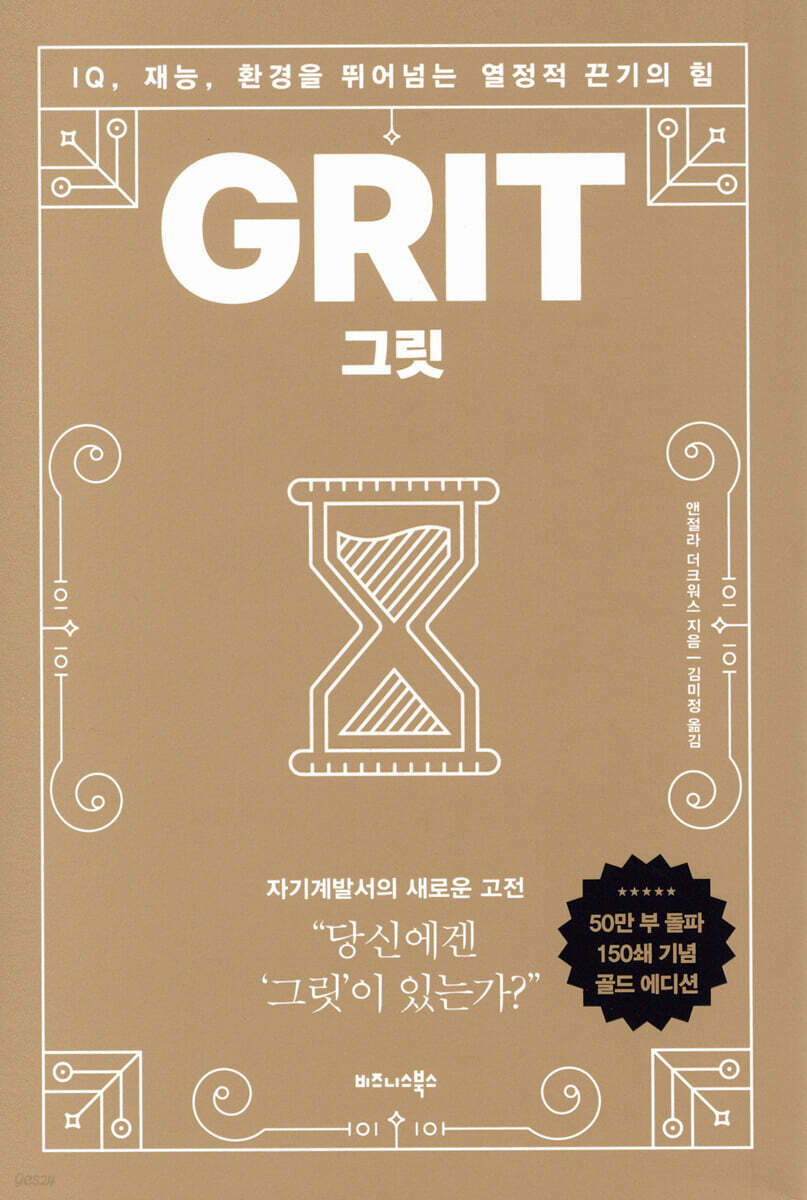
Grit (500,000 copies sold commemorative recovered gold edition)
 |
Description
Book Introduction
The never-ending reverse driving storm! Recommended by celebrities, leaders, and the media, including Kelly Choi and Ja-Cheong A new self-help classic! 『Grit GRIT』 Gold Edition published to commemorate 150th printing, surpassing 500,000 copies sold in Korea! “Do you have ‘grit’?” The secret to success that only those who have overcome failure, adversity, and slumps have! The book "Grit," which immediately rose to the top of Amazon's bestseller list upon its publication in 2016 and created a worldwide sensation in education, industry, and broadcasting, has now sold over 500,000 copies in Korea and is now back in a gold edition commemorating its 150th printing. This re-cover has a luxurious hardcover, increasing its collection value. The reason this book continues to be loved by 6 million readers around the world is probably because it reminds us of the value of passion, effort, and perseverance, which are the most important attitudes for success, but whose meaning has faded today. If you want to learn the secrets of success in this new era, open this book! It will offer a message of courage and hope to those who dream of their own success, to parents who want to foster a sense of accomplishment in their children, and to entrepreneurs who never stop challenging themselves. As Malcolm Gladwell writes in his recommendation, this book reminds us of the simple truth that the characteristics that distinguish successful people are 'passion' and 'persistence.' Scientifically proving the "secret to success" that has been sought for decades and showing us how we can achieve our goals through our own will, this book will deliver a message of courage and hope to all of us who seek a better life. Grit is the power to keep trying without giving up, and it refers to the mental strength to persevere without being discouraged in the face of adversity and failure. The author vividly demonstrates the power of grit, a concept everyone believes is important but few realize how it contributes to success, through ten years of research, empirical case studies, and interviews with people from all walks of life. Furthermore, this book clearly presents how we can cultivate 'grit'. |
- You can preview some of the book's contents.
Preview
index
Introduction: How I, an Ordinary Person, Went to Receive the "Genius Award"
Part 1: What is Grit?
Chapter 1: Grit: A Necessary Condition for Success
Attitude: What Successful People Have in Common
Who passes through the beast?
Does grit work everywhere?
The Difference Between 'Potential' and 'Exercising' Potential
Chapter 2: Why Are We So Fascinated by Talent?
Finding the source of achievement
People who favor talent
The catastrophe brought about by talent-centered management
Why We Need to Let Go of the Talent Myth
Chapter 3: Effort is Twice as Important as Talent
Achievement = Talent × Effort 2
Chapter 4: Measure Your Grit
Passion also requires persistence
What is your 'top goal'?
The Trap of 'Can Do'
Sometimes a change of course is necessary
Four indicators that distinguish great people from ordinary people
Chapter 5: The Secret to Grit Growth
The Correlation Between Grit, Genetics, and Environment
As we age, our grit grows.
Four Ways to Develop Grit
Part 2: How to Create a "Never-Give-Up Me": How to Cultivate Grit Within Yourself
Chapter 6: Clarify Your Interests
Is pursuing your passion really such a futile endeavor?
Passion is something you discover and nurture.
Passion doesn't come like a revelation.
The role of parents in fostering passionate perseverance
Dig into your interests.
And be patient
Chapter 7: Practice qualitatively different exercises.
If you want to be the best, practice deliberately.
Can deliberate practice be applied to all fields?
The joys and sorrows of grueling practice
How to Get 100% Out of Conscious Practice
Chapter 8: Have a Higher Purpose
People who move for a greater purpose
Altruism, the foundation of grit
Livelihood, occupation, and vocation
Your calling doesn't come suddenly one day.
How to become a winner and help others at the same time
When you do something you love, you gain a sense of purpose.
Three Ways to Develop a Sense of Purpose
Chapter 9: Rise Again, Embrace Hope
When you are blocked by the thought that you 'can't control it'
An optimistic attitude toward adversity
How is an optimistic mindset created?
Beware of inconsistencies between words and actions.
If you want to raise a child who is strong in trials
How to Teach Yourself Hope
Part 3: How to Raise a Child with Inner Strength: How to Develop Grit in Children
Chapter 10: Parenting Styles that Develop Grit
Don't mistake parental selfishness for strictness.
If you want your child to have grit
The need for mentors, wise teachers, and supporters
Chapter 11: The Grit-Cultivating Playground
Special activities needed to perfect grit
Let your children experience completion.
Grit Education Needed More by Poor Children
Mental strength that must be developed in childhood
Chapter 12: The Power of a Strong Grit Culture
A great team makes great players.
Culture and Identity Explained by Grit
How to Create a Culture That Cultivates Grit
The magic of the Seahawks team culture
Chapter 13: To All Those Who Are Not Geniuses
Can too much fighting spirit be a bad thing?
Grit isn't everything in success.
Acknowledgements
annotation
Part 1: What is Grit?
Chapter 1: Grit: A Necessary Condition for Success
Attitude: What Successful People Have in Common
Who passes through the beast?
Does grit work everywhere?
The Difference Between 'Potential' and 'Exercising' Potential
Chapter 2: Why Are We So Fascinated by Talent?
Finding the source of achievement
People who favor talent
The catastrophe brought about by talent-centered management
Why We Need to Let Go of the Talent Myth
Chapter 3: Effort is Twice as Important as Talent
Achievement = Talent × Effort 2
Chapter 4: Measure Your Grit
Passion also requires persistence
What is your 'top goal'?
The Trap of 'Can Do'
Sometimes a change of course is necessary
Four indicators that distinguish great people from ordinary people
Chapter 5: The Secret to Grit Growth
The Correlation Between Grit, Genetics, and Environment
As we age, our grit grows.
Four Ways to Develop Grit
Part 2: How to Create a "Never-Give-Up Me": How to Cultivate Grit Within Yourself
Chapter 6: Clarify Your Interests
Is pursuing your passion really such a futile endeavor?
Passion is something you discover and nurture.
Passion doesn't come like a revelation.
The role of parents in fostering passionate perseverance
Dig into your interests.
And be patient
Chapter 7: Practice qualitatively different exercises.
If you want to be the best, practice deliberately.
Can deliberate practice be applied to all fields?
The joys and sorrows of grueling practice
How to Get 100% Out of Conscious Practice
Chapter 8: Have a Higher Purpose
People who move for a greater purpose
Altruism, the foundation of grit
Livelihood, occupation, and vocation
Your calling doesn't come suddenly one day.
How to become a winner and help others at the same time
When you do something you love, you gain a sense of purpose.
Three Ways to Develop a Sense of Purpose
Chapter 9: Rise Again, Embrace Hope
When you are blocked by the thought that you 'can't control it'
An optimistic attitude toward adversity
How is an optimistic mindset created?
Beware of inconsistencies between words and actions.
If you want to raise a child who is strong in trials
How to Teach Yourself Hope
Part 3: How to Raise a Child with Inner Strength: How to Develop Grit in Children
Chapter 10: Parenting Styles that Develop Grit
Don't mistake parental selfishness for strictness.
If you want your child to have grit
The need for mentors, wise teachers, and supporters
Chapter 11: The Grit-Cultivating Playground
Special activities needed to perfect grit
Let your children experience completion.
Grit Education Needed More by Poor Children
Mental strength that must be developed in childhood
Chapter 12: The Power of a Strong Grit Culture
A great team makes great players.
Culture and Identity Explained by Grit
How to Create a Culture That Cultivates Grit
The magic of the Seahawks team culture
Chapter 13: To All Those Who Are Not Geniuses
Can too much fighting spirit be a bad thing?
Grit isn't everything in success.
Acknowledgements
annotation
Detailed image
.jpg)
Into the book
In short, highly successful people, regardless of their field, exhibited a strong sense of determination, which manifested itself in two characteristics.
First, they were extremely resilient and hard-working.
Second, he had a very deep understanding of what he wanted.
They were not only decisive, but they also knew where to go.
What makes successful people special is their perseverance combined with passion.
In a word, they had grit.
---From Chapter 1, Grit, a Necessary Condition for Success
“Talent is probably the most common non-professional description we give to successful athletes.
We talk as if there is some invisible entity called talent that exists behind the surface reality of performance and separates the best players from the rest.
And we look at great athletes as if they were blessed with special talents and physical, genetic, psychological and physiological "factors" that the rest of us are not granted.
There are players who have 'talent' and players who don't.
“There are players who are ‘naturally gifted’ and there are players who are not.” I think Chambliss’ observation is accurate.
When we can't explain how an athlete or musician achieves something jaw-dropping, we tend to give up and say, "That's talent! You can't teach that."
In other words, when it is difficult to understand how someone could reach a level of excellence that far exceeds the normal range through experience and training alone, we automatically classify them as "natural."
(…) The assumption that talent perfectly explains outstanding skills seems wrong, but on the other hand, it is understandable.
He explains:
“If the Olympics, which come every four years, are your only chance to see the best athletes, or if you only watch the games without seeing them train every day, it’s easy to explain their success solely in terms of talent.”
---From Chapter 2, “Why Are We So Dazzled by Talent?”
Researchers at Harvard University had the same idea in 1940.
With the goal of "helping people live happier and more successful lives" by identifying "characteristics of healthy young adults," they asked 130 Harvard sophomores to run on a treadmill for up to five minutes.
With the treadmill set to high incline and maximum speed, students could typically only last four minutes.
Some people lasted only 1 minute and 30 seconds.
This treadmill experiment is designed to tire students out not only physically but also mentally.
Researchers measured "endurance and willpower" by setting the treadmill to be harder than the students' baseline physical fitness.
Decades later, a psychiatrist named George Vaillant followed up with those who had participated in the treadmill experiment.
The subjects, now in their 60s, were contacted by researchers every two years after graduating from college, and (…) the researchers recorded each subject’s income, promotions, sick leave, social activities, self-reported satisfaction with work and home life, history of psychiatric treatment, and use of mood-altering medications such as tranquilizers.
Vaillant synthesized all of that information to estimate psychological adjustment across adulthood.
As a result, the time spent running on a treadmill at age 20 was found to be a reliable variable predicting psychological adaptation in adulthood.
(…) That is, Will Smith pointed out an important fact.
When running the marathon of life, effort is extremely important.
---From "Chapter 3: Effort is Twice as Important as Talent"
It seems that trials that threaten death make people stronger, but sometimes they also make them weak.
So, in what situations does this occur? When does a difficult struggle lead to hope, and when does it lead to helplessness? A few years ago, Steve Meyer and his students devised an experiment.
It was almost the same experiment he and Martin Seligman had done 40 years earlier.
One group of rats received electric shocks, but could turn a small handle with their forepaw to block the current until the next shock was delivered.
A second group of rats received electric shocks of the same intensity as the first group, but had no control over how long the shock lasted.
A crucial difference from the original experiment was that the new experiment involved rats that were five weeks old, the equivalent of adolescence in rats.
A second difference is that the effects of this experiment were measured five weeks later, when the mice were fully adult.
Five weeks later, both groups of rats were shocked again, but there was no way for the rats to turn off the current.
The next day, the rats were released into a new environment and their exploratory behavior was observed.
The results of Meyer's experiment are as follows.
Rats that experienced uncontrollable electric shocks as adolescents and then received the same shock again as adults exhibited fearful behavior.
It was an unexpected result.
Like other rats in that situation, it had learned to feel helpless.
In contrast, rats that were able to control electric shocks during adolescence grew up to be more adventurous.
What's even more surprising is that as adults, they act as if they've been vaccinated against learned helplessness.
Yes, these 'resilient' rats were not helpless when subjected to uncontrollable electric shocks during adulthood.
In other words, the trials that the young rats faced, even if they were not fatal, only made them grow into strong adults if they were able to control the situation through their own efforts.
---From Chapter 9, “The Posture of Rising Again, Embrace Hope”
Isn't there a fine line between tough love and bullying? What is the difference? Young said this.
“I knew the decision was mine.
And I also knew that my father didn't want me to be like him.
Parents must first demonstrate to their children that they are not trying to make them do what they say, control them, or make them like me. They are not asking them to do what they did or to do what they failed to do.
Your father has long since shown you that you and your needs are not important.
“It was a genuine, ‘I’ll give you everything I have.’” “Tough love requires the premise that the parents are not selfish,” Steve continued.
“I think that’s crucial.
If you use strict love to control your children, they will notice.
'We just need to see you succeed.
“You come before us.’ My parents showed that through their actions.”
First, they were extremely resilient and hard-working.
Second, he had a very deep understanding of what he wanted.
They were not only decisive, but they also knew where to go.
What makes successful people special is their perseverance combined with passion.
In a word, they had grit.
---From Chapter 1, Grit, a Necessary Condition for Success
“Talent is probably the most common non-professional description we give to successful athletes.
We talk as if there is some invisible entity called talent that exists behind the surface reality of performance and separates the best players from the rest.
And we look at great athletes as if they were blessed with special talents and physical, genetic, psychological and physiological "factors" that the rest of us are not granted.
There are players who have 'talent' and players who don't.
“There are players who are ‘naturally gifted’ and there are players who are not.” I think Chambliss’ observation is accurate.
When we can't explain how an athlete or musician achieves something jaw-dropping, we tend to give up and say, "That's talent! You can't teach that."
In other words, when it is difficult to understand how someone could reach a level of excellence that far exceeds the normal range through experience and training alone, we automatically classify them as "natural."
(…) The assumption that talent perfectly explains outstanding skills seems wrong, but on the other hand, it is understandable.
He explains:
“If the Olympics, which come every four years, are your only chance to see the best athletes, or if you only watch the games without seeing them train every day, it’s easy to explain their success solely in terms of talent.”
---From Chapter 2, “Why Are We So Dazzled by Talent?”
Researchers at Harvard University had the same idea in 1940.
With the goal of "helping people live happier and more successful lives" by identifying "characteristics of healthy young adults," they asked 130 Harvard sophomores to run on a treadmill for up to five minutes.
With the treadmill set to high incline and maximum speed, students could typically only last four minutes.
Some people lasted only 1 minute and 30 seconds.
This treadmill experiment is designed to tire students out not only physically but also mentally.
Researchers measured "endurance and willpower" by setting the treadmill to be harder than the students' baseline physical fitness.
Decades later, a psychiatrist named George Vaillant followed up with those who had participated in the treadmill experiment.
The subjects, now in their 60s, were contacted by researchers every two years after graduating from college, and (…) the researchers recorded each subject’s income, promotions, sick leave, social activities, self-reported satisfaction with work and home life, history of psychiatric treatment, and use of mood-altering medications such as tranquilizers.
Vaillant synthesized all of that information to estimate psychological adjustment across adulthood.
As a result, the time spent running on a treadmill at age 20 was found to be a reliable variable predicting psychological adaptation in adulthood.
(…) That is, Will Smith pointed out an important fact.
When running the marathon of life, effort is extremely important.
---From "Chapter 3: Effort is Twice as Important as Talent"
It seems that trials that threaten death make people stronger, but sometimes they also make them weak.
So, in what situations does this occur? When does a difficult struggle lead to hope, and when does it lead to helplessness? A few years ago, Steve Meyer and his students devised an experiment.
It was almost the same experiment he and Martin Seligman had done 40 years earlier.
One group of rats received electric shocks, but could turn a small handle with their forepaw to block the current until the next shock was delivered.
A second group of rats received electric shocks of the same intensity as the first group, but had no control over how long the shock lasted.
A crucial difference from the original experiment was that the new experiment involved rats that were five weeks old, the equivalent of adolescence in rats.
A second difference is that the effects of this experiment were measured five weeks later, when the mice were fully adult.
Five weeks later, both groups of rats were shocked again, but there was no way for the rats to turn off the current.
The next day, the rats were released into a new environment and their exploratory behavior was observed.
The results of Meyer's experiment are as follows.
Rats that experienced uncontrollable electric shocks as adolescents and then received the same shock again as adults exhibited fearful behavior.
It was an unexpected result.
Like other rats in that situation, it had learned to feel helpless.
In contrast, rats that were able to control electric shocks during adolescence grew up to be more adventurous.
What's even more surprising is that as adults, they act as if they've been vaccinated against learned helplessness.
Yes, these 'resilient' rats were not helpless when subjected to uncontrollable electric shocks during adulthood.
In other words, the trials that the young rats faced, even if they were not fatal, only made them grow into strong adults if they were able to control the situation through their own efforts.
---From Chapter 9, “The Posture of Rising Again, Embrace Hope”
Isn't there a fine line between tough love and bullying? What is the difference? Young said this.
“I knew the decision was mine.
And I also knew that my father didn't want me to be like him.
Parents must first demonstrate to their children that they are not trying to make them do what they say, control them, or make them like me. They are not asking them to do what they did or to do what they failed to do.
Your father has long since shown you that you and your needs are not important.
“It was a genuine, ‘I’ll give you everything I have.’” “Tough love requires the premise that the parents are not selfish,” Steve continued.
“I think that’s crucial.
If you use strict love to control your children, they will notice.
'We just need to see you succeed.
“You come before us.’ My parents showed that through their actions.”
---From Chapter 10, Parenting Styles that Cultivate Grit
Publisher's Review
*#1 Amazon Bestseller for 165 consecutive weeks!
*TED views surpass 28 million! Published in 35 countries worldwide!
*Comprehensive bestseller at Kyobo Bookstore, Yes24, and Aladdin bookstores nationwide!
*[New York Times][Forbes][Wall Street Journal][Washington Post] Best Books!
Luck, talent, family background…
What is the real key to success?
Why do some people achieve remarkable success, while others, despite having the same background and qualifications, remain mediocre? How did those who achieved remarkable success despite facing far less favorable circumstances and possessing less exceptional talent overcome such obstacles and rise to the top? In an era where prestigious universities and wealthy parents no longer guarantee success, what truly constitutes the "key to success"?
[GRIT], a hot topic by psychologist Angela Duckworth, which has garnered attention from the international media and praise from world leaders such as Barack Obama and Bill Gates, is a book that presents new insights into the 'decisive factors of success' commonly found in people who have overcome failure, adversity, and slumps to achieve outstanding results.
Angela Duckworth, a renowned consultant whose advice is sought by the White House, the World Bank, and CEOs of Fortune 500 companies, and who is emerging as a next-generation intellectual after winning the MacArthur Award, a prestigious "award for geniuses," reveals in this book that the biggest factor in achieving outstanding achievement in any field is not intelligence, personality, financial status, or appearance, but rather "grit."
Grit, which can be translated as 'unyielding will', 'fighting spirit', or 'tenacity', means 'passionate perseverance', that is, 'the ability to steadily move forward toward a goal without being discouraged by failure'.
This concept, which was known only among researchers, became a hot keyword across the United States through her TED talk in 2013, and the results of grit research were cited in speeches by Barack Obama and former Federal Reserve Chair Janet Yellen, creating a 'grit craze' in fields such as psychology, media, education, and sports.
The author, who first introduced the concept of 'grit' to the field of psychology in 2007, originally worked as a consultant at McKinsey & Company, a global management consulting firm.
However, he realized that being a teacher was his true calling, rather than a consultant, and he quit his high-paying job to become a low-paid public school teacher, teaching math to children.
There, the author questioned the fact that some of the so-called smart students were unexpectedly getting mediocre grades, and that many of the students with high academic performance were, by social convention, "dumb."
Also, seeing a student who had a terrible math score in high school become a world-class engineer who builds rockets made me realize that 'there is something more important than talent or grades when it comes to true success in life.'
The author, who began researching psychology to find out that 'something', studied who dropped out and who completed the notoriously difficult training at the US Military Academy (Beast Barracks), who among the new teachers assigned to schools full of problem students stayed and taught the children, and which salespeople in sales jobs where rejection is a daily occurrence kept on giving up and achieved good sales results, and discovered that 'grit' was at the center of all these successes.
Anyone can start.
But not everyone can achieve 'completion'
The presence or absence of 'grit' determines your success!
This book is divided into three parts: Part 1, which covers what grit is and why it's important; Part 2, which presents methods for developing grit on your own; and Part 3, which provides information on how to foster grit in children during their growing years.
Part 1 points out the flaws in our tendency to worship 'innate talent' and emphasizes that the conditions for long-term and sustained success depend on the amount of effort and the 'attitude' with which we respond to setbacks.
To easily explain the importance of grit, the author presents the formula 'Success = Talent × Effort 2'.
In other words, no matter how excellent your skills and talents are, you cannot achieve great things without maintaining effort and perseverance.
You can also measure how much grit and determination you have in life through the 'Grit Scale' in Part 1.
Part 2, “How to Become a Gritty Person”, teaches you how to develop your own grit.
Grit is not something you are born with or given; it is a learnable trait.
The author says that grit can be developed through four psychological assets.
The first is ‘passion’, that is, clarifying your interests.
The second is to engage in qualitatively different 'deliberate practice' that allows you to connect your interests with extraordinary achievements.
Third, it is about having a higher sense of purpose, and it is said that altruism is the motivation that forms the basis of grit.
The fourth is to have the mindset that you can overcome any adversity, in other words, to have hope in yourself.
Part 3, "How to Raise Children with Inner Strength," offers parents and teachers ways to cultivate grit in children.
The author cites Martin Seligman's famous research showing that just as helplessness can be learned, optimism can also be learned, and suggests that grit shares the same characteristics.
We examine the characteristics of wise parenting that fosters grit and emphasize the importance of extracurricular activities that are essential for fostering grit.
It also explains how a group's culture influences the development of grit and teaches those in leadership positions how to create a culture that fosters grit.
As Malcolm Gladwell writes in his recommendation, this book reminds us of the simple truth that the characteristics that distinguish successful people are 'passion' and 'persistence.'
Scientifically proving the "secret to success" that has been sought for decades and showing us how we can achieve our goals through our own will, this book will deliver a message of courage and hope to all of us who seek a better life.
*TED views surpass 28 million! Published in 35 countries worldwide!
*Comprehensive bestseller at Kyobo Bookstore, Yes24, and Aladdin bookstores nationwide!
*[New York Times][Forbes][Wall Street Journal][Washington Post] Best Books!
Luck, talent, family background…
What is the real key to success?
Why do some people achieve remarkable success, while others, despite having the same background and qualifications, remain mediocre? How did those who achieved remarkable success despite facing far less favorable circumstances and possessing less exceptional talent overcome such obstacles and rise to the top? In an era where prestigious universities and wealthy parents no longer guarantee success, what truly constitutes the "key to success"?
[GRIT], a hot topic by psychologist Angela Duckworth, which has garnered attention from the international media and praise from world leaders such as Barack Obama and Bill Gates, is a book that presents new insights into the 'decisive factors of success' commonly found in people who have overcome failure, adversity, and slumps to achieve outstanding results.
Angela Duckworth, a renowned consultant whose advice is sought by the White House, the World Bank, and CEOs of Fortune 500 companies, and who is emerging as a next-generation intellectual after winning the MacArthur Award, a prestigious "award for geniuses," reveals in this book that the biggest factor in achieving outstanding achievement in any field is not intelligence, personality, financial status, or appearance, but rather "grit."
Grit, which can be translated as 'unyielding will', 'fighting spirit', or 'tenacity', means 'passionate perseverance', that is, 'the ability to steadily move forward toward a goal without being discouraged by failure'.
This concept, which was known only among researchers, became a hot keyword across the United States through her TED talk in 2013, and the results of grit research were cited in speeches by Barack Obama and former Federal Reserve Chair Janet Yellen, creating a 'grit craze' in fields such as psychology, media, education, and sports.
The author, who first introduced the concept of 'grit' to the field of psychology in 2007, originally worked as a consultant at McKinsey & Company, a global management consulting firm.
However, he realized that being a teacher was his true calling, rather than a consultant, and he quit his high-paying job to become a low-paid public school teacher, teaching math to children.
There, the author questioned the fact that some of the so-called smart students were unexpectedly getting mediocre grades, and that many of the students with high academic performance were, by social convention, "dumb."
Also, seeing a student who had a terrible math score in high school become a world-class engineer who builds rockets made me realize that 'there is something more important than talent or grades when it comes to true success in life.'
The author, who began researching psychology to find out that 'something', studied who dropped out and who completed the notoriously difficult training at the US Military Academy (Beast Barracks), who among the new teachers assigned to schools full of problem students stayed and taught the children, and which salespeople in sales jobs where rejection is a daily occurrence kept on giving up and achieved good sales results, and discovered that 'grit' was at the center of all these successes.
Anyone can start.
But not everyone can achieve 'completion'
The presence or absence of 'grit' determines your success!
This book is divided into three parts: Part 1, which covers what grit is and why it's important; Part 2, which presents methods for developing grit on your own; and Part 3, which provides information on how to foster grit in children during their growing years.
Part 1 points out the flaws in our tendency to worship 'innate talent' and emphasizes that the conditions for long-term and sustained success depend on the amount of effort and the 'attitude' with which we respond to setbacks.
To easily explain the importance of grit, the author presents the formula 'Success = Talent × Effort 2'.
In other words, no matter how excellent your skills and talents are, you cannot achieve great things without maintaining effort and perseverance.
You can also measure how much grit and determination you have in life through the 'Grit Scale' in Part 1.
Part 2, “How to Become a Gritty Person”, teaches you how to develop your own grit.
Grit is not something you are born with or given; it is a learnable trait.
The author says that grit can be developed through four psychological assets.
The first is ‘passion’, that is, clarifying your interests.
The second is to engage in qualitatively different 'deliberate practice' that allows you to connect your interests with extraordinary achievements.
Third, it is about having a higher sense of purpose, and it is said that altruism is the motivation that forms the basis of grit.
The fourth is to have the mindset that you can overcome any adversity, in other words, to have hope in yourself.
Part 3, "How to Raise Children with Inner Strength," offers parents and teachers ways to cultivate grit in children.
The author cites Martin Seligman's famous research showing that just as helplessness can be learned, optimism can also be learned, and suggests that grit shares the same characteristics.
We examine the characteristics of wise parenting that fosters grit and emphasize the importance of extracurricular activities that are essential for fostering grit.
It also explains how a group's culture influences the development of grit and teaches those in leadership positions how to create a culture that fosters grit.
As Malcolm Gladwell writes in his recommendation, this book reminds us of the simple truth that the characteristics that distinguish successful people are 'passion' and 'persistence.'
Scientifically proving the "secret to success" that has been sought for decades and showing us how we can achieve our goals through our own will, this book will deliver a message of courage and hope to all of us who seek a better life.
GOODS SPECIFICS
- Date of issue: February 20, 2019
- Format: Hardcover book binding method guide
- Page count, weight, size: 416 pages | 609g | 152*225*20mm
- ISBN13: 9791162540633
- ISBN10: 116254063X
You may also like
카테고리
korean


korean

![GQ KOREA Mark (Monthly): December [2025]](http://librairie.coreenne.fr/cdn/shop/files/8ef265dbbfbf186523ed75ba7319009d.jpg?v=1765340328&width=3840)


