

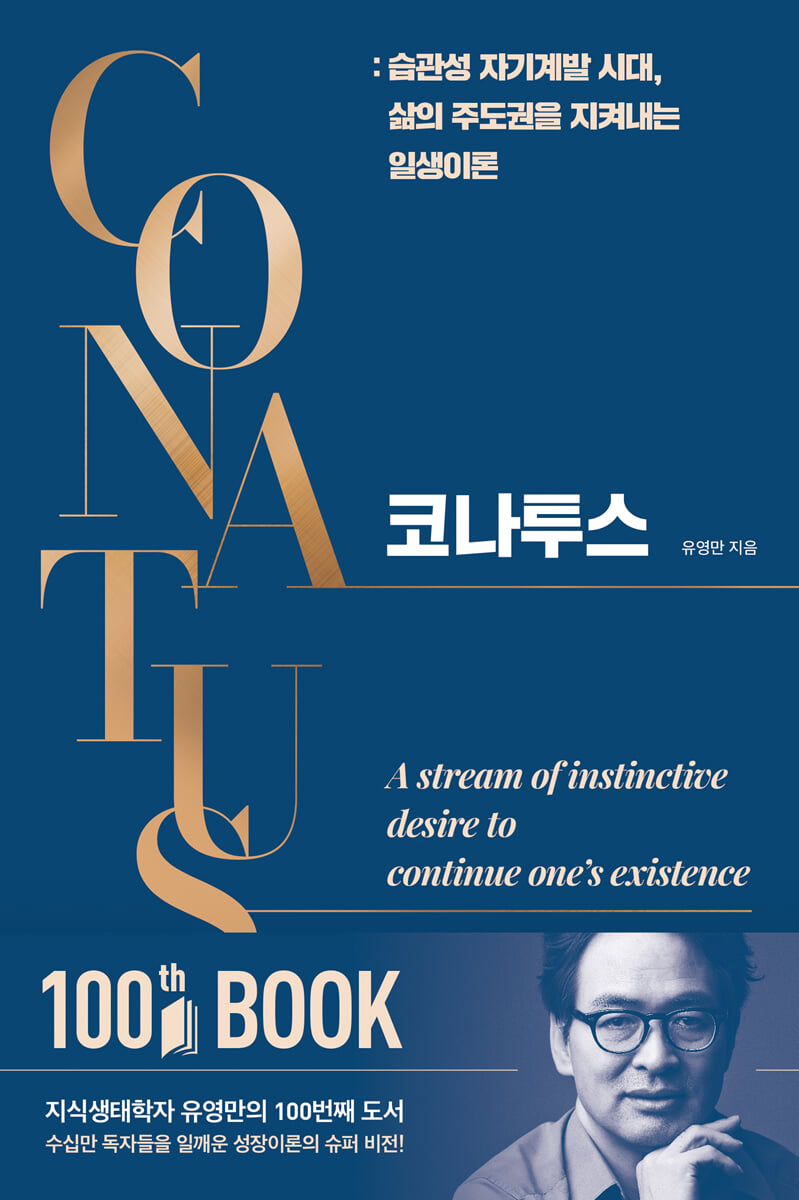
Conatus
 |
Description
Book Introduction
Only by stopping habitual self-improvement can the self be developed.
The Inner Strength That Builds the Best You: The Conatus Life Theory
Have you ever considered why, despite your consistent efforts at self-improvement, your ego is being squandered rather than developed? Other people's success is different from your own.
If you get stuck in a stereotypical self-development routine and an elevated average, growth becomes distant and your world becomes easily eroded.
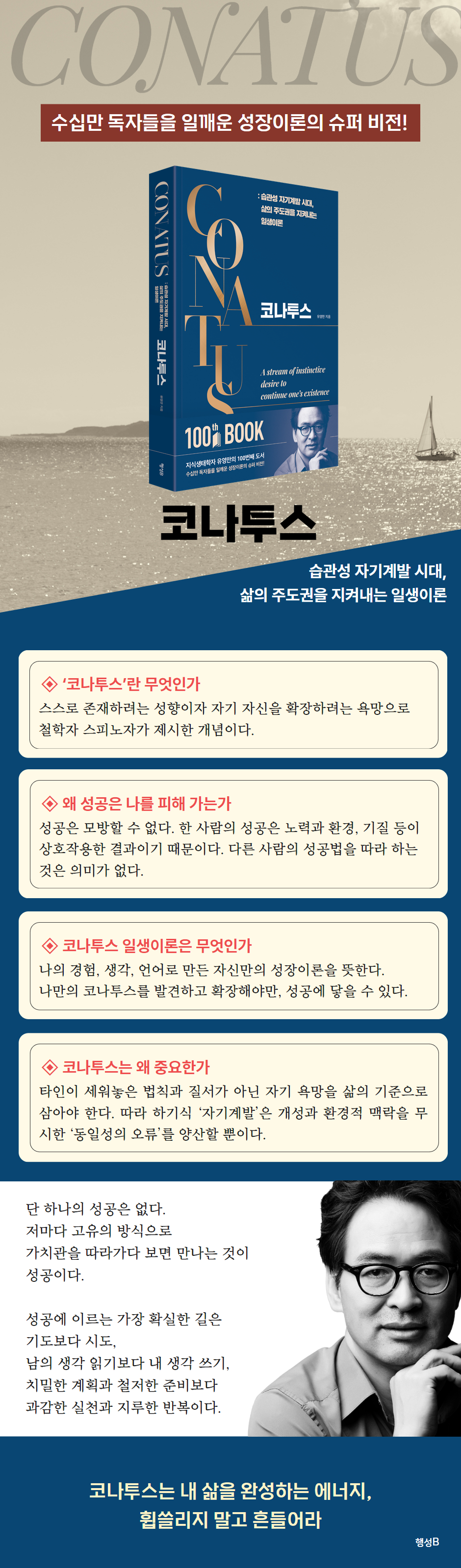
Conatus, a concept mentioned by the philosopher Spinoza, is the tendency to exist for oneself and the desire to expand oneself.
This book, "Conatus," guides each reader to discover and develop their own "conatus."
And it guides you on how to create your own growth theory, or life theory, using three tools: experience, thought, and language.
To achieve success, you must not be swayed by the desires that the world encourages.
You have to think with your body, not your head, and you have to cultivate your own language.
Here are the countless success stories and real success tips for those tired of routine self-improvement.
You can learn to explore, expand, and apply conatus, the inner strength necessary for true growth.
『Conatus』 helps you build and practice your best self.
The Inner Strength That Builds the Best You: The Conatus Life Theory
Have you ever considered why, despite your consistent efforts at self-improvement, your ego is being squandered rather than developed? Other people's success is different from your own.
If you get stuck in a stereotypical self-development routine and an elevated average, growth becomes distant and your world becomes easily eroded.
Conatus, a concept mentioned by the philosopher Spinoza, is the tendency to exist for oneself and the desire to expand oneself.
This book, "Conatus," guides each reader to discover and develop their own "conatus."
And it guides you on how to create your own growth theory, or life theory, using three tools: experience, thought, and language.
To achieve success, you must not be swayed by the desires that the world encourages.
You have to think with your body, not your head, and you have to cultivate your own language.
Here are the countless success stories and real success tips for those tired of routine self-improvement.
You can learn to explore, expand, and apply conatus, the inner strength necessary for true growth.
『Conatus』 helps you build and practice your best self.
- You can preview some of the book's contents.
Preview
index
Prologue: You must stop habitual self-improvement to become self-improved.
INTRO: For those who build a life theory
Philosopher Deleuze's bitter words to those who dream of empty success
Encouragement for those seeking a life theory
PART 1: The Power to Live Your Best Life: The Conatus Life Theory
The Importance of Your Own Way, According to Nine Visionaries
A life theory that maintains control over life
Four Steps to Building a Theory of Life Through Scientific Thinking
Practical Syllogism for Developing a Theory of Life
The Growth Equation That Turns Even Bad Experiences Around
PART 2: The Scriptures for Building a Theory of Life: "Experience"
When concepts and experiences meet, unshakable beliefs are born.
The safest insurance is the experience of taking risks.
Insights change only when the outside world changes.
The 'relationship' that must not be forgotten between what must be done and what wants to be done.
PART 3: Language, the Clothing of Thought that Completes the Theory of Life
If you don't learn a language, it will abandon you.
Laughter is wasted growth
Conceptual terms that abstract the specificity of life are violent.
Language is a billboard that reveals style and color.
A language of one's own is an event that takes control of the body.
Ten Ways to Escape from the Conceptless Human
PART 4: Define Conatus for Yourself
Reading generalized self-help books is a waste of self-esteem.
Why is information that only provides impulsive experiences dangerous?
If you don't read deeply, you'll be avoided.
Self-development is a collaborative relationship-building exercise.
Epilogue: A writer is a sentence-building worker who germinates the seeds of thought into language.
INTRO: For those who build a life theory
Philosopher Deleuze's bitter words to those who dream of empty success
Encouragement for those seeking a life theory
PART 1: The Power to Live Your Best Life: The Conatus Life Theory
The Importance of Your Own Way, According to Nine Visionaries
A life theory that maintains control over life
Four Steps to Building a Theory of Life Through Scientific Thinking
Practical Syllogism for Developing a Theory of Life
The Growth Equation That Turns Even Bad Experiences Around
PART 2: The Scriptures for Building a Theory of Life: "Experience"
When concepts and experiences meet, unshakable beliefs are born.
The safest insurance is the experience of taking risks.
Insights change only when the outside world changes.
The 'relationship' that must not be forgotten between what must be done and what wants to be done.
PART 3: Language, the Clothing of Thought that Completes the Theory of Life
If you don't learn a language, it will abandon you.
Laughter is wasted growth
Conceptual terms that abstract the specificity of life are violent.
Language is a billboard that reveals style and color.
A language of one's own is an event that takes control of the body.
Ten Ways to Escape from the Conceptless Human
PART 4: Define Conatus for Yourself
Reading generalized self-help books is a waste of self-esteem.
Why is information that only provides impulsive experiences dangerous?
If you don't read deeply, you'll be avoided.
Self-development is a collaborative relationship-building exercise.
Epilogue: A writer is a sentence-building worker who germinates the seeds of thought into language.
Detailed image
Into the book
Those who are addicted to habitual self-improvement are so addicted to other people's success stories and secrets that they just move their fingers.
And then, they fall into the illusion of already being successful, and they appear to be addicted to the dopamine of success.
Self-development is not something you do with your eyes on social media, but rather a situational product that occurs when you put in the effort with your hands and feet.
--- p.20
Life reveals its secrets only to those who cherish it.
No matter how grand your dreams or grand visions are, if they don't begin in your daily life, they will remain nothing more than a mirage.
To achieve true success, you must not miss the wondrous moments of life hidden in the repetitive routine of everyday life.
Rather than sacrificing the present for future success, we must be able to live faithfully to the demands of this moment.
--- p.48
One day, philosophers and novelists gathered together at the call of Kierkegaard, the philosopher of anxiety and despair.
The reason they gathered together was to establish a theory of life and to advise people who want to live their lives in their own way without being swayed by the temptations of the world.
These philosophers and novelists have something in common.
Rather than looking at reality through established logic and theories, it means persuading others through the body language acquired through direct practice, and living according to the desires of one's own conatus.
If you bring up someone else's story that you haven't experienced, it will only become more complicated and difficult.
On the other hand, ‘self-story’ evokes empathy.
Stories that pierce the skin, messages that pierce the lungs, and meanings that shake the frontal lobe are possible when the physicality of the body meets the specificity of life.
--- p.54
Even if you've been living your life 'up until now' addicted to other people's secrets to success or insights, it's not too late.
Even from now on, if I focus on Conatus, where my own instinctive desires stir, the future will change.
This requires decisive action along with resolution.
There are philosophers who have lived according to conatus, which promotes joy, despite the fear that fundamentally threatens their lives.
Spinoza, Merleau-Ponty, who lived as a philosopher of the body and flesh; Derrida, who tried to dismantle the existing fixed meaning with differences different from yesterday; Foucault, who tried to transform into a unique self that had never been before with self-care bordering on self-destruction; Maturana, who tried to change the world with action knowledge ingrained in him by making knowledge, life, and doing into a trinity; and Rorty, who tried to recreate the self by redefining the self in a language different from yesterday.
--- p.79
Let's say a duck, a rabbit, and a sparrow enter animal school.
The first day of class is about swimming.
Ducks are the best swimmers.
However, rabbits are animals that are not naturally good at swimming.
The rabbit wants to catch up with the duck's 'talent' of swimming.
So I went to Guam for training.
Still, rabbits can't swim as well as ducks.
The second day's subject is hiking on a snowy day.
The most stressed animal during class is the duck.
The duck goes to Alaska for training to become a good mountain climber like a rabbit.
He trained with the determination to cut his bones, but all he was left with were torn webbed feet, frostbitten feet, arthritis, and a herniated disc.
The last day's subject is singing.
Sparrows sing best.
Of course, ducks can do it to some extent too.
Rabbits can't sing at all.
No matter what you do, singing will never be a rabbit's talent.
Tragic? But if you think about it another way, this story becomes a happy fairy tale.
A rabbit doesn't need to swim, a duck doesn't need to climb a mountain ridge, and a sparrow can live happily all its life just by singing.
--- p.151
The process of building a life theory is broadly divided into four stages.
The first step is to observe reality and collect and record various data.
The second step is to organize the recorded data into a certain system or structure to create information.
The collected data becomes meaningful information that reveals the truth through examination.
The third stage is to build knowledge based on established information.
By understanding patterns in information or relationships between information, we can glean meaningful knowledge.
This requires scientific and critical thinking.
The fourth and final stage is to perfect knowledge with your own wisdom.
Wisdom is created through deep reflection and application of previously discovered knowledge to life.
Wisdom at this time is a provisional truth that is effective for a certain period of time and in a certain situation.
--- p.185
The way to break out of the old frame is to constantly provide your brain with different experiential stimulation so that it can think differently.
Just as we eat food when we are hungry, our brains also need to consume knowledge.
'My brain is hungry' means that I am in a situation that cannot be solved with my existing experience and knowledge.
When this happens, our brain realizes the deficiency and begins to move.
They try hard to absorb new information and knowledge from outside.
This is the best time to acquire knowledge.
The brain doesn't have a set meal time.
I only eat when I'm 'brain hungry'.
However, if this state of brain hunger persists, new thoughts cannot be generated.
--- p.190
To creatively express or convey 'different thoughts from yesterday', two things are needed.
First of all, it's a different experience from yesterday.
Experience is a source of enlightenment and a stimulant that shakes the body from becoming complacent.
However, we must avoid the 'experience trap' of trying to interpret future experiences based on past experiences.
Experience is a source of learning, but if it is not accumulated anew, it can at some point turn into an obstacle that blocks learning.
Next is the language needed to translate the experience differently from yesterday.
If your language skills are poor or inadequate, you cannot conceptualize unfamiliar experiences in a new way.
The meaning cannot be fully understood through language steeped in habit.
An inspiring writer intentionally repeats unfamiliar experiences, sharpens and separates sharp language, and constructs sentences that call for new thoughts.
--- p.206
The vocabulary you like to use varies depending on your occupation, age, and where you live.
The same words are used differently.
Conversation provides a great opportunity to experience these differences.
So, if you want to build your own language, you have to meet a variety of people.
Especially when I meet younger people, I often hear new and interesting things.
It may be unfamiliar, but you'll find yourself nodding along as you listen to the explanation.
These are new concepts of language that make you think about their meaning again.
In this way, conversations with others are a great opportunity to learn new concepts.
--- p.270
There are many things in our lives that don't go as planned no matter how hard we try.
The very idea that you can control everything is absurd.
What changes me and the world is not my will, but concrete actions that I take while moving my body.
I can only go down that path if it makes me as difficult and uncomfortable as possible.
It is difficult, but at the end, the light of truth that dispels the darkness awaits.
The moment comes when I overcome my past self and am reborn with new thoughts.
--- p.303
A person cannot prove his own existence.
Only in our relationship with others can the meaning and reason for our existence be revealed.
Likewise, the meaning and value of a book are discovered and proven only in its relationship with the reader.
The books I write are my own interpretations of my life, but when they are delivered to readers, they are accompanied by annotations that interpret them through the reader's life.
For me, writing a book was an effort to transform facts into truth by not taking established facts for granted but looking behind the scenes, and to prove their possibility.
And then, they fall into the illusion of already being successful, and they appear to be addicted to the dopamine of success.
Self-development is not something you do with your eyes on social media, but rather a situational product that occurs when you put in the effort with your hands and feet.
--- p.20
Life reveals its secrets only to those who cherish it.
No matter how grand your dreams or grand visions are, if they don't begin in your daily life, they will remain nothing more than a mirage.
To achieve true success, you must not miss the wondrous moments of life hidden in the repetitive routine of everyday life.
Rather than sacrificing the present for future success, we must be able to live faithfully to the demands of this moment.
--- p.48
One day, philosophers and novelists gathered together at the call of Kierkegaard, the philosopher of anxiety and despair.
The reason they gathered together was to establish a theory of life and to advise people who want to live their lives in their own way without being swayed by the temptations of the world.
These philosophers and novelists have something in common.
Rather than looking at reality through established logic and theories, it means persuading others through the body language acquired through direct practice, and living according to the desires of one's own conatus.
If you bring up someone else's story that you haven't experienced, it will only become more complicated and difficult.
On the other hand, ‘self-story’ evokes empathy.
Stories that pierce the skin, messages that pierce the lungs, and meanings that shake the frontal lobe are possible when the physicality of the body meets the specificity of life.
--- p.54
Even if you've been living your life 'up until now' addicted to other people's secrets to success or insights, it's not too late.
Even from now on, if I focus on Conatus, where my own instinctive desires stir, the future will change.
This requires decisive action along with resolution.
There are philosophers who have lived according to conatus, which promotes joy, despite the fear that fundamentally threatens their lives.
Spinoza, Merleau-Ponty, who lived as a philosopher of the body and flesh; Derrida, who tried to dismantle the existing fixed meaning with differences different from yesterday; Foucault, who tried to transform into a unique self that had never been before with self-care bordering on self-destruction; Maturana, who tried to change the world with action knowledge ingrained in him by making knowledge, life, and doing into a trinity; and Rorty, who tried to recreate the self by redefining the self in a language different from yesterday.
--- p.79
Let's say a duck, a rabbit, and a sparrow enter animal school.
The first day of class is about swimming.
Ducks are the best swimmers.
However, rabbits are animals that are not naturally good at swimming.
The rabbit wants to catch up with the duck's 'talent' of swimming.
So I went to Guam for training.
Still, rabbits can't swim as well as ducks.
The second day's subject is hiking on a snowy day.
The most stressed animal during class is the duck.
The duck goes to Alaska for training to become a good mountain climber like a rabbit.
He trained with the determination to cut his bones, but all he was left with were torn webbed feet, frostbitten feet, arthritis, and a herniated disc.
The last day's subject is singing.
Sparrows sing best.
Of course, ducks can do it to some extent too.
Rabbits can't sing at all.
No matter what you do, singing will never be a rabbit's talent.
Tragic? But if you think about it another way, this story becomes a happy fairy tale.
A rabbit doesn't need to swim, a duck doesn't need to climb a mountain ridge, and a sparrow can live happily all its life just by singing.
--- p.151
The process of building a life theory is broadly divided into four stages.
The first step is to observe reality and collect and record various data.
The second step is to organize the recorded data into a certain system or structure to create information.
The collected data becomes meaningful information that reveals the truth through examination.
The third stage is to build knowledge based on established information.
By understanding patterns in information or relationships between information, we can glean meaningful knowledge.
This requires scientific and critical thinking.
The fourth and final stage is to perfect knowledge with your own wisdom.
Wisdom is created through deep reflection and application of previously discovered knowledge to life.
Wisdom at this time is a provisional truth that is effective for a certain period of time and in a certain situation.
--- p.185
The way to break out of the old frame is to constantly provide your brain with different experiential stimulation so that it can think differently.
Just as we eat food when we are hungry, our brains also need to consume knowledge.
'My brain is hungry' means that I am in a situation that cannot be solved with my existing experience and knowledge.
When this happens, our brain realizes the deficiency and begins to move.
They try hard to absorb new information and knowledge from outside.
This is the best time to acquire knowledge.
The brain doesn't have a set meal time.
I only eat when I'm 'brain hungry'.
However, if this state of brain hunger persists, new thoughts cannot be generated.
--- p.190
To creatively express or convey 'different thoughts from yesterday', two things are needed.
First of all, it's a different experience from yesterday.
Experience is a source of enlightenment and a stimulant that shakes the body from becoming complacent.
However, we must avoid the 'experience trap' of trying to interpret future experiences based on past experiences.
Experience is a source of learning, but if it is not accumulated anew, it can at some point turn into an obstacle that blocks learning.
Next is the language needed to translate the experience differently from yesterday.
If your language skills are poor or inadequate, you cannot conceptualize unfamiliar experiences in a new way.
The meaning cannot be fully understood through language steeped in habit.
An inspiring writer intentionally repeats unfamiliar experiences, sharpens and separates sharp language, and constructs sentences that call for new thoughts.
--- p.206
The vocabulary you like to use varies depending on your occupation, age, and where you live.
The same words are used differently.
Conversation provides a great opportunity to experience these differences.
So, if you want to build your own language, you have to meet a variety of people.
Especially when I meet younger people, I often hear new and interesting things.
It may be unfamiliar, but you'll find yourself nodding along as you listen to the explanation.
These are new concepts of language that make you think about their meaning again.
In this way, conversations with others are a great opportunity to learn new concepts.
--- p.270
There are many things in our lives that don't go as planned no matter how hard we try.
The very idea that you can control everything is absurd.
What changes me and the world is not my will, but concrete actions that I take while moving my body.
I can only go down that path if it makes me as difficult and uncomfortable as possible.
It is difficult, but at the end, the light of truth that dispels the darkness awaits.
The moment comes when I overcome my past self and am reborn with new thoughts.
--- p.303
A person cannot prove his own existence.
Only in our relationship with others can the meaning and reason for our existence be revealed.
Likewise, the meaning and value of a book are discovered and proven only in its relationship with the reader.
The books I write are my own interpretations of my life, but when they are delivered to readers, they are accompanied by annotations that interpret them through the reader's life.
For me, writing a book was an effort to transform facts into truth by not taking established facts for granted but looking behind the scenes, and to prove their possibility.
--- p.346
Publisher's Review
“Why Does Success Elude Me?”
Success cannot be imitated.
Don't copy, create.
Why is it that, despite consistently practicing self-improvement, I feel like I'm not improving myself, but rather, I'm wasting my ego? The internet is full of fantastic success stories.
People who have become rich in a short period of time and become members of the FIRE tribe, people who have vacations and overseas travel as their daily routine, people who earn hundreds of millions of won a year and don't do anything they don't want to do.
My ordinary daily life feels infinitely shabby.
I search for books and videos written by them because I want to become successful quickly and enjoy a life of leisure.
If I follow the habits of successful people, refer to their schedules, or learn the secrets of success that have been passed down from generation to generation, I feel like I too can soon achieve success.
But contrary to expectations, this self-development does not bring success.
According to philosopher Deleuze, the 'self-development' of following others only produces the 'error of identity' that ignores individuality and environmental context.
Conatus is the energy that completes my life.
Don't be swept away, shake it up
Knowledge ecologist Yoo Young-man asserts that knowledge gained from a desk can never lead to success.
The road is nearby.
He advises focusing on 'the conatus within oneself' rather than trying to imitate the success of others.
Conatus is the true law of success, the key concept for completing your own life theory.
The philosopher Spinoza once spoke of 'conatus' as the fundamental desire to maintain existence and continue on in his famous work, 'Ethics'.
The energy that keeps us alive and develops us differently from yesterday is ‘conatus.’
The principles of life presented by Conatus are simple.
It is to move forward in life with the thoughts and insights gleaned from one's own experiences.
The enlightenment you cultivate in your own life is the foundation of success.
I need to find a way to success that works for me.
No matter how excellent the rules of success are, if they don't apply to me, they remain meaningless declarations.
This is precisely why the more you become enthusiastic about other people's success, the further you move away from your own success.
This book, "Conatus," guides you through creating your own growth equation, or life theory, based on your own instincts and experiences.
It is a method of success in which you determine and create your own value using the materials of experience, thought, and language.
The 100th book by knowledge ecologist Yoo Young-man—the definitive philosophical thought.
Reversing the Science of Success in the Age of Habitual Self-Improvement
"Conatus: A Life Theory for Maintaining Control of Life in the Age of Habitual Self-Development" is the author's 100th book.
The author, who has won the hearts of many readers for his profound thoughts, unique language, and warm perspective, seeks to show us the path to true success through his monumental achievements.
By examining contemporary philosophers and their insights, we explore what makes our lives worth living, the unique ways to transform inner strength into outer success, and how to move forward toward your own goals without succumbing to the temptations of the world.
Through Deleuze's concept of 'difference and identity', he criticizes self-development that ignores individual differences and blindly follows others.
Nietzsche's 'will to power' persuades us to transcend our past selves.
While Spinoza's conatus emphasizes that we should be able to focus on the direction of our own lives, he also says that we should follow the free spirit of Zorba the Greek in Kazantzakis's work and make our own desires the standard of life rather than the laws and order established by others.
Through this book, filled with the intellect and insight of his time, the author offers warm comfort to those struggling with the pain of life.
And it encourages readers to discover and bring out their own potential and use it as a weapon in the battlefield of life.
Success cannot be imitated.
Don't copy, create.
Why is it that, despite consistently practicing self-improvement, I feel like I'm not improving myself, but rather, I'm wasting my ego? The internet is full of fantastic success stories.
People who have become rich in a short period of time and become members of the FIRE tribe, people who have vacations and overseas travel as their daily routine, people who earn hundreds of millions of won a year and don't do anything they don't want to do.
My ordinary daily life feels infinitely shabby.
I search for books and videos written by them because I want to become successful quickly and enjoy a life of leisure.
If I follow the habits of successful people, refer to their schedules, or learn the secrets of success that have been passed down from generation to generation, I feel like I too can soon achieve success.
But contrary to expectations, this self-development does not bring success.
According to philosopher Deleuze, the 'self-development' of following others only produces the 'error of identity' that ignores individuality and environmental context.
Conatus is the energy that completes my life.
Don't be swept away, shake it up
Knowledge ecologist Yoo Young-man asserts that knowledge gained from a desk can never lead to success.
The road is nearby.
He advises focusing on 'the conatus within oneself' rather than trying to imitate the success of others.
Conatus is the true law of success, the key concept for completing your own life theory.
The philosopher Spinoza once spoke of 'conatus' as the fundamental desire to maintain existence and continue on in his famous work, 'Ethics'.
The energy that keeps us alive and develops us differently from yesterday is ‘conatus.’
The principles of life presented by Conatus are simple.
It is to move forward in life with the thoughts and insights gleaned from one's own experiences.
The enlightenment you cultivate in your own life is the foundation of success.
I need to find a way to success that works for me.
No matter how excellent the rules of success are, if they don't apply to me, they remain meaningless declarations.
This is precisely why the more you become enthusiastic about other people's success, the further you move away from your own success.
This book, "Conatus," guides you through creating your own growth equation, or life theory, based on your own instincts and experiences.
It is a method of success in which you determine and create your own value using the materials of experience, thought, and language.
The 100th book by knowledge ecologist Yoo Young-man—the definitive philosophical thought.
Reversing the Science of Success in the Age of Habitual Self-Improvement
"Conatus: A Life Theory for Maintaining Control of Life in the Age of Habitual Self-Development" is the author's 100th book.
The author, who has won the hearts of many readers for his profound thoughts, unique language, and warm perspective, seeks to show us the path to true success through his monumental achievements.
By examining contemporary philosophers and their insights, we explore what makes our lives worth living, the unique ways to transform inner strength into outer success, and how to move forward toward your own goals without succumbing to the temptations of the world.
Through Deleuze's concept of 'difference and identity', he criticizes self-development that ignores individual differences and blindly follows others.
Nietzsche's 'will to power' persuades us to transcend our past selves.
While Spinoza's conatus emphasizes that we should be able to focus on the direction of our own lives, he also says that we should follow the free spirit of Zorba the Greek in Kazantzakis's work and make our own desires the standard of life rather than the laws and order established by others.
Through this book, filled with the intellect and insight of his time, the author offers warm comfort to those struggling with the pain of life.
And it encourages readers to discover and bring out their own potential and use it as a weapon in the battlefield of life.
GOODS SPECIFICS
- Date of issue: May 30, 2024
- Page count, weight, size: 360 pages | 476g | 140*210*23mm
- ISBN13: 9791164712632
- ISBN10: 1164712632
You may also like
카테고리
korean


korean

![GQ KOREA Mark (Monthly): December [2025]](http://librairie.coreenne.fr/cdn/shop/files/8ef265dbbfbf186523ed75ba7319009d.jpg?v=1765340328&width=3840)


