

Reading the Analects at Fifty
 |
Description
Book Introduction
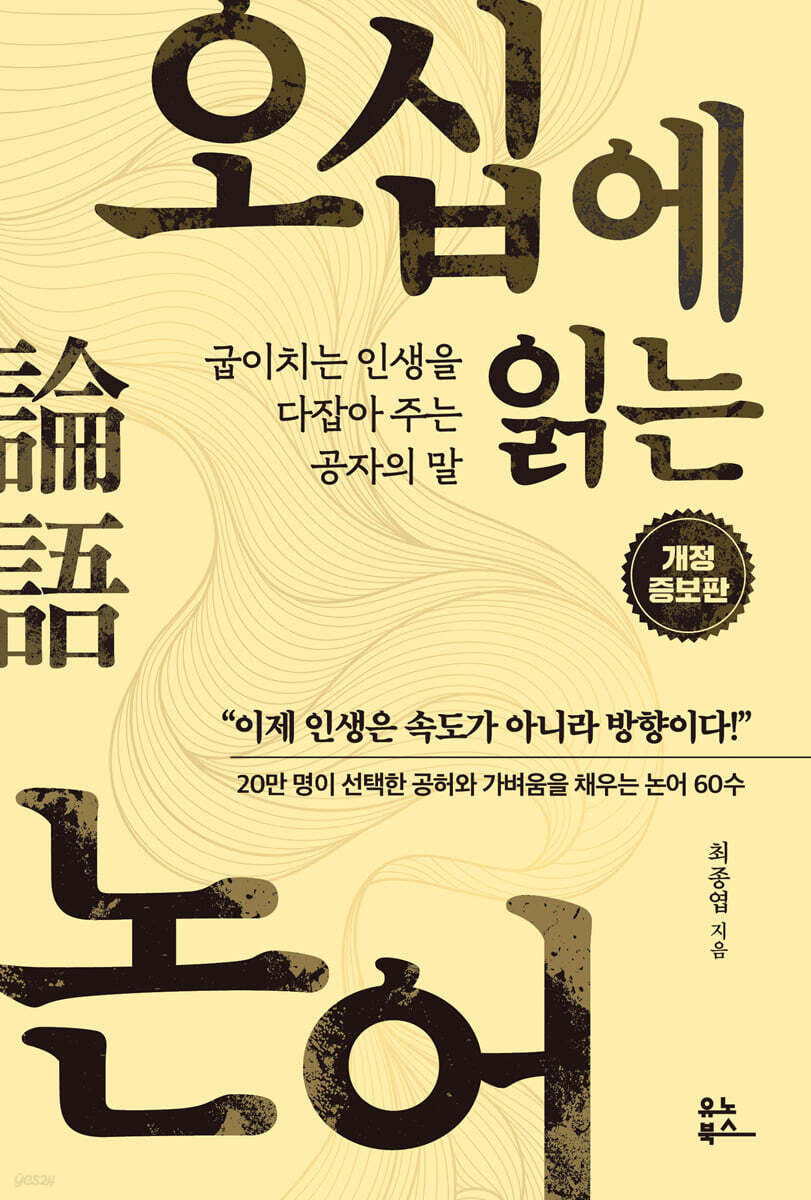
Life is now about direction, not speed!
60 Analects of Confucius that Fill Emptiness and Lightness Chosen by 200,000 People
The book that firmly captured the hearts of middle-aged people who have lived tirelessly, 『Reading the Analects in Your Fifties』, has returned in a revised and expanded edition with even more depth.
Five years since publication, 100 printings, and 200,000 readers' choice prove its significance.
This revised and expanded edition is based on the 50 poems of the Analects of Confucius from the first edition and stories that resonate with people in their fifties, and adds 10 new poems carefully selected from the Analects of Confucius to provide insight into the concerns faced by people in their fifties and the direction they should take going forward.
It was completed in 60 moves, containing 10 concerns (flow, strength, effort, reason, mind, attitude, courtesy, choice, justice, and transition) that people in their fifties are actually facing today.
Like the Analects of Confucius, which has been edited and expanded over time, this book has been reborn as a classic perfectly suited to today's fifty-year-olds.
Why should we read the 2,500-year-old classic, the Analects, now, at the age of fifty? Why does the Analects still resonate with us after all these years? Author Choi Jong-yeop, who gives over 100 humanities lectures annually, has long shared the teachings of Confucius with people.
He says that the Analects are not a classic for special people, but rather a 'skill of wisdom' that ordinary people need to live ordinary lives.
Confucius entered the political arena only after he was over fifty, but he had to wander in a foreign country in his mid-sixties without achieving anything.
Nevertheless, he did not become discouraged, but continued to study hard and quietly walked his own path.
And at the age of seventy, he summed up his life thus:
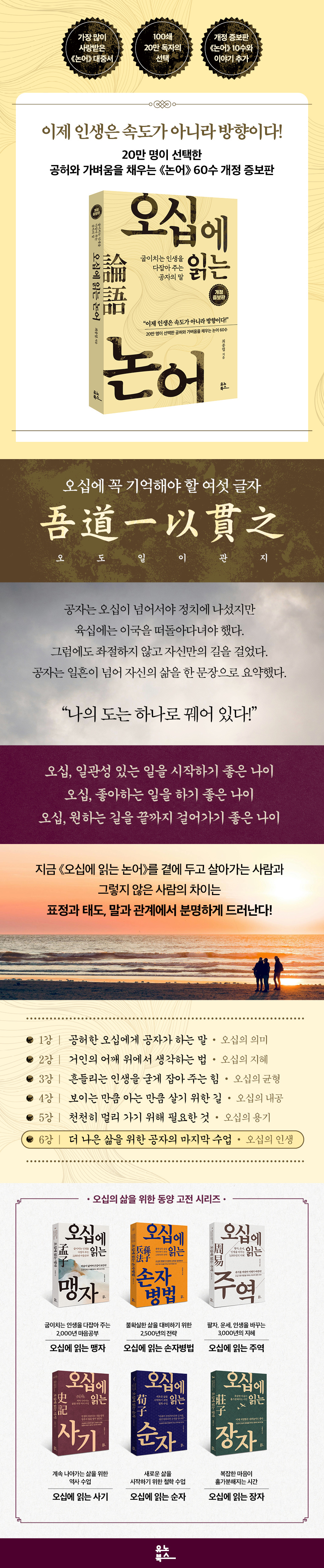
“My path is one.
“I have walked my path consistently until now, unshaken by the flow of the world (吾道一以貫之).” What is important now at fifty is not a faster speed, but a more accurate direction.
Fifty is the best time to start studying and living consistently.
There is no need to be shaken any longer.
Now, I just need to find the path I want and walk it to the end.
『Reading the Analects at Fifty』 will be the start.
60 Analects of Confucius that Fill Emptiness and Lightness Chosen by 200,000 People
The book that firmly captured the hearts of middle-aged people who have lived tirelessly, 『Reading the Analects in Your Fifties』, has returned in a revised and expanded edition with even more depth.
Five years since publication, 100 printings, and 200,000 readers' choice prove its significance.
This revised and expanded edition is based on the 50 poems of the Analects of Confucius from the first edition and stories that resonate with people in their fifties, and adds 10 new poems carefully selected from the Analects of Confucius to provide insight into the concerns faced by people in their fifties and the direction they should take going forward.
It was completed in 60 moves, containing 10 concerns (flow, strength, effort, reason, mind, attitude, courtesy, choice, justice, and transition) that people in their fifties are actually facing today.
Like the Analects of Confucius, which has been edited and expanded over time, this book has been reborn as a classic perfectly suited to today's fifty-year-olds.
Why should we read the 2,500-year-old classic, the Analects, now, at the age of fifty? Why does the Analects still resonate with us after all these years? Author Choi Jong-yeop, who gives over 100 humanities lectures annually, has long shared the teachings of Confucius with people.
He says that the Analects are not a classic for special people, but rather a 'skill of wisdom' that ordinary people need to live ordinary lives.
Confucius entered the political arena only after he was over fifty, but he had to wander in a foreign country in his mid-sixties without achieving anything.
Nevertheless, he did not become discouraged, but continued to study hard and quietly walked his own path.
And at the age of seventy, he summed up his life thus:
“My path is one.
“I have walked my path consistently until now, unshaken by the flow of the world (吾道一以貫之).” What is important now at fifty is not a faster speed, but a more accurate direction.
Fifty is the best time to start studying and living consistently.
There is no need to be shaken any longer.
Now, I just need to find the path I want and walk it to the end.
『Reading the Analects at Fifty』 will be the start.
- You can preview some of the book's contents.
Preview
index
Preface to the Revised and Expanded Edition: Hope for the Next 20 Years
Preface to the First Edition: Filling the Void of Fifty with the Analects
Lesson 1: Confucius's Words to the Empty Fifty: The Meaning of Fifty
When I need to find my hidden path_Fifty
The Way Out of the Hatred of the Fifties_Strategy
Money only solves half the problem_goods
The number one crisis to overcome in your fifties: health
Filial piety is a matter of daily life and a matter of the heart_Parents
Don't rush and don't worry about small profits_Direction
Not everyone can reach the same place_Career
Know the path you should take and walk it consistently_Center
If it blooms, let it bear fruit_fruit
Stand up straight and let others follow_action
Lesson 2: Thinking on the Shoulders of Giants_The Wisdom of Fifty
At fifty, you must find yourself within yourself.
Learn, be together, and be unwavering_Leader
What should I do? The power to think for myself_Contemplation
Life Principles: Keeping the Promises I Make
Knowing your calling, knowing your manners, knowing your words_criterion
Living a single day like a human being_passion
Learning the old to know the new_Learning
Knowing what you know and what you don't know clearly_Knowledge
If you haven't fixed it yet, now is the time to worry.
Should we follow profit or public interest?_Profit
The Power to Hold a Shaky Life Together: The Balance of Fifty
A masterpiece is one that has good decoration and good foundation_Harmony
Unwavering will and unbreakable dreams
It is wrong to know a mistake and not correct it_Change
Just one virtue is enough_dignity
Do the hard work first and the rewards later_Practice
We also need the leisure to write poetry and sing_leisure
Homework to be done in the half-time of life_Half
From the age of fifty, the life of a person is good_way
Both the good and the bad are teachers_Teachers
In the second half of life, everything is my responsibility_responsibility
The Way to Live as Much as You See and Know_Fifty's Internal Strength
If you don't like being cursed, don't curse_Love
A person who can bring about change under any circumstances_a vessel
See clearly and hear clearly_Basic
There is no grave without an excuse_Excuse
Confucius, who loved to learn_Learning
From a life that is pushed to a life that is pushed_led
A person who knows how to accept mistakes_self-awareness
Giving Up Creates Discrimination_Forward
Knowing, liking, and enjoying_homework
From a life of solitude to a life of togetherness_public
Lesson 5: What it takes to go far slowly_The courage of fifty
Don't draw the line in advance and say no_Positive
Focus on what you can do right now
Study with eagerness and fear_Grief
The power of repetition to overcome nature_Repetition
Think just one step further_Wonryeo
An uncomfortable yesterday creates a comfortable today_Vision
When the sun comes up, the wet straw must be dried_Determination
If you only think about it and don't learn, it's dangerous_method
The most appropriate age to look back and plan_opportunity
A person without passion is a dead battery_immersion
Lesson 6: Confucius's Last Lesson for a Better Life_Life at Fifty
Like a river flowing without stopping_flow
Pine and white never wither_Strength
When you stop learning, life stops_Effort
Why We Do What We Do
If you are not kind, it is of no use_mind
Life Balance: Tao, Virtue, Integrity, and Propriety
If only there was a school that taught shame_etiquette
Now is the time to find what you love to do_choose
So more urgent justice_justice
On the way from A to B_Transition
Conclusion: The Analects of Confucius: A Guide to My Life
Preface to the First Edition: Filling the Void of Fifty with the Analects
Lesson 1: Confucius's Words to the Empty Fifty: The Meaning of Fifty
When I need to find my hidden path_Fifty
The Way Out of the Hatred of the Fifties_Strategy
Money only solves half the problem_goods
The number one crisis to overcome in your fifties: health
Filial piety is a matter of daily life and a matter of the heart_Parents
Don't rush and don't worry about small profits_Direction
Not everyone can reach the same place_Career
Know the path you should take and walk it consistently_Center
If it blooms, let it bear fruit_fruit
Stand up straight and let others follow_action
Lesson 2: Thinking on the Shoulders of Giants_The Wisdom of Fifty
At fifty, you must find yourself within yourself.
Learn, be together, and be unwavering_Leader
What should I do? The power to think for myself_Contemplation
Life Principles: Keeping the Promises I Make
Knowing your calling, knowing your manners, knowing your words_criterion
Living a single day like a human being_passion
Learning the old to know the new_Learning
Knowing what you know and what you don't know clearly_Knowledge
If you haven't fixed it yet, now is the time to worry.
Should we follow profit or public interest?_Profit
The Power to Hold a Shaky Life Together: The Balance of Fifty
A masterpiece is one that has good decoration and good foundation_Harmony
Unwavering will and unbreakable dreams
It is wrong to know a mistake and not correct it_Change
Just one virtue is enough_dignity
Do the hard work first and the rewards later_Practice
We also need the leisure to write poetry and sing_leisure
Homework to be done in the half-time of life_Half
From the age of fifty, the life of a person is good_way
Both the good and the bad are teachers_Teachers
In the second half of life, everything is my responsibility_responsibility
The Way to Live as Much as You See and Know_Fifty's Internal Strength
If you don't like being cursed, don't curse_Love
A person who can bring about change under any circumstances_a vessel
See clearly and hear clearly_Basic
There is no grave without an excuse_Excuse
Confucius, who loved to learn_Learning
From a life that is pushed to a life that is pushed_led
A person who knows how to accept mistakes_self-awareness
Giving Up Creates Discrimination_Forward
Knowing, liking, and enjoying_homework
From a life of solitude to a life of togetherness_public
Lesson 5: What it takes to go far slowly_The courage of fifty
Don't draw the line in advance and say no_Positive
Focus on what you can do right now
Study with eagerness and fear_Grief
The power of repetition to overcome nature_Repetition
Think just one step further_Wonryeo
An uncomfortable yesterday creates a comfortable today_Vision
When the sun comes up, the wet straw must be dried_Determination
If you only think about it and don't learn, it's dangerous_method
The most appropriate age to look back and plan_opportunity
A person without passion is a dead battery_immersion
Lesson 6: Confucius's Last Lesson for a Better Life_Life at Fifty
Like a river flowing without stopping_flow
Pine and white never wither_Strength
When you stop learning, life stops_Effort
Why We Do What We Do
If you are not kind, it is of no use_mind
Life Balance: Tao, Virtue, Integrity, and Propriety
If only there was a school that taught shame_etiquette
Now is the time to find what you love to do_choose
So more urgent justice_justice
On the way from A to B_Transition
Conclusion: The Analects of Confucius: A Guide to My Life
Detailed image
Into the book
At fifty, many people step down or are pushed out of their organizations.
Even if you hold out until retirement, you will eventually leave around the age of sixty.
Withdrawing from social connections also leads to mental health problems.
They become alienated from the treatment and recognition they have received, and they find themselves in a position where they seek self-esteem and authority.
As social distancing increases, a vicious cycle begins, leading to mental health problems and ultimately, physical health deterioration.
No matter how high life expectancy and health scores are, if they deviate from actual health, they are nothing more than empty numbers.
If there's one thing that people in their fifties have to overcome, it's health.
--- From "The Greatest Crisis to Overcome at Fifty"
Fifty, now I'm thinking about direction.
Leaving behind the breathless competition, I slow down and think about my goals for the second half of my life.
Accepting early retirement at fifty isn't easy, but if you think about it, it's not so fatal that it will ruin your life.
Accepting retirement at age sixty may feel empty and bring about a sense of loss, both big and small, but it's not powerful enough to discourage you from taking on new challenges.
Even if your health is not what it used to be after you are in your fifties or sixties, it is not fatal enough to destroy your hopes for the future.
--- From "Don't rush and don't care about small profits"
If you are blaming someone right now, it is because you want to find the cause in that other person.
If I want to make excuses about who I am now, it means I am weak.
It doesn't matter if it's your parents, siblings, boss, or friends.
If I don't move, the world won't give me anything.
If you only take what is given, you will starve if you do not give.
The same goes for work and income.
If you only do the work given to you, one day you will run out of work.
If you just take what you give, eventually your income will stop.
--- From "At fifty, you must find it in me"
When you turn fifty, you start to look back on your life.
Only then do I realize how difficult it is to live by the principles I have set for myself.
A happy life may not be a special life.
The richest people are not the happiest people.
If you want to become rich and live in the countryside, people who live in the countryside are already happy people.
Ordinary people have a desire to be special, but special people dream of the small happiness of ordinary people.
There are no set answers in life.
But a life of principles, especially the ones you set for yourself
A life that silently adheres to the principles of life will certainly be beautiful and happy.
--- From "A Life of Keeping the Promises I Made"
The quality of a gentleman begins with learning and benevolence, and his literary qualities are revealed in language and etiquette.
The inner self of a human being is not something that is innate, but rather it deepens and becomes stronger depending on what one learns and how one practices it.
So we learn and grow throughout our lives.
A door is not just a decoration; it is completed through words, attitude, and courtesy.
Only when the depth of one's inner self is firmly established and the outward expression harmoniously embraces it can one become a true gentleman.
--- From "A luxury product is one that has good decoration and good foundation"
Cultivating virtue means acknowledging and accepting the life we share as a shared destiny.
It is a way to escape from the loneliness and lonely life of life.
The way to have good neighbors is not in the neighbors, but in me.
The way to meet good people is not in them, but in me.
The way to regain the love of my brothers and sisters is not in them, but in me.
The way to be loved by seniors and customers is not in their hands, but in mine.
The way to change a lonely past into a non-lonely future lies not in the environment, but in my heart.
--- From "Even one virtue is enough"
When you turn sixty, you will definitely look back on your fifties and have regrets.
If only I were 10 years younger, I could start over, but I'll regret not doing it 10 years ago.
We can learn from Confucius how to break this cycle of regret and sorrow that has lasted for thousands of years.
Confucius's teachings were earnest.
It is said that if your heart is sincere, there is nothing you cannot do.
This is a solution we already know.
Maybe it's too ordinary a method.
There might be a better way, but since it's so desperate, I have no choice but to pretend to be fooled and believe it.
So we have to stop now.
We need to stop making excuses and think.
If you make excuses about being busy now and get past the age of fifty, you'll regret whatever you do when you're sixty.
If you pass the age of sixty, you will face the age of seventy, which will bring you regrets again.
Just like that song 2,500 years ago.
--- From "There is no grave without an excuse"
Confucius often said this:
“Except for An Hui, who did not let his anger get the better of him and did not repeat the same mistakes, I have never seen anyone who realized their mistakes and sincerely reflected on them.
Anyone can make mistakes, but if you make a mistake and don't correct it, that's the real mistake.
If you make a mistake, don't hesitate to correct it immediately.
Mistakes usually arise from thinking one is right, and recognizing one's own mistakes is the same as knowing humanity.
“Also, a gentleman is someone who is ashamed of saying things that are difficult to put into action.”
--- From "A person who knows how to accept mistakes"
You should not study without thinking.
Just as homework must be completed even in the face of discomfort, the studies of those in their 50s should primarily focus on adult learning that enhances expertise.
Even if you read just one book, there must be consistency.
You must clearly define the purpose of your study and reading.
It is essential to know 'why' expertise in a certain field is needed.
Because the second half of your life may be determined by it.
--- From "It is dangerous to just think and not learn"
Fifty is never too late to start over again.
Because fifty is still twenty years away from turning seventy.
Because it's no different from 20 years ago when I was looking forward to turning 50 at the age of 30.
Fifty is never too late to be courageous.
Because fifty is our last chance to leave a wonderful life for our children, just like our parents who lived wonderful lives and set an example.
A very good age to start is fifty.
--- From "The Most Appropriate Age to Look Back and Plan"
“Only when winter comes do you realize that pines and cedars wither late.”
This meant that only in difficult times can true, unwavering will and integrity be revealed.
Confucius wanted his disciples to be like Pine and Bai.
I hope that you will have a strong character that will not waver in any environment or crisis, like pine and cedar trees that do not lose their greenness even in the harsh cold of midwinter.
I hope that you will not be a disciple who grows lushly in the summer when growth is good and then withers when winter comes, but a disciple who can stand firm in the face of trials and adversity.
--- From "Pine and Baek Never Wither"
People often ask themselves, 'What is a good life?'
And I want to find the answer, and I want to find it again and again, and I want the right answer that I can be sure of.
But Confucius' answer was concise.
“I just liked the old things and worked hard to get them.”
It is said that he simply studied, organized, applied, and practiced the valuable things created by the ancients and taught them to his disciples.
Hogo (好古), meaning liking old things, means hohak (好學), meaning liking to learn.
The phrase “min-i-gu-ji-ja-ya (敏以求之者)” means someone who seeks it quickly, and it means that he studied it diligently, organized it, applied it, and put it into practice.
It is an autobiography of someone who has lived their entire life in that attitude.
That's all there is to it.
It's not that I became an adult because I was special, but because I loved learning and worked hard to become one.
That was Confucius' answer.
Even if you hold out until retirement, you will eventually leave around the age of sixty.
Withdrawing from social connections also leads to mental health problems.
They become alienated from the treatment and recognition they have received, and they find themselves in a position where they seek self-esteem and authority.
As social distancing increases, a vicious cycle begins, leading to mental health problems and ultimately, physical health deterioration.
No matter how high life expectancy and health scores are, if they deviate from actual health, they are nothing more than empty numbers.
If there's one thing that people in their fifties have to overcome, it's health.
--- From "The Greatest Crisis to Overcome at Fifty"
Fifty, now I'm thinking about direction.
Leaving behind the breathless competition, I slow down and think about my goals for the second half of my life.
Accepting early retirement at fifty isn't easy, but if you think about it, it's not so fatal that it will ruin your life.
Accepting retirement at age sixty may feel empty and bring about a sense of loss, both big and small, but it's not powerful enough to discourage you from taking on new challenges.
Even if your health is not what it used to be after you are in your fifties or sixties, it is not fatal enough to destroy your hopes for the future.
--- From "Don't rush and don't care about small profits"
If you are blaming someone right now, it is because you want to find the cause in that other person.
If I want to make excuses about who I am now, it means I am weak.
It doesn't matter if it's your parents, siblings, boss, or friends.
If I don't move, the world won't give me anything.
If you only take what is given, you will starve if you do not give.
The same goes for work and income.
If you only do the work given to you, one day you will run out of work.
If you just take what you give, eventually your income will stop.
--- From "At fifty, you must find it in me"
When you turn fifty, you start to look back on your life.
Only then do I realize how difficult it is to live by the principles I have set for myself.
A happy life may not be a special life.
The richest people are not the happiest people.
If you want to become rich and live in the countryside, people who live in the countryside are already happy people.
Ordinary people have a desire to be special, but special people dream of the small happiness of ordinary people.
There are no set answers in life.
But a life of principles, especially the ones you set for yourself
A life that silently adheres to the principles of life will certainly be beautiful and happy.
--- From "A Life of Keeping the Promises I Made"
The quality of a gentleman begins with learning and benevolence, and his literary qualities are revealed in language and etiquette.
The inner self of a human being is not something that is innate, but rather it deepens and becomes stronger depending on what one learns and how one practices it.
So we learn and grow throughout our lives.
A door is not just a decoration; it is completed through words, attitude, and courtesy.
Only when the depth of one's inner self is firmly established and the outward expression harmoniously embraces it can one become a true gentleman.
--- From "A luxury product is one that has good decoration and good foundation"
Cultivating virtue means acknowledging and accepting the life we share as a shared destiny.
It is a way to escape from the loneliness and lonely life of life.
The way to have good neighbors is not in the neighbors, but in me.
The way to meet good people is not in them, but in me.
The way to regain the love of my brothers and sisters is not in them, but in me.
The way to be loved by seniors and customers is not in their hands, but in mine.
The way to change a lonely past into a non-lonely future lies not in the environment, but in my heart.
--- From "Even one virtue is enough"
When you turn sixty, you will definitely look back on your fifties and have regrets.
If only I were 10 years younger, I could start over, but I'll regret not doing it 10 years ago.
We can learn from Confucius how to break this cycle of regret and sorrow that has lasted for thousands of years.
Confucius's teachings were earnest.
It is said that if your heart is sincere, there is nothing you cannot do.
This is a solution we already know.
Maybe it's too ordinary a method.
There might be a better way, but since it's so desperate, I have no choice but to pretend to be fooled and believe it.
So we have to stop now.
We need to stop making excuses and think.
If you make excuses about being busy now and get past the age of fifty, you'll regret whatever you do when you're sixty.
If you pass the age of sixty, you will face the age of seventy, which will bring you regrets again.
Just like that song 2,500 years ago.
--- From "There is no grave without an excuse"
Confucius often said this:
“Except for An Hui, who did not let his anger get the better of him and did not repeat the same mistakes, I have never seen anyone who realized their mistakes and sincerely reflected on them.
Anyone can make mistakes, but if you make a mistake and don't correct it, that's the real mistake.
If you make a mistake, don't hesitate to correct it immediately.
Mistakes usually arise from thinking one is right, and recognizing one's own mistakes is the same as knowing humanity.
“Also, a gentleman is someone who is ashamed of saying things that are difficult to put into action.”
--- From "A person who knows how to accept mistakes"
You should not study without thinking.
Just as homework must be completed even in the face of discomfort, the studies of those in their 50s should primarily focus on adult learning that enhances expertise.
Even if you read just one book, there must be consistency.
You must clearly define the purpose of your study and reading.
It is essential to know 'why' expertise in a certain field is needed.
Because the second half of your life may be determined by it.
--- From "It is dangerous to just think and not learn"
Fifty is never too late to start over again.
Because fifty is still twenty years away from turning seventy.
Because it's no different from 20 years ago when I was looking forward to turning 50 at the age of 30.
Fifty is never too late to be courageous.
Because fifty is our last chance to leave a wonderful life for our children, just like our parents who lived wonderful lives and set an example.
A very good age to start is fifty.
--- From "The Most Appropriate Age to Look Back and Plan"
“Only when winter comes do you realize that pines and cedars wither late.”
This meant that only in difficult times can true, unwavering will and integrity be revealed.
Confucius wanted his disciples to be like Pine and Bai.
I hope that you will have a strong character that will not waver in any environment or crisis, like pine and cedar trees that do not lose their greenness even in the harsh cold of midwinter.
I hope that you will not be a disciple who grows lushly in the summer when growth is good and then withers when winter comes, but a disciple who can stand firm in the face of trials and adversity.
--- From "Pine and Baek Never Wither"
People often ask themselves, 'What is a good life?'
And I want to find the answer, and I want to find it again and again, and I want the right answer that I can be sure of.
But Confucius' answer was concise.
“I just liked the old things and worked hard to get them.”
It is said that he simply studied, organized, applied, and practiced the valuable things created by the ancients and taught them to his disciples.
Hogo (好古), meaning liking old things, means hohak (好學), meaning liking to learn.
The phrase “min-i-gu-ji-ja-ya (敏以求之者)” means someone who seeks it quickly, and it means that he studied it diligently, organized it, applied it, and put it into practice.
It is an autobiography of someone who has lived their entire life in that attitude.
That's all there is to it.
It's not that I became an adult because I was special, but because I loved learning and worked hard to become one.
That was Confucius' answer.
--- From "When you stop learning, life stops"
Publisher's Review
Bestseller of all time
The Analects of Confucius for Fifty-Year-Olds Revised and Expanded Edition
Published 5 years ago, 100th printing, 200,000 copies sold.
"The Analects of Confucius for Fifty Years" is a book that has been loved by countless readers, warmly embracing their emptiness.
The book has returned with a new format.
Classics never get old.
However, it must be reread to suit the times.
Just as the Analects have been edited and expanded over time, this revised and expanded edition has also been reborn as a classic that breathes new life into today's fifty-year era.
In addition to the existing 50 Analects, we added 10 new poems containing realistic concerns to make Confucius' wisdom more applicable to today's life.
But why should we read the Analects, especially at fifty? Fifty is a time when we've already come a long way, but there's still a long way to go.
But at this point, life becomes even more bleak.
Money, health, and relationships are all shaken, and you start to wonder if you're on the right path.
Until forty, you could make excuses, but from fifty onwards, you can't.
Now it's a question of direction.
Author Choi Jong-yeop has lectured on the Analects over 1,000 times.
He says.
“The Analects of Confucius is not a book for special people, but a book that ordinary people should read as they live their ordinary days.”
With that faith, he retells the message of Confucius in practical language suited to the life of a fifty-year-old.
Confucius said, “My path is one-sided.”
What matters in life is not speed, but direction, and that direction comes from a consistent standard.
If you want to change your life after 50, you must first decide which path you want to focus your life on.
"The Analects of Confucius for those in their fifties" presents a direction and central philosophy for life that will allow those facing this question to walk unwaveringly.
Now life is
It's not about speed, it's about direction!
The Analects were not written by Confucius himself.
It is a record of conversations between Confucius and his disciples as they ate together, walked together, and shared their lives.
Therefore, the Analects can be said to be a ‘book of people’ rather than a book of philosophy.
The reason the Analects of Confucius are still read today, thousands of years later, is because they contain everyday words that help us hold on to life again.
《Reading the Analects at Fifty》 reinterprets this to fit the time of fifty.
The present fifty is a time to pause at the speed at which we have been running and ask ourselves again where we should go from now on.
I've been living my life only looking forward, caught up in responsibilities and roles, and putting off asking myself 'why', and now I'm in my fifties.
But life is not a marathon.
Even if you run for a long time, if you go in the wrong direction, you have to go back.
So what we need now is not speed, but the right direction.
The Analects of Confucius ask for direction, reestablish it, and lead us to put it into practice every day.
“If you don’t think far ahead, there will always be worries nearby.”
“People are born with similar natures, but they become completely different through repetition (性相近也 習相遠也).”
“Set your mind on the Way, rely on virtue, rely on humanity, and play with propriety.”
Confucius's words become the central axis of life.
This book explains those standards in a way that today's fifty-somethings can put them into practice.
“Reading the Analects at Fifty” is a book that re-establishes the classics as the standard for life.
So, the Analects of Confucius do not come across as just an old saying.
As we read books, we ask ourselves:
“By what standards do I live and what do I repeat?” said Confucius.
This book helps you choose that repetition anew.
It sets the standard, sets the direction, and guides us to keep it going.
Chosen by 200,000 people
Confucius's 60 sayings
The revised and expanded edition of “The Analects of Confucius for the Fifty-Year-Old” was reorganized into 60 chapters in 6 parts by adding 10 chapters to the original 50 chapters.
The content was supplemented with a focus on topics that people in their fifties actually face in various aspects of life, including flow, strength, effort, reason, mind, attitude, manners, choice, justice, and transition.
Each number begins with a short Confucian saying and story, and then illuminates the turbulent life after fifty, from life after retirement, to supporting parents and children becoming independent, to the challenges of maintaining oneself in relationships.
Confucius said that at thirty he stood firm (而立), at forty he was unshaken (不惑), and at fifty he knew the mandate of heaven (知天命).
It means that he realized his own path.
Now our fifties are more shaky and more unstable.
But, like Confucius, I must decide on the direction I want to take in life from now on and walk consistently towards it.
In this way, the words of the Analects serve as a guide for us today.
In an age of uncertainty and uncertainty, the Analects of Confucius become the central axis of life.
This book is the force that makes the difference.
The lives of those who live each day with the Analects by their side and those who do not gradually change.
The difference is not evident now, but in the expressions, attitudes, words, and relationships ten years from now.
For those in their fifties, halfway through life, and wondering what standards to live by, the Analects of Confucius still offer valid wisdom.
If you want to live without losing your center even in the face of turbulent times, if you want to hold on to the twists and turns of life, if you want to fill the emptiness and lightness you feel at fifty, then "Reading the Analects at Fifty" is a book you must keep by your side.
The Analects of Confucius for Fifty-Year-Olds Revised and Expanded Edition
Published 5 years ago, 100th printing, 200,000 copies sold.
"The Analects of Confucius for Fifty Years" is a book that has been loved by countless readers, warmly embracing their emptiness.
The book has returned with a new format.
Classics never get old.
However, it must be reread to suit the times.
Just as the Analects have been edited and expanded over time, this revised and expanded edition has also been reborn as a classic that breathes new life into today's fifty-year era.
In addition to the existing 50 Analects, we added 10 new poems containing realistic concerns to make Confucius' wisdom more applicable to today's life.
But why should we read the Analects, especially at fifty? Fifty is a time when we've already come a long way, but there's still a long way to go.
But at this point, life becomes even more bleak.
Money, health, and relationships are all shaken, and you start to wonder if you're on the right path.
Until forty, you could make excuses, but from fifty onwards, you can't.
Now it's a question of direction.
Author Choi Jong-yeop has lectured on the Analects over 1,000 times.
He says.
“The Analects of Confucius is not a book for special people, but a book that ordinary people should read as they live their ordinary days.”
With that faith, he retells the message of Confucius in practical language suited to the life of a fifty-year-old.
Confucius said, “My path is one-sided.”
What matters in life is not speed, but direction, and that direction comes from a consistent standard.
If you want to change your life after 50, you must first decide which path you want to focus your life on.
"The Analects of Confucius for those in their fifties" presents a direction and central philosophy for life that will allow those facing this question to walk unwaveringly.
Now life is
It's not about speed, it's about direction!
The Analects were not written by Confucius himself.
It is a record of conversations between Confucius and his disciples as they ate together, walked together, and shared their lives.
Therefore, the Analects can be said to be a ‘book of people’ rather than a book of philosophy.
The reason the Analects of Confucius are still read today, thousands of years later, is because they contain everyday words that help us hold on to life again.
《Reading the Analects at Fifty》 reinterprets this to fit the time of fifty.
The present fifty is a time to pause at the speed at which we have been running and ask ourselves again where we should go from now on.
I've been living my life only looking forward, caught up in responsibilities and roles, and putting off asking myself 'why', and now I'm in my fifties.
But life is not a marathon.
Even if you run for a long time, if you go in the wrong direction, you have to go back.
So what we need now is not speed, but the right direction.
The Analects of Confucius ask for direction, reestablish it, and lead us to put it into practice every day.
“If you don’t think far ahead, there will always be worries nearby.”
“People are born with similar natures, but they become completely different through repetition (性相近也 習相遠也).”
“Set your mind on the Way, rely on virtue, rely on humanity, and play with propriety.”
Confucius's words become the central axis of life.
This book explains those standards in a way that today's fifty-somethings can put them into practice.
“Reading the Analects at Fifty” is a book that re-establishes the classics as the standard for life.
So, the Analects of Confucius do not come across as just an old saying.
As we read books, we ask ourselves:
“By what standards do I live and what do I repeat?” said Confucius.
This book helps you choose that repetition anew.
It sets the standard, sets the direction, and guides us to keep it going.
Chosen by 200,000 people
Confucius's 60 sayings
The revised and expanded edition of “The Analects of Confucius for the Fifty-Year-Old” was reorganized into 60 chapters in 6 parts by adding 10 chapters to the original 50 chapters.
The content was supplemented with a focus on topics that people in their fifties actually face in various aspects of life, including flow, strength, effort, reason, mind, attitude, manners, choice, justice, and transition.
Each number begins with a short Confucian saying and story, and then illuminates the turbulent life after fifty, from life after retirement, to supporting parents and children becoming independent, to the challenges of maintaining oneself in relationships.
Confucius said that at thirty he stood firm (而立), at forty he was unshaken (不惑), and at fifty he knew the mandate of heaven (知天命).
It means that he realized his own path.
Now our fifties are more shaky and more unstable.
But, like Confucius, I must decide on the direction I want to take in life from now on and walk consistently towards it.
In this way, the words of the Analects serve as a guide for us today.
In an age of uncertainty and uncertainty, the Analects of Confucius become the central axis of life.
This book is the force that makes the difference.
The lives of those who live each day with the Analects by their side and those who do not gradually change.
The difference is not evident now, but in the expressions, attitudes, words, and relationships ten years from now.
For those in their fifties, halfway through life, and wondering what standards to live by, the Analects of Confucius still offer valid wisdom.
If you want to live without losing your center even in the face of turbulent times, if you want to hold on to the twists and turns of life, if you want to fill the emptiness and lightness you feel at fifty, then "Reading the Analects at Fifty" is a book you must keep by your side.
GOODS SPECIFICS
- Date of issue: June 4, 2025
- Page count, weight, size: 364 pages | 472g | 142*210*20mm
- ISBN13: 9791171831104
- ISBN10: 1171831102
You may also like
카테고리
korean


korean

![ELLE 엘르 스페셜 에디션 A형 : 12월 [2025]](http://librairie.coreenne.fr/cdn/shop/files/b8e27a3de6c9538896439686c6b0e8fb.jpg?v=1766436872&width=3840)


