

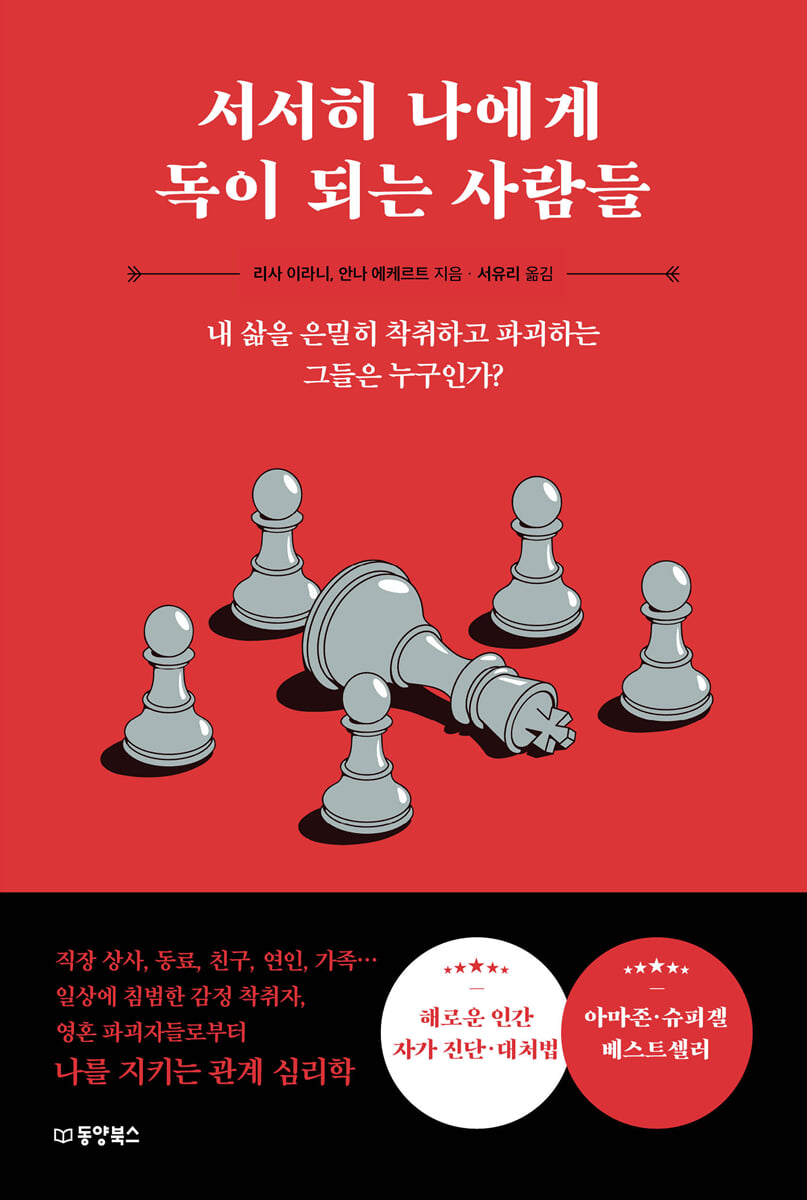
People who are slowly becoming poison to me
 |
Description
Book Introduction
★ Amazon, Spiegel Bestseller
★ TikTok @cuteaberpsycho 3.3 million likes
★ Self-diagnosis and coping methods for toxic people
★ Prescription for immunity needed for toxic human relationships
If you're constantly feeling anxious and in difficult relationships, look around to see if there are people like these:
People who avoid responsibility and blame you for all their problems, people who only contact you when they need help and ignore you when you're struggling, people who criticize and ignore you under the pretense of jokes and belittle your successes or efforts, people who make you nervous and anxious with constant lies, and people who threaten you with physical, verbal, or emotional violence.
You must have always been looking at their faces and wondering, 'Am I the problem?'
But you are not the cause of the problem.
In every hurtful relationship there are 'toxic people'!
Relationship Solutions for Those Who Are Getting Hit by People and Having a Hard Time Because of People
Poisonous people are not distant strangers.
It's your closest friends, lovers, coworkers, bosses, and family.
They come to you disguised as good people, then manipulate your emotions like a roller coaster, trying to exploit everything you have by manipulating unfavorable situations.
And it forces us to face various dilemmas, such as the pressure to understand because we love each other, the sacrifices we have to make because we are family, and the burden of having to accommodate our friends, colleagues, and bosses.
As a result, you gradually lose yourself and feel suffocated under the weight of distorted relationships.
Now is the time to break those chains.
The only person who can change your relationships is you.
"People Who Slowly Turn You Into Poison" explains why you get involved with these people and how to break free from them and find yourself again.
It also pinpoints the relationship problems you're experiencing, reveals the toxic people and their manipulative techniques that create those problems, and introduces ways to deal with them and build healthy relationships.
This book, which is based on psychological theory and clinical cases and contains concrete solutions that are scientifically substantiated and proven in real-world settings, has been a bestseller and a must-read for counseling centers and psychotherapy settings since before its publication, thanks to word-of-mouth spread throughout German society.
This book will also provide a definite answer to Korean readers who are suffering from the pain caused by interpersonal relationships.
★ TikTok @cuteaberpsycho 3.3 million likes
★ Self-diagnosis and coping methods for toxic people
★ Prescription for immunity needed for toxic human relationships
If you're constantly feeling anxious and in difficult relationships, look around to see if there are people like these:
People who avoid responsibility and blame you for all their problems, people who only contact you when they need help and ignore you when you're struggling, people who criticize and ignore you under the pretense of jokes and belittle your successes or efforts, people who make you nervous and anxious with constant lies, and people who threaten you with physical, verbal, or emotional violence.
You must have always been looking at their faces and wondering, 'Am I the problem?'
But you are not the cause of the problem.
In every hurtful relationship there are 'toxic people'!
Relationship Solutions for Those Who Are Getting Hit by People and Having a Hard Time Because of People
Poisonous people are not distant strangers.
It's your closest friends, lovers, coworkers, bosses, and family.
They come to you disguised as good people, then manipulate your emotions like a roller coaster, trying to exploit everything you have by manipulating unfavorable situations.
And it forces us to face various dilemmas, such as the pressure to understand because we love each other, the sacrifices we have to make because we are family, and the burden of having to accommodate our friends, colleagues, and bosses.
As a result, you gradually lose yourself and feel suffocated under the weight of distorted relationships.
Now is the time to break those chains.
The only person who can change your relationships is you.
"People Who Slowly Turn You Into Poison" explains why you get involved with these people and how to break free from them and find yourself again.
It also pinpoints the relationship problems you're experiencing, reveals the toxic people and their manipulative techniques that create those problems, and introduces ways to deal with them and build healthy relationships.
This book, which is based on psychological theory and clinical cases and contains concrete solutions that are scientifically substantiated and proven in real-world settings, has been a bestseller and a must-read for counseling centers and psychotherapy settings since before its publication, thanks to word-of-mouth spread throughout German society.
This book will also provide a definite answer to Korean readers who are suffering from the pain caused by interpersonal relationships.
- You can preview some of the book's contents.
Preview
index
Opening remarks
Part 1.
toxic relationship
Chapter 1.
How do you create a relationship that destroys you?
A toxic relationship
Indicators of dysfunctional behavior
Poisonous people and their manipulative techniques
Mirror of Love: Looking into My Shadow
Repeated toxic dating patterns
Trauma Bonding: An Addictive, Destructive Bond and a Hormonal Journey
Retraumatization: Why Do We Revisit Wounds?
Chapter 2.
The Invisible Bond: The Dynamics of Relationships
Your place in a relationship
Part 2.
People with mental poison
Chapter 1.
Uncovering Narcissism
Is personality disorder the cause of toxicity?
Definition and Characteristics of Narcissism
There is also healthy narcissism.
The Boundaries of the Ego: When Does Narcissism Become a Disease?
The Narcissist Trapped in the Mirror and the Struggle for Self-Esteem
How does narcissistic personality disorder develop?
The Impact of Narcissism on Relationships
Chapter 2.
Who is a narcissist?
Self-reflection instead of diagnosis
Could I be a narcissist?
The Invisible Alliance: Narcissistic Collusion
Chapter 3.
How to Deal with Narcissism
How to Communicate and Cope Effectively with Narcissists
Setting boundaries and strengthening self-efficacy
Healing from Negative Relationship Experiences
Understanding Narcissistic Behavior
Chapter 4.
Strategies for Coping with Narcissist Manipulation
Narcissist Communication
Decode
The Drive for Control: Why Do People Manipulate Others?
Chapter 5.
Useful Strategies for Relating to People with Difficult Personalities
Histrionic personality disorder: theatrical tendencies and a need for attention
Antisocial Personality Disorder: Relationships Are a Means to an End
Borderline personality disorder: emotional turmoil and impulsivity
Part 3.
Immunity against poisonous people
Chapter 1.
Boost your mental immunity
The art of learning from mistakes
psychological resistance
Aspects of resilience
How Resilience Affects Our Physical and Mental Health
Integrity that strengthens the mental immune system
Chapter 2.
Strengthening Self-Protection: How to Build Psychological Resilience
Becoming Inner Strong: How We Affect Our Resilience
Ready to break up
Chapter 3.
Strategies, Tools, and Practices for Dealing with Toxic People
Setting clear standards
Getting out of a crisis positively
Thorough Acceptance: Some People Don't Change
Breaking free from the victim role and building self-efficacy
Take responsibility
Reimagining the Future
Simple mindfulness practices for a more positive everyday life
The power of the people around us
Habits you can practice in your daily life
A Look to the Future: Embrace the Positive and Let Go of the Toxic
Conclusion
Acknowledgements
Part 1.
toxic relationship
Chapter 1.
How do you create a relationship that destroys you?
A toxic relationship
Indicators of dysfunctional behavior
Poisonous people and their manipulative techniques
Mirror of Love: Looking into My Shadow
Repeated toxic dating patterns
Trauma Bonding: An Addictive, Destructive Bond and a Hormonal Journey
Retraumatization: Why Do We Revisit Wounds?
Chapter 2.
The Invisible Bond: The Dynamics of Relationships
Your place in a relationship
Part 2.
People with mental poison
Chapter 1.
Uncovering Narcissism
Is personality disorder the cause of toxicity?
Definition and Characteristics of Narcissism
There is also healthy narcissism.
The Boundaries of the Ego: When Does Narcissism Become a Disease?
The Narcissist Trapped in the Mirror and the Struggle for Self-Esteem
How does narcissistic personality disorder develop?
The Impact of Narcissism on Relationships
Chapter 2.
Who is a narcissist?
Self-reflection instead of diagnosis
Could I be a narcissist?
The Invisible Alliance: Narcissistic Collusion
Chapter 3.
How to Deal with Narcissism
How to Communicate and Cope Effectively with Narcissists
Setting boundaries and strengthening self-efficacy
Healing from Negative Relationship Experiences
Understanding Narcissistic Behavior
Chapter 4.
Strategies for Coping with Narcissist Manipulation
Narcissist Communication
Decode
The Drive for Control: Why Do People Manipulate Others?
Chapter 5.
Useful Strategies for Relating to People with Difficult Personalities
Histrionic personality disorder: theatrical tendencies and a need for attention
Antisocial Personality Disorder: Relationships Are a Means to an End
Borderline personality disorder: emotional turmoil and impulsivity
Part 3.
Immunity against poisonous people
Chapter 1.
Boost your mental immunity
The art of learning from mistakes
psychological resistance
Aspects of resilience
How Resilience Affects Our Physical and Mental Health
Integrity that strengthens the mental immune system
Chapter 2.
Strengthening Self-Protection: How to Build Psychological Resilience
Becoming Inner Strong: How We Affect Our Resilience
Ready to break up
Chapter 3.
Strategies, Tools, and Practices for Dealing with Toxic People
Setting clear standards
Getting out of a crisis positively
Thorough Acceptance: Some People Don't Change
Breaking free from the victim role and building self-efficacy
Take responsibility
Reimagining the Future
Simple mindfulness practices for a more positive everyday life
The power of the people around us
Habits you can practice in your daily life
A Look to the Future: Embrace the Positive and Let Go of the Toxic
Conclusion
Acknowledgements
Detailed image
Publisher's Review
# Mr. A's boss at work always encourages him by hinting at the possibility of a promotion or a pay raise.
Mr. A works hard every day, even working overtime, with the expectation that his efforts will eventually be rewarded.
However, the expected promotions and pay raises rarely come about.
Person A has a bad feeling, but he can't bring himself to ask his boss about it.
Because they don't want to jeopardize their future at work and are afraid of ruining their good relationship with their boss.
# Today, too, Mr. B's parents are pouring criticism on Mr. B.
“What the hell are you doing right?” “You don’t listen to me.” “You’re too emotional.
“Why are you crying like an idiot?” Mr. B continues to apologize for his mistakes and vows to work harder to gain his parents’ approval.
Mr. B is anxious and feels helpless, but he cannot find the cause.
I just think that I am not smart and have many problems.
# Mr. C's love life is always marred by violence.
As much as I longed for love and stability, I was careful every time I started a relationship, but as time passed, my partner inevitably became angry and violent.
Mr. C received counseling to help him recover from the trauma of violence and a bad relationship.
Through psychological analysis, I realized that I was unconsciously attracted to people who resembled my father, who was abusive to me during my childhood.
I feel like I need to break out of this bad relationship pattern, but honestly, I'm not sure.
Person A, who is exploited by his boss under the pretext of a salary increase and promotion; Person B, who falls into self-doubt and denial due to his parents' gaslighting; Person C, who repeats bad relationships due to negative attachment experiences in childhood.
What do they have in common? They're all associated with "toxic people."
“The most factual and useful book on human relationships.”
The Best Relationship Psychology for Dealing with Toxic People
Lisa Irani and Anna Eckert, two of Germany's most prominent psychologists, accurately point out the problems of human relationships through "People Who Slowly Turn You Into Poison."
If you find yourself in a relationship that is constantly difficult and unstable, the problem is not you, but the toxic people who have entered your life.
If you ever feel like you're not good enough, that you're not smart enough, that you're not attractive enough, that you're not worthy of love, that you're not worthy of love, then you're probably in a toxic relationship.
Poisonous people are not distant strangers.
It's your closest friends, lovers, colleagues, bosses, and family.
They come to you disguised as good people, then manipulate your emotions like a roller coaster, manipulating unfavorable situations to exploit everything you have.
And it forces us to face various dilemmas, such as the pressure to understand because we love each other, the sacrifices we have to make because we are family, and the burden of having to accommodate our friends, colleagues, and bosses.
As a result, you gradually lose yourself and feel suffocated under the weight of distorted relationships.
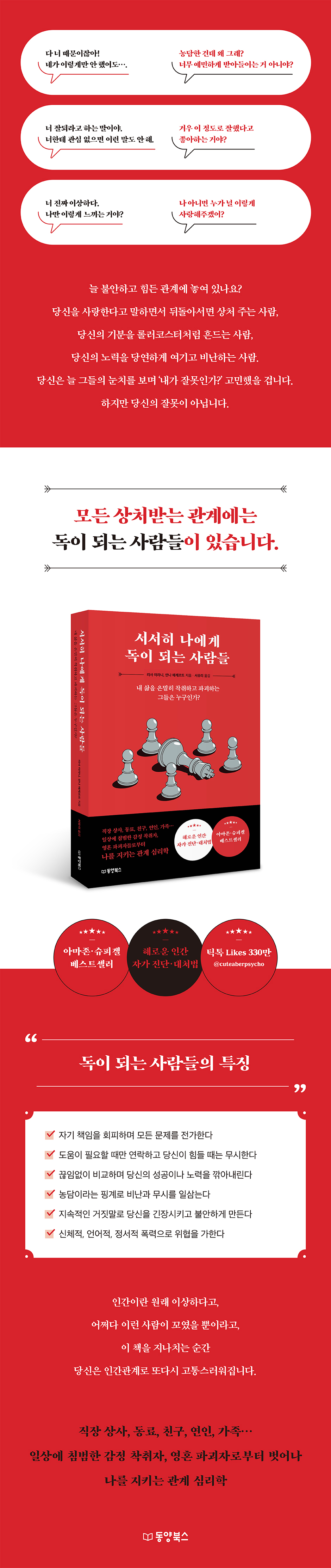
★ Characteristics of Poisonous People ★
① Avoids responsibility and shifts all the blame to you.
② Contact them only when you need help and ignore them when you are having a hard time.
③ Constantly comparing yourself to others and belittling your success or efforts.
④ They criticize and ignore others under the pretext of joking.
⑤ Continuous lies make you nervous and anxious.
⑥ Threaten with physical, verbal, or emotional violence.
If you have people like this around you, you need to realize that continuing to tolerate and maintain that relationship is actually harmful to you.
Anyone can have a painful experience because of someone.
In such cases, rather than looking for the cause of the problem within yourself, it is important to accurately identify the behaviors and patterns of the toxic people in the relationship.
And we need to come up with countermeasures and solutions accordingly.
Don't be exploited, abandoned, or hurt again!
How to Regain Control in a Relationship Without Just Breaking Off
"People Who Slowly Become Poisonous to Me" deeply analyzes the causes of various conflicts and wounds that arise in human relationships and offers specific solutions to those suffering from them.
You can learn to diagnose the toxic people around you, break free from toxic relationships, and establish healthy boundaries.
Additionally, through practical advice based on psychological theory and clinical cases, you can build the immunity you need and ultimately regain your self-confidence.
This process helps you find your own initiative rather than simply cutting ties, and learn to deal with it wisely rather than blindly enduring it.
This relationship psychology answer from Lisa Irani and Anna Eckert will be the starting point for true change for you.
As the review says, “This is the most realistic and useful book on human relationships,” the structure of this book is really solid.
Part 1 will teach you the basics and patterns of toxic relationships so you can understand the relationships and dynamics in your own lives.
We explore how subtle manipulation and trauma influence your behavior, and explore ways to break free from long-term, toxic relationships.
In Part 2, we delve a little deeper into the world of psychology and diagnosis.
Learn about the characteristics of toxic people and personality disorders.
It also addresses precisely which behaviors still fall within the normal range and which ones may take on pathological characteristics and be considered diseases.
It focuses specifically on people with narcissistic personality disorder, histrionic personality disorder, antisocial personality disorder, and borderline personality disorder, which are all toxic in most relationships, and teaches people how to relate to and communicate with them.
Part 3 will teach you how to build immunity against toxic people and strengthen your psychological resilience.
So that you can protect yourself well even when you encounter toxic people in the future.
The various self-diagnosis tests, tools, and strategies presented in this book are all useful for coping better with those who challenge you and strengthening your immune system.
Take a look at your relationships and think seriously about them.
Is there someone around you who repeatedly gets on your nerves? Someone who constantly needs to be the center of attention, who casually crosses your boundaries, humiliates you in front of others, or exploits you for their own purposes? Someone who constantly brags about how special and empathetic they are? How long will you suffer in relationships with these people? Stop making excuses like, "That's just how relationships are."
If you take the pain you experience in relationships lightly and ignore it, you will only end up suffering more because of them.
There is no human or human relationship that will get better just by enduring it.
Mr. A works hard every day, even working overtime, with the expectation that his efforts will eventually be rewarded.
However, the expected promotions and pay raises rarely come about.
Person A has a bad feeling, but he can't bring himself to ask his boss about it.
Because they don't want to jeopardize their future at work and are afraid of ruining their good relationship with their boss.
# Today, too, Mr. B's parents are pouring criticism on Mr. B.
“What the hell are you doing right?” “You don’t listen to me.” “You’re too emotional.
“Why are you crying like an idiot?” Mr. B continues to apologize for his mistakes and vows to work harder to gain his parents’ approval.
Mr. B is anxious and feels helpless, but he cannot find the cause.
I just think that I am not smart and have many problems.
# Mr. C's love life is always marred by violence.
As much as I longed for love and stability, I was careful every time I started a relationship, but as time passed, my partner inevitably became angry and violent.
Mr. C received counseling to help him recover from the trauma of violence and a bad relationship.
Through psychological analysis, I realized that I was unconsciously attracted to people who resembled my father, who was abusive to me during my childhood.
I feel like I need to break out of this bad relationship pattern, but honestly, I'm not sure.
Person A, who is exploited by his boss under the pretext of a salary increase and promotion; Person B, who falls into self-doubt and denial due to his parents' gaslighting; Person C, who repeats bad relationships due to negative attachment experiences in childhood.
What do they have in common? They're all associated with "toxic people."
“The most factual and useful book on human relationships.”
The Best Relationship Psychology for Dealing with Toxic People
Lisa Irani and Anna Eckert, two of Germany's most prominent psychologists, accurately point out the problems of human relationships through "People Who Slowly Turn You Into Poison."
If you find yourself in a relationship that is constantly difficult and unstable, the problem is not you, but the toxic people who have entered your life.
If you ever feel like you're not good enough, that you're not smart enough, that you're not attractive enough, that you're not worthy of love, that you're not worthy of love, then you're probably in a toxic relationship.
Poisonous people are not distant strangers.
It's your closest friends, lovers, colleagues, bosses, and family.
They come to you disguised as good people, then manipulate your emotions like a roller coaster, manipulating unfavorable situations to exploit everything you have.
And it forces us to face various dilemmas, such as the pressure to understand because we love each other, the sacrifices we have to make because we are family, and the burden of having to accommodate our friends, colleagues, and bosses.
As a result, you gradually lose yourself and feel suffocated under the weight of distorted relationships.
★ Characteristics of Poisonous People ★
① Avoids responsibility and shifts all the blame to you.
② Contact them only when you need help and ignore them when you are having a hard time.
③ Constantly comparing yourself to others and belittling your success or efforts.
④ They criticize and ignore others under the pretext of joking.
⑤ Continuous lies make you nervous and anxious.
⑥ Threaten with physical, verbal, or emotional violence.
If you have people like this around you, you need to realize that continuing to tolerate and maintain that relationship is actually harmful to you.
Anyone can have a painful experience because of someone.
In such cases, rather than looking for the cause of the problem within yourself, it is important to accurately identify the behaviors and patterns of the toxic people in the relationship.
And we need to come up with countermeasures and solutions accordingly.
Don't be exploited, abandoned, or hurt again!
How to Regain Control in a Relationship Without Just Breaking Off
"People Who Slowly Become Poisonous to Me" deeply analyzes the causes of various conflicts and wounds that arise in human relationships and offers specific solutions to those suffering from them.
You can learn to diagnose the toxic people around you, break free from toxic relationships, and establish healthy boundaries.
Additionally, through practical advice based on psychological theory and clinical cases, you can build the immunity you need and ultimately regain your self-confidence.
This process helps you find your own initiative rather than simply cutting ties, and learn to deal with it wisely rather than blindly enduring it.
This relationship psychology answer from Lisa Irani and Anna Eckert will be the starting point for true change for you.
As the review says, “This is the most realistic and useful book on human relationships,” the structure of this book is really solid.
Part 1 will teach you the basics and patterns of toxic relationships so you can understand the relationships and dynamics in your own lives.
We explore how subtle manipulation and trauma influence your behavior, and explore ways to break free from long-term, toxic relationships.
In Part 2, we delve a little deeper into the world of psychology and diagnosis.
Learn about the characteristics of toxic people and personality disorders.
It also addresses precisely which behaviors still fall within the normal range and which ones may take on pathological characteristics and be considered diseases.
It focuses specifically on people with narcissistic personality disorder, histrionic personality disorder, antisocial personality disorder, and borderline personality disorder, which are all toxic in most relationships, and teaches people how to relate to and communicate with them.
Part 3 will teach you how to build immunity against toxic people and strengthen your psychological resilience.
So that you can protect yourself well even when you encounter toxic people in the future.
The various self-diagnosis tests, tools, and strategies presented in this book are all useful for coping better with those who challenge you and strengthening your immune system.
Take a look at your relationships and think seriously about them.
Is there someone around you who repeatedly gets on your nerves? Someone who constantly needs to be the center of attention, who casually crosses your boundaries, humiliates you in front of others, or exploits you for their own purposes? Someone who constantly brags about how special and empathetic they are? How long will you suffer in relationships with these people? Stop making excuses like, "That's just how relationships are."
If you take the pain you experience in relationships lightly and ignore it, you will only end up suffering more because of them.
There is no human or human relationship that will get better just by enduring it.
GOODS SPECIFICS
- Date of issue: October 20, 2025
- Page count, weight, size: 384 pages | 530g | 146*214*24mm
- ISBN13: 9791172101374
- ISBN10: 117210137X
You may also like
카테고리
korean


korean

![GQ KOREA Mark (Monthly): December [2025]](http://librairie.coreenne.fr/cdn/shop/files/8ef265dbbfbf186523ed75ba7319009d.jpg?v=1765340328&width=3840)


