

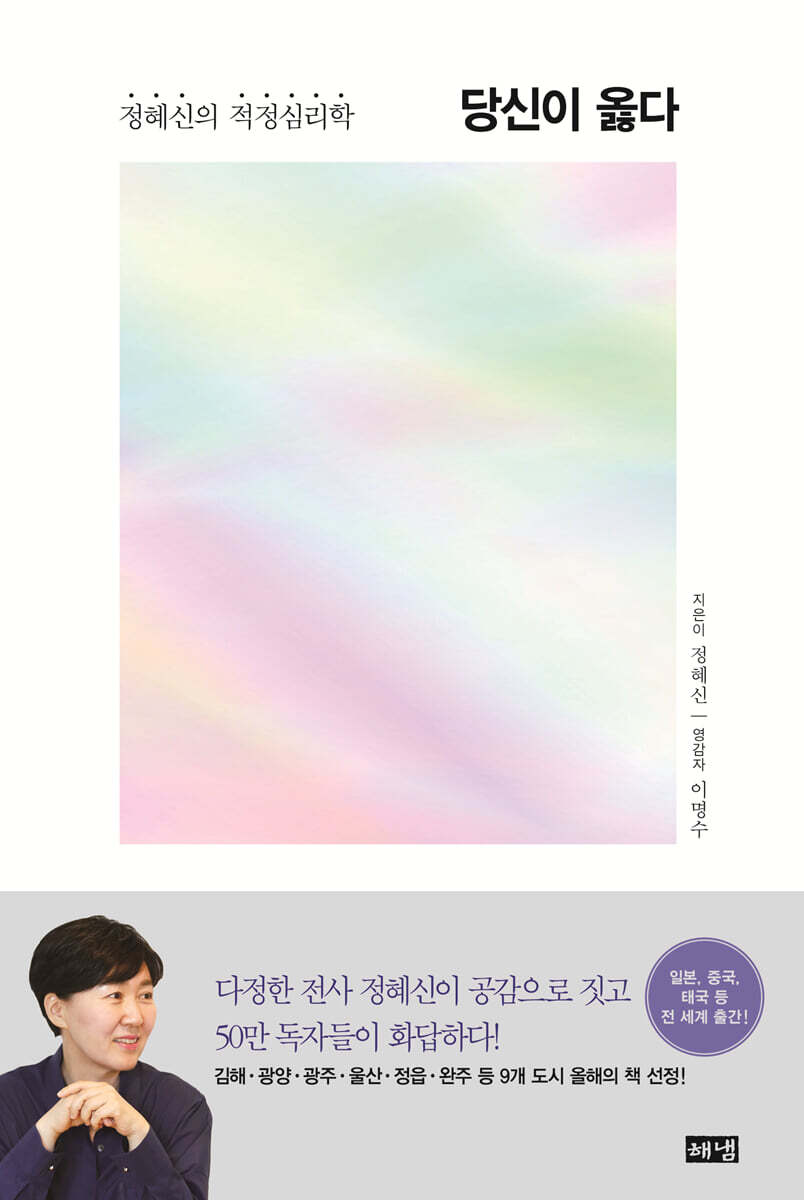
You are right
 |
Description
Book Introduction
- A word from MD
-
Empathy, the panacea for mental illnessJust as you go to the doctor when your body is sick, you go to the hospital when your mind is sick.
But there are times when you don't have to go, but you have to rely on experts.
Because you don't know the heart.
It is important to understand why I am sick and why others are suffering.
Empathy is the panacea for all mental illnesses.
October 12, 2018. Humanities PD Son Min-gyu
A Psychological CPR Guideline from "Affectionate Warrior" Jeong Hye-shin
That one person who covers your heart will save you.
From everyday life to social trauma
Healing experience and inner strength accumulated over 30 years
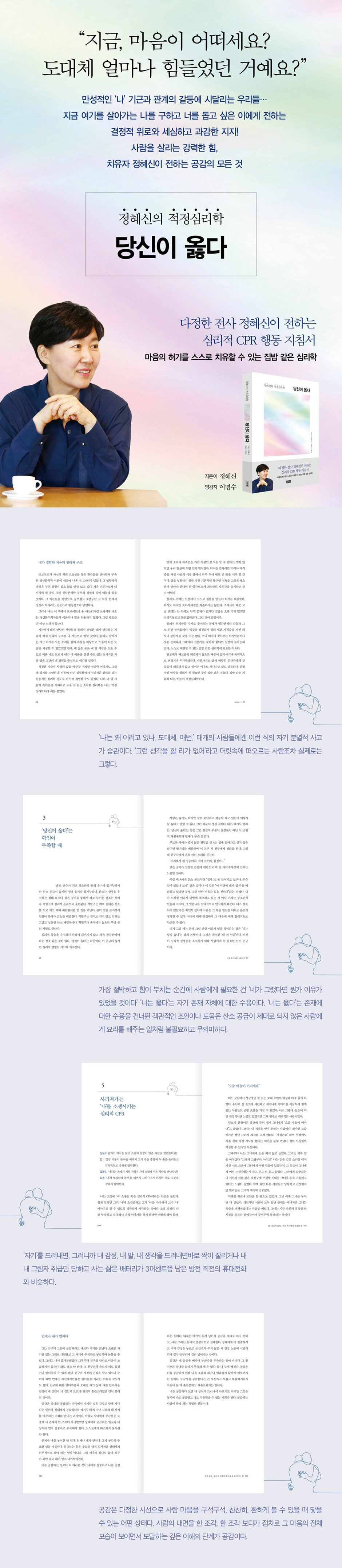
“How are you feeling now? How difficult has it been?”
A simple yet solid 'home-cooked' psychology built on the skills of empathy and vigilance!
A book for those suffering from chronic "self-starvation" and relationship conflict.
When we struggle to meet the gaze and expectations of others, endure with a forced smile in a bullying organization, struggle to meet the standards of a society that pursues success and efficiency, and let our own feelings take a backseat in the arduousness of relationships… we are not respected for our very existence, and our individuality is ignored.
In this increasingly harsh reality, one in three people in our country suffers from depression, and the suicide rate has been the highest in the world for several years.
Are we okay now?
Accordingly, psychiatrist Jeong Hye-shin, who has been with those suffering from social disasters to everyday moments, diagnoses that we are in dire need of 'psychological CPR (cardiopulmonary resuscitation)'.
This is the result of my experience over the past 15 years of working outside the clinic, meeting with the inner thoughts of a wide range of people, from ordinary people to trauma victims to CEOs, and confirming that many people are falling apart and hurting in every corner of our society.
In these emergency situations, the author aims to guide anyone through the behavioral guidelines of psychological CPR through his new book, "You Are Right."
This book, which contains detailed practical methods to 'save me and save you', is also the culmination of his experience, inner strength, and sincerity accumulated over 30 years as a psychiatrist and street healer.
That one person who covers your heart will save you.
From everyday life to social trauma
Healing experience and inner strength accumulated over 30 years
“How are you feeling now? How difficult has it been?”
A simple yet solid 'home-cooked' psychology built on the skills of empathy and vigilance!
A book for those suffering from chronic "self-starvation" and relationship conflict.
When we struggle to meet the gaze and expectations of others, endure with a forced smile in a bullying organization, struggle to meet the standards of a society that pursues success and efficiency, and let our own feelings take a backseat in the arduousness of relationships… we are not respected for our very existence, and our individuality is ignored.
In this increasingly harsh reality, one in three people in our country suffers from depression, and the suicide rate has been the highest in the world for several years.
Are we okay now?
Accordingly, psychiatrist Jeong Hye-shin, who has been with those suffering from social disasters to everyday moments, diagnoses that we are in dire need of 'psychological CPR (cardiopulmonary resuscitation)'.
This is the result of my experience over the past 15 years of working outside the clinic, meeting with the inner thoughts of a wide range of people, from ordinary people to trauma victims to CEOs, and confirming that many people are falling apart and hurting in every corner of our society.
In these emergency situations, the author aims to guide anyone through the behavioral guidelines of psychological CPR through his new book, "You Are Right."
This book, which contains detailed practical methods to 'save me and save you', is also the culmination of his experience, inner strength, and sincerity accumulated over 30 years as a psychiatrist and street healer.
- You can preview some of the book's contents.
Preview
index
To the reader: Everything about my wife
Prologue: Healing Like Simple Home Cooking: Appropriate Psychology
Chapter 1: Why We Get Sick
1.
On the brink of self-destruction
2.
A violent gaze that ignores the individuality of existence
3.
When there is a lack of confirmation that 'you are right'
4.
People suffering from chronic 'me' starvation
Chapter 2: Psychological CPR: What We Need Now
1.
A social atmosphere that treats people like shadows
2.
Outsourcing empathy: entrusting my heart to others
3.
Depression is the universal color of life.
4.
As 'I' fades, I struggle to prove my existence.
5.
Psychological CPR to revive the fading 'self'
Chapter 3: Empathy: The Power to Move Hearts Quickly and Accurately
1.
The decisive force that saves people
2.
Empathy is not innate, it is learned.
3.
Target of Empathy 1 Focus on yourself in the world of history
4.
Target of Empathy 2: It's different from a feast of praise or kind words.
5.
Empathy Target 3: Focus on Emotions
6.
Target of Empathy 4: A Scalpel and Ointment to Heal Repressed Wounds
7.
Empathy Target 5 The Heart is Always Right
8.
Empathy Target 6 Just because your feelings are right doesn't mean your actions are right.
Chapter 4: Setting Boundaries: Empathy is about protecting both you and me.
1.
We are all individual beings
2.
Self-protection comes first
3.
Don't cross boundaries with commitment and expectations.
4.
Can I reveal my 'self' as the 'eul' in a 'gap-eul' relationship?
Chapter 5: Overcoming the Hurdles of Empathy: Obstacles to True Healing
1.
Become a 'Kind Warrior'
2.
Good feelings vs. bad feelings
3.
unfulfilled need for love
4.
The complex that remains inside me
5.
Groupthink that erases individuality
6.
The habit of judging people by type and condition
Chapter 6: Empathy in Practice: How Can We Become That "One Person"?
1.
Questions arise only when you are genuinely curious.
2.
It's okay if you don't feel the same way as the other person.
3.
Empathy for myself comes before empathy for others.
4.
Apologize to the hurt child with all your might
5.
Even if they are your children, do not be disrespectful
6.
Is false empathy still empathy?
Epilogue: Things I felt and experienced in the midst of life
Prologue: Healing Like Simple Home Cooking: Appropriate Psychology
Chapter 1: Why We Get Sick
1.
On the brink of self-destruction
2.
A violent gaze that ignores the individuality of existence
3.
When there is a lack of confirmation that 'you are right'
4.
People suffering from chronic 'me' starvation
Chapter 2: Psychological CPR: What We Need Now
1.
A social atmosphere that treats people like shadows
2.
Outsourcing empathy: entrusting my heart to others
3.
Depression is the universal color of life.
4.
As 'I' fades, I struggle to prove my existence.
5.
Psychological CPR to revive the fading 'self'
Chapter 3: Empathy: The Power to Move Hearts Quickly and Accurately
1.
The decisive force that saves people
2.
Empathy is not innate, it is learned.
3.
Target of Empathy 1 Focus on yourself in the world of history
4.
Target of Empathy 2: It's different from a feast of praise or kind words.
5.
Empathy Target 3: Focus on Emotions
6.
Target of Empathy 4: A Scalpel and Ointment to Heal Repressed Wounds
7.
Empathy Target 5 The Heart is Always Right
8.
Empathy Target 6 Just because your feelings are right doesn't mean your actions are right.
Chapter 4: Setting Boundaries: Empathy is about protecting both you and me.
1.
We are all individual beings
2.
Self-protection comes first
3.
Don't cross boundaries with commitment and expectations.
4.
Can I reveal my 'self' as the 'eul' in a 'gap-eul' relationship?
Chapter 5: Overcoming the Hurdles of Empathy: Obstacles to True Healing
1.
Become a 'Kind Warrior'
2.
Good feelings vs. bad feelings
3.
unfulfilled need for love
4.
The complex that remains inside me
5.
Groupthink that erases individuality
6.
The habit of judging people by type and condition
Chapter 6: Empathy in Practice: How Can We Become That "One Person"?
1.
Questions arise only when you are genuinely curious.
2.
It's okay if you don't feel the same way as the other person.
3.
Empathy for myself comes before empathy for others.
4.
Apologize to the hurt child with all your might
5.
Even if they are your children, do not be disrespectful
6.
Is false empathy still empathy?
Epilogue: Things I felt and experienced in the midst of life
Detailed image
Into the book
Healer Jeong Hye-shin's decisive comfort and meticulous, bold support!
A star is the ultimate survivor in an ecosystem where only those who completely adapt to the public's tastes survive.
This is a realm that only those with a highly developed intuition for adjusting themselves to you can reach.
To put it another way, the status and power enjoyed by stars are the splendid rewards of those who have reached the realm of self-annihilation through outstanding talent and high-level intuition.
That's the essence of being a star.
You can escape that kind of life temporarily, but if you're a star, you can't escape that kind of life permanently.
So the star is like a gorgeously withered flower.
The moment when a star shines most perfectly is when I fit you perfectly.
When I am completely 'your desire itself', when I do not assert 'me', when 'me' disappears.
There are times when it is possible to assert oneself as 'I'.
It is only to the extent that 'you' look upon 'me' asserting myself' with admiration, like the kindness of saying that it is okay to spend as if it were water within ten thousand won.
In that respect, a star's life is a perfect microcosm of our lives.
This is true both in terms of constantly erasing myself to fit someone else's expectations and desires in daily life, and in terms of living a life that is on the edge of self-destruction and screaming for help.
---From "1-1 On the Brink of Self-Destruction"
When I meet people in my daily life, I often ask them, “How are you feeling these days?”
This is true not only when two people meet, but also when many people meet and talk.
In any gathering, there is always room for this seemingly random remark to slip in.
Ask yourself when you feel like the story is empty or going around in circles.
When you ask this question, something surprising happens.
The quality of the conversation before and after the question can be noticeably different.
It may not seem like much, but it is because it draws attention to the very existence of the person.
The reality is that many people are on the edge of a psychological cliff, yet they are falling silently without even showing any signs of it. So, a simple question like, “How are you feeling these days?” can unexpectedly lead to the start of “psychological cardiopulmonary resuscitation (CPR).”
This question has the power of a defibrillator.
Just as there is a true story of an elementary school student who received basic CPR training and saved the life of an adult who suddenly collapsed on the street, the same goes for psychological CPR.
Psychological CPR is a must-learn.
Then, you will save people without even knowing it.
---From "1-4 People Suffering from Chronic 'I' Famine"
Emotions like sadness, lethargy, and loneliness are similar to the weather.
Emotions are not symptoms of illness, but natural responses that reveal the inner workings of our lives and existence.
Depression is the emotional response a person experiences when they stand before a high and solid wall that seems insurmountable.
Human life is faced with the wall of death, the absolute limit of time, which is only 24 hours in a day.
Human life is a wall itself.
In that sense, all humans are inherently depressed beings.
Therefore, depression is not a disease but a universal color of life.
It's not a disease, it's life itself.
However, if you fall into the shackles of depression, it feels like it will never end and you may feel like you will be trapped in a prison of depression for the rest of your life.
It feels distant and overwhelming.
There are many times when it is difficult to go through it alone.
This is a moment when help is needed.
In such cases, the help I need should be 'helpful help' that is closely related to my daily life.
---From "2-3 Depression is the universal background color of life"
Psychological CPR should focus solely on the existence of 'me'.
When performing chest compressions, remove any thick clothing, remove any accessories attached to the clothing, and place both hands on the bare skin directly above the center of the chest.
Psychological CPR also pushes aside many things that appear to be 'me' but are not 'me' and strongly stimulates the very being that is 'me'.
But where is the existence called ‘I’ itself?
Even though I think that everyone else is jealous of me and that this is just an extravagant complaint, I can still feel anxious and lonely.
At times like that, I wonder if I'm okay or not.
At that time, was my thinking right or was my feeling right?
Feelings are always right.
Since the core of my existence is located in my emotions and feelings, it is accurate to judge my well-being based on that.
Whether or not psychological CPR is necessary in a situation should also be determined by emotion.
---From "2-5 Psychological CPR to revive the disappearing 'self'"
There is a common belief about empathy.
Empathy is innate. When faced with someone's wounds or pain, someone who immediately empathizes and brings tears to their eyes is a person with great empathy. If not, they are a cold person who lacks empathy. Empathy that is tried is not true empathy, and empathy cannot be taught.
People think of empathy as something pure and unidentifiable.
Is that really true?
Emotional empathy refers to mature empathy combined with a high sensitivity to the suffering of others.
It must be distinguished from emotional fuss.
Just because you shed tears at the sight of suffering doesn't mean you empathize emotionally.
At a meeting with a friend who had lost a child after a long time, he said, “Your face is brighter than I expected.
To truly empathize, you must know that saying something like, “I guess you’re feeling much better now,” can sometimes be a secondary harm to the person involved.
---From "3-2 Empathy is not innate, it is learned"
If you search with your heart, you will come across a high, long, and solid wall in a dark place.
If you feel around there with your hand, you will find a door.
If you want to hear someone's story and get into their innermost thoughts, you have to find that door first.
How many years would it take to dig the ground with a spoon to get over the solid walls of a prison like in the movies?
However, if you find a door somewhere in the wall, you can move through the wall in one breath.
To touch existence itself is to find the very door into the inner self where the archetype of the wound is located in the high and mighty wall.
After you find the door, just find the doorknob and turn it.
Then the door will open and you can go inside.
If the door is existence itself, the doorknob is the 'emotion or feeling' of existence.
The last circle of the empathy target is the emotion or feeling that the being feels.
When we accurately cover our eyes and empathize with the emotions or feelings of being, our inner hearts are decisively opened.
Empathy is the power that turns the doorknob.
---From "3-5 Target of Empathy 3_ Focusing on Emotions"
Just as there are borders between countries, there are also borders between people.
The fact that every human being is an individual means that there is a boundary that separates me and you.
Just like the border of my body is my skin.
However, boundaries between people are invisible and difficult to maintain.
There are many cases where we don't know why we are in so much pain even though our boundaries have been breached and we are bleeding profusely.
On the other hand, it is common to mistakenly think that you are the victim, saying that you did it because you loved the other person or that you are frustrated because the other person did not understand your true feelings, even though you are completely unaware of it when you violate the other person's boundaries and trample and damage them.
He doesn't even know that he did such a thing.
The same principle applies to giving and receiving empathy.
In the relationship between me and you, you must be able to recognize the boundary between where 'I' ends and where 'you' begins.
To empathize in a way that benefits both of us, we need to know when it's time to empathize with you or when we need to be empathized with first.
---From "4-1 We are all individual beings"
It's easy to be kind and considerate to your next-door neighbor, but it's not easy to be kind and considerate to your spouse.
It's more difficult.
Because there are less special expectations or personal desires from others.
But it's a different story when it comes to my spouse or family.
I have my own individual needs and desires that I want to receive from him.
As the desire grows, frustration and lack accumulate.
It's only natural that I don't want to be swayed and manipulated further by someone I believe has something to give me.
But the feeling that you are constantly making demands without giving anything in return is a common feeling that people have toward those with whom they have a close relationship, such as their family or lover.
It's not just me who feels this way toward my family or lover, my family and lover also feel similar feelings toward me.
It is bound to be difficult for two people who believe they have something to give to each other to deeply accept and empathize with each other.
This is why the family or lover you loved the most in the world becomes the most resentful and hated person.
---From "5-3 Unfulfilled Desire for Love"
When someone becomes ashes to empathize with someone, it is not empathy, it is emotional labor.
If you misunderstand empathy, it will only lead to exhaustion.
Empathy is not based on one person's sacrifice.
Empathy is an emotional exchange that begins with the premise that there is both you and me.
Empathy is the process of finding the golden mean where both parties feel free and at ease.
True empathy is when no one is sacrificed.
When you don't know, don't just nod and pretend to know, but ask more.
Trying to accept and empathize with what you don't understand is an obsession with empathy, not sympathy.
The energy consumption is enormous.
It's hard to keep holding on like that.
How can you empathize with something you don't understand?
It seems like if you master the art of asking empathetic questions, you'll be able to ask the right questions, but that's not always the case.
That is why conceptual and theoretical studies on empathy are not applied to everyday life.
It's not that I don't know the right questions to ask.
If you are curious, you will have questions.
To be curious, you have to have the space to think that your diagnosis and judgment may not be everything.
A star is the ultimate survivor in an ecosystem where only those who completely adapt to the public's tastes survive.
This is a realm that only those with a highly developed intuition for adjusting themselves to you can reach.
To put it another way, the status and power enjoyed by stars are the splendid rewards of those who have reached the realm of self-annihilation through outstanding talent and high-level intuition.
That's the essence of being a star.
You can escape that kind of life temporarily, but if you're a star, you can't escape that kind of life permanently.
So the star is like a gorgeously withered flower.
The moment when a star shines most perfectly is when I fit you perfectly.
When I am completely 'your desire itself', when I do not assert 'me', when 'me' disappears.
There are times when it is possible to assert oneself as 'I'.
It is only to the extent that 'you' look upon 'me' asserting myself' with admiration, like the kindness of saying that it is okay to spend as if it were water within ten thousand won.
In that respect, a star's life is a perfect microcosm of our lives.
This is true both in terms of constantly erasing myself to fit someone else's expectations and desires in daily life, and in terms of living a life that is on the edge of self-destruction and screaming for help.
---From "1-1 On the Brink of Self-Destruction"
When I meet people in my daily life, I often ask them, “How are you feeling these days?”
This is true not only when two people meet, but also when many people meet and talk.
In any gathering, there is always room for this seemingly random remark to slip in.
Ask yourself when you feel like the story is empty or going around in circles.
When you ask this question, something surprising happens.
The quality of the conversation before and after the question can be noticeably different.
It may not seem like much, but it is because it draws attention to the very existence of the person.
The reality is that many people are on the edge of a psychological cliff, yet they are falling silently without even showing any signs of it. So, a simple question like, “How are you feeling these days?” can unexpectedly lead to the start of “psychological cardiopulmonary resuscitation (CPR).”
This question has the power of a defibrillator.
Just as there is a true story of an elementary school student who received basic CPR training and saved the life of an adult who suddenly collapsed on the street, the same goes for psychological CPR.
Psychological CPR is a must-learn.
Then, you will save people without even knowing it.
---From "1-4 People Suffering from Chronic 'I' Famine"
Emotions like sadness, lethargy, and loneliness are similar to the weather.
Emotions are not symptoms of illness, but natural responses that reveal the inner workings of our lives and existence.
Depression is the emotional response a person experiences when they stand before a high and solid wall that seems insurmountable.
Human life is faced with the wall of death, the absolute limit of time, which is only 24 hours in a day.
Human life is a wall itself.
In that sense, all humans are inherently depressed beings.
Therefore, depression is not a disease but a universal color of life.
It's not a disease, it's life itself.
However, if you fall into the shackles of depression, it feels like it will never end and you may feel like you will be trapped in a prison of depression for the rest of your life.
It feels distant and overwhelming.
There are many times when it is difficult to go through it alone.
This is a moment when help is needed.
In such cases, the help I need should be 'helpful help' that is closely related to my daily life.
---From "2-3 Depression is the universal background color of life"
Psychological CPR should focus solely on the existence of 'me'.
When performing chest compressions, remove any thick clothing, remove any accessories attached to the clothing, and place both hands on the bare skin directly above the center of the chest.
Psychological CPR also pushes aside many things that appear to be 'me' but are not 'me' and strongly stimulates the very being that is 'me'.
But where is the existence called ‘I’ itself?
Even though I think that everyone else is jealous of me and that this is just an extravagant complaint, I can still feel anxious and lonely.
At times like that, I wonder if I'm okay or not.
At that time, was my thinking right or was my feeling right?
Feelings are always right.
Since the core of my existence is located in my emotions and feelings, it is accurate to judge my well-being based on that.
Whether or not psychological CPR is necessary in a situation should also be determined by emotion.
---From "2-5 Psychological CPR to revive the disappearing 'self'"
There is a common belief about empathy.
Empathy is innate. When faced with someone's wounds or pain, someone who immediately empathizes and brings tears to their eyes is a person with great empathy. If not, they are a cold person who lacks empathy. Empathy that is tried is not true empathy, and empathy cannot be taught.
People think of empathy as something pure and unidentifiable.
Is that really true?
Emotional empathy refers to mature empathy combined with a high sensitivity to the suffering of others.
It must be distinguished from emotional fuss.
Just because you shed tears at the sight of suffering doesn't mean you empathize emotionally.
At a meeting with a friend who had lost a child after a long time, he said, “Your face is brighter than I expected.
To truly empathize, you must know that saying something like, “I guess you’re feeling much better now,” can sometimes be a secondary harm to the person involved.
---From "3-2 Empathy is not innate, it is learned"
If you search with your heart, you will come across a high, long, and solid wall in a dark place.
If you feel around there with your hand, you will find a door.
If you want to hear someone's story and get into their innermost thoughts, you have to find that door first.
How many years would it take to dig the ground with a spoon to get over the solid walls of a prison like in the movies?
However, if you find a door somewhere in the wall, you can move through the wall in one breath.
To touch existence itself is to find the very door into the inner self where the archetype of the wound is located in the high and mighty wall.
After you find the door, just find the doorknob and turn it.
Then the door will open and you can go inside.
If the door is existence itself, the doorknob is the 'emotion or feeling' of existence.
The last circle of the empathy target is the emotion or feeling that the being feels.
When we accurately cover our eyes and empathize with the emotions or feelings of being, our inner hearts are decisively opened.
Empathy is the power that turns the doorknob.
---From "3-5 Target of Empathy 3_ Focusing on Emotions"
Just as there are borders between countries, there are also borders between people.
The fact that every human being is an individual means that there is a boundary that separates me and you.
Just like the border of my body is my skin.
However, boundaries between people are invisible and difficult to maintain.
There are many cases where we don't know why we are in so much pain even though our boundaries have been breached and we are bleeding profusely.
On the other hand, it is common to mistakenly think that you are the victim, saying that you did it because you loved the other person or that you are frustrated because the other person did not understand your true feelings, even though you are completely unaware of it when you violate the other person's boundaries and trample and damage them.
He doesn't even know that he did such a thing.
The same principle applies to giving and receiving empathy.
In the relationship between me and you, you must be able to recognize the boundary between where 'I' ends and where 'you' begins.
To empathize in a way that benefits both of us, we need to know when it's time to empathize with you or when we need to be empathized with first.
---From "4-1 We are all individual beings"
It's easy to be kind and considerate to your next-door neighbor, but it's not easy to be kind and considerate to your spouse.
It's more difficult.
Because there are less special expectations or personal desires from others.
But it's a different story when it comes to my spouse or family.
I have my own individual needs and desires that I want to receive from him.
As the desire grows, frustration and lack accumulate.
It's only natural that I don't want to be swayed and manipulated further by someone I believe has something to give me.
But the feeling that you are constantly making demands without giving anything in return is a common feeling that people have toward those with whom they have a close relationship, such as their family or lover.
It's not just me who feels this way toward my family or lover, my family and lover also feel similar feelings toward me.
It is bound to be difficult for two people who believe they have something to give to each other to deeply accept and empathize with each other.
This is why the family or lover you loved the most in the world becomes the most resentful and hated person.
---From "5-3 Unfulfilled Desire for Love"
When someone becomes ashes to empathize with someone, it is not empathy, it is emotional labor.
If you misunderstand empathy, it will only lead to exhaustion.
Empathy is not based on one person's sacrifice.
Empathy is an emotional exchange that begins with the premise that there is both you and me.
Empathy is the process of finding the golden mean where both parties feel free and at ease.
True empathy is when no one is sacrificed.
When you don't know, don't just nod and pretend to know, but ask more.
Trying to accept and empathize with what you don't understand is an obsession with empathy, not sympathy.
The energy consumption is enormous.
It's hard to keep holding on like that.
How can you empathize with something you don't understand?
It seems like if you master the art of asking empathetic questions, you'll be able to ask the right questions, but that's not always the case.
That is why conceptual and theoretical studies on empathy are not applied to everyday life.
It's not that I don't know the right questions to ask.
If you are curious, you will have questions.
To be curious, you have to have the space to think that your diagnosis and judgment may not be everything.
---From "6-1 Questions only come when you are genuinely curious"
Publisher's Review
Empathy: Psychological CPR That Saves You and Me
In this book, the author presents powerful healing principles and structures through a new paradigm called 'appropriate psychology.'
This is simple, but like appropriate technology that changes the world by touching its essence, it means psychology that moves the human mind and the essence of existence to heal wounds and restore life.
It is a simple yet powerful healing method, a home-cooked healing method that allows you to care for and heal yourself and others without relying solely on complex theories and expert diagnoses.
The core of it is 'empathy', and it is based on a delicate gaze and support that covers one's own suffering as well as that of another.
Empathy is none other than the healer Jeong Hye-shin's decisive weapon that saved people in extreme situations.
For over a decade, as a "street healer," the author has worked to heal and recover victims of state violence, including laid-off Ssangyong Motors workers and victims of the Sewol Ferry disaster. He has confirmed that empathy is more powerful than any therapeutic agent or expert's highly qualified qualifications in reviving the human spirit.
Psychological CPR, which focuses on a person's very existence rather than their external conditions or life history, and precisely stimulates the core of their existence through questions and support that ask about 'my feelings,' is also another name for empathy.
By starting to tell a true story about oneself through this kind of empathy, anyone can revive the oppressed 'self' and regain the strength and breath to look at their own situation and problems for themselves.
This emphasizes that you can get out of an emergency situation and save someone's life at a critical moment without having to outsource your mind to a professional.
This book, which promotes itself as a "guide to empathy," examines in Chapter 1 the reasons why we are sick today through the social perspective and environment that ignore the individuality of existence.
Chapter 2 emphasizes the importance of psychological CPR, facing the reality that diagnoses such as depression are overused and daily life is outsourced.
Chapter 3 corrects misconceptions about empathy and presents a truly helpful way to empathize.
Chapter 4 reminds us that each person is an individual being and suggests boundaries that increase the accuracy of empathy.
Chapter 5 identifies hurdles to empathy that hinder true healing, such as the need for love, complexes, and groupthink.
Chapter 6 provides practical healing tips to keep in mind in order to become a 'person' who saves existence through specific situations.
The skills of empathy and vigilance we must learn to live a humane life.
The desire to be loved and acknowledged is a human instinct, so no matter how many relationships we have, if we don't receive proper empathy and focus on our own existence, we will all be discharged and in pain.
That is why the author emphasizes that everyone needs 'one person' who can truly empathize and sympathize with them.
The author explains practical ways to become that 'one person' through the target of empathy, setting boundaries, and overcoming the hurdle of empathy.
It shatters the misconceptions and stereotypes that empathy is nodding and unconditionally agreeing with others, being born with the ability to quickly empathize with others, and offering 'loyalty and reputation' (advice, counsel, evaluation, judgment) for the sake of others, and explains the six targets that helpful empathy should aim for.
In particular, the author urges us not to forget that self-protection comes first when we encounter our own wounds before the other person's in the process of empathizing.
He also emphasizes that when we establish healthy boundaries between ourselves and what is not ourselves, and bravely overcome the hurdles that hinder empathy, a liberating healing occurs in which both we and you empathize.
Ultimately, we can see that true empathy is not something that is innate, but something that must be constantly learned, and that it is not one-sided, but two-way.
A must-have healing book for everyone
This book is densely packed with insights into the human mind and healing powers.
Unlike conventional psychology books that rely on theory, statistics, and stereotypical cases, it is supported by cases based on rich field experience and nurturing.
Moreover, the author's unique language, which is firm yet deeply moving, makes the reading process itself a moment of deep empathy.
When you're hurting at home, at work, or in society, this book will look into your heart and offer thoughtful, bold support that says, "You're right."
It will also provide the strength, like a home-cooked meal, to help people live strong lives by sharing the pain of life with those around them, and will once again remind us of the importance and direction of empathy in our society.
A target of empathy that moves hearts quickly and accurately
Target of Empathy 1_ Focusing on oneself in world affairs
Target of Empathy 2_ It's different from a feast of praise or kind words.
Empathy Target 3_ Focus on Emotions
Target of Empathy 4_ A scalpel and ointment that heals suppressed wounds
Target of Empathy 5_ The heart is always right
Target of Empathy 6_ Just because your feelings are right doesn't mean your actions are right.
Healing like a simple home-cooked meal: Appropriate Psychology
In reality, we solve our hunger by making our own home-cooked meals in our daily lives.
We eat out, but we don't rely solely on chefs.
There's nothing wrong with not eating fancy food prepared by a chef, but if you don't eat home-cooked meals for a long time, you become psychologically unstable.
A problem that comes as often as physical hunger is the conflict in interpersonal relationships and the resulting discomfort.
You can't always find a licensed doctor or counselor to address this.
It's a problem as frequent as hunger that comes with every meal, so if you have to see a specialist every time, it makes daily life impossible.
This is why we need a home-cooked psychology that we can solve on our own.
If hunger is not resolved in daily life, people become irritable, violent, or lethargic.
Likewise, if conflicts in human relationships, which are the foundation of life, are not resolved and accumulate, our hearts become misaligned and our lives become distorted.
For a stable daily life, healing like home-cooked meals is essential.
Another name for home-cooked healing is appropriate psychology.
In this book, the author presents powerful healing principles and structures through a new paradigm called 'appropriate psychology.'
This is simple, but like appropriate technology that changes the world by touching its essence, it means psychology that moves the human mind and the essence of existence to heal wounds and restore life.
It is a simple yet powerful healing method, a home-cooked healing method that allows you to care for and heal yourself and others without relying solely on complex theories and expert diagnoses.
The core of it is 'empathy', and it is based on a delicate gaze and support that covers one's own suffering as well as that of another.
Empathy is none other than the healer Jeong Hye-shin's decisive weapon that saved people in extreme situations.
For over a decade, as a "street healer," the author has worked to heal and recover victims of state violence, including laid-off Ssangyong Motors workers and victims of the Sewol Ferry disaster. He has confirmed that empathy is more powerful than any therapeutic agent or expert's highly qualified qualifications in reviving the human spirit.
Psychological CPR, which focuses on a person's very existence rather than their external conditions or life history, and precisely stimulates the core of their existence through questions and support that ask about 'my feelings,' is also another name for empathy.
By starting to tell a true story about oneself through this kind of empathy, anyone can revive the oppressed 'self' and regain the strength and breath to look at their own situation and problems for themselves.
This emphasizes that you can get out of an emergency situation and save someone's life at a critical moment without having to outsource your mind to a professional.
This book, which promotes itself as a "guide to empathy," examines in Chapter 1 the reasons why we are sick today through the social perspective and environment that ignore the individuality of existence.
Chapter 2 emphasizes the importance of psychological CPR, facing the reality that diagnoses such as depression are overused and daily life is outsourced.
Chapter 3 corrects misconceptions about empathy and presents a truly helpful way to empathize.
Chapter 4 reminds us that each person is an individual being and suggests boundaries that increase the accuracy of empathy.
Chapter 5 identifies hurdles to empathy that hinder true healing, such as the need for love, complexes, and groupthink.
Chapter 6 provides practical healing tips to keep in mind in order to become a 'person' who saves existence through specific situations.
The skills of empathy and vigilance we must learn to live a humane life.
The desire to be loved and acknowledged is a human instinct, so no matter how many relationships we have, if we don't receive proper empathy and focus on our own existence, we will all be discharged and in pain.
That is why the author emphasizes that everyone needs 'one person' who can truly empathize and sympathize with them.
The author explains practical ways to become that 'one person' through the target of empathy, setting boundaries, and overcoming the hurdle of empathy.
It shatters the misconceptions and stereotypes that empathy is nodding and unconditionally agreeing with others, being born with the ability to quickly empathize with others, and offering 'loyalty and reputation' (advice, counsel, evaluation, judgment) for the sake of others, and explains the six targets that helpful empathy should aim for.
In particular, the author urges us not to forget that self-protection comes first when we encounter our own wounds before the other person's in the process of empathizing.
He also emphasizes that when we establish healthy boundaries between ourselves and what is not ourselves, and bravely overcome the hurdles that hinder empathy, a liberating healing occurs in which both we and you empathize.
Ultimately, we can see that true empathy is not something that is innate, but something that must be constantly learned, and that it is not one-sided, but two-way.
A must-have healing book for everyone
This book is densely packed with insights into the human mind and healing powers.
Unlike conventional psychology books that rely on theory, statistics, and stereotypical cases, it is supported by cases based on rich field experience and nurturing.
Moreover, the author's unique language, which is firm yet deeply moving, makes the reading process itself a moment of deep empathy.
When you're hurting at home, at work, or in society, this book will look into your heart and offer thoughtful, bold support that says, "You're right."
It will also provide the strength, like a home-cooked meal, to help people live strong lives by sharing the pain of life with those around them, and will once again remind us of the importance and direction of empathy in our society.
A target of empathy that moves hearts quickly and accurately
Target of Empathy 1_ Focusing on oneself in world affairs
Target of Empathy 2_ It's different from a feast of praise or kind words.
Empathy Target 3_ Focus on Emotions
Target of Empathy 4_ A scalpel and ointment that heals suppressed wounds
Target of Empathy 5_ The heart is always right
Target of Empathy 6_ Just because your feelings are right doesn't mean your actions are right.
Healing like a simple home-cooked meal: Appropriate Psychology
In reality, we solve our hunger by making our own home-cooked meals in our daily lives.
We eat out, but we don't rely solely on chefs.
There's nothing wrong with not eating fancy food prepared by a chef, but if you don't eat home-cooked meals for a long time, you become psychologically unstable.
A problem that comes as often as physical hunger is the conflict in interpersonal relationships and the resulting discomfort.
You can't always find a licensed doctor or counselor to address this.
It's a problem as frequent as hunger that comes with every meal, so if you have to see a specialist every time, it makes daily life impossible.
This is why we need a home-cooked psychology that we can solve on our own.
If hunger is not resolved in daily life, people become irritable, violent, or lethargic.
Likewise, if conflicts in human relationships, which are the foundation of life, are not resolved and accumulate, our hearts become misaligned and our lives become distorted.
For a stable daily life, healing like home-cooked meals is essential.
Another name for home-cooked healing is appropriate psychology.
GOODS SPECIFICS
- Date of publication: October 10, 2018
- Page count, weight, size: 316 pages | 540g | 145*217*30mm
- ISBN13: 9788965746669
- ISBN10: 8965746663
You may also like
카테고리
korean


korean

![ELLE 엘르 스페셜 에디션 A형 : 12월 [2025]](http://librairie.coreenne.fr/cdn/shop/files/b8e27a3de6c9538896439686c6b0e8fb.jpg?v=1766436872&width=3840)


