

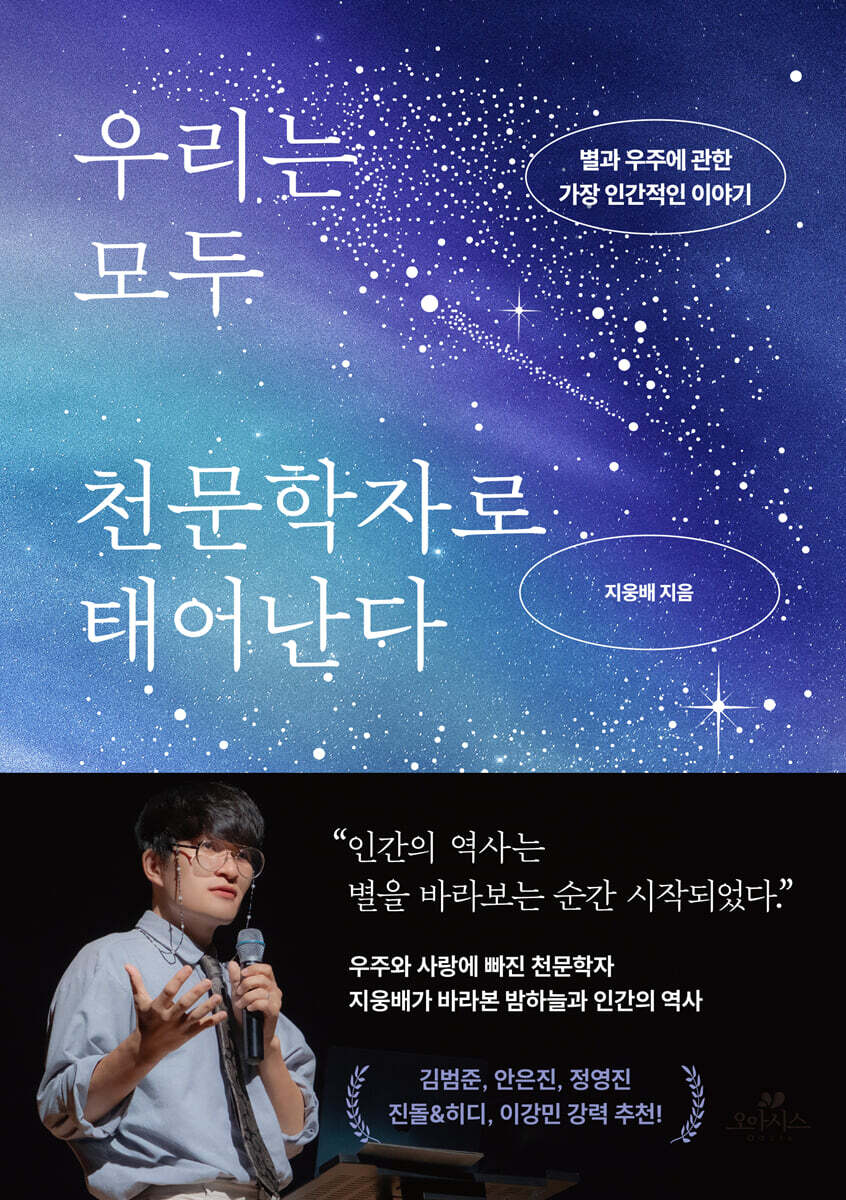
We are all born astronomers
 |
Description
Book Introduction
Strongly recommended by Kim Beom-jun, Ahn Eun-jin, Jeong Yeong-jin, Lee Kang-min, and Jindol & Hidi!
Stars, the Universe, and What the History of Observation Tells Us
“Looking at the stars is the most human thing you can do.”
When was the last time you looked up at the night sky? Yesterday? Last week? Last month? Or even a time in the past you can't even remember? We all live with the sky above us, yet at some point, we stopped looking up at it properly.
We are so focused on the achievements right in front of us, the tasks we need to get done today, and where we need to go right now that we don't even have time to look up and see the sky.
Here's the one and only astronomy book for you.
Author Ji Woong-bae, who is so in love with space that his shirts, glasses straps, and even his frequently used notebooks are filled with stars and planets, boldly says, “We are all born as astronomers” in an age when even looking at the night sky, let alone astronomy, is considered useless.
And from the latest astronomical issues where artificial intelligence has become another astronomer, to the history of paradigm shifts that cannot be left out when talking about astronomy, the discovery of light and gravitational waves, the debate over dark matter and dark energy, and the debate over terraforming Mars and extraterrestrial life, this book covers all the historical issues of astronomy in one volume, narrowing the distance between you and the universe.
According to the author, astronomy, unlike other sciences, has spatiotemporal limitations that make experiments impossible and require viewing the subject of study from a distance.
So the universe is a world that can only be known to the extent that it is visible, and its very existence humbles humans.
Why should we be interested in astronomy, which is of no immediate use? The author asks.
Humanity begins with being curious about useless things.
Perhaps the advantage humans gained from walking upright was that they could look up at the sky.
As you read the history of astronomy and the stories of those who struggled to unlock the secrets of the night sky, you too will want to look up at the sky tonight.
"I hope that through this book, everyone will quietly contemplate the beauty of astronomy." - Kim Beom-jun (Professor of Statistical Physics, Sungkyunkwan University)
“Like the universe, which is out of reach but always by your side, I hope this book will bring you a little closer to those distant stars.” - Ahn Eun-jin (actress)
"The only thing I trust is Professor Ji Woong-bae's sincere and kind demeanor, and his genuine gaze that seems to encapsulate the entire galaxy." - Jeong Yeong-jin (Jeong Pro, Host of [See Science])
“For those of us who have forgotten that we are astronomers, staring only at our smartphones, this book offers the romance of looking up at the night sky.” - Lee Kang-min (Editor-in-Chief of CBS [Lee Kang-min's Magazine])
"Reading this book, you'll feel as if you're participating in a special event, secretly hearing about the universe's untold secrets." - Jindol (webtoon artist, YouTuber)
“The more I read, the more strangely the universe, which had seemed so far away, seemed to get closer.” - Hidi (webtoon artist)
Stars, the Universe, and What the History of Observation Tells Us
“Looking at the stars is the most human thing you can do.”
When was the last time you looked up at the night sky? Yesterday? Last week? Last month? Or even a time in the past you can't even remember? We all live with the sky above us, yet at some point, we stopped looking up at it properly.
We are so focused on the achievements right in front of us, the tasks we need to get done today, and where we need to go right now that we don't even have time to look up and see the sky.
Here's the one and only astronomy book for you.
Author Ji Woong-bae, who is so in love with space that his shirts, glasses straps, and even his frequently used notebooks are filled with stars and planets, boldly says, “We are all born as astronomers” in an age when even looking at the night sky, let alone astronomy, is considered useless.
And from the latest astronomical issues where artificial intelligence has become another astronomer, to the history of paradigm shifts that cannot be left out when talking about astronomy, the discovery of light and gravitational waves, the debate over dark matter and dark energy, and the debate over terraforming Mars and extraterrestrial life, this book covers all the historical issues of astronomy in one volume, narrowing the distance between you and the universe.
According to the author, astronomy, unlike other sciences, has spatiotemporal limitations that make experiments impossible and require viewing the subject of study from a distance.
So the universe is a world that can only be known to the extent that it is visible, and its very existence humbles humans.
Why should we be interested in astronomy, which is of no immediate use? The author asks.
Humanity begins with being curious about useless things.
Perhaps the advantage humans gained from walking upright was that they could look up at the sky.
As you read the history of astronomy and the stories of those who struggled to unlock the secrets of the night sky, you too will want to look up at the sky tonight.
"I hope that through this book, everyone will quietly contemplate the beauty of astronomy." - Kim Beom-jun (Professor of Statistical Physics, Sungkyunkwan University)
“Like the universe, which is out of reach but always by your side, I hope this book will bring you a little closer to those distant stars.” - Ahn Eun-jin (actress)
"The only thing I trust is Professor Ji Woong-bae's sincere and kind demeanor, and his genuine gaze that seems to encapsulate the entire galaxy." - Jeong Yeong-jin (Jeong Pro, Host of [See Science])
“For those of us who have forgotten that we are astronomers, staring only at our smartphones, this book offers the romance of looking up at the night sky.” - Lee Kang-min (Editor-in-Chief of CBS [Lee Kang-min's Magazine])
"Reading this book, you'll feel as if you're participating in a special event, secretly hearing about the universe's untold secrets." - Jindol (webtoon artist, YouTuber)
“The more I read, the more strangely the universe, which had seemed so far away, seemed to get closer.” - Hidi (webtoon artist)
- You can preview some of the book's contents.
Preview
index
Recommendation
Prologue - Stargazing is the most human act.
Chapter 1.
Every story begins with counting stars.
An astronomer lives on the little prince's fourth planet.
Humanity is observing farther and farther.
Before the age of data, there were people who counted the stars.
Astronomers see the universe in perspective.
Under the sky, we are all born astronomers.
Artificial Intelligence: A New Astronomer Appears Among Us
The value of astronomy begins with human questions.
Chapter 2.
How Old Beliefs Collapsed
Do humans truly understand the universe?
Humans outside of cosmic narcissism
The moment the center of the universe flipped from Earth to the Sun
Will the expansion of the universe ever stop?
Another truth about the universe revealed by supernova
What will our future universe look like?
Chapter 3.
A message that flew through the darkness of light years
Why is the night sky, full of stars, dark?
Starlight tells the universe's past
Beyond the visible world
Telescopes, giant eyes looking into space
The perfect solution to Olbers' paradox has finally arrived.
Chapter 4.
How an apple explained the power of the universe
Three Apples That Changed Human History
The discovery of Neptune began with Newton.
The mystery of the force plaguing Mercury's orbit
Einstein finds answers to the questions posed by the solar system
Gravitational Lensing: A Cosmic Mirage That Bending Light
We can touch and feel the universe thanks to gravitational waves.
Chapter 5.
The invisible force that fills the empty space
People who couldn't imagine an empty universe
What could possibly be in the cracks of space?
The dark matter hidden in space
How Dark Matter Has Become a Conundrum for Astronomers
The Shadow of Aether Resurrected in the Darkness
We still don't know the universe
The endless quest to uncover the secrets of the universe
Chapter 6.
A story that goes beyond Earth
NASA's announcement that shook the nation
So, is there really life out there?
In search of traces of life remaining on the red planet
Why Humanity Hasn't Set Foot on Mars Yet
A special mission given to the Mars rover Perseverance
Should we find another Earth?
Epilogue - Astronomy Makes Us Humble
Photo and illustration sources
Prologue - Stargazing is the most human act.
Chapter 1.
Every story begins with counting stars.
An astronomer lives on the little prince's fourth planet.
Humanity is observing farther and farther.
Before the age of data, there were people who counted the stars.
Astronomers see the universe in perspective.
Under the sky, we are all born astronomers.
Artificial Intelligence: A New Astronomer Appears Among Us
The value of astronomy begins with human questions.
Chapter 2.
How Old Beliefs Collapsed
Do humans truly understand the universe?
Humans outside of cosmic narcissism
The moment the center of the universe flipped from Earth to the Sun
Will the expansion of the universe ever stop?
Another truth about the universe revealed by supernova
What will our future universe look like?
Chapter 3.
A message that flew through the darkness of light years
Why is the night sky, full of stars, dark?
Starlight tells the universe's past
Beyond the visible world
Telescopes, giant eyes looking into space
The perfect solution to Olbers' paradox has finally arrived.
Chapter 4.
How an apple explained the power of the universe
Three Apples That Changed Human History
The discovery of Neptune began with Newton.
The mystery of the force plaguing Mercury's orbit
Einstein finds answers to the questions posed by the solar system
Gravitational Lensing: A Cosmic Mirage That Bending Light
We can touch and feel the universe thanks to gravitational waves.
Chapter 5.
The invisible force that fills the empty space
People who couldn't imagine an empty universe
What could possibly be in the cracks of space?
The dark matter hidden in space
How Dark Matter Has Become a Conundrum for Astronomers
The Shadow of Aether Resurrected in the Darkness
We still don't know the universe
The endless quest to uncover the secrets of the universe
Chapter 6.
A story that goes beyond Earth
NASA's announcement that shook the nation
So, is there really life out there?
In search of traces of life remaining on the red planet
Why Humanity Hasn't Set Foot on Mars Yet
A special mission given to the Mars rover Perseverance
Should we find another Earth?
Epilogue - Astronomy Makes Us Humble
Photo and illustration sources
Detailed image

Into the book
I believe that the ability to see the stars is the most special gift that upright walking has given us.
Thanks to this, unlike other four-legged animals, we have become beings who can comfortably look up at the sky by just raising our heads a little.
Thanks to this, we have become beings who know the universe, are curious about the universe, and feel lonely in the vast universe.
And in this universe, I became the only beautiful being who knew how to look at stars and enjoy it.
--- p.12 "Prologue: Stargazing is the most human act."
Although stars and galaxies are far away, the light from them that we have counted so far is in the hundreds of billions.
It has been a long time since human touch began to gradually disappear from the observatory.
Every night, all over the globe, diligent businessmen at automated observatories count the stars.
But even if artificial intelligence one day completely replaces human astronomers, the day will never come when humans stop looking at the sky.
And we will pass on what we have seen to future generations.
I became the little prince who told the story of a businessman.
--- p.61 「Chapter 1.
"All stories begin with counting stars."
It wasn't because scientists of the past were stupid that they came up with ridiculous theories.
It's just that the universe really did look that way to them.
The grand framework of the Big Bang cosmology that we firmly believe in today may one day be replaced by a completely different paradigm.
In the distant future, say, in the 30th century, our distant descendants may laugh at us for once insisting on the Big Bang theory, adding a crude correction called dark energy.
And they may be living in a completely different universe, telling the story of the birth and evolution of the universe in a completely different way that we cannot even dare to imagine today.
It's coming.
--- p.109 「Chapter 2.
How Old Beliefs Collapsed
This is why the stars in the night sky appear to twinkle when viewed with the naked eye.
In fact, starlight originally does not shake.
If we looked at a star from the Moon, which has no atmosphere, the star would appear as a perfect, unwavering little dot.
The reason stars appear to twinkle is purely due to the Earth's atmosphere.
As poet Yun Dong-ju said, it is because the starlight is blown by the wind.
In astronomical observation, the extent to which starlight appears to spread out like this is called seeing.
Spitzer believed that if he could go into space and look directly at starlight without the obstruction of Earth's atmosphere, he could obtain an overwhelming view that could not be replicated by ground-based telescopes.
--- p.137 「Chapter 3.
A message that flew through the darkness of light years
I believe that scientific advancements can significantly change our perspectives beyond the realm of science, in fields as diverse as music and literature.
Before we learned about the existence of gravitational waves, the expression “seeing gravity” would have been an extremely synesthetic and literary expression.
You might have thought that gravity wasn't originally a visual sensation.
But now we live in a world where we can actually see gravity.
The expression 'seeing gravity' is no longer a literary expression.
It is a scientific expression that expresses the reality of the universe as it is.
Now we see gravity.
I say this as an astronomer, not a poet.
--- p.200 Chapter 4.
How did the apple explain the power of the universe?
Dark matter allows the matter of the universe to be kneaded more efficiently, quickly, and stably.
The clump of dark matter that gathered in the primordial universe served as the seed of galaxies, the condensation nucleus of galaxies.
If there were no dark matter, the universe might never have formed any of these large and beautiful galaxies.
Because there would still be no place where baryons were densely packed and kneaded together.
The age of the universe, 13.8 billion years, may seem like an incredibly long time to us, but interestingly, thanks to dark matter, the universe has formed its current beautiful, massive structure in 'only' 13.8 billion years.
It was possible to complete it.
--- p.249 「Chapter 5.
"The invisible force that fills the empty space"
It is right to solve problems that occur on Earth within the Earth itself, if possible.
Abandoning Earth and dreaming of a new beginning somewhere else is a lazy and expensive alternative.
When we talk about Mars these days, we don't mean Earth.
There is a tendency to perceive Mars as a hopeful utopia where we can escape all the problems of Earth and start anew.
But Mars doesn't solve our fundamental problems.
The dream of going to Mars merely postpones the mistakes and resulting tragedies of our present reality for a future that will not arrive immediately.
--- p.318 「Chapter 6.
A story that goes beyond Earth
There is a very cool philosophical concept that runs through modern astronomy.
This is the concept of 'cosmological awareness', which refers to an attitude of living always aware that everything seen is influenced by everything unseen, and everything known is connected to everything yet unknown.
Only by becoming accustomed to this attitude can we fully accept and feel the universe.
Astronomy humbles us, and at the same time, only when we are humble can we truly enjoy astronomy.
The heart to admit what you don't know, not what you know.
The desire to show how much one does not know, even by underestimating what one knows.
That feeling made me an astronomer.
Thanks to this, unlike other four-legged animals, we have become beings who can comfortably look up at the sky by just raising our heads a little.
Thanks to this, we have become beings who know the universe, are curious about the universe, and feel lonely in the vast universe.
And in this universe, I became the only beautiful being who knew how to look at stars and enjoy it.
--- p.12 "Prologue: Stargazing is the most human act."
Although stars and galaxies are far away, the light from them that we have counted so far is in the hundreds of billions.
It has been a long time since human touch began to gradually disappear from the observatory.
Every night, all over the globe, diligent businessmen at automated observatories count the stars.
But even if artificial intelligence one day completely replaces human astronomers, the day will never come when humans stop looking at the sky.
And we will pass on what we have seen to future generations.
I became the little prince who told the story of a businessman.
--- p.61 「Chapter 1.
"All stories begin with counting stars."
It wasn't because scientists of the past were stupid that they came up with ridiculous theories.
It's just that the universe really did look that way to them.
The grand framework of the Big Bang cosmology that we firmly believe in today may one day be replaced by a completely different paradigm.
In the distant future, say, in the 30th century, our distant descendants may laugh at us for once insisting on the Big Bang theory, adding a crude correction called dark energy.
And they may be living in a completely different universe, telling the story of the birth and evolution of the universe in a completely different way that we cannot even dare to imagine today.
It's coming.
--- p.109 「Chapter 2.
How Old Beliefs Collapsed
This is why the stars in the night sky appear to twinkle when viewed with the naked eye.
In fact, starlight originally does not shake.
If we looked at a star from the Moon, which has no atmosphere, the star would appear as a perfect, unwavering little dot.
The reason stars appear to twinkle is purely due to the Earth's atmosphere.
As poet Yun Dong-ju said, it is because the starlight is blown by the wind.
In astronomical observation, the extent to which starlight appears to spread out like this is called seeing.
Spitzer believed that if he could go into space and look directly at starlight without the obstruction of Earth's atmosphere, he could obtain an overwhelming view that could not be replicated by ground-based telescopes.
--- p.137 「Chapter 3.
A message that flew through the darkness of light years
I believe that scientific advancements can significantly change our perspectives beyond the realm of science, in fields as diverse as music and literature.
Before we learned about the existence of gravitational waves, the expression “seeing gravity” would have been an extremely synesthetic and literary expression.
You might have thought that gravity wasn't originally a visual sensation.
But now we live in a world where we can actually see gravity.
The expression 'seeing gravity' is no longer a literary expression.
It is a scientific expression that expresses the reality of the universe as it is.
Now we see gravity.
I say this as an astronomer, not a poet.
--- p.200 Chapter 4.
How did the apple explain the power of the universe?
Dark matter allows the matter of the universe to be kneaded more efficiently, quickly, and stably.
The clump of dark matter that gathered in the primordial universe served as the seed of galaxies, the condensation nucleus of galaxies.
If there were no dark matter, the universe might never have formed any of these large and beautiful galaxies.
Because there would still be no place where baryons were densely packed and kneaded together.
The age of the universe, 13.8 billion years, may seem like an incredibly long time to us, but interestingly, thanks to dark matter, the universe has formed its current beautiful, massive structure in 'only' 13.8 billion years.
It was possible to complete it.
--- p.249 「Chapter 5.
"The invisible force that fills the empty space"
It is right to solve problems that occur on Earth within the Earth itself, if possible.
Abandoning Earth and dreaming of a new beginning somewhere else is a lazy and expensive alternative.
When we talk about Mars these days, we don't mean Earth.
There is a tendency to perceive Mars as a hopeful utopia where we can escape all the problems of Earth and start anew.
But Mars doesn't solve our fundamental problems.
The dream of going to Mars merely postpones the mistakes and resulting tragedies of our present reality for a future that will not arrive immediately.
--- p.318 「Chapter 6.
A story that goes beyond Earth
There is a very cool philosophical concept that runs through modern astronomy.
This is the concept of 'cosmological awareness', which refers to an attitude of living always aware that everything seen is influenced by everything unseen, and everything known is connected to everything yet unknown.
Only by becoming accustomed to this attitude can we fully accept and feel the universe.
Astronomy humbles us, and at the same time, only when we are humble can we truly enjoy astronomy.
The heart to admit what you don't know, not what you know.
The desire to show how much one does not know, even by underestimating what one knows.
That feeling made me an astronomer.
--- p.323 "Epilogue: Astronomy Makes Us Humble"
Publisher's Review
"Space Dust's Sage Times" has 260,000 subscribers and 40 million cumulative views.
The story of astronomy told by Ji Woong-bae, an astronomer in love with space.
“Human history began the moment we looked up at the stars.”
In The Little Prince, there is a businessman who tirelessly counts the stars in the night sky.
The little prince meets him on the fourth planet, and he sits at his desk all day, counting the stars and recording their number in a ledger.
This 'star-counting businessman' is often seen as a character meant to criticize foolish capitalism, blinded by money.
But, would you believe that this person is an astronomer?
Human history began with upright walking.
We learn that humans began to walk upright, freeing up both hands to use tools, and that was the beginning of human history.
But from an astronomer's perspective, upright walking looks a little different.
As humans began to stand on two feet, they were able to raise their heads and look up at the sky.
It was only through upright walking that we were able to perceive the universe.
Perhaps the act of looking up at the night sky is an innate human trait and the beginning of a long history of exploration.
This is because humans have long looked up to the sky to know when fruits will ripen and fall, when wild beasts will come, and when rivers will overflow.
Astronomy was born from the curiosity and inquisitiveness to understand the world, and even now, when artificial intelligence and computers have taken over the role of astronomers, we can all see the nature of an astronomer within us.
Astronomy seems useless
Why we need it in our lives
Why do humans look up at the night sky? What secrets does the dark night sky hold? "We Are All Born Astronomers" begins with this age-old question.
For thousands of years, humans have been counting stars and recording the movements of the sky to understand themselves.
From the debate between geocentrism and heliocentrism, to the physics of Newton and Einstein, to gravitational waves and dark matter, and even the latest in astronomy involving artificial intelligence, the history of astronomy is closely linked to the history of humanity, which has always wondered about the night sky.
Observing the movements of stars and planets was an activity more closely related to survival than any other activity.
In this way, astronomy has been the most human science since the beginning.
Even now, when artificial intelligence is taking over human roles, the task of telling the stories of the stars remains human.
Ji Woong-bae, an 'astronomer in love with space', is also a science creator who runs 'Space Dust's Sage Times', which has 260,000 subscribers and 40 million cumulative views, and is working hard to spread the word about space to the public.
In this book, the author talks about the universe across starlight, data, science, and humanities.
The author says that the act of looking at the sky is not just a simple scientific inquiry, but a fundamental act that makes humans human.
The simple act of looking up at the night sky and counting stars has evolved into full-scale space exploration as astronomy has advanced, developing into a technology that allows us to observe the universe thousands of light-years beyond our reach.
This book contains historical moments that transformed the paradigm of astronomy, from the stories of female astronomers counting stars on glass plates to today's "artificial intelligence astronomy" that analyzes tens of exabytes of data.
Meanwhile, it also contains the secrets of the universe and the limitations of astronomy that have yet to be discovered.
Humanity is a fleeting existence compared to the time of the universe, and even the universe as we know it may not be true.
However, the author says that astronomy is the discipline that makes people humble.
The mind of an astronomer is one that acknowledges what one does not know, rather than what one knows.
“We are all born astronomers.”
What we get when we look up at the night sky
The author says:
“Astronomy is a useless discipline.” Astronomy, which has no impact on real life, cannot conduct experiments on objects of study, and requires observing objects that are far beyond our reach, feels useless and, at times, too distant from our daily lives.
But without astronomy, we wouldn't be able to predict the weather, know when fruit will ripen, or divine romance from the constellations.
Humanity always comes from useless acts like this.
And looking up at the night sky right now is something you can do even if you are not Einstein, Newton, or Galileo.
Astronomy can make us realize our own helplessness, but the author warns us not to despair easily.
It is our instinct to understand the universe and our unwavering questioning that has protected humanity until now.
As long as we wonder about space, humanity will not disappear.
And astronomy will continue to whisper to us countless secrets of the universe.
The sky still stretches wide above our heads.
After you close the bookcase, you will find yourself looking up at the sky.
And you will realize.
The fact that under the sky we are all born as astronomers.
The story of astronomy told by Ji Woong-bae, an astronomer in love with space.
“Human history began the moment we looked up at the stars.”
In The Little Prince, there is a businessman who tirelessly counts the stars in the night sky.
The little prince meets him on the fourth planet, and he sits at his desk all day, counting the stars and recording their number in a ledger.
This 'star-counting businessman' is often seen as a character meant to criticize foolish capitalism, blinded by money.
But, would you believe that this person is an astronomer?
Human history began with upright walking.
We learn that humans began to walk upright, freeing up both hands to use tools, and that was the beginning of human history.
But from an astronomer's perspective, upright walking looks a little different.
As humans began to stand on two feet, they were able to raise their heads and look up at the sky.
It was only through upright walking that we were able to perceive the universe.
Perhaps the act of looking up at the night sky is an innate human trait and the beginning of a long history of exploration.
This is because humans have long looked up to the sky to know when fruits will ripen and fall, when wild beasts will come, and when rivers will overflow.
Astronomy was born from the curiosity and inquisitiveness to understand the world, and even now, when artificial intelligence and computers have taken over the role of astronomers, we can all see the nature of an astronomer within us.
Astronomy seems useless
Why we need it in our lives
Why do humans look up at the night sky? What secrets does the dark night sky hold? "We Are All Born Astronomers" begins with this age-old question.
For thousands of years, humans have been counting stars and recording the movements of the sky to understand themselves.
From the debate between geocentrism and heliocentrism, to the physics of Newton and Einstein, to gravitational waves and dark matter, and even the latest in astronomy involving artificial intelligence, the history of astronomy is closely linked to the history of humanity, which has always wondered about the night sky.
Observing the movements of stars and planets was an activity more closely related to survival than any other activity.
In this way, astronomy has been the most human science since the beginning.
Even now, when artificial intelligence is taking over human roles, the task of telling the stories of the stars remains human.
Ji Woong-bae, an 'astronomer in love with space', is also a science creator who runs 'Space Dust's Sage Times', which has 260,000 subscribers and 40 million cumulative views, and is working hard to spread the word about space to the public.
In this book, the author talks about the universe across starlight, data, science, and humanities.
The author says that the act of looking at the sky is not just a simple scientific inquiry, but a fundamental act that makes humans human.
The simple act of looking up at the night sky and counting stars has evolved into full-scale space exploration as astronomy has advanced, developing into a technology that allows us to observe the universe thousands of light-years beyond our reach.
This book contains historical moments that transformed the paradigm of astronomy, from the stories of female astronomers counting stars on glass plates to today's "artificial intelligence astronomy" that analyzes tens of exabytes of data.
Meanwhile, it also contains the secrets of the universe and the limitations of astronomy that have yet to be discovered.
Humanity is a fleeting existence compared to the time of the universe, and even the universe as we know it may not be true.
However, the author says that astronomy is the discipline that makes people humble.
The mind of an astronomer is one that acknowledges what one does not know, rather than what one knows.
“We are all born astronomers.”
What we get when we look up at the night sky
The author says:
“Astronomy is a useless discipline.” Astronomy, which has no impact on real life, cannot conduct experiments on objects of study, and requires observing objects that are far beyond our reach, feels useless and, at times, too distant from our daily lives.
But without astronomy, we wouldn't be able to predict the weather, know when fruit will ripen, or divine romance from the constellations.
Humanity always comes from useless acts like this.
And looking up at the night sky right now is something you can do even if you are not Einstein, Newton, or Galileo.
Astronomy can make us realize our own helplessness, but the author warns us not to despair easily.
It is our instinct to understand the universe and our unwavering questioning that has protected humanity until now.
As long as we wonder about space, humanity will not disappear.
And astronomy will continue to whisper to us countless secrets of the universe.
The sky still stretches wide above our heads.
After you close the bookcase, you will find yourself looking up at the sky.
And you will realize.
The fact that under the sky we are all born as astronomers.
GOODS SPECIFICS
- Date of issue: October 31, 2025
- Page count, weight, size: 328 pages | 460g | 148*210*21mm
- ISBN13: 9791168273689
- ISBN10: 1168273684
You may also like
카테고리
korean


korean

![GQ KOREA Mark (Monthly): December [2025]](http://librairie.coreenne.fr/cdn/shop/files/8ef265dbbfbf186523ed75ba7319009d.jpg?v=1765340328&width=3840)


