

Park Wan-seo began writing at the age of forty.
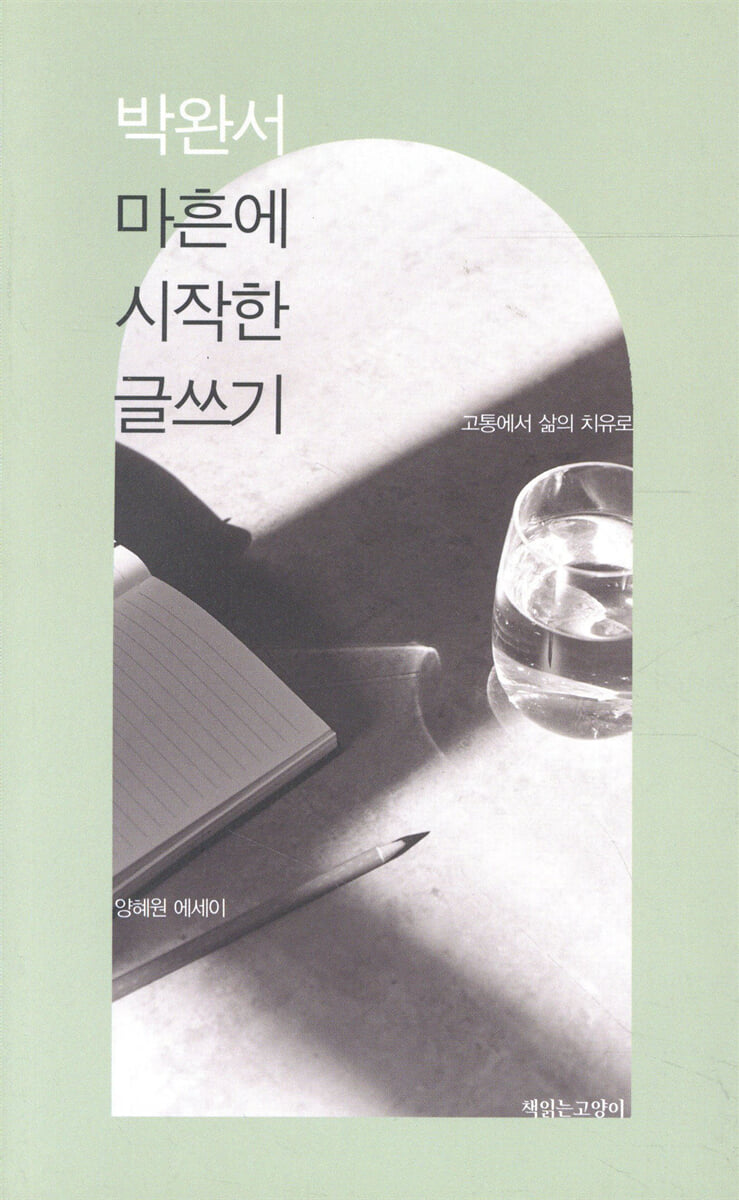 |
Description
Book Introduction
Park Wan-seo, a female writer who debuted in her forties after living as a housewife!
What did writing mean to Park Wan-seo?
"Park Wan-seo's Writing at Forty" is a story about Park Wan-seo, researched by feminist scholar Yang Hye-won. It conveys the meaning of writing to Park Wan-seo through her works, and leads us, each struggling with our own wounds, to healing.
The author offers empathetic research within the five keywords that permeate Park Wan-seo's novels—"equality and love," "sex and pregnancy," "trauma," "pain," and "independence"—providing comfort and strength to those in their forties, experiencing a mix of anxiety and hope.
What did writing mean to Park Wan-seo, who started her career as a housewife in her forties?
In the early days, she called it “a completely selfish job for me,” as she was afraid of being seen as a wife or mother with personal desires other than taking care of her family, but in a 1996 interview, she said, “It’s hard to do it as a hobby.”
For Park Wan-seo, writing was both a painful act of surrendering one's whole being and abandoning oneself, and a selfish tool for approaching one's complete self.
Just as Park Wan-seo, who devoted herself to writing to achieve complete independence in the latter half of her life, the story of Park Wan-seo, who changed her life in her forties, serves as a beacon for us as we contemplate what tools we should choose to live a life that is truly our own.
- You can preview some of the book's contents.
Preview
index
prolog
An Apology for the Book
1.
Park Wan-seo's Forty
Start writing
There was a trigger, I started, and I saw it through to the end.
Respect for yourself
2.
Equality and Love
Becoming an individual
A middle-aged housewife as a living woman
The standard of one's own heart
3.
Sex and Pregnancy
daughter and son
elective son birth
What is sex for?
The right to be a mother
4.
trauma
An ear to listen to trauma
Words that no one understood
Reject the easy answer
5.
pain
The pain that even God is silent about
You have to find the reason yourself and be convinced.
Back to the place of the living
His empty seat
6.
independence
emotional independence
Standing in the “gap”
Standing alone
One person's share
Epilogue
The writing continues
List of cited works and books
Publisher's Review
Equality and Love
Why is a husband jealous of his wife's work?
In the author's note in "Standing Woman," Park Wan-seo says she wanted to address the question, "What punishment will our customs impose on a woman when her wife's straying is her 'business' and not that of another man, and how will the husband deal with this newly emerged rival?"
It's truly Park Wan-seo's style to express the problem of balancing work and family life in such a novel way.
Nowadays, even men want working wives, so a wife's work is no longer a rival to her husband.
However, seeing that it is rare to find a husband who does as much housework as his working wife, it seems that husbands still view their wives' work as rivals.
Even when it is difficult to make a living without their wives working, when I see husbands who do not lift a finger at home, I think the husbands' jealousy towards their rivals, the 'own work' that their wives are slacking off from, must be quite intense.
So, even today, we live as “unattractive women who bring up the issue of gender equality in conversations between couples,” like Yeonji in “Standing Woman” (1985).
Yeonji's lack of charm is still attractive and valid to us.
Sex and Pregnancy
What was denied was the 'right to be a mother'
Park Wan-seo gave birth to four daughters and finally a son.
In a time when people should have fewer children, it seems that they felt the gaze of those who thought they had so many children just to have a son.
Perhaps that is why he was particularly sensitive to sex-selective abortion.
[The Sea Bucket] (1985), [The Dreaming Incubator] (1993), and 『A Very Old Joke』 (2000) contain stories of women who use or are forced to use the 'new technology' of selective son-bearing for their own gain.
Nowadays, there is no need to make a distinction between sons and daughters, but there was a time when it was possible to legally confirm the gender of the fetus and have a son.
We often think of sex as an impulsive, instinctive act, but in fact, sex is a very calculated act.
Especially when you consider the possibility of pregnancy.
The woman in 'That Man's House' couldn't have sex with the person she wanted to have sex with, but had sex with the person she didn't mind getting pregnant with.
Fortunately, women of the next generation after the woman in the novel don't have to do that.
Because I know how to use contraception.
In recent years, the abolition of abortion laws and abortion rights have emerged as important issues in the women's community, but reading Park Wan-seo's novels makes me wonder whether we really had the right to be mothers before the right to abortion.
The Republic of Korea reflected in Park Wan-seo's novel was not a country that denied abortion to women.
Rather, what women were denied was the right to become mothers.
So, Park Wan-seo supports women's right to be mothers, regardless of whether the child in their womb is a boy or a girl, rich or poor, or whether they have a husband or not—see [Are You Still Dreaming] (1989) for this story.
These days, when we give up on having children because we don't want to pass on our poor past, what we're really being deprived of may not be the right to abortion, but the right to be a mother.
Trauma: Seeking a Listening Ear
The moment healing begins
Trauma forces us to replay memories endlessly, against our will.
So I'm always looking for an ear to listen to my story.
In her 1992 publication, Park Wan-seo stated in her book, “Park Wan-seo Literature Album,” that the reason she became a novelist was ultimately due to the trauma of her war experience.
At first, it was a struggle to escape the ghost of her older brother who died in the war, but later, this war experience became a memory that haunted her and she could not shake it off, and it dominated her writing.
Park Wan-seo, who had written so much in search of ears to listen, was forced to face loneliness in her later years because of the nature of trauma that rejects easy answers.
Trauma, which makes it impossible to compare who suffered more horribly, always trivializes the trauma of others, and thus our traumas lose their way to meet each other.
Trauma always teaches us that it is a task that we must solve on our own.
Park Wan-seo, who began writing due to trauma, put down her pen for about a year.
The extreme suffering he described as “a death sentence with no hope of salvation” was the loss of his 25-year-old son in an accident.
The suffering that even God remained silent about was long.
The short story collection, "My Most Dirty Thing," published in 1993, has one narrator and is a monologue from beginning to end.
Besides, that monologue is a monologue spoken over the phone.
A monologue that cannot find sympathy or answers shows the greatest loneliness in suffering.
Pain has a strange nature. On the one hand, I want someone to understand it, but on the other hand, I despair that no one can understand my pain.
But in the final scene, the use of others is revealed in an unexpected way.
A sob heard in the silence as thick as a cliff! The moment we realize someone is crying with us, our pain finally turns into healing.
When it comes to the weight of trauma and pain, it's always your own that's the biggest.
However, Park Wan-seo's experiences and solutions give us strength by giving us a calm resonance as we find the exit.
A middle-aged housewife as a living woman
Park Wan-seo's writing is in progress
It would be difficult to expect a sweet love story from a writer who debuted in his forties.
But for Park Wan-seo, it was rather a strength.
At a time when no one paid attention to middle-aged housewives, they were given individuality and voices, making them into living women.
It speaks of the true independence of a woman who has broken free from the system, not only in having her own job, but also in love.
Considering that Park Wan-seo was born in 1931, the equality and love expressed by the author, as well as the right of women to be mothers, are refreshing and even groundbreaking.
Moreover, the trauma and loneliness experienced by a family who could not escape the modern history of the Korean Peninsula, which was war, the extreme pain that a mother had to bear after sending her child away, and the loneliness of a middle-aged woman are the thoughts of an individual, but at the same time, they are social experiences that we all share, so Park Wan-seo's writing is still ongoing and serves as a lighthouse in our lives.
The author started out as a reader and became a researcher of Park Wan-seo, but he hoped to portray Park Wan-seo as someone who could reach the general reader rather than as a subject of academic research, so that she would always live on with us.
Just like Park Wan-seo, who believed in the power of stories and hoped that her stories would have various effects and comfort and make readers laugh.
Researchers and novelists always dig up things that are more painful if they know about them.
But the author says that the reason why the effort cannot be stopped is because it is the only way for humans, who exist as separate bodies, to connect with each other.
Park Wan-seo's suffering, fully captured in "Park Wan-seo's Writing at Forty," meets the suffering of us all, and we are comforted by this connection and gradually move toward healing.
GOODS SPECIFICS
- Publication date: March 11, 2022
- Page count, weight, size: 176 pages | 174g | 112*184*12mm
- ISBN13: 9791186274910
- ISBN10: 1186274913
You may also like
카테고리
korean


korean


