

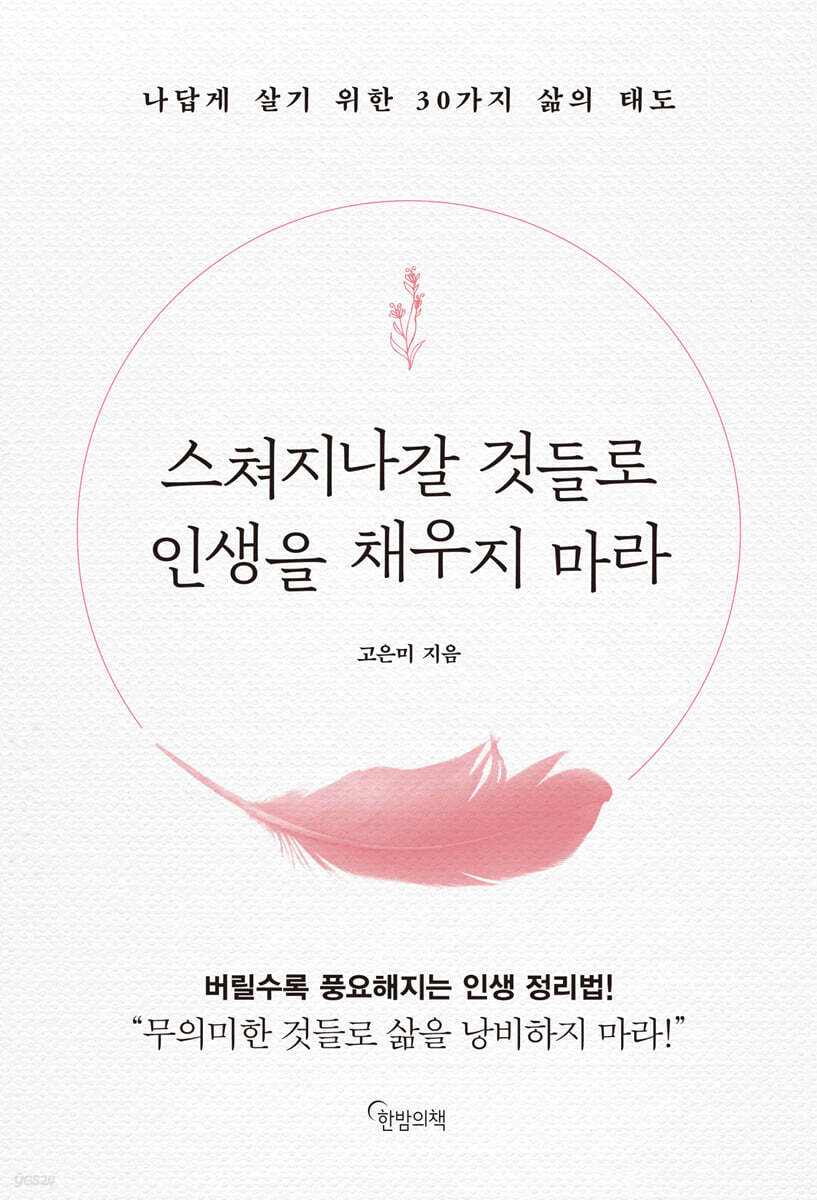
Don't fill your life with things that will pass you by.
 |
Description
Book Introduction
99% of the worries are
If you leave it alone, it will just disappear!
The author of this book, Eunmi Ko, is a health psychologist who studies various stresses in everyday life, and is particularly an expert in physical and mental pain.
The author speaks bluntly.
The reason why our body and mind become sick and tired is because of the 'habit of holding on to unnecessary things and not letting go.'
We pass by hundreds of people every day.
But how many of them are memorable? Probably less than ten.
The reason we don't remember the faces of every person we meet isn't because we have a bad memory, but because 'there's no need to.'
Life is the same.
Big or small, dozens of problems plague us every day.
But 99% of them will go away in a day if left alone, and less than 1% of the problems will last more than a year.
Let's practice letting go of the problems that come to you.
It is not that we are incapable of dealing with those problems, but rather that there is no reason to do so.
Life becomes much more enjoyable if you just save the energy you waste on useless worries.
This book contains 30 psychological laws to help us lightly dismiss the troubles that come our way.
Instead of filling the basket of life with worries that are like chaff that will blow away at the slightest breeze, let's fill it with only solid fruits that will enrich our bodies and minds.
That alone will make your life a little richer.
If you leave it alone, it will just disappear!
The author of this book, Eunmi Ko, is a health psychologist who studies various stresses in everyday life, and is particularly an expert in physical and mental pain.
The author speaks bluntly.
The reason why our body and mind become sick and tired is because of the 'habit of holding on to unnecessary things and not letting go.'
We pass by hundreds of people every day.
But how many of them are memorable? Probably less than ten.
The reason we don't remember the faces of every person we meet isn't because we have a bad memory, but because 'there's no need to.'
Life is the same.
Big or small, dozens of problems plague us every day.
But 99% of them will go away in a day if left alone, and less than 1% of the problems will last more than a year.
Let's practice letting go of the problems that come to you.
It is not that we are incapable of dealing with those problems, but rather that there is no reason to do so.
Life becomes much more enjoyable if you just save the energy you waste on useless worries.
This book contains 30 psychological laws to help us lightly dismiss the troubles that come our way.
Instead of filling the basket of life with worries that are like chaff that will blow away at the slightest breeze, let's fill it with only solid fruits that will enrich our bodies and minds.
That alone will make your life a little richer.
- You can preview some of the book's contents.
Preview
index
Preface - Life is enriched when you subtract rather than add.
Chapter 1.
Don't bother me by worrying about what other people think.
Are there differences between "wanting" and "liking"? | Acting thoughtlessly only leads to bad habits? | Answering rude questions is a waste of time? | Enjoying the process will lead to results? | A rigid mind is easily broken? | Failure is not the end, but the beginning.
Chapter 2.
Don't waste your life on meaningless relationships.
Do small actions create precious relationships? | Forget grudges quickly and remember kindness for a long time? | If you want to clear up a misunderstanding, take a step back? | If you want to be treated well, treat others first? | Delete unnecessary contact information immediately? | All relationships require a safe distance.
Chapter 3.
Don't sweat over things that haven't happened.
Do your worries disappear just by breathing properly? | Do you think that trying to do well actually ruins things? | Start quickly and progress slowly? | If you try to do everything at once, you'll end up with nothing? | Don't misunderstand and get angry alone? | If something can't be helped, leave it alone and it will be resolved.
Chapter 4.
Don't put off today's happiness until tomorrow.
Are the obvious things the most precious? | Regret breeds frustration, while reflection breeds hope? | To go far, you must rest while you go? | The first person you should consider is yourself? | Do the things you don't want to do first. | Life becomes easier when you create a manual.
Chapter 5.
Don't fill your life with things you should throw away.
Is life too short to live only happily? | If you want to fill it, you must first let go? | If you want to organize your life, start by organizing your room? | The busier you are, the more you need to take care of yourself first? | The things I keep close to me shape me? | The size of my confidence determines the size of my future.
Chapter 1.
Don't bother me by worrying about what other people think.
Are there differences between "wanting" and "liking"? | Acting thoughtlessly only leads to bad habits? | Answering rude questions is a waste of time? | Enjoying the process will lead to results? | A rigid mind is easily broken? | Failure is not the end, but the beginning.
Chapter 2.
Don't waste your life on meaningless relationships.
Do small actions create precious relationships? | Forget grudges quickly and remember kindness for a long time? | If you want to clear up a misunderstanding, take a step back? | If you want to be treated well, treat others first? | Delete unnecessary contact information immediately? | All relationships require a safe distance.
Chapter 3.
Don't sweat over things that haven't happened.
Do your worries disappear just by breathing properly? | Do you think that trying to do well actually ruins things? | Start quickly and progress slowly? | If you try to do everything at once, you'll end up with nothing? | Don't misunderstand and get angry alone? | If something can't be helped, leave it alone and it will be resolved.
Chapter 4.
Don't put off today's happiness until tomorrow.
Are the obvious things the most precious? | Regret breeds frustration, while reflection breeds hope? | To go far, you must rest while you go? | The first person you should consider is yourself? | Do the things you don't want to do first. | Life becomes easier when you create a manual.
Chapter 5.
Don't fill your life with things you should throw away.
Is life too short to live only happily? | If you want to fill it, you must first let go? | If you want to organize your life, start by organizing your room? | The busier you are, the more you need to take care of yourself first? | The things I keep close to me shape me? | The size of my confidence determines the size of my future.
Detailed image

Into the book
Has living a life dictated by others ever truly brought me joy? No, not at all.
A life of catch-up like that cannot bring me the deep satisfaction that truly fills my heart.
I'm just wavering between the anxiety of falling behind and the relief that at least I'm not falling behind.
--- p.8
A person who wants something constantly thinks about the object of his desire.
But this is just an illusion.
What he truly wants is not the object of desire itself, but 'me who has it'.
These people constantly compare themselves to their future selves who have it and their current selves who don't have it.
And I want to escape from the 'me that I can't have'.
--- p.19
In the future, when you are asked a rude question, try to ask the other person what their intentions are.
It is a request for an explanation as to why such a question is being asked.
This has the effect of maintaining control and protecting myself in my relationship with the other person.
Not only that, but you can also calmly remind the other person that you are offended, even if they haven't yet noticed your rudeness.
Without getting emotionally excited.
--- p.
38
Rather, let's keep some distance from the person we like.
Just as you need to maintain an appropriate distance from the car in front to ensure smooth traffic flow on the road, you need to maintain an appropriate distance from others to maintain smooth human relationships.
If you stand too far apart, you won't be able to communicate at all, but if you stand too close, a momentary mistake could lead to an accident.
It is because of these little mistakes that relationships fall apart.
--- p.102
Set big goals, but break down the steps to reach them into smaller ones.
Instead of thinking about achieving everything at once, focus on what you can do right now.
Only then can we move forward even one step further.
Just as it is difficult to break a bunch of dozens of wooden chopsticks, it is easy to break a single wooden chopstick.
--- p.133
There is a set amount of daily focus available to a person.
If you start using your focus on other things rather than on important tasks, your brain will be tired by the time you start doing important tasks.
It's like if you only have enough fuel to go from Seoul to Bundang, but you stop by Incheon and Suwon, you won't be able to get to Bundang.
Even concentration is not something that can be filled with money.
--- p.192
All this time, I just kept accumulating whatever I had.
My heart was the same.
I just kept all the various emotions that came from work and interpersonal relationships, such as burden, sense of duty, resistance, fear, and anger, piling up here and there in my heart.
I feel like I have to accept it.
But in retrospect, it wasn't like that.
Just as I could reject or throw away things I didn't need, I could also reject or throw away emotions I didn't need.
--- p.223
The reason I feel like the busier I am, the better, is because I don't know what makes me me.
It means that you don't really know what's important.
Then there will be no standards and you will just end up doing this and that.
Then, it ends in a vague manner, with nothing gained and just exhaustion.
That won't do.
Maintaining the right ratio of beginning and end allows life to breathe comfortably.
--- p.230
Courage is not the absence of fear, but the ability to do something even when your legs tremble with fear.
It's always scary to step outside the safety of your fence.
Everyone is like that.
But when we muster the courage to break the chains and take even one step forward, we gain that much freedom and growth.
A life of catch-up like that cannot bring me the deep satisfaction that truly fills my heart.
I'm just wavering between the anxiety of falling behind and the relief that at least I'm not falling behind.
--- p.8
A person who wants something constantly thinks about the object of his desire.
But this is just an illusion.
What he truly wants is not the object of desire itself, but 'me who has it'.
These people constantly compare themselves to their future selves who have it and their current selves who don't have it.
And I want to escape from the 'me that I can't have'.
--- p.19
In the future, when you are asked a rude question, try to ask the other person what their intentions are.
It is a request for an explanation as to why such a question is being asked.
This has the effect of maintaining control and protecting myself in my relationship with the other person.
Not only that, but you can also calmly remind the other person that you are offended, even if they haven't yet noticed your rudeness.
Without getting emotionally excited.
--- p.
38
Rather, let's keep some distance from the person we like.
Just as you need to maintain an appropriate distance from the car in front to ensure smooth traffic flow on the road, you need to maintain an appropriate distance from others to maintain smooth human relationships.
If you stand too far apart, you won't be able to communicate at all, but if you stand too close, a momentary mistake could lead to an accident.
It is because of these little mistakes that relationships fall apart.
--- p.102
Set big goals, but break down the steps to reach them into smaller ones.
Instead of thinking about achieving everything at once, focus on what you can do right now.
Only then can we move forward even one step further.
Just as it is difficult to break a bunch of dozens of wooden chopsticks, it is easy to break a single wooden chopstick.
--- p.133
There is a set amount of daily focus available to a person.
If you start using your focus on other things rather than on important tasks, your brain will be tired by the time you start doing important tasks.
It's like if you only have enough fuel to go from Seoul to Bundang, but you stop by Incheon and Suwon, you won't be able to get to Bundang.
Even concentration is not something that can be filled with money.
--- p.192
All this time, I just kept accumulating whatever I had.
My heart was the same.
I just kept all the various emotions that came from work and interpersonal relationships, such as burden, sense of duty, resistance, fear, and anger, piling up here and there in my heart.
I feel like I have to accept it.
But in retrospect, it wasn't like that.
Just as I could reject or throw away things I didn't need, I could also reject or throw away emotions I didn't need.
--- p.223
The reason I feel like the busier I am, the better, is because I don't know what makes me me.
It means that you don't really know what's important.
Then there will be no standards and you will just end up doing this and that.
Then, it ends in a vague manner, with nothing gained and just exhaustion.
That won't do.
Maintaining the right ratio of beginning and end allows life to breathe comfortably.
--- p.230
Courage is not the absence of fear, but the ability to do something even when your legs tremble with fear.
It's always scary to step outside the safety of your fence.
Everyone is like that.
But when we muster the courage to break the chains and take even one step forward, we gain that much freedom and growth.
--- p.246
Publisher's Review
Just by shifting your focus, negative emotions disappear!
Why is life so difficult and exhausting? Why are positive emotions fleeting, while negative ones follow one after another? The author, a health psychologist who studies stress in the body and mind, explains the secrets through fascinating experimental examples from various psychologists.
It's not just you, it's just how the human heart is.
People are sensitive to negative emotions.
Once you feel depressed, you tend to keep ruminating on it, even bringing up past mistakes and regretting them.
This is a natural survival instinct inherited from primitive humans.
This is because being sensitive to negative information allows you to detect danger more quickly and escape dangerous situations more quickly, which increases your chances of survival.
However, modern people do not need to be as sensitive to negative information as primitive people.
The wild beasts that roamed the area have disappeared, and we are well prepared for sudden heavy rains and landslides.
However, if negative emotions still occur, the author says to shift the focus of your thoughts from 'me' to 'the event'.
If you keep thinking about bad 'events' in relation to 'me', you will start to feel self-reproach, regret, and resentment towards 'me'.
However, no matter how bad the 'incident' is, if you focus on the 'incident' itself, you will start to think about solutions.
Depending on where you focus your thoughts, negative emotions can either become a fuse that torments you or a fuel that helps you overcome failure and grow.
The anger lasts only 90 seconds!
Between people, love and happiness sprout, but also discontent and resentment.
The same applies between parents and children, lovers, and friends.
At such times we say:
“Oh really, why are you like that?” The very words we habitually blurt out hold the key to resolving the cause of negative feelings toward others and the problem.
The fundamental reason we feel disappointed in someone and suffer from anger toward someone is not because they did something bad, but because we cannot understand their actions.
The author advises that most problems in human relationships can be solved through 'asking questions'.
The important thing is not to ask questions to the ‘other person’, but to ask questions to ‘myself’.
Instead of asking, “Why is that person like that?” you should ask, “Why am I angry?”
Simply changing the subject of the question naturally shifts the target of negative emotions from the person to the situation.
Then, you can look at the problem more objectively, and the burning anger will subside and you will become calm.
According to psychological research, anger lasts only 90 seconds.
Depending on the questions you ask during these 90 seconds, your relationship can either be strengthened or ruined.
Let's build a dam with this book to keep us from being swept away by our emotions.
Difficult tasks become easier when broken down into smaller ones!
What's your most frequent thought during the day? Is it "I'm tired," "I want to go home," or "I don't want to do this?" If so, you're in "lethargic mode."
But the interesting thing is that it's not that you're really lethargic and you're moaning, it's that your brain goes into lethargic mode because you're moaning.
The reason you keep sounding lethargic is because you're trying to do too many things at once.
The bigger the goal you set, the farther the distance between your current state and the goal becomes, and the more the vague anxiety of, "What if I can't do it?" arises.
To forget that anxiety, we avoid it by saying, “I want to give up,” or “I don’t want to do it,” which ultimately leads to helplessness.
It's not that I really don't want to do it, I just turn my head away for fear of failing.
In other words, helplessness is only a temporary illusion.
The author introduces a secret method to shake off this lethargy.
It's about breaking down the actions that lead to a big goal into smaller ones.
You can't go 10 meters with just one step.
But if you think of it as going 10 meters in ten steps, it becomes easier, and if you increase it to twenty steps, it becomes even easier.
Let's give up on trying to do big things all at once and focus on the small things right in front of us.
With the 30 psychological laws contained in this book, you will be able to take a small but powerful step toward a better life.
Why is life so difficult and exhausting? Why are positive emotions fleeting, while negative ones follow one after another? The author, a health psychologist who studies stress in the body and mind, explains the secrets through fascinating experimental examples from various psychologists.
It's not just you, it's just how the human heart is.
People are sensitive to negative emotions.
Once you feel depressed, you tend to keep ruminating on it, even bringing up past mistakes and regretting them.
This is a natural survival instinct inherited from primitive humans.
This is because being sensitive to negative information allows you to detect danger more quickly and escape dangerous situations more quickly, which increases your chances of survival.
However, modern people do not need to be as sensitive to negative information as primitive people.
The wild beasts that roamed the area have disappeared, and we are well prepared for sudden heavy rains and landslides.
However, if negative emotions still occur, the author says to shift the focus of your thoughts from 'me' to 'the event'.
If you keep thinking about bad 'events' in relation to 'me', you will start to feel self-reproach, regret, and resentment towards 'me'.
However, no matter how bad the 'incident' is, if you focus on the 'incident' itself, you will start to think about solutions.
Depending on where you focus your thoughts, negative emotions can either become a fuse that torments you or a fuel that helps you overcome failure and grow.
The anger lasts only 90 seconds!
Between people, love and happiness sprout, but also discontent and resentment.
The same applies between parents and children, lovers, and friends.
At such times we say:
“Oh really, why are you like that?” The very words we habitually blurt out hold the key to resolving the cause of negative feelings toward others and the problem.
The fundamental reason we feel disappointed in someone and suffer from anger toward someone is not because they did something bad, but because we cannot understand their actions.
The author advises that most problems in human relationships can be solved through 'asking questions'.
The important thing is not to ask questions to the ‘other person’, but to ask questions to ‘myself’.
Instead of asking, “Why is that person like that?” you should ask, “Why am I angry?”
Simply changing the subject of the question naturally shifts the target of negative emotions from the person to the situation.
Then, you can look at the problem more objectively, and the burning anger will subside and you will become calm.
According to psychological research, anger lasts only 90 seconds.
Depending on the questions you ask during these 90 seconds, your relationship can either be strengthened or ruined.
Let's build a dam with this book to keep us from being swept away by our emotions.
Difficult tasks become easier when broken down into smaller ones!
What's your most frequent thought during the day? Is it "I'm tired," "I want to go home," or "I don't want to do this?" If so, you're in "lethargic mode."
But the interesting thing is that it's not that you're really lethargic and you're moaning, it's that your brain goes into lethargic mode because you're moaning.
The reason you keep sounding lethargic is because you're trying to do too many things at once.
The bigger the goal you set, the farther the distance between your current state and the goal becomes, and the more the vague anxiety of, "What if I can't do it?" arises.
To forget that anxiety, we avoid it by saying, “I want to give up,” or “I don’t want to do it,” which ultimately leads to helplessness.
It's not that I really don't want to do it, I just turn my head away for fear of failing.
In other words, helplessness is only a temporary illusion.
The author introduces a secret method to shake off this lethargy.
It's about breaking down the actions that lead to a big goal into smaller ones.
You can't go 10 meters with just one step.
But if you think of it as going 10 meters in ten steps, it becomes easier, and if you increase it to twenty steps, it becomes even easier.
Let's give up on trying to do big things all at once and focus on the small things right in front of us.
With the 30 psychological laws contained in this book, you will be able to take a small but powerful step toward a better life.
GOODS SPECIFICS
- Date of issue: May 13, 2024
- Page count, weight, size: 248 pages | 276g | 128*188*16mm
- ISBN13: 9791191731637
- ISBN10: 1191731634
You may also like
카테고리
korean


korean

![GQ KOREA Mark (Monthly): December [2025]](http://librairie.coreenne.fr/cdn/shop/files/8ef265dbbfbf186523ed75ba7319009d.jpg?v=1765340328&width=3840)


