

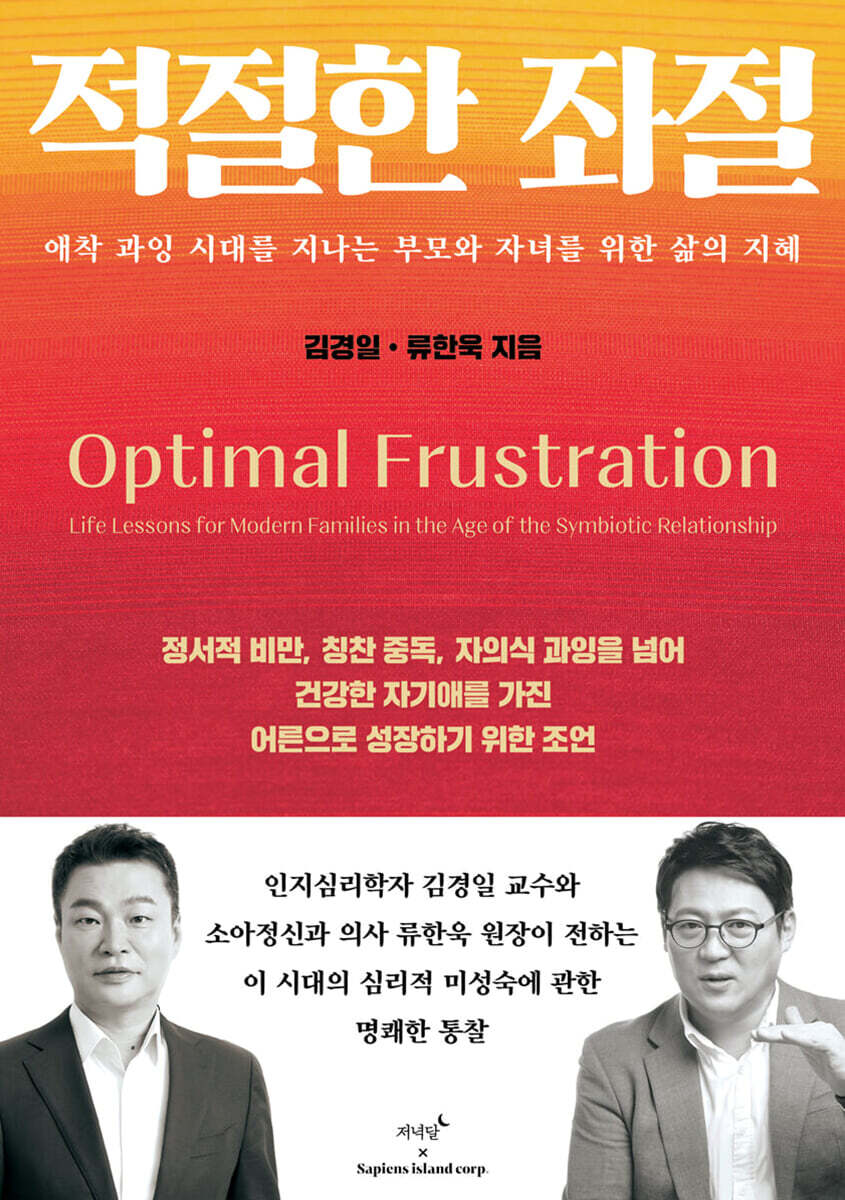
Appropriate frustration
 |
Description
Book Introduction
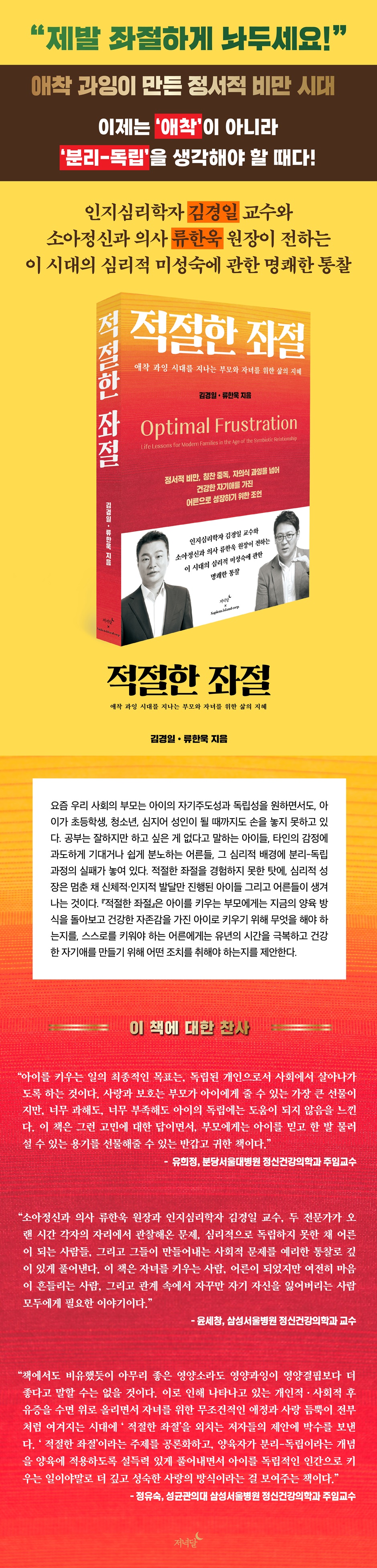
"Please let me be frustrated."
Life Wisdom for Parents and Children in an Age of Overattachment
Professor Kim Kyung-il, a cognitive psychologist, and
Dr. Han-Wook Ryu, a pediatric psychiatrist, tells us:
A clear insight into the psychological immaturity of our time.
The psychology textbook "Appropriate Frustration," written by Dr. Ryu Han-wook, who has been working with children and their parents in a pediatric psychiatry clinic for 20 years, and Professor Kim Kyung-il, a cognitive psychologist who has explored the structure of human psychology, has been published.
Children who are good at studying but don't have a specific path they want to take and follow the path their mothers set for them, adults who are overly concerned about what others think or get angry easily...
A psychiatrist who has observed the growth process of children and a psychologist who has studied the psychology of adults have identified this as the most fundamental concept that can solve the problems of our current society.
It is the ‘absence of appropriate frustration’ and ‘failure of separation and independence.’
The authors argue that Korean society is currently experiencing excessive control and intervention, packaged in the language of attachment, which is causing children to grow up into seemingly well-off but empty adults, unable to explore their own desires, design their own lives, or learn to manage their emotions. They diagnose that the psychological background to this lies in the failure of the separation-independence process.
This book also analyzes that South Korea's overheated private education system is also a psychological structure in which parents view their children as objects to be controlled rather than as independent beings.
The growing phenomenon of narcissism and the problem of adults avoiding responsibility or exploding emotionally in relationships are also explained as problems derived from this failure of separation and independence.
“Appropriate Frustration” goes beyond simply pointing out the problem.
Based on real-world counseling and research, it conveys what we are missing in life and what choices we can make now as parents, individuals, and members of society in a warm yet solid language that is easy to understand.
This book is a practical manual for psychological independence that we all need in this age of excessive attachment.
Life Wisdom for Parents and Children in an Age of Overattachment
Professor Kim Kyung-il, a cognitive psychologist, and
Dr. Han-Wook Ryu, a pediatric psychiatrist, tells us:
A clear insight into the psychological immaturity of our time.
The psychology textbook "Appropriate Frustration," written by Dr. Ryu Han-wook, who has been working with children and their parents in a pediatric psychiatry clinic for 20 years, and Professor Kim Kyung-il, a cognitive psychologist who has explored the structure of human psychology, has been published.
Children who are good at studying but don't have a specific path they want to take and follow the path their mothers set for them, adults who are overly concerned about what others think or get angry easily...
A psychiatrist who has observed the growth process of children and a psychologist who has studied the psychology of adults have identified this as the most fundamental concept that can solve the problems of our current society.
It is the ‘absence of appropriate frustration’ and ‘failure of separation and independence.’
The authors argue that Korean society is currently experiencing excessive control and intervention, packaged in the language of attachment, which is causing children to grow up into seemingly well-off but empty adults, unable to explore their own desires, design their own lives, or learn to manage their emotions. They diagnose that the psychological background to this lies in the failure of the separation-independence process.
This book also analyzes that South Korea's overheated private education system is also a psychological structure in which parents view their children as objects to be controlled rather than as independent beings.
The growing phenomenon of narcissism and the problem of adults avoiding responsibility or exploding emotionally in relationships are also explained as problems derived from this failure of separation and independence.
“Appropriate Frustration” goes beyond simply pointing out the problem.
Based on real-world counseling and research, it conveys what we are missing in life and what choices we can make now as parents, individuals, and members of society in a warm yet solid language that is easy to understand.
This book is a practical manual for psychological independence that we all need in this age of excessive attachment.
- You can preview some of the book's contents.
Preview
index
Recommendation 4
Introduction_Ryu Han-wook: 10 Stories Someone Must Tell Now
Introduction_Kim Kyung-il: Why the world doesn't go my way
And that's a good thing, 16 reasons why
PART I: The Age of Overattachment and Appropriate Frustration
Era of Emotional Obesity 26
What is Appropriate Frustration? 38
Times have changed, but 63 parenting theories remain the same.
77 children running away from home
Time for bed separation and blanket kicking 99
Setting Appropriate Boundaries 125
How old is the child in your heart? 132
The relationship between parents and children is always changing 144
152 Things Dads Must Do
How to Respect Your Child as a Person 166
PART II Adults Who Cannot Be Independent
Adults who are not independent 186
The Birth of a Dangerous Narcissist 193
People with high rejection sensitivity 204
People with high relational aggression 214
People who always follow others' standards 224
231 People who feel secure only when they hold onto everything
People with unusually low resilience 239
People who think the world hates them 247
People who pretend to be okay and only want to be seen as good people 256
About Real Adult Relationships 264
Man is a being of possibility 272
Why Failure and Setbacks Are Important in Life 280
288 To develop the power to take charge of your own future
Introduction_Ryu Han-wook: 10 Stories Someone Must Tell Now
Introduction_Kim Kyung-il: Why the world doesn't go my way
And that's a good thing, 16 reasons why
PART I: The Age of Overattachment and Appropriate Frustration
Era of Emotional Obesity 26
What is Appropriate Frustration? 38
Times have changed, but 63 parenting theories remain the same.
77 children running away from home
Time for bed separation and blanket kicking 99
Setting Appropriate Boundaries 125
How old is the child in your heart? 132
The relationship between parents and children is always changing 144
152 Things Dads Must Do
How to Respect Your Child as a Person 166
PART II Adults Who Cannot Be Independent
Adults who are not independent 186
The Birth of a Dangerous Narcissist 193
People with high rejection sensitivity 204
People with high relational aggression 214
People who always follow others' standards 224
231 People who feel secure only when they hold onto everything
People with unusually low resilience 239
People who think the world hates them 247
People who pretend to be okay and only want to be seen as good people 256
About Real Adult Relationships 264
Man is a being of possibility 272
Why Failure and Setbacks Are Important in Life 280
288 To develop the power to take charge of your own future
Detailed image
Into the book
Children who are emotionally obese are born to over-attached parents.
Over-attachment refers to the attitude of parents or guardians who excessively intervene or protect their children. A representative example is interfering with or making decisions on behalf of the child's behavior, emotions, and choices.
However, the number of parents who show excessive attachment to their children due to their excessive love for them is increasing, and as a result, the number of children who are emotionally obese is also increasing.
These days, parents have to set boundaries of what they don't allow and what they don't accept, but they try to provide unlimited nutrients.
When the emotional nutrition provision, which should have already stopped at a developmental stage, continues until too late, the child becomes emotionally obese and is less and less able to become independent as an individual.
The problem is that over-attachment can be a factor that prevents us from experiencing “optimal frustration.”
--- p.29~30
In the past, when our country was going through economic difficulties and the concept of child-rearing was not fully established, it was not easy for newborns to receive focused attention from their parents and form a good relationship with them until they were 6 to 10 months old.
There was a time when South Korea had the highest infant mortality rate in the world.
So at that time, basic survival and care were considered the core tasks of parenting.
Because of this, a parenting method that emphasized the 'close relationship between child and parent' that was lacking at the time emerged and became very popular.
But now, with economic conditions improving and birth rates declining, parents have significantly increased the amount of attention and resources they can devote to each child.
Accordingly, a more important part of parenting is shifting to the post-symbiotic stage, that is, the 'separation-independence process'.
Parenting has now become more than just caring for and protecting children; it's become increasingly important to provide a psychological foundation that helps children develop their own identities and function autonomously.
Parents must act as emotional coordinators who help their children develop the internal resources necessary for them to grow into independent beings, such as emotional regulation, stress coping skills, and self-efficacy.
--- p.47~48
So, the core message I'm really trying to get across is this.
I gave a long explanation before to say this.
For adolescence to be a healthy stage, the preceding stage, separation and independence, must proceed steadily.
That is, it is essential to achieve appropriate independence in one's relationship with one's parents and maintain a balanced relationship with one another.
The stable relationship with parents that is formed after going through the separation-independence process is not simply an emotional bond, but becomes established as a psychological representation within the child.
This process is called 'internalization'.
Simply put, the child accepts the model of the relationship with the parents in his or her mind, thinking, 'Ah, so this is what a relationship is like.'
When a stable relationship with parents is internalized in this way, children in their teens naturally develop plans and hopes for the future.
“What kind of life do I want to live in the future?”
“What kind of job should I have?”
“What kind of environment will we live in?”
With these concerns, the child gradually begins to explore the outside world to shape his or her future.
In other words, the more prepared a child is to become psychologically independent from his or her parents, the more actively he or she plans his or her future and develops the strength to move into adulthood through various experiences.
The core of adolescence can be said to be the process of preparing for the future while becoming psychologically independent from parents and receiving internal support from them.
--- p.59~60
This also ties in with the concept of 'forming intrinsic motivation' in psychology.
In other words, people behave more carefully and responsibly when given autonomy and responsibility rather than coercive regulations.
This principle can also be applied to raising children.
When parents give their children appropriate freedom and responsibility instead of controlling their every action, the child gradually begins to consider the consequences of his or her actions.
On the other hand, if parents constantly set restrictions and monitor their children, they will start to think, 'My parents will figure it out somehow.'
But the moment a child realizes that responsibility lies entirely with him, he gains the power to control his own behavior.
There is a line that many parents say when they get angry.
“At your age, you should know how to do this on your own! Why does your mom have to do it for you again?”
Who is responsible for "doing things on their own" at this point? If parents constantly check and confirm what they need to do, the child may think, "Oh, Mom and Dad are still trying to solve my problems."
The important question is, 'Who is responsible in this situation?'
Because mom is currently in charge, she becomes anxious, angry, and impatient.
We need to make our children responsible and realize that they have to solve this problem themselves.
Then your mom won't be upset.
From the child's perspective, if the mother does not get angry in a situation where she would normally get angry, only then will the child begin to reflect on the situation on his or her own.
From the moment the fence is removed, the child is responsible for his or her own actions.
--- p.136~137
Professor Eddie Brummelman of the University of Amsterdam in the Netherlands, who attracted the attention of the academic world with an interesting study that found that excessive parental praise causes children to become narcissistic, argued that when children frequently hear comparative praise such as “You are better than others,” they feel pressured to put others down in order to maintain their own superiority.
On the other hand, when someone receives recognition that focuses on their unique strengths, such as saying, “I really like this about you,” they learn the value of collaborating and working together rather than competing with others.
This difference is not simply a matter of expression.
When compliments are repeated based on comparison, an atmosphere is created where people have to push each other away to survive.
A culture that respects unique values must be established to build trust and cooperation among people.
A community that recognizes these differences will not tear each other down, but will move forward together.
--- p.198~199
When people can support themselves, they can be much warmer to others.
According to research by positive psychologist Christopher Peterson, people who accept themselves as they are tend to be more tolerant of others' mistakes and less easily shaken by conflict.
If I can tell myself, “That’s okay,” then I can smile and say, “That could be true.”
Ultimately, we can see that a good relationship begins with 'a feeling that I am okay with myself.'
Even people who, as children, were unable to properly handle frustration and reacted unstably in relationships can regain control of their emotions and become psychologically independent adults by practicing reflecting on and regulating their emotions as adults.
Instead of attacking others for feeling bad or blaming others for your feelings, try to understand those feelings yourself.
This awareness ultimately creates a balance between self-respect and respect for others.
If your self-esteem is too high, it can easily lead to narcissism, and on the other hand, if you respect others too much, you can easily sacrifice yourself.
A truly healthy and happy relationship is only possible when these two stand side by side without harming each other.
A happy human relationship is not something that ends once it is completed, but rather a process of continuous adjustment.
You may become close and then drift apart, or misunderstandings may arise and then you come to understand each other again.
Reducing relational aggression, reducing rejection sensitivity, building resilience, avoiding self-sacrifice, and relating like a true adult doesn't begin with grand changes, but rather with noticing and noticing the small emotions that arise within you.
As this awareness accumulates, we will be able to live with others, but as our own selves, unswayed by them.
Over-attachment refers to the attitude of parents or guardians who excessively intervene or protect their children. A representative example is interfering with or making decisions on behalf of the child's behavior, emotions, and choices.
However, the number of parents who show excessive attachment to their children due to their excessive love for them is increasing, and as a result, the number of children who are emotionally obese is also increasing.
These days, parents have to set boundaries of what they don't allow and what they don't accept, but they try to provide unlimited nutrients.
When the emotional nutrition provision, which should have already stopped at a developmental stage, continues until too late, the child becomes emotionally obese and is less and less able to become independent as an individual.
The problem is that over-attachment can be a factor that prevents us from experiencing “optimal frustration.”
--- p.29~30
In the past, when our country was going through economic difficulties and the concept of child-rearing was not fully established, it was not easy for newborns to receive focused attention from their parents and form a good relationship with them until they were 6 to 10 months old.
There was a time when South Korea had the highest infant mortality rate in the world.
So at that time, basic survival and care were considered the core tasks of parenting.
Because of this, a parenting method that emphasized the 'close relationship between child and parent' that was lacking at the time emerged and became very popular.
But now, with economic conditions improving and birth rates declining, parents have significantly increased the amount of attention and resources they can devote to each child.
Accordingly, a more important part of parenting is shifting to the post-symbiotic stage, that is, the 'separation-independence process'.
Parenting has now become more than just caring for and protecting children; it's become increasingly important to provide a psychological foundation that helps children develop their own identities and function autonomously.
Parents must act as emotional coordinators who help their children develop the internal resources necessary for them to grow into independent beings, such as emotional regulation, stress coping skills, and self-efficacy.
--- p.47~48
So, the core message I'm really trying to get across is this.
I gave a long explanation before to say this.
For adolescence to be a healthy stage, the preceding stage, separation and independence, must proceed steadily.
That is, it is essential to achieve appropriate independence in one's relationship with one's parents and maintain a balanced relationship with one another.
The stable relationship with parents that is formed after going through the separation-independence process is not simply an emotional bond, but becomes established as a psychological representation within the child.
This process is called 'internalization'.
Simply put, the child accepts the model of the relationship with the parents in his or her mind, thinking, 'Ah, so this is what a relationship is like.'
When a stable relationship with parents is internalized in this way, children in their teens naturally develop plans and hopes for the future.
“What kind of life do I want to live in the future?”
“What kind of job should I have?”
“What kind of environment will we live in?”
With these concerns, the child gradually begins to explore the outside world to shape his or her future.
In other words, the more prepared a child is to become psychologically independent from his or her parents, the more actively he or she plans his or her future and develops the strength to move into adulthood through various experiences.
The core of adolescence can be said to be the process of preparing for the future while becoming psychologically independent from parents and receiving internal support from them.
--- p.59~60
This also ties in with the concept of 'forming intrinsic motivation' in psychology.
In other words, people behave more carefully and responsibly when given autonomy and responsibility rather than coercive regulations.
This principle can also be applied to raising children.
When parents give their children appropriate freedom and responsibility instead of controlling their every action, the child gradually begins to consider the consequences of his or her actions.
On the other hand, if parents constantly set restrictions and monitor their children, they will start to think, 'My parents will figure it out somehow.'
But the moment a child realizes that responsibility lies entirely with him, he gains the power to control his own behavior.
There is a line that many parents say when they get angry.
“At your age, you should know how to do this on your own! Why does your mom have to do it for you again?”
Who is responsible for "doing things on their own" at this point? If parents constantly check and confirm what they need to do, the child may think, "Oh, Mom and Dad are still trying to solve my problems."
The important question is, 'Who is responsible in this situation?'
Because mom is currently in charge, she becomes anxious, angry, and impatient.
We need to make our children responsible and realize that they have to solve this problem themselves.
Then your mom won't be upset.
From the child's perspective, if the mother does not get angry in a situation where she would normally get angry, only then will the child begin to reflect on the situation on his or her own.
From the moment the fence is removed, the child is responsible for his or her own actions.
--- p.136~137
Professor Eddie Brummelman of the University of Amsterdam in the Netherlands, who attracted the attention of the academic world with an interesting study that found that excessive parental praise causes children to become narcissistic, argued that when children frequently hear comparative praise such as “You are better than others,” they feel pressured to put others down in order to maintain their own superiority.
On the other hand, when someone receives recognition that focuses on their unique strengths, such as saying, “I really like this about you,” they learn the value of collaborating and working together rather than competing with others.
This difference is not simply a matter of expression.
When compliments are repeated based on comparison, an atmosphere is created where people have to push each other away to survive.
A culture that respects unique values must be established to build trust and cooperation among people.
A community that recognizes these differences will not tear each other down, but will move forward together.
--- p.198~199
When people can support themselves, they can be much warmer to others.
According to research by positive psychologist Christopher Peterson, people who accept themselves as they are tend to be more tolerant of others' mistakes and less easily shaken by conflict.
If I can tell myself, “That’s okay,” then I can smile and say, “That could be true.”
Ultimately, we can see that a good relationship begins with 'a feeling that I am okay with myself.'
Even people who, as children, were unable to properly handle frustration and reacted unstably in relationships can regain control of their emotions and become psychologically independent adults by practicing reflecting on and regulating their emotions as adults.
Instead of attacking others for feeling bad or blaming others for your feelings, try to understand those feelings yourself.
This awareness ultimately creates a balance between self-respect and respect for others.
If your self-esteem is too high, it can easily lead to narcissism, and on the other hand, if you respect others too much, you can easily sacrifice yourself.
A truly healthy and happy relationship is only possible when these two stand side by side without harming each other.
A happy human relationship is not something that ends once it is completed, but rather a process of continuous adjustment.
You may become close and then drift apart, or misunderstandings may arise and then you come to understand each other again.
Reducing relational aggression, reducing rejection sensitivity, building resilience, avoiding self-sacrifice, and relating like a true adult doesn't begin with grand changes, but rather with noticing and noticing the small emotions that arise within you.
As this awareness accumulates, we will be able to live with others, but as our own selves, unswayed by them.
--- p.270~271
Publisher's Review
Now it's not 'attachment'
An era in which the keywords "separation and independence" are needed
This is a story that took place at a large hospital.
A problem arose in the medical department where one of the residents was affiliated.
Within a hospital, the medical department is an organization, and within that organization, numerous roles and responsibilities are intertwined, and when a problem arises, someone must take responsibility.
It was the same that day.
An incident occurred where it was difficult to pinpoint who was at fault, and responsibility had to be determined. Ultimately, the blame fell on one resident.
It was not a good feeling, but it was something that most office workers would have just swallowed and let it go.
But the next day, the resident's mother came to the hospital.
The mother opened the door to the manager's office and entered, demanding in an agitated voice why her daughter was being reprimanded.
The manager was flustered when someone who was neither the patient's guardian nor a hospital official suddenly showed up and started talking about hospital personnel issues, and the resident quit the hospital because of that incident.
It must have been a difficult hospital to get into.
It was the most coveted department in the country and the most competitive position.
He was a talented person who had passed the difficult gate of medical school and was at the starting line ahead of others.
The mother felt insulted that her daughter, whom she had devoted decades of her life to raising, was being humiliated, and unable to bear it, she forced her daughter to resign from her job.
Usually, no matter how angry parents are, adult children end up deciding for themselves what happens at work.
But this resident could not go against his mother's wishes.
It was bad when my mother was upset, and my life was supposed to be my life, but even in my late twenties, I was still unable to separate from my mother.
The daughter would have always discussed with her mother everything from daily life to study plans and future aspirations.
Without being able to distinguish between my mother's will and my own.
When my daughter was accepted to medical school, she would probably be talked about as a success story in Daechi-dong.
The story of admission to a prestigious university created by the 'Daechi-dong System'.
But that's the end of the story most people want to hear.
Self-initiative and independence
It starts with appropriate frustration.
Children who are good at studying but have no particular passion and follow the path their mother sets for them; adults who are overly concerned with what others think or get angry easily; people who don't care who gets hurt for their own benefit, don't feel guilty, and don't know how to apologize...
Psychiatrist Ryu Han-wook, who has been working with children and their parents in a pediatric psychiatry clinic for 20 years, and cognitive psychologist Professor Kim Kyung-il, who has been studying the human psychological structure, have published a psychology textbook titled “Appropriate Frustration” on the concept of “the absence of appropriate frustration,” or “failure to separate and become independent,” as the most fundamental concept to solve the current problems of our society.
Optimal frustration refers to the process by which a child first learns that the world does not always go as planned.
As the child grows day by day, the parents maintain an appropriate distance, and in that uncertain space, the child faces unfamiliar emotions and, through trial and error, gradually grows into an independent individual.
However, in our society today, parents want their children to be self-directed and independent, but they cannot let go of their children until they become elementary school students, teenagers, and even adults.
The authors argue that Korean society is currently in an era of excessive attachment, with excessive emphasis on attachment relationships, resulting in children who are emotionally obese.
If children receive too much emotional care or constant emotional intervention while growing up, they will not be able to properly develop the ability to digest and regulate their emotions on their own.
Just as consuming too many calories can lead to obesity, emotionally, too, if undigested affection builds up, it can lead to 'emotional obesity'.
People like this easily break down even with small failures or criticism, and have difficulty controlling their emotions on their own, so they become emotionally shaken without someone's comfort or recognition.
They become increasingly dependent on the attention and reactions of others, and lack confidence in making decisions or taking responsibility for themselves.
This emotional obesity usually comes from parents who are 'over-attached'.
Children who grow up with parents who intervene in or make decisions for their children about every emotion, action, and choice have difficulty developing autonomy and independence.
In fact, it is an action that parents do because they love their children, but if excessive affection does not allow the child to experience the frustration that he or she needs, it will eventually become a great obstacle to the child's growth into an independent individual.
These days, there are more and more cases where children struggle to separate from their parents because they are not given emotional nourishment until too late, and they end up growing up to be adults who cannot stand on their own.
As a result, children become adults who are physically grown but still mentally young, without being able to explore their own desires, design their own lives, or learn how to deal with their emotions. The authors diagnose that the psychological background to this lies in the failure of the separation-independence process.
This book explains the need for appropriate experiences of frustration and the process of achieving separation and independence, and presents alternatives.
Father's indifference, sense of unity with mother
The absurdity of Daechi-dong's private education system
This book also analyzes that South Korea's overheated private education system is also a psychological structure in which parents view their children as objects to be controlled rather than as independent beings.
From the time a child is born until he or she becomes independent, he or she lives in a world of 'just mom and me' and a world of 'just dad and me', but as he or she gradually establishes his or her self-identity, he or she becomes an independent being.
And as they begin to realize that they have their own territory, they resist excessive interference.
However, mothers who are uncomfortable with this process naturally realize that 'when a relationship with the father is formed, the child does not listen to me well', and this is why in areas where the private education craze is high, the strange saying that "the father's indifference is more advantageous in sending the child to an academy" is circulated.
He argues that in order to solve the educational reality and private education problem in Korea, everyone must understand the concept of separation and independence, and emphasizes that the increasing number of narcissists and the problem of adults avoiding responsibility or exploding emotionally in relationships are also problems that arise from the failure of this separation and independence.
Beyond emotional obesity, praise addiction, and excessive self-consciousness
Having healthy self-love
Advice for Growing Up as an Adult
Above all, this book goes beyond simply pointing out the problem; it provides specific guidance on what we should do now.
Based on real-life cases and counseling experiences, this book explains how parents should maintain an appropriate distance during their child's developmental stages, and how those who struggle with autonomy and intimacy in relationships even after becoming adults can recover from this.
Introducing cases of people who are physically and cognitively adults but not yet psychologically independent, the book uses warm but firm language to explain how to face and manage the conflicts and emotional anxieties they experience in daily life.
This book makes us reflect on what we are missing in our lives and clearly shows us what psychological independence we need in this day and age as parents, individuals, and members of society.
This book isn't just advice on parenting or education; it's a practical guide on how to recognize and express emotions, establish healthy boundaries with others, and develop self-supporting and self-improvement skills.
This book, which teaches parents raising children how to let go at the right time and adults who are wavering how to find their place again, is a psychological independence manual for everyone living in an era of excessive attachment.
An era in which the keywords "separation and independence" are needed
This is a story that took place at a large hospital.
A problem arose in the medical department where one of the residents was affiliated.
Within a hospital, the medical department is an organization, and within that organization, numerous roles and responsibilities are intertwined, and when a problem arises, someone must take responsibility.
It was the same that day.
An incident occurred where it was difficult to pinpoint who was at fault, and responsibility had to be determined. Ultimately, the blame fell on one resident.
It was not a good feeling, but it was something that most office workers would have just swallowed and let it go.
But the next day, the resident's mother came to the hospital.
The mother opened the door to the manager's office and entered, demanding in an agitated voice why her daughter was being reprimanded.
The manager was flustered when someone who was neither the patient's guardian nor a hospital official suddenly showed up and started talking about hospital personnel issues, and the resident quit the hospital because of that incident.
It must have been a difficult hospital to get into.
It was the most coveted department in the country and the most competitive position.
He was a talented person who had passed the difficult gate of medical school and was at the starting line ahead of others.
The mother felt insulted that her daughter, whom she had devoted decades of her life to raising, was being humiliated, and unable to bear it, she forced her daughter to resign from her job.
Usually, no matter how angry parents are, adult children end up deciding for themselves what happens at work.
But this resident could not go against his mother's wishes.
It was bad when my mother was upset, and my life was supposed to be my life, but even in my late twenties, I was still unable to separate from my mother.
The daughter would have always discussed with her mother everything from daily life to study plans and future aspirations.
Without being able to distinguish between my mother's will and my own.
When my daughter was accepted to medical school, she would probably be talked about as a success story in Daechi-dong.
The story of admission to a prestigious university created by the 'Daechi-dong System'.
But that's the end of the story most people want to hear.
Self-initiative and independence
It starts with appropriate frustration.
Children who are good at studying but have no particular passion and follow the path their mother sets for them; adults who are overly concerned with what others think or get angry easily; people who don't care who gets hurt for their own benefit, don't feel guilty, and don't know how to apologize...
Psychiatrist Ryu Han-wook, who has been working with children and their parents in a pediatric psychiatry clinic for 20 years, and cognitive psychologist Professor Kim Kyung-il, who has been studying the human psychological structure, have published a psychology textbook titled “Appropriate Frustration” on the concept of “the absence of appropriate frustration,” or “failure to separate and become independent,” as the most fundamental concept to solve the current problems of our society.
Optimal frustration refers to the process by which a child first learns that the world does not always go as planned.
As the child grows day by day, the parents maintain an appropriate distance, and in that uncertain space, the child faces unfamiliar emotions and, through trial and error, gradually grows into an independent individual.
However, in our society today, parents want their children to be self-directed and independent, but they cannot let go of their children until they become elementary school students, teenagers, and even adults.
The authors argue that Korean society is currently in an era of excessive attachment, with excessive emphasis on attachment relationships, resulting in children who are emotionally obese.
If children receive too much emotional care or constant emotional intervention while growing up, they will not be able to properly develop the ability to digest and regulate their emotions on their own.
Just as consuming too many calories can lead to obesity, emotionally, too, if undigested affection builds up, it can lead to 'emotional obesity'.
People like this easily break down even with small failures or criticism, and have difficulty controlling their emotions on their own, so they become emotionally shaken without someone's comfort or recognition.
They become increasingly dependent on the attention and reactions of others, and lack confidence in making decisions or taking responsibility for themselves.
This emotional obesity usually comes from parents who are 'over-attached'.
Children who grow up with parents who intervene in or make decisions for their children about every emotion, action, and choice have difficulty developing autonomy and independence.
In fact, it is an action that parents do because they love their children, but if excessive affection does not allow the child to experience the frustration that he or she needs, it will eventually become a great obstacle to the child's growth into an independent individual.
These days, there are more and more cases where children struggle to separate from their parents because they are not given emotional nourishment until too late, and they end up growing up to be adults who cannot stand on their own.
As a result, children become adults who are physically grown but still mentally young, without being able to explore their own desires, design their own lives, or learn how to deal with their emotions. The authors diagnose that the psychological background to this lies in the failure of the separation-independence process.
This book explains the need for appropriate experiences of frustration and the process of achieving separation and independence, and presents alternatives.
Father's indifference, sense of unity with mother
The absurdity of Daechi-dong's private education system
This book also analyzes that South Korea's overheated private education system is also a psychological structure in which parents view their children as objects to be controlled rather than as independent beings.
From the time a child is born until he or she becomes independent, he or she lives in a world of 'just mom and me' and a world of 'just dad and me', but as he or she gradually establishes his or her self-identity, he or she becomes an independent being.
And as they begin to realize that they have their own territory, they resist excessive interference.
However, mothers who are uncomfortable with this process naturally realize that 'when a relationship with the father is formed, the child does not listen to me well', and this is why in areas where the private education craze is high, the strange saying that "the father's indifference is more advantageous in sending the child to an academy" is circulated.
He argues that in order to solve the educational reality and private education problem in Korea, everyone must understand the concept of separation and independence, and emphasizes that the increasing number of narcissists and the problem of adults avoiding responsibility or exploding emotionally in relationships are also problems that arise from the failure of this separation and independence.
Beyond emotional obesity, praise addiction, and excessive self-consciousness
Having healthy self-love
Advice for Growing Up as an Adult
Above all, this book goes beyond simply pointing out the problem; it provides specific guidance on what we should do now.
Based on real-life cases and counseling experiences, this book explains how parents should maintain an appropriate distance during their child's developmental stages, and how those who struggle with autonomy and intimacy in relationships even after becoming adults can recover from this.
Introducing cases of people who are physically and cognitively adults but not yet psychologically independent, the book uses warm but firm language to explain how to face and manage the conflicts and emotional anxieties they experience in daily life.
This book makes us reflect on what we are missing in our lives and clearly shows us what psychological independence we need in this day and age as parents, individuals, and members of society.
This book isn't just advice on parenting or education; it's a practical guide on how to recognize and express emotions, establish healthy boundaries with others, and develop self-supporting and self-improvement skills.
This book, which teaches parents raising children how to let go at the right time and adults who are wavering how to find their place again, is a psychological independence manual for everyone living in an era of excessive attachment.
GOODS SPECIFICS
- Date of issue: May 10, 2025
- Page count, weight, size: 296 pages | 416g | 148*210*19mm
- ISBN13: 9791189217518
- ISBN10: 1189217511
You may also like
카테고리
korean


korean

![ELLE 엘르 스페셜 에디션 A형 : 12월 [2025]](http://librairie.coreenne.fr/cdn/shop/files/b8e27a3de6c9538896439686c6b0e8fb.jpg?v=1766436872&width=3840)


